
Private Walter Nagel
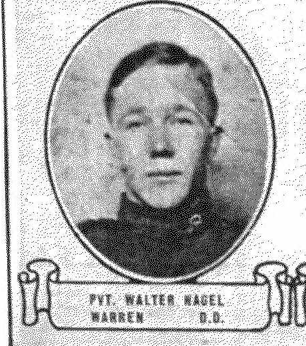
- Unit: Company D, 16th Forestry Company, 6th Battalion, 20th Engineers
- Service Number: 250368
- Date of Birth: September 8, 1895
- Entered the Military: December 14, 1917
- Date of Death: July 28, 1918
- Hometown: Warren, Oregon
- Place of Death: Dax, France
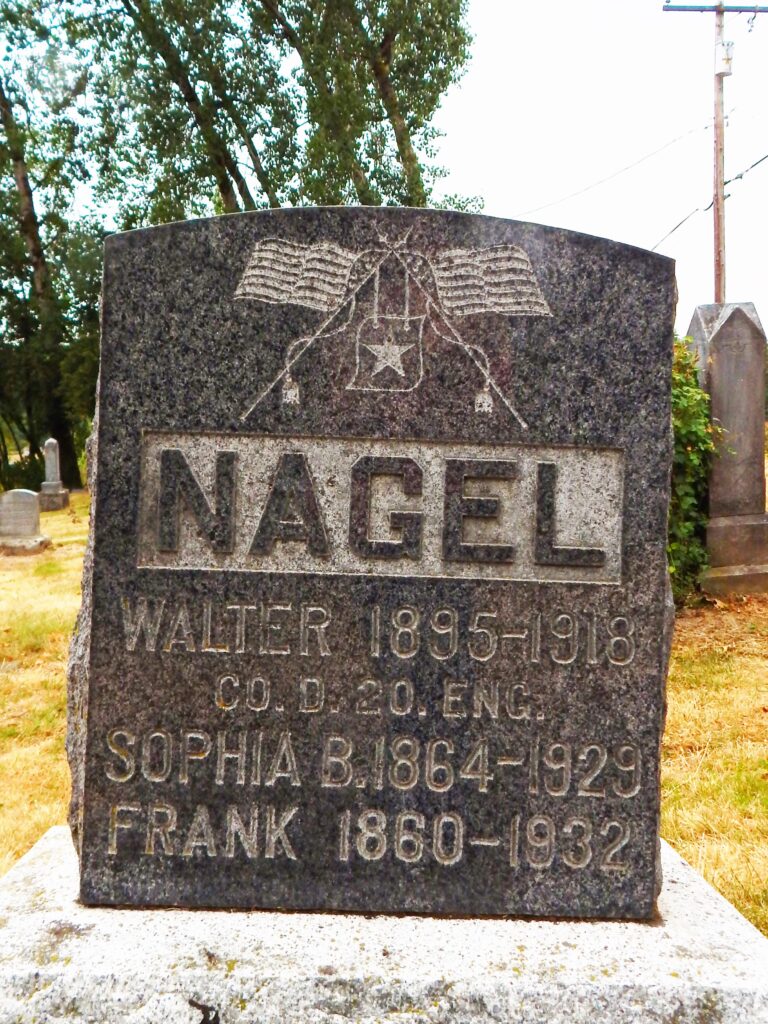
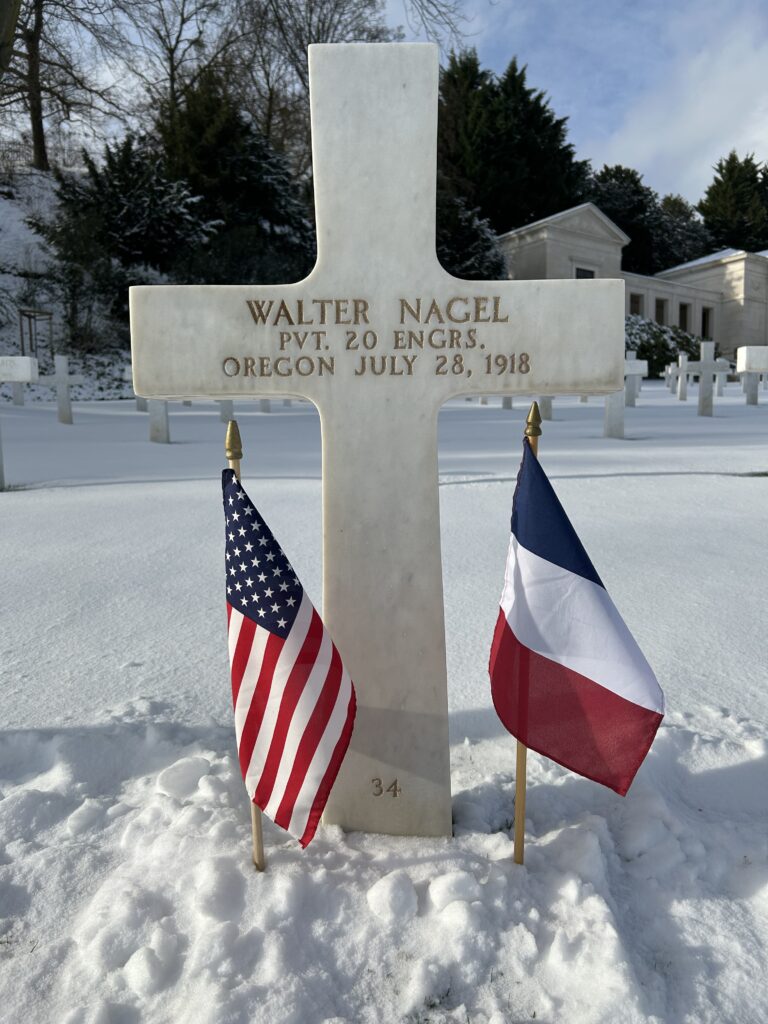
- Cemetery: Plot A, Row 9, Grave 34. Suresnes American Cemetery, Suresnes, France. Memorial marker at Old Yankton Cemetery, St. Helens, Oregon.
Ashbrook Independent School, Corvallis, Oregon
2025/2026
Early Life
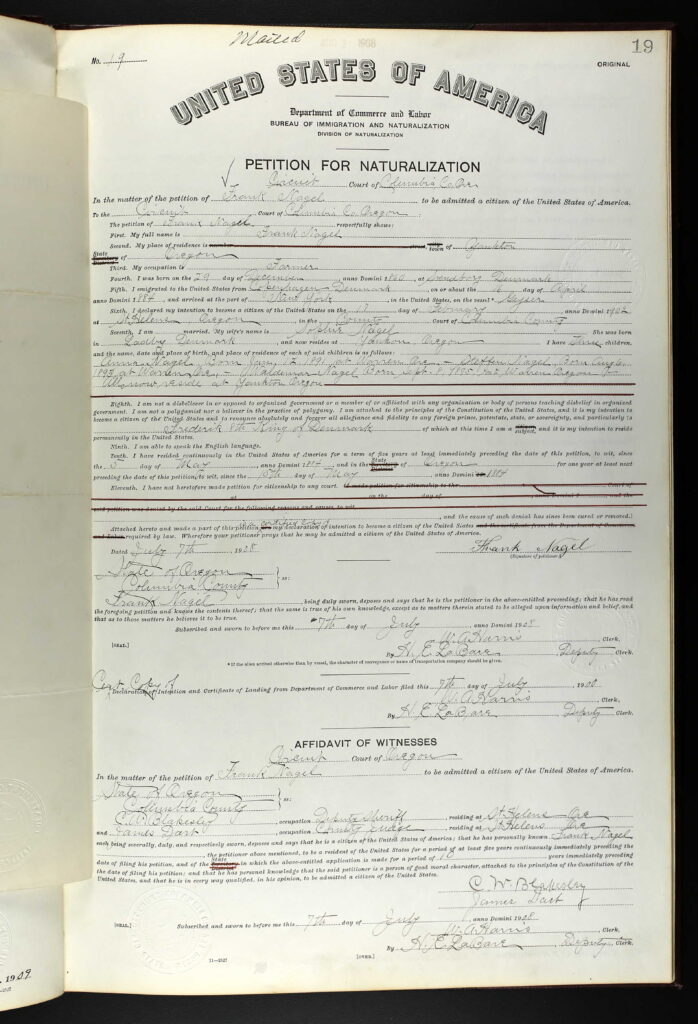
Walter Nagel was born on September 8, 1895, in Warren, Oregon. His parents, Frank Nagel and Sophia B. (Anderson) Nagel, immigrated to the United States from Denmark. Frank arrived in New York in 1884, and Sophia arrived in 1887. The couple married in the early 1890s. Walter Nagel, whose birth name is also listed as Wardermar Nagel, was the youngest of the three Nagel children. He joined his older siblings, Anna and Steffen, at the family home in Warren. By 1908, the Nagel family lived on a farm they owned in Yankton, Oregon, and by 1910, the older siblings had moved out, leaving young Walter at home with his parents.
The Danish Experience in Oregon
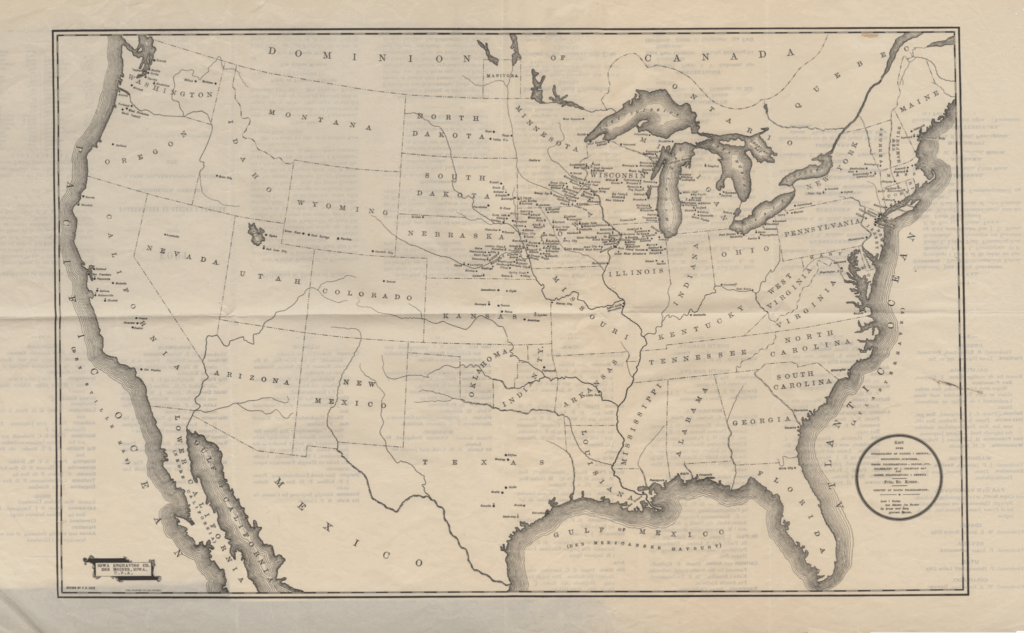
Many Nordic immigrants were drawn to Oregon because of the generous terms of the Homestead Act of 1862. This Act allowed them to claim 160 acres of government land in exchange for the promise to live on the land and make improvements. Many Danish immigrants, like the Nagels, left Denmark because a population boom made it difficult to find well-paying jobs. Danish immigrants settled in the northwest region of Oregon, and many of them found work in farming, shipbuilding, logging, fishing, and canning. Historians note that Danish immigrants tended to assimilate quickly into American society, were often literate, and faced little discrimination or anti-immigrant sentiment.
Logging in Northwest Oregon
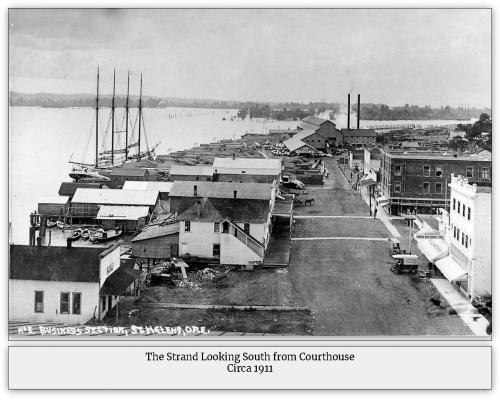
Logging and the timber industry provided significant employment in the area around St. Helens. This area included the neighboring towns of Yankton and Warren, where Nagel resided during the early 1900s. Nagel worked in the logging industry and was employed as a signal boy in a logging camp in 1910. The important work of the signal boy, also referred to as a whistle punk, required him to communicate instructions to teams through a coded series of blasts on a whistle. Accurate communication from the signal boy helped keep all crew members safe from accidents. Nagel later became a logger and found employment at Deer Island Lumber. He served in this position until his enlistment in the U. S. Army in 1917.
Homefront
The St. Helens Region
The Nagel family lived in several locations near St. Helens, Oregon, during the early twentieth century. Agriculture, fishing, and canning remained important parts of the economy during World War I, and the region was known for wheat, apples, hogs, sheep, beef cattle, fish, and dairy products. The shipbuilding industry grew significantly during the war, especially in nearby Columbia City, where Sommarstrom Shipbuilding received government contracts to build steamship hulls.
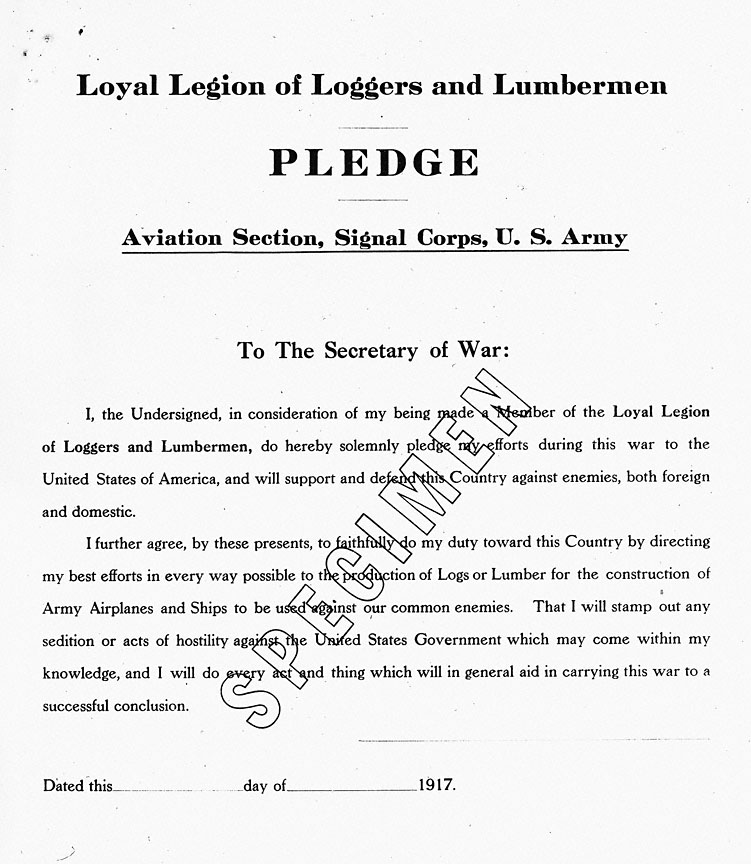
The lumber industry also experienced a boom. The area’s Sitka spruce and Douglas fir were used in the production of aircraft frames and in shipbuilding. In 1917, a major labor strike by loggers and lumbermen in the region threatened to disrupt the timber supply needed for the war effort. This strike led to the establishment of the Loyal Legion of Loggers and Lumbermen (known as the 4L). Members of the 4L vowed to “stamp out any sedition or acts of hostility” to bring the “war to a successful conclusion.” The Spruce Production Division, which included the 4L, established lumber camps throughout the Pacific Northwest to ensure that work and production were not disrupted.
Wartime Cautions
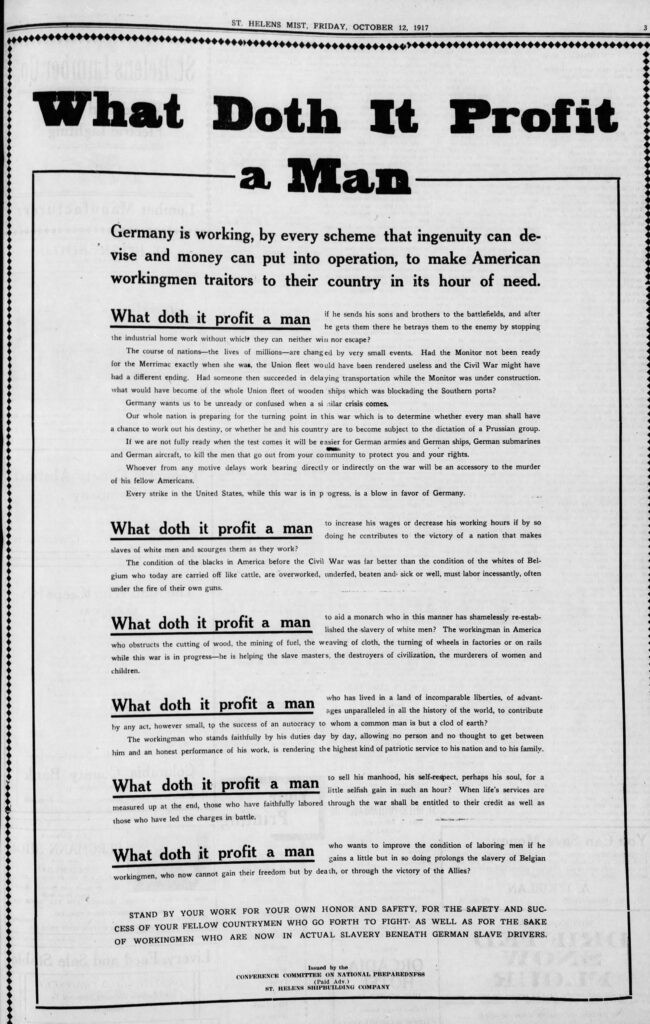
Because of the importance of the logging and lumber industries to the war effort, the public was cautioned to be wary of union members who might encourage their fellow workers to strike. These individuals were viewed as particularly anti-American. Authors of articles in the St. Helens Mist also regarded pacifists with a high degree of suspicion. Desertion from the armed forces seemed to be a local concern, too, as an article noted that a $50 cash reward would be offered to anyone who turned in a deserter.
Support of the War Effort
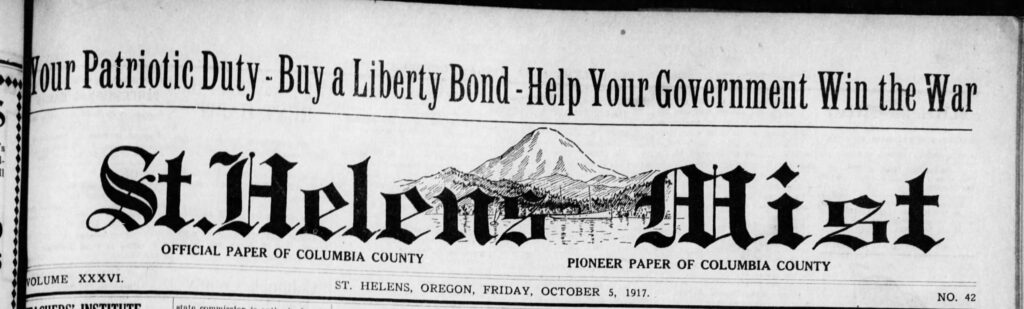
The residents of St. Helens and the surrounding areas supported the American war effort in various ways. Homemakers were encouraged to reduce food waste and their meat consumption as a patriotic duty. The St. Helens Mist newspaper provided readers with a number of recipes that focused on increased use of cabbage and other vegetables as part of wartime meal plans. In addition to these conservation measures, the newspaper printed numerous government advertisements promoting the purchase of Liberty Bonds and articles encouraging participation in Liberty Loans. Nagel’s mother, Sophie, is mentioned as a contributor to these fund drives in several newspaper articles. The local YMCA also held various fundraising activities in support of the war effort. The Red Cross held dances and packed Christmas boxes to ship to local soldiers serving in Europe.
Military Experience
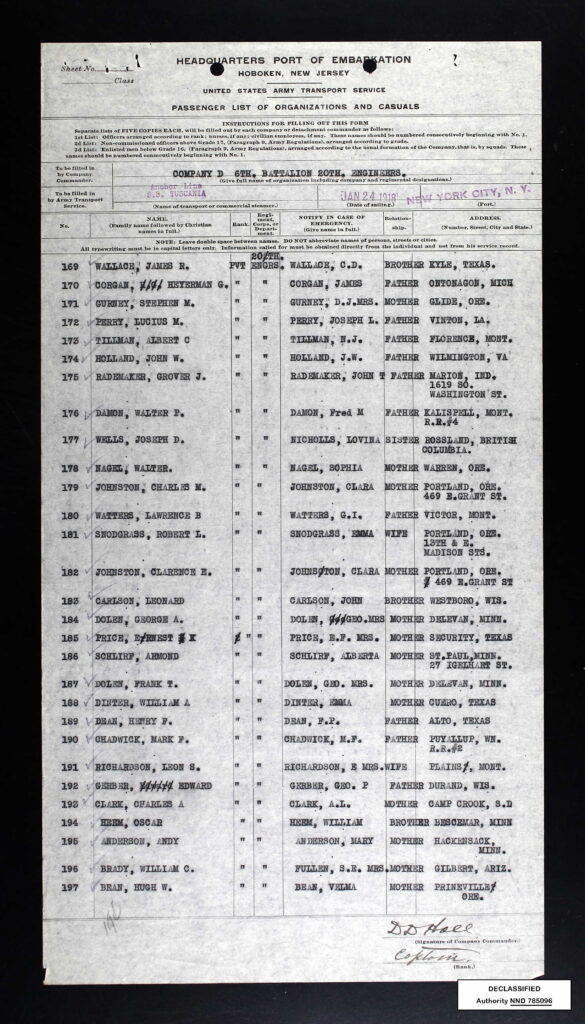
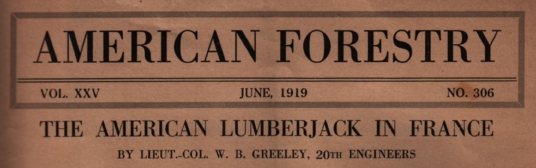
Nagel enlisted in the U.S. Army on December 4, 1917. He traveled to Camp American University in Washington, D.C., in late December for training. As part of the 20th Engineers, Nagel learned how to build pontoon bridges and dig trenches. The 20th Engineers provided lumber for the massive infrastructure required to support the American Expeditionary Forces (AEF) in France. The lumber they harvested would be used to construct ports, hospitals, railroads, barracks, warehouses, bakeries, and power plants. The Engineers also supplied the trench timbers, barbed-wire stakes, dugouts, and railroad ties needed by the AEF. As a lumberman, Nagel was expected to perform a range of tasks: felling trees, transporting them to the portable saw mills set up around the region, operating the mills, and preparing the finished lumber products for shipment via railway.
Sinking of S.S. Tuscania
Nagel and his unit experienced a harrowing journey to Europe. They left Camp American University on January 22, 1918, and hiked five-and-a-half miles through the snow to Fort Myer, Virginia, to board their train to New York City. The unit arrived the following day and sailed for Europe aboard S.S. Tuscania on January 24. After a relatively uneventful voyage across the Atlantic, Tuscania was met by a protective convoy of eight British destroyers off the coast of Ireland. On February 5, Tuscania was torpedoed by a German submarine.
The lifeboats and rescue gear were in terrible condition, and because the ship was listing sharply to starboard, the men had difficulty launching them. As heavy seas buffeted Tuscania, 30 lifeboats and multiple rafts were launched, but many of them capsized and dumped men into the frigid sea. Only 12 lifeboats successfully pulled away from Tuscania. Several of the destroyers in the escort convoy drew near enough to pluck men from the water and to save those clinging to debris. Other destroyers, fishing boats, and trawlers rescued men still on board. Survivors were ferried to several ports in Ireland and ultimately regrouped in Winchester, England. The 6th Battalion remained there for five weeks to reoutfit and resupply.
The Engineers in France
After arriving in Le Havre, France, Nagel’s unit moved on to its headquarters in Angers. In April 1918, his unit was stationed in the Landes region, near Bordeaux, France. The company was famous for pushing its machinery to its limits and beyond. A “twenty” mill could produce 20,000 board feet of lumber in a ten-hour shift. The 6th Battalion, working with the British forces at Castets, produced 124,242 board feet of lumber on a mill during a 19-hour run.

Commemoration
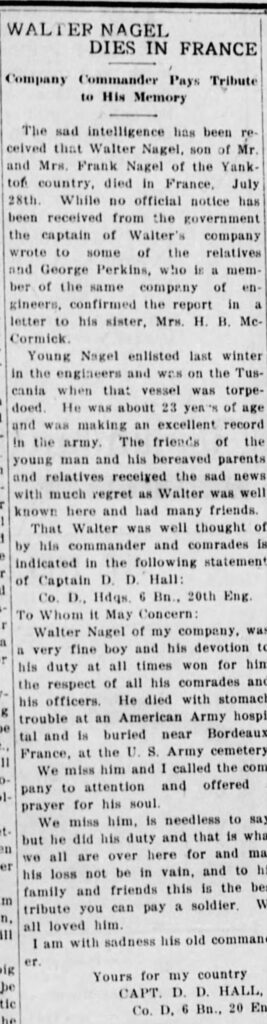
After several months’ service in France, Nagel contracted an illness which resulted in his death on July 28, 1918. Enterocolitis, which describes a variety of severe gastrointestinal issues usually resulting from poor hygiene, contaminated food and water, and bacteria, was listed as his cause of death. He was originally buried on July 30, 1918, in a cemetery in Talence, in the Gironde region of France. Captain D. D. Hall, Nagel’s commanding officer, wrote to his family to inform them of the death. Excerpts of the letter appeared in the St. Helens Mist on August 30, 1918.
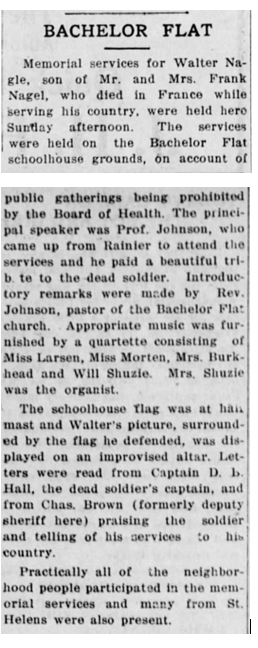
A memorial service was held at the Bachelor Flat schoolhouse in Warren, Oregon, on Sunday, October 13, 1918. Because of the Board of Health’s influenza pandemic protocols, the service was held outdoors. The local newspaper reported that the service was well attended by a large number of community members. A letter from Nagel’s captain was read, as well as a letter from the former local sheriff. Other tributes were offered by Professor Johnson of Rainier and Reverend Johnson of the town’s Lutheran church. A local quartet provided music for the gathering.
Nagel was ultimately laid to rest in the Suresnes American Cemetery in Suresnes, France. A memorial marker was also placed in the Old Yankton Cemetery in St. Helens, Oregon.
Bibliography
Primary Sources
“Brother, You Don’t Want to Be A Slacker, Do You?” St. Helens Mist [St. Helens, Oregon], October 19, 1917. Newspapers.com (185280296).
“Charles B Moores For Sec’ty of State.” St. Helens Mist [St. Helens, Oregon], April 28, 1916. Newspapers.com (78177123).
“Chiropractic.” St. Helens Mist [St. Helens, Oregon], November 8, 1918. Newspapers.com (78257401).
“Christmas Boxes Off to Soldier Boys.” St. Helens Mist [St. Helens, Oregon], November 16, 1917. Newspapers.com (78202776).
“Correspondence.” St. Helens Mist [St. Helens, Oregon], October 18, 1917. Newspapers.com(78257087).
“Correspondence.” St. Helens Mist [St. Helens, Oregon], December 21, 1917. Newspapers.com (78203731).
“Correspondence.” St. Helens Mist [St. Helens, Oregon], August 30, 1918. Newspapers.com (78256254).
“Correspondence.” St. Helens Mist [St. Helens, Oregon], September 27, 1918. Newspapers.com (184786221).
“Correspondence.” St. Helens Mist [St. Helens, Oregon], October 18, 1918. Newspapers.com (78257087).
“Eat Cottage Cheese and Save the Meat.” St. Helens Mist [St. Helens, Oregon], September 28, 1917. Newspapers.com (185279213).
“Fighting Ourselves.”St. Helens Mist [St Helens, Oregon], September 21, 1917. Newspapers.com (78201846).
“Food Conservation for Columbia County.” St. Helens Mist [St Helens, Oregon], October 12, 1917. Newspapers.com (185279681).
“Frances Willard Day.” St. Helens Mist [St. Helens, Oregon], October 15, 1920. Newspapers.com (78246545).
Frank Nagel. Oregon, U.S., Naturalization Records, 1840-1982. Digital Images. https://ancestry.com.
“Governor Withycombe Announces Candidacy.” St. Helens Mist [St. Helens, Oregon], March 22, 1918. Newspapers.com (78253114).
Graves, Henry S. “The Forest Engineers.” American Forestry [Washington, D.C.], June 1919. https://foresthistory.org/digital-collections/world-war-10th-20th-forestry-engineers/.
Greeley, W.B. “The American Lumberjack in France.” American Forestry [Washington, D.C.], June 1919. https://foresthistory.org/digital-collections/world-war-10th-20th-forestry-engineers/.
“How to Keep and Use Corn Meal.” St. Helens Mist [St Helens, Oregon], November 9, 1917. Newspapers.com (185280853).
“Increase Production of Poultry.” St. Helens Mist [St. Helens, Oregon], September 28, 1917. Newspapers.com (185279213).
“A Letter from Washington.” St. Helens Mist [St. Helens, Oregon], October 12, 1917. Newspapers.com (185279889).
“A Liberty Bond in Every Home.”St. Helens Mist [St. Helens, Oregon], October 19, 1917. Newspapers.com (78202432).
“Liberty Bond Quoto Is Now Assured.”St. Helens Mist [St. Helens, Oregon], October 26, 1917. Newspapers.com (184785542).
“L. J. Simpson Enters Race for Governor.” St. Helens Mist [St Helens, Oregon], February 22, 1918. Newspapers.com (61707631).
Loyal Legion of Loggers & Lumbermen Pledge. Oregon History Project, Oregon Historical Society (OrHi 77731). https://www.oregonhistoryproject.org/articles/historical-records/loyal-legion-of-loggers-amp-lumbermen-pledge/.
“Loyal Legion of Loggers Organized.” St. Helens Mist [St Helens, Oregon], March 22, 1918. Newspapers.com (78253114).
“M’Nary Is Named for Lane’s Seat.” St Helens Mist [St. Helens, Oregon], June 1, 1917. Newspapers.com (78199084).
Moore, Barrington. “French Forests in the War.” American Forestry [Washington, D.C.], June 1919. https://foresthistory.org/digital-collections/world-war-10th-20th-forestry-engineers/.
“Morale is Winning the War.” St. Helens Mist [St. Helens, Oregon], November 8, 1918. Newspapers.com (78257414).
“More Forest Battalions Authorized.”St. Helens Mist [St Helens, Oregon], September 21, 1917. Newspapers.com (78201846).
“Mrs. Foreman in Limelight Again.” St. Helens Mist [St Helens, Oregon], January 14, 1916. Newspapers.com (78175586).
Oregon. Columbia County. 1900 U.S. Census. Digital images. https://ancestry.com.
Oregon. Columbia County. 1910 U.S. Census. Digital images. https://ancestry.com.
“Pvt. Walter Nagel.” American Soldiers of World War I. Digital image. https://ancestry.com.
“Raise More Hogs.” St. Helens Mist [St Helens, Oregon], October 5, 1917. Newspapers.com (185279400).
“Red Cross Dance Saturday Night.”St. Helens Mist [St Helens, Oregon], October 5, 1917. Newspapers.com (185281031).
“Redmen Well Represented.” St. Helens Mist [St. Helens, Oregon], August 30, 1918. Newspapers.com (183689933).
“Republican Candidate Secretary of State.” St. Helens Mist [St. Helens, Oregon], May 14, 1920. Newspapers.com (78241799).
“Reward Offered for Deserters.” St. Helens Mist [St. Helens, Oregon], October 5, 1917. Newspapers.com (78202273).
Ridsdale, Percival Sheldon. “How the American Army Got Its Wood.” American Forestry [Washington, D.C.], June 1919. https://foresthistory.org/digital-collections/world-war-10th-20th-forestry-engineers/.
“Senator M’Nary Keeps His Word.” St. Helens Mist [St Helens, Oregon], October 18, 1918. Newspapers.com (78257123).
“Social Dance.” St. Helens Mist [St. Helens, Oregon], November 2, 1917. Newspapers.com (78202750).
“Soldier Boy Letters.”St. Helens Mist [St Helens, Oregon], August 30, 1918. Newspapers.com (78256275).
“Some Cabbage Recipes.” St. Helens Mist [St Helens, Oregon], November 9, 1917. Newspapers.com (185280853).
St. Helens Mist [St. Helens, Oregon], October 5, 1917. Newspapers.com (78202164).
St. Helens Mist [St. Helens, Oregon], November 16, 1917. Newspapers.com (78202776).
“Vegetable and Fruit Marmalade.” St. Helens Mist [St Helens, Oregon], November 9, 1917. Newspapers.com (185280853).
Walter Nagel. U.S.; Personnel Military Service Records, WWI. Digital images. https://ancestry.com.
Walter Nagel. Transcriptions of Card Register of Burials of Deceased American Soldiers, 1917-1922. https://fold3.com.
Walter Nagel. U.S. Army Transport Service Arriving and Departing Passenger Lists, 1910-1939. Digital images. https://ancestry.com.
Walter Nagel. World War I Draft Registration Cards, 1917-1918. Digital images. https://ancestry.com.
“Walter Nagel Dies in France.” St. Helens Mist [St. Helens, Oregon], August 30, 1918. Newspapers.com (183689273).
“The Welfare Fund.” American Forestry [Washington, D.C.], June 1919. https://foresthistory.org/digital-collections/world-war-10th-20th-forestry-engineers/.
“What Does L.J. Simpson Stand For?” St Helens Mist [St. Helens, Oregon], April 26, 1918. Newspapers.com (78253916).
“What Doth it Profit a Man?” St. Helens Mist [St. Helens, Oregon], October 12, 1917. Newspapers.com (185279819).
World War I Poster Collection (MSS WW1Posters), Oregon State University Special Collections and Archives Research Center, Corvallis, Oregon.
“You Are Invited To Attend the Grand Social Dance.” St. Helens Mist [St. Helens, Oregon], November 9, 1917. Newspapers.com (78193821).
“You Buy a Liberty Bond.” St. Helens Mist [St. Helens, Oregon], October 26, 1917. Newspapers.com (185280494).
Secondary Sources
“Columbia City.” The Oregon Encyclopedia. Accessed November 19, 2025. https://www.oregonencyclopedia.org/articles/columbia-city/.
“Danish Immigration: An Overview.” The Museum of Danish America. Accessed October 25, 2025. https://www.danishmuseum.org/exhibition/danish-immigration-an-overview/.
Davies, Alfred H. Twentieth Engineers, France, 1917-1918-1919. Twentieth Engineers Publishing Assn., 1920.
Engeman, Richard H. The Oregon Companion: An Historical Gazetteer of The Useful, The Curious, and The Arcane. Timber Press, 2009.
Fulton, Ann. “The Development of Columbia County, Oregon, 1792-1930: Historic Context Statement.” Report for Columbia County Forests, Parks, and Recreation Department, Portland, 1998. https://digitalcollections.library.oregon.gov/nodes/view/139346.
“History of St Helens.” City of St. Helens, Oregon. Accessed October 25, 2025. https://www.sthelensoregon.gov/about/page/history-st-helens.
“Immigration and Relocation in U.S. History: The Danes.” Library of Congress. Accessed October 25, 2025. https://www.loc.gov/classroom-materials/immigration/scandinavian/the-danes/.
“Navigating Danish Genealogy.” The Museum of Danish America. Accessed October 25, 2025. https://www.danishmuseum.org/danish-culture/navigating-danish-genealogy-census-records/.
“Pvt. Walter Nagel.” Find a Grave. Updated August 5, 2010. Accessed February 2, 2026. https://www.findagrave.com/memorial/55953706/walter-nagel.
“Pvt. Walter Nagel.” Find a Grave. Updated October 3, 2009. Accessed October 5, 2025. https://www.findagrave.com/memorial/42665755/walter-nagel.
Rasmussen, Janet E. New Land, New Lives: Scandinavian Immigrants to the Pacific Northwest. University of Washington Press, 1994.
“Scandinavian Immigration.” Oregon History Project. Accessed October 25, 2025. https://www.oregonhistoryproject.org/articles/historical-records/scandinavian-immigration/.
“Sophia Nagel.” Find a Grave. Updated October 3, 2009. Accessed January 2, 2026. https://www.findagrave.com/memorial/42665753/sophia-b-nagel.
“Spruce Production Division.” The Oregon Encyclopedia. Accessed November 19, 2025. https://www.oregonencyclopedia.org/articles/spruce_production_division/.
Terjesen, Nancy Conn. “Scandinavian Immigrants.” EBSCO. Accessed October 25, 2025. https://www.ebsco.com/research-starters/social-sciences-and-humanities/scandinavian-immigrants#full-article.
“Walter Nagel.” American Battle Monuments Commission. Accessed October 5, 2025. https://weremember.abmc.gov/s?q=*&criteria=title%3Dnagel~first_name%3DWalter~military_rank%3DPrivate~branch%3DU.S.%20Army~war%3DWWI~cemetery%3DSuresnes%20American%20Cemetery~unit%3D20th%20Engineer%20Regiment&type=16&v=G&sort=title:ASC.
“Walter Nagel.” Veterans Legacy Memorial, National Cemetery Administration. Accessed February 2, 2026. https://www.vlm.cem.va.gov/WalterNagel/16038.
Wever, Peter C. and Leo van Bergen. “Death from 1918 Pandemic Influenza During the First World War: A Perspective from Personal and Anecdotal Evidence.” Influenza and Other Respiratory Viruses 8, 5 [2014]: 538-46.
“World War I: 10th and 20th Forestry Engineers.” The Forest History Society. Accessed January 2, 2026. https://foresthistory.org/digital-collections/world-war-10th-20th-forestry-engineers/.
This profile was researched and created through the Researching Silent Heroes program, sponsored by the American Battle Monuments Commission.