
Private Monek Weitz
- Unit: Company B, 1st Battalion, 3rd Marines, 3rd Marine Division
- Service Number: 2466335
- Date of Birth: December 19, 1950
- Entered the Military: June 28, 1968
- Date of Death: May 25, 1969
- Hometown: Wolfrathausen, Germany; South Boston and Roxbury, Massachusetts
- Place of Death: Quang Tri Province, Vietnam
- Award(s): National Defense Service Medal, Vietnam Service Medal with One Bronze Star, Combat Action Ribbon, Republic of Vietnam Service Medal with 1960 Device
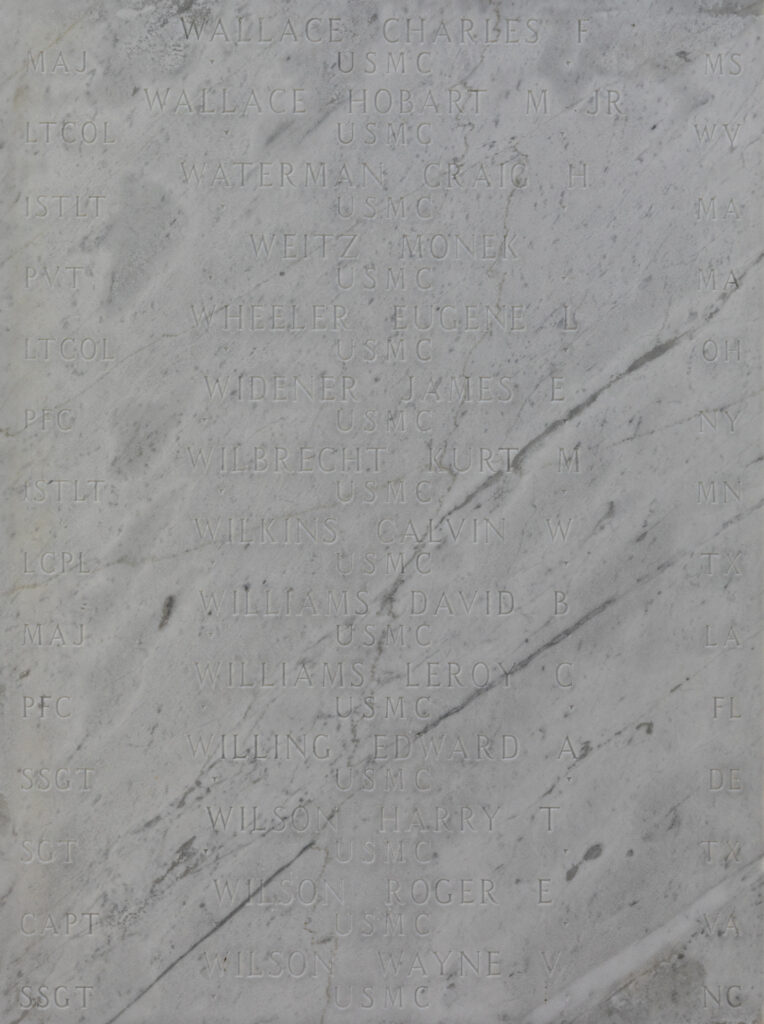
- Cemetery: Court A, Courts of the Missing. National Memorial Cemetery of the Pacific, Honolulu, Hawai‘i
Lynn English High School, Lynn, Massachusetts
2025/2026
Early Life
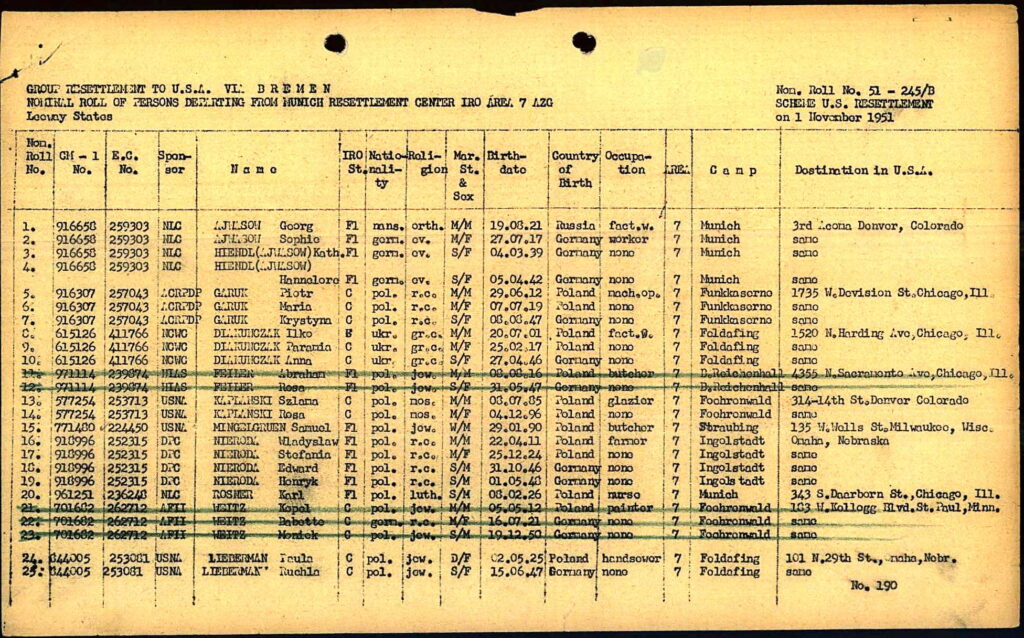
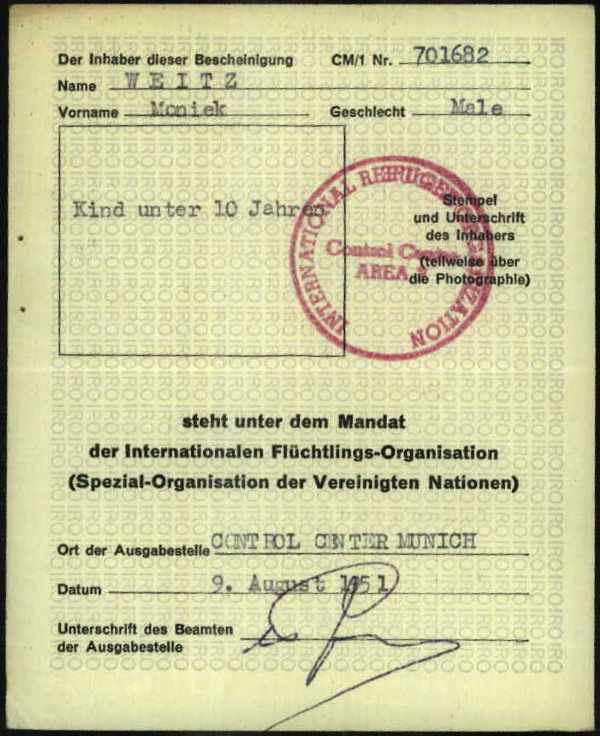
Moniek Weitz was born in the Foehrenwald Displaced Persons Camp, near Wolfrathausen, Germany, in December 1950 to Kopel and Babette Weitz. His father, Kopel, was a Polish Jew, and his mother, Babette, a Roman Catholic German. During the year Moniek lived in Germany, his parents obtained assistance from the International Refugee Organization (IRO) to leave the country. Babette applied through the IRO to be resettled to various areas, including Israel. The family was approved for resettlement in Australia.
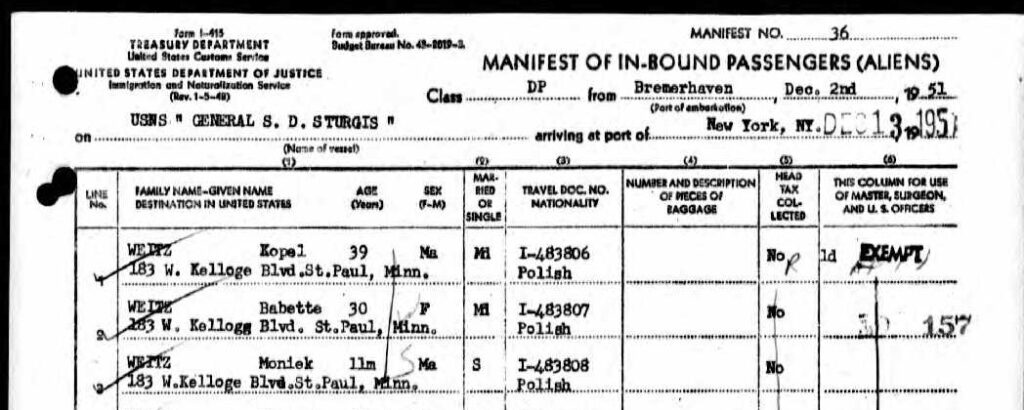
However, when Weitz was 11 months old, he left Germany with his parents. They sailed out of Bremerhaven, Germany, on December 2, 1951, aboard USS General S.D. Sturgis. They arrived in New York City on December 13, 1951. Originally destined to head west to St. Paul, Minnesota, the Weitz family found themselves in Massachusetts. Somewhere in his first year of life, his first name lost the “i”, and he went the rest of his life by the name Monek.
Life in Massachusetts
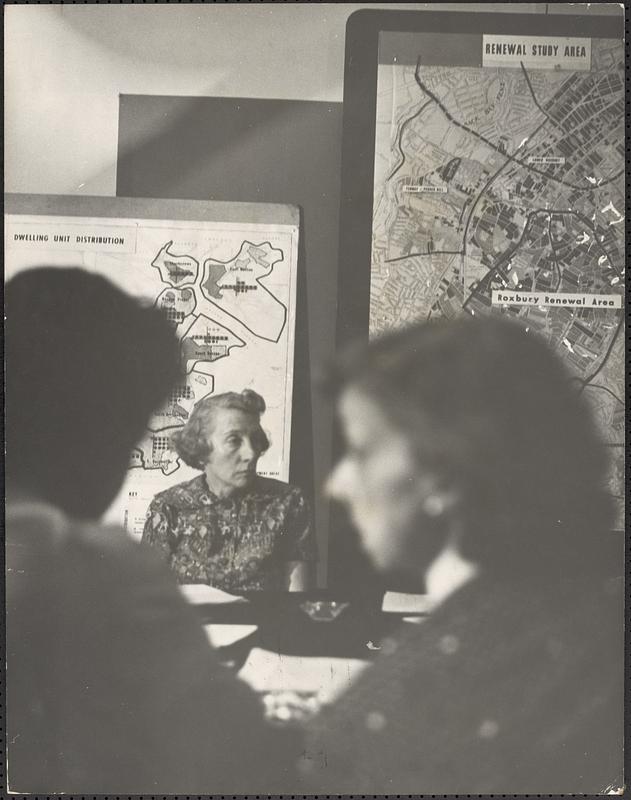
In Massachusetts, the Weitz family settled in South Boston, living on Compton Street. South Boston was a lower-middle-class neighborhood, mostly composed of Irish families. Here, Monek became an older brother to Leon and Rosa. The family lived in South Boston until the city of Boston took over the area for urban development, forcing out the families who lived in the section of town where the Weitzs resided. Once the houses in South Boston were demolished, the Weitz family moved to Weld Avenue in Roxbury, Boston.
Like South Boston, Roxbury is a neighborhood within the city of Boston. Unlike South Boston, Roxbury was populated predominantly by African American families. During the 1940s, redlining practices labeled this part of the city as an “undesirable” area. The neighborhood never fully recovered from this designation and still suffers from the problems that stemmed from redlining and unfair housing practices.
Community
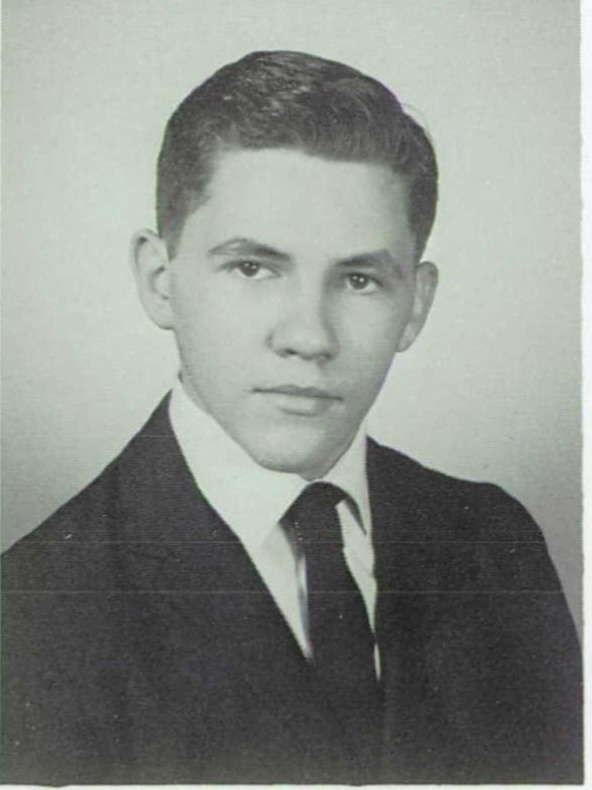
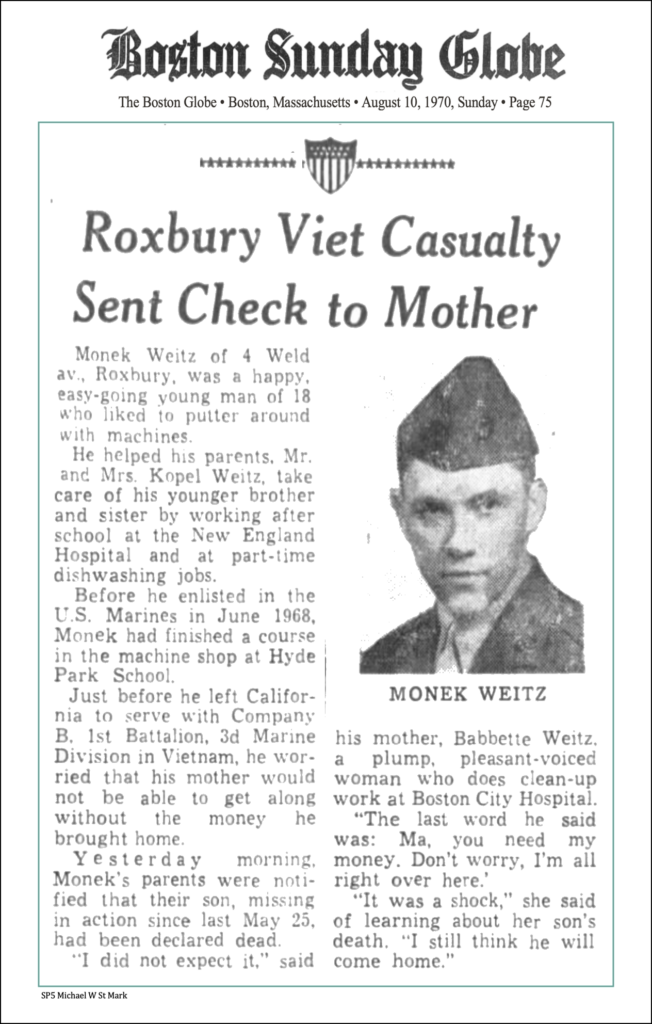
The Weitz family became active members of the community after settling in from Germany. Kopel Weitz became a shoemaker and later a salesman, while Babette Weitz went from a housewife to working at the local hospital. Monek also contributed to the community, working at New England Hospital and taking on part-time dishwashing jobs when he was in high school. Outside of work, Monek was a member of the Parish Youth Group of St. Mary’s of the Angel. While attending Hyde Park High School, he was a member of many clubs, including Key Club, Camera Club, Chess Club, and Jazz Club.
After graduating from the machine shop program at Hyde Park High School in 1967, Monek continued to work until he enlisted in the United States Marine Corps in June 1968.
Homefront
Boston, Massachusetts, has been a home front to war and rebellion since the country’s founding. The people of Boston were leaders of the American Revolution, contributed to the War of 1812, and used the Charlestown Navy Yards during World War I and World War II. Alongside these contributions to the war efforts over time, the young men of Boston were also sent off to fight, some voluntarily and some by law.
Boston has a rich history of well-known historical figures passing through, from George Washington to Ho Chi Minh. In 1912, Ho Chi Minh spent time in Boston, working as a chef at the Omni Parker Hotel, before returning to Vietnam as a member of the Communist Party, and working to gain Vietnamese independence from France. He later led the North Vietnamese push to take control and reunite all of Vietnam into one Communist nation. Malcolm X also worked as a busboy at the same hotel in the 1940s. Before he became a well-known Civil Rights leader, a teenage Malcolm X shared a home in the Roxbury neighborhood with his half-sister, Ella Little-Collins. The house is the only remaining boyhood home of Malcolm X in the United States. The home is currently owned by Ella’s son and is listed on the National Register of Historic Places.
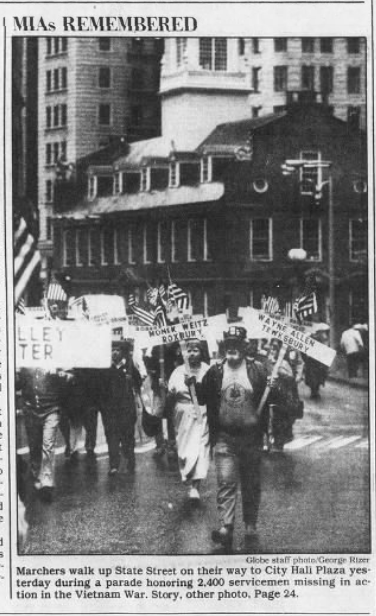
Boston and its neighborhoods have lived up to their legacy of places for rebellion and revolution many times over. Dr. Martin Luther King, Jr. preached sermons at the Twelfth Baptist Church and led his first march outside of the South in Roxbury. The Mothers for Adequate Welfare staged a sit-in at the Roxbury welfare agency, which led to a three-day riot in the city’s streets in the summer of 1967. Anti-war protests and peace rallies also filled the streets at the height of the Vietnam conflict in the late 1960s.
Demographics of Boston 1950 – 1960
The South Boston and Roxbury neighborhoods of Boston were typical New England neighborhoods in the 1950s and 1960s. The Massachusetts State Advisory Committee to the United States Commission on Civil Rights noted that in 1950, there were 20 White residents for each non-White resident. Ten years later, in 1960, the ratio shifted to 1 White resident for each resident of color. During this period, the White population of Boston decreased by 130,000 people, while the population of people of color increased by 26,000. Redlining led to racial imbalance in neighborhoods. South Boston was selected for urban renewal, displacing over 10,000 families. From 1962 to 1966, at the height of urban renewal, 3,550 families of color accounted for 49% of those displaced. During this time, the Weitz family moved from South Boston to Roxbury.
War Production
During the 1960s, Boston was also home to many businesses that manufactured defense products during the Vietnam War. The American Appliance Company, located in Cambridge, alongside the Massachusetts Institute of Technology (MIT) and Harvard College, began operations in 1922, focusing on refrigeration and electronics. By World War II, the company shifted to defense production and continued through the Korean and Vietnam Wars. The company also changed its name to Raytheon. During the early years of the Vietnam War, Raytheon built US HAWK ground equipment. The US HAWK is a medium-range surface-to-air guided missile designed to provide air defense against low- to medium-altitude aircraft. The first basic HAWK missile was deployed in Vietnam in 1960, although the weapons were never fired. The first combat use of the missile system came in 1967, by Israel, during the Six-Day War.
Escalating Tensions
As the war escalated in Vietnam and young men in the United States began to be drafted for military service, Boston served as a center for the Civil Rights and Anti-War Movements.
Schools that were previously segregated due to redlining and racial imbalances in neighborhoods were legally desegregated with busing. The predominantly White South Boston children were bused to Roxbury, while the predominantly Black Roxbury children were bused to South Boston. Neither neighborhood supported this measure, which led to protests and riots that continued into the 1970s.
Teenagers caught in this process also faced increased tensions because of the conflict in Vietnam. Young Americans were drafted to fight, whether they wanted to go or not.
Resistance to the Draft
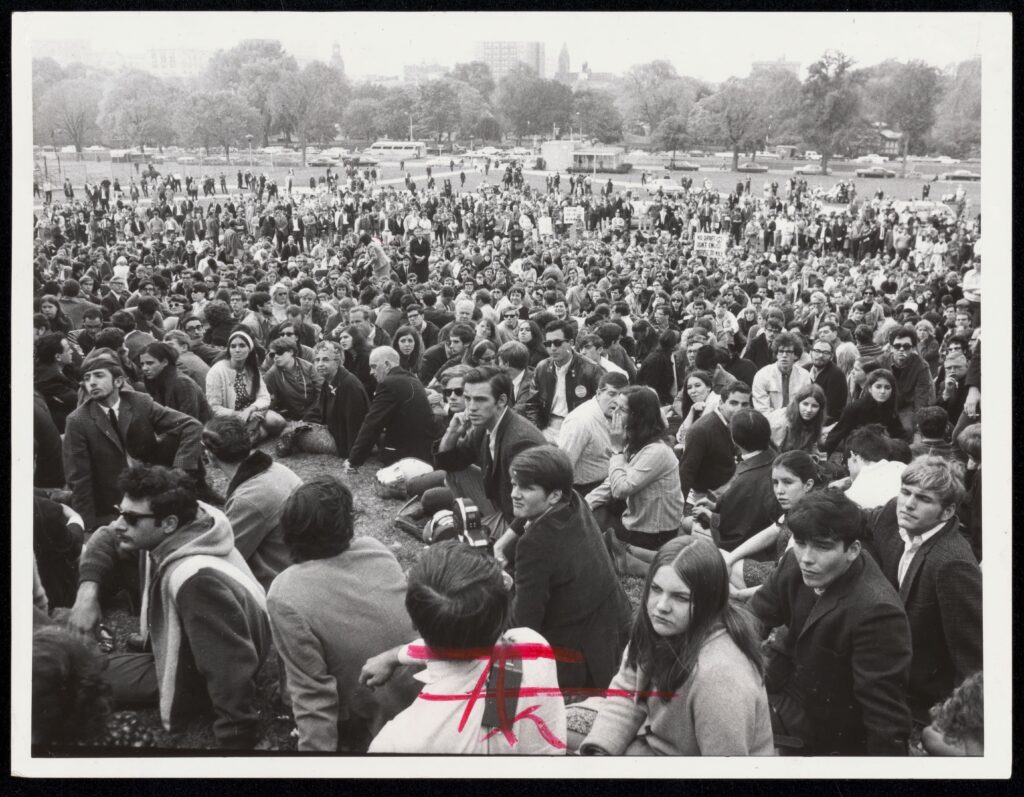
By 1967, the war in Vietnam had reached a high point and was becoming increasingly unpopular with many young Americans. Black men were being drafted at a disproportionately higher rate than their White peers. Anti-war rallies and draft card burnings were held across the country, and on October 16, 1967, a Resistance Rally was planned for Boston.
More than 5,000 supporters gathered on Boston Common to protest the draft. Well-known prominent figures spoke at this rally, including pediatrician Dr. Benjamin Spock, Yale Chaplain William Sloane Cofflin, and Boston University Professor Howard Zinn. They spoke against the constitutionality of the draft and led a peaceful march from the Common to Arlington Street Church at the conclusion of their remarks. At the church, the marchers listened to a sermon, and at the end, over 280 men stepped up to turn over or burn their draft cards. The crowd dispersed.
In January 1968, five men were charged with conspiracy against the Selective Service. These five men included Reverend Cofflin and Dr. Spock, as well as Marcus Raskin, Mitchell Goodman, and Michael Ferber. Of the five, only Ferber was an actual draft resister. Anti-war activists hoped these charges would allow them to put the federal government’s actions in Southeast Asia on trial. However, before the trial began, the judge ruled that testimony on the illegality of the draft and the war would not be allowed. Instead, arguments could focus only on whether the five men had broken the law. At the end of the trial, four of the five were found guilty and sentenced to prison. Their convictions were overturned the following year.
Military Experience
Monek Weitz enlisted in the U.S. Marine Corps in June 1968. On June 29, he began basic training in Parris Island, South Carolina. Here, Weitz received roughly eight weeks of training before graduating as a private. He was then sent to Camp Lejeune, North Carolina, for specialized infantry training. Before being sent to Camp Pendleton, California, in October 1968.
Military Occupational Specialty Training (MOS)
At Camp Pendleton, Private Weitz was trained to be an artillery scout observer. These Marines were assigned to an infantry unit and were sent ahead to monitor enemy movement. If enemy troops were spotted, scouts would radio in the location for an artillery strike.
After completing artillery scout training, Weitz was attached to the 1st Battalion of the 12th Marines in the 3rd Division. Weitz deployed to Vietnam in early May 1969.
Combat
When Weitz arrived in Vietnam, the 3rd Division was stationed near the demilitarized zone (DMZ) and often faced North Vietnamese regulars with artillery support. He was stationed in Cam Lo, Quang Tri Province, South Vietnam, as part of Operation Virginia Ridge, an effort to remove two North Vietnamese Army units that had crossed the DMZ and were advancing south. Between January 1, 1968, and May 31, 1969, 47 percent of the 3rd Division’s casualties in this region would be caused by mortars, artillery, and rockets. Private Weitz would soon be counted as one of these casualties.
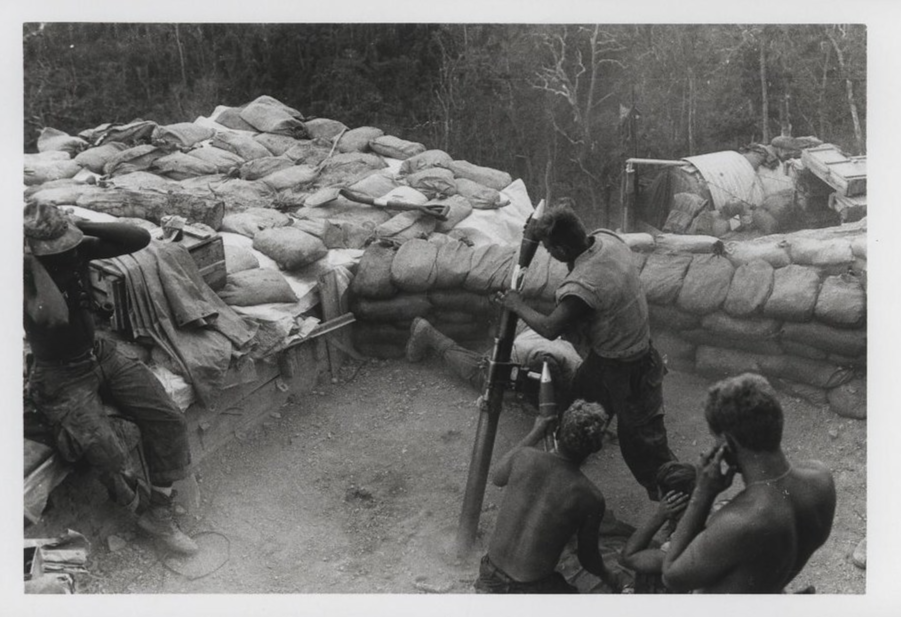
On May 25, 1969, around 4:00 p.m., an 81MM mortar ammunition pallet caught fire in the base where Weitz was stationed. Private Weitz and another Marine, Private First Class Leroy Williams, were seen running towards the fire. Weitz carried an entrenching tool and attempted to put out the fire alongside Williams and six other unidentified Marines. As the men ran towards the fire, an incoming mortar attack from the enemy landed on the ammunition pallet, detonating the pallet and causing a massive explosion. The area was evacuated as the Marines fought to save their fallen members and prevent any further damage to the base.
After the area had been cleared, a platoon was sent back to the explosion site for search and recovery. The company was able to locate the remains of six Marines, none of whom were identified as Monek Weitz or Leroy C. Williams. Mokek Weitz was declared Missing in Action as of May 25, 1969.
Commemoration
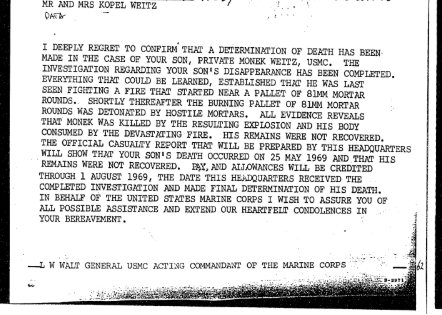
For months after the mortar attack, the military sought information about the two missing Marines. Without definitive proof of death, there could be no assurance that the men had not survived the attack. Additionally, some Marines believed they had seen Williams being put into a helicopter after the blast. After a full investigation of the surrounding area, as well as checking in with medics and field hospitals, both in South and North Vietnam, the military determined that both men were killed during the initial attack. According to the final report, Monek Weitz’s proximity to the blast left no remains to be found. Leroy Williams’s remains were also never recovered.
Monek Weitz was declared killed in action (KIA) on August 7, 1969, with a date of death determined to be May 25, 1969, as a result of the mortar attack on the base. Weitz’s family was notified of the determination of his death in August 1969. A requiem mass was sung at the local church after receiving this news.
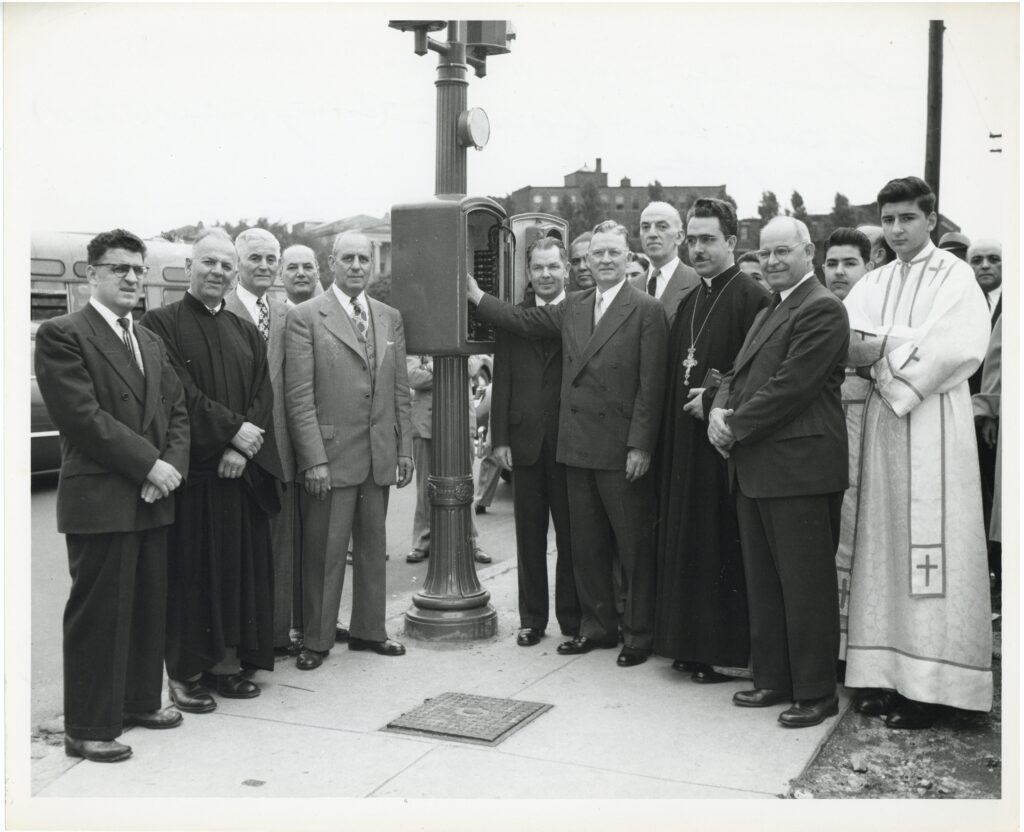
Weitz is commemorated on the Court of the Missing in Honolulu, Hawai‘i, and his name is inscribed on the Vietnam Veterans Memorial Wall in Washington, D.C. In 2024, Roxbury dedicated a Hero Square to PVT Weitz at the corner of Weld Avenue and Columbus Avenue, close to where he had grown up.
Monek Weitz was survived by his parents, Kopel and Babette, and his younger siblings, Leon and Rosa Weitz.
Bibliography
Primary Sources
Anti-Vietnam and Anti-Draft – Part of crowd of more than 4,000 at noon-hour rally on Boston Common listen to speakers at “Oct. 16 Resistance.” More than 200 young men marched from rally to Arlington Street Church and destroyed or surrendered their draft cards at the altar. Photograph. October 1967. Digital Commonwealth. https://ark.digitalcommonwealth.org/ark:/50959/9880zv184.
Babbette Weitz. Boston, Massachusetts, U.S., List of Boston Residents, 1909-1972. Digital images. https://ancestryclassroom.com.
“Boston Card Party Protests Draft War.” Yale Daily News [New Haven, CT], October 17, 1967.
“A Call to Resist Illegitimate Authority.” University of Massachusetts – Boston Library. Accessed November 10, 2025. https://vietnamwar.lib.umb.edu/warHome/docs/1967CallToResistIllegit.html.
Central Housing Project Files Collection, c.1938-1982. City of Boston Archives. https://archives.boston.gov/repositories/2/resources/460.
Development meeting with Roxbury Renewal Area map. Photograph. c.1960-1970. Digital Commonwealth. https://ark.digitalcommonwealth.org/ark:/50959/7d27cj20x.
“Dr. Spock Delivers Analysis of Vietnam War.” Yale Daily News [New Haven, CT], October 17, 1967.
“Freedom Schools Open.” The New Boston Citizen [Boston, MA], November 22, 1963. https://www.digitalcommonwealth.org/book_viewer/commonwealth:61091g865.
“Marine Private Monek Weitz of Roxbury.” Boston Evening Globe, August 21, 1969. Newspapers.com (435166296).
The Massachusetts State Advisory Committee to the United States Commission on Civil Rights. Report on Racial Imbalance in the Boston Public Schools. January 1965. https://www.usccr.gov/files/historical/1965/65-003.pdf.
MIAs Remembered. Photograph. The Boston Globe [Boston, MA], September 19, 1987. Newspapers.com (438908143).
Moniek Weitz. Free Access: Africa, Asia and Europe, Passenger Lists of Displaced Persons, 1946-1971. Digital images. https://ancestryclassroom.com.
Monek Weitz. Freedom of Information Act Files. National Archives and Records Administration – St. Louis.
Moniek Weitz. Germany, Lists from Displaced Persons Camps, 1938-1985. Digital images. https://ancestryclassroom.com.
Monek Weitz. Hyde Park High School Yearbook. Hyde Park: Boston Public Schools, 1968.
Monek Weitz. Manuscript/Mixed Materials. Library of Congress (PWMASTER_111889). https://www.loc.gov/collections/vietnam-era-pow-mia-database/?fa=subject_name:weitz,+monek.
Moniek Weitz. New York, U.S., Arriving Passenger and Crew Lists, 1820-1957. Digital images. https://ancestryclassroom.com.
Riot Cases Collection 1967-1972. City of Boston Archives. https://archives.boston.gov/repositories/2/resources/260.
“Roxbury Viet Casualty Sent Check to Mother.” The Boston Globe [Boston, MA], August 10, 1970. Newspapers.com (435188678).
“War Protestors Cut Ties with Draft Movement Heads to Active Resistance” The Heights [Boston, MA] October 20, 1967.
“A Welfare Protest Spurs Boston Riot; Scores are Injured; Boston Protest Erupts into Riot.” The New York Times. [New York, NY], June 3, 1967. https://www.nytimes.com/1967/06/03/archives/a-welfare-protest-spurs-boston-riot-scores-are-injured-boston.html.
Zimmerman, Corporal G.N. 81s in Action: A member of the 81mm Mortar Platoon, 2d Battalion, 4th Marines [2/4] drops another round into the tube during a fire mission . . . Photograph. 1969. Jonathan F. Abel Collection Marine Corps History Division (COLL/3611). https://www.flickr.com/photos/usmcarchives/28717423803/in/album-72157669993214973.
Secondary Sources
“A Battery, 1st Battalion, 12th Marines.” Together We Served. Accessed December 12, 2025 https://marines.togetherweserved.com/usmc/servlet/tws.webapp.WebApp?cmd=PublicUnit&type=Unit&ID=4594#.
“About Roxbury.” Roxbury Historical Society. Accessed February 10, 2026. https://www.roxburyhistoricalsociety.org/about-roxbury.
“Anti-war Activists Sentenced to Prison.” Mass Moments. Accessed November 10, 2025. https://www.massmoments.org/moment-details/anti-war-activists-sentenced-to-prison.html.
Boston Area Population Data Map. Map. 1940. Redlining in New Deal America, Mapping Inequality, University of Richmond. https://dsl.richmond.edu/panorama/redlining/map/MA/Boston/area_descriptions#mapview=full&loc=12/42.3138/-71.0809.
“Experiences of the War” The Vietnam War: A Film by Ken Burns & Lynne Novick. https://mass.pbslearningmedia.org/collection/kenburnsclassroom/film/the-vietnam-war/#experiences-of-war.
“Forward Observers: The Eyes of Indirect Fire Support.” 1st Marine Division. Accessed December 12, 2025. https://www.1stmardiv.marines.mil/News/Article/Article/541983/forward-observers-the-eyes-of-indirect-fire-support/.
Moitoso, Graham, and Anja Clark. Roxbury Murals: An Exploration of Racialized Landscapes. Northeastern University Library. Accessed February 10, 2026. https://landscapes.northeastern.edu/roxburymurals/.
“Monek Weitz.” American Battle Monuments Commission. Accessed February 10, 2026. https://weremember.abmc.gov/s?q=*&type=16&criteria=title%3Dweitz&b=0&a=c&v=G.
“Monek Weitz.” Defense Personnel POW/MIA Accounting Agency. Accessed October 23, 2025. https://dpaa-mil.sites.crmforce.mil/dpaaProfile?id=a0Jt0000000Xef3EAC.
“Monek Weitz.” Veterans Legacy Memorial, National Cemetery Administration. Accessed February 10, 2026. https://www.vlm.cem.va.gov/MonekWeitz/49796.
“Operation Virginia Ridge.” History Maps. Accessed February 10, 2026. https://history-maps.com/warmap/vietnam-war/event/operation-virginia-ridge.
Park, Bob. “Raytheon: The Tip of a Stolen Iceberg.” Science for the People 3 (no. 3) July 1971. https://archive.scienceforthepeople.org/vol-3/v3n3/raytheon-tip-stolen-iceberg/.
“Pvt Monek Weitz.” Find a Grave. Updated September 22, 2014. Accessed February 10, 2026. https://www.findagrave.com/memorial/136272153/monek-weitz.
Researching Black History at BPL. Research Guide. Boston Public Library. Accessed November 19, 2025. https://guides.bpl.org/c.php?g=1397513&p=10476416.
Simmons, General Edwar H. “Marine Corps Operations in Vietnam, 1969 – 1970.” Proceedings, May 1973. U.S. Naval Institute. https://www.usni.org/magazines/proceedings/1973/may/marine-corps-operations-vietnam-1969-1972
Shulimson, Jack, Charles Smith, Lieutenant Colonel Leonard A. Blasiol, USMC, and Captain David A. Dawson, USMC. US Marines in Vietnam: The Defining Year, 1968. History and Museums Divisions, 1997.
“Weitz, Monek.” POW Network. Updated February 2020. Accessed December 15, 2025 https://www.pownetwork.org/bios/w/w144.htm.
This profile was researched and created through the Researching Silent Heroes program, sponsored by the American Battle Monuments Commission.