

Technical Sergeant Thomas Joseph Walker
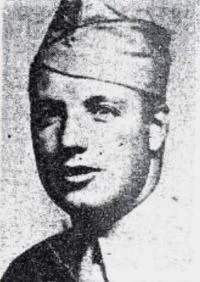
- Unit: 728th Bomber Squadron, 452nd Bomber Group (Heavy)
- Service Number: 19028549
- Date of Birth: January 24, 1921
- Date of Death: August 15, 1945
- Hometown: Kingman, Arizona
- Place of Death: Near Strasbourg, France
- Award(s): Air Medal with Oak Leaf Cluster, Purple Heart
- Cemetery: Walls of the Missing. Epinal American Cemetery, Dinozé, France
Santan Junior High School, Chandler, Arizona
2025/2026
Early Life
Thomas J. Walker was born on January 21, 1921, in Michigan to James Thomas Walker and Mary Elizabeth (Westerfelt) Walker. His father was a World War I Veteran, and his mother was Canadian. Thomas, affectionately called “Tommy” or “Tom,” was the second of three children and the eldest boy. His sister, Mary, was two years older and born in Ontario, Canada. After his family moved to Huntington, Indiana, where his father was a salesman, his younger brother, James Jr., was born in 1930.
A Life of Talent and Aspiration
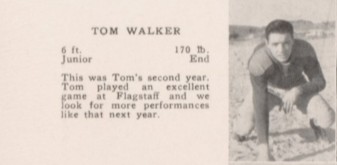
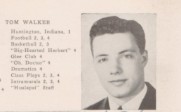
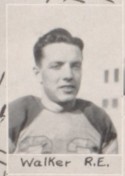
Walker moved to Arizona with his mother following his parents’ divorce in the 1930s. He attended Kingman/Mohave County High School, where he graduated in 1939. A natural athlete, Walker lettered in basketball and football starting in his sophomore year, eventually earning a spot on the Northern Conference Honorable Mention Team. He was truly a jack of all trades; beyond excelling in sports, he starred in three-part plays and played the saxophone in the school orchestra. Walker was so beloved by his peers that his yearbook even predicted he would be a future governor of Arizona.
Love In Uncertain Times
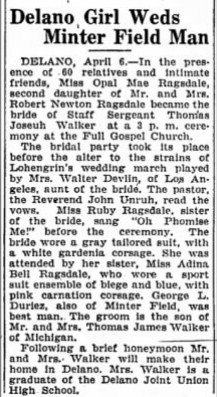
On March 31, 1942, Tom Walker married Opal Ragsdale in Delano, California. They made their vows at the Full Gospel Church in the presence of 60 relatives and friends. The maid of honor was Opal’s sister, Adina, and the best man was fellow serviceman, George L. Duriez. After their honeymoon, Tom and Opal made their home in Delano near her family. On July 17, 1944, Opal gave birth to their son, Randall Thomas Walker.

Homefront
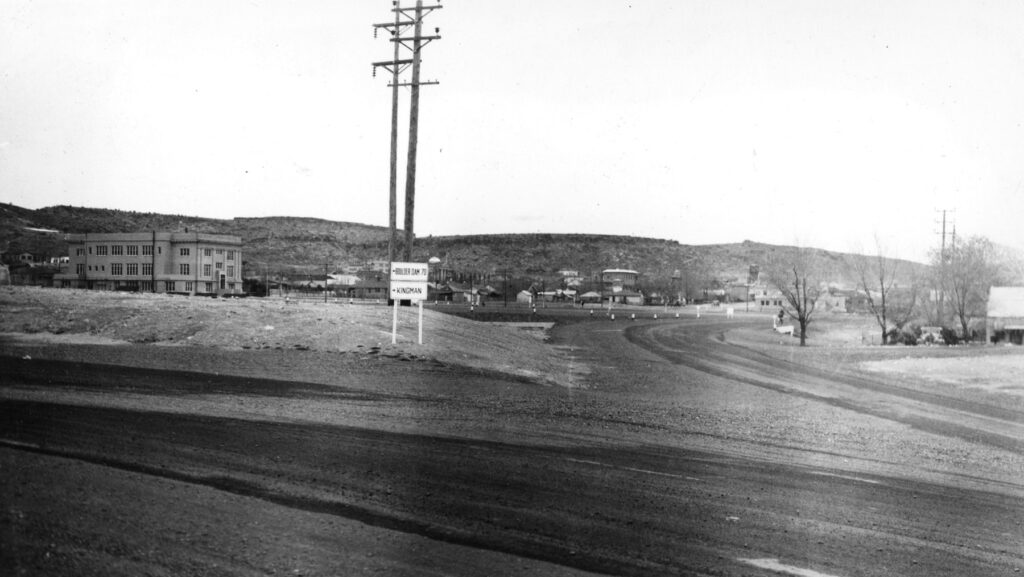
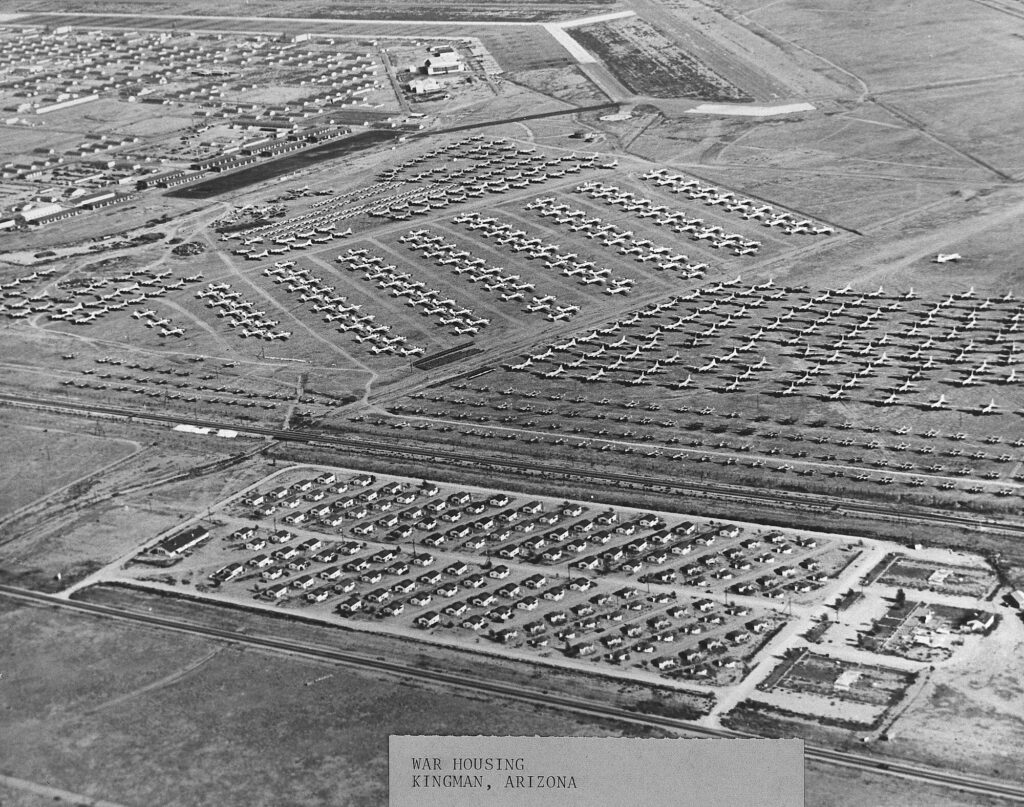
Kingman, Arizona, was a fairly small city known for its location on Route 66. Located in northwest Arizona, it is surrounded by beautiful mountains and deserts. It was named for Lewis Kingman, a railroad surveyor, who founded the town in 1882. Known for its mining and historic stop along Route 66, Kingman grew to a population of about 500 residents in the 1900s. At the end of the First World War, silver prices had dropped, but with the rise of Route 66 traffic, the mining industry saw a revival.
The War Comes to Kingman
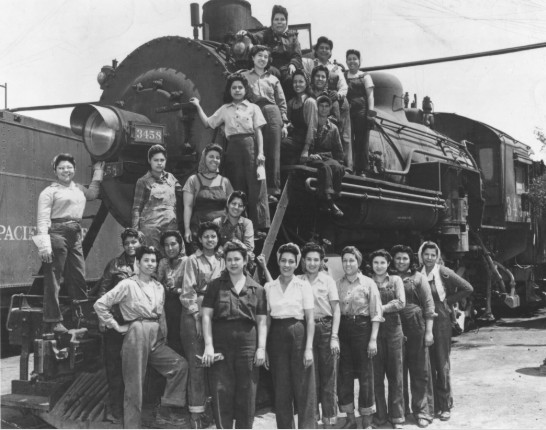
Kingman was also known for its agriculture, which included alfalfa, cotton, lettuce, cattle, corn, and wheat. Farmers were asked to increase their production for the war effort, which was aided by increased rainfall in 1942. Due to the number of men drafted into the war, farmers were required to work longer hours, and the need for migrant labor increased. Kingman and the surrounding communities organized patriotic activities to support the war effort, including selling war bonds, buying war stamps, and planting victory gardens. The community also provided childcare for mothers who filled positions on the airfield, made machinery for the war effort, or were employed on the Southern Pacific Railroad in Arizona.
Taking Aim in Kingman
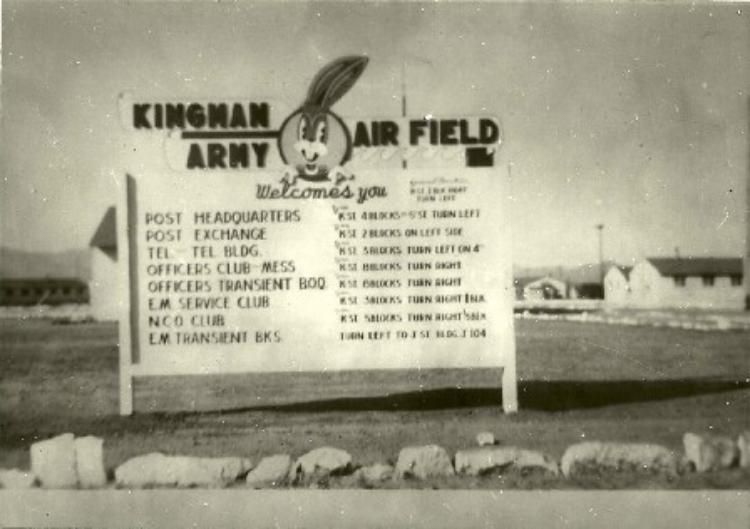
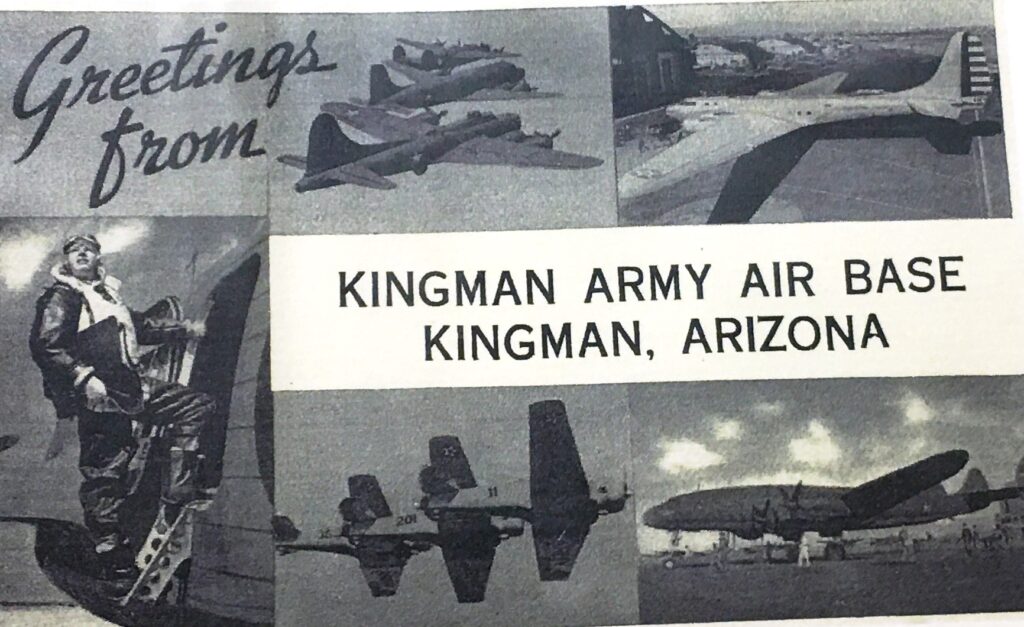
In May 1942, the U.S. Army Air Forces authorized construction of the Kingman Army Air Field (KAAF), one of six national aerial gunnery schools. The Wartime Aircraft Gunnery School was built rapidly, beginning in June 1942 at an estimated cost of $9 million. The facility officially opened on August 4, 1942, and included both the Kingman Ground-to-Ground Gunnery Range and the Kingman Air-to-Air Gunnery Range located about six miles north of today’s city limits. These ranges extended roughly 31 miles north through the Hualapai Valley, covering about half a million acres between the Cerbat Mountains and the Hualapai Reservation. During World War II, more than 35,000 cadets earned their gunnery certificates, and Kingman Air Field also served as the training ground for Chinese Officer-Gunners, the all-African-American 334th Aviation Squadron, and women from the TB-26 Co-Pilot School.
Military Experience
Thomas J. Walker enlisted in the U.S. Army in Arizona and was stationed at Minter Field in Shafter, California, in 1942. On August 17, 1943, he began his Army Air Forces training at Yuma Army Air Field in Arizona. That same month, Special Order 229 directed him to Long Beach, California, for instruction on the B-17 before returning to Yuma.
Walker continued his training with the 950th Aviation Cadets through October 1943. On November 7, 1943, he transferred to Kingman Army Air Field, Arizona, arriving on November 10, 1943, as an unassigned but attached trainee from Yuma. By January 10, 1944, Walker had successfully graduated from Flexible Gunnery School at Kingman and was sent to the 18th Replacement Wing in Salt Lake City, Utah, for further assignment.
In early February 1944, he moved to the 469th Combat Crew Training School at Alexandria, Louisiana, where he helped establish his crew list by February 22, 1944. Following additional preparation, he was attached to the 271st AAF Base Unit at Kearney, Nebraska, in May and later staged at Camp Kilmer, New Jersey, before deployment overseas.
On June 23, 1944, Walker arrived at Deopham Green, Norfolk, England, where he joined the 728th Bomb Squadron of the 452nd Bomb Group. There, he completed the final phase of his training and preparation, joining his established crew for combat operations in the European Theater.
Flying Headfirst Into the Heart of the War
Between July 6 and August 14, 1944, the 452nd Bomb Group, including Walker’s 728th Bomb Squadron, participated in an intense series of strategic bombing operations as part of the Eighth Air Force’s sustained air offensive in Western Europe. These missions displayed the importance of Allied air support following D-Day, including strategic raids into Germany and additional missions in France.
Early missions in July 1944 focused heavily on southern Germany, particularly Munich and its surrounding industrial infrastructure. These missions included bombing railroad yards, aircraft engine plants, IG Farben, and BMW factories. These large-scale raids often involved over 1,000 Allied bombers, which encountered heavy flak and increased German fighter resistance. Over time, this resulted in significant aircraft losses and crew casualties. The repeated missions against Munich demonstrated the city’s importance as a transportation and industrial hub critical to the German war effort, thereby making it a necessity for the Allies to capture or destroy it.
In August, the operations included France, where Walker and his crew began supporting the Allied breakout from Normandy and preparations for Operation Dragoon. Missions included supply drops to French Resistance forces, attacks on airfields, bridges, rail junctions, troop concentrations, and strikes on V-weapon sites. These operations were often conducted under challenging weather conditions, resulting in staggering casualties.
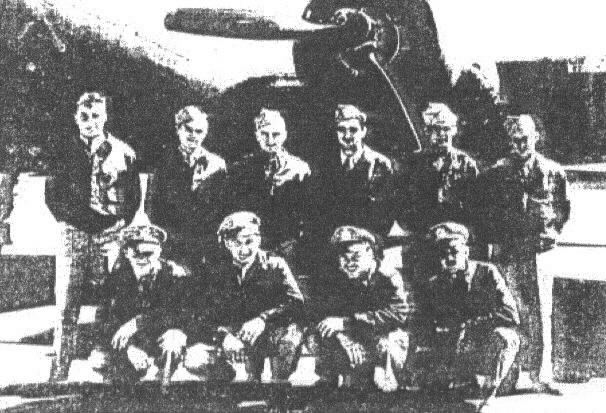
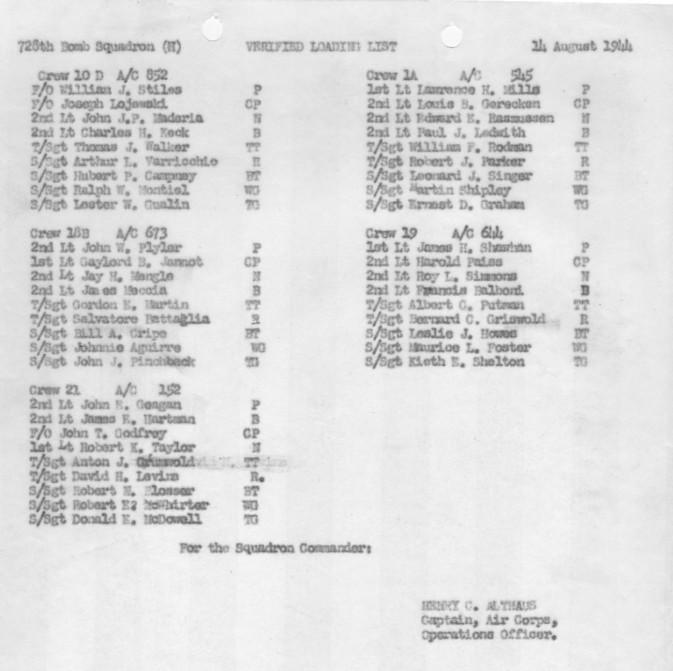
The tempo of operations was relentless for the 452nd Bombing Group, with crews flying frequent missions across multiple target sets in Germany, northern France, and southern France almost every day. Walker’s crew, led by Lieutenant Stiles, would carry out three to four missions before earning a short time off.
A Hero’s Final Flight
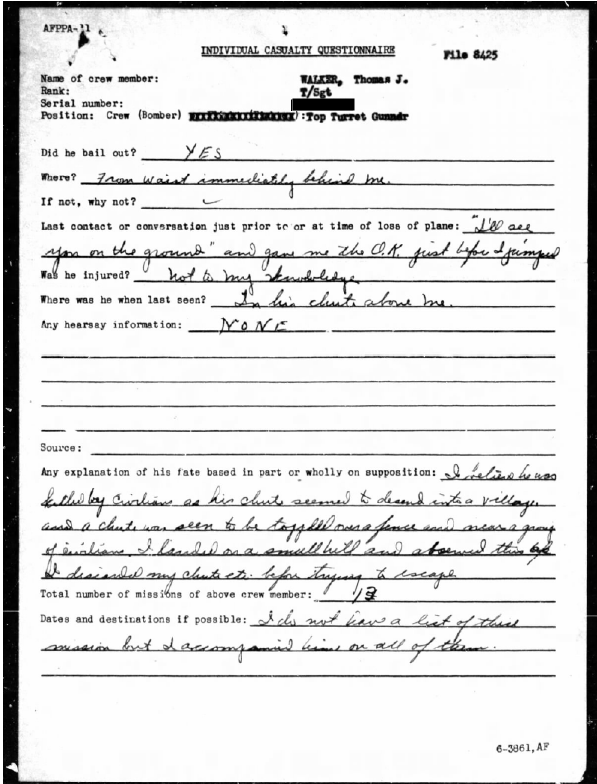
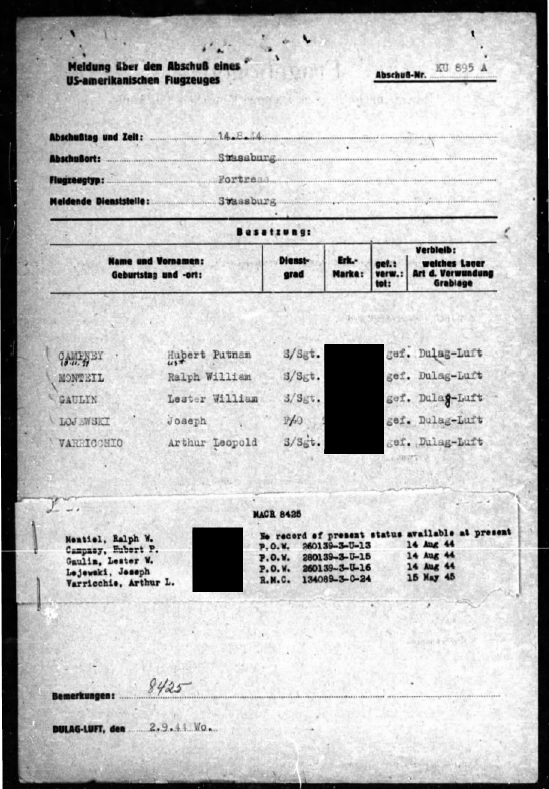
Tragically, on August 14, 1944, during a mission to Ludwigshafen and Mannheim, Germany, Walker’s B-17G, 42-97852, was struck by flak. The pilot tried to gain control of the plane, but the crew was required to bail out near Strasbourg, France, just west of the German border.
The bailout resulted in the loss, capture, or death of much of Walker’s crew. Technical Sergeant Walker bailed out over Wolfisheim, a French village near Strasbourg, on the border of France and Germany. According to initial speculation, Walker was determined to have been captured and killed by the French, but his remains were never found. A year to the date after his plane crashed, Walker’s status was changed from Missing in Action to Presumed Dead.
Commemoration
Tom Walker was pronounced dead on August 15, 1945, one year and one day after he went missing.
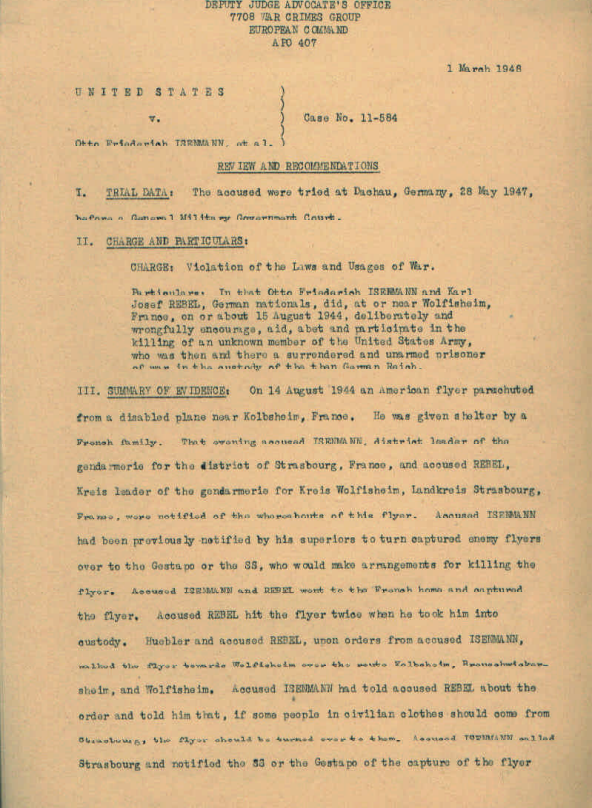
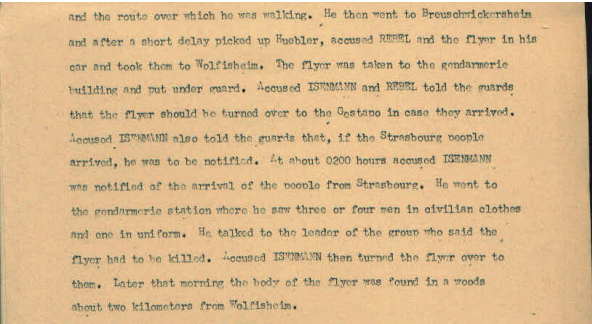
It was not until years after his death that light was shed on what happened the day of Walker’s crash. In a 1947 trial of two German soldiers, the truth about Walker’s death emerged. When he bailed out over Wolfisheim, France, two members of the French Resistance saved and hid him. When the Germans became aware of this, two Nazi soldiers, Otto Friederich Isenmann and Josef Rebel, arrested those who saved him, sending them to Dachau Concentration Camp. Walker was beaten, abducted, and ultimately turned over to the German Gestapo. To conceal their identity, the Gestapo dressed in plain French clothing, took Walker out to a wooded area about 1.5 miles from Wolfisheim, and murdered him. Isenmann testified to finding Walker’s body when he arrived at the location the next morning.
On May 28, 1947, both Otto Friederich Isenmann and Karl Josef Rebel were tried in Dachau, Germany, before a General Military Government Court under the charges of “Violation of the Laws and Usages of War.” On March 1, 1948, both Isenmann and Rebel were convicted of war crimes for Walker’s murder. Isenmann was sentenced to life imprisonment, and Rebel to 10 years.
Honoring Service and Sacrifice
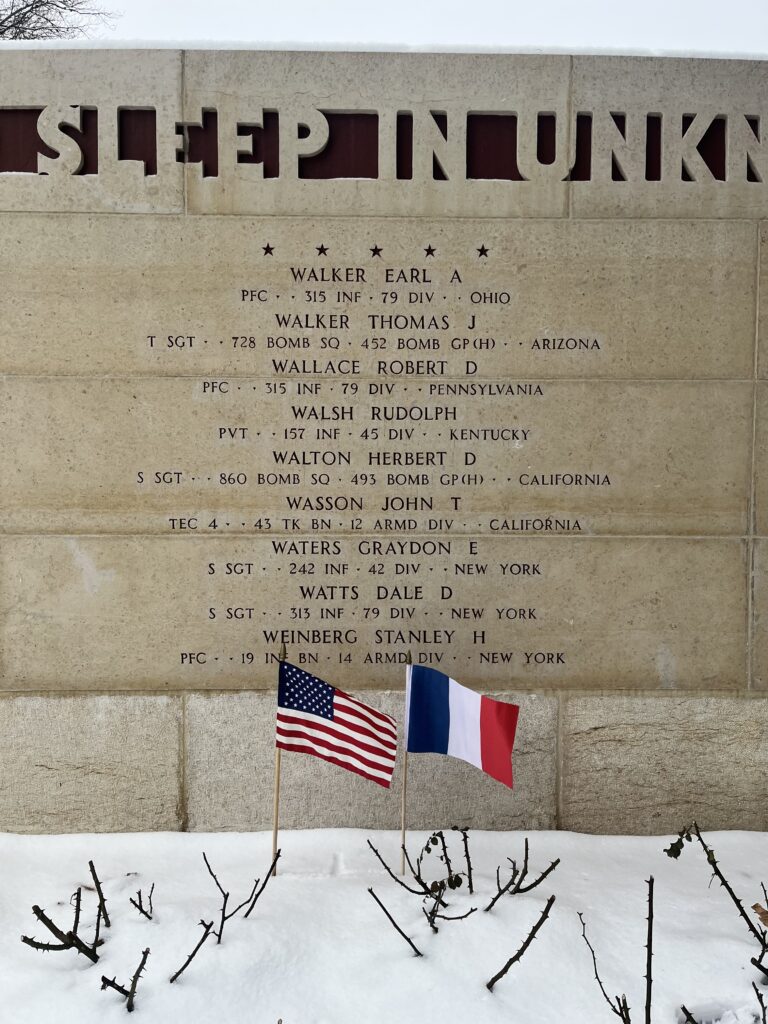
Technical Sergeant Thomas J. Walker was honored with an Air Medal (Oak Leaf Cluster) and posthumously awarded the Purple Heart for sacrificing his life in defense of his country. Walker is memorialized on the Tablets of the Missing at the Epinal American Cemetery in Dinozé, France.
Though Thomas J. Walker’s life was tragically cut short, his service and sacrifice remain deeply meaningful. Like countless American servicemen during World War II, he answered his country’s call, placing duty before self in the hope of securing a peaceful world for future generations. After his crew was shot down over occupied France, Walker briefly found help among civilians who risked their own lives to help him. The circumstances of his death, even unknown to his wife before her death, later revealed Walker’s strength and bravery in the face of fear.
Bibliography
Primary Sources
1937 Kingman City Directory. R.L. Polk & Co.: 1937. State of Arizona Research Library- Arizona State Library, Archives and Public Records, Arizona Memory Project (010990546). https://azmemory.azlibrary.gov/nodes/view/319242.
1942 Kingman Airfield Map. Map. 1942. City of King Municipal Airport. https://www.kingmanairport.com/about-us/about-kma-photo-archive/the-kingman-story-photo-archives.
1944 “Win the War” Stamp. Stamp. 1944. Arizona Capitol Museum, Arizona Memory Project (1996041017). https://azmemory.azlibrary.gov.
“Approximately 30 Per Cent Of National War Fund Quota Attained.” The Mohave County Miner [Kingman, AZ], January 14, 1943. https://news.google.com/newspapersnid=YGhAHpnIhDoC&dat=19441026&printsec=frontpage&hl=en.
Arizona. Yavapai County. 1940 U.S. Census. Digital images. https://ancestry.com/.
“Army Air Force Flexible Gunnery School Officially Opens Mon., January 18.” The Mohave County Miner [Kingman, AZ], January 14, 1943.
Barr, George. Arizona Agriculture 1942 Supplies, Prices, and Income. College of Agriculture, University of Arizona: 1942. https://arizona.aws.openrepository.com/bitstream/handle/10150/212280/B178-1942.pdf.
“Butter Shortage Seen Improving.” The Mohave County Miner [Kingman, AZ], January 14, 1943.
“Cattlement’s Meeting.” The Mohave County Miner [Kingman, AZ], January 14, 1943.
Charles Spaulding Walker. Indiana, U.S., Birth Certificates, 1907-1944. Digital image. https://ancestry.com/.
“Efforts of Local Red Cross Appreciated.” The Mohave County Miner [Kingman, AZ], January 14, 1943.
“Film Fare on the Fort.” The Apache Sentinel [Fort Huachuca, AZ], June 16, 1944. https://azmemory.azlibrary.gov/nodes/view/32161.
Indiana. Huntington County. 1930 U.S. Census. Digital images. https://familysearch.org/.
Indiana. Huntington County. 1940 U.S. Census. Digital images. https://familysearch.org/.
Kingman/Mohave County Union High School Yearbook. Mohave County Union High Schools, 1936. https://classmates.com/.
Kingman/Mohave County Union High School Yearbook. Mohave County Union High Schools, 1937. https://classmates.com/.
Kingman/Mohave County Union High School Yearbook. Mohave County Union High Schools, 1938. https://classmates.com/.
Lea Faye Spidell. Arizona, U.S. Birth Certificates, 1880-1935.2025. Digital image. https://ancestry.com/.
“Learn to Hate the Enemy.” The Buffalo, July 10, 1943. https://azmemory.azlibrary.gov/nodes/view/37946.
“Loading Lists Missions 1-250.” 452nd Bomb Group Association. Accessed December 30, 2025. https://452ndbombgroupassociation-deophamgreen.org/loading-lists.
James Thomas Walker and Mary Elizabeth Vesterfelt. Ontario, Canada, Marriages, 1829-1943. https://familysearch.org/.
L. Floyd Spidell and Mary E. Walker. Arizona, U.S., County Marriage Records, 1865-1972. https://ancestry.com/.
“Marriages.” Arizona Republic [Phoenix, AZ], June 24, 1939. Newspapers.com (4456402).
Michigan. Wayne County. 1920 U.S. Census. Digital images. https://ancestry.com/.
Missing Air Crew Report Number 8425. National Archives and Records Administration (NAID 91053762). https://catalog.archives.gov/id/91053762.
Southern Pacific Railroad Female Workers during World War II. Photograph. c.1941-1945. Arizona Historical Society Library and Archives, Arizona Memory Project (63527). https://azmemory.azlibrary.gov/nodes/view/41691.
“This Week’s Entertainment Calendar.” The Buffalo, July 10, 1943. https://azmemory.azlibrary.gov/nodes/view/37946.
Thomas J. Walker. U.S., Defense POW/MIA Accounting Agency, Unaccounted-for Remains, Group A. https://ancestry.com/.
U. S. 66, Oatman to Kingman. Photograph. c.1940. Mohave Museum of History and Arts, Arizona Memory Project. https://azmemory.azlibrary.gov/nodes/view/42024.
United States Army Air Forces. A Trip Through Kingman Army Air Field. Universal Press: 1943. https://upload.wikimedia.org/wikipedia/commons/7/7b/Kingman_Army_Airfield_Arizona_photo_pictorial.pdf.
United States v. Otto Friederich Isenmann, et al., Case No. 11-584. U.S. Military Tribunal at Dachau, Dachau, Germany, March 1, 1948. Jewish Virtual Library. https://jewishvirtuallibrary.org/jsource/Holocaust/dachautrial/fs26.pdf.
View of City Cafe and Texaco Station. Photograph. 1949. Mohave Museum of History and Arts, Arizona Memory Project. https://azmemory.azlibrary.gov/nodes/view/42008.
Secondary Sources
“452nd Bomb Group.” American Air Museum in Britain. Accessed December 30, 2025. https://www.americanairmuseum.com/archive/unit/452nd-bomb-group.
“Air Force.” World War Photos. Accessed December 31, 2025. https://www.worldwarphotos.info/gallery/usa/aircrafts-2-3/.
“Area Historic Points of Interest.” Kingman, Arizona Historic District. Accessed November 28, 2025. kingmanhistoricdistrict.com/points-of-interest/radar-station/index.htm.
Army Airfield Kingman Museum. Accessed December 30, 2025. https://armyairfieldkingmanmuseum.com/.
“Camp Kilmer.” National Archives and Records Administration. Accessed December 30, 2025. https://www.archives.gov/files/nyc/public/camp-kilmer.pdf.
Collins, William S. The United States Military in Arizona, 1846-1945. Arizona State Historic Preservation Office, 1993. Arizona State Government Publications, Arizona Memory Project. https://azmemory.azlibrary.gov/nodes/view/108359.
Edwards, Joshua S. “Kingman Army Airfield.” Cornerstone Environmental Consulting. Updated February 2015. Accessed November 28, 2025. https://www.cornerstone-environmental.com/publications/item/kingman-army-air-field.
“Flight Engineer.” B-17 Flying Fortress: Queen of the Skies. Updated 2003. Accessed December 31, 2025. b17queenofthesky.com/flteng.htm.
FO Stiles Crew Photograph Taken in January 1944. Photograph. January 1944. Aircrew Remembered. Accessed December 30, 2025. https://aircrewremembered.com/stiles-william.html.
“Gunners.” National Museum of the United States Air Force. Accessed December 31, 2025. https://www.nationalmuseum.af.mil/Visit/Museum-Exhibits/Fact-Sheets/Display/Article/1519669/gunners/.
“Gunnery Training in the AAF.” Army Air Forces Historical Studies (no. 31). https://www.ibiblio.org/hyperwar/AAF/AAFHS/AAFHS-31/AAFHS-31-1.html.
“Kingman, Arizona – Gateway to Hoover Dam.” Legends of America. Accessed November 28, 2025. https://www.legendsofamerica.com/az-kingman/.
“Kingman Army Air Field, Depot 41, Kingman, Arizona, Archeology Page.” QuestMasters. Accessed November 25, 2025. https://questmasters.us/Kingman.html.
Marin, Christine. “Mexican Americans On the Home Front: Community Organizations in Arizona During World War II.” Presented to the National Association for Chicano Studies, April 1987. Accessed November 28, 2025. https://files.eric.ed.gov/fulltext/ED315252.pdf.
Petersen, Todd L. “Kearney, Nebraska, and the Kearney Army Air Field in World War II,” Nebraska History 72 (1991): 118-126. https://history.nebraska.gov/wp-content/uploads/2017/12/doc_publications_NH1991KearneyField.pdf.
“Thomas J. Walker.” American Air Museum in Britain. Accessed December 30, 2025. https://www.americanairmuseum.com/archive/person/thomas-j-walker.
“Thomas J. Walker.” American Battle Monuments Commission. Accessed October 19, 2025. https://weremember.abmc.gov/s?q=*&type=16&criteria=title%3DWalker&b=0&a=c&v=G.
“Thomas J. Walker.” Veterans Legacy Memorial, National Cemetery Administration. Accessed February 12, 2026. https://www.vlm.cem.va.gov/ThomasJWalker/3D144.
“TSgt Thomas J. ‘Tommy’ Walker.” Find a Grave. Updated August 7, 2010. Accessed October 19, 2025. https://www.findagrave.com/memorial/56376176/thomas-j-walker.
“A Visual Guide To: U.S. Army Rank Insignia, World War II.” Veteran Voices. Accessed December 31, 2025. https://veteran-voices.com/wp-content/uploads/2018/11/wwii-us-army-rank-insignia.pdf.
“War Relocation Centers.” National Park Service. Accessed November 25, 2025. https://www.nps.gov/articles/000/war-relocation-centers.htm.
Writers’ Program of the Work Projects Administration in the State of Arizona. Arizona: Facts, Events, Places, Tours. Bacon & Wieck, Inc., 1940.
Zimmerman, Susan. “Lucky All the Way!” Warfare History Network, Spring 2021. https://warfarehistorynetwork.com/article/lucky-all-the-way/.
This profile was researched and created through the Researching Silent Heroes program, sponsored by the American Battle Monuments Commission.