
Technician Fifth Grade Walter Burtis Harper
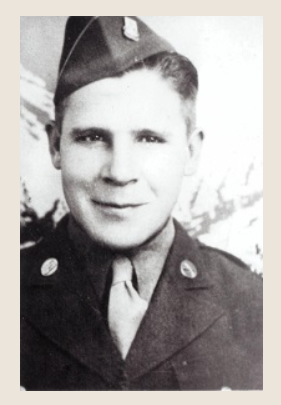
- Unit: Company F, 117th Infantry Regiment, 30th Infantry Division
- Service Number: 19071812
- Date of Birth: February 9, 1922
- Entered the Military: May 5, 1942
- Date of Death: February 24, 1945
- Hometown: Roundup, Montana
- Place of Death: Julich, Germany
- Award(s): Purple Heart, Bronze Star, Combat Infantry Badge
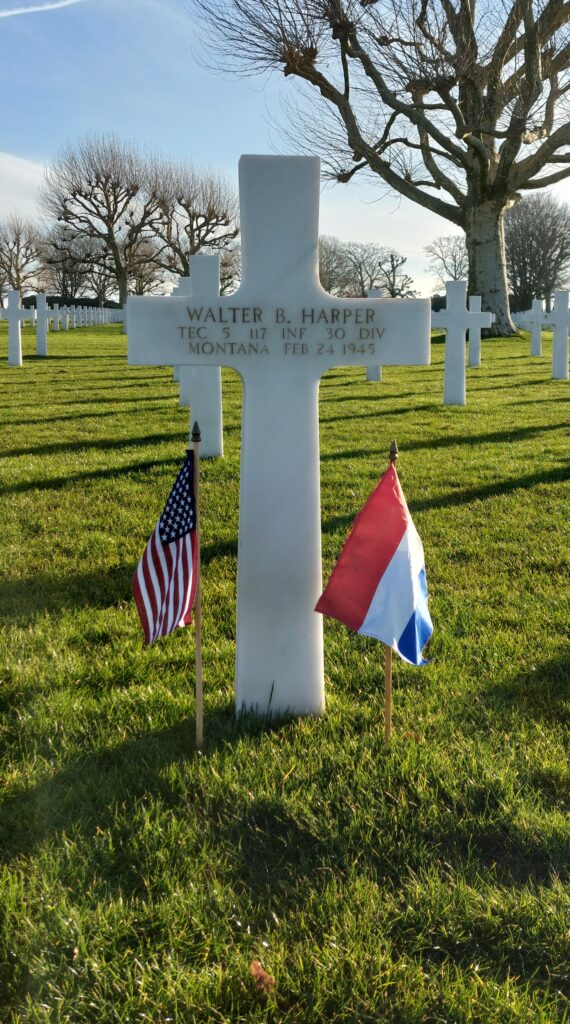
- Cemetery: Plot D, Row 16, Grave 4. Netherlands American Cemetery, Margraten, the Netherlands
Kennedy Elementary School, Butte, Montana
2025/2026
Early Life
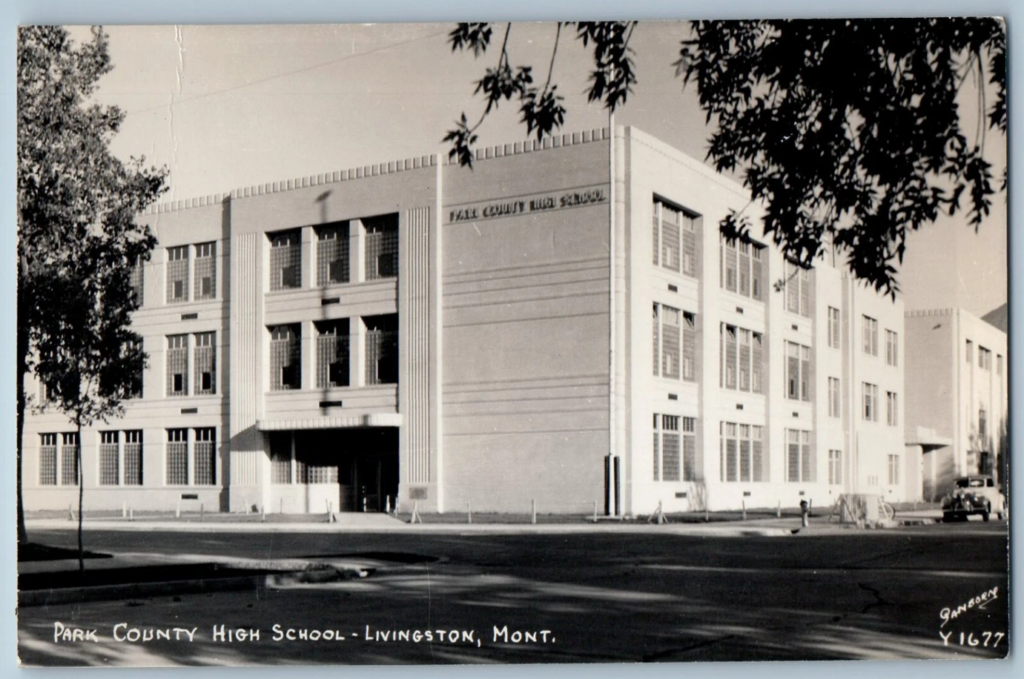
Walter Burtis Harper was born on February 9, 1922, on a ranch near Roundup, Montana. He was the fourth of five boys and one girl born to Willard Burtis Harper and Emma Caroline McKinney Harper, who met and married in Indiana. In 1928, his brother, Wayne, died. Walter was a student during much of the Great Depression, attending school in Park County, Montana, from 1928 until he graduated in 1940.
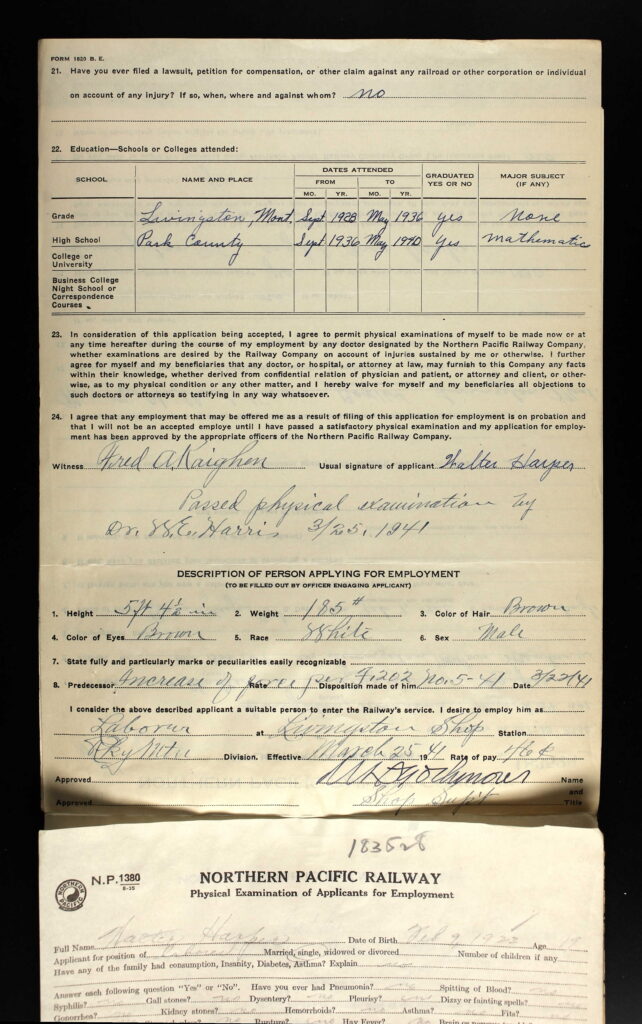
He was raised a member of the Seventh-day Adventist Church. His sister, Lucile, left home at age 13 to pursue a Seventh-day Adventist education. Upon graduating from high school, Walter worked on the family farm until he joined the Union Pacific Railroad as a laborer. In September 1941, his father died at the age of 55. In May 1942, he was drafted into the U.S. Army in Missoula, Montana.

Homefront
Keeping the Trains Running
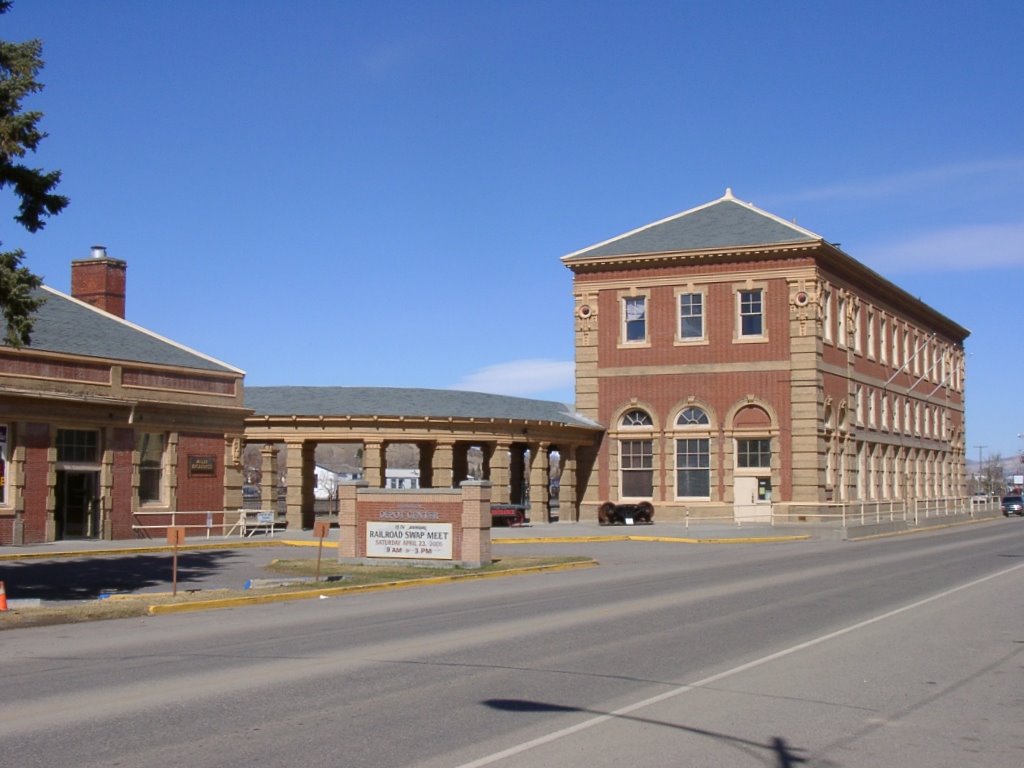
Harper grew up near Livingston, Montana. His parents moved there and homesteaded a ranch in Musselshell County, Montana, around 1918. The family moved to Park County in 1928. Between 1930 and 1950, both counties saw population changes. While Musselshell County’s population decreased, Park County’s increased. In both cases, the populations became less rural and more urban. During World War I and World War II, the Northern Pacific Railroad played a large role in Livingston as a central repair facility, beginning in 1882.
Both Walter Harper and his brother, Willard, were employed by the Northern Pacific Railroad. In 1943, his brother, Willis, was drafted into the U.S. Army, where he served as a paratrooper until his discharge in 1946. Another brother, Howard, began working for the Union Pacific Railroad at 17.
Military Experience
Walter Harper was drafted into the U.S. Army on May 5, 1942. He received extensive infantry training at Camp Blanding in Florida. In September of 1942, as part of the 117th Infantry Regiment, he was ordered to Fort Benning, Georgia. At the end of February, the 117th Infantry Regiment returned to Camp Blanding.
Harper and his regiment moved to Murfreesboro, Tennessee, in May 1943, and participated in the Second Army’s Tennessee Maneuvers in September 1943. The regiment transferred to Camp Atterbury, Indiana, in November of 1943, where they completed the final phase of their training before heading overseas.
The regiment set sail from Boston aboard USS John Ericsson on February 12, 1944, and arrived in Liverpool, England, on February 24, 1944. The regiment then received additional infantry training before crossing the English Channel for Normandy, France, on June 10, 1944. The regiment assembled at a staging area in Lison, France, where they stayed until July 2, 1944.
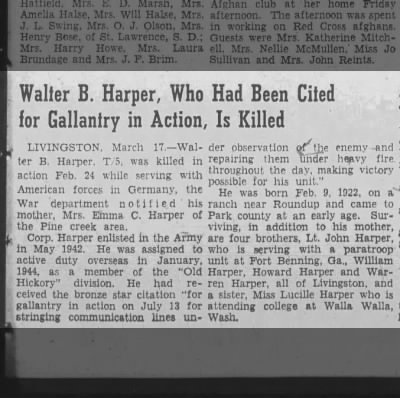
Harper and his regiment fought in the Normandy Breakout, reaching the Saint-Lô–Periers road in July 1944. On July 13, he received a Bronze Star for stringing and repairing communication lines while under fire. He then took part in Operation Cobra, moving towards Belgium.
With his regiment, Harper advanced over the Meuse River and entered Holland on September 13, 1944. The regiment also served in the Battle of the Bulge. On February 23, 1945, the regiment crossed into Germany. During this offensive, Harper was killed in battle.
Commemoration
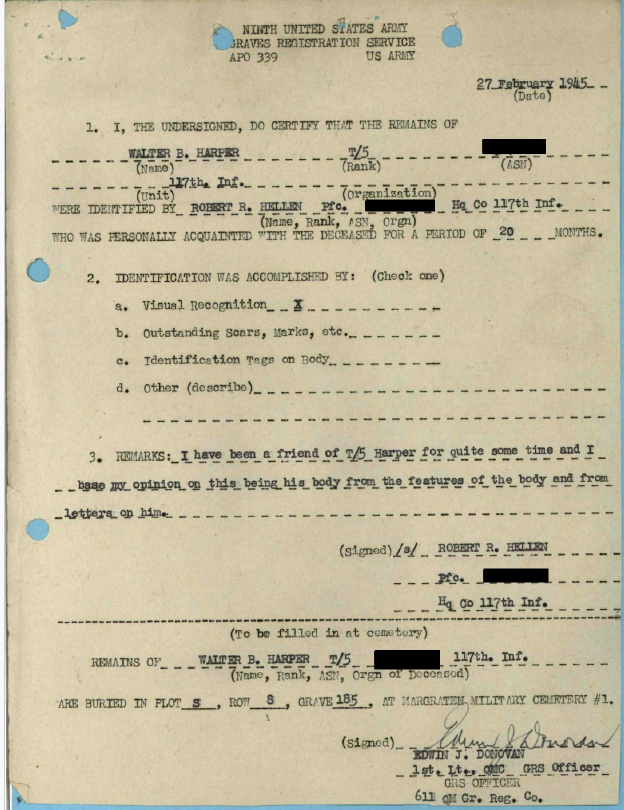
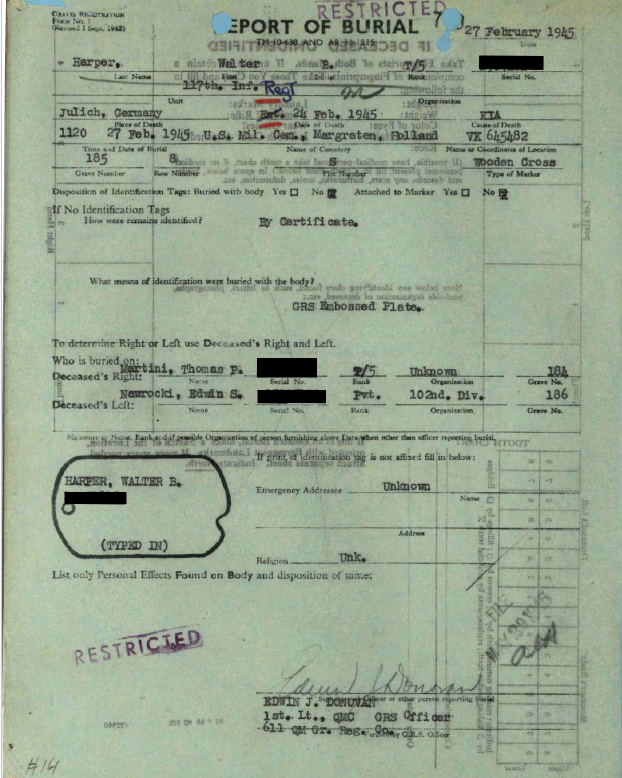
23-year-old Walter Burtis Harper was killed in action on February 24, 1945. Harper was single at the time of his death with no children. Three days later, on February 27, his friend, Private First Class Robert R. Hellen, identified his friend’s remains for the U.S. Army Graves Registration Unit. He was buried that day in Margraten Military Cemetery.
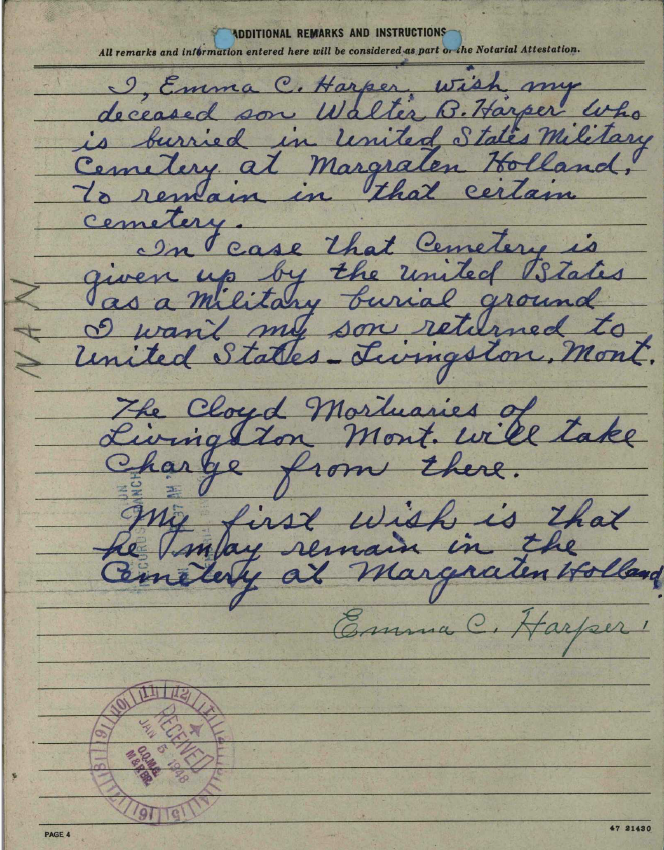
In 1948, his mother, Emma, was given the choice to leave his remains in Margraten or return them to Montana. She requested that her son’s remains stay where they were buried, but if that could not happen, that they be returned to be reinterred with his family members who were buried in Livingston, Montana. After the war, the Margraten Military Cemetery became the Netherlands American Cemetery. On July 23, 1948, Harper’s remains were disinterred. They were placed in their permanent grave on July 29, 1948.
During his service, Harper received the Combat Infantry Badge and Bronze Star, and he posthumously received a Purple Heart.
After the war, Harper’s mother, Emma, was an active member of the Gold Star Mothers and Disabled American Veterans Auxiliary.
Bibliography
Primary Sources
Indiana. Gibson County. 1900 Federal Census. Digital Images. https://ancestry.com/.
Indiana. Pike County. 1900 Federal Census. Digital Images. https://ancestry.com/.
Montana. Park County. 1930 Federal Census. Digital Images. https://ancestry.com/.
Montana. Park County. 1940 Federal Census. Digital Images. https://ancestry.com/.
Rogers, Chris. Historic Northern Pacific Depot in Livingston, Montana. Photograph. March 31, 2005. https://commons.wikimedia.org/wiki/File:Livingston_Montana_Depot,_2005.JPG.

Walter Harper. Individual Deceased Personnel File, Department of the Army. National Archives and Records Administration – St. Louis.
“Walter B. Harper Killed in German Action.” The Park County News [Livingston, Montana] March 8, 1945. Newspapers.com (349695043).
“Walter B. Harper, Who Had Been Cited for Gallantry in Action, Is Killed.” Montana Standard [Butte, Montana] March 18, 1945. Newspapers.com (349695043).
Walter B. Harper. U.S., Headstone and Interment Records for U.S., Military Cemeteries on Foreign Soil, 1942-1949. https://ancestry.com.
Walter B. Harper. U.S., World War II Army Enlistment Records, 1938-1946. Digital Images. https://ancestry.com.
Walter B. Harper. U.S., World War II Hospital Admission Card Files, 1942-1954. Digital Images. https://ancestry.com.
Walter Burtis Harper. Montana, U.S., Birth Records, 1897-1988. Digital Images. https://ancestry.com.
Walter Burtis Harper. Northern Pacific Railway Company Personnel Files, 1890-1963. Digital Images. https://ancestry.com.
Secondary Sources
Homes, Krys, Sue Dailey, and Dave Walter. “World War II in Montana, 1939-1945.” Montana Stories of Our Land. Montana Historical Society, Press: 2008. https://mhs.mt.gov/education/textbook/Chapter19/Chapter19.pdf.
“Like Father Like Daughter-Women who worked for the Northern Pacific Railroad.” Montana Women’s History. Updated July 10. 2014. Accessed December 5, 2025. https://montanawomenshistory.org/like-father-like-daughter-women-who-worked-for-the-northern-pacific-railroad/.
MacDonald, Charles B. The Last Offensive. Center for Military History: 1993. https://history.army.mil/portals/143/Images/Publications/catalog/7-9.pdf.
“Montana Moment: Pearl Harbor Changes Life in Montana.” Great Falls Tribune [Great Falls, Montana], July 19, 2014. https://www.greatfallstribune.com/story/life/my-montana/2014/07/20/montana-moment-pearl-harbor-changes-life-montana/12852851/.
“Tec5 Walter Burtis Harper.” Find a Grave. Updated August 6, 2010. Accessed January 8, 2026. https://www.findagrave.com/memorial/56299508/walter-burtis-harper.
“Walter B. Harper.” American Battlefield Monuments Commission. Accessed October 25, 2025. https://weremember.abmc.gov/s?q=*&. type=16&criteria=title%3DHarper&b=0&a=c&v=G&sort=title:ASC.
“Walter B. Harper.” Veterans Legacy Memorial, National Cemetery Administration. Accessed March 4, 2026. https://www.vlm.cem.va.gov/WalterBHarper/24BF3.
“World War II.” Indiana Military Organization. https://www.indianamilitary.org/Camp%20Atterbury/Un-Used/117th%20Reg%20History.htm.
This profile was researched and created through the Researching Silent Heroes program, sponsored by the American Battle Monuments Commission.