

Sergeant Francis Dubose Moore
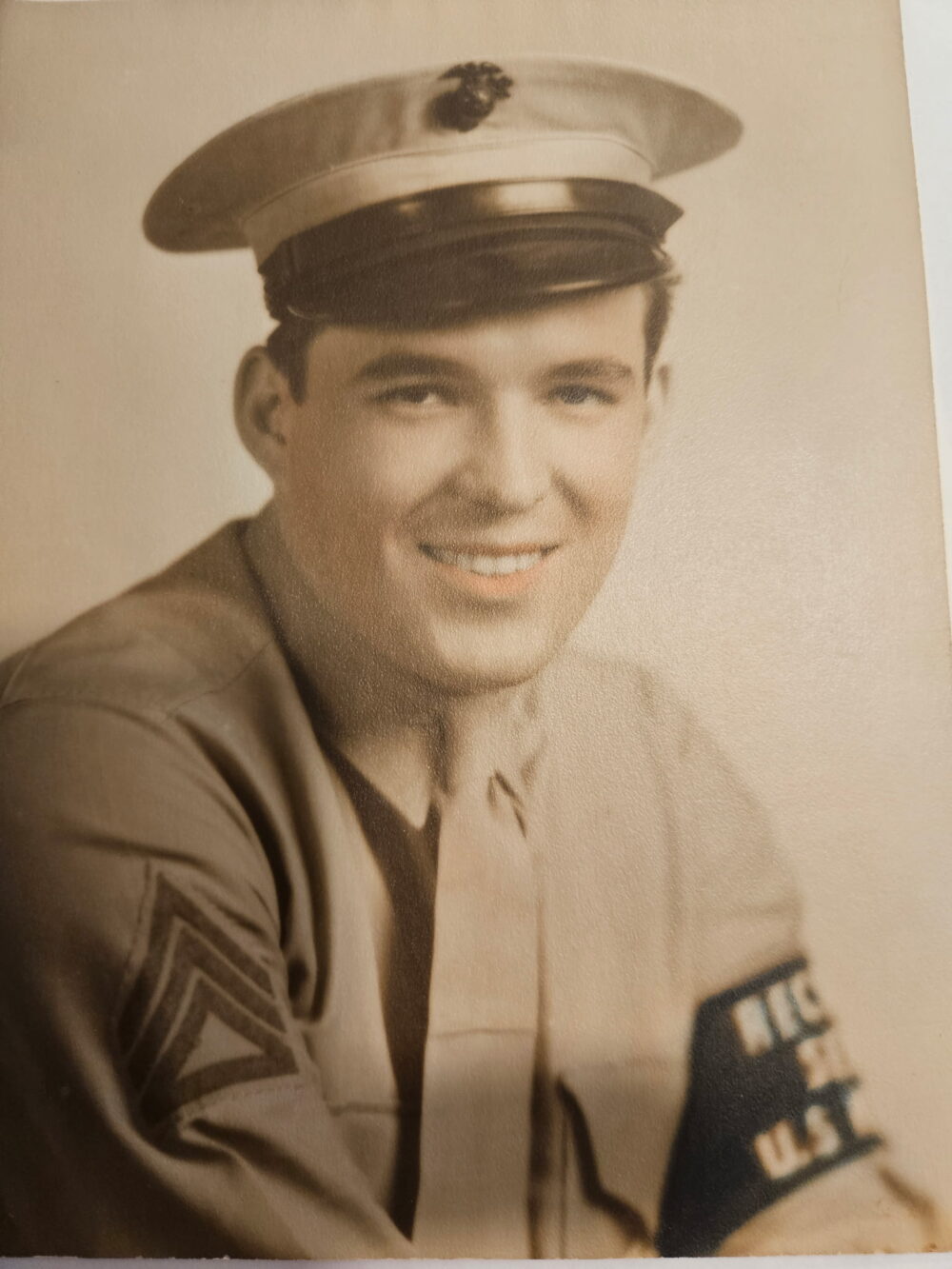
- Unit: Headquarters Battalion, 33rd Replacement Battalion, 1st Casual Company; USS Tuscaloosa; USS Texas
- Date of Birth: April 17, 1920
- Entered the Military: November 18, 1938
- Date of Death: September 23, 2014
- Hometown: Selma, Alabama
- Place of Death: Tennessee
- Award(s): Good Conduct Medal
- Cemetery: Section OO, grave 755-F. Nashville National Cemetery, Madison, Tennessee
Mentored by Mrs. Whitney Joyner
Kirkwood Middle School
2025/2026
Early Life
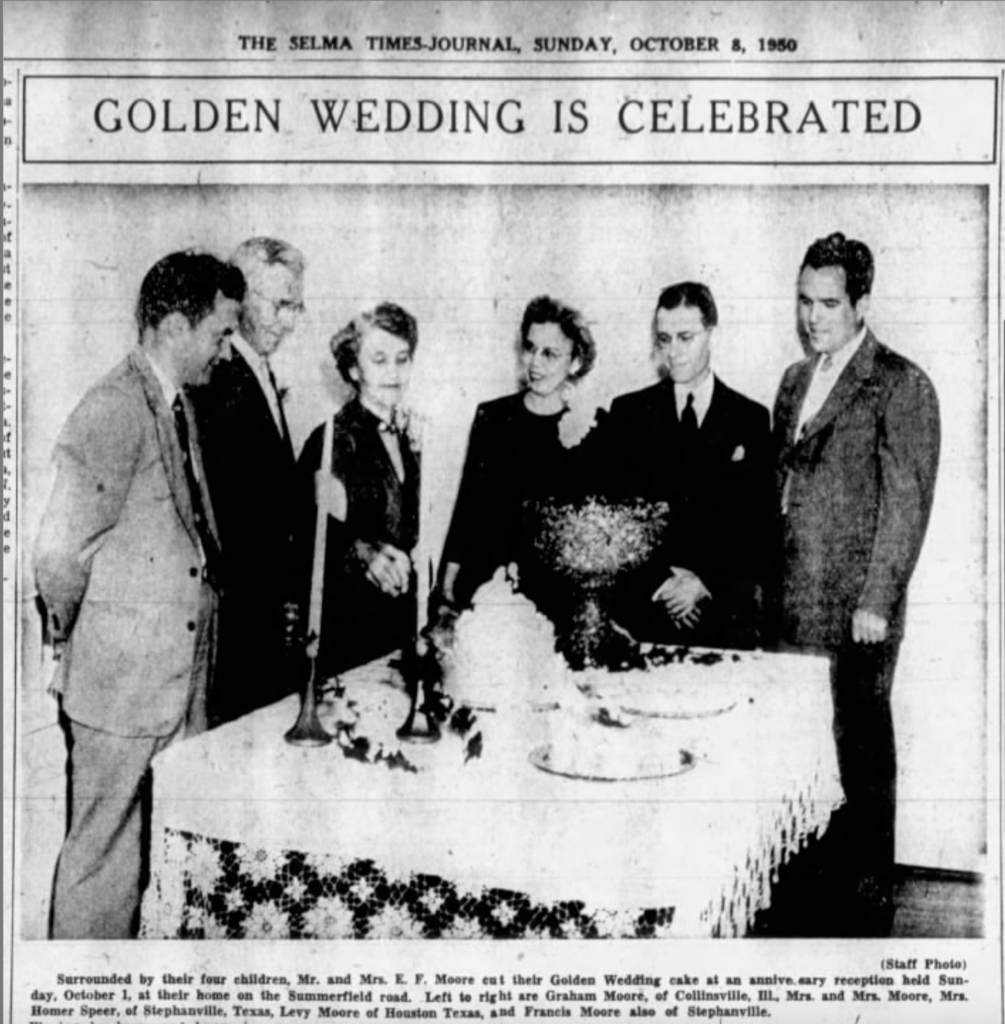
Francis Dubose Moore was born on April 17, 1920, in Selma, Alabama, to Edgar Franklin Moore and Martha Elizabeth Cargill Moore. His parents named him after a family physician, Francis Dubose, who gave him five dollars each year on his birthday. He had three siblings: Levy Edgar Moore, Graham Earl Moore, and Helen Virginia Moore.
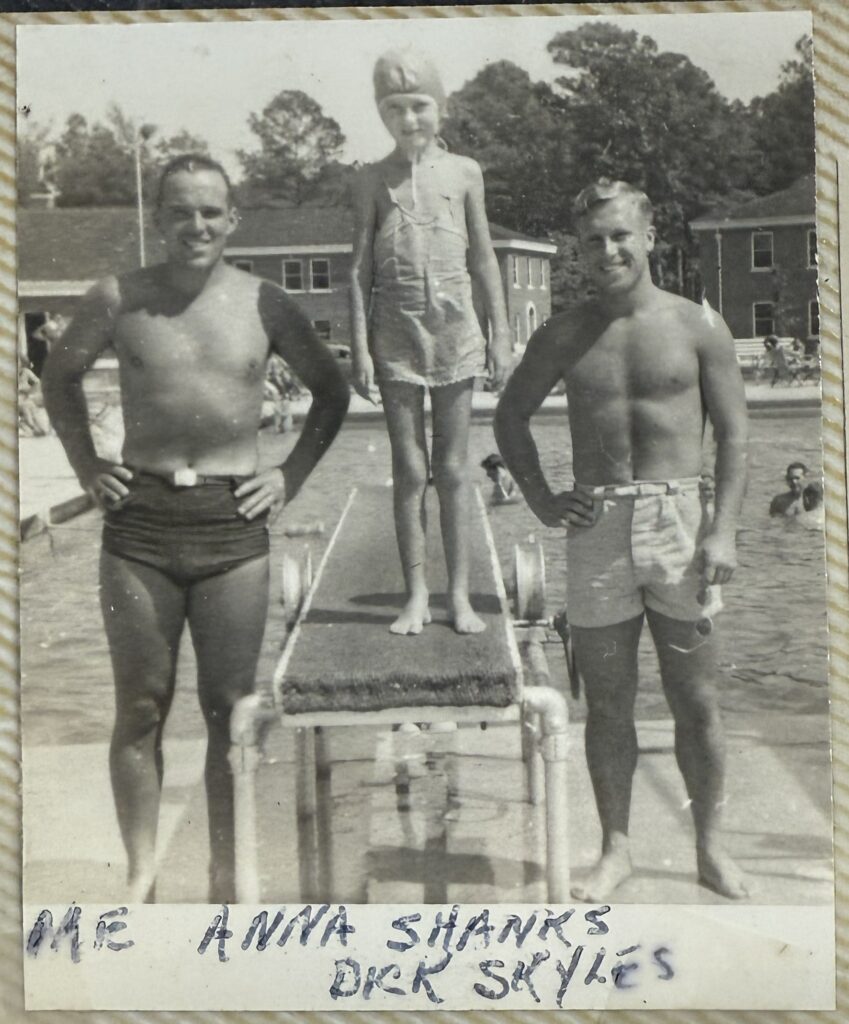
During the Great Depression, Moore hunted and fished in his free time to help provide food for his family. As a boy, he participated in American Legion Baseball. Moore also worked as a lifeguard at a public pool in Selma, where he provided swimming lessons, assisted distressed swimmers, and performed resuscitation when necessary.
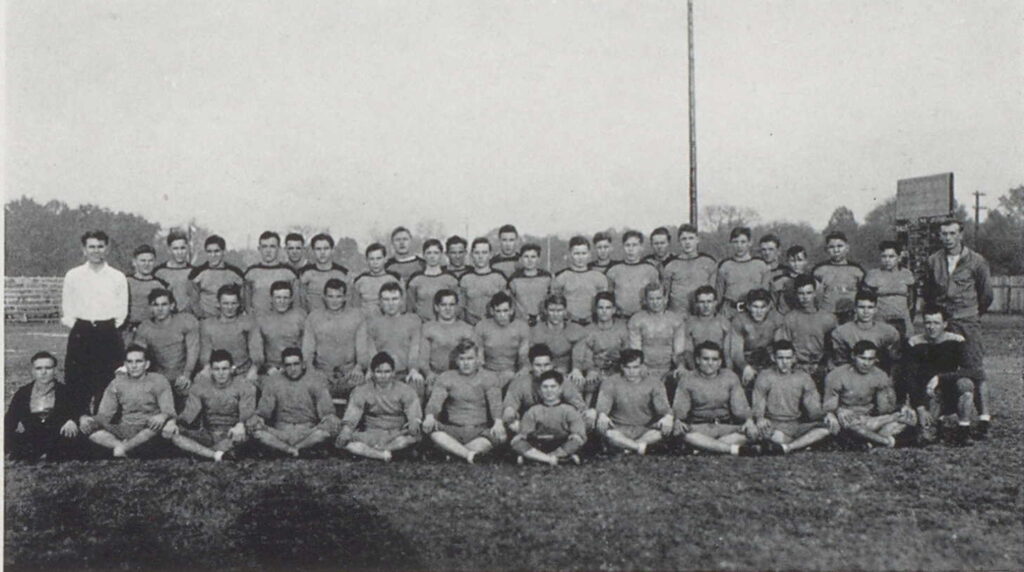
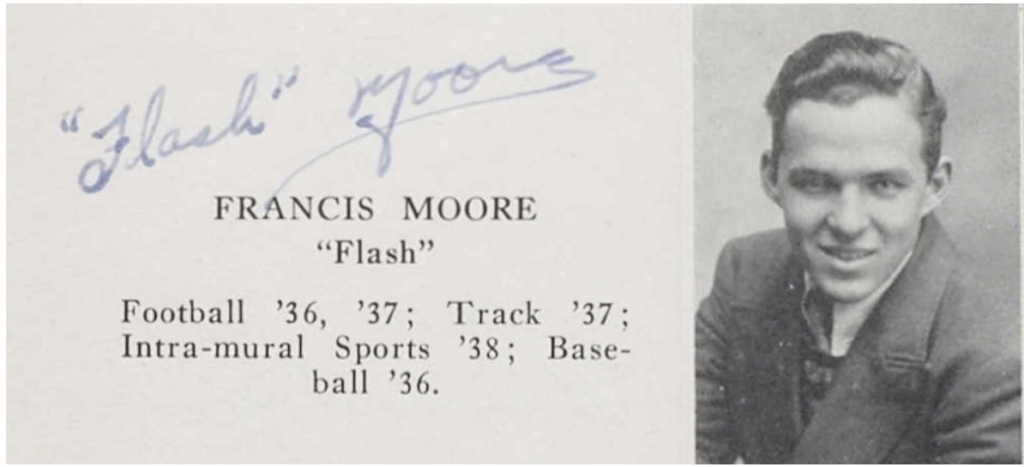
Moore attended Selma High School, where he participated in football, track, intramural sports, and baseball. While there, he earned the nickname “Flash.” He graduated in 1938 and enlisted in the United States Marine Corps later that year.
Homefront
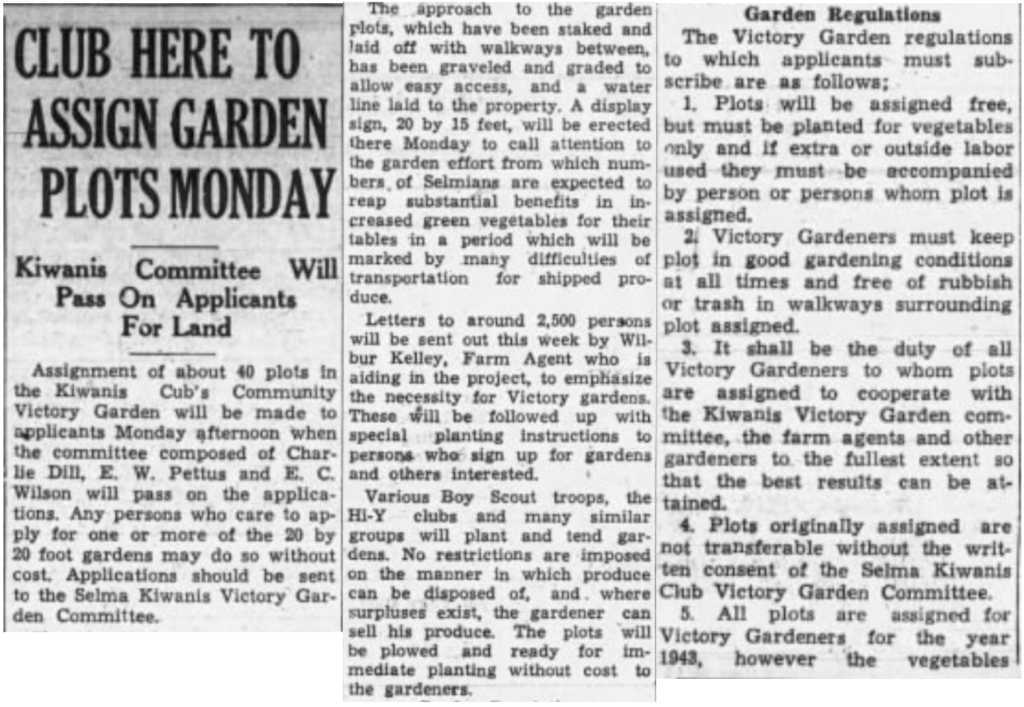
During World War II, Selma, Alabama, supported the war effort by supplying agricultural products and observing rationing regulations. Farmers increased production of staple crops such as cotton and corn and expanded beef cattle operations to provide more food for the soldiers. Residents were encouraged to plant victory gardens.
Military Connections
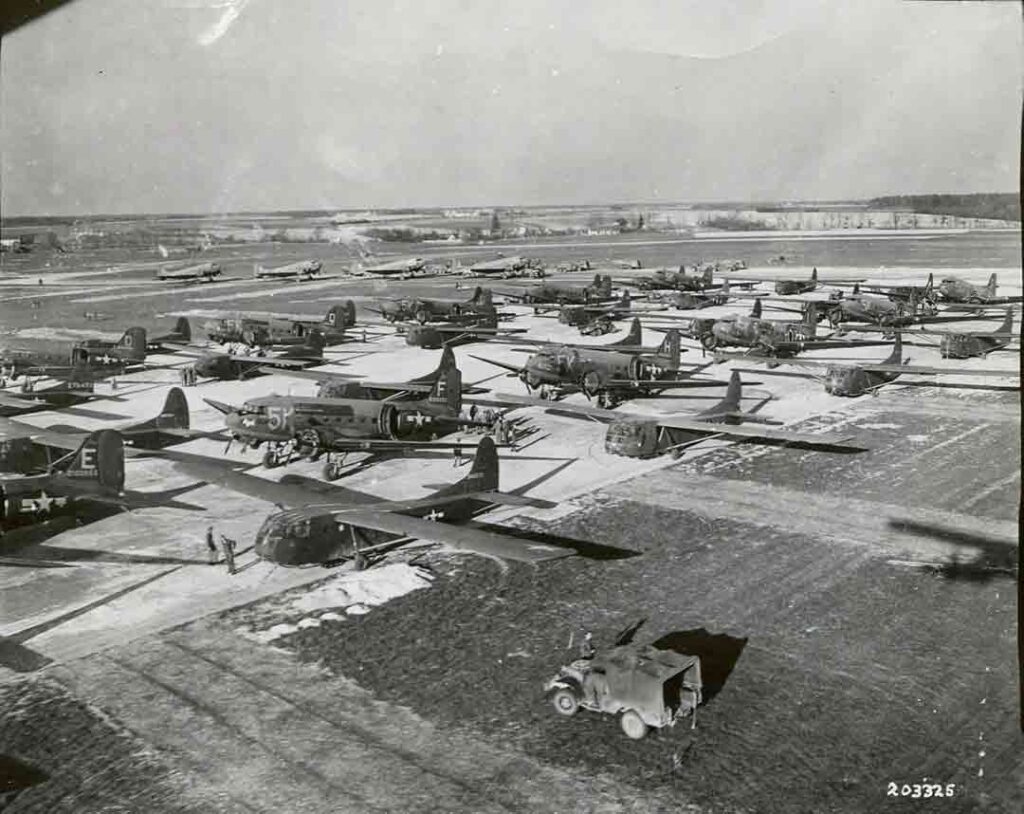
The U.S. military began building the Selma Army Air Base in 1940. The U.S. Army later named it the Craig Army Air Base in honor of Selma-native Lieutenant Bruce K. Craig, who died during a flight test of a B-24 Liberator bomber in San Diego, California. The U.S. Army used the base to train pilots on single-engine aircraft. By the end of the war, more than 9,000 American pilots had graduated from its program.
Industry
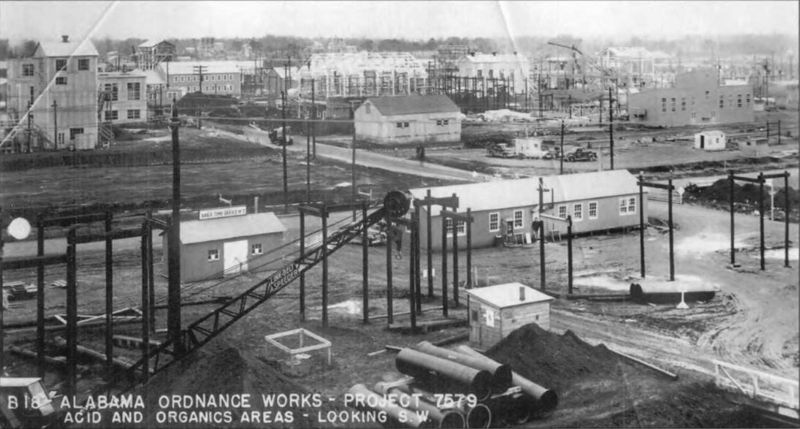
The DuPont company operated the Alabama Ordnance Works, later renamed the Alabama Army Ammunition Plant, about 100 miles northeast of Selma. It was responsible for large-scale employment in Alabama. It produced nitrocellulose, TNT, and smokeless powder, reaching a peak of nearly 40 million pounds of munitions per month during the war.
Women in the region held positions in defense industries and also served as nurses, clerks, and telephone operators. In addition, many participated in volunteer organizations such as the Red Cross, the Ground Observer Corps, and the Citizens Service Corps, while managing household responsibilities under wartime rationing.
Rather than experiencing a statewide population increase, Alabama saw migration from rural areas to larger cities, including Mobile, Childersburg, and Huntsville, as residents relocated for employment opportunities.
Military Experience
Francis Dubose Moore enlisted in the U.S. Marine Corps on November 18, 1938. He completed his military training at Parris Island, South Carolina. In January 1939, the Marines transferred Moore to a base in Portsmouth, Virginia. He also served aboard USS Texas and USS Tuscaloosa.
While aboard the Tuscaloosa, Private First Class Moore served as an aide to President Franklin D. Roosevelt during three presidential cruises to Campobello Island, Canada, South America, and the West Indies, respectively.
Moore witnessed an encounter with the German vessel SS Columbus during a neutrality patrol. The Columbus, a German ocean liner, was out to sea when the war broke out. The captain put the passengers ashore in Havana, Cuba, and tried to evade capture by the British to return to Germany.
On December 14, 1939, Columbus attempted to return to Germany, escorted by seven American destroyers through the American coastal neutrality zone. On December 19, the British destroyer HMS Hyperion spotted the vessel and fired a warning shot to signal the capture of SS Columbus. The captain of SS Columbus deliberately sank his own vessel to avoid capture. The crew of USS Tuscaloosa then focused on rescuing the 576 crewmembers aboard SS Columbus, treating them as rescued seamen rather than prisoners of war, which would have been their fate had the British picked them up. The Tuscaloosa took all personnel to New York City.
During the rescue efforts, Private First Class Moore acted quickly to provide first aid to several injured crewmembers, including a nurse who later gave him her life jacket in gratitude.
Stateside Service
On September 27, 1940, the Marines promoted Moore to corporal. In 1941, due to a joint internal derangement of his left knee, the Marines reassigned Corporal Moore to shore duty at the Lake Denmark Naval Ammunition Depot in Dover, New Jersey. There, he worked as a recruiter, supporting the war effort by enlisting large numbers of volunteers. He performed well in this role and consistently exceeded recruitment quotas.
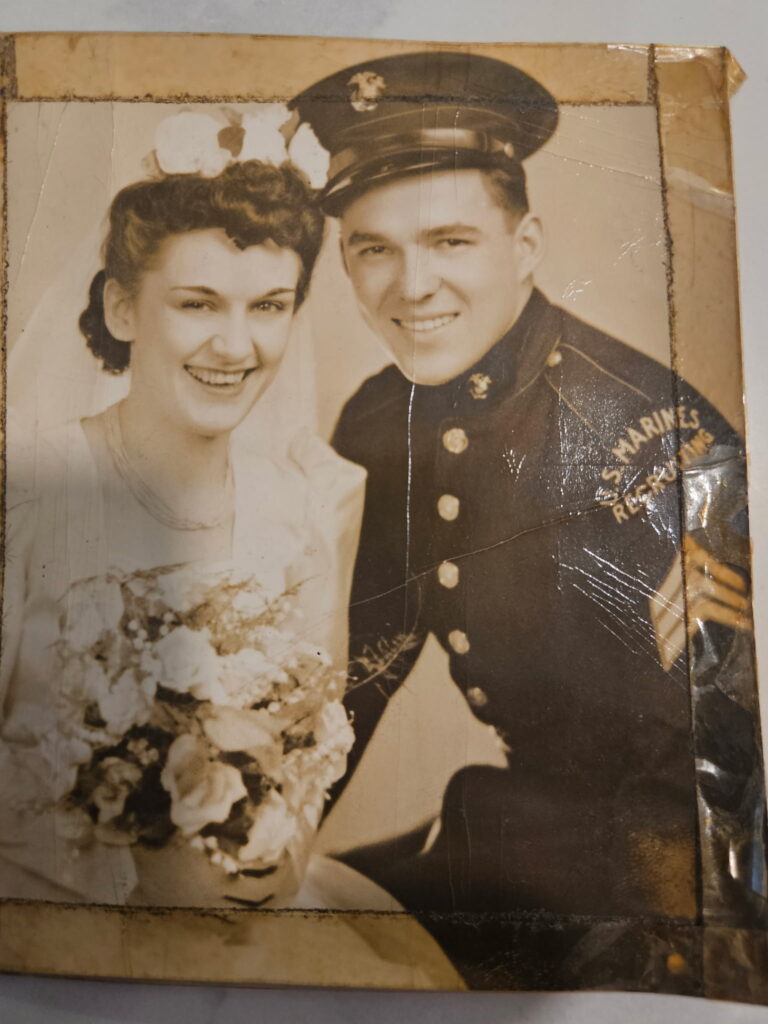
In 1941, Francis Dubose Moore married Phyllis Mae Elston at the First Methodist Church in Canton, Illinois. Moore’s first son, Gary, was born the next year.
In 1943, the Marines assigned Moore, now a sergeant, to the 33rd Replacement Battalion at Camp Lejeune, North Carolina.
The Marines soon transferred Moore to the First Casual Company of the Headquarters Battalion, also stationed at Camp Lejeune. Right before the Marines discharged Moore, they assigned him to the Company C Casual Battalion at Camp Pendleton, California.
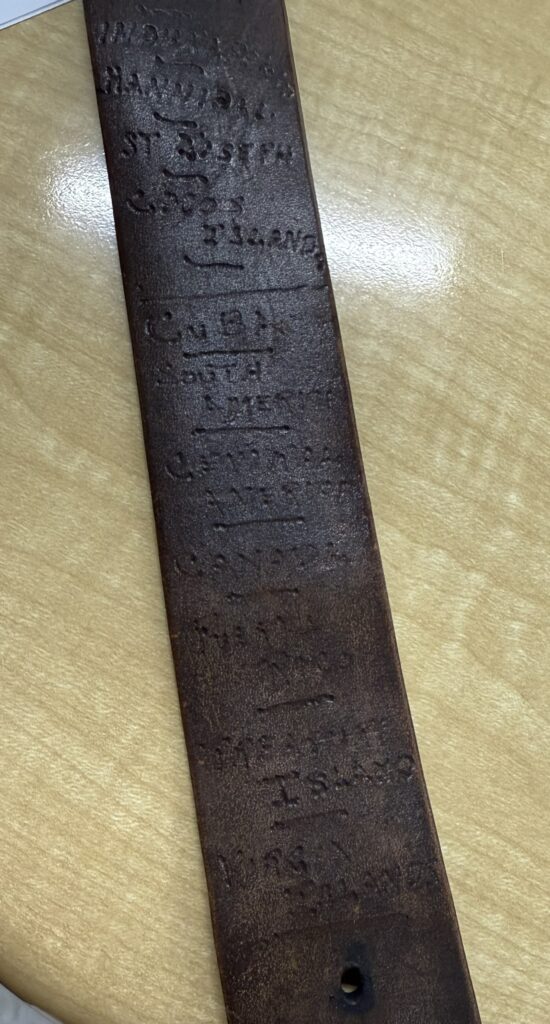
During his years of service, Moore inscribed all the places he traveled to on his belt. He kept his belt as a memento, even after his discharge, as a reminder of his days in the Marine Corps.
Veteran Experience
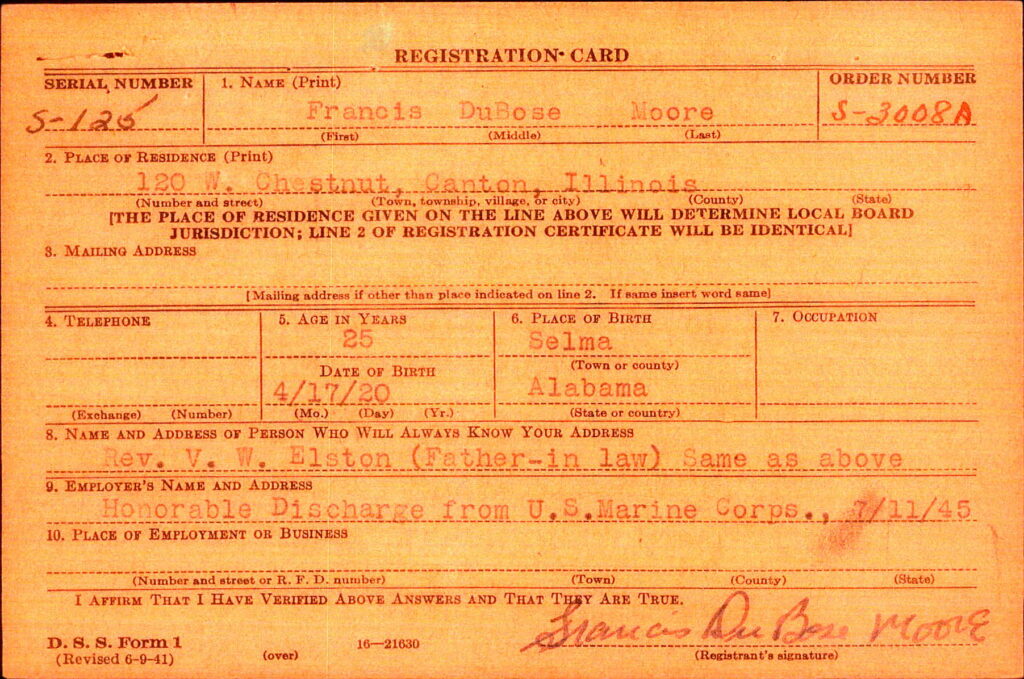
After his discharge on July 11, 1945, at Marine Corps Base San Diego, California, Moore held multiple sales positions and developed a reputation for being able to repair or fix a wide range of items.
Life for Moore and his family was difficult, and he often worked two or three jobs to support his household. The family later moved to Indianapolis after receiving assistance from a friend from the Marine Corps.
Moore struggled to find steady work, so the family moved to Shelbyville, Illinois, where they lived with his in-laws for approximately six months. In 1947, Moore and his family relocated again to Stephenville, Texas, where he worked in his brother’s business repairing and servicing jukeboxes and pinball machines. The family eventually saved enough money to purchase a small home after living in a relative’s garage for a time.
Moore was an avid gardener and fisherman. He also worked as a Sunday school teacher alongside his wife. The couple had their second son, Michael, in 1948. Beginning in the mid-1950s, they helped pay for children to attend summer camp and later provided scholarships for teenagers to attend Christian conferences.
After playing American Legion Baseball as a youth, Moore returned to the organization as the Tarrant County Commissioner and subsequently served as the Texas State Commissioner.
Commemorationtion
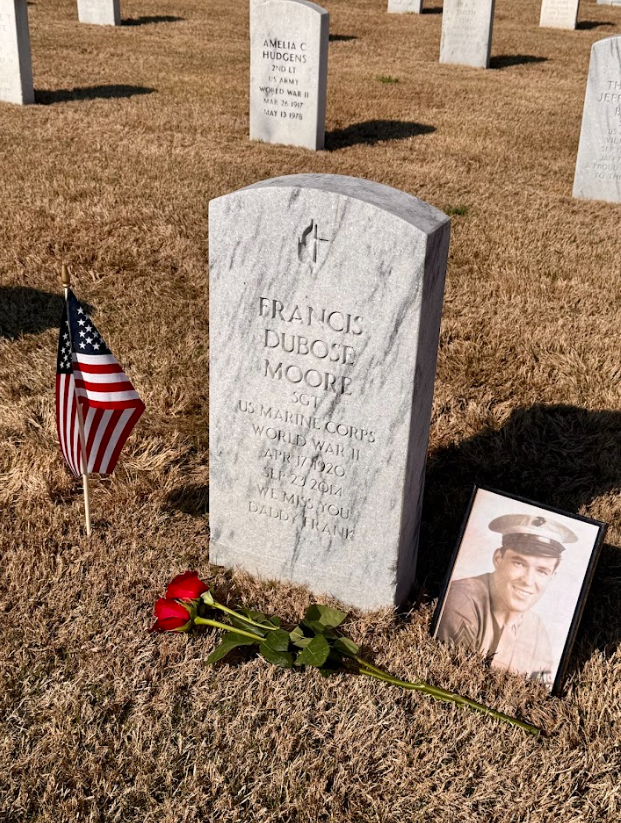
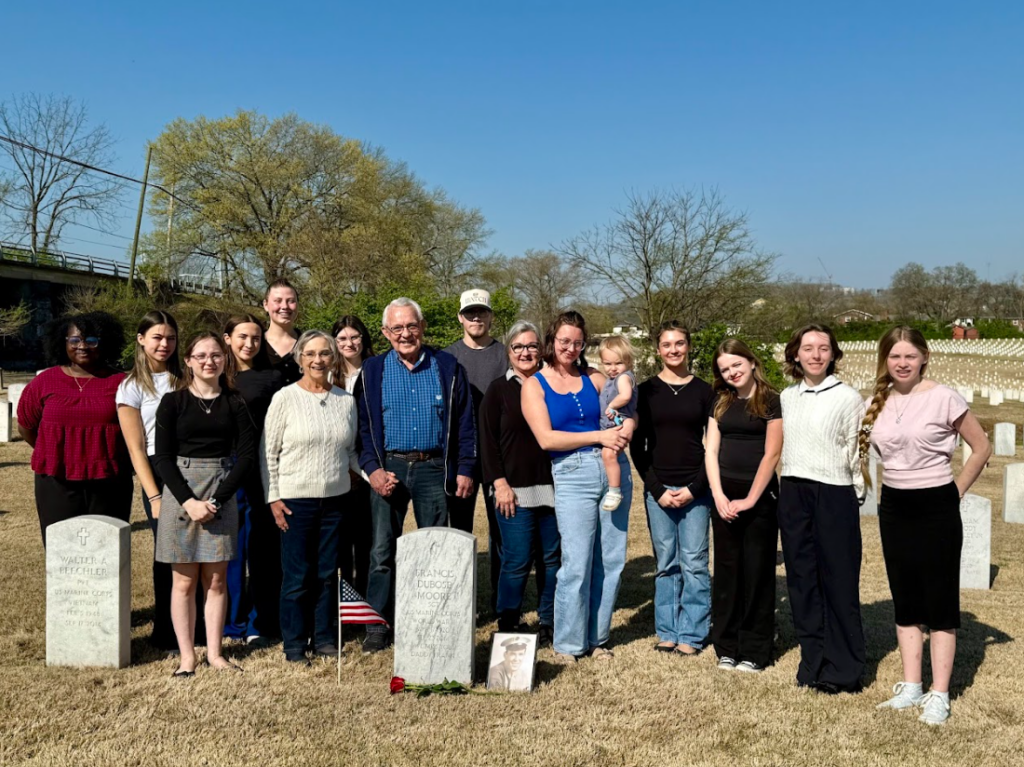
Francis Dubose Moore passed away on September 23, 2014, at Grace Healthcare of Whites Creek, Tennessee. He was buried at Nashville National Cemetery. His wife, Phyllis Mae Elston, passed away on June 20, 2015, and was buried with her husband.
Bibliography
Primary Sources
Alabama. Dallas County. 1910 U.S. Census. Digital images. https://ancestry.com
Alabama. Dallas County. 1920 U.S. Census. Digital images. https://ancestry.com
Alabama. Dallas County. 1930 U.S. Census. Digital images. https://ancestry.com
Alabama. Dallas County. 1940 U.S. Census. Digital images. https://ancestry.com
Alabama Ordinance Works. Photograph. Unknown. BHAM Wiki. https://www.bhamwiki.com/w/File:Alabama_Ordnance_Works.jpg#file.

“Baker Chosen Agricultural Man of the Year.” The Selma Times-Journal [Selma, Alabama], December 05, 1943. Newspapers.com (569930734).
“Club Here to Assign Garden Plots Monday.” The Selma Times-Journal [Selma, Alabama], February 7, 1943. Newspapers.com (569898412).
Edgar Franklin Moore. U.S., World War I Draft Registration Cards, 1917-1918. Digital images. https://ancestry.com.
“Farmers Likely to Reach First War Production Goal.” The Selma Times-Journal [Selma, Alabama], August 03, 1942. Newspapers.com (569943744).
Francis Dubose Moore, Official Military Personnel File, Department of the Navy, National Archives and Records Administration – St. Louis.
Francis Dubose Moore. U.S. Marine Corps Muster Rolls. 1983-1958. https://ancestry.com.
Francis Dubose Moore. U.S., School Yearbooks, 1880-2012. https://ancestry.com.
Francis Dubose Moore. World War II Draft Cards Young Men, 1940-1947. Digital images. https://ancestry.com
Geographical Publishing Company. Historic Maps of Alabama 1941-1950. https://alabamamaps.ua.edu/historicalmaps/alabama/index2_1941-1950.htm.
“Golden Wedding is Celebrated” The Selma-Times Journal [Selma, Alabama], October 08, 1950. Newspapers.com (569917764).
“Help Win the War with the Money You Save.” The Selma Times-Journal [Selma, Alabama], June 12, 1942. Newspapers.com (5699421440).
“Miss Elston Wed to Mr. Moore in Illinois” The Selma Times-Journal [Selma, Alabama], January 02, 1942. Newspapers.com (569929499).
Moore Family Records. 1938-2014. Courtesy of Gary Moore.
“New Items of Army Personnel, Prisoners of War Camp, Opelika.” The Opelika-Auburn News [Opelika, Alabama], January 03, 1945. Newspapers.com (981873061).
“Personal Mention.” The Selma Times-Journal [Selma, Alabama], July 03, 1938. Newspapers.com (570090801).
“Places Needed for Places of Personnel of Craig Field.” The Selma Times-Journal [Selma, Alabama], June 26, 1946. Newspapers.com (570127611).
“Ration Books Almost Ready.” The Selma Times-Journal [Selma, Alabama], December 20, 1942. Newspapers.com (5699176040).
“Red Cross News.” The Selma Times-Journal [Selma, Alabama], August 02, 1942. Newspapers.com (569943658).
Texas. Erath County. 1950 U.S. Census. Digital images. https://ancestry.com
“Up and Down the Town” The Selma-Times Journal [Selma, Alabama], November 27, 1942. Newspapers.com (569912792).
Secondary Sources
“Alabama and the World War II Homefront.” National Council on Public History. Accessed November 20, 2025. https://ncph.org/wp-content/uploads/2025/08/Alabama-State-Summary.pdf.
“The Double V Victory.” The National WWII Museum. Accessed November 20, 2025. https://www.nationalww2museum.org/war/articles/double-v-victory.
“Encyclopedia of Southern Jewish Communities – Selma, Alabama Historical Overview.” Institute of Southern Jewish Life. Accessed November 25, 2025. https://www.isjl.org/alabama-selma-encyclopedia.html.
“Francis Dubose Moore.” Veterans Legacy Memorial. Accessed December 13, 2025. https://www.vlm.cem.va.gov/FRANCISDUBOSEMOORE/2D5C0F9.
“The History of Agriculture in Alabama: A Historic Context.” Alabama Historical Commission. Accessed November 20, 2025. https://ahc.alabama.gov/architecturalprogramsPDFs/History%20of%20Agriculture%20in%20Alabama.pdf.
“Marine Corps: Ammunition Officer.” Careers in the Military. Accessed January 13, 2026. https://www.careersinthemilitary.com/career/detail-service/marine-corps/ordnance-officers/ammunition-officer.
“The Recruiters.” Marine Parents. Accessed January 13, 2026. https://rp.marineparents.com/bootcamp/recruiters.asp#:~:text=Marine%20Corps%20recruiters%20are%20responsible%20for%20the,*%20Age%20*%20Drug%20abuse%20*%20Education.
“Selma.” Encyclopedia of Alabama. Accessed November 21, 2025. https://encyclopediaofalabama.org/article/selma/.
“Sgt Francis Dubose Moore.” Find a Grave. Accessed October 21, 2025. https://www.findagrave.com/memorial/137742307/francis-Dubose-moore.
“A Short History of Alabama Agriculture.” Auburn University Library. Accessed November 20, 2025. https://www.lib.auburn.edu/archive/aghy/alag.htm.
Taylor, Monique. “World War II Glider Pilots: Pioneers in Vertical Envelopment.” The Army Historical Foundation. Accessed March 11, 2026. https://armyhistory.org/world-war-ii-glider-pilots-pioneers-in-vertical-envelopment/#_ednref49.
“Tuscaloosa I (CA-37).” Naval History and Heritage Command. Accessed January 13, 2026. https://www.history.navy.mil/research/histories/ship-histories/danfs/t/tuscaloosa-i.html.
“Win-The-War-Ballads: Musical Propaganda, Visual Propaganda, and the Importance of Context.” University of Alabama. Accessed November 20, 2025. https://musicpolitics.barefield.ua.edu/projects/primary-source-projects/win-the-war-ballads-musical-propaganda-visual-propaganda-and-the-importance-of-context/.
“World War II and Alabama.” Encyclopedia of Alabama. Last modified 2023. Accessed November 7, 2025. https://encyclopediaofalabama.org/article/world-war-ii-and-alabama/.
“World War II POW Camps in Alabama.” Encyclopedia of Alabama. Accessed November 21, 2025. https://encyclopediaofalabama.org/article/world-war-ii-pow-camps-in-alabama/.
“WWII’s Impact on Alabama.” Fiveable. Accessed November 20, 2025. https://fiveable.me/hs-alabama-history/unit-7.
This profile was funded by a grant from the United States Department of Veterans Affairs. The opinions, findings, and conclusions stated herein are those of the author and do not necessarily reflect those of the United States Department of Veterans Affairs.