

Sergeant Isom “Ike” Alto Rigell
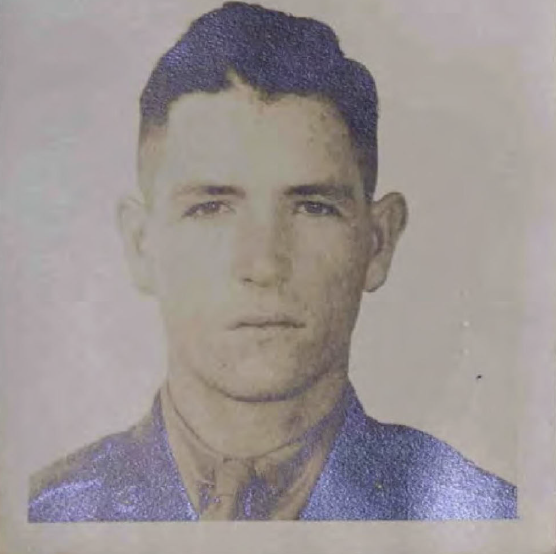
- Unit: 4th Marine Division
- Date of Birth: January 10, 1923
- Entered the Military: June 2, 1941
- Date of Death: February 24, 2022
- Hometown: Slocomb, Alabama
- Place of Death: Titusville, Florida
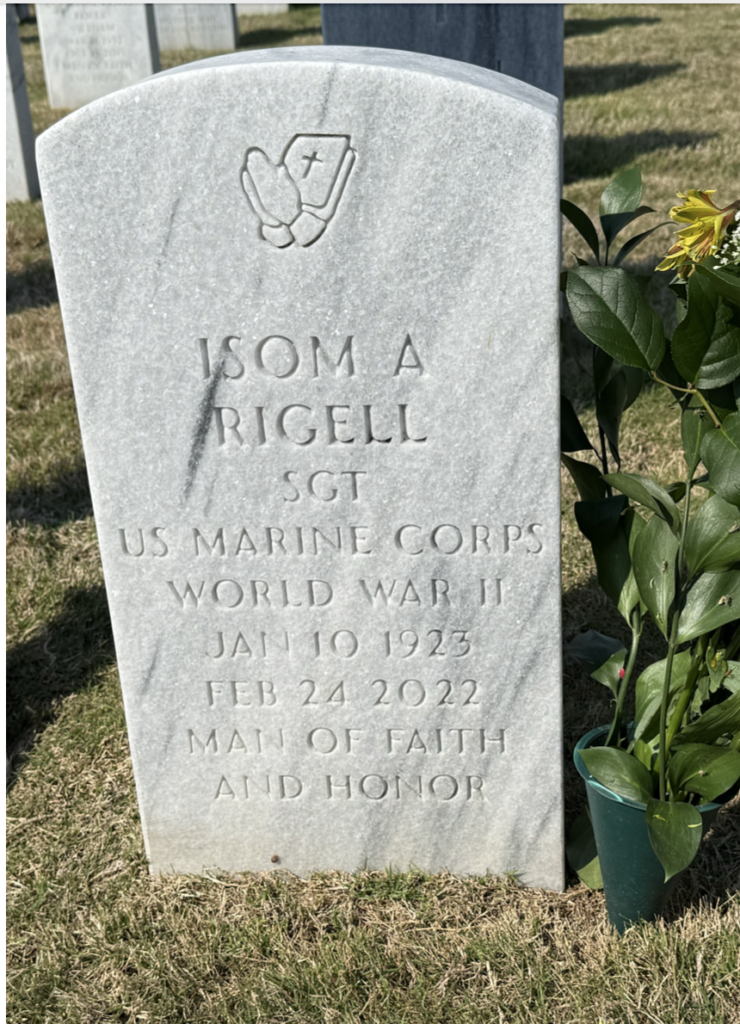
- Cemetery: Section 3, Grave 291. Cape Canaveral National Cemetery, Mims, Florida
Mentored by Mr. Alex Hujik
Lake Highland Preparatory School, Orlando, Florida
2025/2026
Early Life
Isom “Ike” Alto Rigell was born on January 10, 1923, in Slocomb, Alabama. His childhood was marked by both hardship and hard work. His father, a prominent businessman, passed away from pneumonia when Ike was only two years old. His mother, Addie, raised Ike and his two older sisters, Mary Jo and Florence, on her own. To support the family, she worked as a store clerk and rented rooms in their home to teachers.
The Rigells were active members of the Slocomb Baptist Church. Ike’s Christian faith became a cornerstone of his life at a very young age and remained his “true north” throughout his life.
Youth and Hard Work
To help support his family, Rigell began working at the age of eight. His first job was at a blacksmith shop, and he continued working various jobs until he joined the military. As a boy, he picked cotton, delivered newspapers, and even cleaned spittoons. These early experiences instilled in him a strong work ethic and self-reliance.
Outside of work, Rigell was an avid hunter. He began hunting with his grandfather at age 12 and developed a particular love for dove hunting.
Education and Athletics
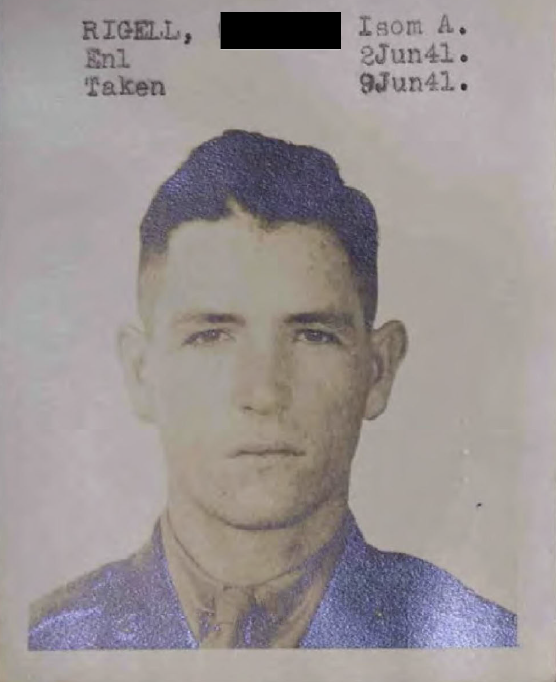
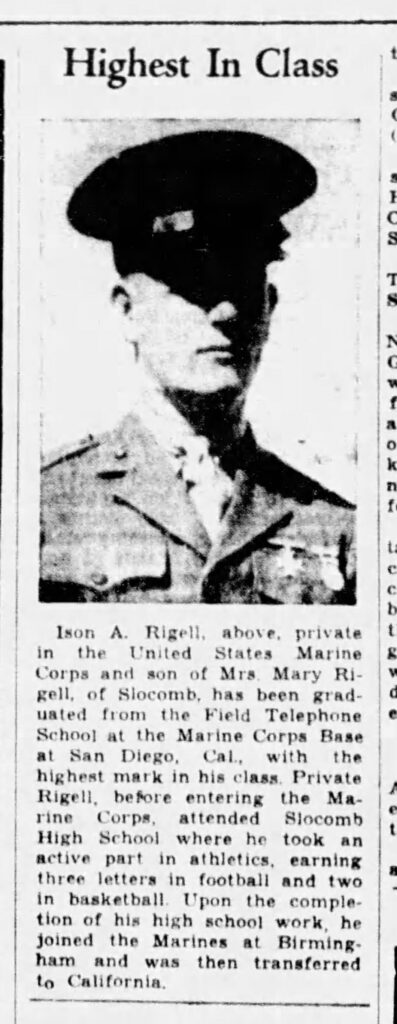
Rigell enjoyed school at Slocomb High School. He was a talented athlete, earning three varsity letters in football and two in basketball. In addition to sports, he was active in the Boy Scouts of America and was proud to be awarded his First Class badge in February 1940. Shortly after his graduation in 1941, Ike swapped his football jersey for a Marine Corps uniform.


Homefront
Agriculture and the War Effort
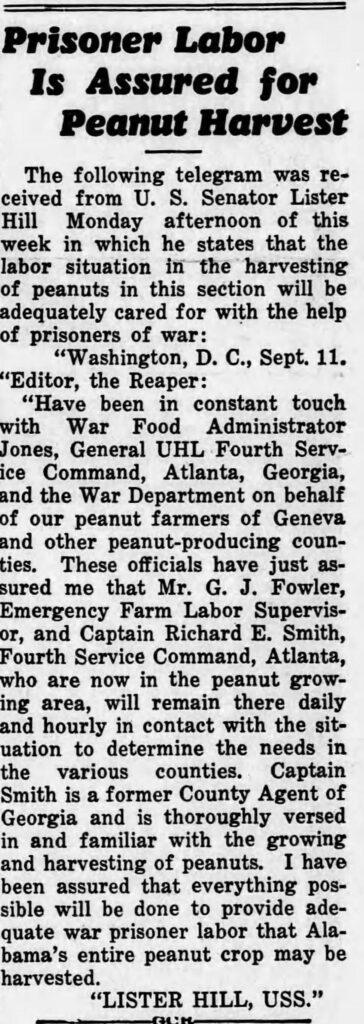
Before the war, Slocomb was a quiet farming community deeply affected by the Great Depression, but the attack on Pearl Harbor changed the local economy overnight. Farmers shifted their focus to growing food for the military, and while Slocomb became famous for its tomatoes, the region also produced massive quantities of peanuts. To address the labor shortage during the 1944 peanut harvest, Senator J. Lister Hill requested that 500 German Prisoners of War (POWs) be sent to Geneva County. These men were part of a larger group of 16,000 German POWs held in camps across Alabama during the war years.
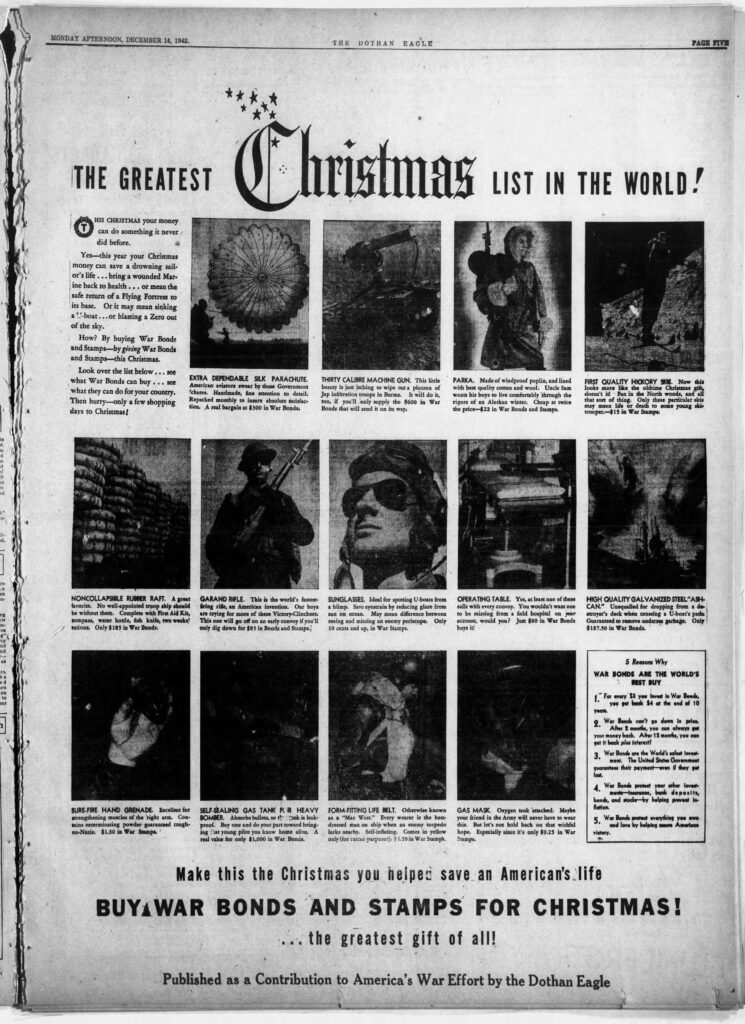
Citizens in Slocomb and the surrounding areas contributed to the war by planting victory gardens, rationing essential goods, and donating money. Geneva County held at least eight separate War Bond drives, an effort so significant that the Dothan Eagle hailed purchasing a War Bond as the “greatest Christmas Gift” of 1942.
The city of Dothan, the largest hub near Slocomb, became a center for military aviation. In 1939, Napier Field Army Air Base was constructed, and throughout World War II, the Army Air Forces used the facility as an advanced pilot training center. This brought a constant flow of servicemen and economic activity to the region.
Segregation and Social Change
While Alabama was united in its support for the troops, the state remained deeply divided by segregation. The war created new job opportunities in defense plants, but these changes often increased racial tension. At the Alabama Dry Dock and Shipbuilding Company in Mobile, a riot broke out in 1943 after the company promoted twelve Black welders. A mob of 4,000 White workers and community members assaulted African American employees, and the military had to be called in to restore order.
Political resistance to social change was also prominent; Governor Frank Dixon famously rejected a federal contract for over 1.7 million yards of cotton because he viewed the proposal as a federal attempt to abolish segregation in the South.
Shifting Demographics
The war forever changed Alabama’s population. Seeking factory jobs in industrial centers, many residents left their rural homes. Approximately 10% of rural white residents and 25% of rural Black residents moved to cities like Huntsville, Mobile, and Montgomery.
The economy of Slocomb, Alabama, like that of most rural southern towns, slowed during the Great Depression. But the Japanese attack on Pearl Harbor changed that.

Military Experience
Enlistment
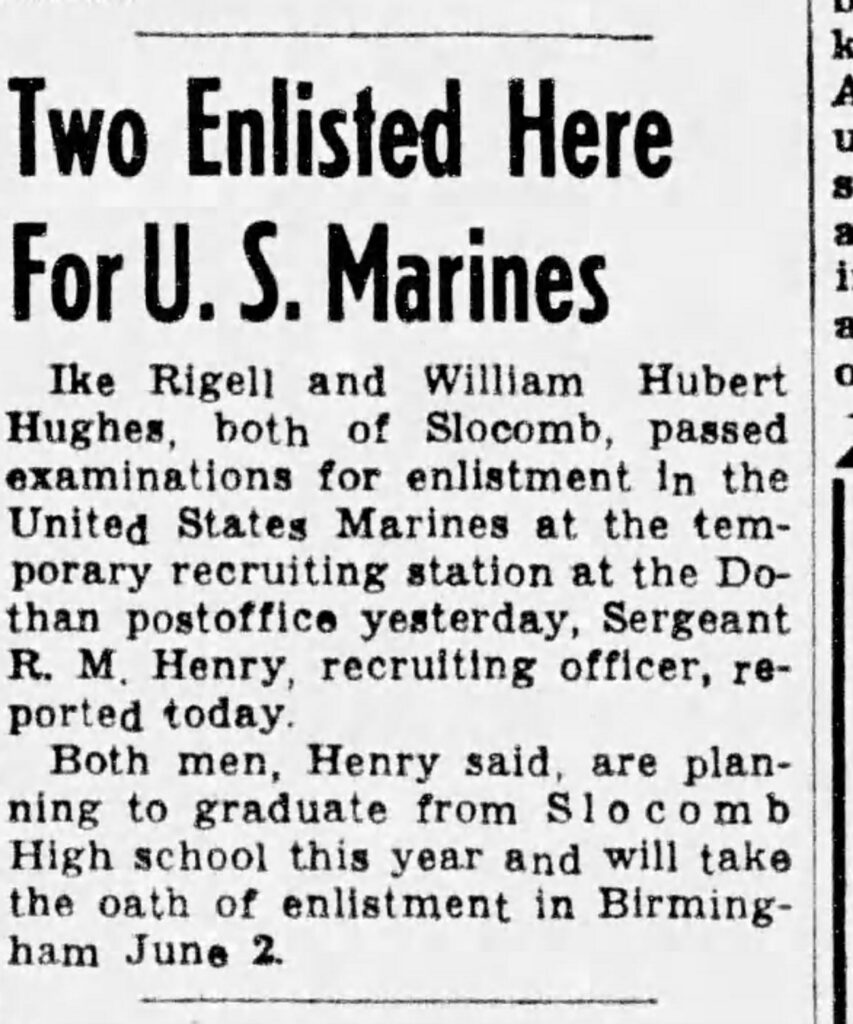
As graduation approached in 1941, Rigell and his friend Gator visited the nearby city of Dothan, Alabama. While walking past the post office, they saw a poster that read, “Join the Marines.” After speaking with a recruiter, Rigell spent time discussing the decision with his family, coaches, and teachers. While some suggested the Navy, Rigell felt a strong calling toward the Marine Corps and its four-year commitment. Following basic training in San Diego, he boarded USS Wharton. The ship departed San Diego on October 3 and arrived in Hawai’i on October 10. He was assigned to the strategic outpost of Midway Island.
The Battle of Midway
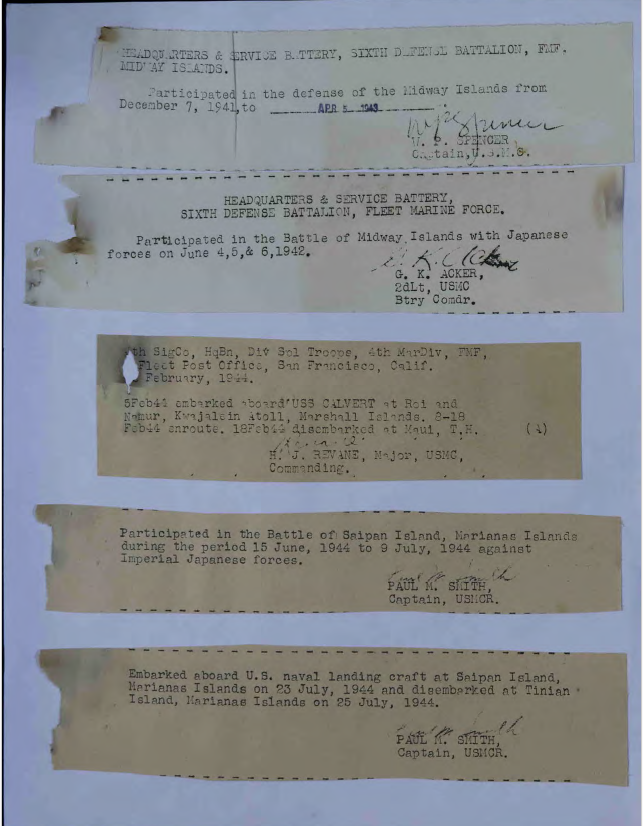
Rigell was stationed on Midway Island on December 7, 1941, when it was attacked as part of the broader Japanese strike on the Pacific. He remained on the island for nearly two years, serving during the pivotal Battle of Midway in June 1942. His primary duty was the dangerous work of laying and maintaining telephone wire to ensure communications during combat.
When he was finally granted leave to return home in April 1943, Rigell used his military savings to buy a new roof for his mother’s house in Slocomb. In April 1943, he was reassigned to the 4th Marine Division, a unit that would become famous for its role in the island-hopping campaign.
Island Hopping
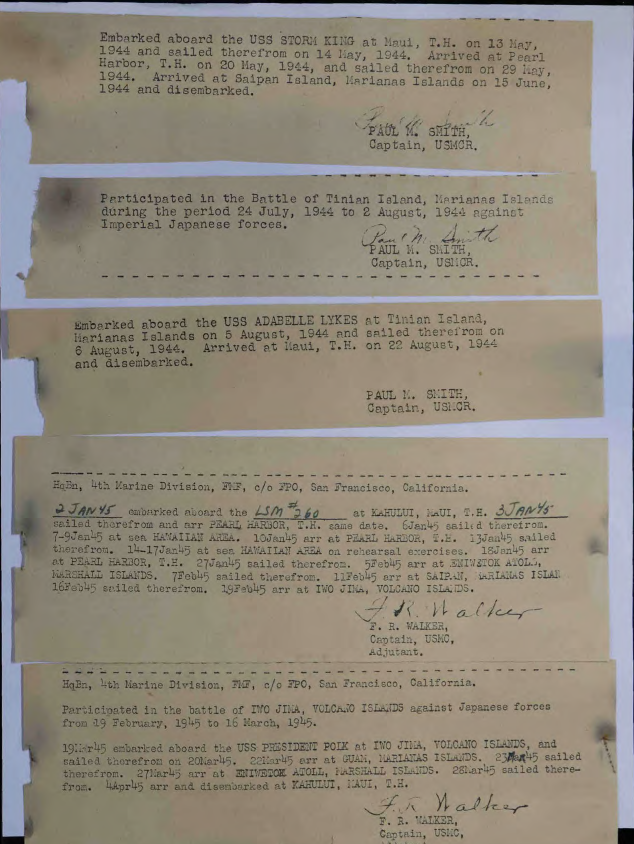
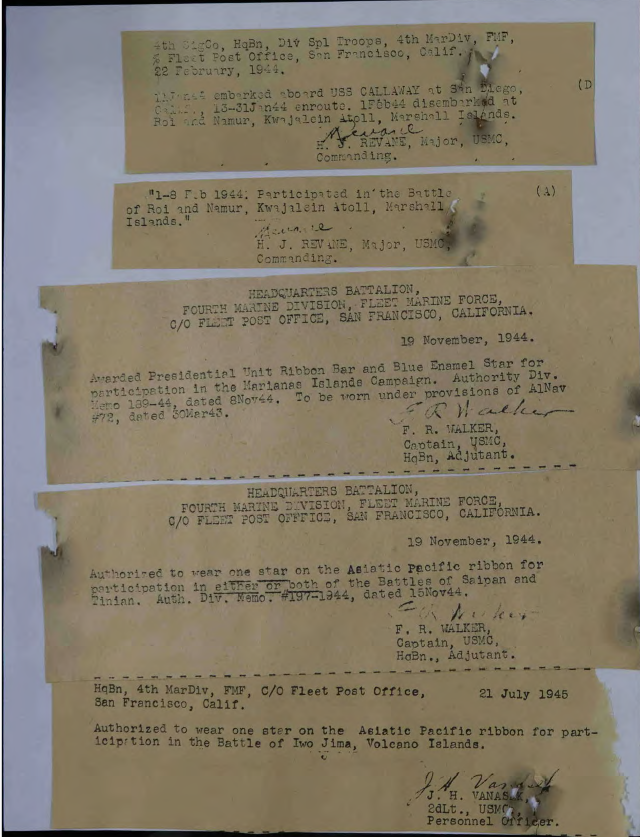
Rigell participated in four major amphibious assaults as the Marines pushed across the Pacific toward Japan. He was responsible for laying vital communication lines under combat conditions at Roi-Namur, Tinian, Saipan, and the Marshall Islands. These operations were essential for coordinating artillery and infantry movements against heavily fortified Japanese positions.
Iwo Jima
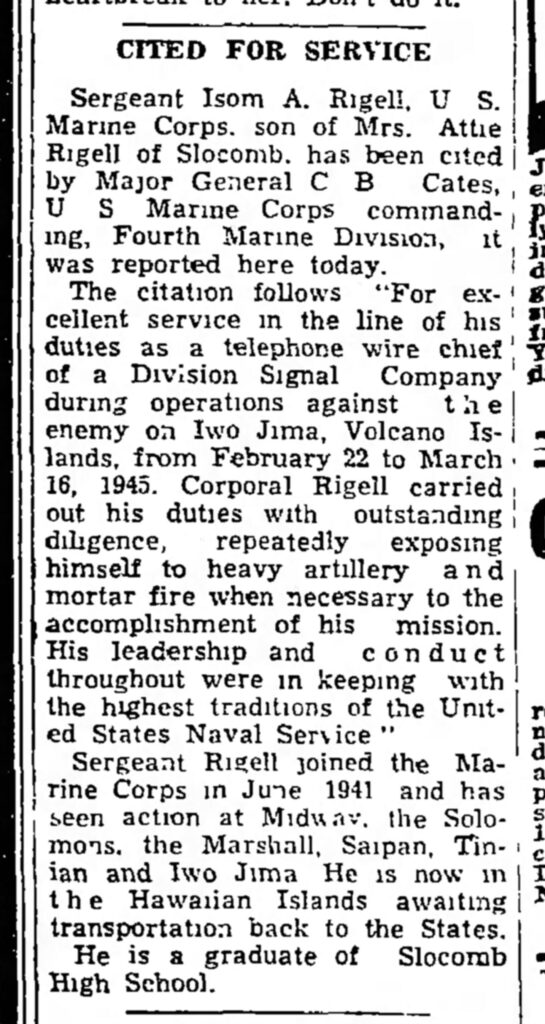
In early 1945, Rigell landed on Iwo Jima. Capturing the island was critical because it provided an airbase for fighter escorts to support bombing missions over Japan. It was one of the bloodiest battles in military history, resulting in over 7,000 American and 17,000 Japanese deaths.
At Iwo Jima, Rigell served as a telephone wire chief. He worked under constant enemy fire, digging through volcanic rock to keep communication lines open. For his bravery and skill, he was officially cited for excellent service between February 22 and March 16, 1945.
While preparing for the invasion of the Japanese mainland, Rigell received word of the atomic bombings and Japan’s surrender. He was honorably discharged from the Marine Corps in October 1945.

Veteran Experience
Education and Early Career
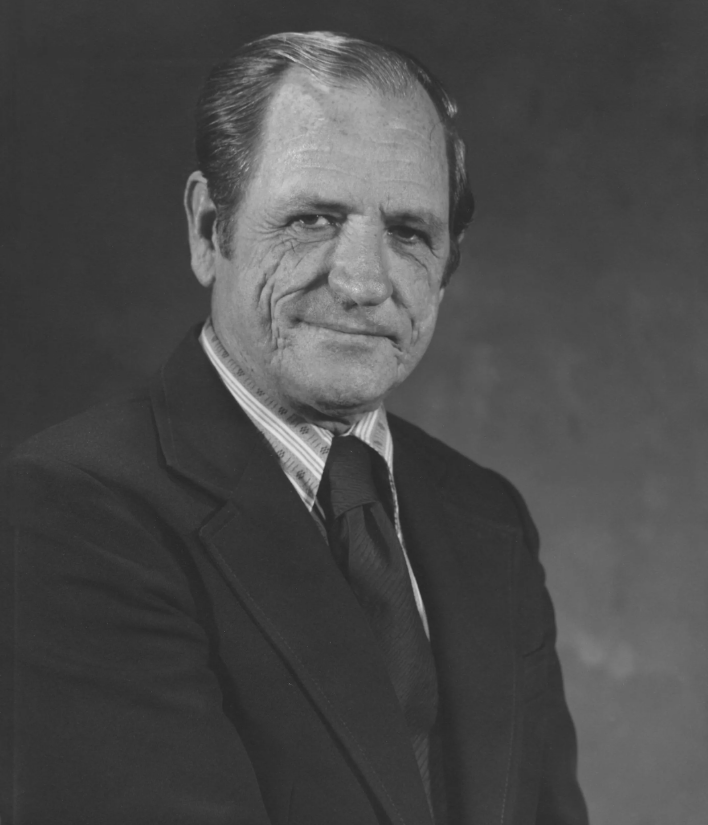
After the war, Rigell returned to Slocomb, Alabama, where he worked various jobs and played semi-professional baseball. In 1947, he used the G.I. Bill to enroll at Georgia Tech. He graduated in 1952 with a degree in electrical engineering and began his professional career with the Tennessee Valley Authority.
In 1953, Rigell moved to Huntsville, Alabama, to work at Redstone Arsenal just as the American space program was beginning to take shape. There he met Kathryn Gillespie, who worked in the data department. They were married on September 11, 1954, beginning a 67-year partnership. Together, they raised four children: David, Mona, Amy, and Scott.
Leadership at NASA
In 1960, Rigell transferred to the National Aeronautics and Space Administration (NASA) at Cape Canaveral, Florida, where he became a foundational member of the American space program. His rocket expertise contributed to the nation’s greatest achievements, including the Apollo mission rocket systems, Skylab, and the Space Shuttle program.
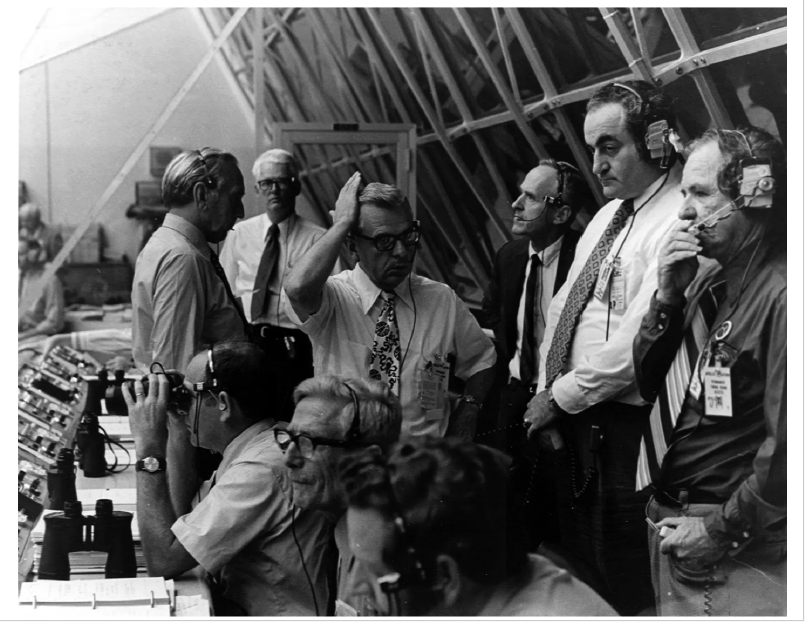
For the historic Apollo 11 mission moon landing in 1969, Rigell served as the Deputy Director and Chief Engineer of Launch Vehicle Operations. He remained a leader at NASA until his retirement in 1982, though he continued to work in the industry for United States Boosters International until 1991. In recognition of his contributions, the National Space Club – Florida Department honored him with a Lifetime Achievement Award in 1993.
Community and Retirement
Ike and Kathryn Rigell were deeply active in their community. Kathryn held leadership roles in local garden and recreation committees, while Rigell sharpened his public speaking skills through Toastmasters and helped Kathryn run an antiques store. They remained devoted to their church and their family throughout their lives.
In retirement, the Rigells traveled extensively throughout America in their Airstream trailer. Internationally, they visited London, Israel, and Hong Kong. They even had the opportunity to fly to Europe on the Concorde. Driven by their faith, they even took the personal risk of smuggling Bibles into China. In 2012, Rigell traveled back to Iwo Jima with the Greatest Generation Foundation to honor his fellow Marines.

Commemoration
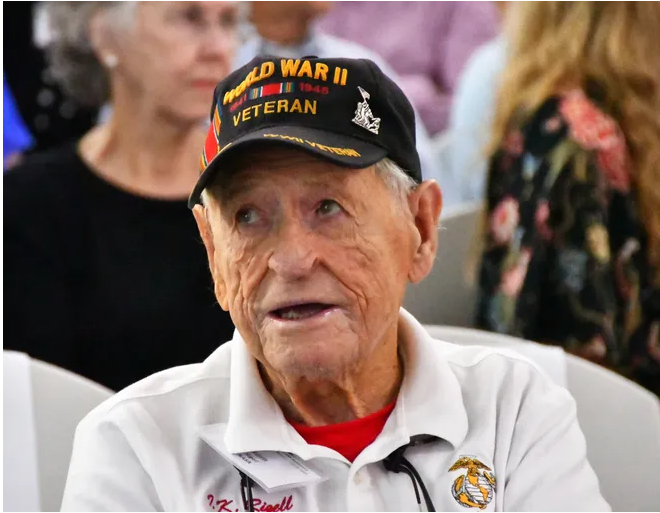
Isom “Ike” Alto Rigell died on February 24, 2022, at the age of 99. He rests at Cape Canaveral Veterans Cemetery in Mims, Florida. To his family, he and Kathryn were a “dream team” who provided a “True North” for their children, grandchildren, and great-grandchildren. His journey from Slocomb to Iwo Jima to the launchpads of the moon is a testament to the character and capability of his generation.

Bibliography
Primary Sources
Alabama. Geneva County. 1930 U.S. Census Digital Images. https://ancestry.com.
Alabama. Geneva County. 1940 U.S. Census Digital Images. https://ancestry.com.
“Army Rushed Explorer III Work In 21 Days.” Orlando Sentinel [Orlando, Florida], March 30, 1958. Newspapers.com (133626807).
“Army Wives Hold First Meeting.” Orlando Sentinel [Orlando, Florida], May 10, 1959. Newspapers.com (223383380).
“Background at Mobile.” Southern Watchman [Mobile, Alabama], May 29, 1943. Newspapers.com (573696463).
“Cited for Service.” The Dothan Eagle [Dothan, Alabama] September 19, 1945. Newspapers.com (6945174).
“Farmers of Co. Mobilize Here for War Effort.” The Geneva County Reaper [Geneva, Alabama]. January 14, 1943. Newspapers.com (535942627).
“Hundred Launches for Rigell.” Orlando Sentinel [Orlando, Florida], April 12, 1964. Newspapers.com (223690649).
“Ike Rigell Key Member of Army Missile Team.” Orlando Sentinel [Orlando, Florida], March 28, 1958. Newspapers.com (22216942).
“Instructors Conference.” Orlando Sentinel [Orlando, Florida], February 16, 1964. Newspapers.com (223821274).
Isom Alto Rigell, Official Military Personnel File, Department of the Navy, National Archives and Records Administration – St. Louis.
Isom Alto Rigell, Report of Separation, Department of the Navy, National Archives and Records Administration – St. Louis.
“Modern Napier Field Was Wiregrass Farmland Only 15 Months Ago.” The Dothan Eagle [Dothan, Alabama] November 11, 1942. Newspapers.com (538939013).
“More POWS Asked by Sen. Lister Hill for P-nut Harvest.” Geneva County Reaper [Geneva, Alabama], September 14, 1944. Newspapers.com (535944218).
“People Rally Behind Gov. Dixon In the Fight For South’s Principles.” Greenville Advocate [Greenville, Alabama], August 6, 1943. Newspapers.com (535640471).
“P. O. Davis Urges All-OUt Farm Production.” The Dothan Eagle [Dothan, Alabama] February 17, 1942. Newspapers.com (978462008).
“Prisoner Labor Is Assured for Peanut Harvest.” Geneva County Reaper [Geneva, Alabama], September 14, 1944. Newspapers.com (535944218).
Rigell, David and Scott Rigell. Zoom Interview with the authors. December 10, 2025.
Rigell, Isom “Ike.” Ike: The Memoir of Isom “Ike” Rigell. Koehler Books, 2017.
“The Greatest Christmas List in the World.” The Dothan Eagle [Dothan, Alabama], December 14, 1942. Newspapers.com (538941351).
“This and That.” The Dothan Eagle [Dothan, Alabama] September 21, 1941.
“Toastmaster Club Names Top Talker.” Orlando Sentinel [Orlando, Florida], February 25, 1962. Newspapers.com (223116974).
“Top of His Class.” The Dothan Eagle [Dothan, Alabama], November 26, 1941. Newspapers.com (978458683).
Torres, John A. “Top NASA Manager: Price of Apollo Moon Program Was Missing His Kids Growing Up.” Florida Today, July 19, 2019. https://www.floridatoday.com/in-depth/tech/science/space/2019/07/08/nasa-kennedy-space-center-ike-rigell/3652982002/.
Various Advertisements. The Dothan Eagle [Dothan, Alabama], November 10, 1942. Newspapers.com (538939000).
Secondary Sources
Boyd, Jared. “The Slocomb tomato: Is it a matter of soil or is it a matter of the soul?” AL.com. Updated July 17, 2020. Accessed November 10, 2025. https://www.al.com/entertainment/2018/08/the_slocomb_tomato_is_it_a_mat.html.
Decuers, Larry. “Banzai Attack: Saipan” Published July 7, 2020. Accessed January 18, 2026. https://www.nationalww2museum.org/war/articles/banzai-attack-saipan.
Drake, Sarah. “Windmill Station used as POW camp for German soldiers in WWII.” WDHN News, June 6, 2019. https://www.wdhn.com/news/windmill-station-used-as-pow-camp-for-german-soldiers-in-wwii/.
Groh, Jamie. “A Tribute to Ike Rigell, March 1, 2022.” NASA Alumni League, Florida Chapter. Accessed March 12, 2026. https://www.nalfl.com/history/nal-memory-book/tribute-to-ike-rigell-march-2022/.
Hemler, Chris. “Seizing Saipan.” United States Naval Institute. Updated June 2024. Accessed March 12, 2026. https://www.usni.org/magazines/naval-history-magazine/2024/june/seizing-saipan.
Herridge, Linda. “NASA Mourns the Loss of Former Apollo Era Deputy Launch Director.” NASA. Last modified February 22, 2022. Accessed December 1, 2025. https://www.nasa.gov/people-of-nasa/nasa-mourns-loss-of-former-apollo-era-deputy-launch-director/.
“Isom A. Rigell.” Find a Grave. Updated March 2, 2022. Accessed December 1, 2025. https://www.findagrave.com/memorial/237179437/isom-alto-rigell.
“Isom Alto ‘Ike’ Rigell.” Veterans Legacy Memorial, National Cemetery Administration. Accessed March 12, 2026. https://www.vlm.cem.va.gov/ISOMARIGELL/9fb90f.
“Isom ‘Ike’ Rigell.” Florida Today [Melbourne, Florida], March 15, 2022. https://www.floridatoday.com/obituaries/bft080677.
Krvido, Mike. “Operation FLINTLOCK, the Invasion of the Marshall Islands, January-February 1944.” U.S. Army Pacific. Updated February 1, 2024. Accessed March 12, 2026. https://www.usarpac.army.mil/Our-Story/Our-News/Article-Display/Article/3662781/operation-flintlock-the-invasion-of-the-marshall-islands-january-february-1944/.
“Tinian Island.” Atomic Heritage Foundation. Accessed March 12, 2026. https://ahf.nuclearmuseum.org/ahf/location/tinian-island/.
“World War II and Alabama.” Encyclopedia of Alabama. Last modified July 30, 2025. Accessed November 5, 2025. https://encyclopediaofalabama.org/article/world-war-ii-and-alabama/.
“World War II POW Camps in Alabama.” Encyclopedia of Alabama. Last modified August 1, 2024. Accessed November 7, 2025. https://encyclopediaofalabama.org/article/world-war-ii-pow-camps-in-alabama/.
This profile was funded by a grant from the United States Department of Veterans Affairs. The opinions, findings, and conclusions stated herein are those of the author and do not necessarily reflect those of the United States Department of Veterans Affairs.