
Major Thomas Fulton Savage, Jr.
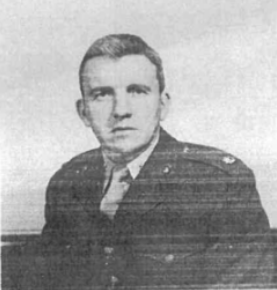
- Unit: 2nd Marine Division, 2nd Shore Party Battalion, Company B
- Date of Birth: August 4, 1920
- Entered the Military: May 15, 1942
- Date of Death: April 30, 2007
- Hometown: Evanston, Illinois
- Place of Death: Waynesville, North Carolina
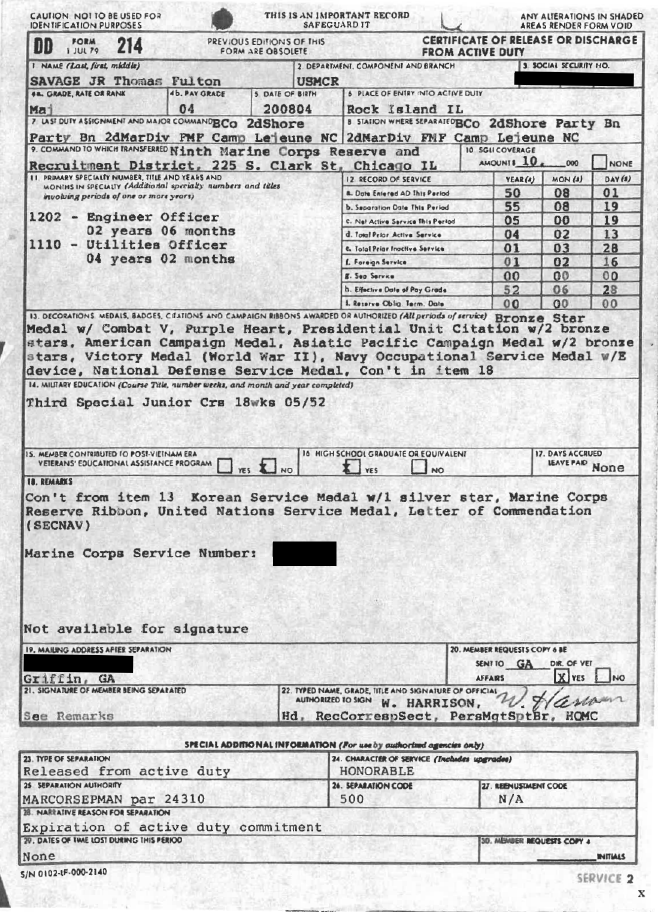
- Award(s): Silver Star, Bronze Star Medal with Combat “V,” Purple Heart, Navy and Marine Corps Medal, Presidential Unit Citation with two stars, Asiatic-Pacific Campaign Medal with two bronze stars, World War II Victory Medal, Navy Occupation Service Medal with Europe clasp, National Defense Service Medal, Korean Service Medal with one silver star, Marine Corps Reserve Ribbon, United Nations Service Medal, Letter of Commendation
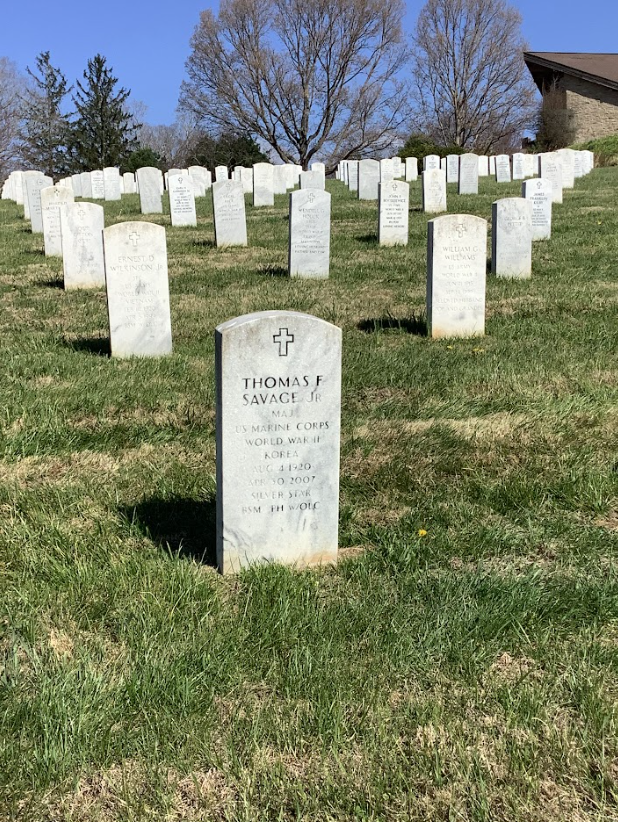
- Cemetery: Section 1R, site 95. Western North Carolina State Veterans Cemetery, Black Mountain, North Carolina
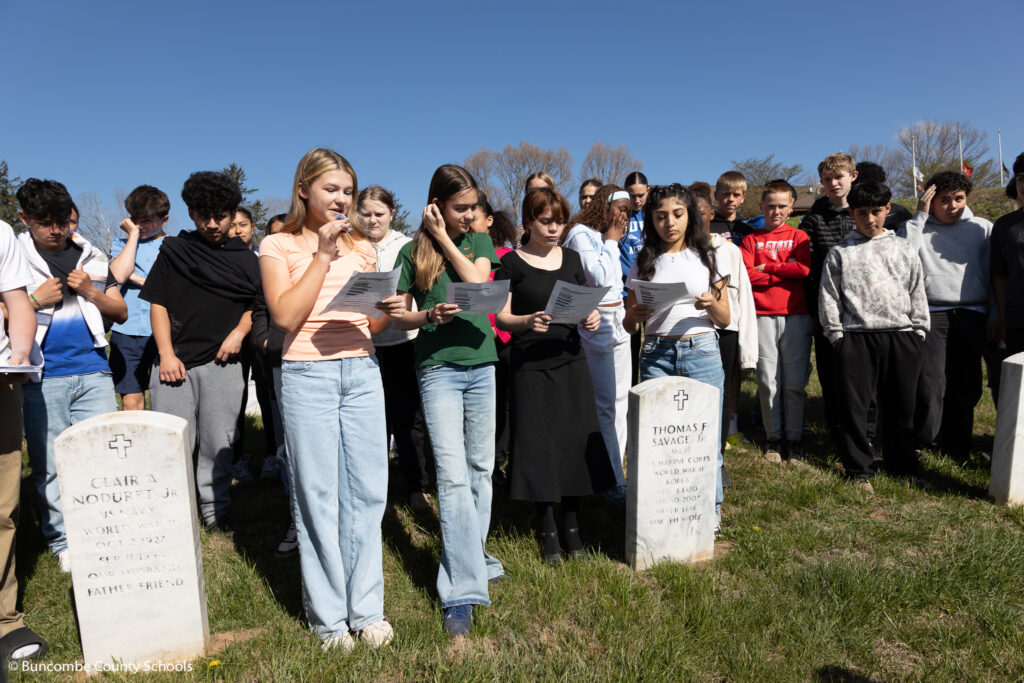
Mentored by Ms. Whitney Cooper
Valley Springs Middle School
2025/2026
Early Life
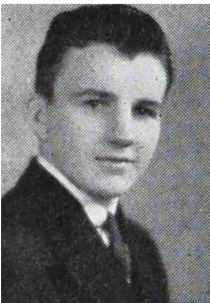
Thomas Fulton Savage, Jr., was born on August 4, 1920, in Evanston, Illinois. His parents, Thomas Sr. and Isabel, were immigrants from Scotland and Ireland who moved to the Chicago suburbs in search of a new start. By 1940, the family lived in a full house that included Thomas’s stepbrother, William, and William’s second wife, Gerda.
A Student Leader
Growing up in Evanston, Thomas stood out as a natural leader throughout his school years. He graduated from Evanston Township High School in 1938, where he served as the class president. His reputation followed him to Monmouth College, where he earned a full scholarship and was elected president of his class once again.
Answering the Call
Thomas was in the middle of his junior year at Monmouth when his life took a sharp turn. On December 8, 1941, the day after the attack on Pearl Harbor, he walked away from his college path to join the United States Marine Corps.

Homefront
A City Connected to the War
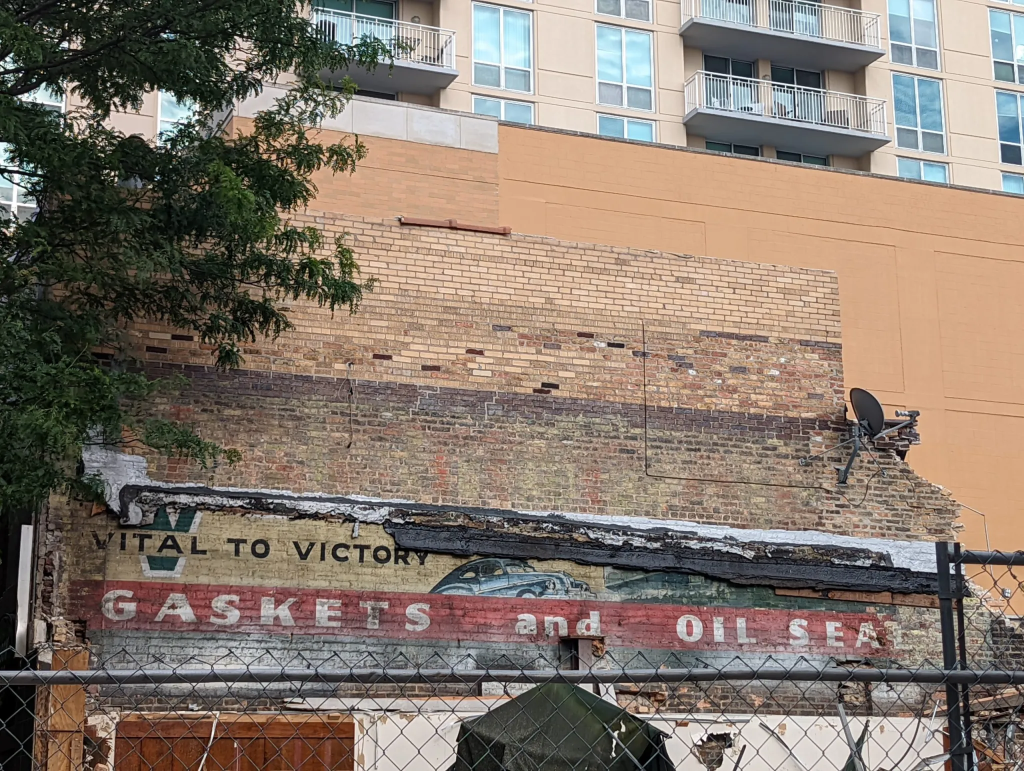
Savage’s hometown of Evanston was not a battlefield, but it was still part of the war. Located just north of Chicago on Lake Michigan, Evanston was tied into transportation, industry, and wartime production. Local factories, including Victor Gaskets Company, produced materials used in military equipment. The city’s location and workforce made it an active part of the national war effort.
Rationing, Gardens, and Civil Defense
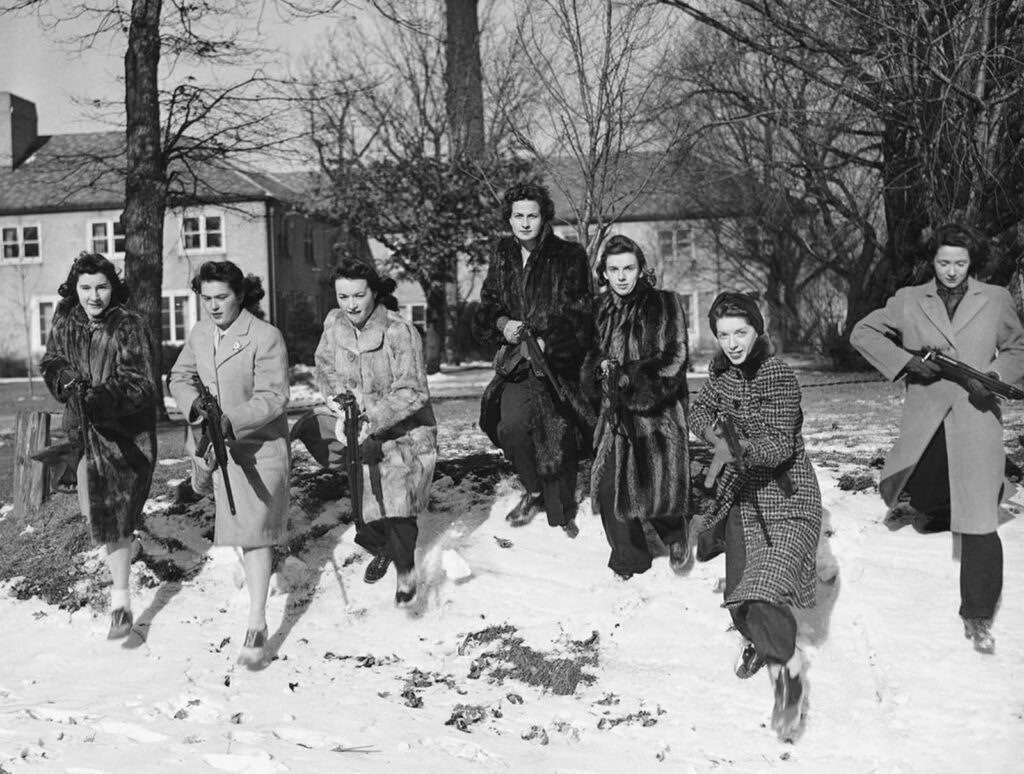
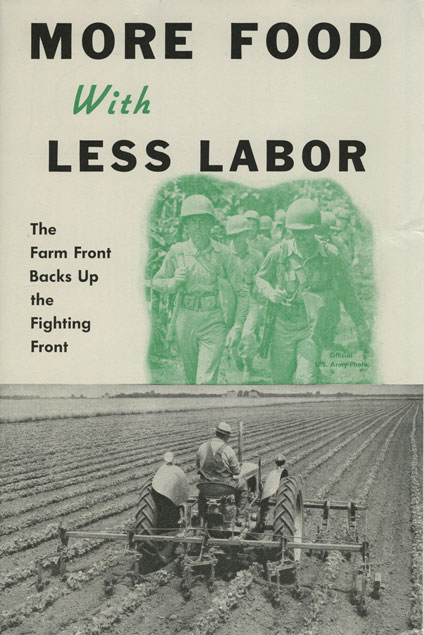
Daily life on the home front required sacrifice. Families dealt with rationing, especially for items like sugar. They planted Victory Gardens, canned food, bought war bonds, and volunteered. Civil defense was also a big part of wartime life. In the Chicago area, thousands of block wardens helped organize emergency planning and support their neighborhoods. Even college women at Northwestern in Evanston took part in rifle drills, showing how the war reached into ordinary local life.
Opportunity and Inequality
The war also brought tension and change. African American families moved north in larger numbers during the Great Migration to fill industrial jobs, but Evanston remained segregated. The Black community in the Triangle faced overcrowding and housing discrimination, even as wartime labor opened some new opportunities for women and African Americans. That mix of patriotism, change, and unfairness shaped the world Savage left behind when he joined the Marines.
Military Experience
Thomas Fulton Savage, Jr., enlisted on May 15, 1942, in Iowa City, Iowa. He first trained in aviation in California, but after a minor crash, his records say he developed a fear of flying in a fighter. As a result, he was removed from flight duty and reassigned to ground service. That change shaped the rest of his military career.
World War II Service in the Pacific
During World War II, Savage served with Marine aviation units in the Pacific, including the Marshall Islands and Okinawa. Instead of flying combat missions, he worked on the ground in jobs that kept airfields operating. As a Personnel Classification Section Officer, he helped place Marines in the jobs for which they were best suited. Later, as a Ground Defense Officer, he helped protect airfields from attack by organizing and planning behind the scenes to keep airfields clear for incoming troops and safe for those leaving for combat.
Korean War Service
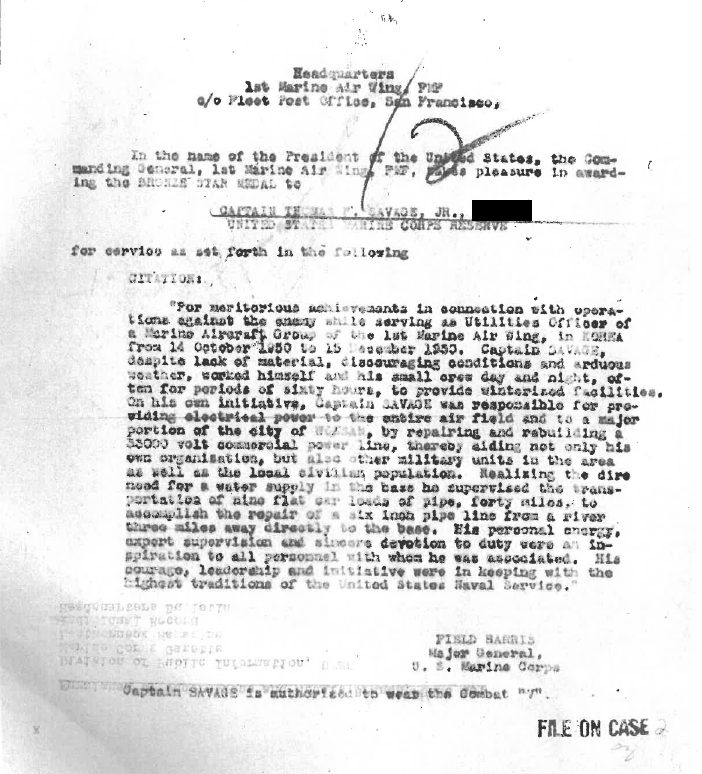
Savage re-enlisted in August 1950 and served in Korea with the 1st Marine Air Wing. There, he worked as an engineer and utilities officer, helping restore water and power systems under dangerous conditions. His records describe him rebuilding electric lines and water pipes during the winter, fighting near Wonsan and other Korean air bases. On November 5, 1950, a sniper fired at his truck. The windshield shattered, and he was wounded by flying glass in his nose and right hand. He received the Purple Heart for those wounds.
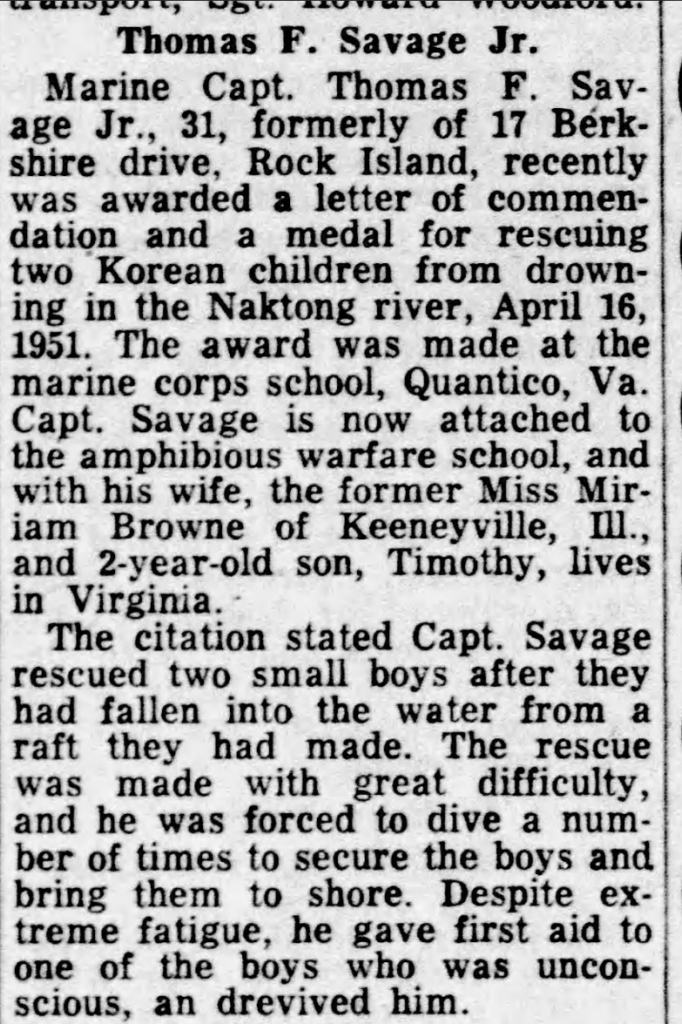
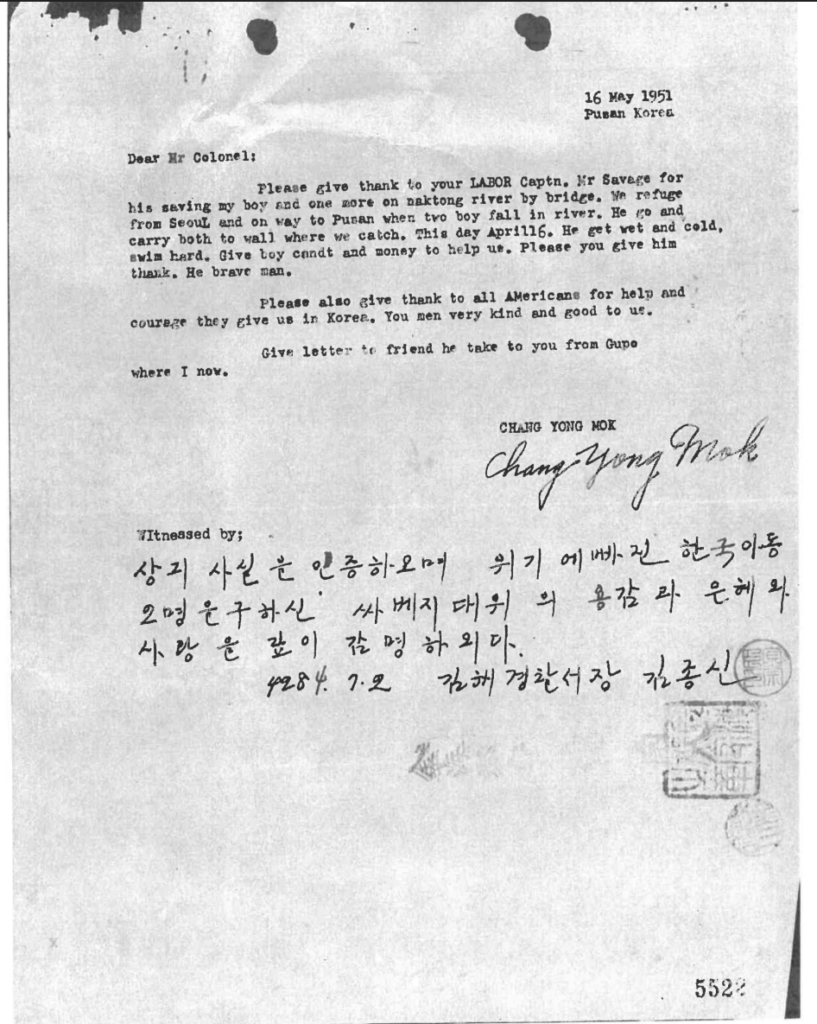
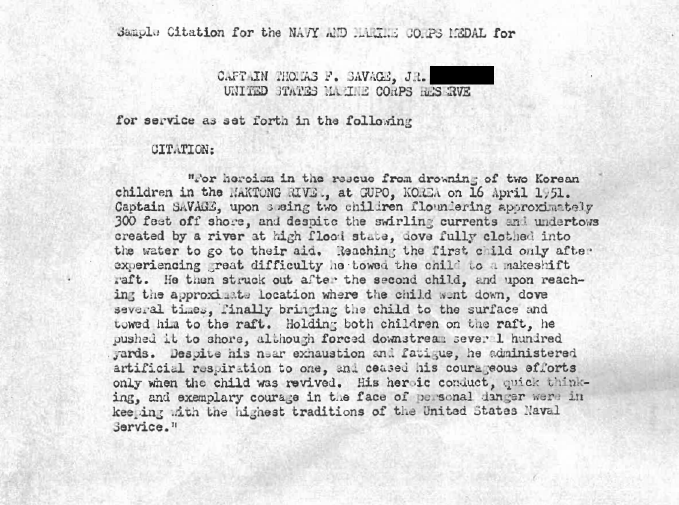
He was also recognized for saving the lives of two boys who were drowning in a river outside of Wonsan. While unrelated to the Korean War itself, it shows his integrity and character.
Rising Through the Ranks
Savage rose steadily in rank throughout his career. He began as a private, was commissioned as a second lieutenant, then became a first lieutenant, a captain, and finally a major. By the end of active duty, he was serving with Company B, 2nd Shore Party Battalion, 2nd Marine Division at Camp Lejeune, North Carolina, where he helped direct the movement of troops and supplies in shore operations. His military career spanned two wars and encompassed many forms of leadership. In his many military evaluations, his peers and superior officers describe him as a hardworking, organized, and committed Marine who set a high bar and helped others succeed.
Veteran Experience
Savage left active duty on August 19, 1955, but he continued to serve in the Marine Corps Reserve until he was transferred to the Retired Reserve on July 1, 1963. After the military, he worked for John Deere and later for the U.S. Air Force. His postwar life shows that his sense of duty did not end with his active service.
Family and Home
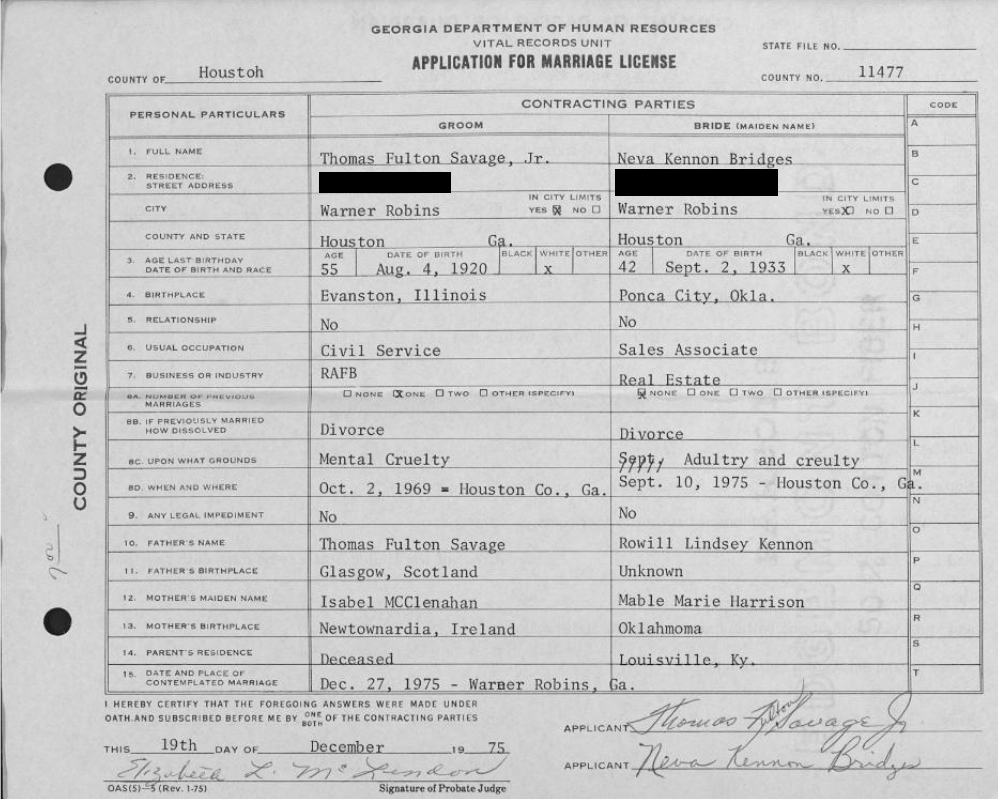
Records show that Savage married Miriam Browne in 1943 and later married Neva Kennon Bridges in 1975. In 1999, he was married to Edna Adams Moore Savage. They are buried together.
At the time of his death, his obituary named Barbara Carter as his fiancée. He had one son, Timothy Savage, as well as grandchildren and great-grandchildren. Over the years, he lived in Illinois, Georgia, Massachusetts, North Carolina, and finally in Canton, North Carolina.
A Lasting Community Impact
Savage remained active in his community long after the wars. He mentored 23 Eagle Scouts, worked with mineralogical organizations, and donated more than 4,000 mineral specimens to a museum in Cartersville, Georgia. He was also active in church and fraternal groups. His legacy was not only military. It was also civic, personal, and local.
Commemoration
Thomas Fulton Savage, Jr. died on April 3, 2007, at the Brian Center in Waynesville, North Carolina, at the age of 86. He was memorialized at the Western North Carolina State Veterans Cemetery in Black Mountain, North Carolina.
How He Should Be Remembered
Savage’s story is larger than one battle or one medal. He was a student leader, a Marine officer, a World War II and Korean War veteran, a father and grandfather, and a man who kept serving after the uniform came off. His life reminds us that military history is not only about combat. It is also about duty, endurance, and the ways veterans continue shaping their communities long after war ends.
Bibliography
Primary Sources
“16,000 Take Chicago Civil Defense Oath.” The Daily Worker [Chicago, IL], April 22, 1942. Newspapers.com (1143764190).
“American Women at War.” Chicago Tribune [Chicago, IL], February 20, 1944. Newspapers.com (369892622).
Communication From Mrs. George Buckley Concerning Sugar Rationing. Letter. November 9, 1943. Illinois State Archives. https://www.ilsos.gov/departments/archives/teaching-packages/illinois-at-war/doc28.html.
Evanston Township High School Yearbook. Evanston Township High School, 1938.
“Expert on Soil to Lecture on Victory Garden.” Chicago Tribune [Chicago, IL], March 8, 1942. Newspapers.com (371269988).
Illinois. Cook County. 1930 U.S. Census. Digital images. https://www.familysearch.org.
Illinois. Cook County. 1940 U.S. Census. Digital images. https://www.familysearch.org.
“Negroes Back Wallace in Fight for Cabinet Post.” The Chicago Defender [Chicago, IL], February 3, 1945. Newspapers.com (1136180544).
“The People’s Pulpit: Shocked by Poisonings.” The Rock Island Argus [Rock Island, IL], March 14, 1950. Newspapers.com (568908132).
Ration Books. Illinois State Museum. https://story.illinoisstatemuseum.org/content/ration-books.
“Thomas Fulton Savage.” Groce Funeral Home & Cremation Service. Accessed October 23, 2025. https://grocefuneralhome.com/obits/thomas-fulton-savage/.
Thomas Fulton Savage and Miriam Browne. California, County Marriages, 1849-1957. Digital images. https://www.familysearch.org/.
Thomas Fulton Savage and Neva Kennon Bridges. Georgia, Houston County, Marriage Records, 1832-2015. Digital images. https://www.familysearch.org/.
“Savage Infant Dies In Hospital.” Shawnee News-Star [Shawnee, OK], March 1, 1945. Newspapers.com (903770608).
These Northwestern University girls brave freezing weather to go through a Home Guard rifle drill on the campus in Evanston, Illinois on January 11, 1942 . . . Photograph. January 11, 1942. Rare Historical Photos. Accessed November 9, 2025. https://rarehistoricalphotos.com/women-at-war-1939-1945/.
“Thomas F. Savage Jr.” The Dispatch [Moline, IL], April 11, 1952. Newspapers.com (341860904).
Thomas Fulton Savage Jr. DD-214, Department of the Navy. National Archives and Records Administration – St. Louis.
Thomas Fulton Savage Jr. Official Military Personnel File, Department of the Navy. National Archives and Records Administration – St. Louis.
“Tolan Sees Need of Woman Labor.” The Daily Worker [Chicago, IL], February 5, 1942. Newspapers.com (1143652312).
“Vets Blast Housing Policies of Northwestern.” The Chicago Defender [Chicago, IL], July 13, 1946. Newspapers.com (1138531563).
“Virtual War Bond Posters Gallery.” Federal Reserve Bank of Chicago. Accessed March 18, 2026.
Secondary Sources
12th General Hospital Collection. Northwestern University Library. https://findingaids.library.northwestern.edu/repositories/8/resources/1335.
“275 – Classification Specialist.” The Military Yearbook Project. Last modified January 1, 2023. Accessed January 16, 2026.
“About Evanston.” City of Evanston. Accessed November 9, 2025. https://www.cityofevanston.org/about-evanston.
“About the 1st Marine Aircraft Wing.” 1st Marine Aircraft Wing Headquarters. Accessed January 16, 2026. https://www.1stmaw.marines.mil/Home/About/.
Alexander, Colonel Joseph H. The Final Campaign: Marines in the Victory on Okinawa. Marine Corps University History Division: 1996. https://www.usmcu.edu/Portals/218/The%20Final%20Campaign%20Marines%20in%20the%20Victory%20of%20Okinawa%20%20PCN%2019000313500.pdf?ver=2018-10-30-100555-327.
“The American Home Front and World War II.” National Park Service. Last modified August 27, 2020. Accessed November 5, 2025. https://www.nps.gov/articles/000/the-american-home-front-and-world-war-ii.htm.
“The Battle of Okinawa.” HISTORY. Last modified March 27, 2023. Accessed January 16, 2026. https://www.history.com/articles/battle-of-okinawa.
The Black Experience at Northwestern University Research Guide. Northwestern University Library. Accessed November 9, 2025. https://libguides.northwestern.edu/c.php?g=849758&p=8795520.
“Constance Llewellyn Howerton.” Evanston Women’s History Project. Accessed November 9, 2025. https://evanstonwomen.org/woman/constance-llewellyn-howerton/.
“Delving into Evanston’s Rich History.” The Chicago Racoons. Accessed November 9, 2025. https://chicagoracoons.com/evanston-il-history/.
“Developing a Segregated Town: 1900–1960.” Evanston RoundTable, December 5, 2019. https://evanstonroundtable.com/2019/12/05/developing-a-segregated-town-1900-1960/.
“Double V Victory.” The National World War II Museum. Accessed November 9, 2025. https://www.nationalww2museum.org/war/articles/double-v-victory.
“Edna Adams Moore Savage.” Find a Grave. Last modified March 13, 2014. Accessed March 18, 2026. https://www.findagrave.com/memorial/126281096/edna_adams-savage.
“Evanston.” Chicago Gang History. Accessed November 9, 2025. https://chicagoganghistory.com/suburb/evanston/.
“The Evanston Community Kitchen.” Evanston Women’s History Project. Last modified April 1, 2020. Accessed November 9, 2025. https://evanstonwomen.org/2020/04/01/the-evanston-community-kitchen/.
“Evanston Women in the Military.” Evanston Women’s History Project. Last modified March 25, 2022. Accessed November 9, 2025. https://evanstonhistorycenter.org/evanston-womens-history-project/.
“Food Rationing and Canning During World War II.” National Women’s History Museum. Accessed November 9, 2025. https://www.womenshistory.org/articles/food-rationing-and-canning-world-war-ii.
Hartzell, Kris. “Ask the Historians: Victor Gaskets ‘Ghost Sign.’” Evanston RoundTable, July 27, 2022. https://evanstonroundtable.com/2022/07/27/evanston-dimension-victor-gaskets-ghost-sign/.
“History of Camp Lejeune.” United States Marine Corps. Last modified September 14, 2022. Accessed January 16, 2026. https://www.lejeune.marines.mil/Offices-Staff/Environmental-Mgmt/Cultural-Resources/History-Live/History-of-Camp-Lejeune/.
Hough, Frank O., and John K. Leyden. History of U.S. Marine Corps Operations in World War II. U.S. Marine Corps Historical Branch, 1958.
Jordan, Angela. “Food Is a Weapon of War.” University of Illinois Archives. January 16, 2013. Accessed November 9, 2025. https://archives.library.illinois.edu/2013/01/16/food-is-a-weapon-of-war/.
“Junior League of Evanston.” Evanston Women’s History Project. Accessed November 9, 2025. https://evanstonwomen.org/organization/junior-league-of-evanston/.
“Korean War Introduction.” National Museum of the U.S. Air Force. Last modified May 22, 2015. Accessed January 16, 2026. https://www.nationalmuseum.af.mil/Visit/Museum-Exhibits/Fact-Sheets/Display/Article/196090/korean-war-introduction/.
Kravetz, Andy. “World War II Caused Dramatic Changes to Illinois’ Way of Life and Economy.” Rockford Register Star [Rockford, IL], June 28, 2018.
“Maj Thomas Fulton Savage, Jr.” Find a Grave. Last modified May 2, 2007. Accessed March 18, 2026. https://www.findagrave.com/memorial/19192224/thomas-fulton-savage.
“Marine Corps Job: Utilities Officer.” Careers in the Military. Last modified October 30, 2025. Accessed January 16, 2026. https://www.careersinthemilitary.com/career/detail-service/marine-corps/facilities-managers/utilities-officer.
“Marshall Islands Campaign.” World War II Database. Last modified September 2006. Accessed January 16, 2026. https://ww2db.com/battle_spec.php?battle_id=73
“Mary Jayne Gold.” Evanston Women’s History Project. Accessed November 9, 2025. https://evanstonwomen.org/woman/mary-jayne-gold/.
Military Training Programs Records. Northwestern University Archives. https://findingaids.library.northwestern.edu/repositories/6/resources/1102.
Montross, Lynn, and Captain Cincolas A. Canzona. The Chosin Reservoir Campaign. U.S. Marine Corps: 1957. https://www.usmcu.edu/Portals/218/Montross_U_S_%20Marine%20Operations%20in%20Korea%20Vol%20lll.pdf.
“No Stranger to Change.” McCormick Magazine, Northwestern University. Spring 2021.
“Operation Magic Carpet.” Naval History and Heritage Command. Last modified July 12, 2023. Accessed January 16, 2026. https://www.history.navy.mil/content/history/museums/nmusn/explore/photography/wwii/wwii-pacific/japanese-surrender/operation-magic-carpet.html.
Duis, Perry R. “People of Chicago.” In Encyclopaedia Britannica. Last updated March 27, 2026. https://www.britannica.com/place/Chicago/People.
Riseborough, Gay. “Who Made Evanston Made.” Evanston RoundTable, January 19, 2022. https://evanstonroundtable.com/2022/01/19/who-made-evanston-made/.
Rogers, Alexis, Isaac Flint, and Eva Sondgeroth. “Decades of Displacement.” The Evanstonian. Last modified May 21, 2024. Accessed November 9, 2025. https://www.evanstonian.net/reparations/2024/05/21/decades-of-displacement/.
“Thomas F. Savage, Jr.” Veterans Legacy Memorial, National Cemetery Administration. Accessed March 18, 2026. https://www.vlm.cem.va.gov/THOMASFSAVAGEJr/28F57E.
“Victory Gardens on the World War II Home Front.” National Park Service. Accessed November 9, 2025. https://www.nps.gov/articles/000/victory-gardens-on-the-world-war-ii-home-front.htm.
This profile was funded by a grant from the United States Department of Veterans Affairs. The opinions, findings, and conclusions stated herein are those of the author and do not necessarily reflect those of the United States Department of Veterans Affairs.