

Private Paul Frederick William Hummel
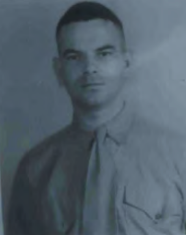
- Unit: U.S. Marine Corps
- Date of Birth: May 2, 1911
- Entered the Military: February 12, 1942
- Date of Death: November 4, 1976
- Hometown: Baltimore, Maryland
- Place of Death: Baltimore County, Maryland
- Cemetery: Section P, Site 44. Baltimore National Cemetery, Baltimore, Maryland
Mentored by Mrs. Amie Dryer
The Calverton School
2025/2026
Early Life
Paul Frederick William Hummel was born on May 2, 1911, in Baltimore, Maryland. He was the youngest child of Frederick William Hummel and Mary Jane Shane Hummel. Tragedy struck early in his life when his mother died in October 1911 after suffering burns in the basement of their home.
Hummel grew up with his older siblings, Alice, William, Eleanor, and Dorothy, in Baltimore, where his father worked as a salesman and eventually remarried. After his father died in 1929, he and several of his siblings lived with their stepmother, Myra Elise Brown Hummel.
As a young adult, Hummel moved to Daytona Beach, Florida, where he worked as an insurance salesman. In 1937, he married Sara Hampton, and the couple had a son, Shane Hampton Hummel, the following year. However, the marriage was short-lived, and the couple divorced in 1939. By 1940, Hummel was living in Daytona Beach as a lodger and continued his insurance sales work. When the United States entered World War II, Hummel answered the call to serve his country.


Homefront
During the late 1930s and World War II, Hummel’s adopted hometown, Daytona Beach, Florida, was more than just a tourist town. Located along Florida’s Atlantic coast, it was a prime location to observe German submarine activity offshore. What had been a leisure destination before the war was transformed by blackout orders, military patrols, rationing, and the constant awareness that war was not as far away as Americans imagined. Residents routinely witnessed tanker ships burning offshore due to U-boat attacks. Seven freighters were sunk off the coast of Cape Canaveral during World War II. Residents in the community lived with the fear of enemy submarines and invasion.
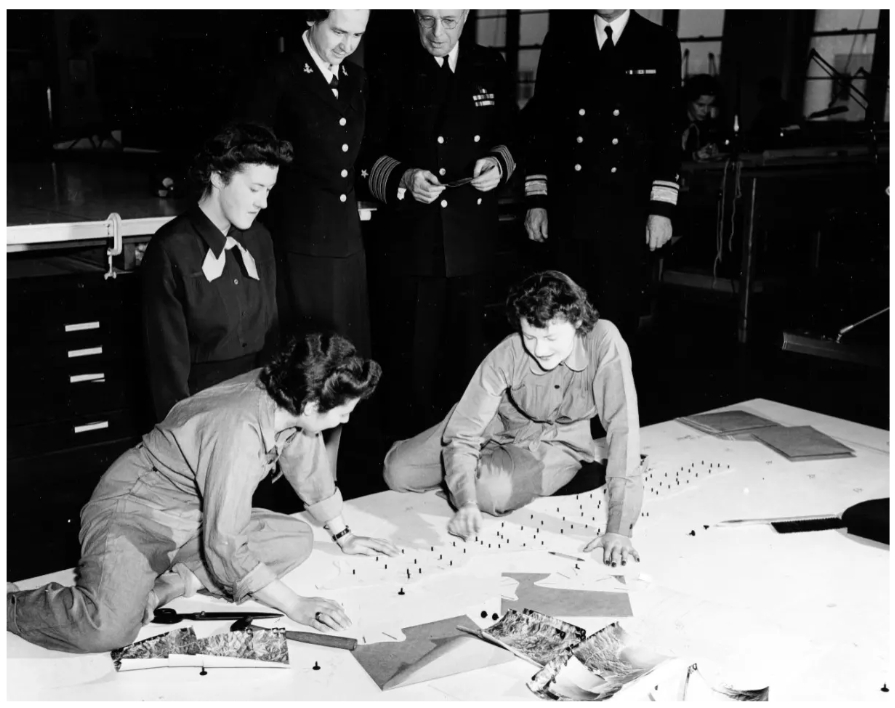
Daytona Beach contributed to the war effort through both manufacturing and military training. Daytona Boat Works switched from building boats to building Navy submarine chasers, which were used for coastal defense and anti-submarine patrols. Even more significant was the transformation of the city’s airport into Daytona Beach Naval Air Station in 1942. There, pilots trained in dive-bomber, fighter, and air-to-sea rescue operations. Women in the Women Accepted for Volunteer Emergency Service (WAVES) trained as radar operators and intercept directors.
Hotels were converted into housing for Women’s Army Auxiliary Corps (WAAC) recruits, trainees, defense workers, and volunteers. Boarding houses and restaurants filled with military personnel as the city’s population grew.
Residents bought war bonds, saved scrap metal, planted Victory Gardens, and served as blackout wardens, airplane spotters, and civil defense volunteers. Everyday life was reshaped by wartime rules: cars drove with partially blacked-out headlights, beaches closed at night, and families lived with shortages of food, gas, rubber, and clothing materials.
Military Experience
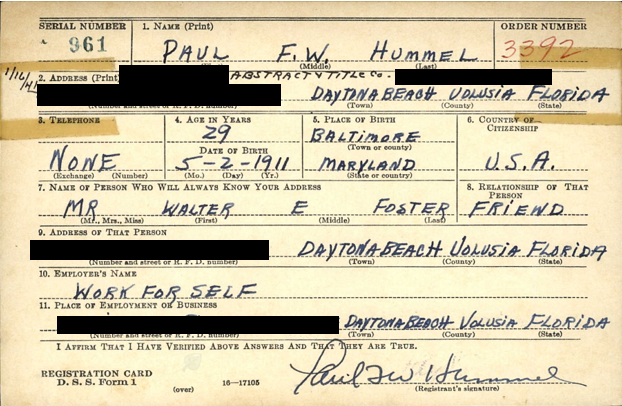
On October 16, 1940, Hummel registered for the draft. In February 1942, as the United States mobilized for war after the attack on Pearl Harbor, Hummel enlisted in the United States Marine Corps while living in Daytona Beach, Florida. He was assigned to active duty the same day. After enlistment, he began training at Parris Island, South Carolina. His training continued with artillery training with Marine units at Camp Lejeune, North Carolina.
Hummel was assigned to Headquarters and Service Battery, 2nd Battalion, 11th Marines, an artillery regiment of the 1st Marine Division. The 11th Marines provided heavy firepower to support Marines during combat operations. Early muster rolls from April 1942 list Hummel as a truck driver, a critical job responsible for transporting ammunition, supplies, and equipment needed to the front lines.
Hummel’s unit deployed with the 1st Marine Division during the Solomon Islands campaign, which included brutal fighting on Guadalcanal. This campaign was one of the first major Allied offenses against Japan and was a turning point in the Pacific Theater. Conditions were extremely harsh as Marines faced relentless combat, tropical disease, exhaustion, and constant artillery and air attacks.
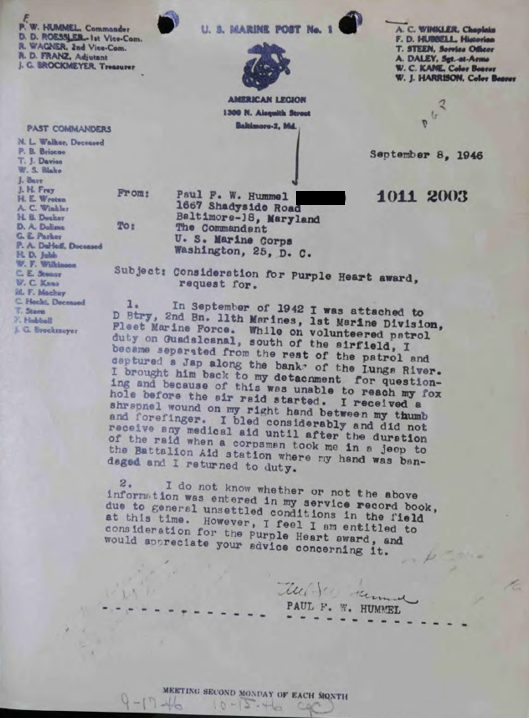
Hummel recounted being separated from his patrol, capturing a Japanese soldier, and being injured when he was unable to get back to his foxhole before an air raid in September of 1942. Military records show that in July 1943, Hummel was listed as “SS,” meaning “sick and evacuated.” This classification was often used during World War II for Marines suffering from “shell shock” or combat fatigue.
Following his evacuation and recovery, Hummel returned to the United States and, on August 31, 1943, received an honorable discharge from the Marine Corps, concluding his service.
Veteran Experience
After being honorably discharged from the United States Marine Corps on August 31, 1943, Paul Frederick William Hummel returned to civilian life in Baltimore, Maryland. Like many veterans of World War II, he had to rebuild his life after a war that left both physical and emotional scars. By 1950, census records show that Hummel was living in Baltimore County with his wife, Ruth Daria Franz Hummel, a fellow Marine Corps Veteran, and their growing family.
Hummel eventually found work serving other Veterans as an office clerk for the Veterans Administration. In this position, he handled administrative paperwork and records for former servicemen navigating the complicated benefits system created after World War II. As a Marine who had himself experienced illness and evacuation during the war, the work placed him on the other side of the system, helping veterans secure assistance and services after returning home.
Over the years, Hummel held several different jobs. At one point, he worked as a truck driver, and later became an insurance claims adjuster for a casualty company, investigating and processing insurance claims. Demonstrating determination to improve his career, Hummel also attended law school at night while supporting his family, eventually completing his degree.
Family remained central to Hummel’s life after the war. He and Ruth raised four children, Patricia, Rosemary, Mark, and John, in Baltimore.
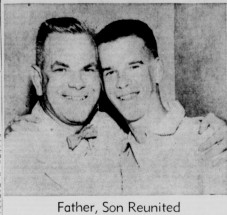
Yet one of the most emotional chapters of his life involved his son from his earlier marriage. Shortly after the child’s birth, Hummel and his wife separated, and the baby, Shane Hampton Hummel, was placed with the Children’s Aid Society. For years, Hummel did not know where his son was, but according to a 1958 newspaper article, he “prayed every night” that he might find him. That reunion finally came in June 1958, when Shane began searching for his biological father. The two met in an emotional reunion. Hummel’s other children welcomed their half-brother. The newspaper reported simply that “Hummel wept when he met his son.”
Hummel remained connected to the Veteran community throughout his life. He joined his local American Legion and was elected commander of Marine Post No. 1, continuing his commitment to the community of men who served.
Commemoration
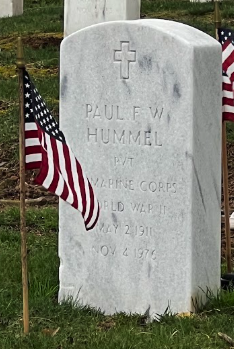
Paul Frederick William Hummel died on November 4, 1976, in Baltimore, Maryland, at the age of 65. His death was noted in The Evening Sun.
Hummel was laid to rest at Baltimore National Cemetery in Baltimore, Maryland, the city where he had spent much of his life before and after World War II. His wife, Ruth, lived until 2009. They are buried together.
Although no monument or public building bears his name, Hummel’s legacy lives on through the people whose lives he touched – his children, grandchildren, and great-grandchildren, as well as through the veterans he assisted while working for the Veterans Administration after the war.
Bibliography
Primary Sources
“Alice B. (Hummel).” The Boston Globe [Boston, Massachusetts], November 10, 1971. Newspapers.com (435875305).
“Baltimore Man Reunited With Son After 20 Years.” The Cumberland News [Cumberland, Maryland], June 14, 1958. Newspapers.com (61926039).
Field Manual 6-20: Field Artillery, Tactical Employment. U.S. Government Printing Office, 1944. Internet Archive. Accessed January 19, 2026. https://archive.org/details/Fm6-20-nsia.
Florida. Volusia County. 1940 U.S. Census. Digital Images. https://ancestryclassroom.com.
For your country’s sake today — For your own sake tomorrow. Poster. 1944. National Archives and Records Administration (NAID: 514315). https://catalog.archives.gov/id/514315.
“Hummel-Hampton.” The Huntsville Times [Huntsville, Alabama], May 14, 1937. Newspapers.com (554576795).
Hummel, Paul Frederick William. Death Certificate. 1944. Maryland Department of Health. Digital Images. https://ancestryclassroom.com.
Maryland. Baltimore City. 1910 U.S. Census. Digital Images. https://ancestryclassroom.com.
Maryland. Baltimore City. 1920 U.S. Census. Digital Images. https://ancestryclassroom.com.
Maryland. Baltimore County. 1930 U.S. Census. Digital Images. https://ancestryclassroom.com.
Maryland. Baltimore City. 1950 U.S. Census. Digital Images. https://ancestryclassroom.com.
Myra Elise Hummel. Commonwealth of Virginia Certificate of Death, February 17, 1965. Digital Images. https://ancestryclassroom.com.
“Paul Frederick William Hummel.” Florida, U.S., Volusia County Marriage Records, 1937. Digital Images. https://ancestryclassroom.com.
Paul Frederick William Hummel, Official Military Personnel File, Department of the United States Marine Corps. National Archives and Records Administration – St. Louis.
Paul Frederick William Hummel. US, Marine Corps Casualty Indexes, 1940–1958. https://www.fold3.com.
“Paul F.W. Hummel.” Florida, U.S., Volusia County Divorce Records, 1939. Digital Images. https://ancestryclassroom.com.
Paul F.W. Hummel. The Evening Sun [Baltimore, Maryland], November 5, 1976. Newspapers.com (371693719).
Paul F.W. Hummel. World War II Draft Cards Young Men, 1940-1947. Digital Images. https://ancestryclassroom.com.
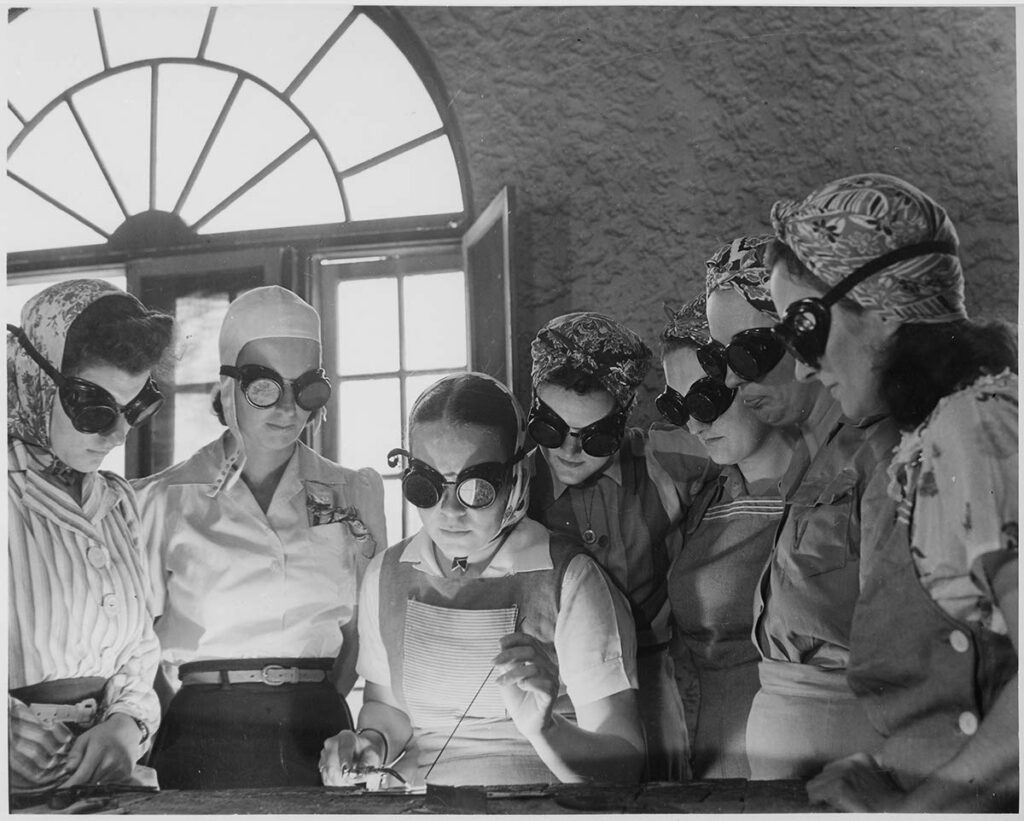
Secretaries, housewives, waitresses, women from all over central Florida are getting into vocational schools to learn war work. Typical are these in the Daytona Beach branch of the Volusia county vocational school. Photograph. 1942. National Archives and Records Administration (NAID: 535579). https://catalog.archives.gov/id/535579?objectPage=3.
Secondary Sources
Bowden, Denny. “World War II Teen-agers’ Remembrances of Daytona Beach.” Volusia History. Updated November 1, 2013. Accessed November 10, 2025. https://volusiahistory.wordpress.com/2013/11/01/world-war-ii-teen-agers-remembrances-of-daytona-beach/.
Brady, Tim. “The Daytona Beach International Airport in Uniform.” Journal of Aviation/Aerospace Education & Research Volume 17, No. 2, (Winter 2008): 9–31. https://doi.org/10.58940/2329-258X.1445.
Coles, David J., and Gregory David. Florida World War II Heritage Trail. Tallahassee: 2004. https://files.floridados.gov/media/32351/worldwariiheritagetrail.pdf.
“Florida – World War II.” Online Exhibition. Museum of Florida History. Accessed November 1, 2025. https://www.museumoffloridahistory.com/explore/exhibits/permanent-exhibits/world-war-ii/.
Emmet, Robert. A Brief History of the 11th Marines: Marine Corps Historical Reference Pamphlet. U.S. Marine Corps, 1968. https://www.usmcu.edu/Portals/218/A%20Brief%20History%20of%20the%2011th%20Marines%20%20PCN%2019000318600.pdf.
Lane, Mark. “Keeping Local History Afloat.” The Daytona Beach News-Journal [Daytona, Florida], May 10, 2015. https://www.news-journalonline.com/story/news/2015/05/11/port-orange-man-works-to-keep-maritime-history-afloat/30715618007/?gnt-cfr=1&gca-cat=p&gca-uir=true&gca-epti=z118173d00—-v118173b0090xxd119065&gca-ft=179&gca-ds=sophi.
“Naval Air Station Training.” National Park Service. Updated January 28, 2025. Accessed November 10, 2025. https://www.nps.gov/articles/000/navalhistory.htm.
“Navy WAVES at Canaveral National Seashore.” National Park Service. Updated October 16, 2023. Accessed November 10, 2025. https://www.nps.gov/articles/000/waves.htm.
Parker, Susan. Canaveral National Seashore Historic Resource Study. Cultural Resources Division Southeast Regional Office, 2008. https://irma.nps.gov/DataStore/DownloadFile/458702.
“Paul F. W. Hummel.” Veterans Legacy Memorial, National Cemetery Administration. Accessed April 8, 2026. https://www.vlm.cem.va.gov/PAULFWHUMMEL/776CC02.
“Paul Frederick William Hummel.” Find a Grave. Updated February 25, 2000. Accessed October 20, 2025. https://www.findagrave.com/memorial/814189/paul-frederick_william-hummel.
“Ruth D. Hummel.” Veterans Legacy Memorial, National Cemetery Administration. Accessed April 8, 2026. https://www.vlm.cem.va.gov/RUTHDHUMMEL/A7B2EEB.
“Ruth Daria Franz Hummel.” Find a Grave. Updated June 30, 2011. Accessed April 8, 2026. https://www.findagrave.com/memorial/72322068/ruth_daria-hummel.
Thacker, Joel D. “The History of the 1st Division through World War II: From the Leatherneck Archives, October 1945.” Leatherneck, April 2021, 52-60. https://www.mca-marines.org/leatherneck/.
This profile was funded by a grant from the United States Department of Veterans Affairs. The opinions, findings, and conclusions stated herein are those of the author and do not necessarily reflect those of the United States Department of Veterans Affairs.