

Sergeant Gladys Mae Toploski Breen
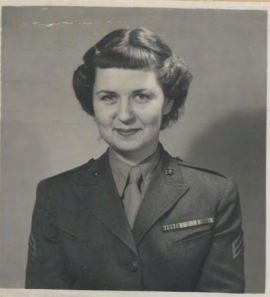
- Unit: 3rd Marine Corps Reserve District
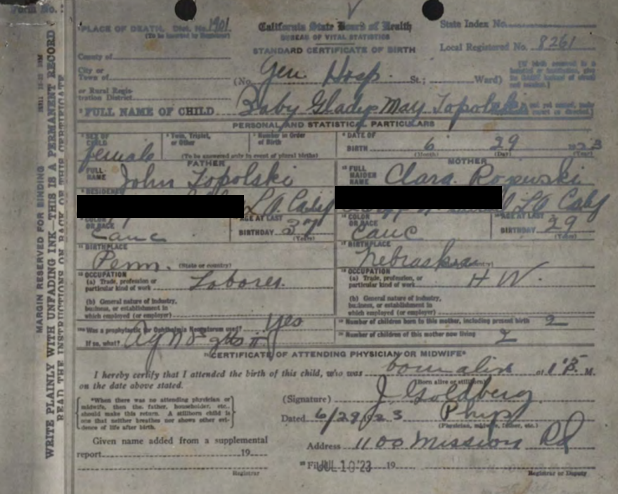
- Date of Birth: June 29, 1923
- Entered the Military: August 20, 1943
- Date of Death: September 18, 2016
- Hometown: Los Angeles, California
- Place of Death: Taylorsville, Utah
- Award(s): Asiatic Pacific Medal, American Theatre, World War II Victory Medal
- Cemetery: Block B3, Grave 501. Utah Veterans Cemetery and Memorial Park, Bluffdale, Utah
Mentored by Mrs. Julia Jane Winslow
Providence Hall Junior High School
2025/2026
Early Life
Gladys Mae Tolpolski was born on June 29, 1923, to John and Clara Victoria Tolpolski in Los Angeles, California. She was the second of three daughters with an older sister, Jeanne, and a younger sister, Dorothy.
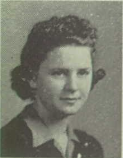
Topoloski attended Benjamin Franklin High School in Los Angeles. She was active in school activities, including drama, journalism, and athletics. She was an assistant editor for the school paper, The Franklin Press. She graduated from high school in 1941.
At the age of 16, she started working with her sister, Jeanne, as a general clerk for an insurance company. She attended the Marinello School of Beauty Culture from 1941 to 1942 and worked in the hairdressing industry before joining the Marine Corps.
Homefront
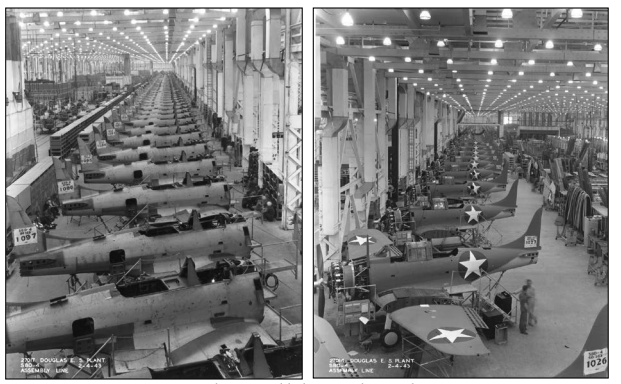
Breen’s hometown of Los Angeles, California, experienced many changes during World War II. The population of California grew by 30% during the war. Much of this growth was due to the need for workers for the defense industry. Los Angeles had two major shipyards, which built almost 500 ships and created 40,000 jobs. In addition to shipbuilding, the Douglas Aircraft Company built a plant in Los Angeles, which became a hub for aircraft manufacturing. Their workforce grew from 700 in 1939 to 21,292 in 1943. Many of these workers were women, as men were required for military service.
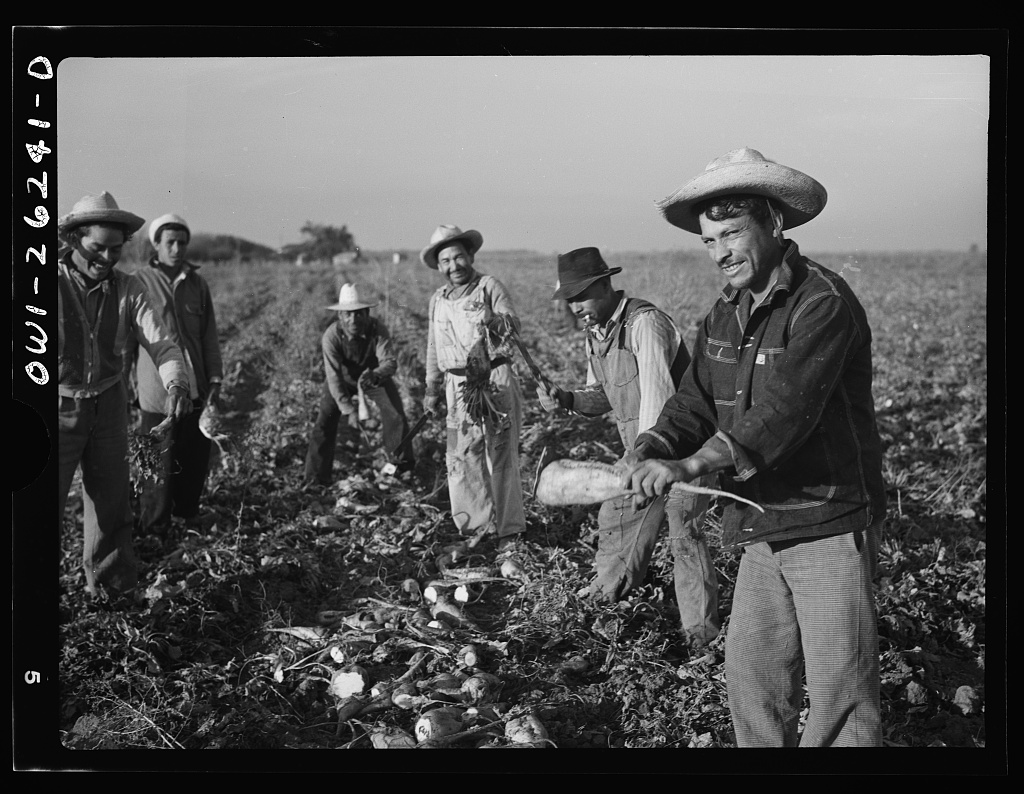
Under Executive Order 9066, some 125,000 Japanese-Americans were forced to leave their homes and jobs in Los Angeles. The incarceration of Japanese Americans led to an influx of new agricultural workers. This included African Americans from the deep south who were escaping increased segregation and violence, and Mexicans who were given work permits under the Bracero program of 1942.
As the city’s population rose, so did shortages of housing and other resources. In 1943, Mexican workers and members of the United States military clashed in an outbreak of racial violence known as the Zoot Suit Riots.
Because of Los Angeles’ location on the West Coast, it was also believed to be at risk of naval attack. On February 23, 1943, a Japanese submarine surfaced about 100 miles north of the city and fired shells at an oil field. The next night, radar showed an unidentified object to the west of the city, and at 3:00 am, U.S. anti-aircraft ordinance filled the sky over the area. This event was dubbed “The Battle of Los Angeles.” The full story of what occurred is still not known.
The citizens of Los Angeles supported the war effort by buying war bonds, planting victory gardens, and conserving materials needed for military production.
Military Experience
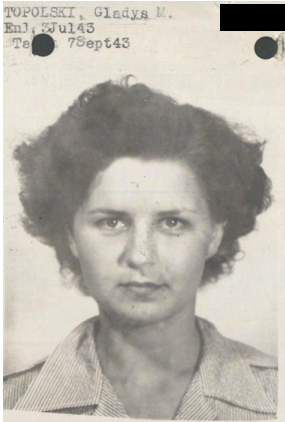
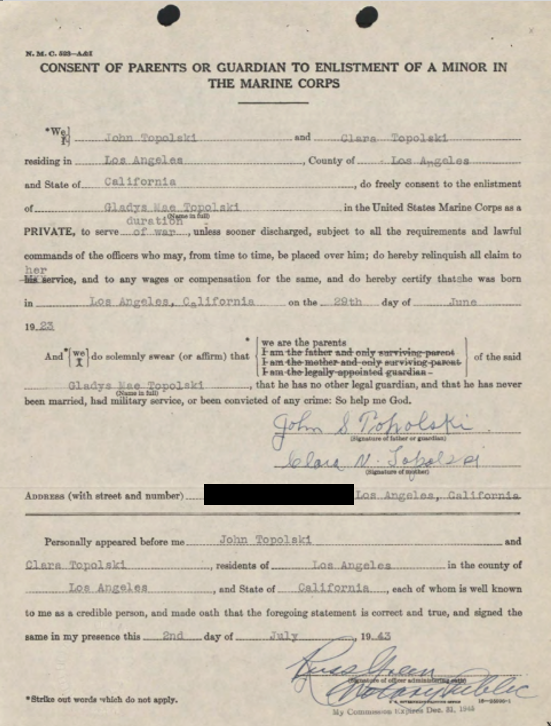
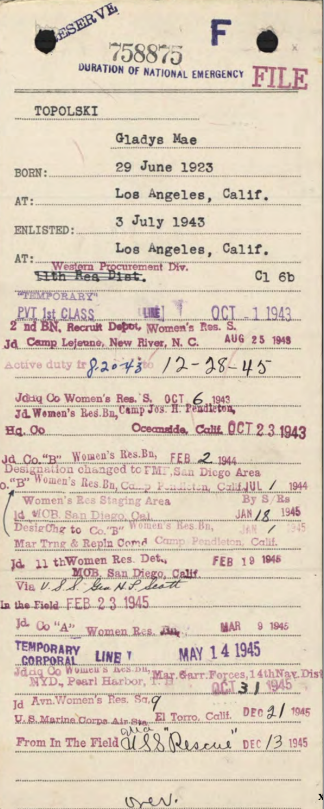
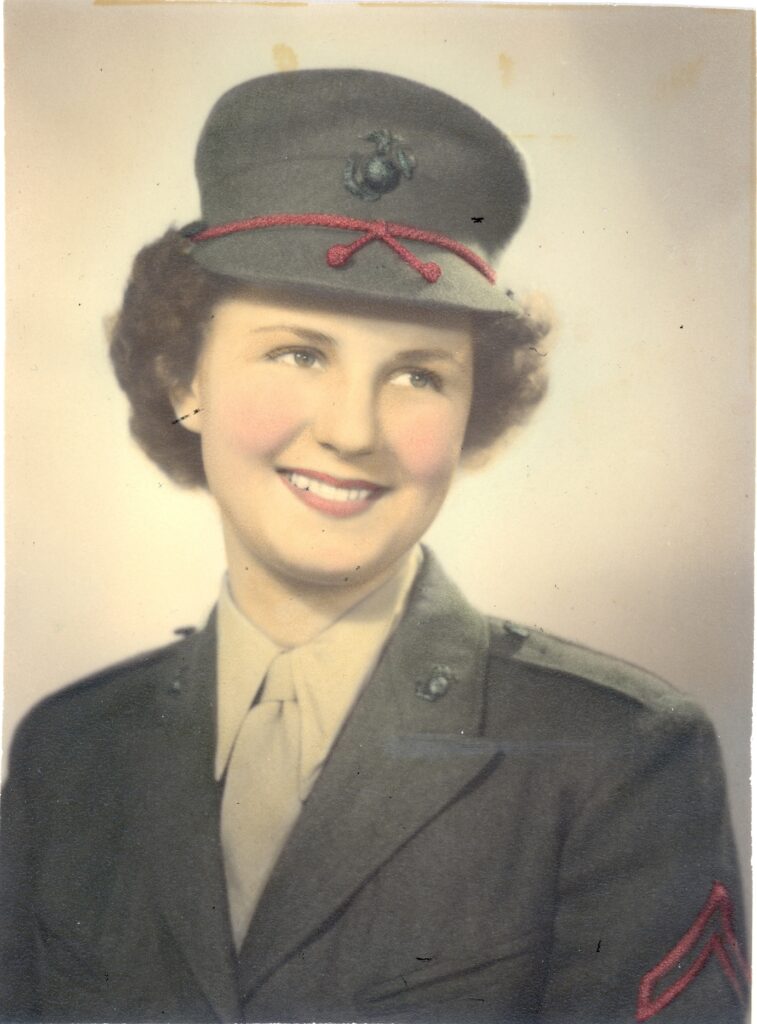
In February 1943, the U.S. Marine Corps Women’s Reserve (MCWR) was formed, and women could officially join the Marine Corps. Topolski joined almost 25,000 women who served in the MCWR during World War II when she enlisted on August 20, 1943, in Los Angeles, California. Despite being over 18, her parents had to sign a consent form for her to undergo basic training at Camp Lejeune in North Carolina.
She was first stationed at Camp Pendleton, where she worked as a secretary for the quartermaster’s office. Her job was very diverse and included typing, clerical work, working with the supplymen, and helping with Post Exchange, Mess Duty, and Barracks Orderly inspections. She earned her Marine Corps driver’s license and was promoted to corporal in 1944.
On November 1, 1945, Topolski transferred to Pearl Harbor, Hawaii, where she continued to work in the office and later in the motor pool. After the war, Pearl Harbor was transitioning from a major wartime naval base to a post-war oversight facility. She returned to California and was honorably discharged on December 28, 1945. She was awarded the Victory, American Campaign, and Asiatic-Pacific Area Medals for her service. However, her involvement in the military did not end there.
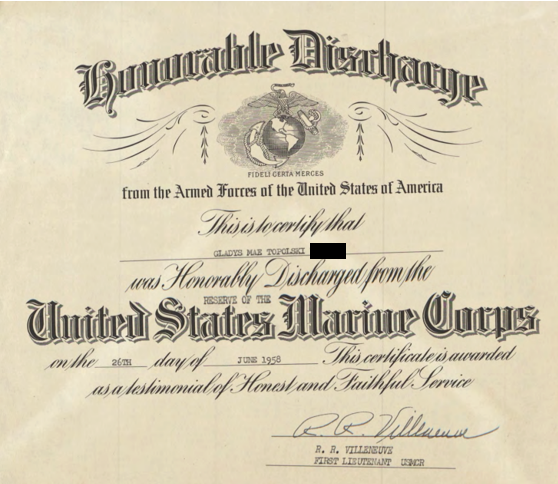
Topolski reenlisted with the Marine Corps Reserves in August 1950 in New York City. During this period of service, she was promoted to sergeant and once again was stationed at Camp Pendleton in California. Her primary role was as a motor transport supply clerk. She was released to inactive duty on July 20, 1951, and was honorably discharged in 1958.
Veteran Experience
After World War II, Topolski used the GI Bill to attend the University of Southern California and earned a degree in economics in 1949. When she finished college, she moved to New York for further economic opportunities.
In New York City, she shared an apartment with her two sisters, Jeanne and Dorothy. Her future husband, William Henry Breen, Jr., also a Marine, returned from active duty in 1953. They married in Brooklyn, New York, that year.
Breen dedicated her life to her children, William, Susan, Patrick, John, and Mary. She was active in the Catholic Church and raised her children in the faith.
Commemoration
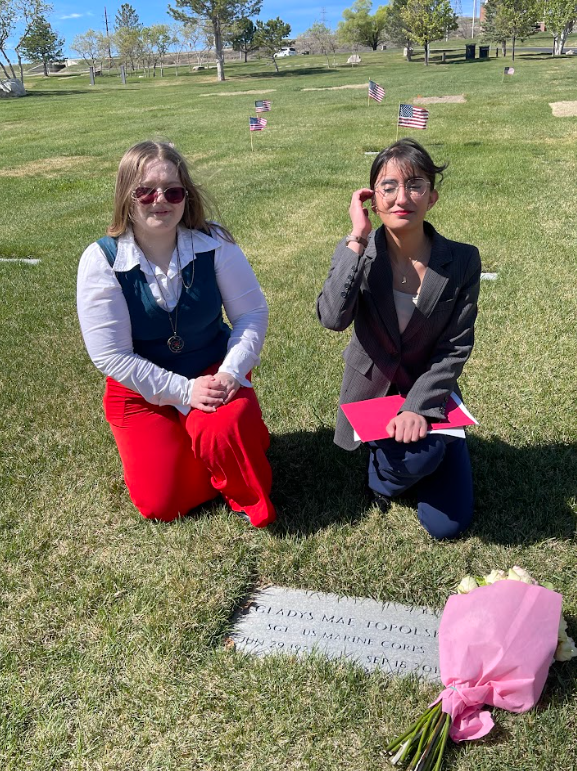
Gladys Mae Topolski Breen passed away on September 18, 2016, at a nursing home in Taylorsville, Utah, surrounded by her children and grandchildren. She was buried in the Utah Veterans Cemetery in Bluffdale, Utah. Breen’s life was all about service, both to her country and her family.
As her eldest daughter, Susan Breen Espinoza explained, “As a mother, she was for me a role model. As I learned more about her service in the Marines, then going to college- at a time when most young women did not– she helped me to realize that women can contribute so much more than they were allowed to at the time. She was also an example of how to deal with things that life can throw at you, but not let them break you down.”
Breen’s children, grandchildren, and great-grandchildren continue her legacy of faith, service, and living life to its fullest.
Bibliography
Primary Sources
Benjamin Franklin High School Yearbook. Los Angeles Public Schools, 1940-1941. http://ancestryclassroom.com.
California. Los Angeles County. 1930 U.S. Census. Digital Images. http://ancestryclassroom.com.
California. Los Angeles County. 1940 U.S. Census. Digital Images. http://ancestryclassroom.com.
Collins, Marjory. Stockton (vicinity), California. Mexican agricultural laborer topping sugar beets. Photograph. May 1943. Library of Congress (2017853212). https://www.loc.gov/item/2017853212/.
Gladys Mae Topolski, Official Military Personnel File, Department of the Navy, National Archives and Records Administration – St. Louis.
Gladys Mae Topolski, Report of Separation, Department of the Navy, National Archives and Records Administration – St. Louis.
Gladys Mae Topolski and William H. Breen Jr. Marriage License Indexes, New York City, New York 1907-2018. https://www.ancestryclassroom.com/.
“Gladys Mae Topolski Breen.” Starks Funeral Parlor. Accessed October 28, 2025. https://starksfuneral.com/obituary/gladys-mae-breen/.
Gladys Mae Topolski Breen. Utah, U.S., Cemetery Inventory, 1847-2021. https://www.ancestryclassroom.com/.
“Negroes Testify at Hearing on Zoot Suit Riots.” The Los Angeles Times [Los Angeles, CA], June 28, 1943. Newspapers.com (380695883).
Susan Espinoza, Interview Email. February 24, 2026.
Row of seven people in uniform walking arm in arm past a row of tents during World War II. Photograph. c.1939. University of California Digital Library (12380). https://doi.org/10.25549/chs-m12921.
William H. Breen, U.S. City Directories, 1822-1995. https://www.ancestryclassroom.com/.
“Women In Service.” The Highland Parks News [Highland Park, CA], April 7, 1944. Newspapers.com (734108157).
Secondary Sources
“Gladys Mae Topolski.” Veterans Legacy Memorial, National Cemetery Administration. Accessed April 16, 2026. www.vlm.cem.va.gov/GLADYSMAETOPOLSKI/907a03.
“Gladys Mae Topolski Breen.” Find A Grave. Updated September 18, 2016. Accessed December 12, 2025. https://www.findagrave.com/memorial/170607009/gladys-mae-breen.
Hayaski, Kristen. “The Return of Japanese Americans to the West Coast in 1945.” National World War II Museum. Updated March 26, 2021. Accessed November 15, 2025. https://www.nationalww2museum.org/war/articles/return-japanese-americans-west-coast-1945.
Hinnerschitz, Stephanie. “The Zoot Suit Riots and Wartime Los Angeles.” National World War II Museum. Updated June 1, 2023. Accessed November 15, 2025. https://www.nationalww2museum.org/war/articles/zoot-suit-riots-and-wartime-los-angeles.
Mulcahey, Robert. “The Douglas Aircraft Plant That Became Los Angeles Air Force Base.” U.S. Space Force. Accessed April 16, 2026. https://www.losangeles.spaceforce.mil/Portals/16/documents/AFD-130424-048.pdf?ver=2016-05-02-112851-697.
“Region Changed Forever: Southern California In WW 2—A Sleeping Giant.” Los Angeles Times [Los Angeles, California], September 1, 1989. https://www.latimes.com/archives/la-xpm-1989-09-01-mn-1469-story.html.
This profile was funded by a grant from the United States Department of Veterans Affairs. The opinions, findings, and conclusions stated herein are those of the author and do not necessarily reflect those of the United States Department of Veterans Affairs.