Private First Class Robert Edward Lemmon
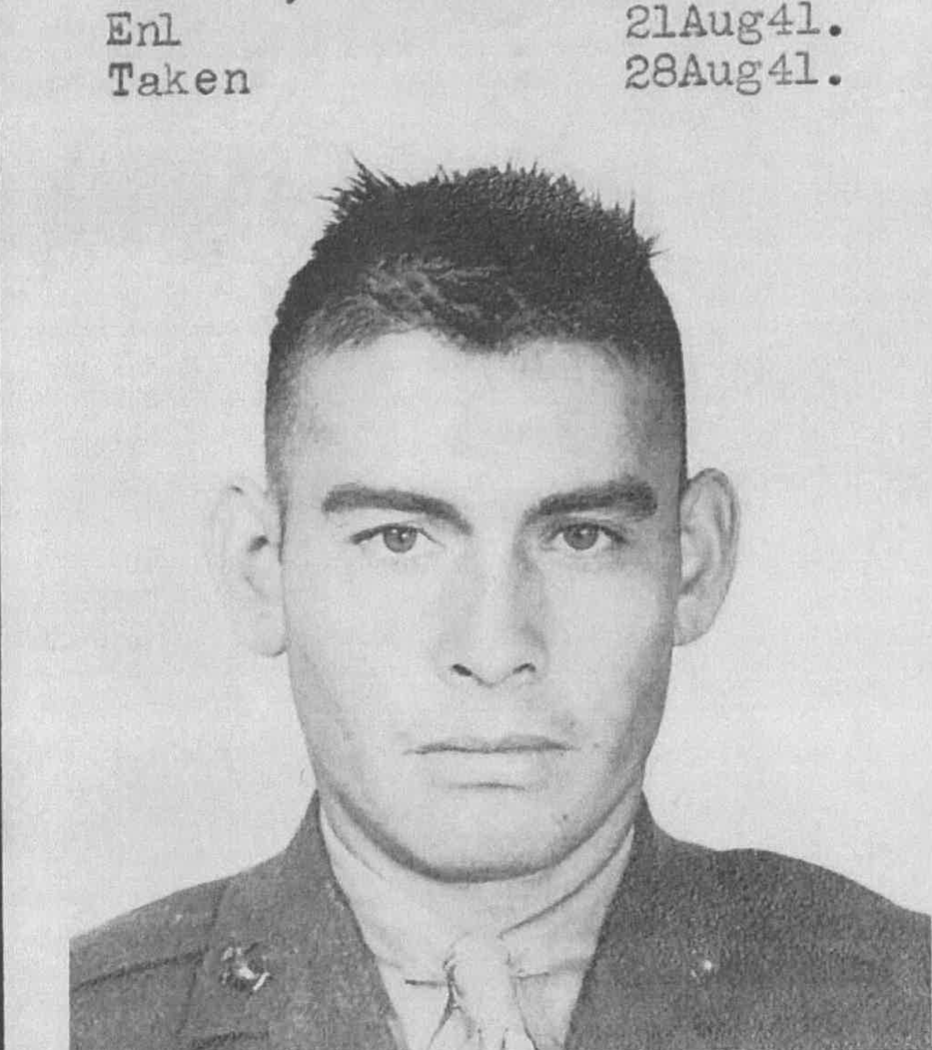
- Unit: 2nd Marine Division, 2nd Motor Transport Battalion, Company A
- Date of Birth: November 27, 1918
- Entered the Military: September 21, 1941
- Date of Death: December 29, 1992
- Hometown: Fort Cobb, Oklahoma
- Place of Death: Hilo, Hawaiʻi
- Award(s): Presidential Unit Citations, Army of Occupation Medal, American Defense Medal, American Campaign Medal, and World War II Victory Medal
- Cemetery: Section 3, Row 4, Plot 1. East Hawaii Veteran Center, No.1
Mentored by Ms. Pualeilani Fernandez
Hilo Intermediate School, Hilo, Hawaiʻi
2025/2026
Early Life
Robert Edward Lemmon was born on November 27, 1918, in a rural part of Caddo County, Oklahoma, known as North Fort Cobb. This area was impacted by droughts and the hardships of the Great Depression. His father, Clint Benjamin, was of Irish descent, and his mother, Stella, was a member of the Kadohadacho tribe. Together, they operated a family farm.
Lemmon’s childhood was chaotic. His father was “very hot-tempered,” and Lemmon was often the target of his father’s abuse. Lemmon was forced to leave school after sixth grade to work on the family farm. He worked as a farmhand, operating various types of machinery, including trucks and tractors, alongside his father on a 160-acre farm that grew corn, wheat, oats, and hay. It is likely that Lemmon’s seven siblings were also expected to help on the farm.
At the age of 18, Lemmon ran away from home and worked as a truck driver for a construction company in Arizona. Lemmon then worked for two years with the Civilian Conservation Corps (CCC) in Sentinel, Oklahoma. Lemmon was briefly married to Lorene Lane from December 1940 to January 1941.



Homefront
Agriculture
Cobb, located in Caddo County, Oklahoma, played a meaningful role in sustaining the nation’s food supply during World War II. When Oklahoma became a state in 1907, 80 percent of the county was farmland, with 360,000 acres of cotton, wheat, sorghum, and peanuts harvested. By the early 1940s, these same crops took on vital national importance. Federal demand for increased agricultural output drove production across Oklahoma, and Caddo County’s farmers answered the call. The food supply they helped sustain was essential to the home front and to overseas operations. One wartime account of Oklahoma noted that consumer goods, including gasoline, sugar, meat, and shoes, were rationed, but “the food supply was adequate.”
Wartime Manufacturing
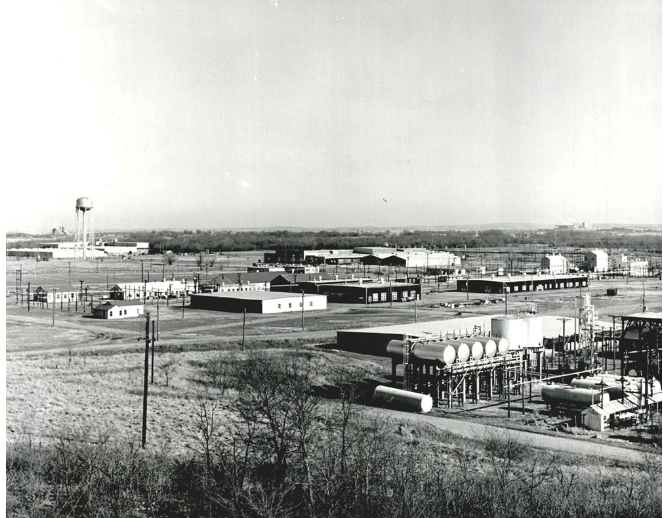
Oklahoma’s communities were deeply integrated into the national war production effort during World War II. According to the Encyclopedia of Oklahoma History and Culture, “during World War II, Oklahoma war facilities manufactured aircraft, weapons, ammunition, explosives, chemicals, aviation gasoline, and petroleum products,” and factories across the state also produced ship components, including masts and valves. Among the most significant of Oklahoma’s wartime industrial projects was the Oklahoma Ordnance Works, constructed in 1942. The plant employed nearly ten thousand workers who produced smokeless powder, nitric acid, sulfuric acid, and tetry, all essential to the production of explosives and detonators.
Government Propaganda and War Bond Campaigns
The wartime propaganda reached Cobb through local newspapers such as The Fort Cobb Express. Its pages featured war bond appeals in comic strips, limericks, and illustrated advertisements, as well as posters promoting the Red Cross. These locally published materials were part of a nationwide campaign that saw Americans invest approximately $185 billion in war bonds.

Military Experience
Enlistment and training
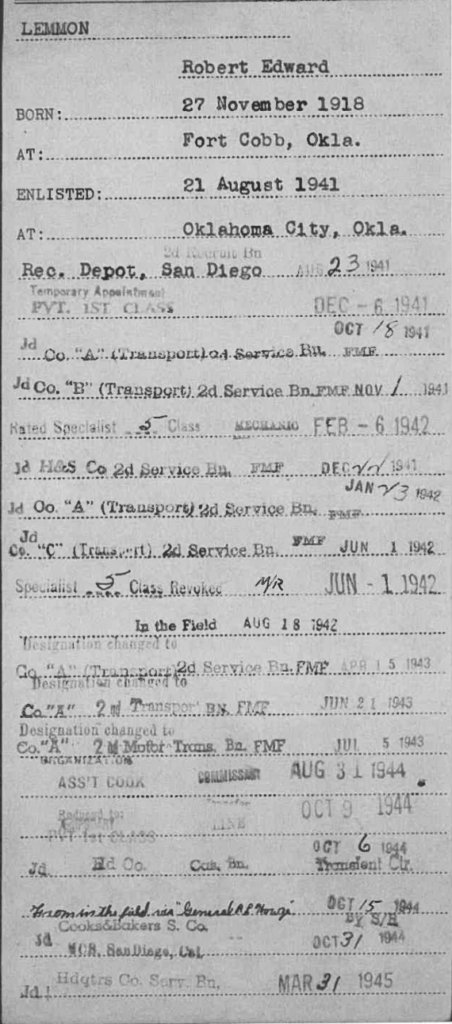
Lemmon enlisted in the United States Marine Corps on August 21, 1941, in Oklahoma City. He was transferred to the 2nd Recruit Battalion, Marine Corps Base San Diego, on August 23, 1941.
After recruit training, he joined Company A, 2nd Service Battalion, Fleet Marine Force. He was appointed to Private First Class on December 6, 1941. In February 1942, he was rated a specialist fifth-class mechanic.
Overseas Service
In June 1942, Lemmon embarked aboard USS Crescent City from San Diego through American Samoa, before participating in the Battle of Guadalcanal and the Battle of Tarawa.
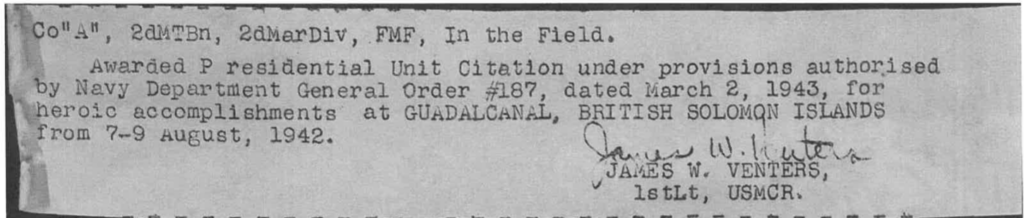
The Battle of Guadalcanal started on August 7, 1942. It was a decisive turning point in the Pacific Theater during World War II. This was the first major Allied land offensive against Japan. Lemmon and his company were awarded the Presidential Unit Citation for their service from August 7 to 9, 1942. They were part of an amphibious task force that landed on Guadalcanal, but after the disastrous Battle of Savo Island on the night of August 8-9, the Navy withdrew its ships to Espiritu Santo. Lemmon did not remain for the rest of the battle.
Following the Guadalcanal campaign, the 2nd Marine Division withdrew to New Zealand for rest and recuperation. From there, they deployed to Tarawa.
On November 20, approximately 12,000 troops from the 2nd Marine Division began amphibious assaults on Tarawa’s Betio Island. The Battle of Tarawa was a brief but significant battle that marked the first time the United States faced serious Japanese opposition to an amphibious landing. This battle was part of the “island hopping” campaign to take control of Japanese outposts in the Pacific Islands. Despite lasting only seventy-six hours, the heavy casualties prompted significant changes in amphibious tactics and equipment that improved survivability in future operations. Lemmon’s company was awarded a Presidential Unit Citation for their service here from November 20-27, 1943.
After Tarawa, the division was shipped to Hilo, Hawaiʻi. In 1944, Lemmon was stationed in multiple locations, including Honolulu, the Marshall Islands, and Saipan. On October 9, 1944, Lemmon embarked aboard USS General R.L. Howze for California. Back in the United States, Lemmon was assigned to a cooks-and-bakers school at Marine Corps Base San Diego. His principal military specialty was that of a cook, and his secondary specialty was auto mechanics.
Stateside
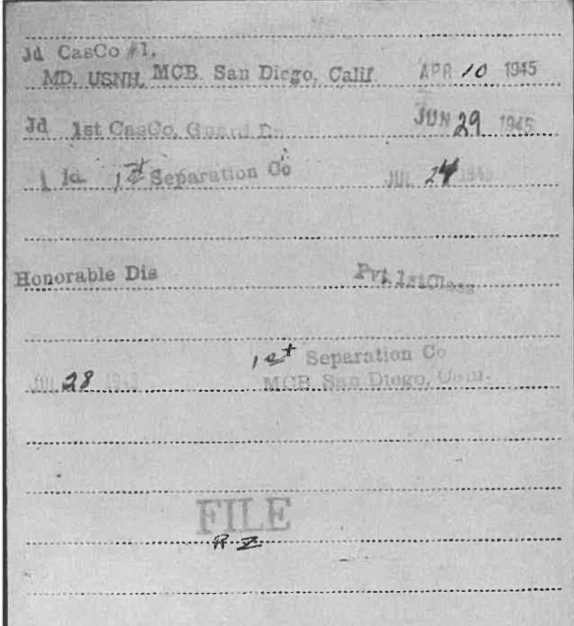
In April 1945, Lemmon started to show significant psychological distress and was placed on the sick list. The doctors determined that the condition was pre-existing but had been exacerbated by his 27 months of service overseas. He was discharged honorably from the U.S. Marine Corps on July 28, 1945, with a medical disability.
U.S. Army
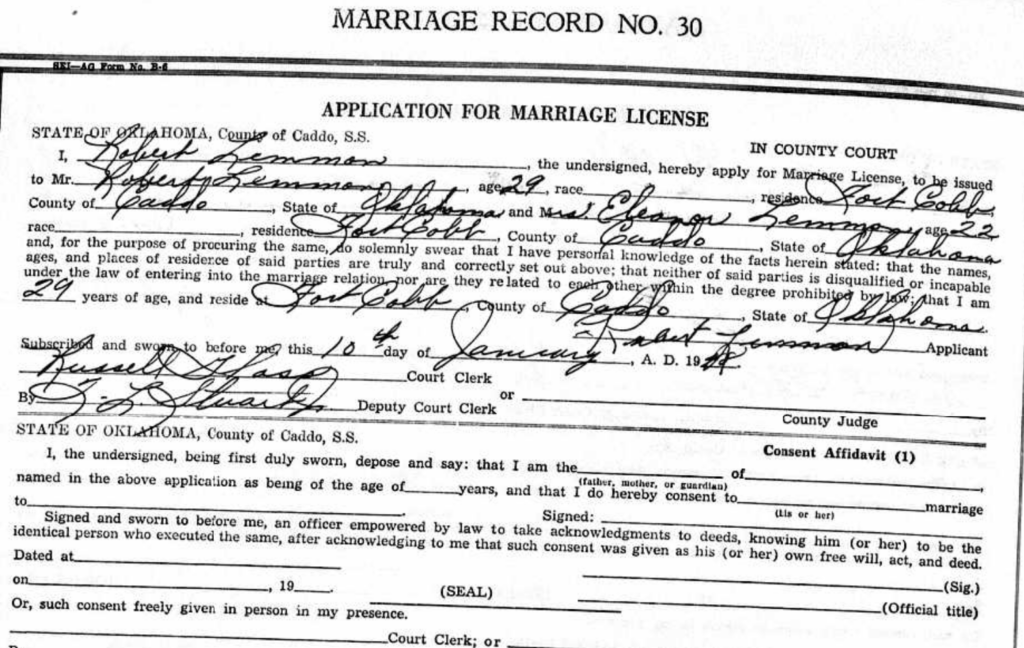
On January 10, 1948, Lemmon married Eleanor Kelaukela Kama. She was from Hilo, Hawaiʻi. On February 13, 1948, Lemmon re-enlisted, this time in the United States Army, in Kansas City, Missouri, as a cook. He was assigned to Company B, 37th Armored Infantry Battalion, and stationed in Kentucky and New Jersey before shipping overseas to Korea.
Korea
On April 15, 1948, Lemmon departed New York for Inchon, Korea, as part of the Army’s occupation forces in the Far East Command. There, he served with the Headquarters and Service Company of the 13th Engineer Battalion.
In late 1948, Lemmon started a series of hospitalizations that eventually led him to Brooke Army Medical Center at Fort Sam Houston, Texas. On May 19, 1949, he was medically discharged with a chronic disability. This time, it was due to chronic low back and left leg pain.

Veteran Experience
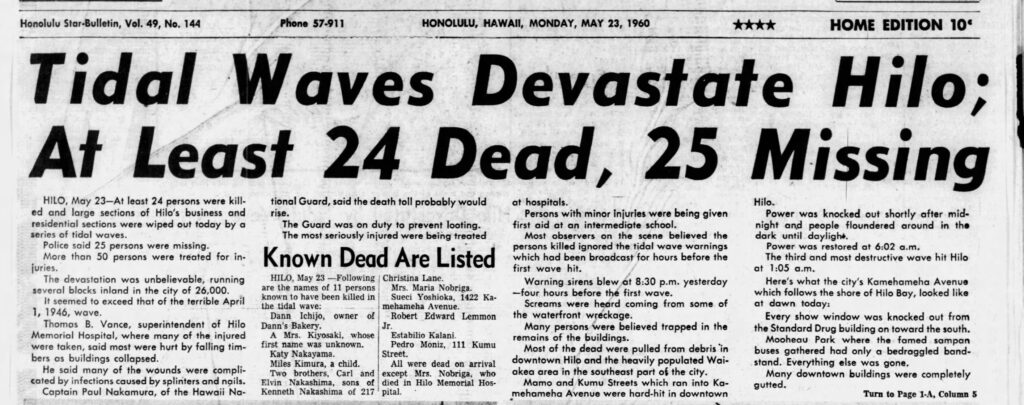
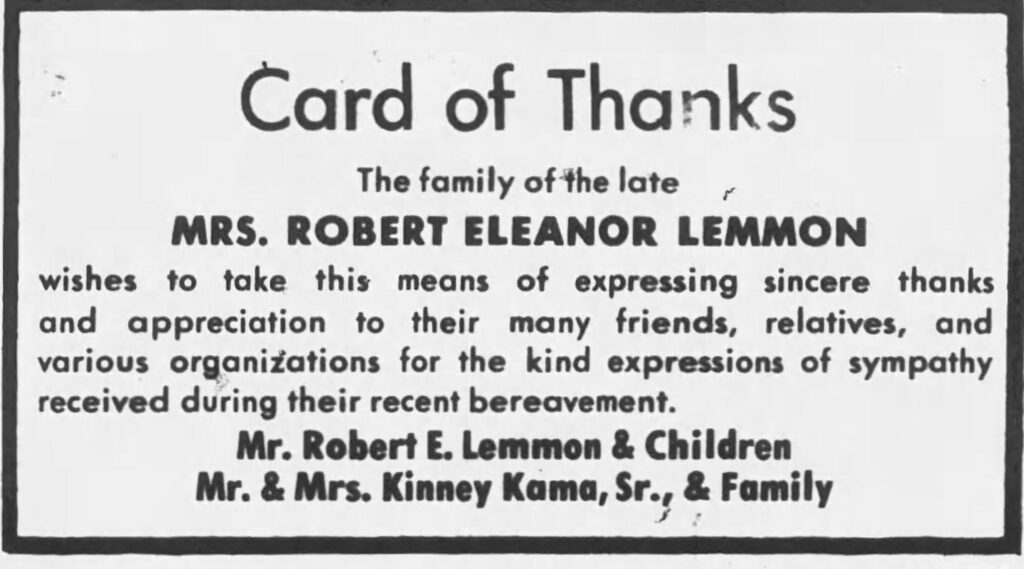
Robert and Eleanor Lemmon had five children: Richard Jr., Roy, Bertha, Richard, and Ruth. In 1957, they moved to Eleanor’s hometown of Hilo, Hawaiʻi. On May 23, 1960, there was a devastating tidal wave that killed dozens of residents, including Robert Jr. He was laid to rest at East Hawaiʻi Veterans Cemetery No. 1. Eleanor passed away on November 2, 1967, and was buried near her son.
Lemmon worked as a laundry worker at Hilo Hospital into his 70s.
Commemoration
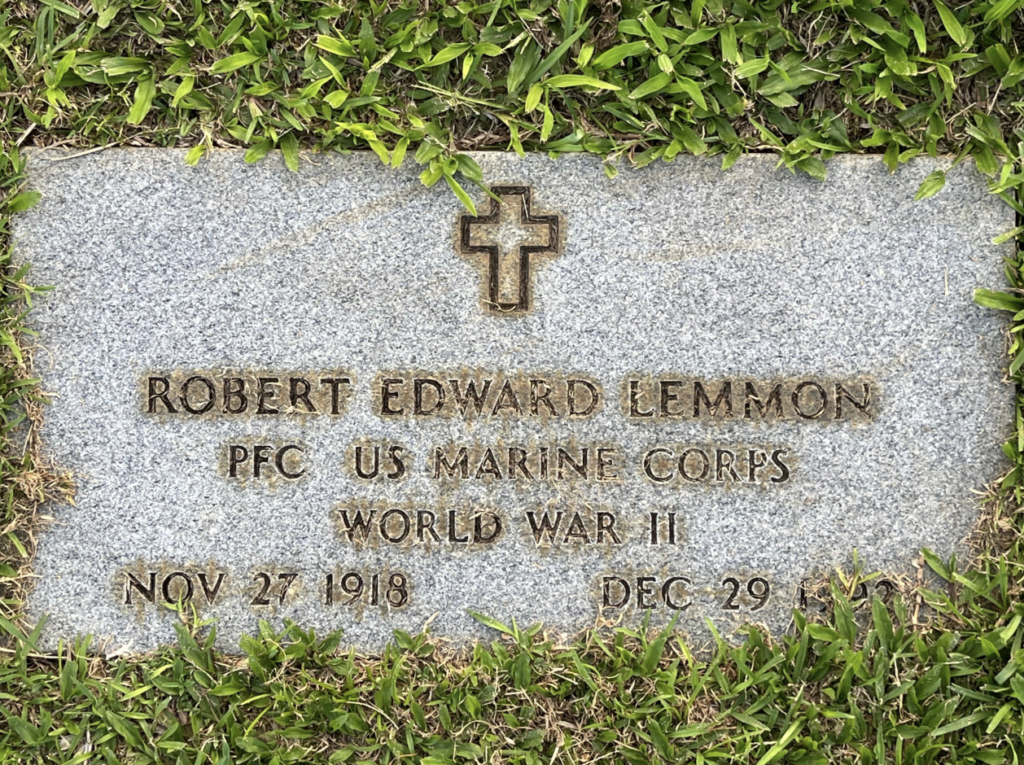
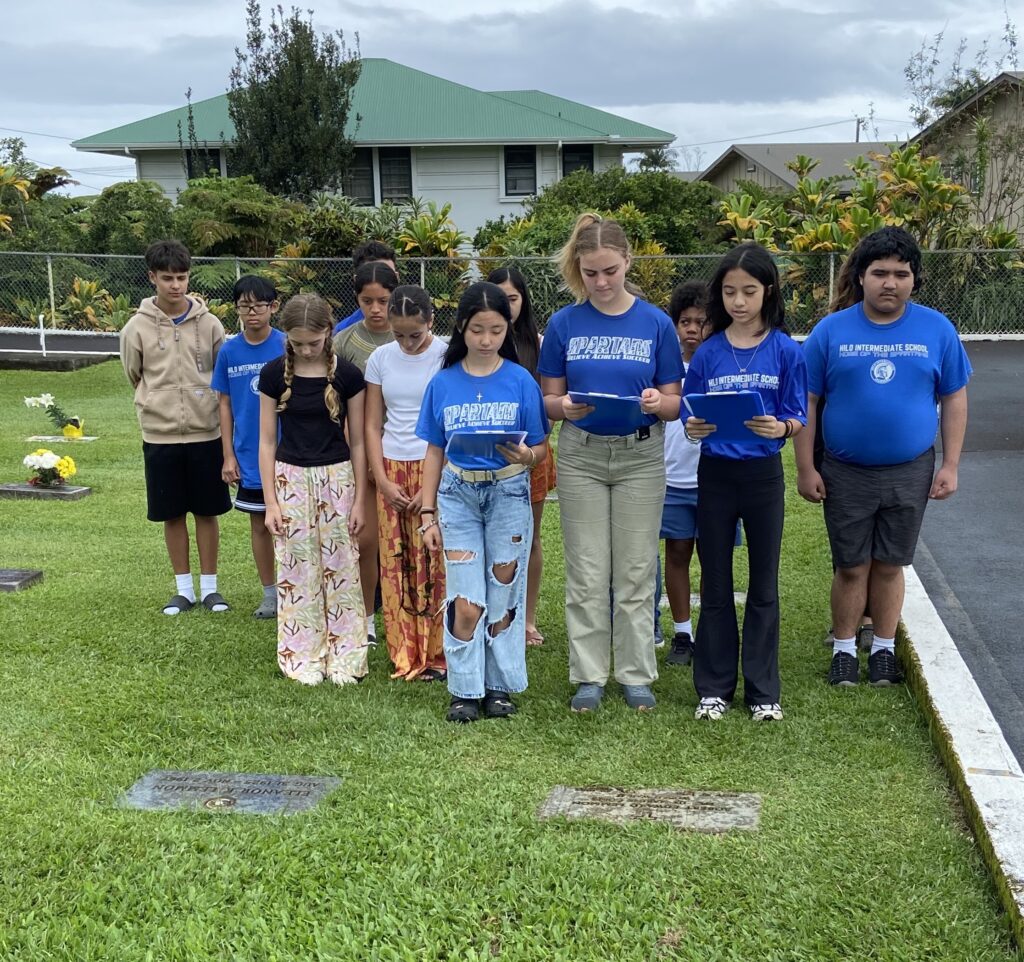
Private First Class Robert Edward Lemmon passed away on December 9, 1992. Lemmon is buried in Hilo, Hawaiʻi, at the East Hawaiʻi Veterans Cemetery No. 1. His life reminds us that we do not need a high-ranking military title to make an impact through service. It is a reminder that “showing up” is the first step and the highest commitment one can make.
Bibliography
Primary Source
“Buy War Savings Bonds.” The Fort Cobb Express [Fort Cobb, Oklahoma], December 10, 1942. Newspapers.com (743897963).
“Card of Thanks.” Hawaii Tribune-Herald [November 9, 1967], Newspapers.com (556323986).
“Divorces.” Anadarko Daily News [January 31, 1941], Newspapers.com (872935242).
“Do You Know?” The Caddo Herald [Caddo, Oklahoma], October 1, 1942. Newspapers.com (788609261).
Hawaii. Hilo County. 1940 Census. Digital Images. https://ancestryclassroom.com.
“Mail G.I. Christmas Gifts Overseas Early.” The Caddo Herald [Caddo, Oklahoma], October 5, 1945. Newspapers.com (788613125).
Nutty. U.S. Indian Census Rolls, 1885-1940. Digital Images. https://ancestryclassroom.com.
Robert Edward Lemmon. Oklahoma, U.S., County Marriage Records, 1890-1995. Digital Images. https://ancestryclassroom.com.
Oklahoma. Caddo County. 1910 U.S. Census. Digital Images. https://ancestryclassroom.com.
Oklahoma. Caddo County. 1920 U.S. Census. Digital Images. https://ancestryclassroom.com.
Oklahoma. Caddo County. 1930 U.S. Census. Digital Images. https://ancestryclassroom.com.
Oklahoma. Caddo County. 1940 U.S. Census. Digital Images. http://ancestryclassroom.com.
“Oklahoma Loses 15 percent of Population in the Past Five Years.” The Caddo Herald [Caddo, Oklahoma], June 1, 1945. Newspaper.com (788612640).
Polk’s Wichita City Directory. Kansas City, MO: R. L. Polk & Co. Publishers, 1951. Digital Images. http://ancestryclassroom.com.
“The Red Cross Needs You.” The Caddo Herald [Caddo, Oklahoma], January 9, 1942. Newspapers.com (788606970).
“Robert E. Lemmon.” Honolulu Star-Bulletin [Honolulu, Hawai’i], December 31, 1992. Newspapers.com (273873803).
Robert Edward Lemmon, Official Military Personnel File, Department of the Navy, National Archives and Records Administration – St. Louis.
Robert Edward Lemmon, Report of Separation, Department of the Navy, National Archives and Records Administration – St. Louis.
Stella Arnold Lemmon. U.S. General Land Office Records, 1776-2015. Digital Images. https://ancestryclassroom.com.
Stella Arnold. U.S., Indian Census Rolls, 1885-1940. Digital Images. https://ancestryclassroom.com.
“Tidal Waves Devastate Hilo; At Least 24 Dead, 25 Missing.” Honolulu Star-Bulletin [Honolulu, Hawai’i], May 23, 1960. Newspapers.com (269913755).
“Women Who Now Enlist in the WACS May Choose Their Jobs.” Hennessey Clipper [Hennessey, Oklahoma], November 4, 1943. Newspapers.com (591903207).
Secondary Source
Agnew, Brad. “The Encyclopedia of Oklahoma History and Culture. World War II.” Oklahoma Historical Society. Accessed November 10, 2025. https://www.okhistory.org/publications/enc/entry?entry=WO025.
“Caddo County.” The Encyclopedia of Oklahoma History and Culture. Accessed March 27, 2026. https://www.okhistory.org/publications/enc/entry?entry=CA005.
“Clint Benjamin Lemmon.” Find a Grave. Accessed October 31, 2025. https://www.findagrave.com/memorial/68771630/clint-benjamin-lemmon.
“Eleanor K. Lemmon.” Find a Grave. Accessed October 31, 2025. https://www.findagrave.com/memorial/215137407/eleanor-k-lemmon.
Everett, Dianna. “Oklahoma Ordinance Works.” Oklahoma Historical Society. Accessed November 10, 2025. https://www.okhistory.org/publications/enc/entry?entry=OK069.
“Fort Cobb (Town).” The Encyclopedia of Oklahoma History and Culture. Accessed March 1, 2026. www.okhistory.org/publications/enc/entry?entry=FO030.
Fugate, Tally D. “War Production Board.” Oklahoma Historical Society. Accessed November 10, 2025. https://www.okhistory.org/publications/enc/entry?entry=WA021.
Fugate, Tally D. “War Production Training Centers.” Oklahoma Historical Society. Accessed November 10, 2025. https://www.okhistory.org/publications/enc/entry?entry=WA022.
Meadows, William C. “Code Talkers.” Oklahoma Historical Society. Accessed November 10, 2025. https://www.okhistory.org/publications/enc/entry?entry=CO013.
Mullins, William H. “Works Progress Administration.” Oklahoma Historical Society. Accessed November 10, 2025. https://www.okhistory.org/publications/enc/entry?entry=WO022.
“Robert Edward Lemmon.” Find a Grave. Updated September 2, 2020. Accessed December 12, 2025. https://www.findagrave.com/memorial/215137447/robert-edward-lemmon.
“School Integration.” Edmond History Museum. Accessed November 10, 2025. https://www.edmondhistory.org/school-integration/.
Smallwood, James M. “Segregation.” Oklahoma Historical Society. Accessed November 10, 2025. https://www.okhistory.org/publications/enc/entry?entry=SE006.
“Stella Nutty Arnold Lemmon.” Find a Grave. Accessed October 31, 2025. https://www.findagrave.com/memorial/68771632/stella-nutty-lemmon.
Wilson, Linda D. “Caddo County.” Oklahoma Historical Society. Accessed November 26, 2025. www.okhistory.org/publications/enc/entry?entry=CA005.
This profile was funded by a grant from the United States Department of Veterans Affairs. The opinions, findings, and conclusions stated herein are those of the author and do not necessarily reflect those of the United States Department of Veterans Affairs.