Payclerk Francis Joseph Nelligan, Jr.
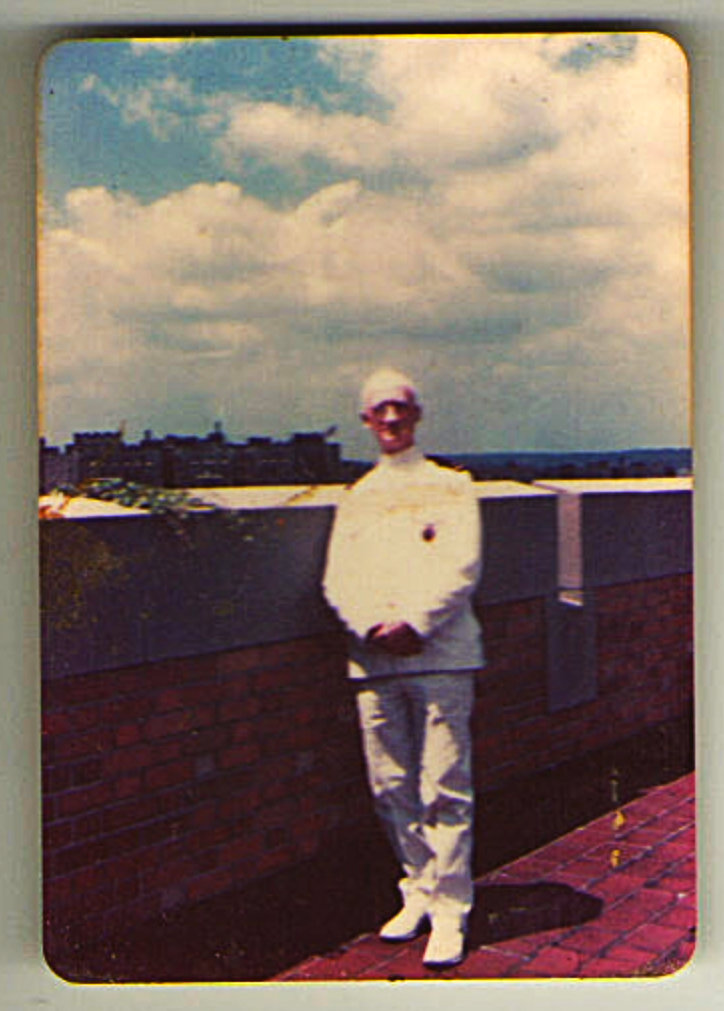
- Unit: Naval Training Station (Women’s Reserve), Bronx, New York
- Date of Birth: January 1, 1880
- Entered the Military: April 19, 1907
- Date of Death: June 28, 1950
- Hometown: Binghamton, New York
- Place of Death: Brooklyn, New York
- Award(s): World War I Victory Medal, American Campaign Medal, World War II Victory Medal
- Cemetery: Section 3, Site 182. Cypress Hills National Cemetery, Brooklyn, New York
Mentored by Mr. Bryan Melnick
Simon Baruch Middle School, MS104, New York, New York
2025/2026
Early Life
Francis Joseph Nelligan, Jr. was born on January 1, 1880, in Binghamton, New York, to Francis Joseph Nelligan Sr. and Mary E. Glynn, Irish immigrants. The couple also had a daughter, Josephine.
Francis Sr. worked as an engineer at a sawmill. In 1900, the family bought a home on Walnut Street in Binghamton, which at least one member of the Nelligan family would live in through the 1950s.
According to the 1900 census, Nelligan was still in school at age 20. Before he entered the military, he worked as a stenographer.

Homefront
During World War I
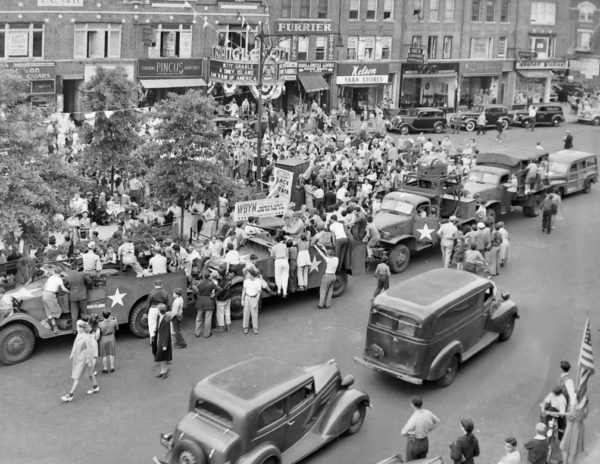
During Nelligan’s time in Binghamton, the city underwent a significant industrial boom, experiencing nearly 300% population growth. The community offered abundant opportunities for maintaining a comfortable standard of living. During World War I, Binghamton and the surrounding Triple Cities of Endicott and Johnson City threw their industrial weight behind the war effort. The region’s dominant employer, the Endicott-Johnson Corporation, was the world’s largest shoe company when the war broke out. It supplied virtually the entire U.S. Army with boots, employing roughly 20,000 workers in its factories.
Binghamton’s immigrant communities, who had come to the area seeking work in its factories, sent sons into service, while those who stayed home participated in Liberty Loan drives, Red Cross volunteer work, and food conservation campaigns.
During World War II
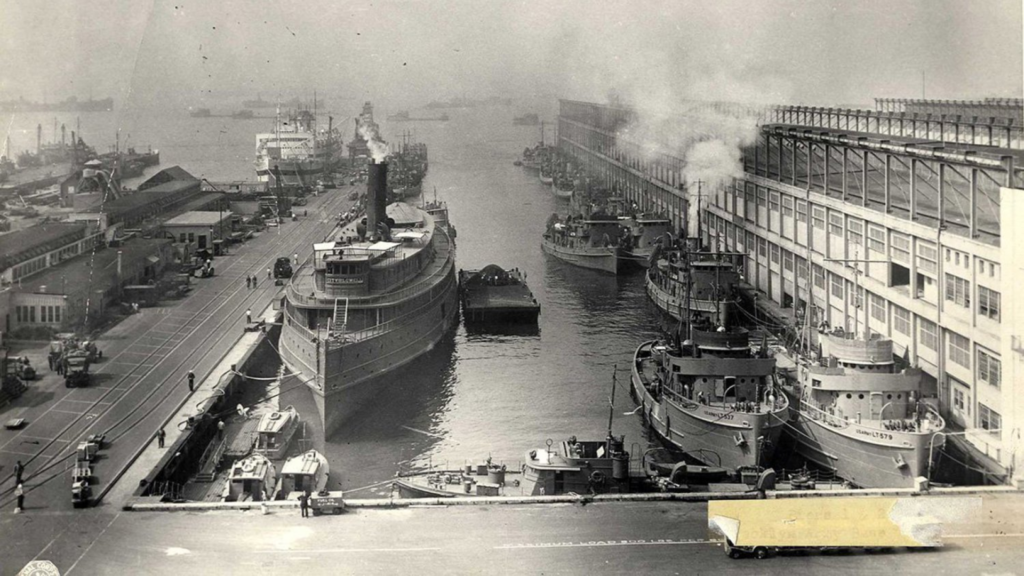
During World War II, Nelligan lived in Brooklyn, New York. As World War II began, Brooklyn transformed into a massive industrial engine. The borough became a significant hub for shipbuilding and the movement of supplies, with the local workforce growing massively to meet this new demand. This effort brought many new groups, including women and African Americans, into crucial roles in factories and shipyards. At the heart of it all, the Brooklyn Army Terminal helped ship tons of supplies and troops overseas. This was the nation’s largest military supply base, employing over 25,000 personnel.
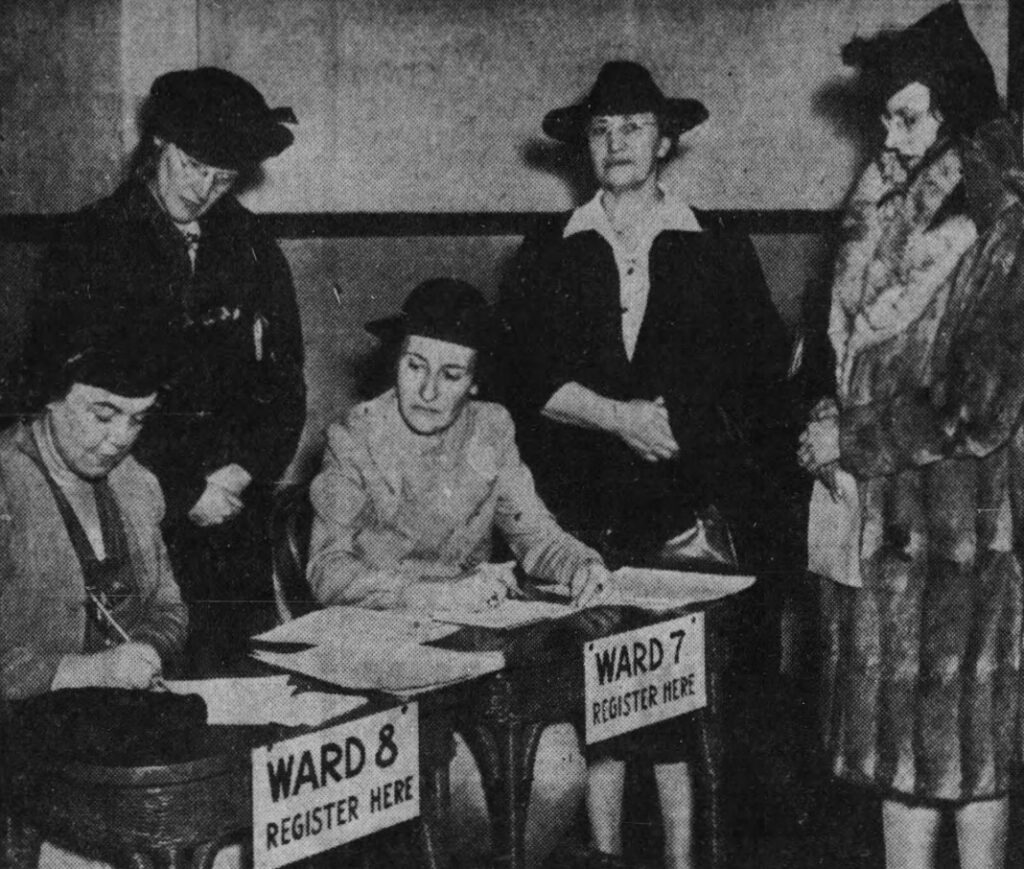
As during World War I, citizens also participated in Liberty Bond rallies, Red Cross volunteer drives, and food conservation efforts. New to this war was the role of “Air Warden.” Citizens from Binghamton to Brooklyn, and across the rest of the East Coast, adopted the practice of memorizing aircraft shapes. Never before had so many aircraft filled the skies. During this time, U.S. factories produced over a quarter of a million planes. Americans as young as grade school quickly learned how to identify friends from foes. Plane spotters sat in thousands of observation posts armed with binoculars and resolve. They maintained focus on the clouds, ready to alert their community of any possible air raid. Fortunately, that threat never materialized.
Military Experience
Enlistment and Early Postings
Nelligan enlisted in the U.S. Navy on April 19, 1907. Over the next few years, he served aboard USS Constellation, USS Kansas, USS Connecticut, and USS Hancock.
World War I
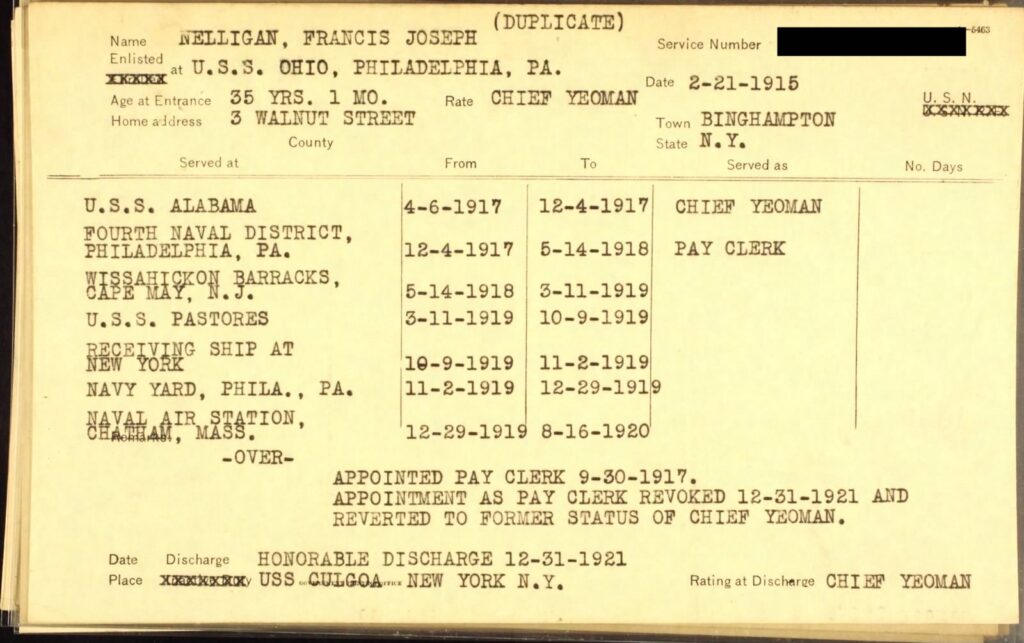
On April 6, 1917, the day Congress declared war on Germany, Nelligan came aboard USS Alabama, a training and receiving ship for recruits, as a chief yeoman. This role required great organization and leadership skills. He would have managed all official correspondence, personnel records, legal documents, and reports, making him an essential figure in maintaining the ship’s operations. On September 30, 1917, he was appointed to pay clerk.
On December 4, 1917, Nelligan left USS Alabama and worked as a pay clerk in several locations, including the 4th Naval District in Philadelphia, Pennsylvania; Wissahickon Barracks in Cape May, New Jersey; USS Pastores; the Naval Air Station in Chatham, Massachusetts; and USS Culgoa. This role included taking up pay accounts, paying mileage and endorsing it on orders, paying uniform allowances, registering allotments, paying personnel twice a month, and closing out accounts at the end of each term. At the end of 1921, the Navy reverted Nelligan’s rank to chief yeoman.
Nelligan re-enlisted on January 5, 1922, and transferred to the Fleet Naval Reserve on July 7, 1922, before being placed on the retired list on March 1, 1937.
Life Between the Wars
Nelligan wore many hats after returning to Binghamton. Family lore said he, by hobby, raced bicycles, a roaring 20’s craze. According to Census records and Binghamton City Indexes, he was, at various times, a clothing salesman, bookkeeper, engraver, and law student.
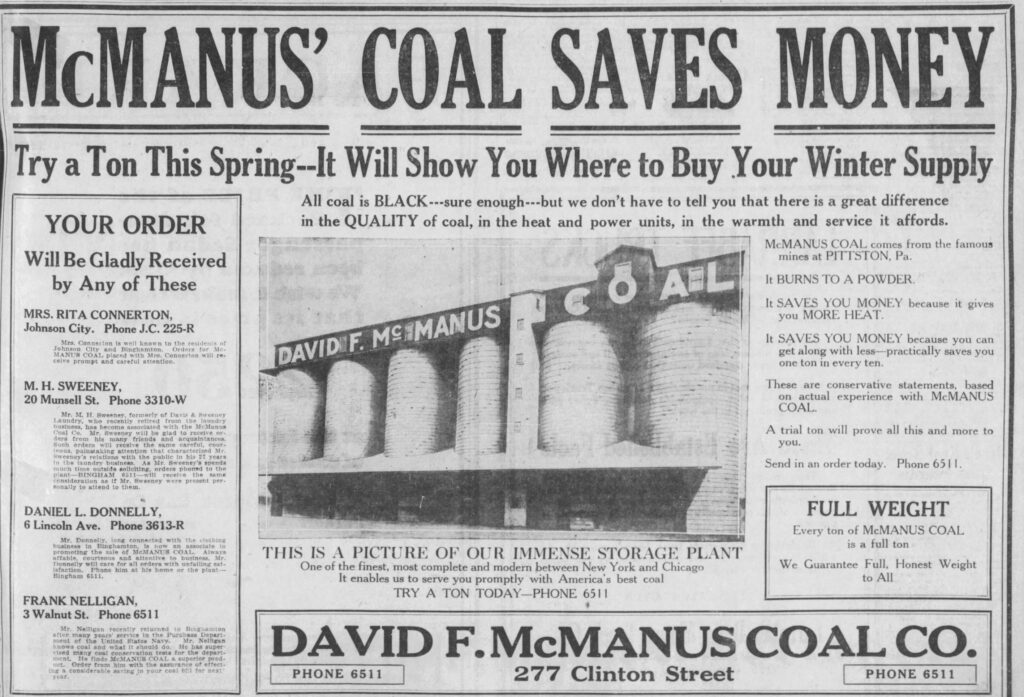
Nelligan met and married Anna Marie Fitzgerald of Poughkeepsie in 1929. They remained in Binghamton through 1940, when Nelligan worked as a coal salesman.
While he spent most of his adulthood between the wars in Binghamton, Nelligan and his wife eventually moved to Brooklyn, New York. They lived at and operated a boarding house on Carlton Avenue in Clinton Hill.
World War II
When the chance to serve his country arose again, on August 3, 1942, at the age of 62, Nelligan was recalled to active duty from retirement. He was reappointed to the acting pay clerk position on December 9, 1942. On January 16, 1943, Nelligan reported to the Naval Training School at Princeton University in New Jersey. Two months later, he was transferred to the Naval Training School (Women’s Reserve) in the Bronx, New York.
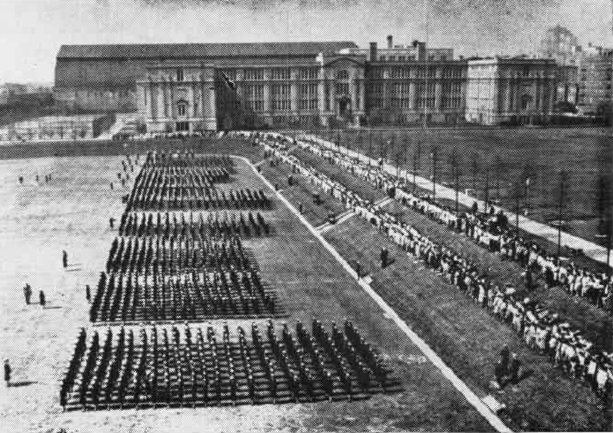
The Naval Training School, also known as USS Hunter, occupied the Bronx campus of Hunter College and served as the primary boot camp for the Women Accepted for Volunteer Emergency Service (WAVES). The WAVES were established on July 30, 1942, and the Bronx Campus opened on February 8, 1943.
The military commandeered the surrounding apartment buildings and adapted campus facilities to house the women. Experienced pay clerks were needed to help process the thousands of new recruits, manage housing requisitions, and maintain pay and personnel records across a constantly rotating population.
WAVES received their boot training there throughout the war up until February 1, 1946. The campus processed roughly 2,000 recruits every two weeks. WAVES served domestically as well as in the territories of Alaska and Hawaii. Of the over 100,000 WAVES, the majority were processed and trained in the Bronx.
Nelligan commuted via the Interborough Rapid Transit Lines (IRT) from his home in Brooklyn to the Bronx campus every day. This ride would have included transfers and taken almost two hours each way. Nelligan served at USS Hunter in an administrative and pay-accounts capacity until August 4, 1944, when he was admitted to the Naval Convalescent Hospital in Harriman, New York, for treatment. He was then ordered to appear before a Retiring Board.
Nelligan was released from active duty on November 30, 1944. On January 31, 1945, he was advanced to the retired list with the permanent grade of acting pay clerk.


Veteran Experience
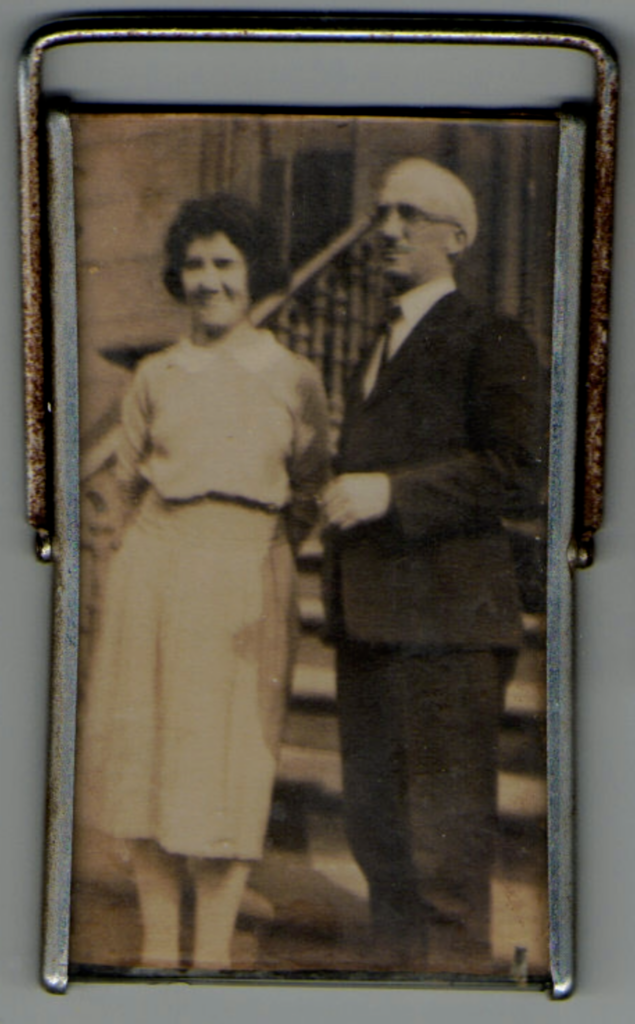
Nelligan and his wife, Anna, spent the post-war years entertaining family in Brooklyn. They also often traveled to Binghamton and Poughkeepsie.
The couple also continued to operate a rooming house out of their home.
Commemoration
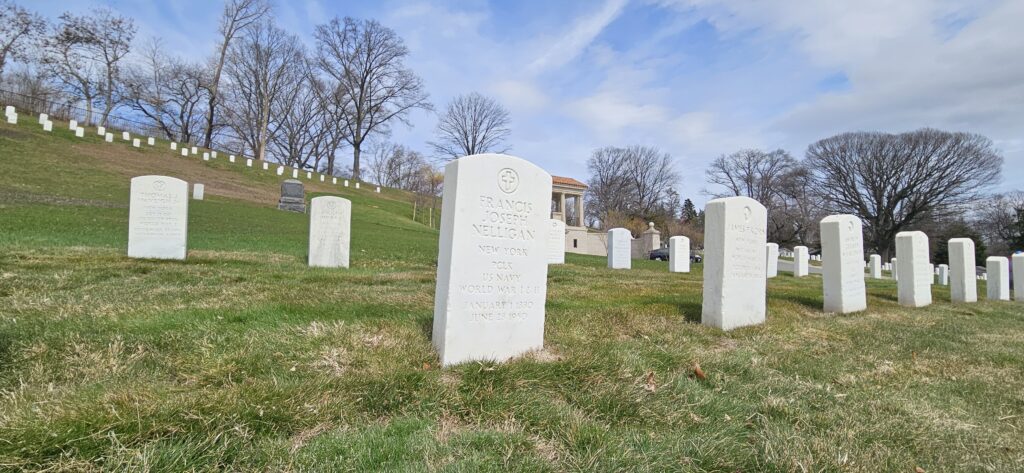
Francis Nelligan, Jr., passed away on June 28, 1950, at the age of 70. He was buried at Cypress Hills National Cemetery in Brooklyn, New York. Anna was buried with him in 1968.
Nelligan proved that a man can be useful at any age. He had just as much to contribute during World War II as he did during World War I. Nelligan showed us the effort, sacrifice, and enduring resilience demonstrated during this period that were instrumental in bringing peace.
Bibliography
Primary Sources
Brooklyn Army Terminal. Photograph. Brooklyn Army Terminal. https://brooklynarmyterminal.com/about.
Burleigh, L. R. “Binghamton, NY | Library of Congress.” Library of Congress, www.loc.gov/resource/g3804b.pm005373/. Accessed 10 Dec. 2025.
Camp Wissahickon, U.S. Naval Training Station, Camp May, N.J. Photograph. 1918. World War 1 Centennial. https://www.worldwar1centennial.org/index.php/communicate/press-media/wwi-centennial-news/2390-cape-may-theater-production-looks-back-at-nj-in-wwi.html.
Francis Joseph Nelligan. New York State, Marriage Index, 1881-1967. Digital Images. https://ancestryclassroom.com.
Francis Joseph Nelligan. New York, U.S., Abstracts of World War I Military Service, 1917-1919. Digital images. https://ancestryclassroom.com.
Francis Joseph Nelligan. U.S., Select Military Register, 1862-1985. Digital Images. https://ancestryclassroom.com.
Francis Joseph Nelligan. US, WWI New York Army Cards, 1917-1919. Digital Images. https://www.fold3.com/.
Francis Joseph Nelligan. World War II Draft Registration Cards, 1942. Digital Images. https://ancestryclassroom.com.
“Francis Nelligan, 43 Years Navy.” Brooklyn Eagle [Brooklyn, New York], July 1, 1950. Newspapers.com (686215194).
Massachusetts. Barnstable County. 1920 U.S. Census. Digital images. https://ancestryclassroom.com.
“McManus’ Coal Saves Money.” Press and Sun-Bulletin [Binghamton, NY], March 16, 1927.
Nelligan Family Records, 1945-1950. Courtesy of Lou Stantz.
New York. Broome County. 1900 U.S. Census. Digital Images. https://ancestryclassroom.com.
New York. Broome County. 1930 U.S. Census. Digital Images. https://ancestryclassroom.com.
“New York’s First Free Sand To Be Given Out in Brooklyn.” Brooklyn Eagle [Brooklyn, New York], March 8, 1942. Newspapers.com (52677636).
NH 2359 USS Culgoa. Photograph. 1920. NH Series Collection, Naval History and Heritage Command. https://www.history.navy.mil/our-collections/photography/numerical-list-of-images/nhhc-series/nh-series/NH-02000/NH-2359.html.
NH 61208 USS Connecticut. Photograph. c.1909-1914. Battleships Collection, Naval History and Heritage Command. https://www.history.navy.mil/our-collections/photography/us-navy-ships/battleships/connecticut-bb-18/NH-61208.html.
Register of Commissioned and Warrant Officers of the United States Navy and Marine Corps of July 1, 1943. Government Printing Office, 1943.
Robb, Izetta Winter. “Reflections on the WAVES.” Naval Aviation News, July 1967. https://www.history.navy.mil/content/dam/nhhc/research/histories/naval-aviation/Naval%20Aviation%20News/1960/pdf/jul67.pdf.
Stantz, Lou. Telephone interview with the authors. April 21, 2026.
“Uncle Sam’s Advice on Flu.” Five Mile Beach Weekly Journal [Wildwood, New Jersey], October 18, 1918. Newspapers.com (891090761).
USS Aeolus and USS Pastores at Hoboken, NJ. Photograph. 1919. USS Pastores Collection, 2nd Division—Second to None. https://2nd-division.com/2nd.engineers/_engr.misc/pastores.htm.
USS Connecticut, U.S. Navy. 1910 U.S. Census. Digital Images. https://ancestryclassroom.com.
Secondary Sources
Brody, Lenny. “Lessons from the Class Struggles of the 1930s and 1940s.” University of the Poor. Accessed November 1, 2025. https://universityofthepoor.org/lessons-from-the-class-struggles-of-the-1930s-and-1940s/.
Brooklyn Connections: Brooklyn Army Terminal Primary Source Packet. Brooklyn Public Library, Brooklyn Connections. https://static.bklynlibrary.org/prod/public/documents/brooklyn-collection/connections/BAT%20PP.pdf.
“Endicott-Johnson Shoe Company.” Gregory Couch. Accessed May 7, 2026. https://www.gregorycouch.com/endicott-johnson-shoe-company.
“Francis Joseph Nelligan Jr.” Find a Grave. Accessed October 31, 2025. https://www.findagrave.com/memorial/15992875/francis_joseph-nelligan.
Hinnershitz, Stephanie. “The Smith-Connally Act and Labor Battles on the Home Front.” The National WWII Museum-New Orleans. Last updated June 22, 2023. Accessed December 10, 2025. https://www.nationalww2museum.org/war/articles/smith-connally-act-and-labor-battles-home-front
Holland, Joy. “Gardens of Brooklyn Part II: Victory Gardens.” Center for Brooklyn History at Brooklyn Public Library. Last updated July 19, 2011. Accessed November 1, 2025. www.bklynlibrary.org/blog/2011/07/19/gardens-brooklyn-part-ii.
Kaufman, Phil. “Kaufman’s Brooklyn: Six Photos of ‘World War II: On the Home Front’.” Brooklyn Daily Eagle [Brooklyn, New York], September 10, 2020. brooklyneagle.com/articles/2020/09/08/kaufmans-brooklyn-six-photos-of-world-war-ii-on-the-home-front/.
National Women’s History Museum. “The WAVES of World War II.” National Women’s History Museum. September 25, 2019. Accessed November 1, 2025. https://www.womenshistory.org/exhibits/waves-world-war-ii.
“Propaganda and the American Public | Experiencing History: Holocaust Sources in Context.” United States Holocaust Memorial Museum. Accessed December 10, 2025. perspectives.ushmm.org/collection/propaganda-and-the-american-public.
“(Re)Connecting Brooklyn’s History: Brooklyn’s Homefront during World War II with Brooklyn Public Library.” Turnstile Tours Last updated January 2, 2024. Accessed December 10, 2025. https://turnstiletours.com/brooklyns-homefront-during-world-war-ii-with-brooklyn-public-library/.
“Shoes Were a Good Fit for Binghamton.” Visit Binghamton. Accessed May 7, 2026. https://visitbinghamton.org/articles/shoes-were-a-good-fit-for-binghamton/.
Smith, Gerald. “During World War II, Air Wardens Helped Area Stay Prepared by Keeping Eyes on the Skies.” Press & Sun-Bulletin [Binghamton, New York], February 28, 2022. https://www.yahoo.com/news/during-world-war-ii-air-104245940.html.
This profile was funded by a grant from the United States Department of Veterans Affairs. The opinions, findings, and conclusions stated herein are those of the author and do not necessarily reflect those of the United States Department of Veterans Affairs.