
Corporal Addie Belle Raybon Bozeman
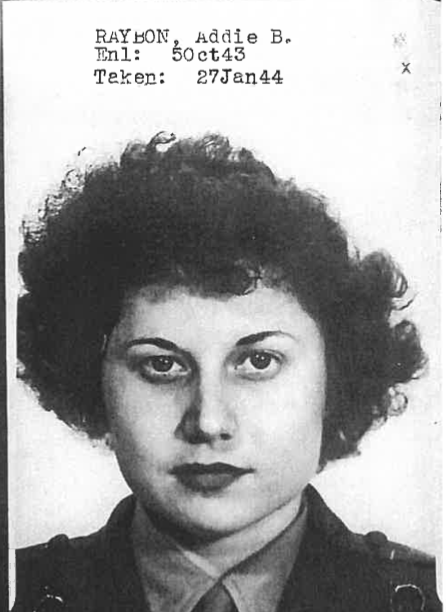
- Unit: Marine Barracks, Washington, D.C., Marine Corps Institute Detachment
- Date of Birth: November 24, 1920
- Entered the Military: October 5, 1943
- Date of Death: February 24, 2019
- Hometown: Randolph, Alabama
- Place of Death: Hueytown, Alabama
- Cemetery: Section 2, Grave 1201. Alabama National Cemetery, Montevallo, Alabama
Mentored by Ms. Callie Rhodes Outlaw
Tuscaloosa Academy, Tuscaloosa, Alabama
2025/2026
Early Life
Addie Belle Raybon was born on November 24, 1920, in Randolph, Bibb County, Alabama. Her parents were Charles “Charley” and Effie Wallace Raybon. Her grandparents were Sandy and Frances Raybon and John and Julia Wallace. She had three older siblings: Charles, Effie, and John Sidney.
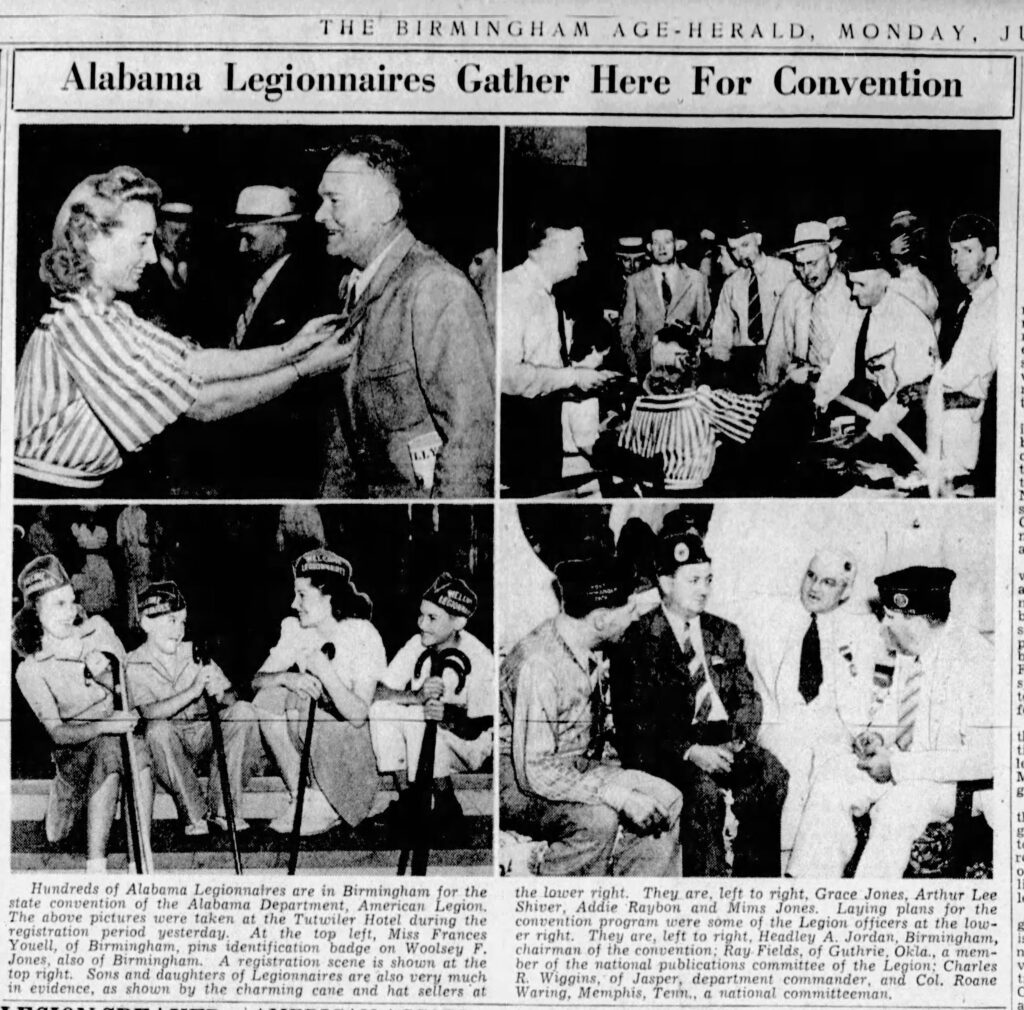
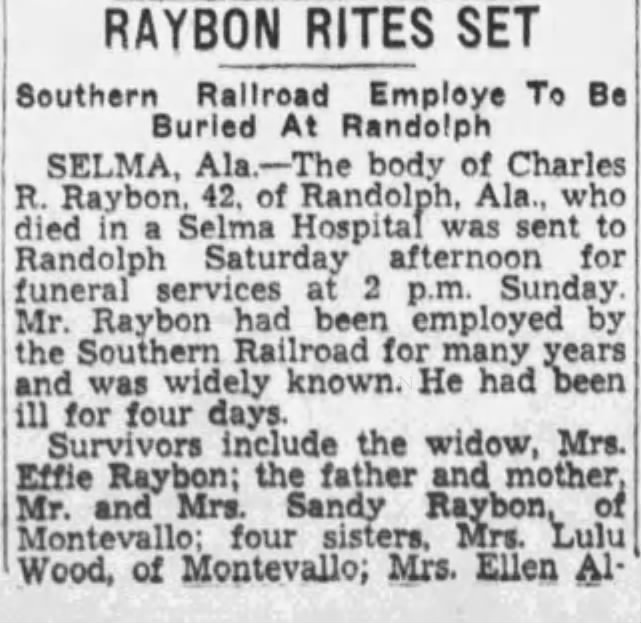
Raybon’s father, Charley, died of a sudden illness in 1934. Soon after, her mother was hospitalized for psychiatric treatment, and she remained in inpatient care until her death in 1942. Raybon moved to Birmingham as a young teenager and lived with her sister’s family. Here, she was active in the Alabama Department of the American Legion.
Raybon graduated from Ensley High School in January 1941 with a commercial track diploma. The program prepared students heading into the workplace after graduation. It typically included courses such as shorthand, bookkeeping, and telephone operations. While in high school, Raybon worked for the Tennessee Coal, Iron and Railroad Company sorting scrap tin. She also worked as a sales clerk at Silver’s Five and Dime Store. Upon graduation, Raybon worked as a switchboard operator for the Southern Bell Telephone and Telegraph Company.
Homefront
History
An industrial city founded in 1871 as the center of Alabama’s new steel industry, Birmingham and the surrounding areas are rich with both coal and iron ore. The city is surrounded by a sprawling cluster of smaller urban neighborhoods and suburban enclaves, all nestled at the southern terminus of the Appalachian Mountains.
Production
Birmingham was home to the Bechtel-McCone-Parsons Birmingham Modification Center. This plant modified planes before they were deployed. It employed 14,000 people, 40 percent of whom were women. In addition to manufacturing work, the plant employed female pilots to shuttle planes between facilities and conduct some test flights, thus freeing up male pilots for combat roles. Half of the B-29 bombers used in World War II were modified in Birmingham.
Tennessee Coal & Iron’s workforce went from 7,000 in 1939 to 30,000 in 1941, due to the massive demand for steel. During the Depression, Franklin Roosevelt called Birmingham “the worst-hit town in the country.” While the New Deal’s welfare and employment programs helped Birmingham significantly, war production ended the Depression.
Community Involvement
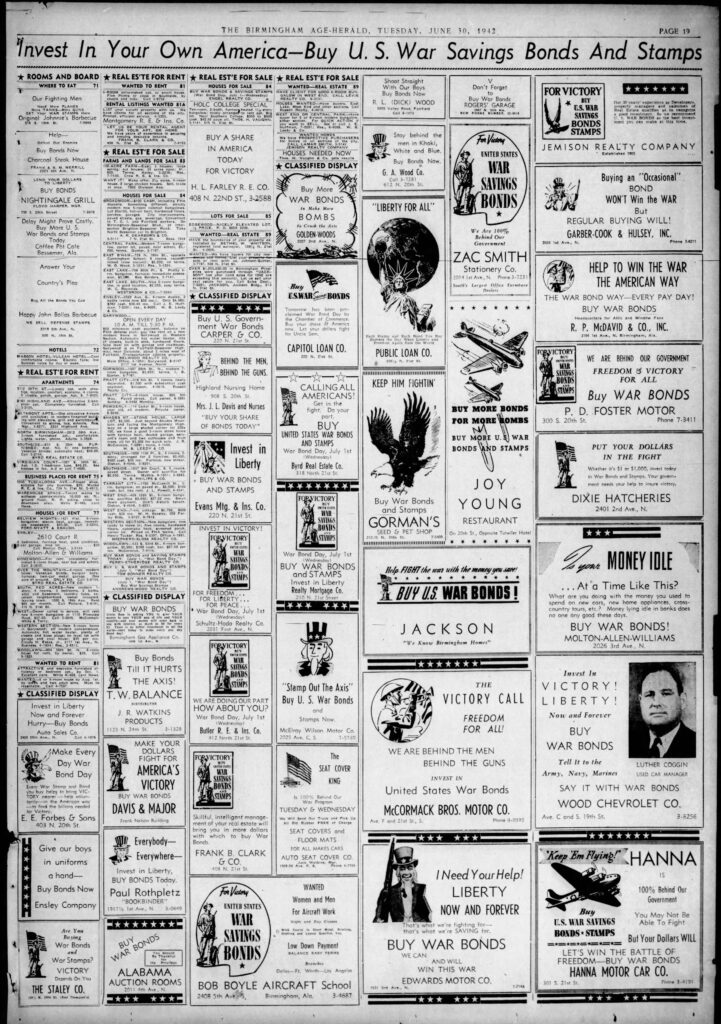
Birmingham residents grew Victory Gardens to support the war effort. The city offered up land for the gardens. The major industrial plants offered employees land and usually took care of plowing. Upper-middle-class clubwomen used their civic leadership to head up the local Victory Garden movement. The Birmingham Post sold a pamphlet on Victory Gardening. Birmingham residents adhered to the same kinds of rationing that all Americans were subject to — everything from sugar to shoes. Birmingham businesses encouraged residents to buy war bonds, and the Red Cross raised hundreds of thousands of dollars for the war effort.
Population Influx
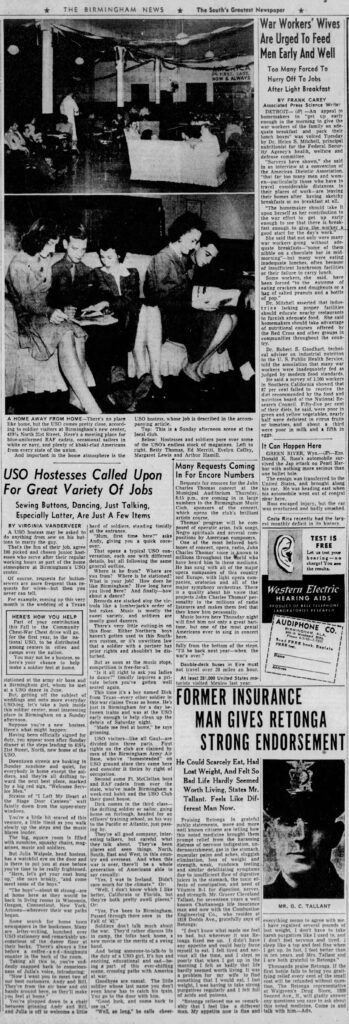
The Birmingham United Service Organizations (USO) canteen received over 1 million visitors in its first 22 months of operation. Birmingham’s overall population increased by about 13 percent by September 1942, but it did not experience the same drastic influx of war workers as cities like Childersburg and Mobile, Alabama. This was due to Birmingham’s already-established industrial presence.
Upper- and middle-class women who did not need to enter the workforce volunteered at organizations such as the Red Cross and USO, drawing on their prior experience leading women’s clubs in the state. Black Alabamians did enter into industry jobs in large numbers, but were excluded from higher-paying skilled jobs in most cases.
Military Experience
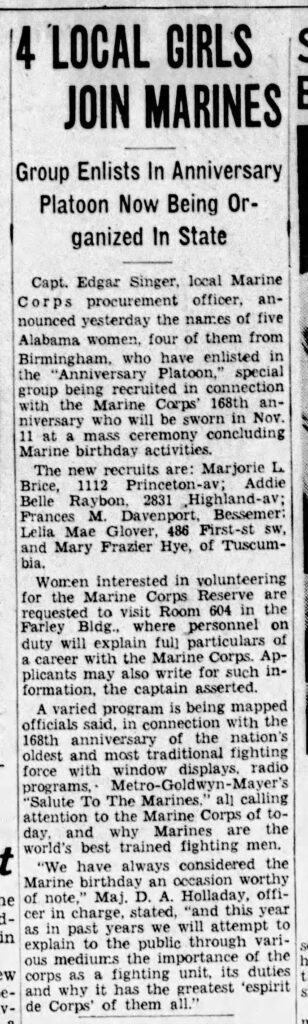
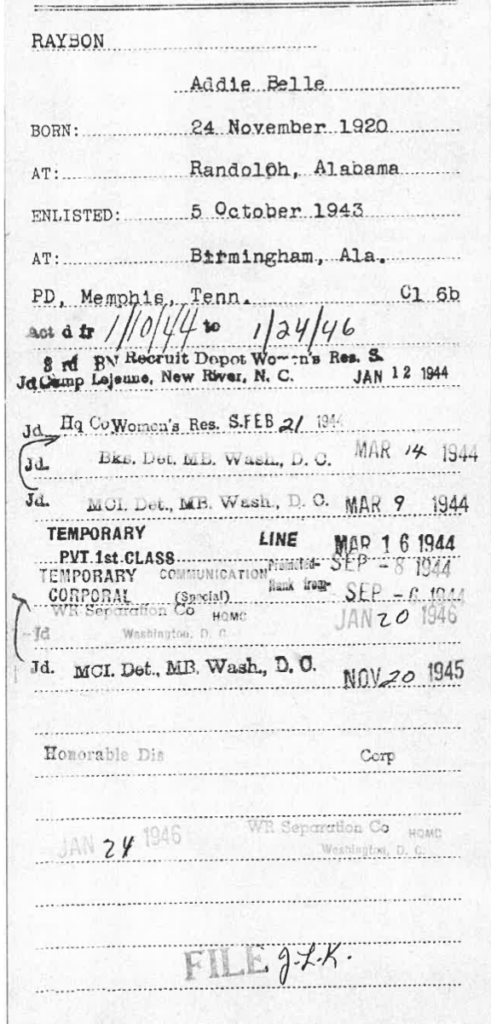
Raybon enlisted in the Women’s Marine Corps Reserve “Anniversary Platoon” on October 5, 1943. She enlisted in Birmingham, Alabama, along with four other women, who were sworn in on November 11, 1943, during a special ceremony that concluded the two-day celebration of the U.S. Marine Corps’s November 10 birthday.
On January 10, 1944, Raybon reported to the Marine Corps Procurement District of Birmingham and traveled by train through Atlanta, Georgia, to Camp Lejeune in North Carolina. Here she completed her training and was assigned to Headquarters Company, Women’s Reserve School on February 21, 1944. In March 1944, she moved to the Barracks Detachment at Marine Barracks, Washington, D.C., and was promoted to private first class.
Private First Class Raybon remained at this post for the rest of the war, working as a telephone switchboard operator, where she manually routed calls and logged communications. On September 8, 1944, Raybon was promoted to corporal.
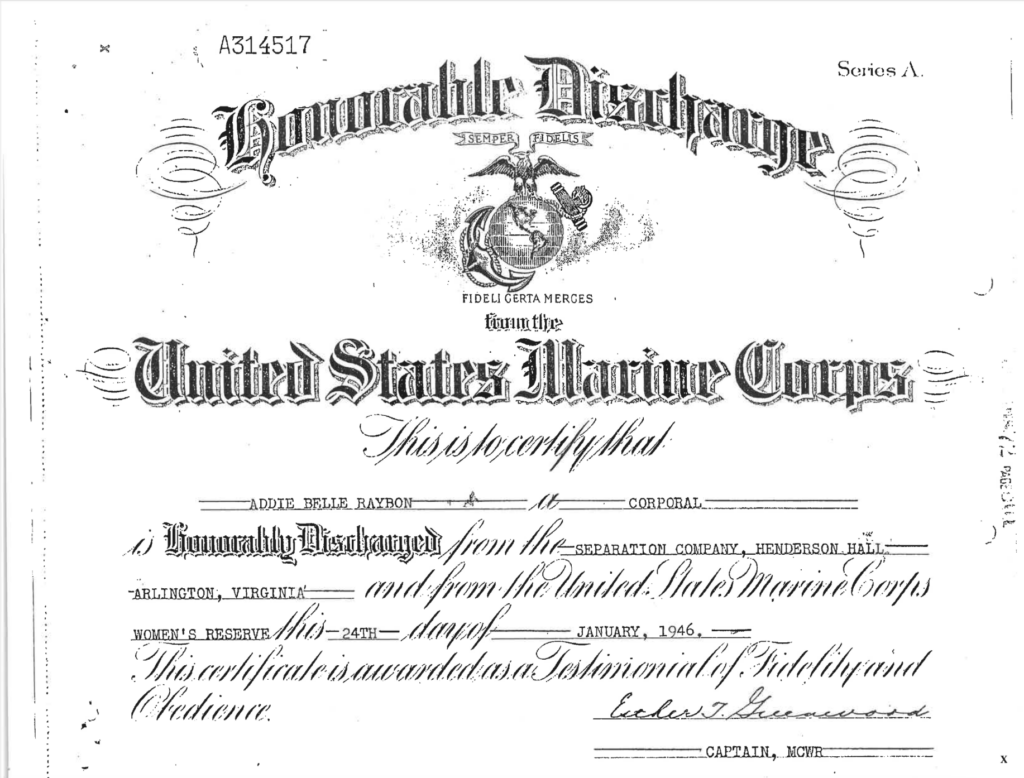
In July 1945, Raybon’s commanding officer, Major Louis H. Wilson, Jr., forwarded a letter to the Commandant of the Marine Corps that recommended her promotion to sergeant. The letter stated that her length of service, high test scores, and excellent performance warranted the promotion. Wilson’s letter was filed, but wasn’t approved before Corporal Raybon left the service. Raybon was honorably discharged on January 24, 1946, at Henderson Hall, Arlington, Virginia.
Veteran Experience
Raybon left the military on January 24, 1946. She briefly moved home to Birmingham upon her exit from the service. However, by 1950, she lived in San Diego, California — the place she had hoped to be stationed during the war.
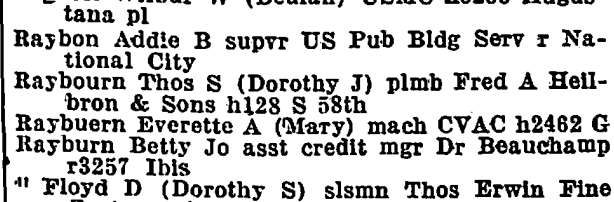
Raybon remained a government employee for the rest of her career. In 1950, Raybon worked as a teletype operator for the U.S. Public Building Service. She quickly moved through the ranks to become a supervisor. In 1956, she began work as a clerk for the Social Security Administration. She remained with Social Security until her retirement in 1986.
In 1961, Raybon married George E. Bozeman, taking the name Addie B. Bozeman. They divorced in April 1977 and had no children together.
Bozeman was a devout member of the Community of Christ Church, then known as the Reorganized Church of Jesus Christ of Latter Day Saints (RLDS). She was a leader of the Zion’s League youth group for the Chula Vista, California, congregation. When she moved back to Alabama in 2009, her health prevented her from attending services, but a Community of Christ minister visited her weekly in the nursing home.

Commemoration
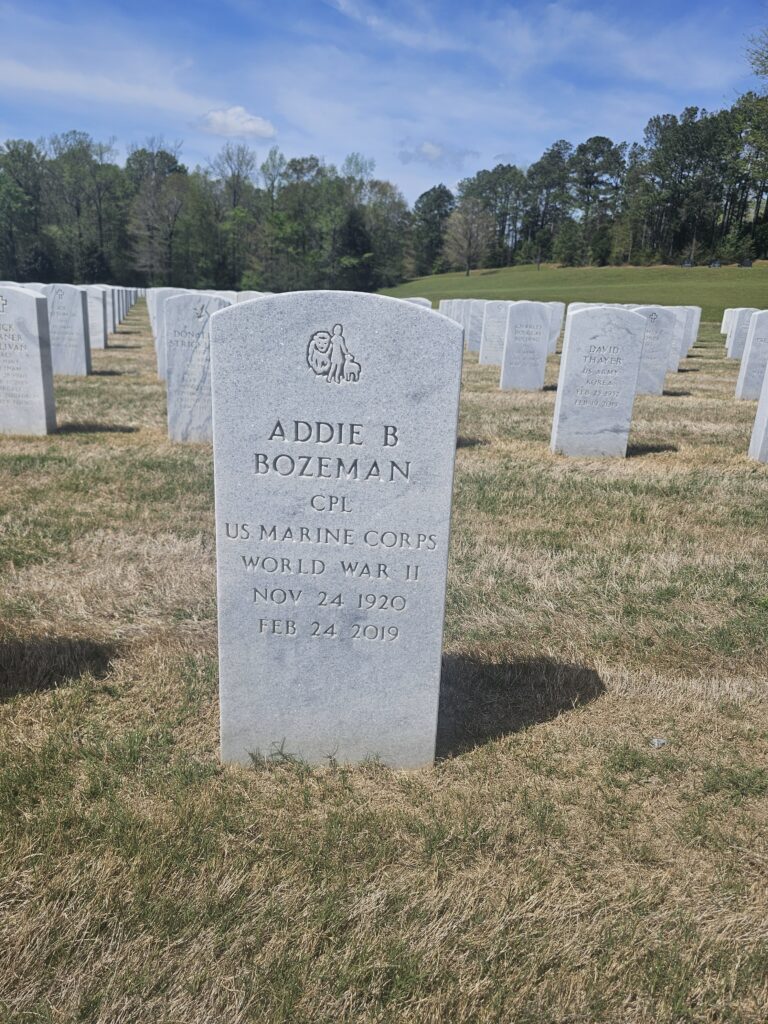
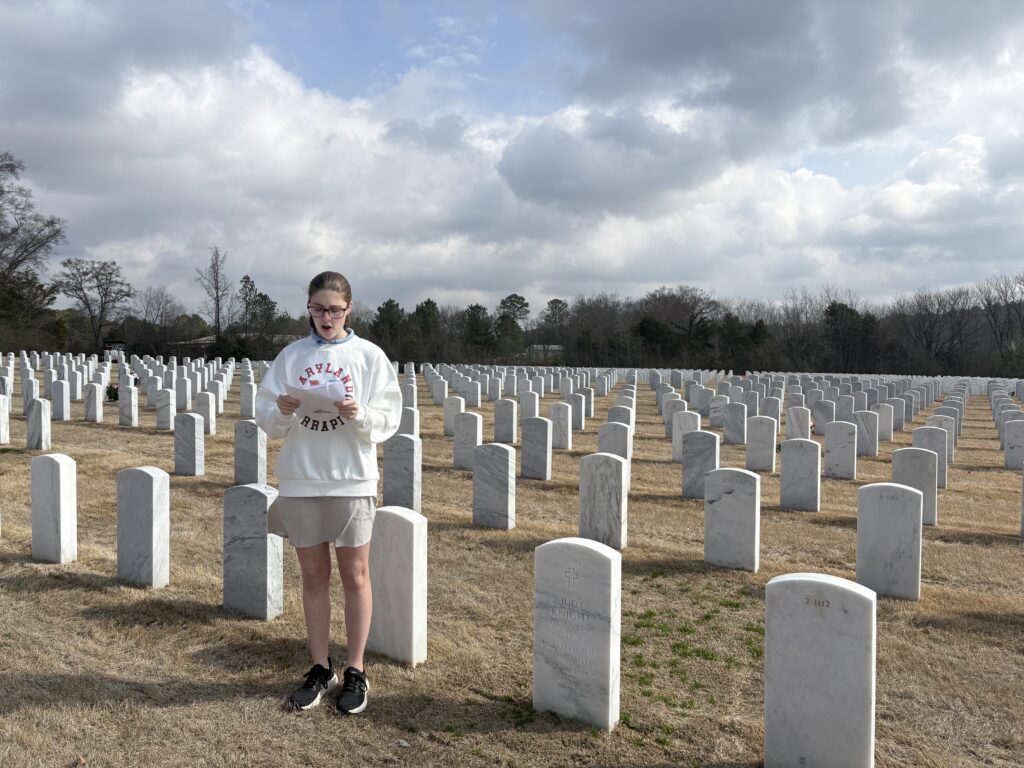
Addie Belle Raybon Bozeman died on February 24, 2019, at the age of 98, in Hueytown, Alabama. She is buried at Alabama National Cemetery in Montevallo, Alabama.
Bibliography
Primary Sources
“4 Local Girls Join Marines.” The Birmingham Post [Birmingham, Alabama], October 13, 1943. Newspapers.com (1002344411).
“890 Seniors to Get Diplomas in Birmingham High Schools.” The Birmingham News [Birmingham, Alabama], January 15, 1941. Newspapers.com (574016252).
Addie B. Raybon. California Marriage Index, 1960-1985. Digital Images. https://familysearch.org.
Addie B. Raybon. San Diego City Directory. https://www.sandiego.gov/sites/default/files/1952_part_2.pdf.
Addie B. Raybon. Washington Divorce Index, 1969-2014. Digital Images. https://familysearch.org.
“Addie Belle Raybon Bozeman.” Peoples Chapel Funeral Home. Accessed October 24, 2025. https://www.peopleschapelfuneralhome.com/obituaries/Addie-Belle-Bozeman/#!/Obituary.
Addie Belle Raybon, Official Military Personnel File, Department of the Navy, National Archives and Records Administration – St. Louis.
Addie Belle Raybon, Report of Separation, Department of the Navy, National Archives and Records Administration – St. Louis.
Alabama. Bibb County. 1900 U.S. Census. Digital Images. https://familysearch.org.
Alabama. Bibb County. 1920 U.S. Census. Digital Images. https://familysearch.org.
Alabama. Jefferson County. 1940 U.S. Census. Digital Images.https://familysearch.org.
“Alabama Legionnaires Gather Here for Convention.” Birmingham Post-Herald [Birmingham, Alabama], July 29, 1940. Newspapers.com (1001490343).
Alabama. Tuscaloosa County. 1940 U.S. Census. Digital Images. https://familysearch.org.
Beach, Clarke. “Sugar Rationing May Be Followed by Doling Out Some Other Items.” The Birmingham Post [Birmingham, Alabama], March 9, 1942. Newspapers.com (574115759).
California. San Diego County. 1950 U.S. Census. Digital Images. https://familysearch.org.
Charles Raybon. United States, Social Security Death Index. Digital Images. https://familysearch.org.
“Citizens Urged to Lend Hand on Rationing Boards.” The Birmingham Post [Birmingham, Alabama], December 14, 1942. Newspapers.com (1002240063).
Dalrymple, Dolly. “Red Cross War Fund Campaigns Plans Outlined.” The Birmingham Post [Birmingham, Alabama], February 28, 1943. Newspapers.com (573993352).
“Doing Your Bit in Tin Drive?” The Birmingham Post [Birmingham, Alabama], July 20, 1944. Newspapers.com (573555054).
Edge, M.C. “200 Volunteers Ready to Aid Motorists with Gas Ration Cards.” The Birmingham Post [Birmingham, Alabama], November 8, 1942. Newspapers.com (573885369).
“Give Generously.” The Birmingham Post [Birmingham, Alabama], February 25, 1944. Newspapers.com (1002280534).
“Historical New Rationing Program Outlined by Secretary Wickard.” The Birmingham Post [Birmingham, Alabama], December 28, 1942. Newspapers.com (573976659).
“Housewives of City Not Doing Their Part in Tin Can Salvage.” The Birmingham Post [Birmingham, AL], August 6, 1944. Newspapers.com (573516805).
“Invest in Your Own America — Buy U.S. War Savings Bonds and Stamps.” The Birmingham Post [Birmingham, Alabama], June 30, 1942. Newspapers.com (573542190).
John Sidney Raybon. United States, Social Security Numerical Identification Files, 1936-2007. Digital Images. https://familysearch.org.
Lively, Cornelia. “Local Man Gets USO Millionth Visitor Awards– and a Nickel.” The Birmingham Post [Birmingham, Alabama], May 7, 1945. Newspapers.com (574076974).
“Mrs. Raybon Rites Set.” Birmingham Post-Herald [Birmingham, Alabama], June 2, 1942. Newspapers.com (1001378814).
“Raybon Rites Set.” The Birmingham News [Birmingham, Alabama], August 5, 1934. Newspapers.com (573971986).
Taylor, Percy. “City’s Industrial Plants Will Help Workers in Victory Garden Projects.” The Birmingham Post [Birmingham, Alabama], April 1, 1944. Newspapers.com (1002322392).
Taylor, Percy. “Early V-Garden Planting Urged.” The Birmingham Post [Birmingham, AL], February 12, 1944. Newspapers.com (1002277390).
Taylor, Percy. “Mrs. Linton to Aid Drive for Gardens.” The Birmingham Post [Birmingham, Alabama], February 11, 1943. Newspapers.com (1002474067).
“Utility Meter Installations Here Show Big Growth in Population.” The Birmingham Post [Birmingham, Alabama], September 13, 1942. Newspapers.com (573881176).
Vanderveer, Virginia. “USO Hostesses Called Upon for Great Variety of Jobs.” The Birmingham Post [Birmingham, AL], October 20, 1942. Newspapers.com (573978608).
“Victory Garden Booklet Offered Readers of Post.” The Birmingham Post [Birmingham, Alabama], March 23, 1943. Newspapers.com (1002474836).
Secondary Sources
“Addie Belle Bozeman.” Veterans Legacy Memorial, National Cemetery Administration. Accessed May 1, 2026. https://www.vlm.cem.va.gov/ADDIEBELLEBOZEMAN/458AC1E.
“Addie Belle Raybon Bozeman.” Find a Grave. Accessed November 1, 2025. https://www.findagrave.com/memorial/197121314/addie-belle-bozeman.
Bridges, Edwin C. Alabama: The Making of an American State. University of Alabama Press, 2016.
This profile was funded by a grant from the United States Department of Veterans Affairs. The opinions, findings, and conclusions stated herein are those of the author and do not necessarily reflect those of the United States Department of Veterans Affairs.