

Platoon Sergeant Andy Nyal Campbell
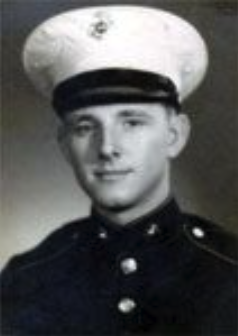
- Unit: 4th Marine Regiment, 1st Battalion, Company B
- Date of Birth: August 5, 1920
- Entered the Military: September 1, 1938
- Date of Death: August 15, 1997
- Hometown: Fremont, Nebraska
- Place of Death: Eugene, Oregon
- Award(s): Purple Heart, Prisoner of War Medal, World War II Victory Medal, American Defense Service Medal, Asiatic-Pacific Campaign Medal, Philippine Defense Ribbon, Presidential Unit Citation, American Campaign Medal, China Service Medal, and Good Conduct Medals
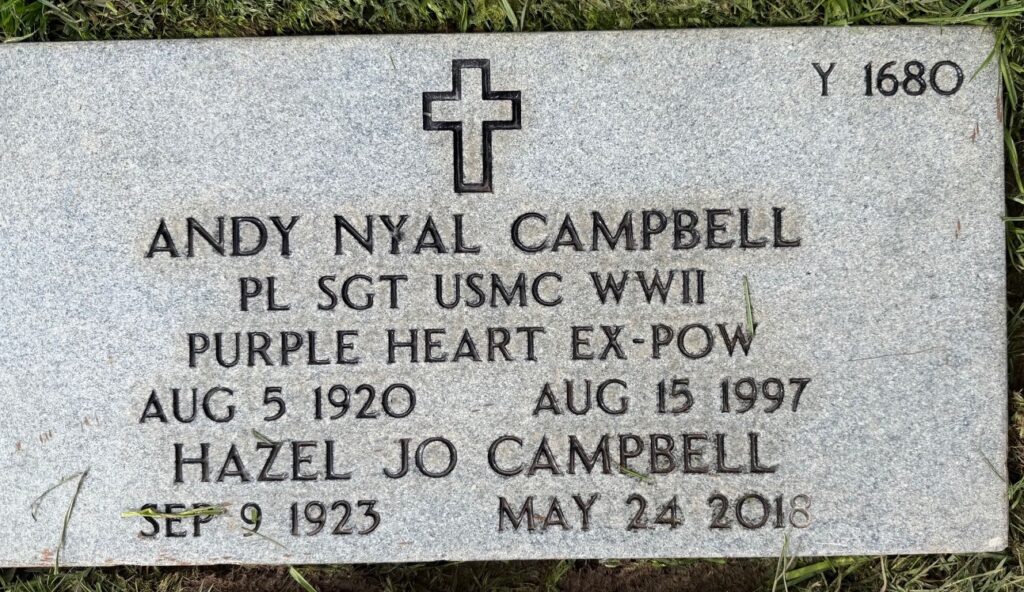
- Cemetery: Section Y, Site 1680. Willamette National Cemetery, Portland, Oregon
Mentored by Mrs. Stefanie Spivey
Heppner High School, Heppner, Oregon
2025/2026
Early Life
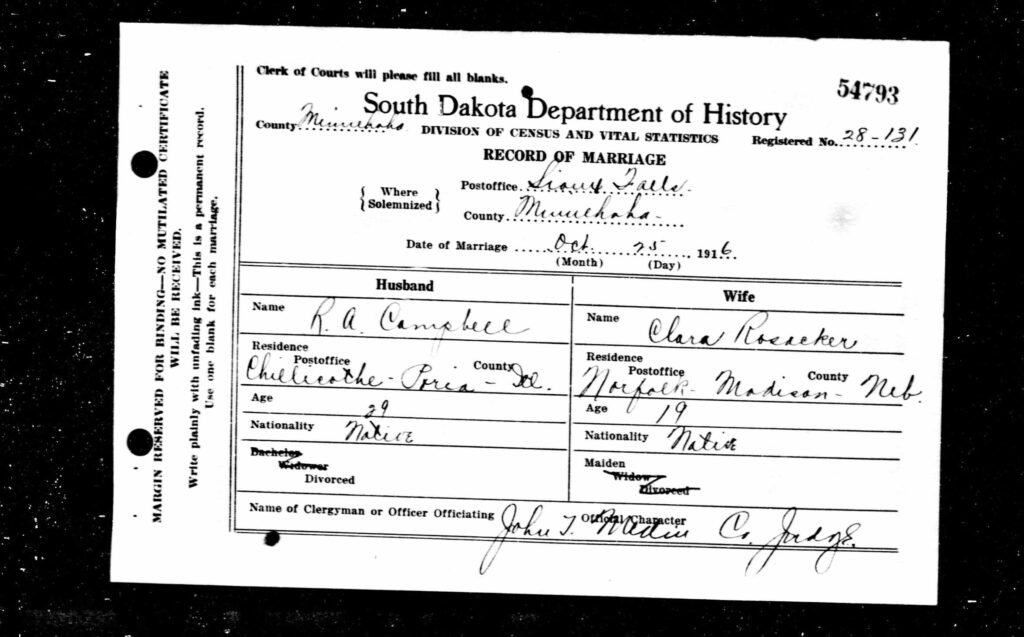
Andy Nyal Campbell was born on August 5, 1920, in Fremont, Dodge County, Nebraska, the son of Ralph Archie Campbell and Clara Kathryn Rosacker Campbell.
Fremont lies along the Mormon Trail and was a significant route for settlers from 1847 to 1869. Later, around 1865, the Union Pacific Railroad was built through Fremont, and the Lincoln Highway, the first highway, was established in 1913. By 1920, Fremont had four rail lines, which supported its agricultural and manufacturing shipping industry.
Andy’s father, Ralph, worked as a railroad hostler, moving cars around the railyard. He later worked as a truck gardener in 1920, the year Andy was born. Truck gardening involved small-acreage family farms growing vegetables and fruits for market. Andy grew up alongside his two brothers, Ralph Arthur Campbell Jr. and Howard Shelton Campbell.
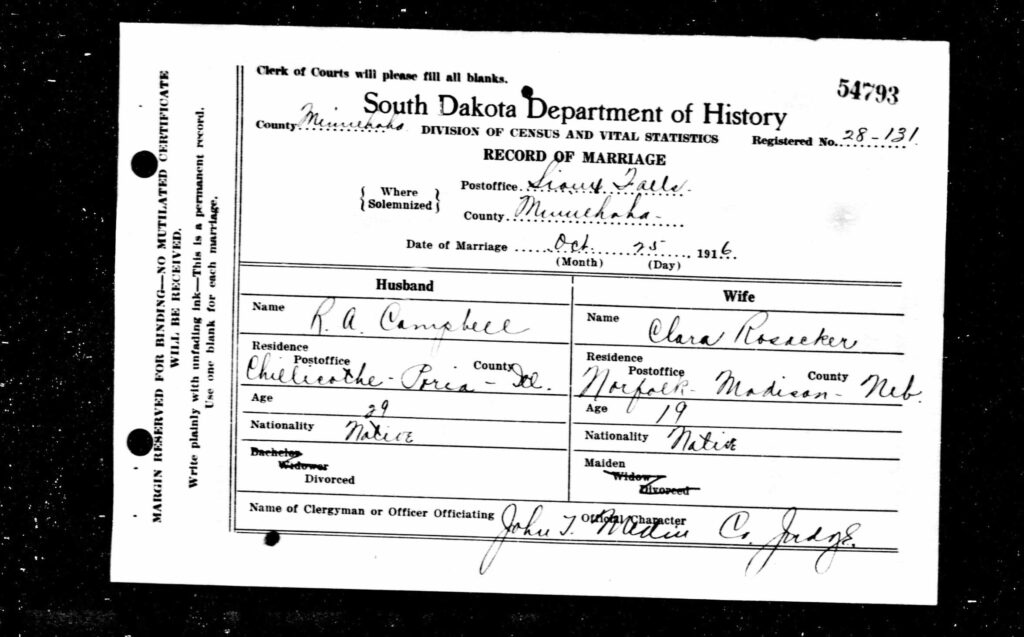
In October 1921, Andy’s father passed away, and in 1923, his mother, Clara, remarried Chris Buerstatte, a furniture store owner. The family eventually moved to Eugene, Oregon, where Campbell attended Santa Clara High School for two years before enlisting in the U.S. Marine Corps in 1938.

Homefront
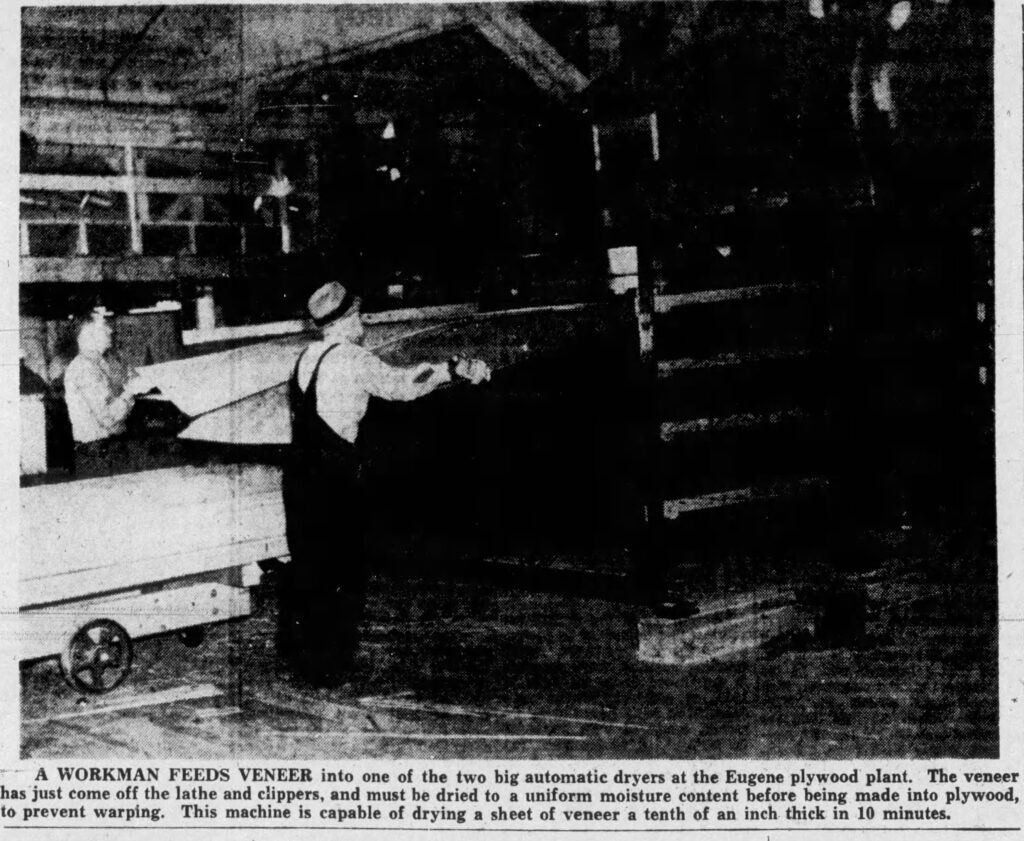
Oregon aided the World War II home front in various ways. For example, in just August 1942, in Lane County alone, 89 lumber mills produced millions of board feet of high-grade lumber for the war effort. This required extra effort because the lumber industry was not considered essential to the war; therefore, it was difficult to obtain parts and materials for equipment repairs. The entire Willamette Valley included at least 442 mills, which produced an estimated 69,210,000 board feet. Considering huge labor shortages, this was an amazing feat!
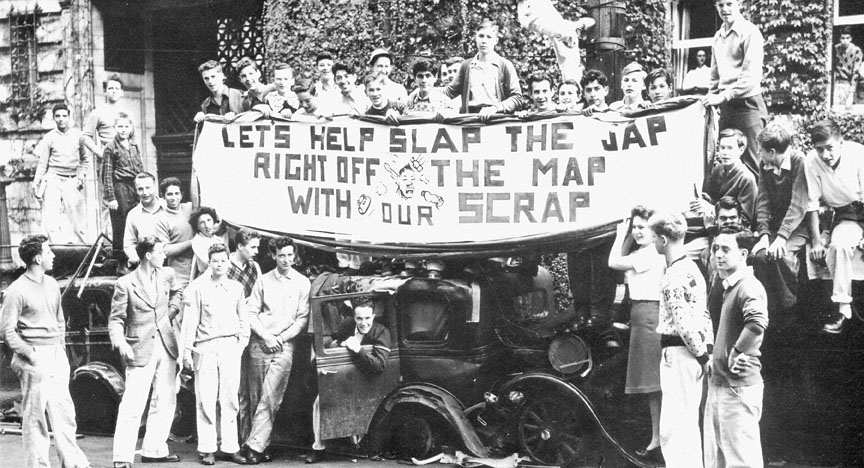
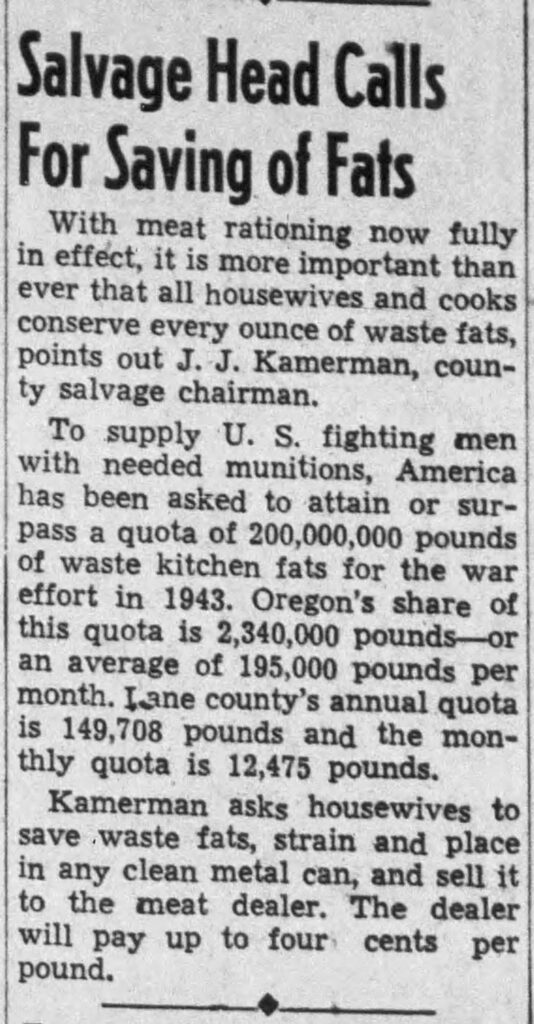
The city of Eugene participated in victory gardens, rationing, and restrictions. Oregon created the Oregon Victory Garden Advisory Program. Citizens also took part in salvage drives, which were very common in the United States. Materials such as scrap metal, rubber, and cooking fats were donated and conserved during these times. Sales of items such as bicycles in Eugene were restricted to essential employees, including doctors, dentists, police officers, religious practitioners, government employees, the American Red Cross, forest firefighters, and commercial fishermen.
The Chemawa Indian School near Salem sent about 40 female students to a training facility in Eugene run by the National Youth Administration (NYA). Roosevelt established this organization during the Great Depression to provide young people with work and education. The young women were trained for skilled work in the Portland shipyards.
Military Experience
Training
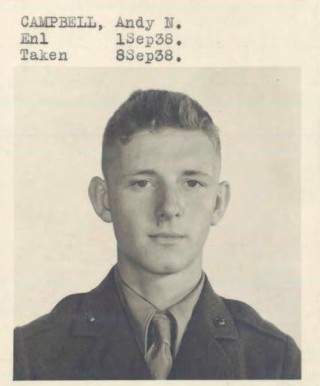
Campbell enlisted in the United States Marine Corps on September 1, 1938, in Portland, Oregon, after completing just two years of high school. He was sent to Marine Corps Base Recruit Depot, San Diego, California, where he joined Base Headquarters Company, Base Service Battalion on November 1, 1938.
Shanghai, China
On December 31, 1938, Campbell was sent to the Asiatic Station in Shanghai, China, where he was assigned to the 4th Marine Regimental Band as a clarinet player. He was a poorly practiced clarinet player, so he then attempted to play the bassoon and was found to be “very inefficient,” and his superior officer stated his future “as a bassoon player is extremely doubtful.” On February 17, 1939, he was reassigned to general duty.
Although details of Campbell’s specific duty and role during this time are unknown, we know the China Marines’ role included protecting American citizens, but the larger mission also included guarding the Standard Oil Company. Other duties included guarding the general hospital and the Naval hospital. On March 20, 1941, while stationed in Shanghai, Campbell married a woman named Lydia Vietshiy, age 22. She was Russian-born with limited English proficiency.
Battle of Corregidor
On November 16, 1941, Campbell was promoted to corporal. Campbell’s battalion, along with the entire 4th Marines, deployed from China to the Philippines to defend the Philippines that same month. They arrived on December 2, 1941, and Campbell was stationed at Fort Mills on Corregidor by December 28. According to his obituary, Campbell was thought to have served as a bodyguard to General Douglas MacArthur at some point, most likely during this period. On March 11, 1942, President Franklin D. Roosevelt ordered General MacArthur to depart for Australia, leaving the Marines behind.
Corporal Campbell participated in combat operations against Japanese forces in the Philippines from December 7, 1941, to May 6, 1942. He sustained a shrapnel wound to his right elbow on May 5, 1942. On May 6, 1942, the 4th Marines burned their colors, and United States Lieutenant General Jonathan Wainwright surrendered to Japanese Lieutenant General Masaharu Homma. This resulted in approximately 11,500 Allied troops being taken prisoner, many of whom were subsequently transported to the Manila area. Corporal Campbell was reported as missing in action (MIA) in the hands of the enemy.
Prisoner of War
Even though Campbell was reported MIA and then presumed dead by the United States government, he was later discovered to be in a Prisoner of War (POW) camp near Manila Bay, although this would not be confirmed for some time. Corporal Campbell was captured by the Japanese and held at Bilibid Prison in Manila from May to October 1942.
Bilibid Prison in Manila was originally built by the Spanish in 1865. It was used by the Japanese during World War II as a POW hospital, internment camp, and major clearinghouse for transferring American POWs throughout the Philippines and to Japan. The conditions were generally better than those in other Japanese camps, but there was still overcrowding, disease, chronic shortages of food, clothing, and medicine, and prolonged starvation that caused widespread illness and death, especially in 1944 and 1945. Cases of brutality were less common. Malnutrition, inadequate supplies, and deadly transport movements defined the prisoners’ experience until the camp was liberated by United States forces on February 4, 1945, when the remaining inmates were near death from starvation.
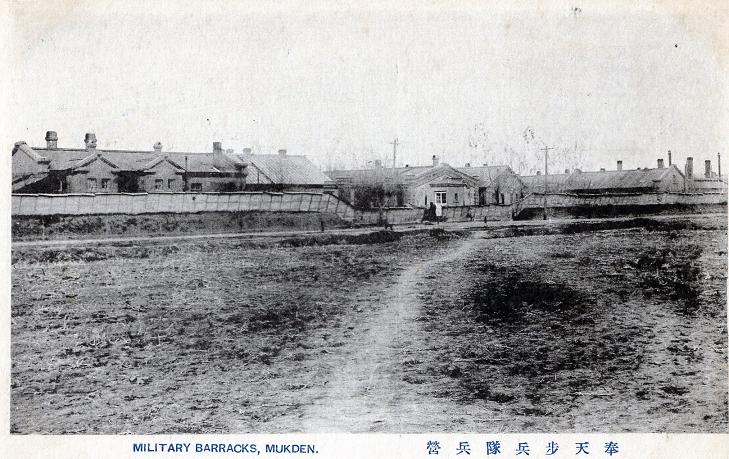
Around October 6, 1942, Campbell was transported from Manila aboard a Japanese hellship, arriving in Korea in early November 1942, and was then taken by train to Hoten Camp, Mukden, Manchuria, where he arrived on November 11, 1942. This POW camp, established by Japan in 1942, held over 2,000 Allied prisoners, mostly Americans, many of whom arrived severely weakened after brutal transport on hellships. Hellships were merchant vessels that the Japanese used to transport POWs.
Once at the camp, prisoners endured extreme cold, chronic malnutrition, forced industrial labor, physical abuse, and frequent violations of the Geneva Convention. Facilities included brick barracks, a hospital, workshops producing military goods, and electrified fencing with guard towers. Hundreds died due to exposure, disease, and mistreatment despite relatively better infrastructure than other Japanese camps.
Liberation
Campbell and the other prisoners were liberated in August 1945 when Soviet forces and a small American OSS team arrived at the camp. Campbell was a POW for over three years.
Campbell was then processed at Guam and then proceeded to Shanghai, where, on October 12, 1945, he sent a telegram home that read, “Leaving (in) for 20 days in Shanghai in hope to bring Lydia home for Christmas, Love Andy.” On November 16, 1945, the Campbells sailed aboard USS Adabelle Lykes. They arrived in San Francisco in early December.
Hospitalization
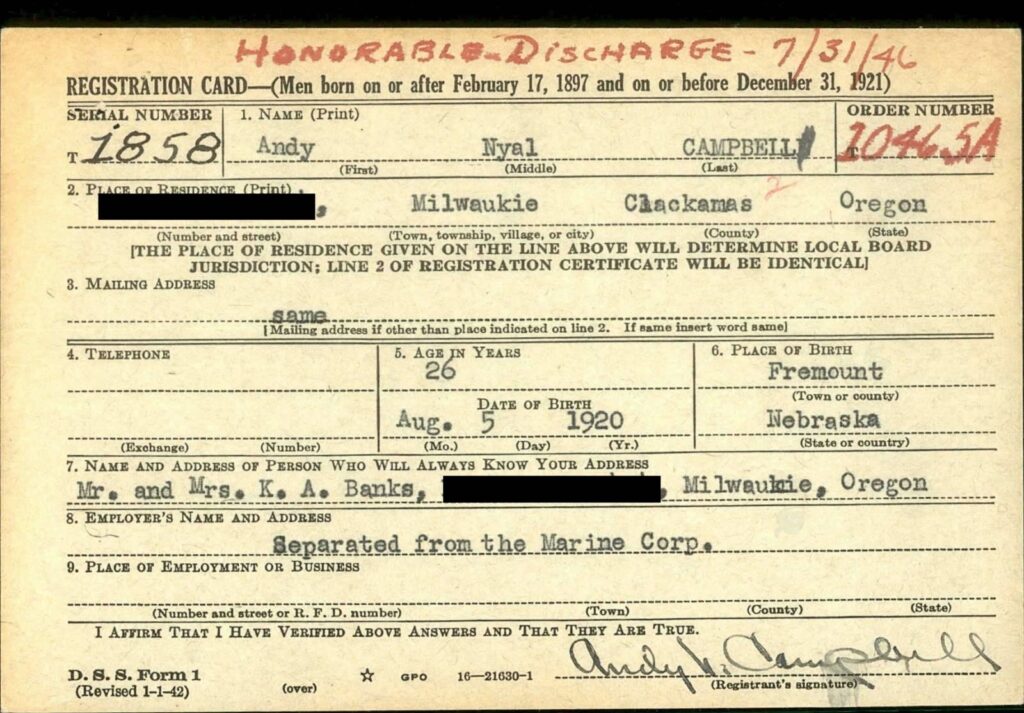
Campbell was admitted to the U.S. Naval Hospital in Oakland on December 6, 1945, where he was treated for his shrapnel injury from years ago. He was also treated for ailments related to his time in captivity, including amoebic dysentery and recurring malaria. While hospitalized, he was promoted to sergeant and then again to platoon sergeant. Campbell was returned to duty on July 24, 1946, and was honorably discharged on July 31, 1946, at Treasure Island, San Francisco, after seven years and one month of service.
Awards
For wounds and shrapnel in his right arm and elbow, sustained in action, he was awarded the Purple Heart. He was also awarded the World War II Victory Medal, American Defense Service Medal, Asiatic-Pacific Campaign Medal, Philippine Defense Ribbon, Presidential Unit Citation, American Campaign Medal, China Service Medal, and Good Conduct Medals recognizing his service before and during the war. On March 1, 1988, he received the Prisoner of War Medal, a newly created medal to honor any prisoner of war after April 5, 1917.
Veteran Experience
When Campbell returned home with his new wife, Lydia, she learned that his family was against their marriage. Campbell filed for divorce in Lane County on February 23, 1946.
On January 6, 1947, Campbell married Hazel Josephine Banks in Tillamook, Oregon. Together, they raised two sons, Edward and Andy.
After the war, Campbell worked as a carpenter, saw filer, gunsmith, and silversmith in Tillamook County. He led a private life after the war, leaving few details on record. Like many veterans of his generation, he spoke little of his wartime experiences. He was a life member of Disabled American Veterans.
Commemoration
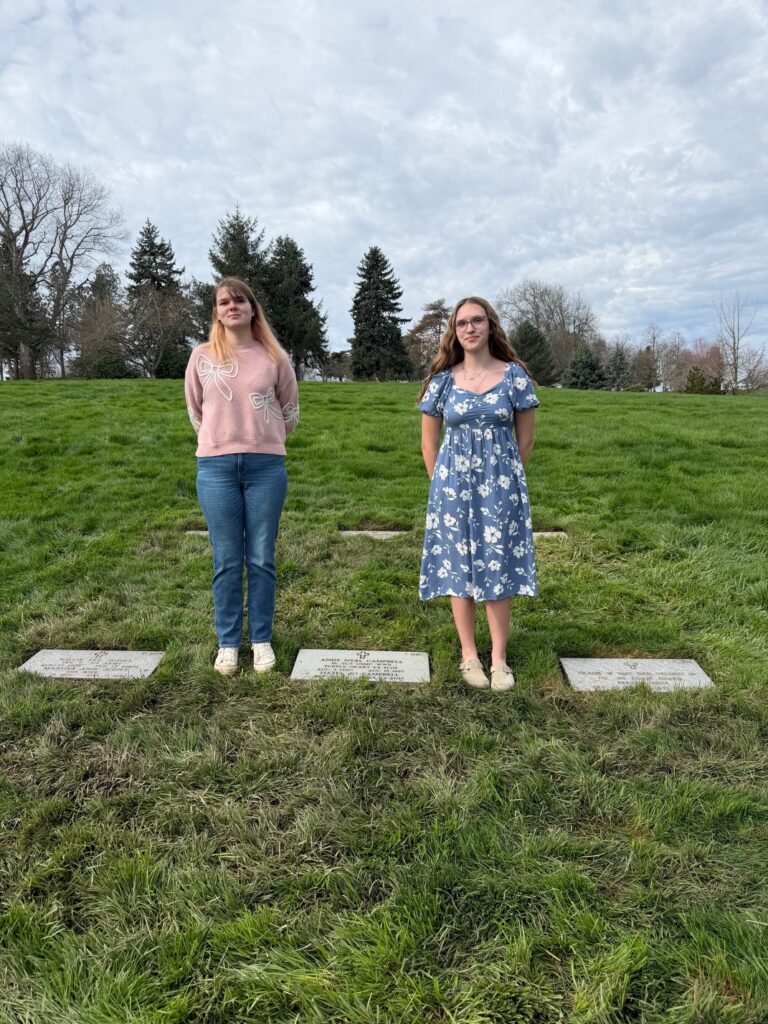
Andy Campbell passed away on August 15, 1997, in Eugene, Oregon. He was laid to rest with honor at Willamette National Cemetery. Hazel Jo Campbell passed away on May 24, 2018, and was laid to rest with her husband.
Bibliography
Primary Sources
“89 Lane County Mills Set Production Records in First Half of 1942: Mills of Lane Go ‘All Out’ In War Effort.” The Register-Guard [Eugene, Oregon], August 2, 1942. Newspapers.com (1290736512).
“Addresses for 42 Prisoners Available.” The Register-Guard [Eugene, Oregon], March 26, 1944. Newspapers.com (136628938).
Andy N. Campbell. World War II Prisoners of the Japanese File, 2007 Update, ca. 1941 – ca. 1945. The National Archives. https://aad.archives.gov.
Andy N. Campbell. World War II Prisoners of War Data File, 12/7/1941 – 11/19/1946. The National Archives. https://aad.archives.gov.
Andy Nyal Campbell, Official Military Personnel File, Department of the Navy, National Archives and Records Administration – St. Louis.
Andy Nyal Campbell. Oregon Social Security Death Index 1935-2014. Digital Images. https://ancestryclassroom.com.
Andy Nyal Campbell. Oregon, U.S., State Marriages 1906-1971. Digital Images. https://ancestryclassroom.com.
Andy Nyal Campbell, Report of Separation, Department of the Navy, National Archives and Records Administration – St. Louis.
“Chris Buerstatte, Former Resident, Died August 13.” Central City Republican [Central City, Nebraska], September 19, 1946. Newspapers.com (672900711).
Chris Buerstatte. Nebraska, U.S., County Marriage Records, 1909-2022. Digital Images. https://ancestryclassroom.com.
Christopher Carl Buerstatte. World War I Draft Registration Card, 1917-1918. Digital Images. https://ancestryclassroom.com.
Clara Campbell. South Dakota, U.S., Marriages, 1905-2024. Digital Images. https://ancestryclassroom.com.
“Hometown Whistle, Week’s Highlights.” The Register-Guard [Eugene, Oregon], April 04, 1943. Newspapers.com (107689728).
Hoten Camp – Mukden Manchuria. Photograph. Prison Camp Galleries, Bataan Project. https://bataanproject.com/prison-camp-galleries/hoten-camp-mukden-manchuria/.
Lincoln High Scrap Metal Drive, 1942. Photograph. Oregon Journal Collection, Oregon History Project. https://www.oregonhistoryproject.org/articles/historical-records/lincoln-high-scrap-metal-drive-1942/.
“List of U.S. Marines Held Prisoners By Japs.” The Miami News [Miami, Florida], May 25, 1943. Newspapers.com (298484582).
“Many Fear Banks: Large Class Prefers to Hoard Its Savings.” The Fremont Herald [Fremont, Nebraska], December 31, 1920. Newspapers.com (690473680).
Nebraska. Dodge County. 1920 U.S. Census. Digital Images. https://ancestryclassroom.com.
Nebraska. Hamilton County. 1930 U.S. Census. Digital Images. https://ancestryclassroom.com.
Ralph Archie Campbell. World War I Draft Registration Card, 1917-1918. Digital Images. https://ancestryclassroom.com.
“Sale of Bicycles To Be Restricted.” The Register-Guard [Eugene, Oregon], August 12, 1942. Newspapers.com (1290746991).
“Salvage Head Calls For Saving of Fats.” The Register-Guard [Eugene, Oregon], June 29, 1943. Newspapers.com (1290272835).
“Shifts In Navy Status Of Lane Men Reported.” The Register-Guard [Eugene, Oregon], October 30, 1945. Newspapers.com (146878329).
Secondary Sources
“Andy Nyal Campbell (1920-1997).” FamilySearch. Accessed date October 20, 2026. https://ancestors.familysearch.org/en/LCFJ-Q5F/andy-nyal-campbell-1920-1997.
“Andy Nyal Campbell.” Find a Grave. Updated February 25, 2000. Accessed January 25, 2026. https://www.findagrave.com/memorial/456726/andy-nyal-campbell.
“Andy Nyal Campbell.” Hall of Valor by Military Times. Accessed October 24, 2025. https://valor.militarytimes.com/recipient/recipient-51726/.
“Andy Nyal Campbell.” Veterans Legacy Memorial, National Cemetery Administration. Accessed April 25, 2026. https://www.vlm.cem.va.gov/ANDYNYALCAMPBELL/765E26A.
“Between Survival and Suffering-Life in the Mukden POW Camp During WWII.” Pacific Atrocities Education. Accessed January 19, 2026. https://www.pacificatrocities.org/blog/between-survival-and-suffering-life-in-the-mukden-pow-camp-during-wwii.
“Brief History of Fremont, Nebraska.” Historic Downtown Fremont. Last modified 2019. Accessed March 30, 2026. https://historicdowntownfremont.com/about/brief-history/.
“A Brief History of The Marine Corps Base and Recruit Depot San Diego, California 1914-1962.” United States Marine Corps University. Last modified August 14, 1962. Accessed March 30, 2026. https://www.usmcu.edu/Portals/218/A%20Brief%20History%20Of%20The%20Marine%20Corps%20Base%20And%20Recruit%20Depot%20San%20Diego%2C%20California%201914%20-%201962.pdf.
Campbell, Andy C. “Andy Nyal Campbell.” China Marines. Accessed October 20, 2025. https://www.chinamarines.com/ver3/campbell.htm.
“Corregidor Island.” China Marines. Accessed March 30, 2026. https://chinamarines.com/PeteGeorge/corregidor.html.
“General D. A. MacArthur and Loss of Corregidor.” Naval History and Heritage Command National Museum of the U.S. Navy. Accessed March 30, 2026. https://www.history.navy.mil/content/history/museums/nmusn/explore/photography/wwii/wwii-pacific/us-entry-into-wwii-japanese-offensive/1941-december-8-1942-may-6-philippines/departure-general-macarthur-loss-corregidor.html.
“The History of the 1st Battalion, 4th Marines.” Marines. Accessed March 30, 2026. https://www.1stmardiv.marines.mil/Units/1ST-MARINE-REGT/1st-Battalion-4th-Marines/History/.
“The History Of Gardens in Times of Turmoil.” Oregon Public Broadcasting, March 21, 2020. Accessed on November 12, 2025. https://www.opb.org/artsandlife/article/victory-gardens-america-coronavirus-history-oregon/.
“Journey to Shanghai.” China Marines. Accessed March 30, 2026. https://chinamarines.com/PeteGeorge/shanghai.html.
“Liberation Day, Sept 5, 1945.” China Marines. Accessed March 30, 2026. https://chinamarines.com/PeteGeorge/liberation.html.
“Old Bilibid Prison.” American Defenders of Bataan and Corregidor Museum. Accessed January 19, 2026. https://philippinedefenders.pastperfectonline.com/archive/43A37635-14AC-4E35-8A40-386150892097.
“The Postwar Economy.” Oregon Historical Society. Last Modified 2014. Accessed November 12, 2025 https://www.oregonhistoryproject.org/narratives/this-land-oregon/oregon-in-depression-and-war-1925-1945/the-postwar-economy/.
“Prisoner of War.” China Marines. Accessed March 30, 2026. https://chinamarines.com/PeteGeorge/POW.html.
Richard H. Engeman, “Wooden Beams and Railroad Ties: The History of Oregon’s Built Environment.” Oregon History Project. Updated 2014. Accessed November 15, 2025. https://www.oregonhistoryproject.org/narratives/wooden-beams-and-railroad-ties-the-history-of-oregons-built-environment/international-northwest-and-cryptic-styles/post-war-population-and-the-building-boom/.
“Truck Farming Was the Path into Agriculture.” Soundings Journal. Last modified May 16, 2019. Accessed March 30, 2026. https://soundingsmag.net/2019/05/16/truck-farming-was-the-path-into-agriculture/.
“What Happened During the Battle of Corregidor?” U.S. Army Airborne and Special Operations Museum. Accessed March 30, 2026.https://www.asomf.org/what-happened-during-the-battle-of-corregidor/.
“World War II Community Programs.” Oregon State University Extension Service. Accessed November 12, 2025 https://scarc.library.oregonstate.edu/omeka/exhibits/show/extension/homefront/wwiicommunity.
This profile was funded by a grant from the United States Department of Veterans Affairs. The opinions, findings, and conclusions stated herein are those of the author and do not necessarily reflect those of the United States Department of Veterans Affairs.