

Private First Class Arthur Espinoza Rodriguez, Sr.
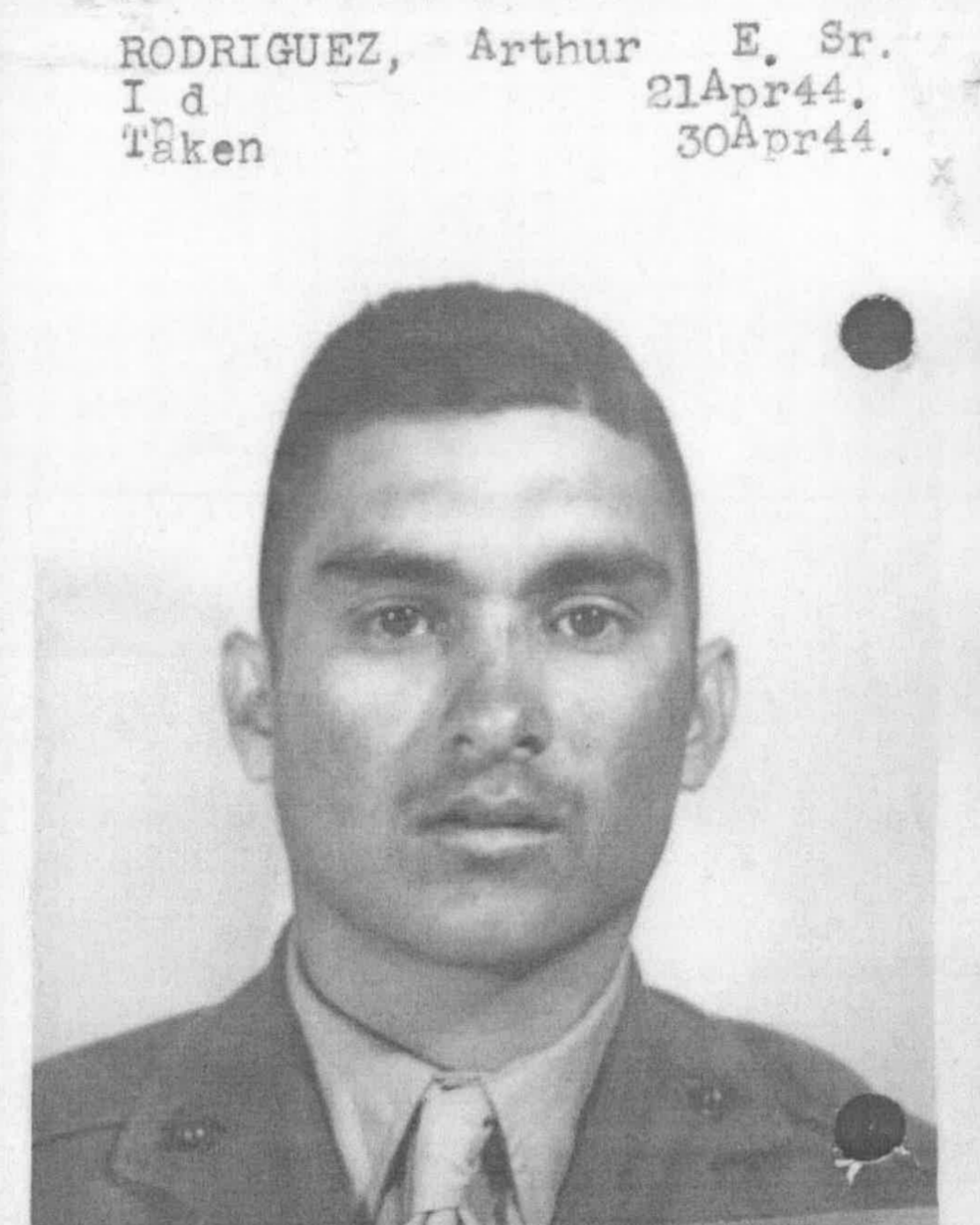
- Unit: Fleet Marine Force, 1st Marine Division, 5th Marines, 1st Battalion
- Date of Birth: September 4, 1919
- Entered the Military: April 21, 1944
- Date of Death: September 11, 1995
- Hometown: Edna and Bay City, Texas
- Place of Death: Houston, Texas
- Award(s): Purple Heart
- Cemetery: Plot G2, Site 2626. Houston National Cemetery, Houston, Texas
Mentored by Mrs. Vannessa Guerra
Dr. Archie Blanson CTE High School
2025/2026
Early Life
Arthur Espinoza Rodriguez, Sr. was born on September 4, 1919, in Edna, Texas. He was the son of Jesus Rodriguez and Carmen Rodriguez.
He grew up in Bay City, where he went to school and completed one year of high school. By 1940, Rodriguez worked as a tailor for the Ideal Tailors company. He worked 52 weeks a year and earned an annual wage of $624.
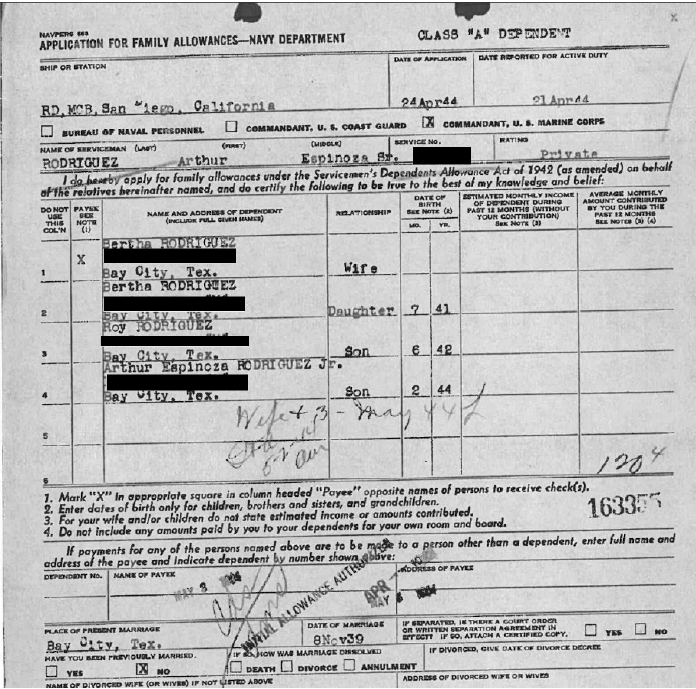
Before the war, Rodriguez married Bertha Rodriguez at 19, and they had three beautiful children, Bertha, Roy, and Arthur Jr. He worked long hours as a presser at a tailor shop, supporting himself and his family. Like many young men of his generation, his life changed when he enlisted in the United States Marine Corps during World War II. In April 1944, Rodriguez answered the call to serve.

Homefront
Life in Bay City During World War II
Arthur Espinoza Rodriguez, Sr. came from Bay City, Texas, a small community in southeast Texas near the Gulf Coast. Bay City served as the county seat of Matagorda County and had road connections to Houston. The town covered about 8.87 square miles and sat only 52 feet above sea level. By 1940, the population had reached 9,427 residents. During the early years of the war, the city continued to grow and even built a United Service Organizations building in 1941 to support servicemen and visitors.
Industry and Agriculture Supporting the War
Although Bay City itself was small, nearby industrial centers played an important role in the wartime economy. Companies such as the Monsanto Chemical Company and Humble Oil and Refining Company produced synthetic chemicals, explosives, rubber, and other materials needed for the war. The Texas City Refining Company also contributed to the production of petroleum products essential for military use. The gas industry in the Bay City area also expanded because petroleum products were essential for military vehicles, ships, and aircraft.
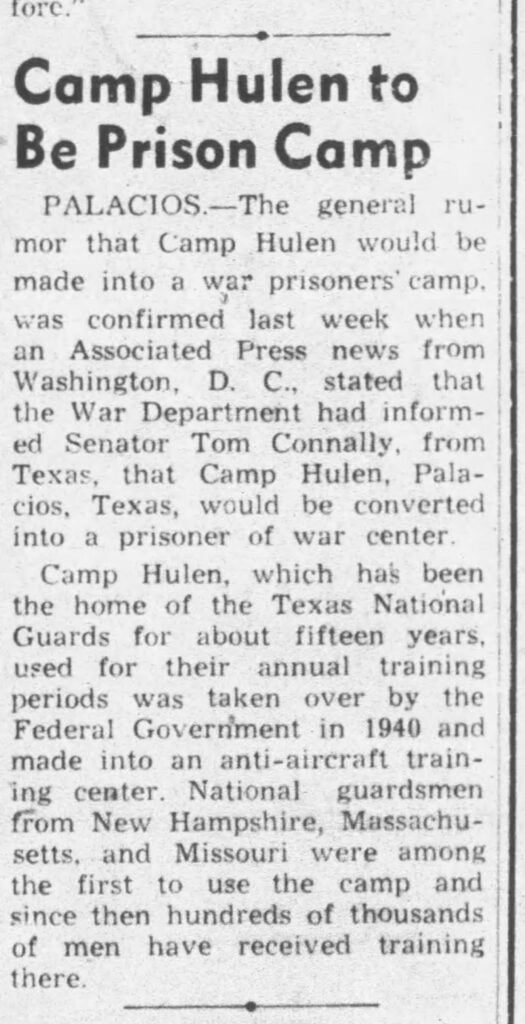
Local agriculture contributed as well. Rice farming was especially important in Matagorda County, and labor shortages caused by the war led to the use of German prisoners of war to help work the rice fields. The Matagorda County fairgrounds were converted into a prisoner-of-war camp that held German prisoners captured during the war. The first group of about 150 prisoners arrived in October 1943 and were assigned to agricultural work in local rice fields.
Community Effort and Wartime Sacrifice
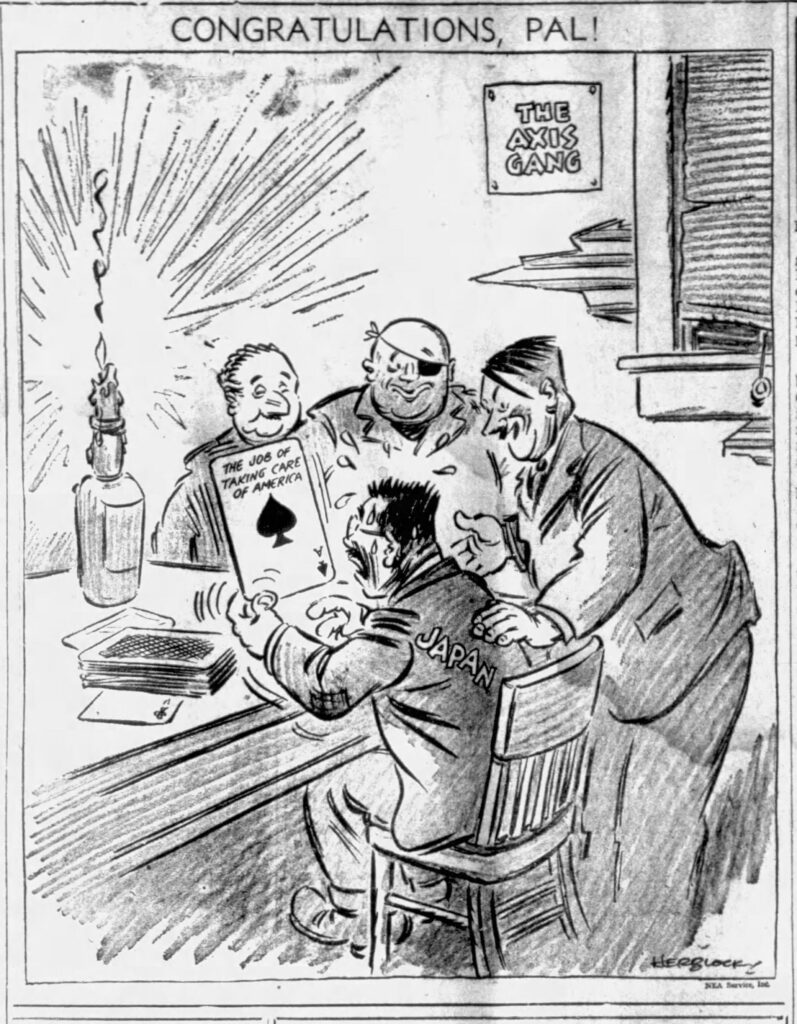
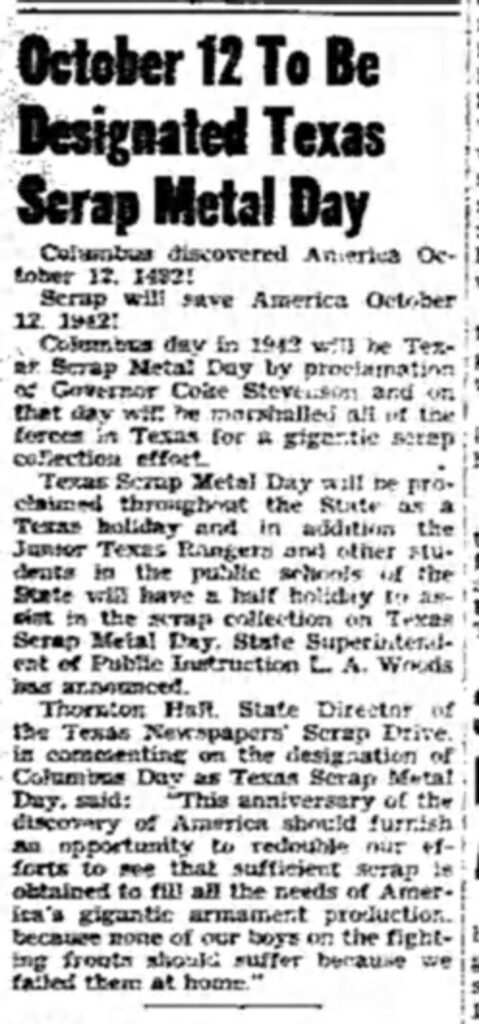
Residents of Bay City participated in nationwide home front efforts to support the war. Newspapers like the Victoria Advocate encouraged citizens to contribute scrap metal during special drives such as Texas Scrap Metal Day, when communities collected materials that could be reused in military production. Women also played a major role in the wartime workforce. Across Texas, women filled jobs left open by men who had gone to fight, working in service stations, delivering mail, driving trucks, and performing clerical work. Newspapers and political cartoons also spread wartime propaganda that both encouraged patriotism and support for the Allied cause and criticized Franklin Roosevelt’s New Deal policies and programs. These debates reflected the tensions many Americans felt during a time of national sacrifice and change.
Military Experience
Draft and Training
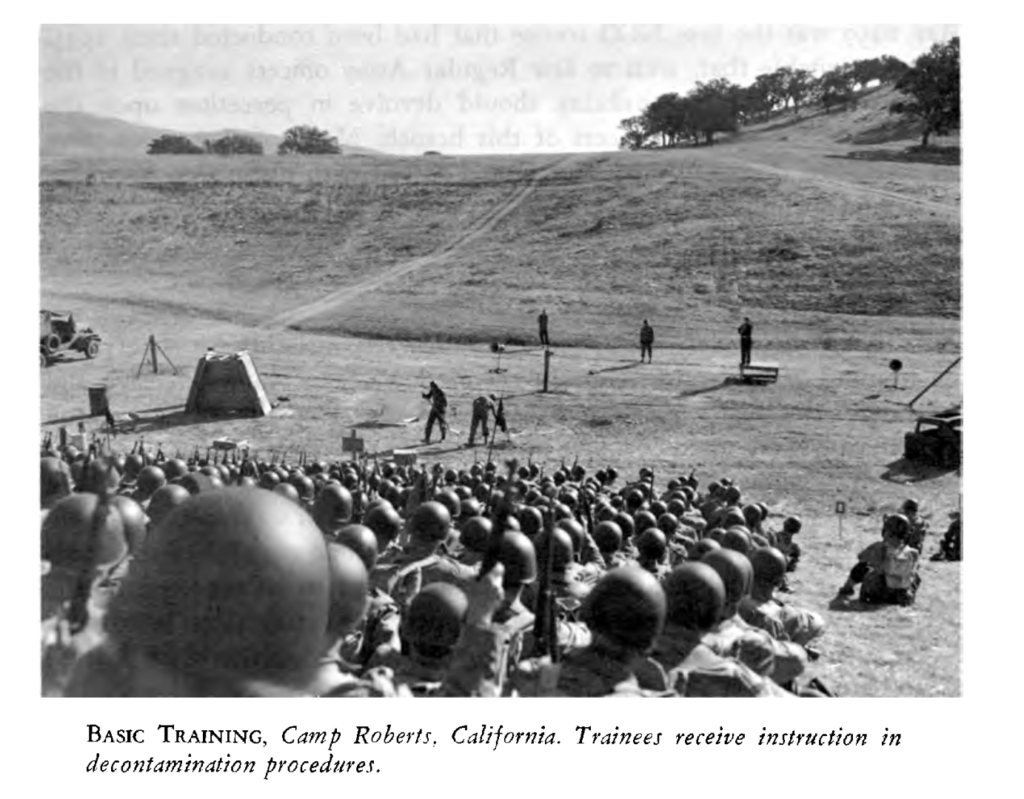
Arthur Espinoza Rodriguez, Sr., enlisted in the Marine Corps on October 16, 1940. He completed training that prepared him for overseas duty. His training took place on the West Coast, including at San Diego and Camp Pendleton, where Marines were prepared for combat in the Pacific.
World War I led to an increase in the stockpile of chemical weapons. Subsequently, the War Department initiated additional preparations for chemical warfare training. The Chemical Warfare Service was a program designed to train soldiers to recognize and protect against chemical warfare, such as gas attacks. Rodriguez received Chemical Warfare instruction on April 26, 1944. Chemical Warfare training focused on the “ability to mask quickly and to wear the mask while performing military duties; an ability to identify the more common chemical agents and a knowledge of the means of defense against them.” He was also a qualified swimmer, and during his training, he served as a messman, gaining both survival and support experience before deployment.
Deployment to the Pacific
Following his training, Rodriguez departed from San Diego, California, on December 14, 1944.
He traveled aboard USS General M. M. Patrick to the Pacific Theater. He first arrived at Pearl Harbor, Hawaii, on December 21, 1944. Soon after, on December 22, he sailed to Pavuu, Russell Islands, on January 1. During this time, Rodriguez was assigned to the 1st Battalion, 5th Marines, 1st Marine Division, Fleet Marine Force. This unit was part of a combat division preparing for major operations in the Pacific.
Combat in Okinawa
Once deployed, Rodriguez participated in offensive and defensive operations at Okinawa Shima beginning on April 1, 1945. As a Marine rifleman, he served in a frontline combat role during one of the war’s most intense campaigns. His unit faced difficult terrain, harsh weather, and heavily defended enemy positions throughout the operation.
Injury, Recovery, and Discharge
During the Okinawa campaign, Rodriguez was wounded in action on May 4, 1945. He suffered a compound fracture to his left leg and received treatment in the field before being evacuated for further medical care.
By June 14, 1945, Rodriguez was receiving treatment at a U.S. Naval Hospital. A letter sent to his wife, Bertha, informed her that he was “making good progress” and that his condition was considered good. The letter also assured her that he was receiving the best possible medical care and that further updates on his recovery would follow.
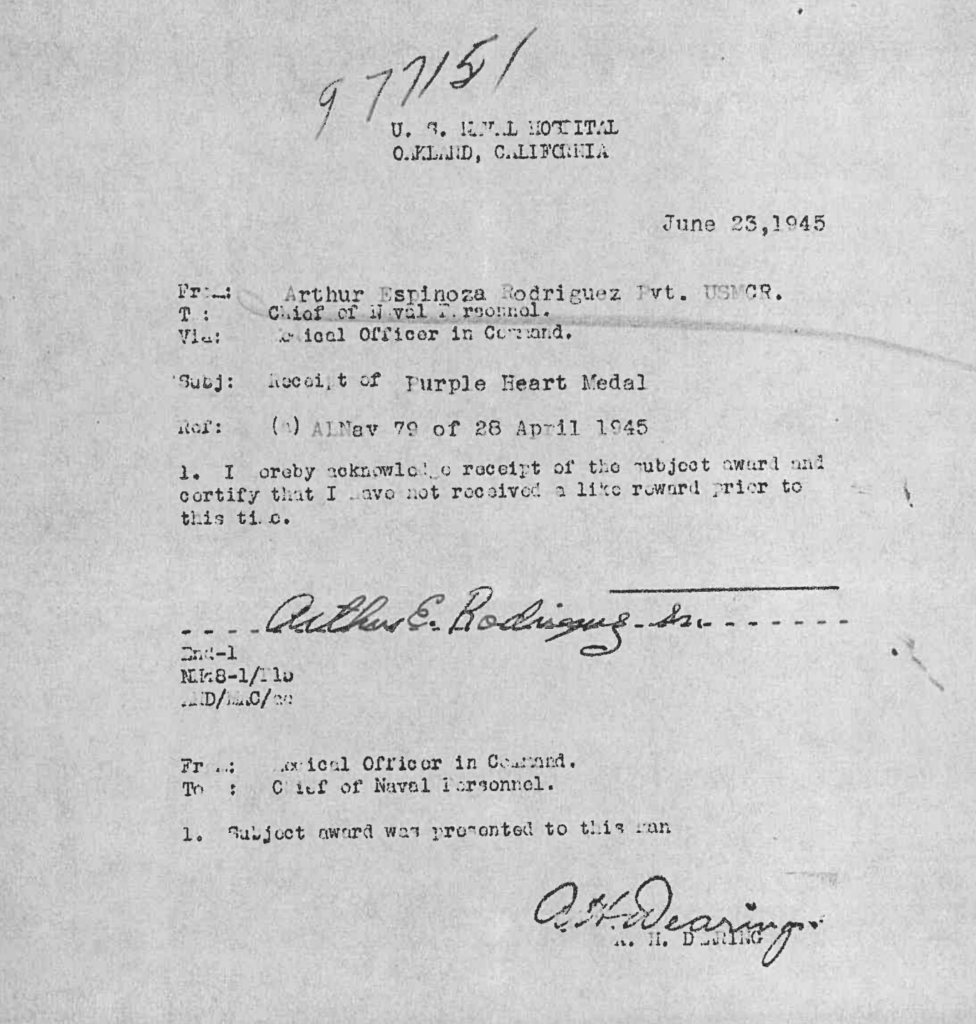
Just days later, on June 23, 1945, Rodriguez formally acknowledged receipt of the Purple Heart Medal, awarded for wounds received in combat.
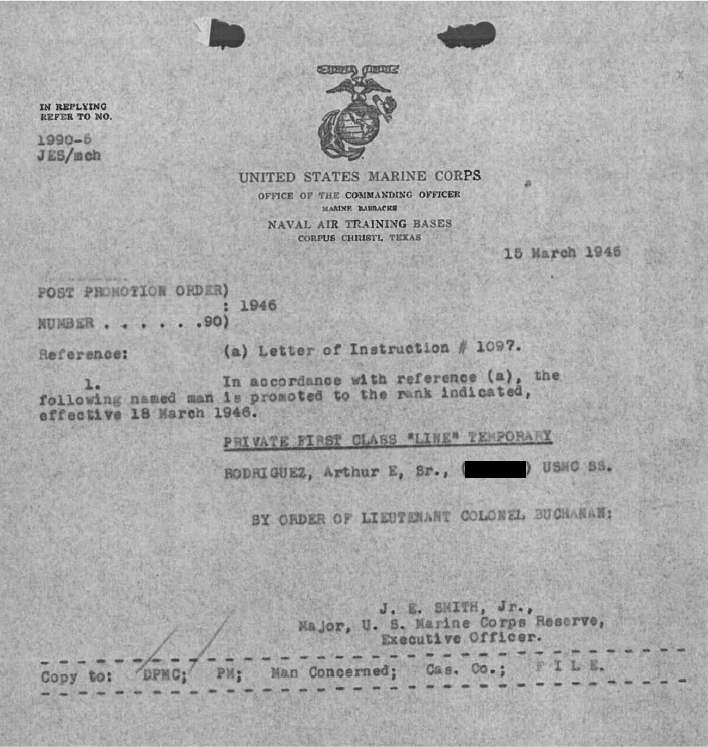
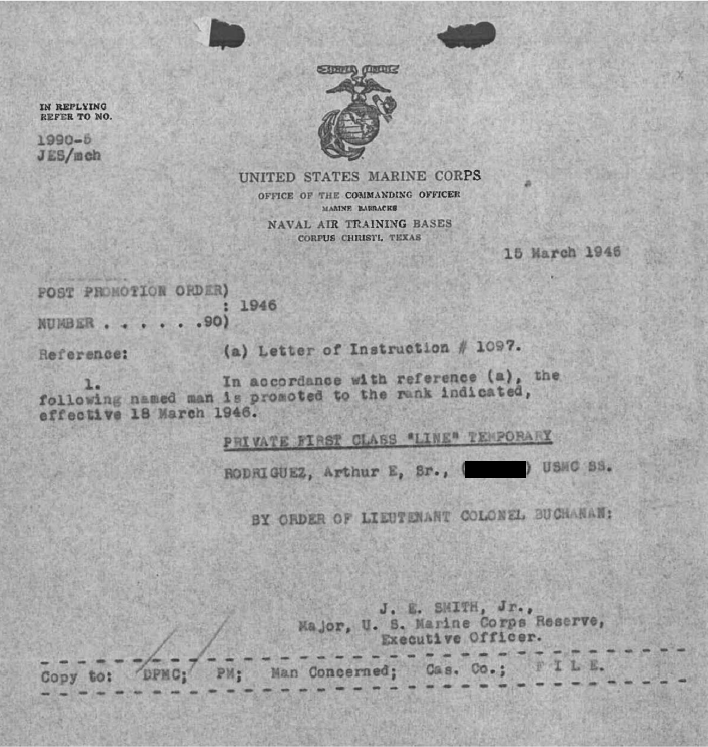
Rodriguez remained under medical care for several months following his injury. By March 15, 1946, official military orders show that he was still in service and was promoted to private first class, effective March 18, 1946.
He was honorably discharged from active duty on March 18, 1946, in Corpus Christi, Texas. His experience reflects both the intensity of combat in the Pacific and the long recovery faced by many wounded Marines at the end of the war.
Veteran Experience
Arthur Espinoza Rodriguez, Sr., was honorably discharged from military service on March 18, 1946.
After leaving the military, he did not return to service. Instead, he began the transition back to civilian life. Rodriguez returned to his job as a presser at a dry cleaning company. He worked there full-time, working 48 hours a week.
Life After the War
After returning home from military service, Rodriguez resumed life in Bay City, Texas, with his wife, Bertha. In January 1948, the couple welcomed a daughter, Ledia Rodriguez. However, just a few months later, tragedy struck. Ledia passed away on July 2, 1948, at only five months old due to gastroenteritis.
By 1950, Rodriguez and Bertha were raising a growing family. Census records show that their household included several children: Bertha, Raul, Arthur Jr., and Ruben. During this time, Rodriguez continued working as a presser at a dry-cleaning business.
Later in life, Rodriguez remarried. On July 18, 1981, he married Minnie H. Hernandez in Harris County, Texas. This marriage marked a new chapter in his life following his earlier years of family life and work in Bay City.

Commemoration
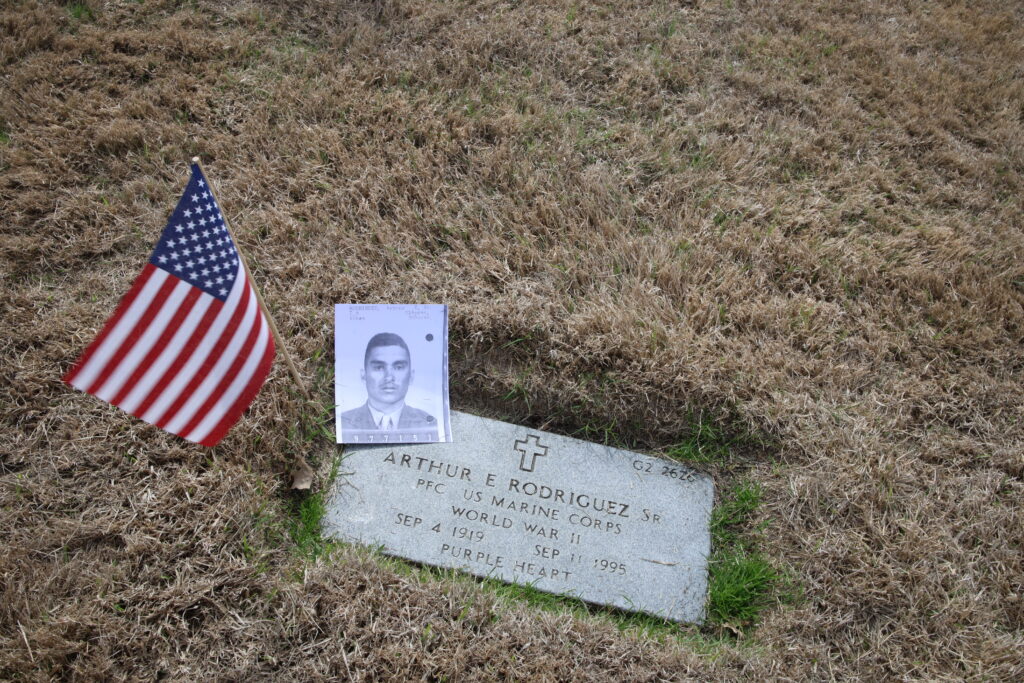
Rodriguez lived in Texas for the remainder of his life. He passed away on September 11, 1995, and is buried in the Houston National Cemetery in Houston, Texas. He was 76 years old at the time of his death. His legacy is not one of loud recognition, but of quiet strength. He was a husband, a father, a Marine, and a Silent Hero, one whose sacrifices helped shape the freedoms we enjoy today.
Bibliography
Primary Sources
“Aerial Navigators Much in Demand.”The Freeport Facts [Freeport, Texas], January 16, 1941. Newspapers.com (11508800).
Arthur E. Rodriguez. Texas, U.S., Marriage Index, 1824-2021. Digital Images. https://ancestry.com.
Arthur E. Rodriguez. U.S., Navy Casualties Books, 1776–1941. Digital Images. https://ancestry.com.
Arthur Espinoza Rodriguez, Sr., Official Military Personnel File, Department of the Navy, National Archives and Records Administration – St. Louis.
Arthur Espinoza Rodriguez, Sr., Report of Separation, Department of the Navy, National Archives and Records Administration – St. Louis.
Arthur Espinosa Rodriguez. World War II Draft Cards Young Men, 1940-1947. Digital Images. https://ancestry.com.
Bertha Rodriguez. Texas, U.S., Birth Index, 1903-1997. Digital Images. https://ancestry.com.
“Camp Hulen to Become Prison Camp.” Victoria Advocate [Victoria, Texas], December 6, 1944. Newspapers.com (440317762).
“Employment Female Help Wanted.” Corsicana Daily Sun [Corsicana, Texas], February 14, 1942. Newspapers.com (51250735).
Ledia Rodriguez. Texas, U.S., Death Certificates. Digital Images. https://ancestry.com.
Texas. Matagorda County. 1930 U.S. Census. Digital Images. https://ancestry.com.
Texas. Matagorda County. 1940 U.S. Census. Digital Images. https://ancestry.com.
Texas. Matagorda County. 1950 U.S. Census. Digital Images. https://ancestry.com.
“Trying Times.” Del Rio News Herald [Del Rio, Texas], May 16, 1944. Newspapers.com (16268314).
“Thousands of Texas Women Fill War Jobs in Manpower Shift.” The Monitor [McAllen, Texas], December 21, 1942. Newspapers.com (291754814).
“U.S. Prepares for Defense Measures.” Victoria Advocate [Victoria, Texas], April 11, 1941. Newspapers.com (440281478).
Secondary Sources
“About Us.” Bay City, Texas. Accessed October 26, 2025. https://www.cityofbaycity.org/157/About-Us.
“Albeza Espinoza Rodriguez.” Find a Grave. Updated June 13, 2021. Accessed November 3, 2025. https://www.findagrave.com/memorial/228430592/albeza-rodriguez.
“Arnulfo Espinoza Rodriguez, Sr.” Find a Grave. Updated February 7, 2016. Accessed November 3, 2025. https://www.findagrave.com/memorial/157911221/arnulfo_espinoza-rodriguez.
“Arthur E. Rodriguez Sr.” Veterans Legacy Memorial, National Cemetery Administration. Accessed April 8, 2026. https://www.vlm.cem.va.gov/ARTHURERODRIGUEZSR/88B94E6.
“Arthur Espinoza Rodriguez Sr.” Find a Grave. Updated February 25, 2000. Accessed November 3, 2025. https://www.findagrave.com/memorial/1130024/arthur_espinoza-rodriguez.
“Bay City WWII German Prisoner of War Labor Camp.” Accessed November 5, 2025. https://www.usgenwebsites.org/TXMatagorda/wwii_pow_camp_bc.htm.
Brophy, Leo P., and George J. B. Fisher. The Chemical Warfare Service: Organizing for War. U.S. Army Center of Military History, 1989.
“Eloy Espinoza Rodriguez.” Find a Grave. Updated March 3, 2000. Accessed November 3, 2025. https://www.findagrave.com/memorial/3121675/eloy_espinoza-rodriguez.
“Esther Rodriguez Brown.” Find a Grave. Updated February 25, 2000. Accessed November 3, 2025. https://www.findagrave.com/memorial/420233/esther-brown.
“History.” Bay City, Texas. Accessed November 5, 2025. https://www.baycitytx.gov/269/History.
Procter, Ben H. “The Impact of World War II on Texas: Social, Economic, and Political Changes.” Texas State Historical Association. Accessed November 5, 2025. https://www.tshaonline.org/handbook/entries/world-war-ii.
This profile was funded by a grant from the United States Department of Veterans Affairs. The opinions, findings, and conclusions stated herein are those of the author and do not necessarily reflect those of the United States Department of Veterans Affairs.