
Sergeant Billy W. Beaverson
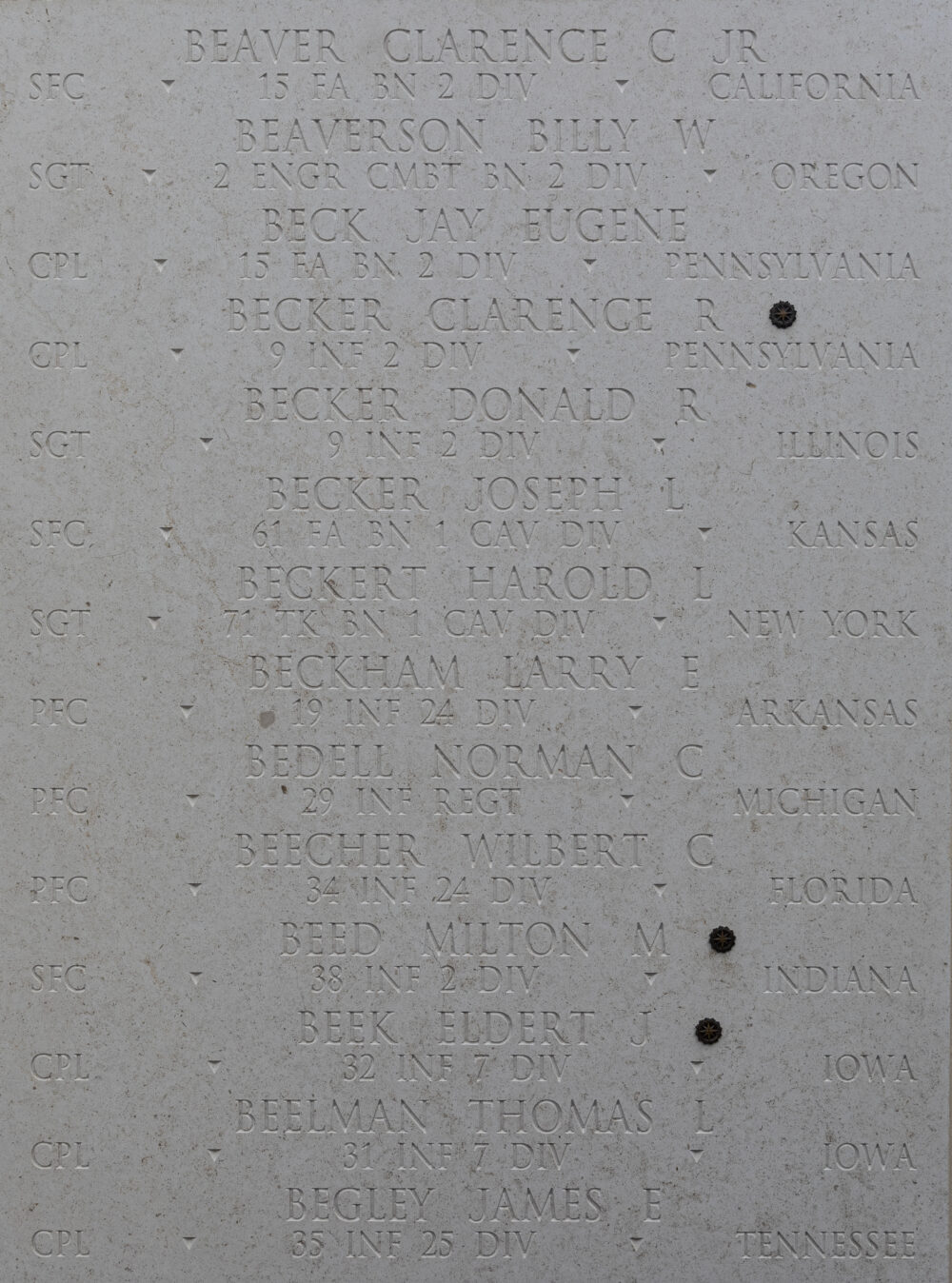
- Unit: A Company, 2nd Engineer Combat Battalion, 2nd Infantry Division
- Service Number: 19253041
- Date of Birth: December 19, 1928
- Entered the Military: May 1, 1946
- Date of Death: December 31, 1953
- Hometown: Portland, Oregon
- Place of Death: Chongchon River, Kunu-Ri, North Korea
- Award(s): Korean Service Medal, National Defense Service Medal, Purple Heart Medal, Republic of Korea Presidential Unit Citation, Republic of Korea War Service Medal, United Nations Service Medal
- Cemetery: Court Four, Courts of the Missing. Honolulu Memorial, National Memorial Cemetery of the Pacific, Honolulu, Hawaiʻi
Early Life
Billy W. Beaverson was born in Portland, Oregon, on December 19, 1928. Some records list 1927 as Billy’s birth year, but military records list 1928. He was placed in an orphanage shortly after his birth. There is no information about his birth family. According to the 1930 census, Billy was under the care of St. Agnes Foundling Asylum, which was later known as St. Agnes Baby Home, at the age of one.
Ten years later, in the 1940 census, Billy was listed as a foster child of Stanleigh and Alberta Bennett. Stanleigh was a funeral director, and Alberta was a stay-at-home wife. Stanleigh earned $1,560 in 1940, above the average income of $1,368 during that time.
Billy Beaverson enlisted in the United States Army on May 1, 1946, before his eighteenth birthday. He was then discharged on February 8, 1947, but registered again on February 10, 1947, and was in active service on March 20, 1947, before the Korean War.


Homefront
During the Korean War, Portland, Oregon, was a small but growing city. According to Oregon state census records, Oregon’s population increased by 39% from 1940 to 1950. During this time, Portland’s population grew from 205,000 in 1940 to 374,000 by 1950. The state of Oregon had an estimated 60,000 residents who served in the Korean War, with 298 individuals giving their lives during the conflict.
New suburban residential and shopping developments emerged outside of cities after World War II. For example, in Cedar Hills, Oregon, just west of Portland, single-level frame ramblers with picture windows began to appear in suburban communities. College towns also welcomed new students who were veterans supported by the Government Issue (GI) Bill, which helped to pay for their college education. The United Services Organization (USO) held several community activities, such as dances, during the Korean War. A new USO office opened in Portland in September 1951 after World War II.
Post World War II Production
World War II post-war production came to a halt with the closing of the Kaiser shipyards. There were temporary declines in aluminum and timber production, which led to limited employment opportunities, but the population remained stable. The post-war housing boom expanded timber cutting, while two new oil refineries and factories for national corporations like Quaker Oats and Nabisco were built. Portland also remained the center of furniture, wood pulp, and paper production. Shipbuilding remained a major industry, and Portland’s multi-million dollar shipping industry continued to make strides in 1950.
Civil Rights
As Portland became more diverse during World War II because of war industry jobs, an unprecedented number of African Americans changed Portland’s mostly White population. This shifted race relations rapidly, increasing racial tensions.
The Urban League, which represented the African American community, urged city officials to appoint an Inter-racial Committee and suggested that Oregon create a Fair Employment Practices Commission to accommodate Black families who needed to vacate World War II housing projects slated for demolition. One example was Vanport, a temporary housing community for World War II industry workers.
The Urban League helped pass a law in 1953 outlawing racial discrimination in public accommodations. However, racial discrimination in housing still remained the largest single obstacle for African Americans in the city of Portland.
Japanese and Japanese Americans who returned to Portland after being forcibly removed from their homes and incarcerated during World War II also faced discrimination. Many decided not to stay in Portland and resettled in other parts of Oregon and the United States.
The Cold War
Cold War tensions were on Oregonians’ minds. Adults were even encouraged in local newspapers not to talk about the fears of nuclear war in front of children. In response to possible Cold War threats, the mayor of Portland at the time, Dorothy McCullough Lee, appointed Charles Pray as Portland’s first director of Civil Defense.
Civil Defense staff educated the public on the dangers of nuclear war and how to respond to a nuclear attack, which included first aid and survival techniques. They also used brochures, bulletins, films, and school visits to educate the public. The Portland Civil Defense department became a national model, opening the first fully underground Civil Defense facility by 1956.


Military Experience
When the Korean War began in 1950, Billy Beaverson was assigned to Company A, 2nd Engineer Combat Battalion, 2nd Infantry Division. This unit was an engineering division in the Army Corps of Engineers. The unit’s job was to protect the military force from rear attacks.
According to Judge Walter Tooze, a friend of Beaverson and a former Multnomah County judge who knew him as a young man before he was in foster care, Beaverson went to Japan for three years after his initial enlistment in 1946, then re-enlisted and was sent there again before serving in Korea. Beaverson was promoted from private to corporal during this time. Corporals are noncommissioned officers who serve as team leaders of smaller army units. They are also responsible for the soldiers’ individual training, appearance, and cleanliness in their units.
According to military records, Beaverson served as a carpenter in the 2nd Engineer Combat Battalion. Carpenters in the 2nd Engineer Combat Battalion played a vital role, performing construction tasks under fire. Their work included building tactical structures and infrastructure for United Nations units while assisting in defensive operations.
By mid-November 1950, U.S. and allied forces had advanced to within a few miles of the Yalu River, which marks the border between North Korea and China. Chinese Communist Forces attacked Beaverson’s unit and withdrew to defensive positions near Sunchon, North Korea.
As they withdrew to defensive positions, Beaverson’s unit conducted an intense rearguard while also fighting to break through roadblocks set by Chinese Communist Forces, which did not occur until December 1, 1950. The 2nd Infantry Division suffered heavy casualties in the process. A Company was forced to retreat across the Chongchon River to Kunu-ri and Sunchon, leaving their dead behind.


Commemoration
Billy Beaverson was reported missing in action on November 28, 1950, while his unit was supporting the 9th Infantry Regiment on the west bank of the Chongchon River. No one noticed Beaverson going missing, and he was not reported as a prisoner of war.
Judge Walter Tooze received a letter from Beaverson dated November 19, 1950, which was Beaverson’s last known correspondence before he went missing in action. In this letter, Judge Tooze stated that Beaverson described being in the middle of the fighting in the Korean War and that he was being recommended for a promotion from corporal to sergeant. Sergeants lead a team or section of a unit as the first line leaders who have the most direct impact on soldiers. They also oversee soldiers in their day-to-day tasks. While missing in action, Beaverson was promoted to a temporary grade of sergeant on May 1, 1953.
After being reported as missing in action for just over three years, the Department of Defense presumed Sergeant Billy Beaverson dead on December 31, 1953. His next of kin, Judge Tooze, was notified. A death announcement was also made in The Capital Journal of Salem, Oregon, on January 8, 1954.
Sergeant Billy Beaverson earned military awards after his death, which included the Purple Heart, the Korean Service Medal, the United Nations Service Medal, the National Defense Service Medal, the Korean Presidential Unit Citation, and the Republic of Korea War Service Medal.


Bibliography
Primary Sources
2nd Infantry Division Soldiers line up for chow in a field in Korea. Photograph. c.1950. U.S. Army. https://www.army.mil/article/155827/soldiers_hold_desperate_line_in_one_of_forgotten_wars_bloodiest_battles.
Billy W. Beaverson, Official Military Personnel File (partial), Department of the Army, National Archives and Records Administration – St. Louis.
Billy W Beaverson. World War II Draft Cards Young Men, 1940-1947. Digital Images. https://ancestryclassroom.com.
“Don’t Talk of War Fears in Front of Children.” The Oregon Daily Journal [Portland, Oregon], August 21, 1952. Newspapers.com (1096248124).
Fighting with the 2nd Infantry Division north of the Chongchon River, Sergeant First Class Major Cleveland, weapons squad leader, points out Communist-led North Korean position to his machine gun crew. Photograph. November 20, 1950. National Archives and Records Administration (NAID: 531389). https://catalog.archives.gov/id/531389.
“‘Friend of Tooze’ Judge’s Protege Now Missing.” The Oregon Daily Journal [Portland, Oregon], January 14, 1951. Newspapers.com (1091472225).
“Number of Inhabitants: Oregon.” U.S. Census Bureau. Accessed December 4, 2025. https://www2.census.gov/library/publications/decennial/1950/population-volume-2/26434445v2p37ch1.pdf.
Oregon. Clackamas County. 1930 U.S. Census. Digital Images. https://ancestryclassroom.com.
Oregon. Multnomah County. 1940 U.S. Census. Digital Images. https://ancestryclassroom.com.
“Portland Civil Defense.” Oregon Encyclopedia. Accessed April 7, 2026. https://www.oregonencyclopedia.org/articles/portland_civil_defense/.
“Shipping Gains Here Continue During 1950.” Oregon Daily Journal [Portland, Oregon], December 31, 1950. Newspapers.com (1091459949).
USO Dance. Photograph. April 25, 1953. Oregon Historical Society (ba018633). https://www.oregonhistoryproject.org/articles/historical-records/uso-dance/.
Secondary Sources
The 2nd Infantry Division in Korea: Korean War Anniversary Reel History. Reel. [3:04]. LionHeart FilmWorks. June 25, 2025. https://youtu.be/lORbPYB7HJ4?si=LkG3ND_KDhqJkJco.
“Billy W. Beaverson.” American Battle Monuments Commission. Accessed November 2, 2025. https://weremember.abmc.gov/s?q=Beaverson&v=G&type=16.
“Billy W. Beaverson.” Veterans Legacy Memorial, National Cemetery Administration. Accessed April 22, 2026. https://www.vlm.cem.va.gov/BillyWBeaverson/1CC80.
“Historical Vignette 017 – The 2d Engineer Combat Battalion.” U.S. Army Corps of Engineers. Accessed April 20, 2026. https://www.usace.army.mil/About/History/Historical-Vignettes/Military-Construction-Combat/017-2d-ECB.aspx.
“Oregon Korean War Memorial and Interpretive Center.” Wilsonville Parks and Recreation. Accessed December 5, 2025. https://www.wilsonvilleparksandrec.com/parksrec/page/oregon-korean-war-memorial-interpretive-center.
Petro, Diane. “Brother, Can You Spare a Dime? The 1940 Census: Employment and Income.” Prologue, Spring 2012. https://www.archives.gov/publications/prologue/2012/spring/1940.html.
“Post-War Malaise and Home Front Boom.” Oregon History Project. Accessed April 8, 2026. https://www.oregonhistoryproject.org/narratives/commerce-climate-and-community-a-history-of-portland-and-its-people/recovery-energy-and-war/post-war-malaise-and-home-front-boom/.
“Post-War Population and the Building Boom.” Oregon History Project. Accessed December 4, 2025. https://www.oregonhistoryproject.org/narratives/wooden-beams-and-railroad-ties-the-history-of-oregons-built-environment/international-northwest-and-cryptic-styles/post-war-population-and-the-building-boom/.
“Service Member Sgt. Billy William Beaverson.” Defense Personnel POW/MIA Accounting Agency. Accessed November 2, 2025. https://dpaa-mil.sites.crmforce.mil/dpaaProfilePrintable?id=a0Jt00000004mOMEAY.
“SGT Billy W Beaverson.” Find a Grave. Accessed November 2, 2025. https://www.findagrave.com/memorial/155428225/billy-w-beaverson.
“Soldiers hold desperate line in one of ‘Forgotten War’s’ bloodiest battles.” U.S. Army. Last modified September 22, 2015. Accessed April 20, 2026. https://www.army.mil/article/155827/soldiers_hold_desperate_line_in_one_of_forgotten_wars_bloodiest_battles.
Toll, William. “Japanese Forced Removal and Incarceration.” Oregon Encyclopedia. Updated 2014. Accessed April 8, 2026. https://www.oregonhistoryproject.org/narratives/commerce-climate-and-community-a-history-of-portland-and-its-people/recovery-energy-and-war/japanese-forced-removal-and-incarceration-2/.
Toll, William. “Origins of a Civil Rights Movement.” Oregon Encyclopedia. Updated 2014. Accessed April 8, 2026. https://www.oregonhistoryproject.org/narratives/commerce-climate-and-community-a-history-of-portland-and-its-people/recovery-energy-and-war/origins-of-a-civil-rights-movement/.
“U.S. Army Ranks.” U.S. Army. Accessed April 20, 2026. https://www.army.mil/ranks/.
This profile was researched and created through the Researching Silent Heroes program, sponsored by the American Battle Monuments Commission.