
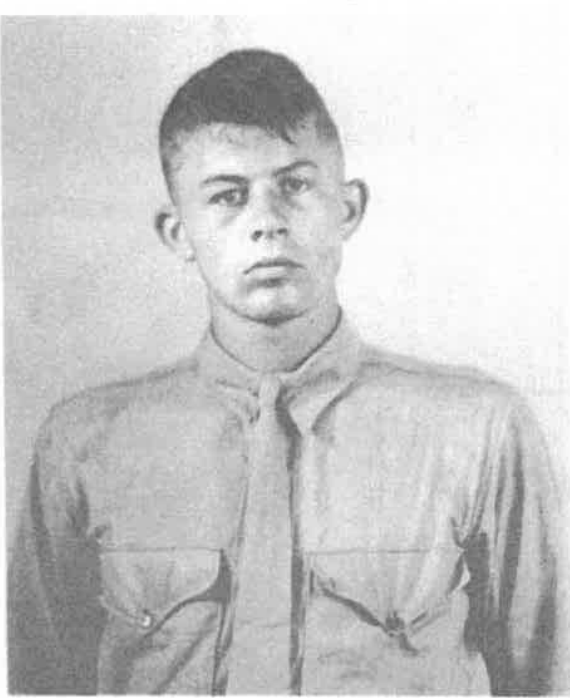
Sergeant Carl Burton Taylor
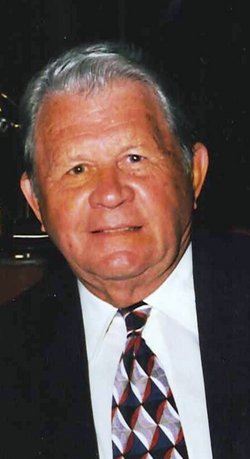
- Unit: Headquarters Battalion, 2nd Marine Division
- Date of Birth: October 18, 1922
- Entered the Military: June 28, 1940
- Date of Death: November 24, 2011
- Hometown: Newport, Tennessee, and Gastonia, North Carolina
- Place of Death: Knoxville, Tennessee
- Award(s): Purple Heart
- Cemetery: Section O, Sites 2587. East Tennessee State Veterans Cemetery, Knoxville, Tennessee
Mentored by Dr. Andrew Fultz
L&N STEM Academy, Knoxville, Tennessee
2025/2026
Early Life
Carl Burton Taylor was born on October 18, 1922, in Newport, Tennessee. He came into a world recovering from the horrors of World War I, trying to figure out a new normal with Prohibition, and women finally voting in national elections
Taylor grew up in a loving household with a large family. This household included his parents, James and Dicie; his grandmother, Laura; two brothers, Harry and Robert; and a sister, Lillian. He loved his family. This was a full house. This house was always full of life and family love. According to his daughter, Gail Long, Taylor’s father, James, fought in World War I, and the family can trace its military service back to the American Revolution.
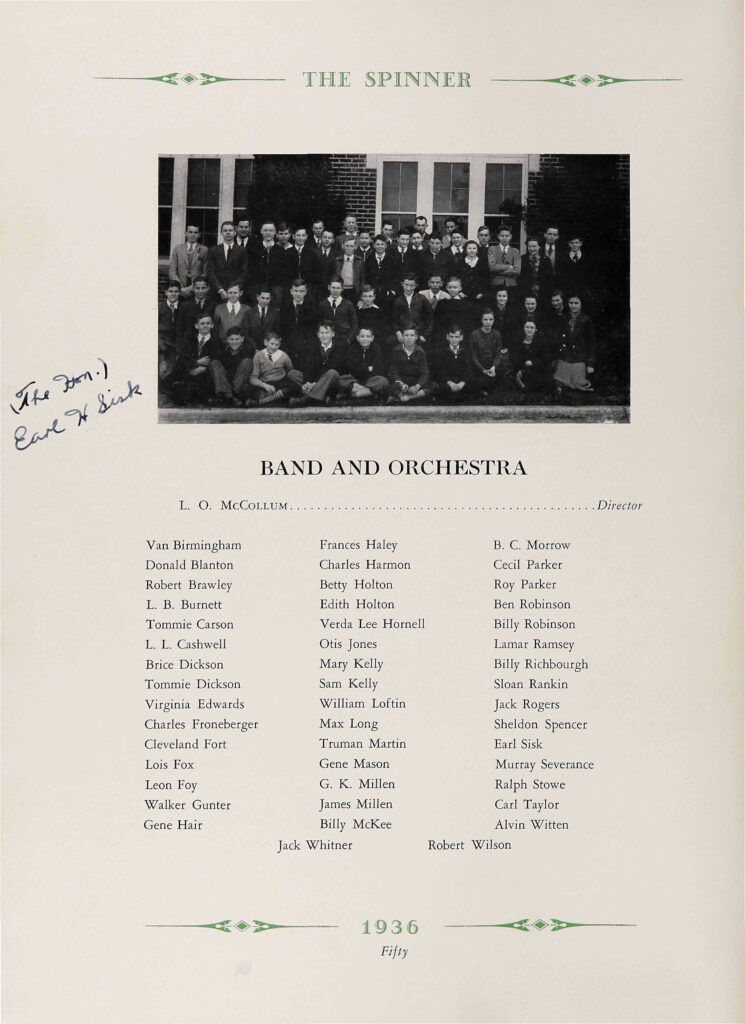
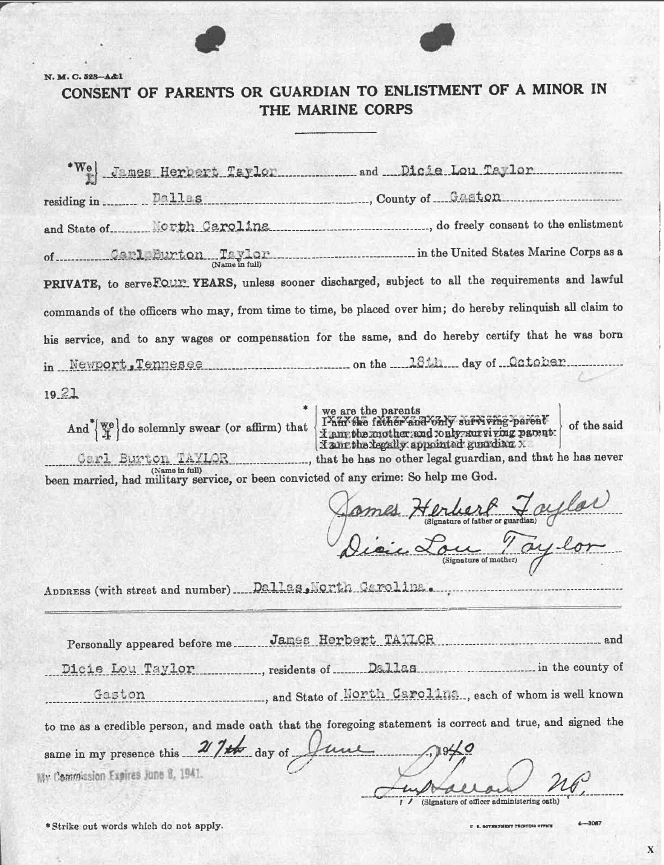
Before 1930, his family moved to Gastonia, North Carolina. Taylor attended Gastonia High School, and the 1936 yearbook featured him and the other members of the freshman class. He left high school after two years. Finding himself unemployed at age 19, he enlisted in the U.S. Marine Corps on June 28, 1940, with his parents’ consent.

Homefront
By 1940, the Taylor family moved from Gastonia to Dallas, North Carolina. Dallas is located near Lincolnton and Bessemer City, and it is the largest urban area surrounding Charlotte. Dallas is a small, unincorporated town.
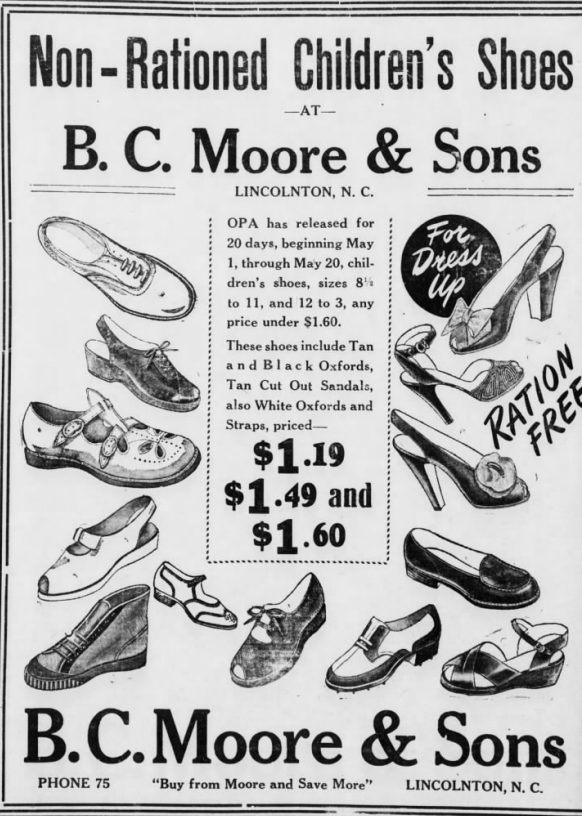
Charlotte, North Carolina, and its surrounding areas contributed to the war effort during World War II by providing food, rationing, and the opening of a rubber plant in Charlotte. The Lincoln Times reported that farmers sought to increase crop yields in order to feed the American military. Additionally, rationing was implemented for shoes, boots, and food items. Lastly, the U.S. Rubber Company opened a plant in Charlotte in 1943, which employed thousands of people.
Women were employed in the war effort. Hattie Lepper, known as “Chatty Hatty,” worked as a radio broadcaster in the Charlotte area on WGIV. She was the first African American woman on air in North Carolina. That is remarkable considering this was both in the South and in the era of Jim Crow. Mr. Taylor’s home front was certainly something worth fighting for.
Military Experience
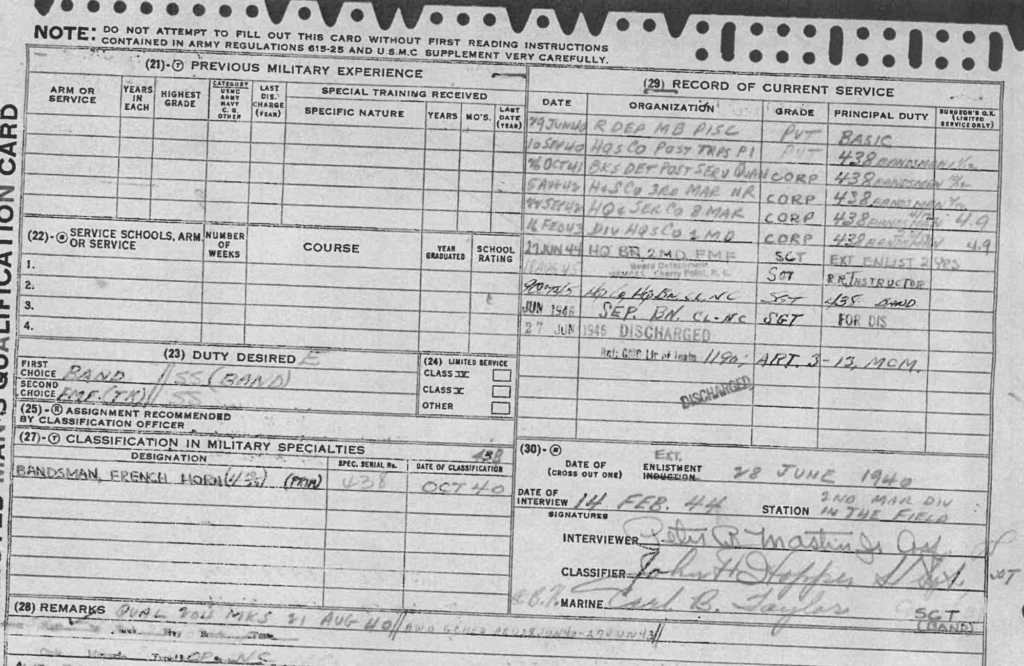
Carl Taylor served his country honorably. He joined the U.S. Marine Corps on June 28, 1940, well before the attack on Pearl Harbor. His military career is unique because he fought the Japanese in many contexts during the island-hopping campaign, and Taylor also served as a French horn player in several military bands. He reenlisted in the Marine Corps when his first tour of duty ended.
After receiving training at Parris Island, South Carolina, Taylor set off toward the Pacific. On August 28, 1942, he departed from San Diego, California, and sailed to American Samoa. Taylor would not see the United States again until after being wounded in combat.
His fighting record against the Japanese is extensive. He fought at Guadalcanal from November 4, 1942, to January 30, 1943. In November 1943, he participated in the Battle of Tarawa. The objective of that battle was to control the airfield on the island. Sergeant Taylor, along with other Marines, endured a banzai charge on November 23, the last day of fighting.
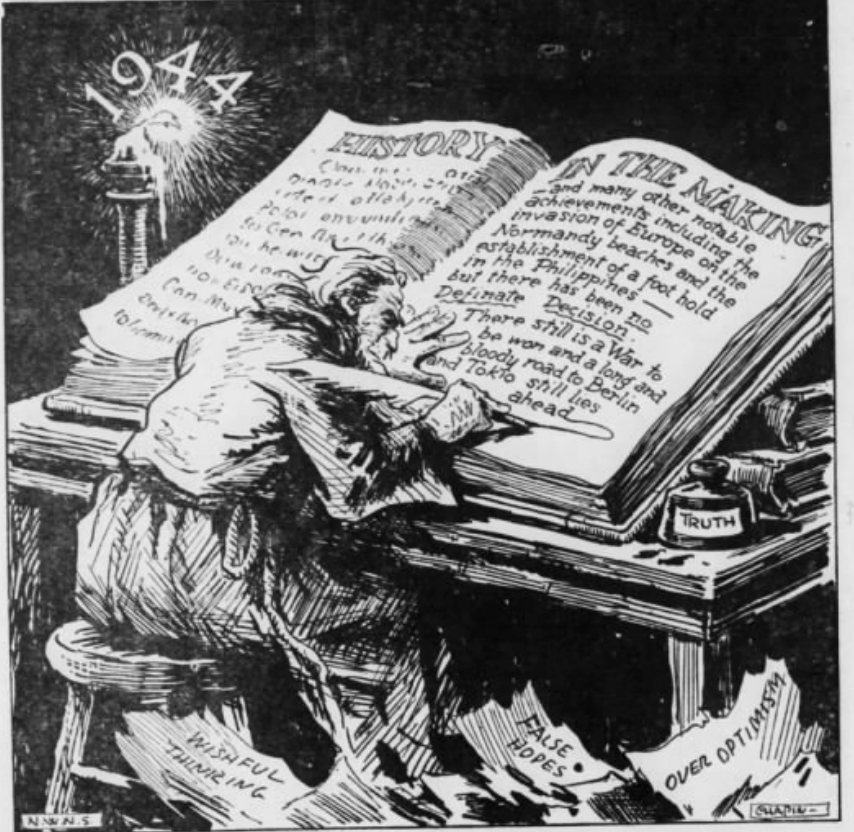
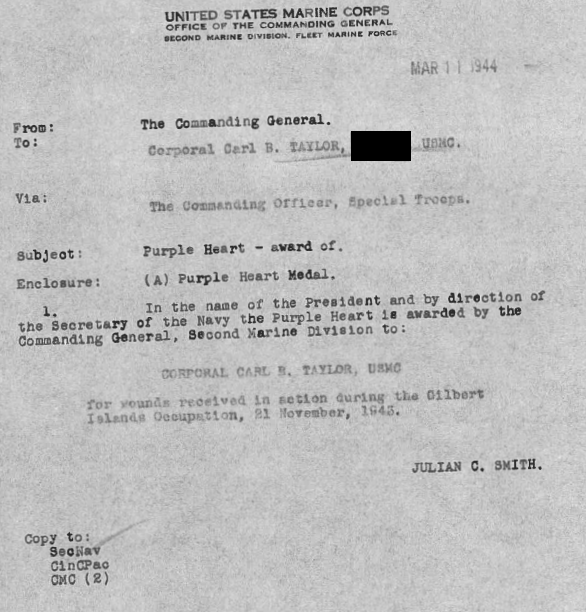
Following the brutality of Guadalcanal, he participated in the fighting at the Gilbert Islands (November 1943), the Marshall Islands (June 1944), and the Marianas Islands (March 1945). Taylor was wounded in action in the Gilbert Islands. A telegram was sent to his parents to warn them about his injury, but it did not reveal much beyond that. He continued to serve at the Battle of Okinawa.
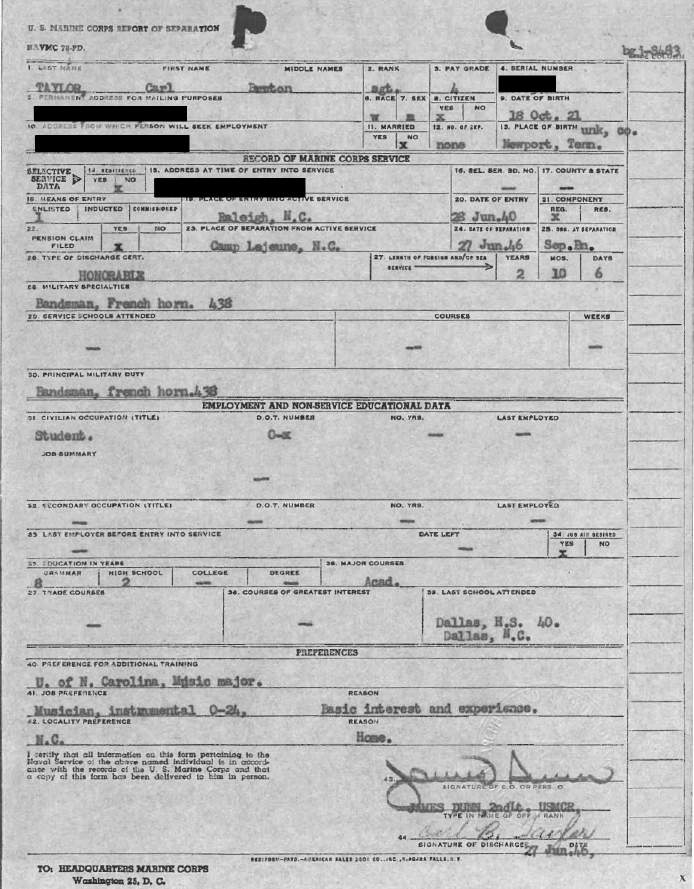
Following Japan’s defeat in World War II, Sergeant Taylor was honorably discharged from the Marines on June 27, 1946, at Camp Lejune, North Carolina.
Veteran Experience
Taylor continued to love his family, a theme throughout his life. He was married to his wife, Helen, for 65 years. The 1950 census indicated that within four years of leaving the Marine Corps, they had two children, Gail and Barry. They would later have a third child, Annette. The Taylors contributed to the Baby Boom in the United States following World War II.
Even though he wanted to play music after life in the Marines, Mr. Taylor found other ways to make a living. In 1950, he worked for Retail Coffey Co. as a salesman, and his wife, Helen, worked as a secretary for a furniture company. Later, he worked as a salesman for Texize Chemicals. They sold chemical cleaning supplies, such as those for pressure washing. He retired from that company in 1982. He moved his family to Knoxville due to his job. They bought a home off Papermill, and their house was next to the construction of Interstate 40 that passed through Knoxville in the mid-1960s.
Upon moving to Knoxville, Mr. Taylor and his wife attended West View Church. According to their daughter, Gail, he loved his faith and his church. In retirement, he played music at his church, and he led a Sunday School class. Also, in retirement, he took care of his grandchildren and ran a snow cone truck. He did not make money with that venture because he often gave away snow cones to children.
He left a legacy of love, affection, and loyalty.


Commemoration
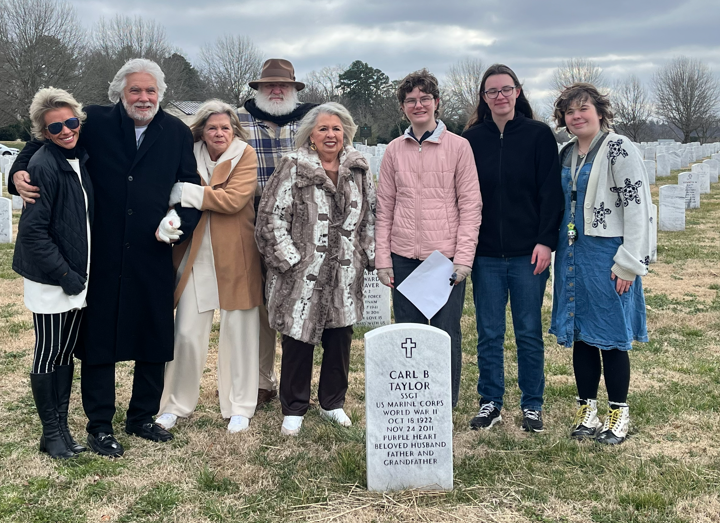
Mr. Burton died on November 24, 2011, at the age of 89. When he died, his family asked for donations to the West View Church, instead of flowers. His wife, Helen, passed away on June 26, 2020. They are buried together at the East Tennessee State Veterans Cemetery in Knoxville, Tennessee.
Bibliography
Primary Sources
Carl Burton Taylor. Official Military Personnel File, Department of the Navy, National Archives and Records Administration – St. Louis.
Carl Burton Taylor. Report of Separation, Department of the Navy, National Archives and Records Administration – St. Louis.
Carl Burton Taylor. U.S., World War II Draft Cards Young Men, 1940-1947. Digital images. https://ancestry.com.
The End of Another Chapter. Political cartoon. The Lincoln Times [Lincolnton, NC], December 28, 1944. Newspapers.com (889991397).
Gastonia High School Yearbook. Gastonia: Gaston County Schools, 1936. Digital images. https://ancestry.com.
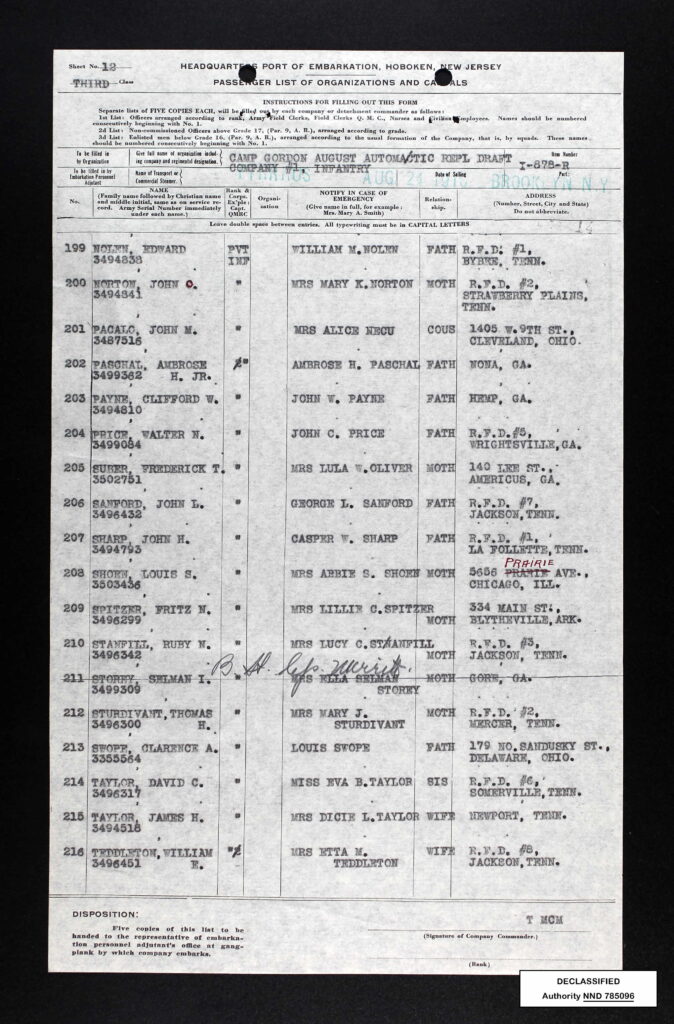
James H. Taylor. U.S., Army Transport Service Arriving and Departing Passenger Lists, 1910-1939. Digital Image. 2019. https://ancestry.com.
Long, Gail. Telephone interview with the author. January 23, 2026.
“Modern Miracle: Fewer Farmers, and More Food.” The Lincoln Times [Lincolnton, North Carolina], November 11, 1943. Newspapers.com (889996088).
“Non-Rationed Children’s Shoes.” The Lincoln Times [Lincolnton, North Carolina], May 4, 1944. Newspapers.com (889988195).
North Carolina. Gaston County. 1930 U.S. Census. Digital images. https://ancestry.com.
North Carolina. Gaston County. 1940 U.S. Census. Digital images. https://ancestry.com.
North Carolina. Caldwell County. 1950 U.S. Census. Digital Images. https://ancestry.com.
“Report Germans Killed American Prisoners.” The Lincoln Times [Lincolnton, North Carolina], December 28, 1944. Newspapers.com (889991397).
Tennessee. Cocke County. 1920 U.S. Census. Digital images. https://ancestry.com.
“Walk! Who Me?” The Lincoln Times [Lincolnton, North Carolina], November 11, 1943. Newspapers.com (889996088).
Secondary Sources
“2D Marine Division.” Marines. Accessed December 17, 2025. https://www.2ndmardiv.marines.mil/.
“Battle of Tarawa Atoll: Betio Island.” Naval History and Heritage Command. Accessed December 17, 2025. https://www.history.navy.mil/content/history/museums/nmusn/explore/photography/wwii/wwii-pacific/gilbert-marshall-islands-campaign/invasion-gilbert-islands/tarawa-atoll-betio.html.
“Carl B. Taylor.” Find a Grave. Updated November 25, 2011. Accessed February 6, 2026. https://www.findagrave.com/memorial/81013782/carl-b-taylor.
“Charlotte Quartermaster Depot/Charlotte Area Missile Plant.” Mecklenburg County. Accessed November 7, 2025. https://hl.mecknc.gov/Properties/Designated-Historic-Landmarks/charlotte/north-inner/charlotte-quartermaster-depotcharlotte-area-missle-plant.
Cole, Robert J. “Morton to sell Texize to Dow for $256 million.” The New York Times [New York, New York], November 16, 1984. https://www.nytimes.com/1984/11/16/business/morton-to-sell-texize-to-dow-for-256-million.html.
Dew, Stephen Herman. “The Queen City at War: Charlotte, North Carolina, during World War II, 1939-1945.” University of Arkansas ProQuest Dissertations & Theses. (1997.9820788), 1997. https://www.proquest.com/openview/e891dad92bf7edd55815035b463783e4/1?cbl=18750&diss=y&pq-origsite=gscholar.
Duvall, John. “North Carolina’s Wartime Miracle: Defending the Nation.” Anchor: A North Carolina Online History Resource. Updated 2008. Accessed November 7, 2025. https://www.ncpedia.org/anchor/north-carolinas-wartime.
Eden, Kiara. “North Carolina Military Women in World War II.” Levine Museum of the New South. Accessed February 6, 2026. https://www.museumofthenewsouth.org/schools/north-carolina-military-women-in-world-war-ii/.
“Helen Lucille Taylor.” Find a Grave. Updated June 27, 2020. Accessed November 20, 2025. https://www.findagrave.com/memorial/211882908/helen_lucille-taylor.
“Historical Ties to World War II.” University of North Carolina Charlotte. Accessed November 7, 2025. https://normandy.charlotte.edu/historical-ties/.
“Home is where our heart is.” Texize. Updated 2025. Accessed November 21, 2025. texize.com/pages/history.
“Invasion of Gilbert Islands.” Naval History and Heritage Command. Accessed November 26, 2025. https://www.history.navy.mil/content/history/museums/nmusn/explore/photography/wwii/wwii-pacific/gilbert-marshall-islands-campaign/invasion-gilbert-islands.html.
“Morris Field (L-118).” State of North Carolina. Updated January 17, 2024. Accessed November 7, 2025. https://www.dncr.nc.gov/blog/2024/01/17/morris-field-l-118.
Moxley, Christopher. “Fact Friday 383 – Charlotte’s Role during WWII.” Blog, April 7, 2023. 704 Shop. 704shop.com/blogs/fact-friday/fact-friday-383-charlottes-role-during-wwii?srsltid=AfmBOoozvdGrbE7cErTw0C9mhQVnfuCs76ZsDVZaSSKjvcyjHjAXXbLG.
“The Neutrality Acts of the 1930s.” The National WWII Museum. Updated August 27, 2024. Accessed November 26, 2025. https://www.nationalww2museum.org/war/articles/neutrality-acts-1930s.
“Population Statistics.” Charlotte Mecklenburg Library. Accessed November 7, 2025. https://www.cmstory.org/exhibits/hornets-nest-appendix/population-statistics.
“Shell Plant.” Charlotte Mecklenburg Library. Accessed February 6, 2025. https://www.cmstory.org/exhibits/home-front-charlotte-mecklenburg-1941-1946-places/shell-plant.
Springate, Megan E. “Rationing of Non-Food Items on the World War II Homefront.” National Park Service. Accessed November 7, 2025. https://www.nps.gov/articles/000/rationing-of-non-food-items-on-the-world-war-ii-home-front.htm.
This profile was funded by a grant from the United States Department of Veterans Affairs. The opinions, findings, and conclusions stated herein are those of the author and do not necessarily reflect those of the United States Department of Veterans Affairs.