

Musician Third Class Donald Perry Stone

- Unit: Uss Wasp
- Service Number: 9788328
- Date of Birth: September 15, 1926
- Entered the Military: January 22, 1945
- Date of Death: December 2, 2003
- Hometown: Mt. Sterling, Kentucky
- Place of Death: Monticello, Kentucky
- Award(s): Asiatic-Pacific Service Ribbon with one engagement star, American Area Campaign Ribbon, and the World War II Victory Medal
- Cemetery: Section L, Site 100. Mill Springs National Cemetery, Nancy, Kentucky
Early Life
Donald Perry Stone was born in Mt. Sterling, Kentucky, on September 15, 1926, to James Leonard and Virginia Manley Stone. His parents married at eighteen, and both came from families with a long history in Kentucky farming communities.
In 1930, the family lived in a rented home at 135 West Locust Street in Mt. Sterling, where James worked as a mechanic at a local garage.
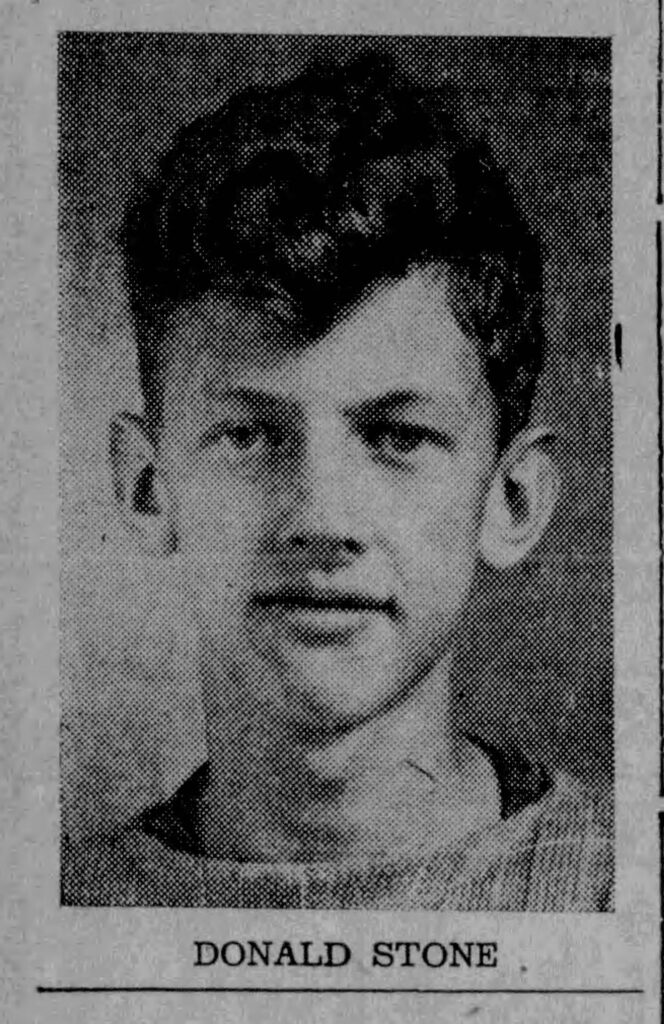
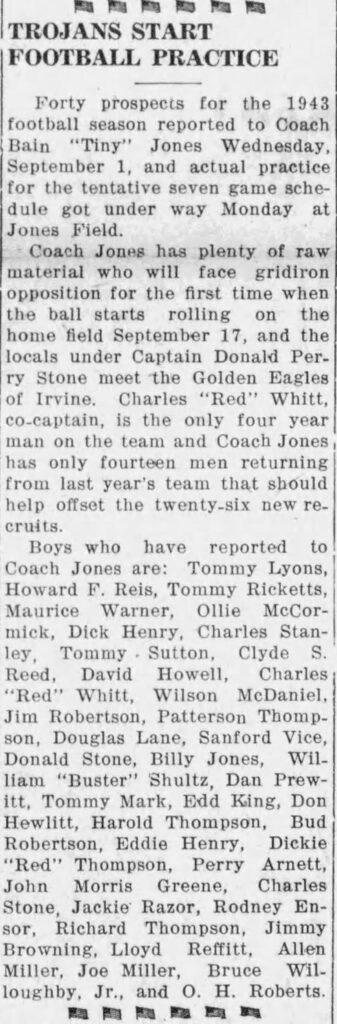
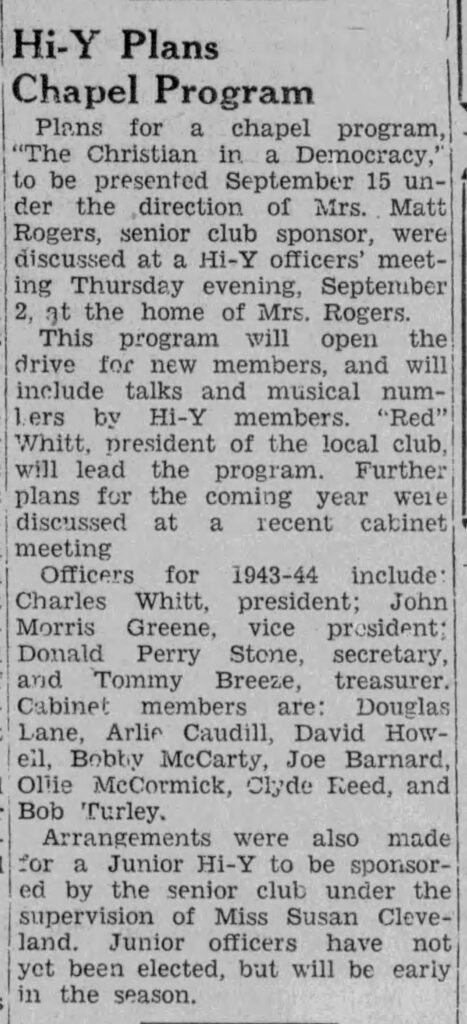
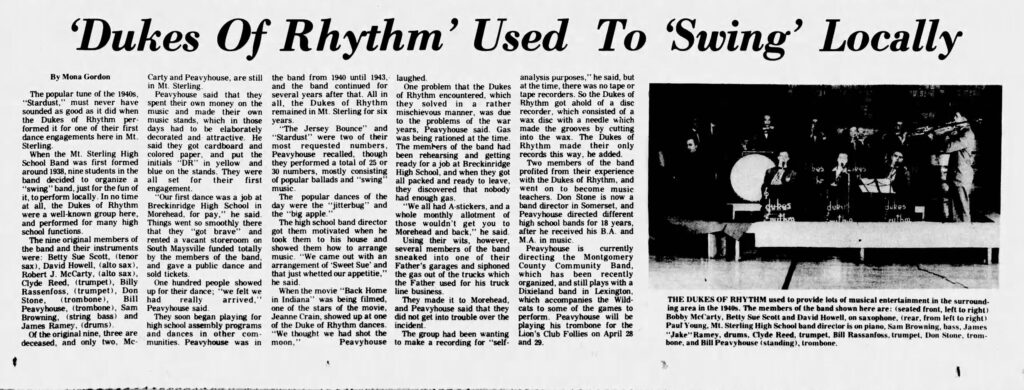
By 1940, the family had moved to 111 Harrison Avenue in Mt. Sterling, and James owned an automobile garage. In 1941, the Stones had another child, Frances. By then, Stone attended Mt. Sterling High School, where he captained the football and basketball teams. He also served as secretary of the Hi-Y, a YMCA service club for high school students that promoted Christian character, leadership, and community service. He was also a founding member of the Dukes of Rhythm, a nine-member big band formed by local students. Stone played the trombone, and the group traveled locally for many events.
In the fall of 1944, Stone enrolled at the University of Kentucky, where he studied engineering. While at the university, Stone played trombone in a fifteen-piece jump band that performed in nightclubs and at college and high school dances. He also drove for a dry-cleaning company. On September 15 of that year, Stone registered for the draft. By December, he had passed his pre-induction examinations, and on January 22, 1945, he left for induction in Louisville.
Homefront
Hemp
Kentucky farmers had grown hemp for ropes and bagging for cotton bales since the state’s founding, drawn by the rich soil and ideal climate. In fact, Kentucky led the nation in industrial hemp until after the Civil War, when manufacturers found it cheaper to import fibers such as Manila hemp from the Philippines and jute from India. Cultivation declined further as hemp became entangled in the campaign against marijuana. After the start of the war, Japanese advances cut off Philippine and East Indian fiber shipments, so the United States Department of Agriculture encouraged Kentucky farmers to plant it again, even producing a short film for farmers titled Hemp for Victory.
To grow hemp, farmers had to obtain a special tax stamp and permits after the passage of the Marihuana Tax Act of 1937 (the period spelling of marijuana). This was the first federal law to regulate cannabis nationwide. In 1942, Kentucky farmers planted 36,000 acres, and in 1943, 52,000 acres. To help process the plants, the government built forty-two hemp mills throughout the country. In 1943, construction of one of these mills began in Winchester, Kentucky, about fifteen miles from Stone’s home in Mt. Sterling. Hemp had many uses during the war, including rope and cordage, canvas and webbing in tents and backpacks, light-duty fire hoses, and shoe thread for soldiers’ footwear.
Effects of the War in Kentucky
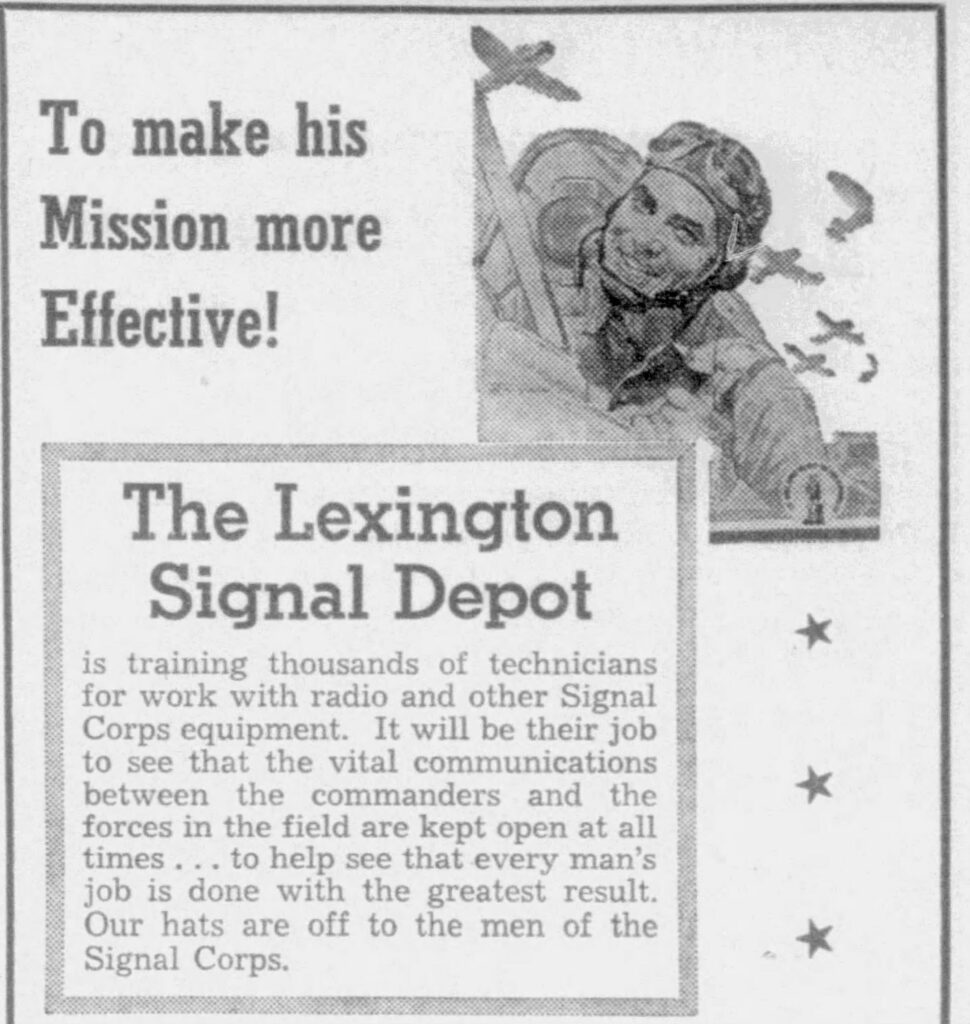
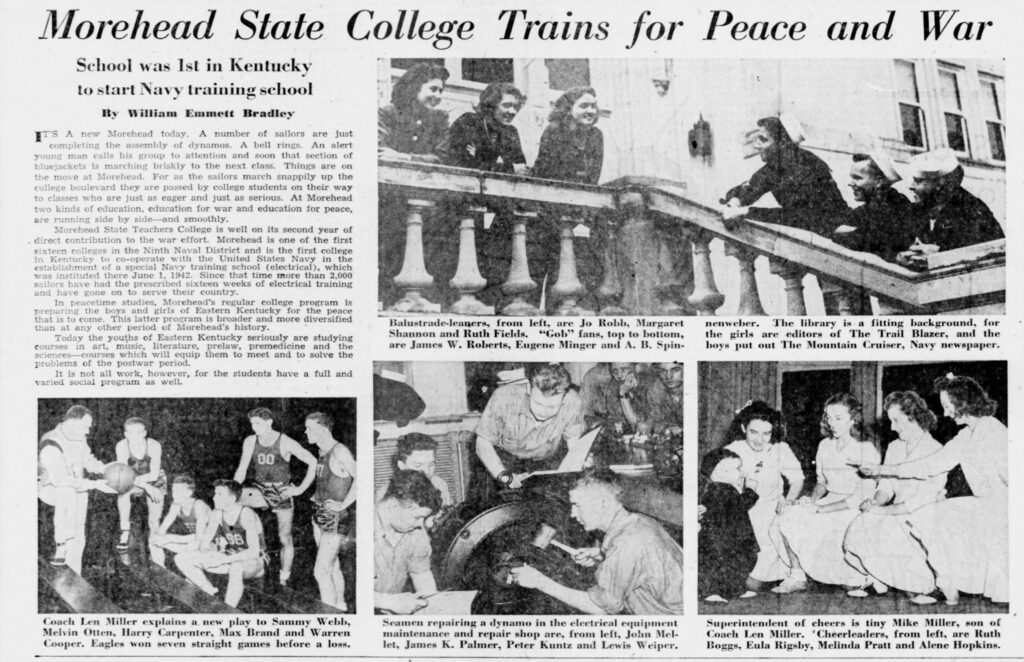
Within forty miles of Mt. Sterling stood three sites central to the war effort. The Army Signal Corps built the Lexington Signal Depot in Avon between 1941 and 1942 and used it to receive, store, and issue radar, radio, and other Signal Corps equipment. The depot was also the site of the Army’s first electronics power school and a school for technicians who maintained mobile and airborne signal equipment. Between 1942 and 1943, the Army built the Blue Grass Ordnance Depot in Richmond to store ammunition and general supplies. Lastly, Morehead State Teachers College (now Morehead State University), which had struggled financially since the start of the war, was the first college in Kentucky to join the Navy College Training Program. Morehead trained more than 3,000 men, known as “Blue Jackets,” from June 1942 to July 1944. This influx of students revitalized not only the college but also the surrounding communities. After the war, GI Bill enrollment brought a second wave of students. Nearly half of the college’s postwar students were Veterans.

Military Experience
Stone attended recruit training at the Great Lakes Naval Training Center in Illinois. Afterward, he passed an intense audition and qualified to attend the U.S. Navy School of Music at Anacostia Naval Receiving Station in Washington, D.C. Before the start of the war, the school was modest, with thirty-one faculty and staff and 320 students. When Stone entered in 1945, there were ninety-one faculty and staff and 400 students. During the war, the program accelerated from two years to one. The school taught courses in harmony, music theory, and ear training. All students had to play at least two instruments across a variety of styles, including symphonic, patriotic, martial, Americana, and jazz.
Students graduated as members of a twenty-one-person unit band. The Navy transferred the men as a unit to ship or shore duty, and they stayed together for the length of their first enlistment. Men who worked for radio networks and the day’s popular big-band conductors produced special arrangements, known as “Navy Specials,” for the bands. Faculty and staff included conservatory and university graduates, former symphony and band members, and recording and repair technicians. During the war, 6,800 band members served in about 285 bands on ships and ashore.
Each band carried thirty-six instruments and knew more than 1,000 musical arrangements. This allowed each band to perform as a marching, ceremonial, concert, or dance band, or as a full orchestra. On a ship, the band might put on a concert on the flight or hangar decks, play for formal ceremonies or burials at sea, or back up traveling USO performers. When destroyers came alongside to refuel, the band would play on the hangar deck, and the music was piped over to the ships. In this way, band members played an important role in crew morale. Beyond their band duties, musicians had battle stations and ship duties such as carrying stretchers, handling ammunition, and standing watch.
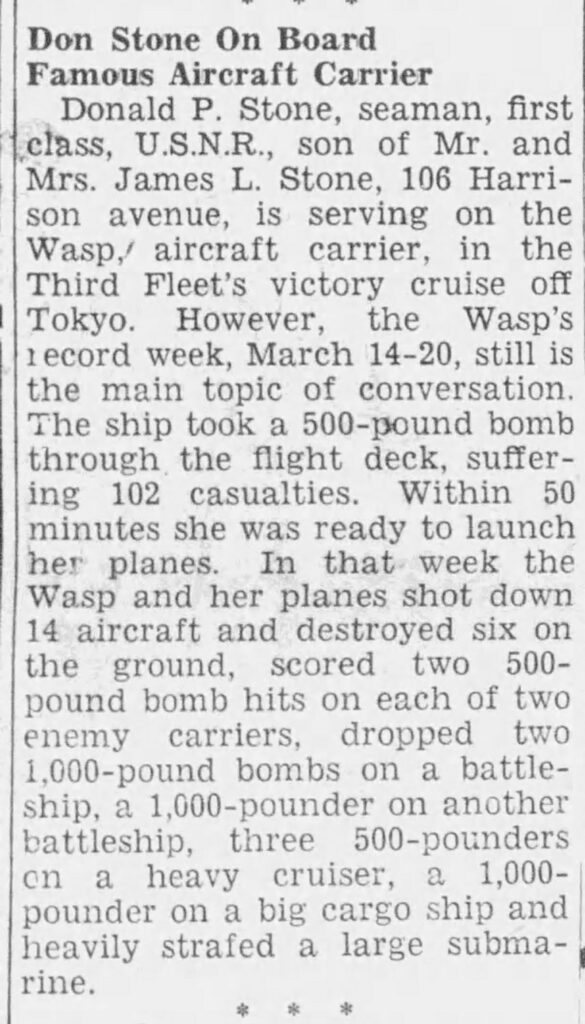
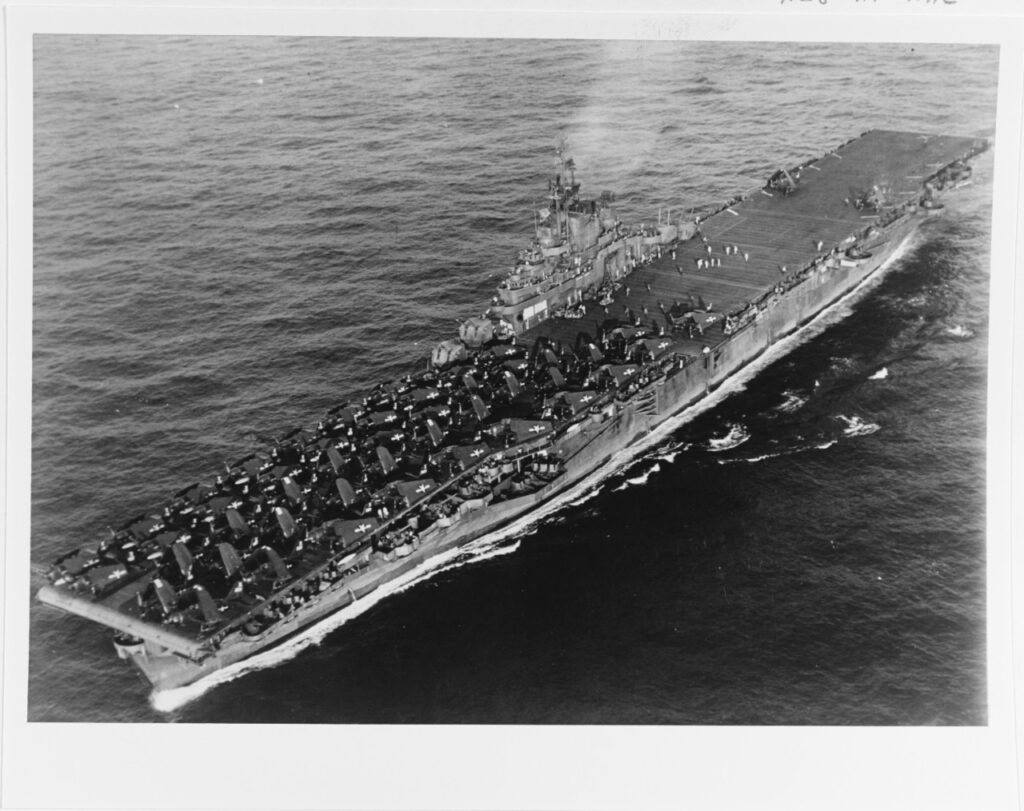
Stone’s previous musical experience allowed him to leave School of Music and receive his assignment within a few months. Stone was stationed aboard USS Wasp as a musician third class. Wasp was an aircraft carrier, originally built in 1942 as Oriskany in Quincy, Massachusetts, by Bethlehem Steel. The Navy renamed the on November 13, 1942, after the previous Wasp was sunk. It was launched on August 17, 1943. From March 14 to 20, 1945, before Stone came aboard, Wasp took part in carrier strikes on Kyushu and the Insland Sea. During these, it was hit by a 500-pound bomb that went through the flight deck and the armored hangar deck before exploding in the crew’s galley. The explosion killed more than 100 crew members. Wasp launched a counterattack over the next week, scoring multiple hits on more than a dozen aircraft, two carriers, two battleships, a heavy cruiser, and a cargo ship; it even strafed a submarine.
After this battle, the ship went to the Puget Sound Navy Yard in Washington for repairs. While there, on May 22, 1945, Stone came aboard. On July 12, Wasp steamed back to Hawai’i and then headed to the western Pacific, where it struck Wake Island before rejoining the Fast Carrier Task Force. On this journey, Stone was inducted into the Order of the Golden Dragon, a ceremony for sailors crossing the 180th meridian for the first time. Wasp struck the Yokosuka Naval Base near Tokyo, along with numerous airfields and hidden factories.
On August 9, a kamikaze plane attempted to crash into Wasp, but a Wasp pilot flying overhead forced it into the sea. On August 15, the day Japan announced its surrender, two enemy planes tried to attack their task group. Wasp pilots, still on air patrol, sent both enemy planes into the sea. That was their last engagement of the war.
On August 25, a severe typhoon struck the ship and crushed a thirty-foot section of the ship’s bow. Even with the damage, Wasp continued to launch planes on missions of mercy to American POWs at Narumi, near Nagoya, Japan. On October 27, the ship returned to Boston for Navy Day, a yearly naval celebration. Three days later, it left for a New York shipyard to install extra berthing so the ship could carry troops home. That work continued for two weeks. After the retrofit, Wasp could transport 5,500 enlisted passengers and 400 officers. Wasp then joined “Operation Magic Carpet,” the effort to bring American service members home from overseas.
Stone served on these transports until he was honorably discharged on June 17, 1946, in Norfolk, Virginia.

Veteran Experience
After his discharge, Stone returned to Kentucky to live with his parents and sister, Frances, while attending the University of Kentucky. While there, he joined the symphony orchestra and, in 1950, graduated with a bachelor’s degree in music, concentrating in trombone.
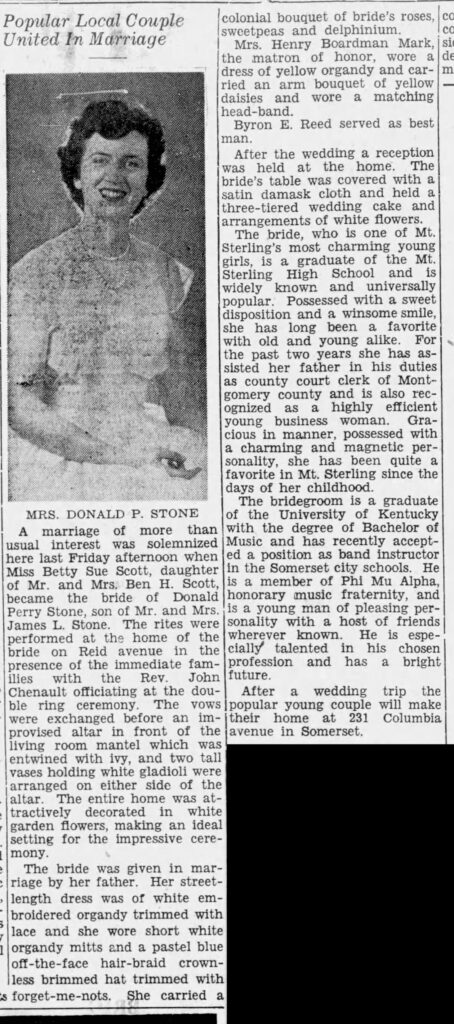
On June 16, 1950, Stone married Betty Sue Scott. They lived in Somerset, Kentucky, where Stone became band director at Somerset High School. The couple had a daughter, Susan, on March 3, 1952. On December 15, 1953, Betty Sue died while giving birth. The baby, a boy, was stillborn.
On June 11, 1955, Stone married Fanie Benelli. Fanie had a daughter, Vicki, from an earlier marriage to Charles Raymond Ritter.
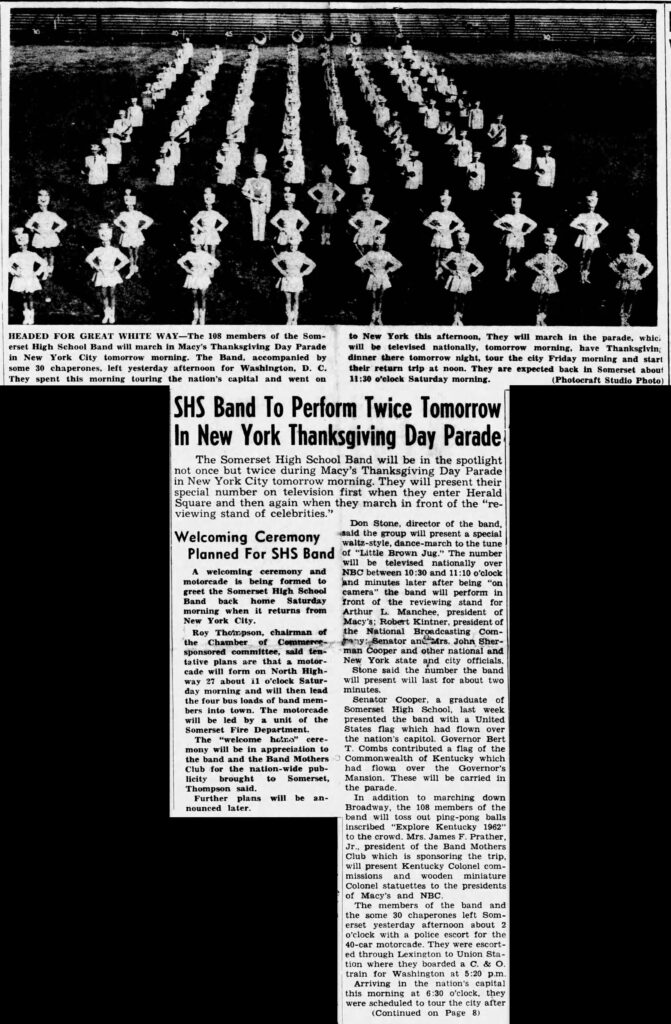
During his twenty-nine years as band and choir director for Somerset High School, Stone grew the Briar Jumper marching band into a competition powerhouse. Under his direction, they earned multiple consecutive superior ratings at the annual state music festival. In 1955, Stone created the “Jumperettes,” a majorette group within the band.
Stone’s marching band was one of only twelve bands in the country invited to perform in the 1961 Macy’s Thanksgiving Day Parade. They were selected for their performances at two gubernatorial ceremonies and the 1959 state fair. Stone learned of the invitation only a month before the parade, and Somerset residents chipped in so all ninety musicians, sixteen Jumperettes, and thirty chaperones could attend. Most band members had never been out of state. They received a police escort to a train in Lexington, stopped for a tour of Washington, D.C., and then continued to New York City.
As an educator, Stone was remembered for his teaching ability and his encouraging nature. His enthusiasm was said to be contagious. His motto was “many as one” — perfect for a marching band. He commanded respect, but did it in a way that also built relationships with his students. By the end of his career, he had directed the beginner, junior, senior, and stage bands, as well as the boys’, girls’, and mixed choruses. He also developed a curriculum for music theory and music humanities.
Stone also taught chorus at the former Dunbar High School, Somerset’s segregated school for Black students, which closed after integration. He also led the beginner band for Science Hill Independent School District, whose students went on to Somerset High School. He also conducted the Somerset Civic Orchestra, directed the Pulaski County Oratorio Chorus and other community choirs, and served as president of the Middle Cumberland Music Educators Association.
Stone also served as an elder and member of the First Christian Church for over forty years, where he taught Sunday school for almost a decade.

Commemoration
By the end of his career, the Master Musicians Festival recognized Stone for his significant lifetime accomplishments. At the time of his death on December 2, 2003, Stone had seven grandchildren and three great-grandchildren. In 2024, he was inducted into the Somerset High School Athletic Hall of Fame.
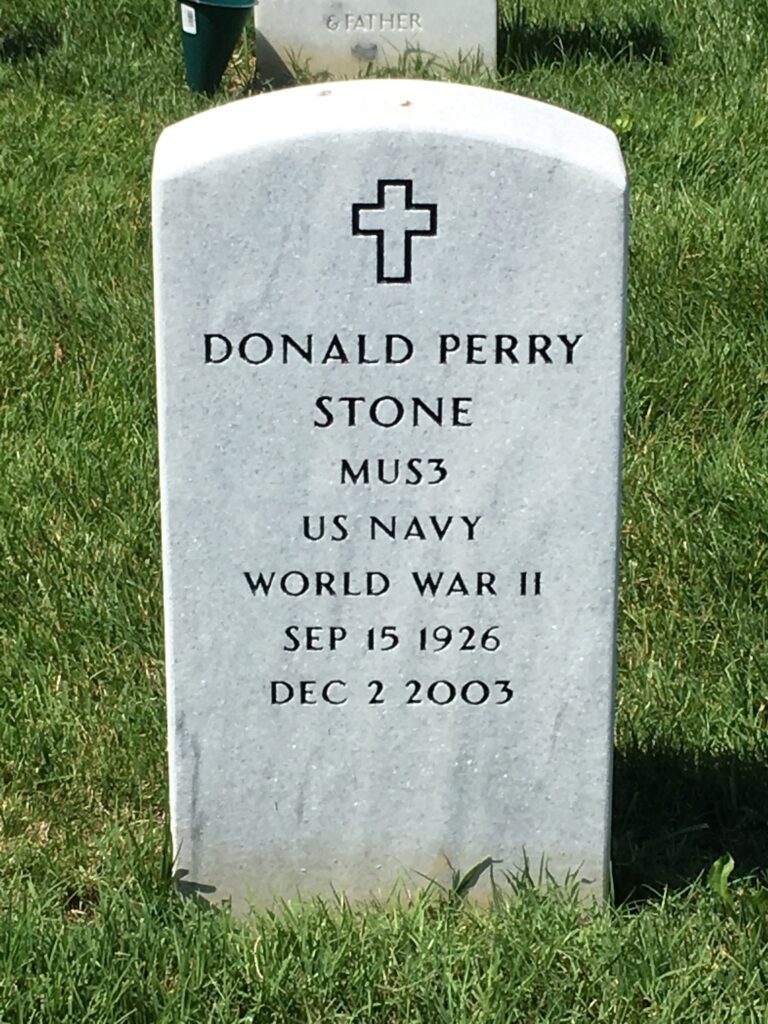
He is buried at Mill Springs National Cemetery in Section L, Site 100.
Bibliography
Primary Sources
“14 Boys Pass Exams for Military Service.” The Mt. Sterling Advocate [Mt. Sterling, Kentucky], December 21, 1944. Newspapers.com (1343413368).
“68 Men Accepted From Months Call; Inductees Listed.” The Sentinel Democrat [Mt. Sterling, Kentucky], January 18, 1945. Newspapers.com (1339932182).
Donald Perry Stone, Official Military Personnel File, Department of the Navy, National Archives and Records Administration – St. Louis.
Donald Perry Stone. U.S., Korean War Era Draft Cards, 1948-1959. https://ancestryclassroom.com.
Donald Perry Stone. U.S., Veterans’ Gravesites, ca. 1775-2019. https://ancestryclassroom.com.
Donald Perry Stone. U.S., World War II Navy Muster Rolls, 1938-1949. https://fold3.com.
Donald Perry Stone. World War II Draft Cards Young Men, 1940-1947. Digital Images. https://ancestryclassroom.com.
“Don Stone on Board Famous Aircraft Carrier.” The Mt. Sterling Advocate [Mt. Sterling, Kentucky], September 27, 1945. Newspapers.com (1343414377).
“‘Dukes of Rhythm’ Used to ‘Swing’ Locally.” The Mt. Sterling Advocate [Mt. Sterling, Kentucky], March 23, 1978. Newspapers.com (1343161961).
“Hi-Y Officers Plan Activities for Year.” The Sentinel Democrat [Mt. Sterling, Kentucky], November 04, 1943. Newspapers.com (1339919777).
“Hi-Y Plans Chapel Program.” The Sentinel Democrat [Mt. Sterling, Kentucky], September 09, 1943. Newspapers.com (1339917985).
Homespun. Somerset: Somerset High School, 1957.
Kentuckian Yearbook. Lexington: University of Kentucky, 1948.
Kentucky. Bath County. 1920 U.S. Census. Digital Images. http://ancestryclassroom.com.
Kentucky. Montgomery County. 1920 U.S. Census. Digital Images. http://ancestryclassroom.com.
Kentucky. Montgomery County. 1930 U.S. Census. Digital Images. http://ancestryclassroom.com.
Kentucky. Montgomery County. 1940 U.S. Census. Digital Images. http://ancestryclassroom.com.
Kentucky. Montgomery County. 1950 U.S. Census. Digital Images. http://ancestryclassroom.com.
“Miss Ritter is Bride of Earl Goode.” Lexington Herald-Leader [Lexington, Kentucky], August 13, 1962. Newspapers.com (684091153).
“Mrs. Donald Stone Passes Tuesday At Somerset.” The Sentinel Democrat [Mt. Sterling, Kentucky], December 16, 1953. Newspapers.com (1337566225).
“Obituaries & Memorials.” Lexington Herald-Leader [Lexington, Kentucky], December 6, 2003. Newspapers.com (693898591).
“Popular Local Couple United in Marriage.” The Mt. Sterling Advocate [Mt. Sterling, Kentucky], June 22, 1950. Newspapers.com (1343203546).
“Robbie Lucas Headlines Somerset’s Hall of Fame Class of 2024.” Commonwealth Journal [Somerset, Kentucky], September 20, 2024. https://sports.yahoo.com/robbie-lucas-headlines-somersets-hall-035900311.html.
“SHS Band to Perform Twice Tomorrow in New York Thanksgiving Day Parade.” The Commonwealth [Somerset, Kentucky], November 22, 1961. Newspapers.com (1140698445).
“Stone Gets Degree From University.” The Sentinel Democrat [Mt. Sterling, Kentucky], June 14, 1950. Newspapers.com (1339972124).
Susan P. Stone. Kentucky, U.S., Birth Index, 1911-1999. https://ancestryclassroom.com.
“Trojans Start Football Practice.” The Mt. Sterling Advocate [Mt. Sterling, Kentucky], September 09, 1943. Newspapers.com (1343410687).
Secondary Sources
Akers, Gwen. “Morehead as a Naval Academy.” The Trail Blazer. Accessed July 30, 2026. https://www.thetrailblazeronline.net/article_9dc6c972-dbf2-11ee-9275-8b5ff97a8d9b.html.
Commonwealth Curiosities. “Morehead State University History of the Blue Jackets,” posted August 15, 2023, YouTube, 4:11, https://www.youtube.com/watch?v=Uu3unrdFwlA.
“Donald Perry ‘Don’ Stone.” Find a Grave. Accessed July 28, 2026. https://www.findagrave.com/memorial/26229061/donald-perry-stone.
“From the Fields to the Frontlines: Hemp’s Unsung Role in WWII.” Straight Hemp. Modified May 28, 2023. Accessed July 30, 2026. https://straighthemp.com/blogs/cbd/from-the-fields-to-the-frontlines-hemps-unsung-role-in-wwii?srsltid=AfmBOopwJ3QmqBPrp9mP6AXlciKaz0ssDAw2WKJXiYmt3V_KXp33Wkct.
“Historical Census of Housing Tables – Gross Rents.” Wyoming Department of Administration and Information: Economic Analysis Division. Accessed July 28, 2026. http://eadiv.state.wy.us/housing/Gross_Rent_ST.htm.
“Historical Marker #1319 ‘Clark County Hemp’.” The Official Hemp Highway of Kentucky. Accessed July 30, 2026. https://www.kentuckyhemphighway.com/index.php/clark/.
“Historical Markers.” Morehead State University. Accessed July 30, 2026. https://www.moreheadstate.edu/about-msu/history-of-msu/historical-markers.
Holtz, Thomas, Barbara Hightower, and William Brenner. “Lexington-Blue Grass Depot.” Washington, D.C., 1985 [HAER-KY-11]. https://tile.loc.gov/storage-services/master/pnp/habshaer/ky/ky0100/ky0196/data/ky0196data.pdf.
Jones, Patrick M. “The Naval School of Music.” Music Educators Journal. March 2015: 47-54. https://veterans.syracuse.edu/wp-content/uploads/2015/03/Jones-Naval-School-of-Music-MEJ-March-2015.pdf.
Malone, Trey. “Four Useful Principles of Behavioral Economics for Farm Managers.” Michigan State University. Accessed July 30, 2026. https://www.canr.msu.edu/news/malone_behavioralecon.
Nuclear Vault. “Hemp for Victory (1942),” posted July 26, 2015, YouTube, 14:11, https://www.youtube.com/watch?v=d3rolyiTPr0.
Peters, Rosemary. “After Arizona: Military Musicians in the Second World War.” Revue LISA. Volume X, Number 1 (2012): 209-234. https://journals.openedition.org/lisa/4994?lang=en.
“Radio Set Ownership 1930.” United States Census Bureau. Accessed July 28, 2026. https://www2.census.gov/geo/pdfs/maps-data/maps/thematic/housing/radios.pdf.
“The Saga of Navy Band 22.” The Syncopated Times. Last Modified October 27, 2023. Accessed July 29, 2026. https://syncopatedtimes.com/the-saga-of-navy-band-22/.
“Wasp IX (CV-18).” Naval Heritage and Heritage Command. Accessed July 29, 2026. https://www.history.navy.mil/research/histories/ship-histories/danfs/w/wasp-ix.html.
“Where in the World: Growing Hemp in Clark County.” The Winchester Sun [Winchester, Kentucky], January 17, 2020. https://winchestersun.com/2020/01/17/where-in-the-world-growing-hemp-in-clark-county/.
This profile was funded by a grant from the United States Department of Veterans Affairs. The opinions, findings, and conclusions stated herein are those of the author and do not necessarily reflect those of the United States Department of Veterans Affairs.