
Private First Class Edward F. Rielly
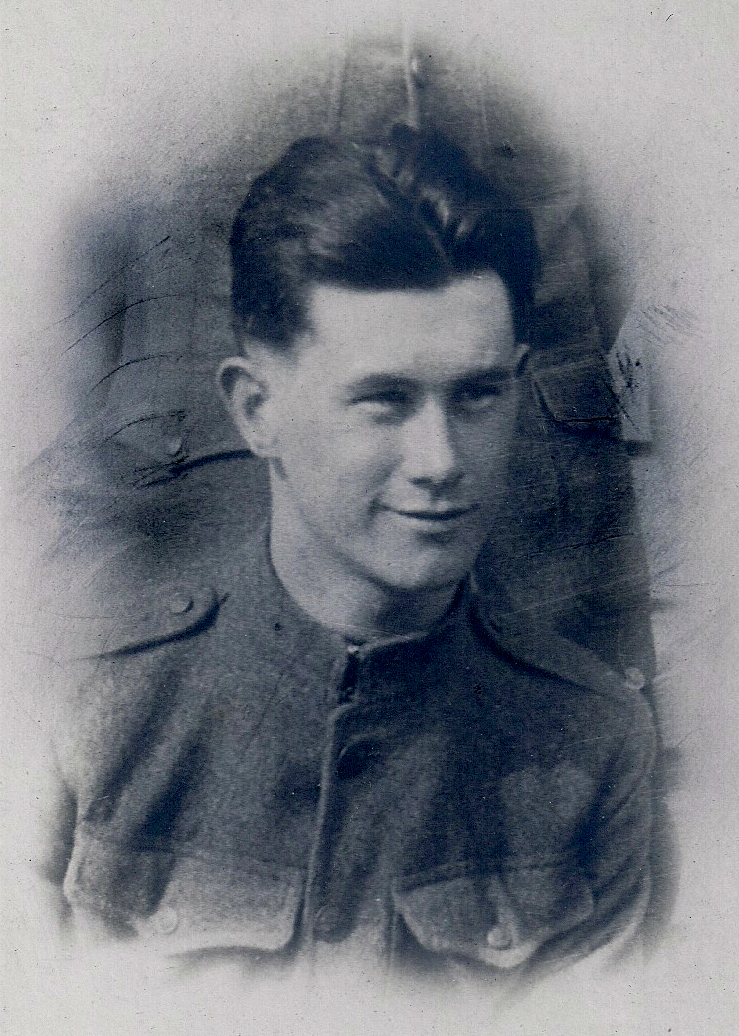
- Unit: Company G, 105th Infantry Regiment, 53rd Brigade, 27th Division
- Service Number: 2671571
- Date of Birth: April 15, 1896
- Entered the Military: April 5, 1918
- Date of Death: September 29, 1918
- Hometown: Long Island City, New York
- Place of Death: Near Bony in Aisne, France
- Award(s): U.S. Army Citation for Bravery, World War I Victory Medal
- Cemetery: Plot B, Row 18, Grave 6. Somme American Cemetery, Bony, France
Horace Greeley High School (Chappaqua, New York)
2025/2026
Early Life
Early Childhood and Family
On April 15, 1896, Edward F. Rielly was born in Long Island City, a neighborhood in Queens, New York.
His parents, Patrick Joseph Rielly and Catherine M. Rielly, were both born in County Tipperary, Ireland. Catherine worked as a shoemaker in Ireland and immigrated to New York in 1884, followed by Patrick in 1887; Patrick had previously worked as a merchant. Patrick first found work in New York as a night watchman, with responsibilities including patrolling the streets, helping keep the peace, and detecting fires. By 1900, he worked as a porter.
Rielly grew up with two older siblings, Martin and Catherine, and a younger brother, John. According to the 1900 U.S. Census, the family owned a mortgaged home on Eighth Street in the western section of Long Island City known as Hunter’s Point. At the turn of the twentieth century, Hunter’s Point was a fast-growing community located just across the East River from Manhattan.
When Rielly was 11 years old, his father died from acute lobar pneumonia. In the years that followed, the Rielly children worked to help support one another and their mother, who took care of the house. By 1910, Rielly’s brother Martin was employed in the foundry industry as a bookkeeper.
Teenage Years and Young Adulthood
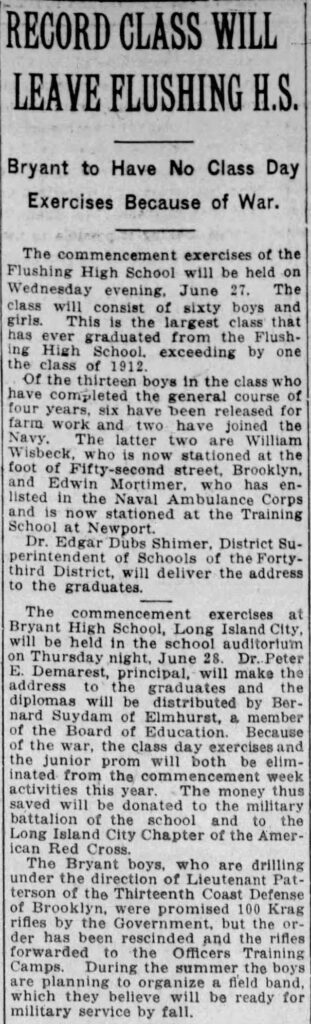
Balancing school, athletics, work, and volunteering with local Catholic organizations, Rielly remained busy throughout his teenage years. He graduated from Public School No. 1 in 1912 and went on to attend William Cullen Bryant High School in Long Island City. He was known for his athleticism, playing on basketball and baseball teams through St. Mary’s Catholic Church.
Additionally, Rielly belonged to fraternal Catholic organizations, including the Knights of Columbus and the Holy Name Society of St. Mary’s Church. At the age of 15, the Knights of Columbus Jamaica Council No. 337 elected him “Warden” for the year 1912. By 1915, Rielly worked as a bookkeeper at the Title Guarantee and Trust Company on Jackson Avenue and Fifth Street in Long Island City. This was the career and civilian life he would have to leave behind when the U.S. Army drafted him, and he entered service in April 1918.
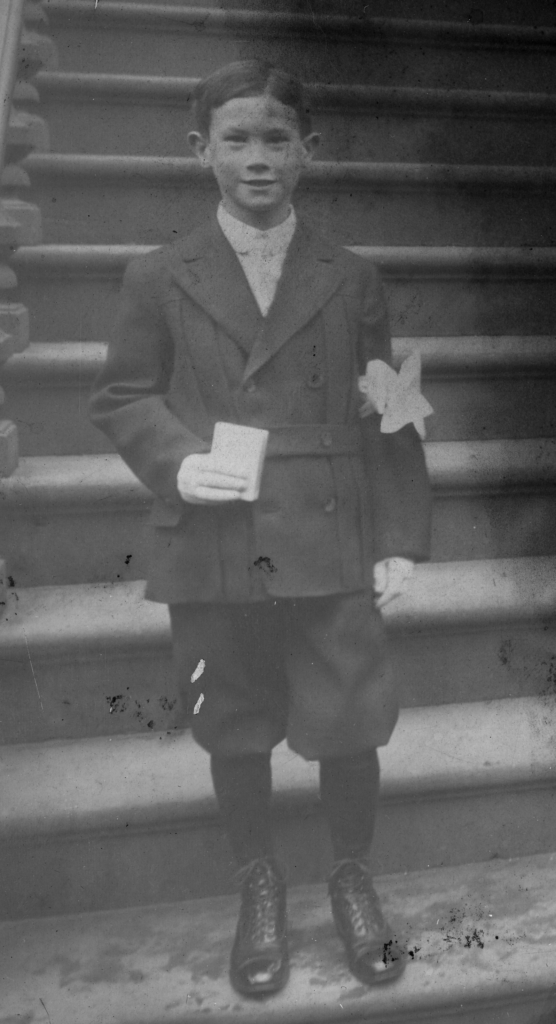
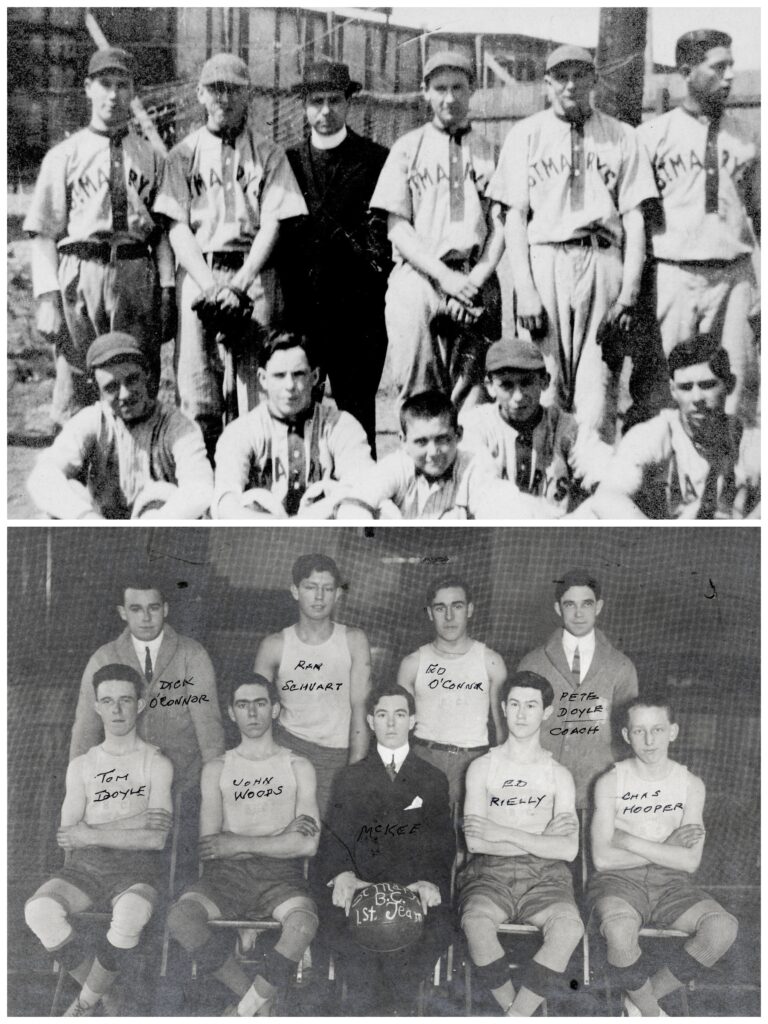
Bottom image: Rielly, seated second from the right in the front row, with St. Mary’s basketball team. Courtesy of the McGill family.
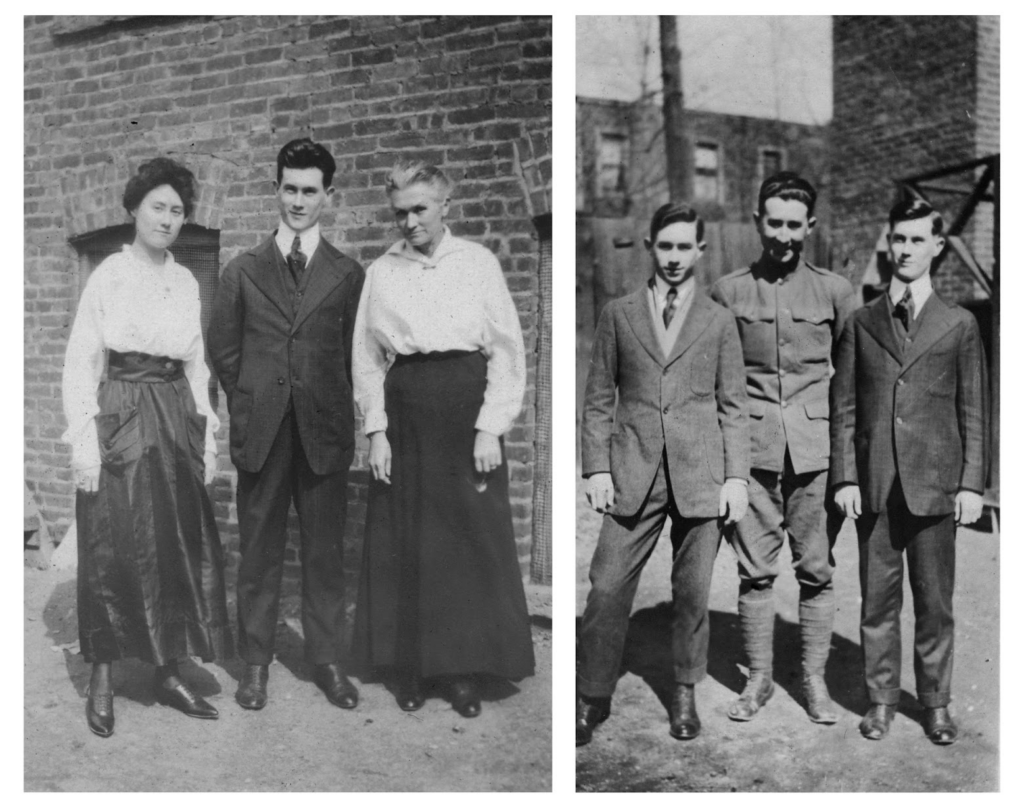
Right image: Rielly (right) with his brothers John and Martin, who is in uniform. Martin never went overseas, but served in the Coast Artillery Corps of the National Guard stationed at Fort Hancock in Sandy Hook, New Jersey. He was honorably discharged in December of 1918 as a first sergeant, c.1917, Courtesy of the McGill family.
Homefront
Long Island City
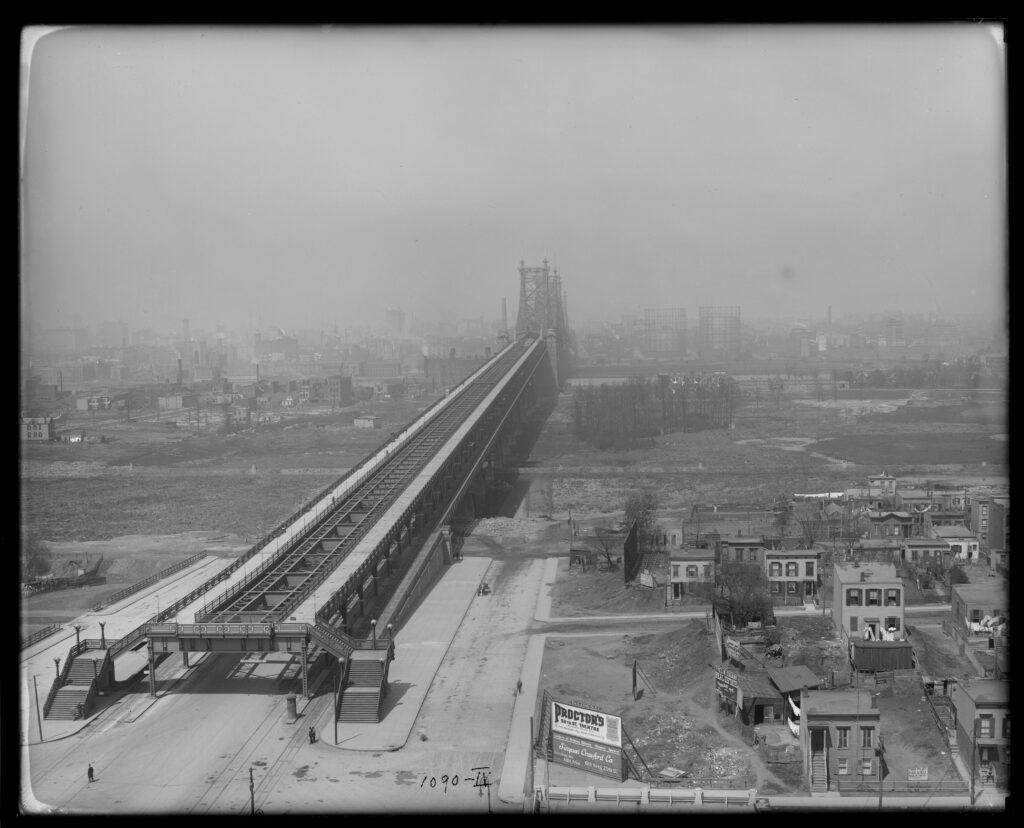
Hunter’s Point is a peninsula surrounded by the East River and Newtown Creek, a tributary of the East River that forms the border between the boroughs of Brooklyn and Queens. This area of Long Island City became heavily industrialized in the early twentieth century. With the start of World War I, factories and refineries grew along Newtown Creek. The Queensboro Bridge, the Pennsylvania Tunnels, and the Steinway Tunnels, all of which opened between 1909 and 1915, helped transport commuters and goods between Manhattan and Long Island City by rail and car. The bridge traffic to and from Queens Plaza during this time grew more than 325%.
The First World War quickly turned Long Island City’s waterfront into a massive production center of war materials. According to Queensboro Historian Jason Antos, the Degnon Terminal produced everything from aircraft and artillery components to gas masks, food, and explosives, turning Newtown Creek into “the busiest waterway in the United States,” transporting nearly five million tons of commerce.
To help with wartime labor in these factories, the U.S. Employment Service, with the New York State Employment Bureau, opened a new office in Long Island City at the beginning of August 1918. This office included a women’s division and required all future unskilled laborers to apply through the bureau rather than the factories.
Queens County
In the neighborhood of College Point in Queens County, the Lowe, the Willard & Fowler (L.W.F.) Engineering Company created the first all-American aircraft to be used in the First World War that did not rely on any foreign components. Several of the L.W.F. aircraft set speed and endurance records, including the Model F, which was equipped with the first Liberty motor engine adapted for flight.
Queens also served as an important defensive location. The military used Fort Tilden and Rockaway Naval Air Station, located on the Rockaway Peninsula, to protect New York Harbor from U-boat attacks. The military built the Rockaway Air Station to send reconnaissance aircraft to locate enemy submarines and alert the Navy. Neither location was attacked during the war.
Women in Queens During Wartime
Women in Queens contributed to the war effort while continuing to advocate for suffrage. One of the most important figures in the borough was Eliza MacDonald. She helped create the Flushing Equal Franchise Association and served as president in 1913. Additionally, MacDonald served on the War Service Committee of the Woman Suffrage Party of New York City in 1917. In 1917, the committee helped organize women to train as nurses in local hospitals so that more experienced nurses could be free for military hospital work. Further, the committee helped to establish victory gardens, raised money for Women’s Overseas Hospitals, and advocated for the purchase of government bonds and war savings stamps.
New York Metropolitan Area
New York City became a central hub for Liberty Loan campaigns and wartime patriotism. Biplanes dropped leaflets over Manhattan advertising Liberty Loans, using both patriotism and fear in their messaging. One leaflet read, “This was dropped by a United States aviator. It might have been a German bomb. To avoid bombs, buy bonds.” By the end of the first war bond campaign, New York City contributed approximately $1 billion, nearly a third of the funds raised across the United States. The metropolis would meet or exceed its quota for all four of the main national bond drives. This patriotic enthusiasm to support the war effort was encouraged by numerous parades and other extravagant events. Thousands of New Yorkers gathered to see public figures, including Charlie Chaplin and President Woodrow Wilson, make appearances to promote war bond campaigns in the city.
German Immigrants and Questions of Loyalty in the City
At the outbreak of war in Europe in 1914, German-language newspapers in New York City encouraged German Americans to support the “fatherland.” German Americans held parades and events to raise money for widows and orphans in Germany, including a charity bazaar at Madison Square Garden in 1916. This soon changed as it became clear the United States would enter the war on the Allies’ side.
Public suspicion of German immigrants increased after the explosion at Black Tom Island. On July 30, 1916, a munitions depot in Jersey City, New Jersey, was deliberately sabotaged to prevent ammunition from reaching Britain and France. Investigators believed German agents caused the blast, which was so powerful that thousands of windows in Manhattan shattered, and shrapnel was found in the Statue of Liberty. As Germany resumed unrestricted submarine warfare in the Atlantic and British intelligence discovered the Zimmermann Telegram, questions about the loyalty of German Americans grew.
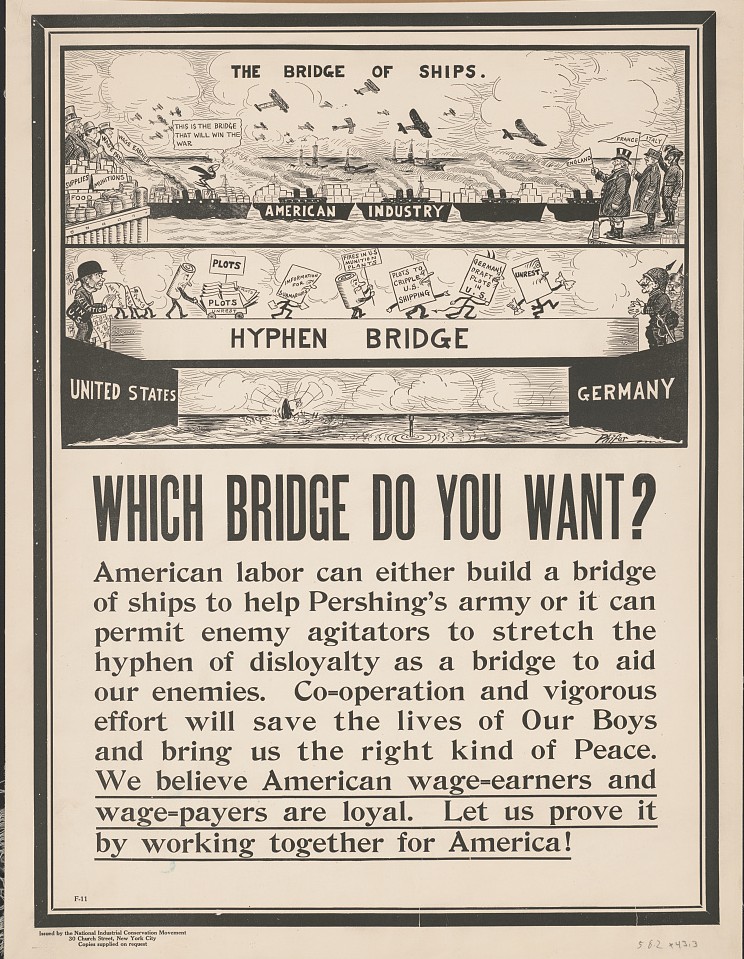
By the time Edward Rielly registered for the draft in 1917, New York City was immersed in an aggressive “Americanization” campaign. Three weeks after the announcement of continued U-boat warfare, over one million New Yorkers signed pledges of support for President Wilson and loyalty to American ideals of justice, liberty, and humanity. The U.S. declaration of war against Germany led many “hyphenated Americans” to renounce ties to their countries of origin. German American newspapers and businesses changed their names in hopes that their loyalty to America would not be questioned. For example, the Germania Bank in Manhattan changed its name to the Commonwealth Bank. As New Yorkers were pressured to prove their allegiance to the United States or risk being labeled suspicious and placed under surveillance, New York City shifted from a community defined by immigrant identities to one that emphasized a unified American identity.
Military Experience
The Draft and Training Camp
As a result of the Selective Service Act passed on May 18, 1917, nearly ten million men aged 21 to 30 across the United States reported to their local registration boards on June 5, 1917, to register for Army service. This included a 21-year-old Edward Rielly. His draft registration card identified him as of medium height, with a slender build, black hair, and brown eyes, and listed no claims for exemption from the draft.
The U.S. Army drafted Rielly into the 152nd Depot Brigade nearly a month before his twenty-second birthday. A Brooklyn Daily Times article dated March 27, 1918, lists 30 men, including Rielly, who were notified by the Long Island City Board to leave for Camp Upton on April 5. Camp Upton, New York, was located near the town of Yaphank on Long Island. This camp was one of only a few to receive an actual British tank for training.
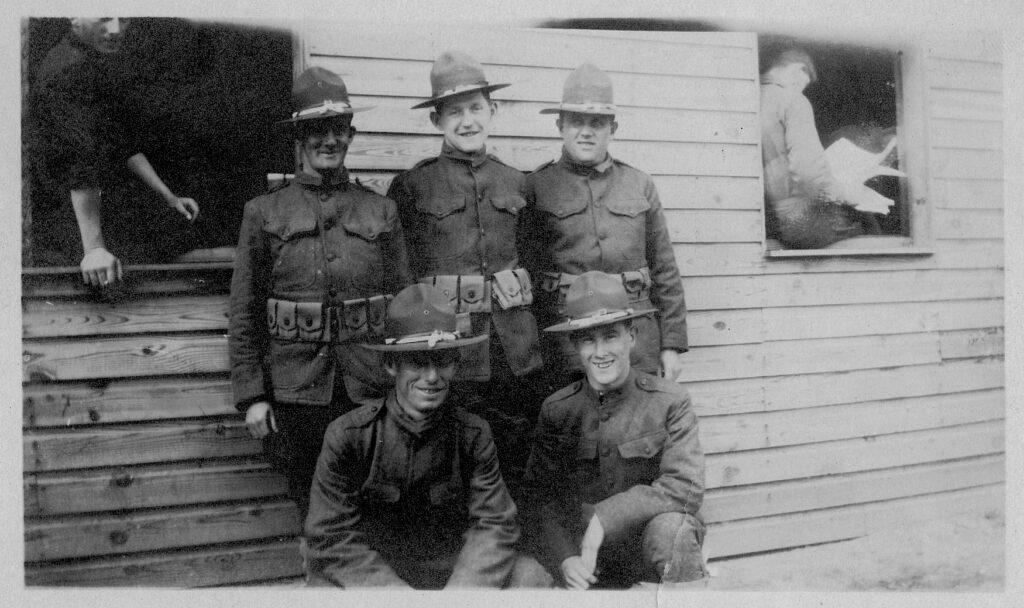
The U.S. Army soon transferred Rielly to Company G of the 105th Infantry Regiment, 53rd Brigade, 27th Infantry Division. This was a National Guard division, mostly from New York, ordered into federal service on July 15, 1917. Historians have described the 27th and 30th divisions of the American II Corps as “borrowed soldiers” as they ended up fighting under British command in the British Expeditionary Force. At the time, the 27th Division was nicknamed “O’Ryan’s Roughnecks” after its well-respected commander, Major General John F. O’Ryan.
Rielly trained with the 27th at Camp Wadsworth in the hot and humid climate of Spartanburg, South Carolina. It was here that he received training on trench warfare techniques such as the use of a bayonet, machine guns, and gas masks. Visiting British and French officers, who had experience in this new type of warfare, carried out some of his instructions.
Overseas to Europe
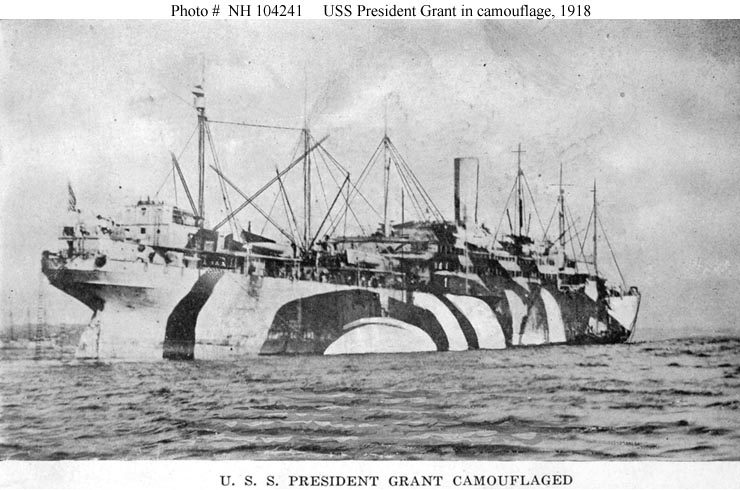
Rielly departed from the port at Newport News, Virginia, on May 17, 1918, on board USS President Grant, bound for Europe. The 27th Division arrived in Brest, France, and continued to train from May to June of 1918.
On July 9, 1918, the 27th Division was assigned to the British Second Army and moved into the reserve position southwest of Ypres, Belgium. They were ordered to defend part of the East Poperinghe line. Being only four miles from the front, the 27th was in range of shellfire. By the end of July, one battalion of each infantry regiment was sent to the frontlines for eight days as part of their training. Here, Rielly and his American comrades encountered the horrors of war for the first time.
First Combat Experience
In late August, the 53rd Brigade, which comprised the 105th and 106th Infantry Regiments, relieved the British 6th Division near Ypres. On the morning of September 1, the 105th Infantry was ordered to move forward through Vierstraat Village, but German resistance forced the Americans back to the village. Since shelling had destroyed communication lines, soldiers used dogs and pigeons to send urgent messages requesting artillery support. With the help of artillery, the 53rd Brigade successfully advanced to a forward trench. Over the course of the two-day engagement, the Brigade lost two officers and seventy-seven men.
Breaking the Hindenburg Line: The Battle of St. Quentin Canal
The Germans built three trench systems, defended by heavy barbed wire and concrete machine-gun shelters, in the winter of 1916 to 1917. This became known as the Hindenburg Line, which German generals believed would be impenetrable. Part of this defense network was the 6,000-yard-long St Quentin Canal. This waterway, constructed under Napoleon Bonaparte’s rule, was 15 to 25 meters deep in certain sections. On September 20, the British Army sent the 27th Division to the front to work under the British Fourth Army, alongside the Australian Corps, to prepare for an attack on these positions.
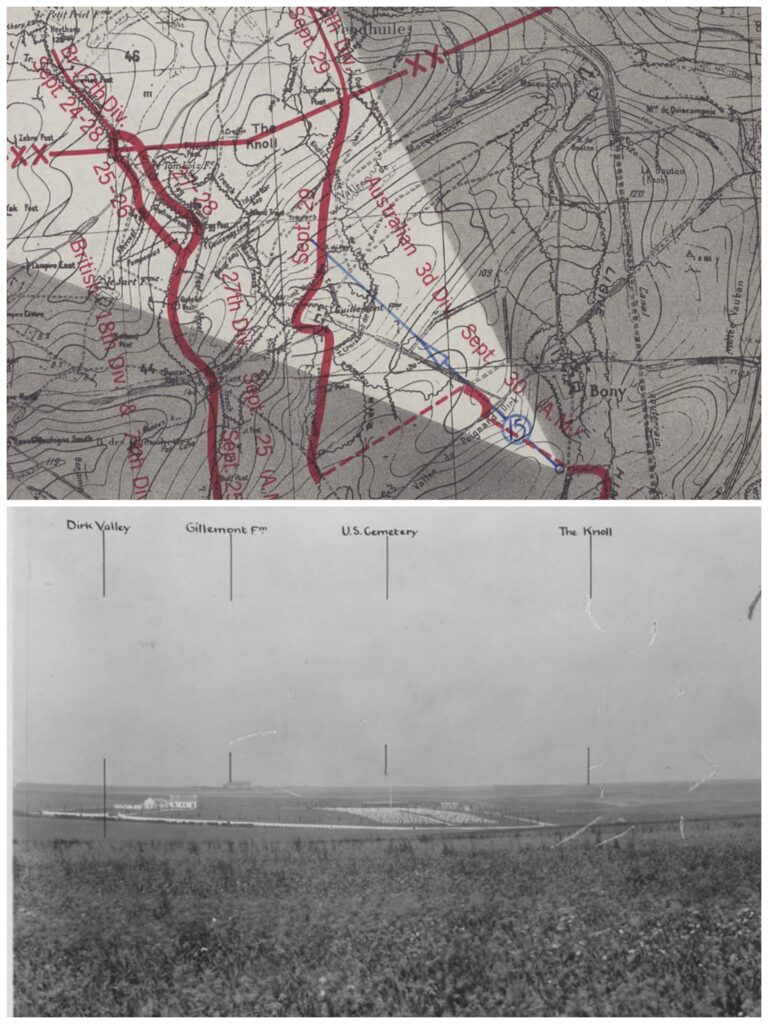
On September 29, the American attack began at 4:50 a.m. The 107th and 108th Infantry Regiments advanced toward German-occupied farmhouses and defended positions in front of the canal. Rielly’s regiment, the 105th, was initially held in reserve and then sent to take an elevated and heavily fortified German position known as “the Knoll.” As the extreme left flank of the 27th Division, the 105th Infantry Regiment suffered many losses due to machine gunners on the knoll. Aided by the British 18th Division, the 105th Infantry Regiment was able to capture and defend this position. However, they were unable to advance further that day, partly due to low visibility from a smoke barrage and fog.
The attack on September 29 led to 3,076 casualties out of the 27th Division’s 18,055. Twenty-six officers and 648 enlisted men were killed. Although the Americans suffered heavy casualties, they eventually took control of the St Quentin Canal, which broke the Hindenburg Line and directly contributed to the end of the war. Nearly six weeks later, the Armistice was signed.
Rielly’s Role in the Battle
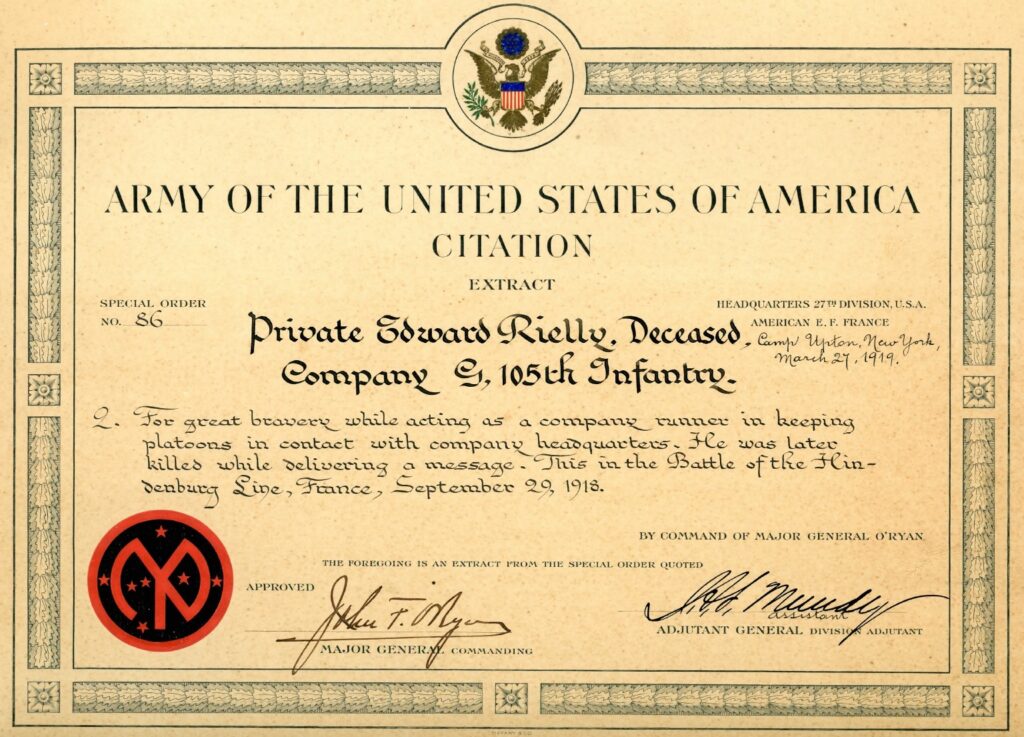
The U.S. Army assigned Rielly as a company runner, helping to keep platoons in contact with company headquarters during the early morning of September 29. American units, including the 27th Division, primarily attempted to communicate by wire, but shelling often destroyed the lines. Commanders considered runners more dependable than telegraph lines, field telephones, dogs, pigeons, or other signaling methods. Since communication between flanking units or coordination with artillery fire was extremely important, runners frequently memorized their messages in case the written orders they carried were damaged or lost.
As one of the most dangerous jobs on the battlefield, commanders often sent two or three runners with the same message. They would each take a different route. Runners had to relay information between units advancing at different speeds while navigating battlefields filled with muddy craters, making their job even more difficult. Additionally, German soldiers actively looked for runners and often purposely targeted them. Unless there was an extreme emergency, runners typically volunteered for the position. Because of these dangers, runners like Rielly were greatly respected by the men who served alongside them.
Commemoration
Fallen in Service
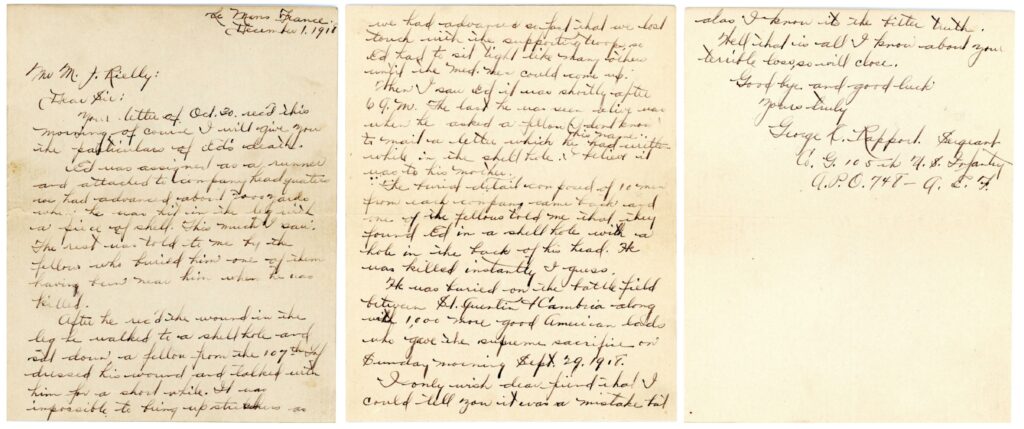
At 22 years old, Edward Rielly was killed in action while carrying a message during the advance of the 105th Infantry Regiment on the morning of September 29, 1918. Much of what is known about his death comes from a letter written by Sergeant George D. Rapport to Rielly’s brother, Martin. This was in reply to an inquiry from Martin regarding the details of his younger brother’s passing.
Sergeant Rapport recalled that Rielly and the 105th Infantry had advanced roughly 2,000 yards when he was “hit in the left leg with a piece of shell.” Despite the wound, Rielly walked to a shell hole, where he sat and waited. A soldier from the 107th Infantry dressed his wound and spoke with him briefly, but because the unit had advanced so far that it had lost contact with supporting troops, it was “impossible to bring up stretchers,” forcing him to “sit tight like many others until the med. men could come up.” The last time Rielly was seen alive was when he asked “a fellow” to mail a letter he had written in the shell hole. Sergeant Rapport believed Rielly wrote it to his mother. Unfortunately, the current whereabouts of this letter are unknown.
When a burial detail later returned to the area, one of the men reported finding Rielly in the same shell hole, this time with “a hole in the back of his head.” Sergeant Rapport believed he “was killed instantly.” Edward Rielly was buried on the battlefield between St. Quentin and Cambrai, alongside “1,000 more good American lads who gave the supreme sacrifice” on the morning of September 29, 1918.
Remembrance and Legacy
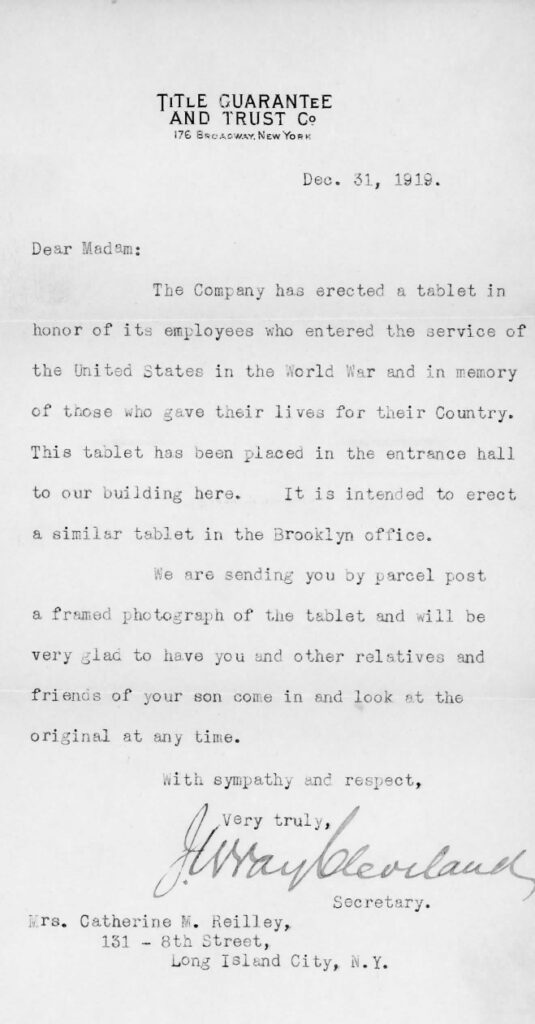
Rielly’s family was likely notified about his death by telegram. They received a sympathy cablegram from the Knights of Columbus and a letter from Rielly’s former employer a year later. The Title Guarantee Post No. 584 of the American Legion was proud to consider Rielly as “an honorary member” of their post and had a prayer said at a Brooklyn church, “for all former employees… who made the supreme sacrifice for their country.”
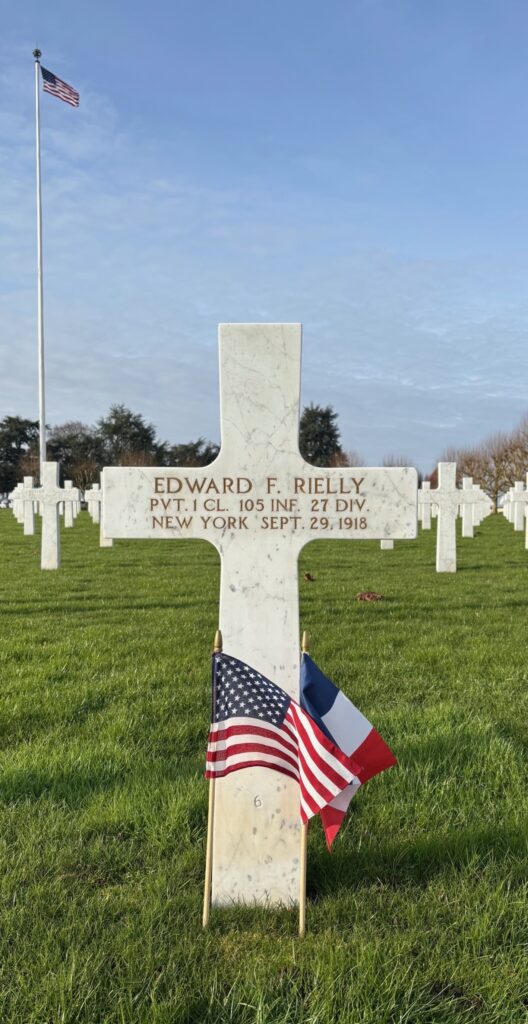
In November 1920, Rielly’s mother, Catherine, made the decision to keep his remains overseas to be buried in the Somme American Cemetery in Bony, France, rather than have him returned home. Catherine was assured in a later letter from the Quartermaster General that, “these graves will be perpetually maintained by the Government in a manner befitting the last resting place of our heroes.” Today, the American Battle Monuments Commission continues to maintain Rielly’s grave in Bony alongside those of 1,843 fellow Americans who also lost their lives.
While his service is honored in France, Rielly’s memory also endured at home. Both of his brothers named sons after him, and later generations continued to pass down his name.
Bibliography
Primary Sources
“Bryant to Have No Class Day Exercises Because of War.” Brooklyn Eagle [Brooklyn, New York], June 22, 1917. Newspapers.com (184083084).
Catherine Ryan. New York, U.S., Arriving Passenger and Crew Lists (including Castle Garden and Ellis Island), 1820–1957. Digital Images. https://ancestry.com.
Edward F. Rielly. New York, U.S., Abstracts of National Guard Service in WWI, 1917–1919. https://ancestry.com.
Edward F. Rielly. New York, U.S., Vital Records, Births 1847–1897, Marriages 1847–1903, Deaths 1798–1900. Digital Images. https://ancestry.com.
Edward F. Rielly. U.S., Army Transport Service Arriving and Departing Passenger Lists, 1910–1939. Digital Images. https://ancestry.com.
Edward F. Rielly. World War I Draft Registration Cards, 1917–1918. Digital Images. https://ancestry.com.
First Ward School, Long Island City. Photograph. 1895. Illustrations Collection, Queens Library.
http://digitalarchives.queenslibrary.org/vital/access/manager/Repository/aql:16507.
“Knights of Columbus.” Daily Long Island Democrat [Jamaica, New York], December 14, 1911. Newspapers.com (188038953).
“L.I. City Soldier Killed in Drive for St. Quentin.” Daily Star [Long Island City, New York], 1918. https://ancestry.com.
Martin Reilly. New York, U.S., Abstracts of National Guard Service in WWI, 1917–1919 Vol 94: 9th Coast Defense Command NYNG L–Z. Digital Images. https://ancestry.com.
Martin Reilly. New York, U.S., Vital Records, Births 1847–1897, Marriages 1847–1903, Deaths 1798–1900. Digital Images. https://ancestry.com.
New York. Queens County. 1900 U.S. Census. Digital Images. https://ancestry.com.
New York. Queens County. 1910 U.S. Census. Digital Images. https://ancestry.com.
New York. Queens County. 1915 N.Y. Census. Digital Images. https://www.ancestry.com.
Patrick O’Reilly. New York, U.S., Arriving Passenger and Crew Lists (including Castle Garden and Ellis Island), 1820–1957. Digital Images. https://ancestry.com.
Patrick Reilly. New York Death Certificate. Digital Images. https://ancestry.com.
Plan of Work, War Service Committee, New York State Woman Suffrage Party. Chemung County Historical Society, 1917. https://nyheritage.contentdm.oclc.org/digital/collection/p16694coll129/id/981.
“Public School Graduates.” Brooklyn Eagle [Brooklyn, New York], January 26, 1912. Newspapers.com (183227405).
“Record Class Will Leave Flushing H.S.” Brooklyn Eagle [Brooklyn, New York], June 22, 1917. Newspapers.com (184083084).
Rielly Family Photographs. 1900–1918. Courtesy of the McGill family.
Rielly Family Records. 1900–1930. Courtesy of the McGill family.
Salignac, Eugene de. Exposures Made for Mr. Pettit West. Photograph. 1912. New York City Municipal Archives, New York City Department of Records and Information Services. https://nycrecords.access.preservica.com/uncategorized/IO_ccad9fc9-1be5-4567-924e-632929780a25/.
“Sending More to Camp Upton.” The Brooklyn Daily Times [Brooklyn, New York], March 27, 1918. Newspapers.com (167502081).
Simon, A.M. USS President Grant. Photograph. c.1918. United States Navy Temporary Auxiliary Ships, U.S. Naval History and Heritage Command. https://www.shipscribe.com/usnaux/ww1/ships/id3014.htm.
“U.S. Employment Bureau Ready Long Island City Office.” The Brooklyn Daily Times [Brooklyn, NY], July 31, 1918. Newspapers.com (185823939).
Which bridge do you want? / Phifer. Lithograph. 1917. Library of Congress Prints and Photographs Division (00653173). https://www.loc.gov/item/00653173/.
Secondary Sources
The American Battle Monuments Commission. Terrain Photographs American World War Battlefields in Europe: 27th Division — Somme Offensive, September 24–October 2, 1918. Defense Technical Information Center, 1946. https://apps.dtic.mil/sti/trecms/pdf/AD1117978.pdf.
Antos, Jason D. “Long Island City: The Gateway to the World’s Greatest Industries.” Give Me Astoria. Updated April 13, 2025. Accessed November 28, 2025. https://givemeastoria.com/2025/04/13/long-island-city-the-gateway-to-the-worlds-greatest-industries/.
Barnes, Alexander F., and Peter L. Belmonte. United States Army Depot Brigades in World War I. McFarland, 2021.
“Catherine M. Ryan Reilly.” Find a Grave. Accessed October 18 2025. https://www.findagrave.com/memorial/189347872/catherine_m-reilly.
Clarke, William F. Over There with O’Ryan’s Roughnecks: Reminiscences of a Private 1stClass Who Served in the 27thU.S. Division with the British Forces in Belgium and France. Superior Publishing Company, 1968.
DeVito, Alexandra. “Biographical Sketch of Eliza MacDonald.” In Part III: Mainstream Suffragists—National American Woman Suffrage Association. https://documents.alexanderstreet.com/d/1010113824
“Domestic Sabotage: The Explosion at Black Tom Island.” National Park Service. Updated July 18, 2017. Accessed November 28, 2025. https://www.nps.gov/articles/black-tom-wwi.htm.
Durr, Eric. “WWI Centennial: New York National Guard Soldiers Break the Hindenburg Line.” The U.S. Army. Accessed November 28, 2025. https://www.army.mil/article/211757/wwi_centennial_new_york_national_guard_soldiers_break_the_hindenburg_line.
“Edward F. Rielly.” American Battle Monuments Commission. Accessed October 18, 2025. https://weremember.abmc.gov/print/certificate/92389.
“Edward F. Rielly.” Honor States. Accessed October 18, 2025. https://www.honorstates.org/profiles/148506/.
“Innovative Defenses at Fort Tilden and Rockaway Naval Air Station during WWI.” National Park Service. Accessed November 28, 2025. https://www.nps.gov/articles/fort-tilden-and-nas-rockaway-wwi.htm.
Kiger, Patrick J. “World War I Runners Faced Perilous but Critical Mission of Carrying Messages.” HISTORY. Accessed November 30, 2025. https://www.history.com/articles/world-war-i-runners-1917.
“Lowe, Willard & Fowler (L. W. F.) Aircraft Photographs Collection.” National Air and Space Museum. Accessed November 28, 2025.
https://airandspace.si.edu/collection-archive/lowe-willard-fowler-l-w-f-aircraft-photographs-collection/sova-nasm-1993-0036.
Mamer, Elizabeth. Exploring Urban Change Using Historical Maps: The Industrialization of Long Island City (LIC), New York. Thesis for the University of Southern California, 2015. https://drive.google.com/file/d/1tcpw5LJPA6hzr36uY1pzxpyG-bFTW1kb/view.
“Patrick J. Reilly.” Find a Grave. Accessed October 18 2025. https://www.findagrave.com/memorial/189347745/patrick-j.-reilly.
“PVT 1CL Edward F. Rielly.” Find a Grave. Accessed October 25, 2025. https://www.findagrave.com/memorial/56099699/edward-f-rielly.
Wilson, Ross J. New York and the First World War. Ashgate Publishing, Ltd., 2014.
Yockelson, Mitchell A. Borrowed Soldiers: Americans under British Command, 1918. University of Oklahoma Press, 2008.
This profile was researched and created through the Researching Silent Heroes program, sponsored by the American Battle Monuments Commission.