
Technical Sergeant Edward Fisher McKnew, Jr.
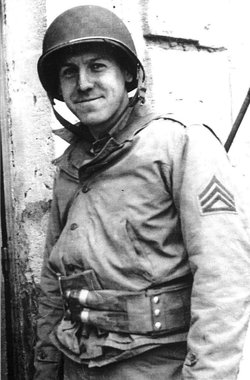
- Unit: Flag Allowance, Commander, Task Force 122
- Date of Birth: October 7, 1919
- Entered the Military: November 18, 1940
- Date of Death: September 12, 2014
- Hometown: Washington, District of Columbia
- Place of Death: Midlothian, Virginia
- Award(s): Good Conduct Medal, American Defense Medal with base clasp, World War II Victory Medal, Marine Corps Reserve Service Medal, European-African-Middle Eastern Campaign Medal
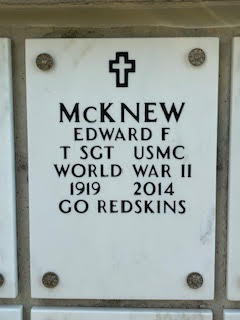
- Cemetery: Section CB1, Row G, Site 20. Virginia Veterans Cemetery, Amelia Court House, Virginia
Mentored by Ms. Nicole Winter
Cosby High School, Midlothian, Virginia
2025/2026
Early Life
Edward Fisher McKnew, Jr. was born on October 7, 1919, in Washington, D.C. His father, Edward Sr., worked as a bookkeeper for a private insurance company, and his mother, Imogene, managed the household. He had no siblings who survived infancy. The McKnew family was well known in D.C., as McKnew’s grandfather, Thomas, was the assistant secretary of the National Geographic Society.
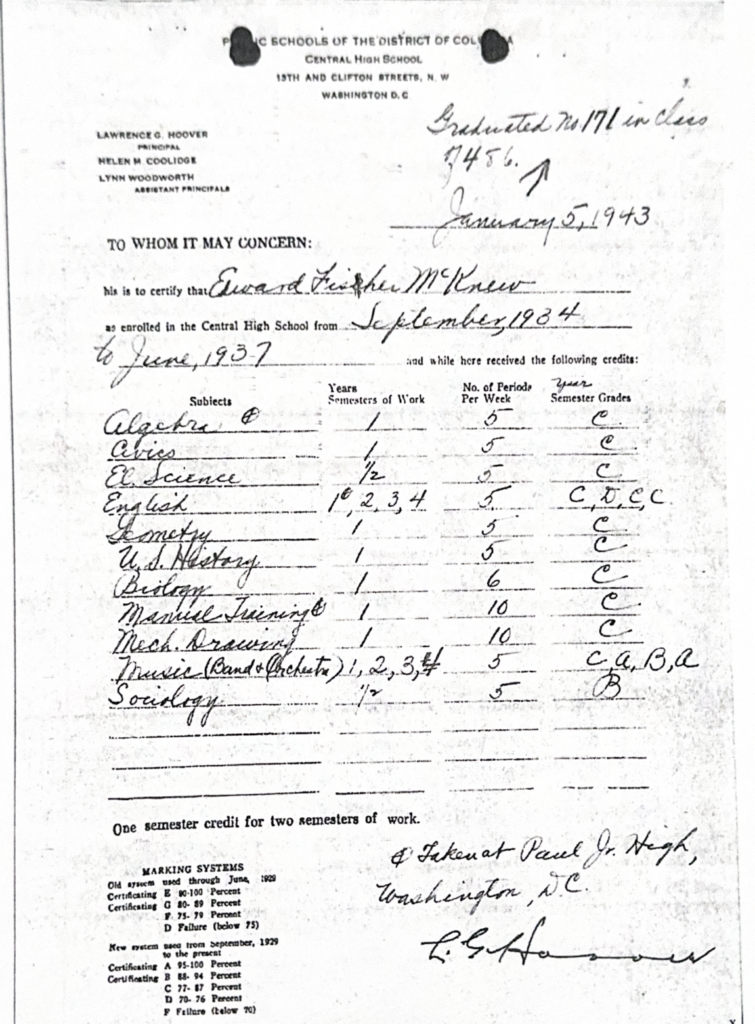
From a young age, McKnew displayed an interest in the military. He attended Central High School and graduated in 1937. He showed particular interest in his orchestra class and indicated in his enlistment records that he would like to be a United States Marine Corps bandsman. He joined the U.S. Marine Corps Reserves at 17, while still in high school. In his youth, his hobbies included camping, reading books about military life, and exploring Washington, D.C.
After his graduation, McKnew attended George Washington University as a social sciences major, and later enrolled in Strayer Business School, where he remained until his enlistment in the United States Marine Corps in 1940.


Homefront
Industry
As the nation’s capital, Washington, D.C., served as a hub for culture, government, and manufacturing. The Defense Plant Corporation, the main supervisor of national industrial expansion, was headquartered in Washington, D.C. They financed approximately 2,300 projects across almost every state, including aircraft assembly plants, magnesium, aluminum, and synthetic rubber plants. Additionally, Washington, D.C. saw the development of new weapons systems at the Naval Gun Factory and the production of aviation parts at the nearby Fairchild plant.
Food production
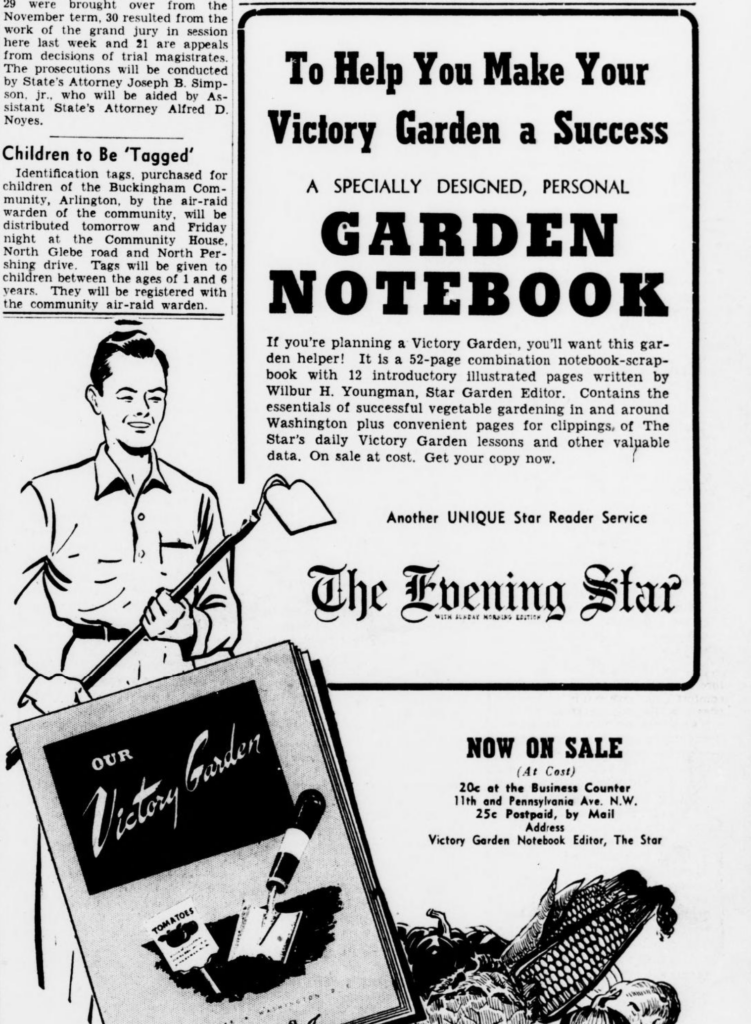
The D.C. community was also involved in food production. As the headquarters of the War Food Administration, Washington, D.C. officials insisted that Washingtonians set the example with victory gardens, rationing, and community war fund drives. The United Service Organizations (USO), which had a large presence in the city, organized many war funds.
Population shifts
Because Washington, D.C. offered a variety of occupations, ranging from factory work to construction to jobs in new federal agencies, it attracted many individuals seeking work. Large construction projects brought on by the war, like the construction of the Pentagon in 1941, allowed those not at war to contribute to the workforce and the war effort. Government agencies like the Federal Public Housing Authority helped find housing for the multitude of new workers, processing around 10,000 new employees per month.
The war also allowed new employment for women and minorities in Washington, D.C. The city saw the rise of “Government Girls,” women who had taken over industrial or government jobs formerly held by men who went to war. Additionally, factories like Fairchild Plant 7, an aviation plant designed specifically for the employment of Black men and women, opened doors previously closed to minority residents.
Fear of attack
Washington, D.C.’s role as the nation’s capital made it extremely vulnerable to attacks by enemy powers. Concern about attacks led to the construction of new defense facilities, such as the Pentagon, and to the protection of cultural landmarks, such as the Smithsonian museums. Officials moved many artifacts from the Smithsonian for safety to protect the history and culture in their collections. Additionally, so-called “Monument Men” collaborated with European museums overseas to ensure that their exhibits were safe from Nazi attack.


Military Experience
Reserve duty
On November 18, 1936, Edward McKnew enlisted in the 5th Battalion Marine Corps Reserves in Quantico, Virginia. He remained in the reserves until November 1940. McKnew stated in a 1943 letter that he participated in a series of drills and field training periods during his time in the Reserves. For this service, he received the Marine Corps Reserve Service Medal after World War II.
Enlistment and Early Service
McKnew enlisted in the regular U.S. Marine Corps on November 18, 1940, as a private first class. He was initially assigned to the 5th Battalion, Marine Corps Headquarters, Quantico, Virginia. On January 21, 1941, he arrived at Guantanamo Bay, Cuba.
While stationed in Cuba, McKnew participated in landing exercises for several weeks. On February 21, 1941, McKnew was designated as a specialist 4th class bandsman, but this assignment only lasted until June 1, 1941. By April 1941, he returned stateside aboard USS Barnett to the Marine Barracks, Parris Island, South Carolina.
Over the next several months, McKnew served with several different units in various locations, including New River, North Carolina; Philadelphia, Pennsylvania; and Washington, D.C. He was also promoted to corporal and then to sergeant during this time. On March 11, 1943, McKnew joined the Candidates Class at Quantico, Virginia, but he was not commissioned before departing for Norfolk, Virginia, on June 5, 1943.
Task Force 122
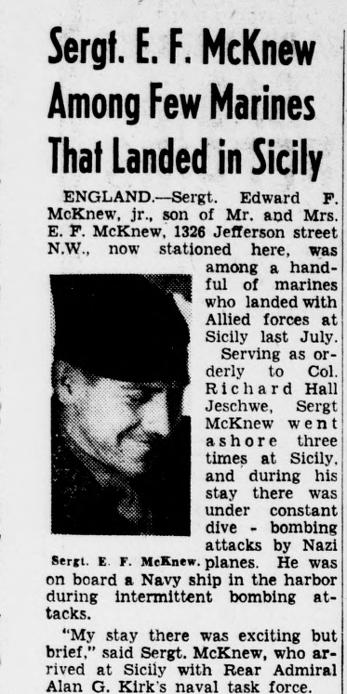
On September 13, 1943, McKnew traveled aboard Queen Mary and served in London for almost a year as a clerical sergeant with Task Force 122. During this time, he was involved in the planning phase of the Normandy invasion. Admiral Harold Stark, Commander, United States Naval Forces in Europe, stated in a commendation letter that McKnew was involved in the logistical planning of the operation and, during the invasion, carried messages to field command posts and reported enemy position data. While overseas, McKnew also spent time in Italy and Mers-el-Kébir, North Africa. During this posting, McKnew was promoted to staff sergeant and then to technical sergeant.
Education and Home Life
While in service, McKnew also participated in several training programs at the Marine Corps Correspondence School. He participated in courses such as stenography, special administration, and field principles.
McKnew also built a home life while serving as a Marine. In 1943, he married Gayle Osen, whom he had met while stationed at the Marine Headquarters administration office in Washington, D.C. The two had a son, Edward McKnew III, in 1944 while McKnew was still in service.
Conclusion of service
After serving in London, he returned to Camp Lejeune, North Carolina, where he participated in the War Dog Training Schools Regiment and the Enlisted Training Regiment between September 1944 and September 1945. He was honorably discharged from the U.S. Marine Corps on September 28, 1945.
Awards
During his time in the service, Technical Sergeant McKnew received the Good Conduct Medal, the American Defense Medal with base clasp, the World War II Victory Medal, the Marine Corps Reserve Service Medal, and the European-African-Middle Eastern Campaign Medal.


Veteran Experience
Domestic life
Edward McKnew and Gayle Osen had five children. They had two sons, Edward III and John, and three daughters, Pamela, Barbara, and Elizabeth. His marriage to Gayle Osen ended in divorce in 1981, and he married his second wife, Marguerite Holman, in October of that same year.
Career
After his honorable discharge from the U.S. Marine Corps in 1945, McKnew worked as an auditor for the U.S. Department of State. He remained here for 32 years before retiring as a senior auditor. This career sent him on temporary duty assignments in 53 countries. His favorite aspect of the job was traveling to U.S. embassies in foreign nations. His experience with logistics and clerical work in the U.S. Marine Corps helped guide his career.
Community involvement
McKnew was involved in many aspects of his community. He volunteered at Fairfax Hospital in Fairfax County, Virginia, and later at Chippenham Hospital in Richmond after moving to Midlothian, Virginia, in the early 1990s. He also worked for the National Council of Senior Citizens in Washington, D.C. McKnew was an active member of the Episcopal Church and played clarinet for the Washington Commanders (formerly the Washington Redskins) marching band for ten years.


Commemoration
Technical Sergeant Edward McKnew, Jr. died on September 24, 2014, in Midlothian, Virginia. He is buried in the Virginia Veterans Cemetery in Amelia County, Virginia.
Technical Sergeant McKnew exemplifies the values of service and dedication. He spent most of his life serving his country, both in the military and in his postwar occupation. His story teaches us a lesson in lifelong commitment to service, passion, and love for both his country and those around him.
Bibliography
Primary Sources
America at War. Poster. World War II Poster Collection, Library of Virginia. https://rosetta.virginiamemory.com/delivery/DeliveryManagerServlet?dps_pid=IE1186378.
The Cherry Tree. Washington, District of Columbia: George Washington University, 1939.
“The Community War Fund Drive Goes On!” The Evening Star [Washington, D.C.], November 2, 1943. https://www.loc.gov.
Edward F McKnew. U.S., Marine Corps Muster Rolls, 1798-1958. Digital Images. https://ancestryclassroom.com.
Edward F McKnew. U.S., World War II Navy Muster Rolls, 1938-1939. Digital Images. https://ancestryclassroom.com .
Edward F. McKnew. Virginia, U.S., Divorce Records, 1918-2014. Digital Images. https://ancestryclassroom.com.
Edward F McKnew Jr. U.S., Public Records Index, 1950-1993, Volume 1. Digital Images. https://ancestryclassroom.com.
Edward Fisher McKnew. District of Columbia, U.S., Marriage Records, 1810-1953. https://ancestryclassroom.com.
Edward Fisher McKnew, Jr., Official Military Personnel File, Department of the Navy, National Archives and Records Administration- St. Louis.
Edward Fisher McKnew. Virginia, U.S., Divorce Records, 1918-2014. Digital Images. https://ancestryclassroom.com.
Edward Fisher McKnew. Virginia, U.S., Marriage Records. 1936-2014. Digital Images. https://ancestryclassroom.com.
Edward Fisher McKnew. World War II Draft Cards Young Men, 1940-1947. Digital Images. https://ancestryclassroom.com.
Essary, Helen. “Seeing America Last.” The Washington Times [Washington, D.C.], August 13, 1937. https://www.loc.gov.
“Fast-Expanding USO Now Follows the Boys Around the Globe.” The Evening Star [Washington, D.C.], December 13, 1942. https://www.loc.gov.
Imigene Burdick. Delaware, U.S., Birth Records, 1860-1932. Digital Images. https://ancestryclassroom.com.
McKnew. District of Columbia, U.S., Glenwood Cemetery Records, 1854-2013. Digital Images. https://ancestryclassroom.com.
McKnew, Edward III. E-mail interview. February 16, 2026.
“Miss Gayle Osen Becomes a Bride.” Evening Star [Washington, D.C.], August 18, 1943. https://www.loc.gov.
“Police Called as Time for Cab Strike Nears.” The Washington Daily News [Washington, D.C.], September 15, 1942. https://www.loc.gov.
“Ration Book Application and Instructions.” The Washington Daily News [Washington, D.C.], February 18, 1942. https://www.loc.gov.
“Sergt. E. F. McKnew Among Few Marines That Landed in Sicily.” The Evening Star [Washington, D.C.], February 27, 1944. https://www.loc.gov.
Stillborn McKnew. District of Columbia, U.S., Select Deaths and Burials Index, 1769-1960. Digital Images. https://ancestryclassroom.com.
“Three Judges Names for Victory Garden $1,000 Prize Contest.” The Evening Star [Washington, D.C.], June 18, 1943. https://www.loc.gov.
To Have and to Hold- Buy War Bonds. Poster, 1944. World War II Poster Collection, Library of Virginia. https://rosetta.virginiamemory.com/delivery/DeliveryManagerServlet?dps_pid=IE1186952.
“To Help You Make Your Victory Garden a Success.” The Evening Star [Washington, D.C.], March 24, 1943. https://www.loc.gov.
“Victory Garden Supplement.” The Evening Star [Washington, D.C.], April 22, 1944. https://virginiachronicle.com.
View of Central High School from Clifton Street NW. Photograph. Historic Image Collection, DC Public Library. https://digdc.dclibrary.org/do/89cec2c5-6761-4543-ac83-4426154f8026.
Virginia. Arlington. 1950 U.S. Census. Digital Images. https://ancestryclassroom.com.
Washington, District of Columbia. 1910 U.S. Census. Digital Images. https://ancestryclassroom.com.
Washington, District of Columbia. 1920 U.S. Census. Digital Images. https://ancestryclassroom.com.
Washington, District of Columbia. 1940 U.S. Census. Digital Images. https://ancestryclassroom.com.
Secondary Sources
“Administrative NCO.” The Military Yearbook Project. Accessed February 17, 2026. https://militaryyearbookproject.org/references/old-mos-codes/wwii-era/army-wwii-codes/administration/administrative-nco-502.
“Agency History.” U.S. Department of Agriculture. Accessed February 13, 2026. https://www.fsa.usda.gov/about-fsa/history-mission/agency-history.
“Brother, Can You Spare a Billion? The Story of Jesse H. Jones.” PBS. Accessed February 13, 2026. https://www.pbs.org/jesse_ww2_2.htm.
“D-Day.” History.com. Last Updated July 22, 2025. Accessed February 17, 2026. https://history.com/articles/d-day.
“Edward F. McKnew.” Veterans Legacy Memorial, National Cemetery Administration. https://www.vlm.cem.va.gov/EDWARDFMCKNEW/89b706.
“Edward Fisher McKnew, Jr.” Find a Grave. Updated December 15, 2015. Accessed February 19, 2026. https://findagrave.com/memorial/156056279/edward-fisher-mcknew.
“Historical Vignette 034- The Corps Built the Pentagon in 16 Months.” U.S. Army Corps of Engineers. Last modified September 2001. Accessed February 13, 2026. https://www.usace.army.mil/About/History/Historical-Vignettes/Military-Construction-Combat/034-Pentagon/.
“Life During Wartime: Fairchild’s Plants 7 & 5.” National Air and Space Museum. Last modified August 2023. Accessed February 13, 2026. https://airandspace.si.edu/stories/editorial/life-during-wartime-fairchilds-plants.
“Race, Gender, and War: Manufacturing in Maryland During WWII.” Maryland Center for History and Culture. Accessed February 13, 2026. https://www.mdhistory.org/wp-content/uploads/2022/06/Fleet-Week_Teachers-Resource-Guide_6.24-1.pdf.
“Rosie, Wendy, and Government Girls: The women behind the war.” National Museum of American History. Last modified March 2022. Accessed February 13, 2026. https://www.americanhistory.si.edu/explore/stories/rosie-wendy-and-government-girls#:~:text=Government%20Girls%20were%20cousins%to,were%20able%20to%20wear%20dresses.
“Smithsonian in Wartime.” Smithsonian Institute Archives. Accessed February 13, 2026. https://siarchives.si.edu/history/featured-topics/wartime/wwii-smithsonian-home-front#:~:text=As%20World%20War%20II%20raged,in%20danger%20from%20the%20Nazis.
“Standing Room Only: DC’s WWII Housing Crunch.” Boundary Stones. Last modified January 4, 2022. Accessed February 25, 2026. https://boundarystones.weta.org/2014/04/08/standing-room-only-dcs-wwii-housing-crunch.
“Washington at War and Peace.” American Historical Association. Last modified December 2003. Accessed February 13, 2026. https://www.historians.org/perspectives-article/washington-at-war-and-peace/.
“WNY: Manufacturing: WWII to 1962.” National Museum of the U.S. Navy. Accessed February 13, 2026. https://www.history.navy.mil/browse-by-topic/organization-and-administration/installations/washington-navy-yard.html.
This profile was funded by a grant from the United States Department of Veterans Affairs. The opinions, findings, and conclusions stated herein are those of the author and do not necessarily reflect those of the United States Department of Veterans Affairs.