
Private Elmer Lee Arnold
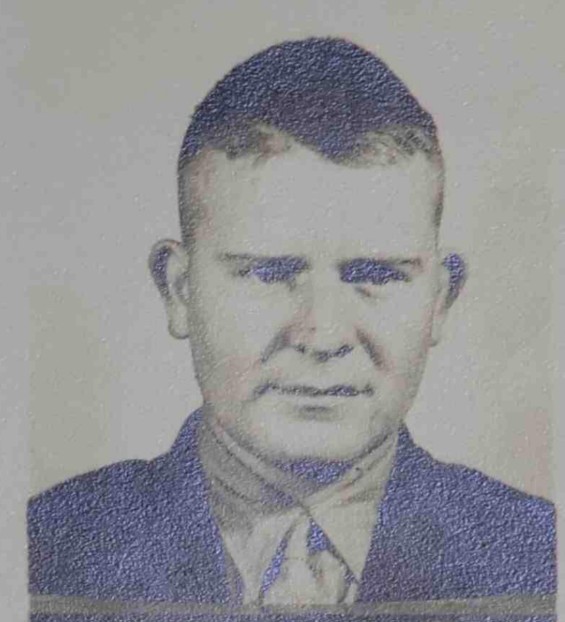
- Unit: 1st Marine Division, 5th Marines, 1st Battalion, Company B
- Date of Birth: May 28, 1925
- Entered the Military: September 10, 1943
- Date of Death: July 7, 2002
- Hometown: Valley Station, Kentucky
- Place of Death: Columbia, Kentucky
- Award(s): Purple Heart
- Cemetery: Section 16, Grave 67. Lebanon National Cemetery, Lebanon, Kentucky
Mentored by Mrs. Laura Craig
Bethlehem High School, Bardstown, Kentucky
2025/2026
Early Life
Elmer Lee Arnold was born May 28, 1925, in Valley Station, Kentucky, to John and Josephine Arnold. They lived on a farm in a home owned by Elmer’s paternal grandparents, Thomas and Mary Arnold. The household included Elmer’s widowed aunt, Rose Kesler, and her three children. The Arnold family also hosted lodgers, including a World War I Veteran.
Arnold attended school up to sixth grade, then went to work on his family’s fifty-acre farm. He plowed, cultivated, and harvested crops, cared for livestock, and hauled wood and grain in his half-ton truck. Before he enlisted, Arnold also worked at the Brown Wood Preserving Company, which manufactured utility poles.

Homefront
Industry
Louisville, Kentucky, is the state’s largest city, and its size attracted government-funded industries during World War II. During the war, industries located in Louisville shifted to wartime production. For instance, the Ford plant in Louisville began producing military jeeps, and Louisville Slugger made gunstocks and sent bats to soldiers for recreation.
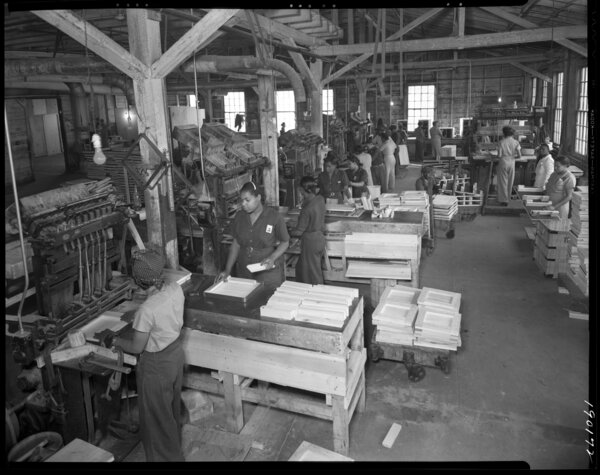
Women, including African American women, found new job opportunities at places like the Mengel Company, which produced wooden crates and supplied plywood to the military during World War II, and Reynolds Metals Company, which directed its operations to the production of war materials.
Many Kentuckians who lived in more rural areas moved to cities like Louisville to take industrial jobs that supported the war effort. However, the city struggled to accommodate the influx of workers.
Education
Local high schools supported the war effort by training young women in the skills they needed to enter Louisville’s industries. The University of Louisville offered V-12 training programs to prepare young men to become Navy and Marine Corps officers. By 1943, nearly half of the university’s enrollment consisted of V-12 students.
Community Support
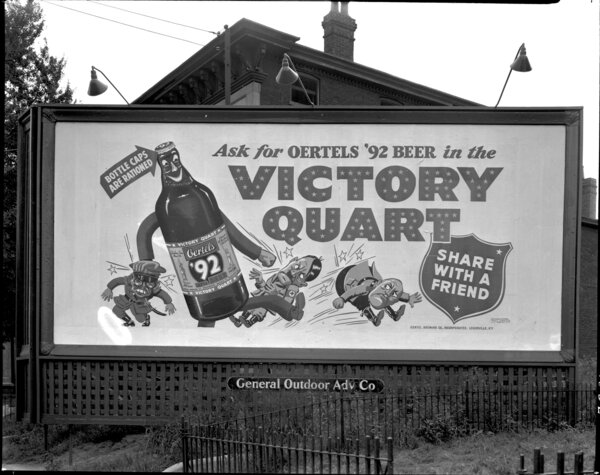
Louisville residents showed their support for the war in visible and practical ways. Billboards around the city encouraged residents to buy war bonds, and local neighborhoods and businesses organized drives to raise funds for the war effort. Residents also participated in the rationing programs and scrap collection drives that the federal government relied on.

Military Experience
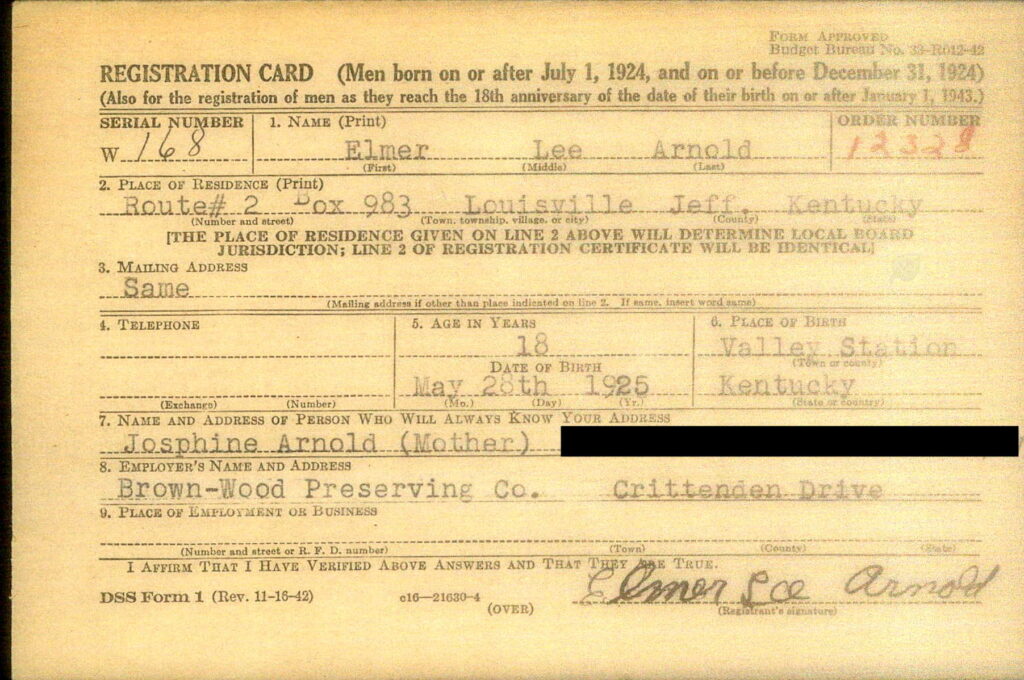
On his eighteenth birthday, on May 28, 1943, Arnold registered for the draft. On September 10, 1943, he enlisted in the U.S. Marine Corps Reserve and was sent to the Marine Corps Recruit Depot in San Diego, California. After boot camp, he joined the Headquarters Company, Service Battalion, and then transferred to Company A, Infantry Battalion, where he completed his rifleman training. He scored 295 on his rifle qualification, surpassing the sharpshooter qualifying score.
Arnold never stopped moving. He went from basic training in San Diego to the Port of San Francisco to Guadalcanal, where he trained with Company B, 1st Battalion, 5th Marines, in amphibious landings. He put his training to the test in the Palau Islands in the Battle of Peleliu and then again at Okinawa.
Islands
Arnold began his training in field exercises and landing operations at Guadalcanal. He and his fellow troops rode on landing craft and charged the beaches as practice for what would come in battle. During these training exercises, Arnold would have all his heavy equipment strapped to him to simulate what it would feel like to charge onto a beach under combat conditions.
After the intense training at Guadalcanal, he was sent to the Palau Islands and fought at Peleliu on September 15, 1944. As a tropical island in the Pacific, Peleliu was covered with palm trees, sand, and jungle. It seemed like every place Arnold went was more and more different from his home and farm in Valley Station. At Peleliu, Arnold suffered a blast concussion. The blast blew him from his trench, and he was removed for medical treatment. The injuries Arnold sustained during the action at Peleliu earned him a Purple Heart. He was evacuated via USS Tryon and treated at sea. He returned to the rear echelon at Pavuvu by September 29, 1944.
Private Arnold arrived at Okinawa Shima on April 1, 1945—L-Day for Operation Iceberg. The 5th Marine Regiment moved into the lines on May 1 and faced ferocious hand-to-hand combat with the Japanese. On May 15, Arnold was wounded again when a shell exploded next to him and concussed him for the second time. This time, though, his suffering burrowed deeper and eroded his will to fight; Private Arnold succumbed to combat fatigue. Arnold was evacuated, then transferred to the U.S. Naval Hospital at Aiea Heights, Hawai’i, and then on to the U.S. Naval Hospital in Pensacola, Florida. After his hospitalization, Private Arnold was honorably discharged on November 9, 1945.


Veteran Experience
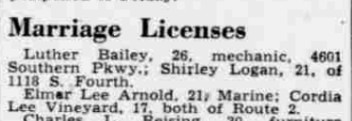
After returning home, Arnold married Cordia Lee Vineyard. They had their first child, Judith, on April 13, 1946. Over the next thirteen years, they had another six children. Arnold and Cordia divorced in 1959, and he later married Marguerite Richards. He and Marguerite had five more children.
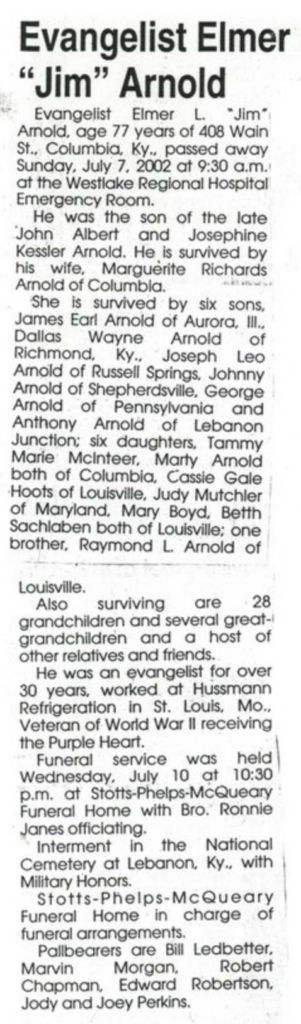
Arnold worked in Louisville at a cooperage company that supplied barrels to Kentucky bourbon distilleries. He and his family later moved to St. Louis, Missouri, where he worked at Hussmann Refrigeration.
Arnold eventually moved back to Kentucky and settled in Columbia. He served as an evangelist through Carrying the Torch Ministries, where he also occasionally presided over funerals for fellow congregants.

Commemoration
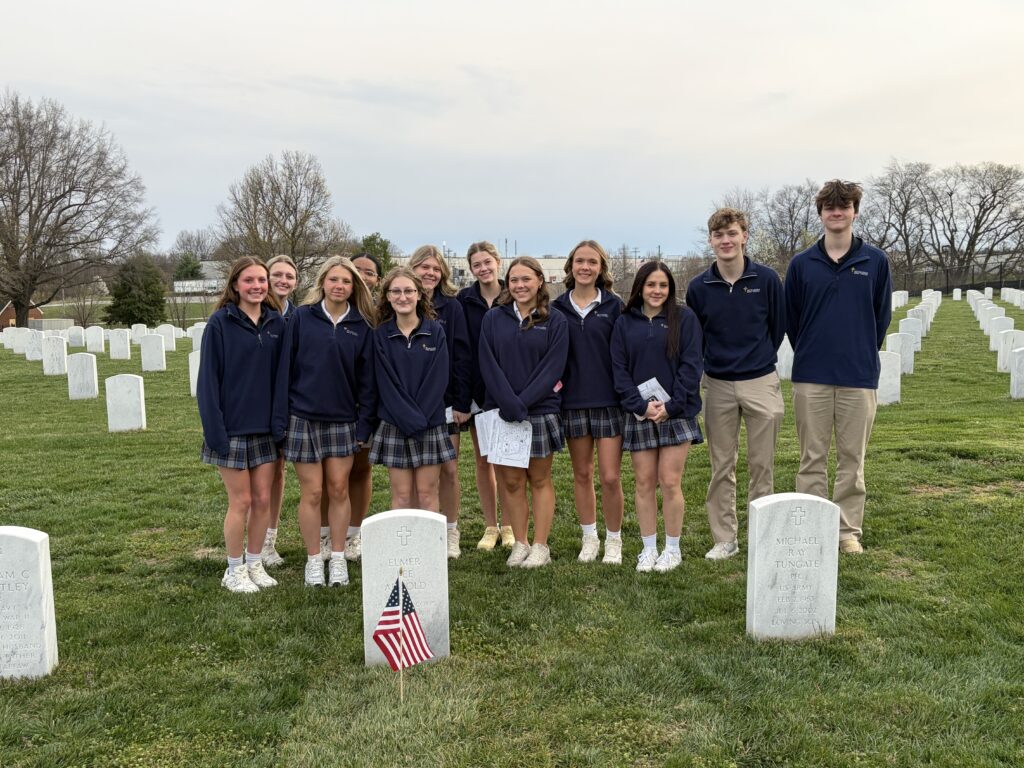
Arnold passed away on July 7, 2002. He is buried in Lebanon National Cemetery in Lebanon, Kentucky. Arnold was survived by twelve children, twenty-eight grandchildren, and several great-grandchildren.
Bibliography
Primary Sources
“2 Violators of Draft Act Get 2 Years.” The Courier-Journal [Louisville, Kentucky], December 23, 1941. Newspapers.com (108374414).
“3 Kentuckians are Reported Killed in War.” The Courier Journal [Louisville, Kentucky], July 9, 1945. https://www.proquest.com/hnplouisvillecourierjournalshell/newspapers/july-9-1945-page-5-10/docview/1865150463/sem-2?accountid=3730.
“Births.” The Courier Journal [Louisville, Kentucky], May 3, 1946. Newspapers.com (112160072).
“Births.” The Courier Journal [Louisville, Kentucky], August 22, 1947. Newspapers.com (108400963).
“Births.” The Courier Journal [Louisville, Kentucky], December 2, 1950. Newspapers.com (108437995).
“Births.” The Courier Journal [Louisville, Kentucky], January 9, 1952. Newspapers.com (110680845).
“Births.” The Courier Journal [Louisville, Kentucky], April 18, 1958. Newspapers.com (116441018).
“Births.” The Courier Journal [Louisville, Kentucky], August 21, 1959. Newspapers.com (110526854).
“Births.” The Courier Journal [Louisville, Kentucky], April 4, 1962. Newspapers.com (108964095).
“Births.” The Courier Journal [Louisville, Kentucky], June 25, 1963. Newspapers.com (107806535).
Caufield & Shook Collection. Photograph Collection. University of Louisville Digital Collections.
“Divorces Granted.” The Courier Journal [Louisville, Kentucky], May 13, 1959. Newspapers.com (108856488).
“DuPont, Dow plants have deep Louisville roots.” The Courier-Journal [Louisville, Kentucky], December 12, 2015. Newspapers.com (141068087).
Elmer Lee Arnold. Kentucky, U.S., Birth Index, 1911-1999. Digital Images. https://ancestry.com.
Elmer Lee Arnold, Official Military Personnel File, Department of the Navy, National Archives and Records Administration – St. Louis.
Elmer Lee Arnold, Report of Separation, Department of the Navy, National Archives and Records Administration – St. Louis.
Elmer Lee Arnold. World War II Draft Cards Young Men, 1940-1947. Digital Images. https://ancestry.com.
“Harold J. Weber Collection.” Library of Congress Veterans History Project. Accessed January 19, 2026. https://www.loc.gov/item/afc2001001.99814/.
Kentucky. Jefferson County. 1930 U.S. Census. Digital Images. http://ancestry.com.
Kentucky. Jefferson County. 1940 U.S. Census. Digital Images. http://ancestry.com.
Kentucky. Jefferson County. 1950 U.S. Census. Digital Images. http://ancestry.com.
“Marriage Licenses.” The Courier-Journal [Louisville, Kentucky], November 6, 1945. https://www.proquest.com/hnplouisvillecourierjournalshell/docview/1865190237?sourcetype=Newspapers.
“Odd Lots.” The Courier-Journal [Louisville, KY], May 20, 1942. Newspapers.com (107271098).
“Old Louisville Home Tours showcases mansions.” The Courier-Journal [Louisville, Kentucky], May 22, 2015. Newspapers.com (108208460).
PELELIU ISLAND OPERATIONS, PALAU GROUP, WEST CAROLINE ISLANDS, WEST PACIFIC. Moving Images Relating to Military Activities, Record Group 111. National Archives Catalog at College Park, Maryland. https://catalog.archives.gov/id/17241?objectPage=2.
Pound Peleliu Japanese. Photograph. 1944. National Museum of the Pacific War, Digital Public Library of America. https://dp.la/item/5a3ef336626f87c99674141d26d44004.
Pounding Peleliu. Photograph. 1944. National Museum of the Pacific War, Digital Public Library of America. https://dp.la/item/d2c12a80ed66bd5928695c588e60b6a4.
“Roosevelt will use his reins on wages to avoid a long debate.” The Courier-Journal [Louisville, Kentucky], August 2, 1942. Newspapers.com (107267890).
Royal Photo Company Collection. Photograph Collection. University of Louisville Digital Collections.
Silenced – Peleliu. Photograph. 1944. National Museum of the Pacific War, Digital Public Library of America. https://dp.la/item/d8bcac0d0aea2b0abe0a97b221457c1f .
University of Louisville Images Collection. University of Louisville Digital Collections, Louisville, Kentucky.
United States Marine Corps. 00020 Palau Operation Part I. Produced by the United States Marine Corps. Palalu, 1944. https://digital.tcl.sc.edu/digital/collection/MarineCorps/id/3479.
United States Marine Corps. 00020 Palau Operation Part II. Produced by the United States Marine Corps. Palalu, 1944 .https://digital.tcl.sc.edu/digital/collection/MarineCorps/id/3493.
Secondary Sources
“Anthony Eugene Arnold.” Newcomer Cremations, Funerals, and Receptions. Accessed October 23, 2025. https://www.newcomerkentuckiana.com/obituaries/anthony-arnold.
“Elmer Lee Arnold.” Find a Grave. Accessed December 12, 2025. https://www.findagrave.com/memorial/90450268/elmer-lee-arnold.
“Elmer Lee Arnold.” Veterans Legacy Memorial, National Cemetery Administration. Accessed May 1, 2026. https://www.vlm.cem.va.gov/ELMERLEEARNOLD/F91EC8F.
“Encyclopedia of Southern Jewish Communities – Louisville, Kentucky.” Goldring/Woldenberg Institute of Southern Jewish Life. Accessed November 17, 2025. https://www.isjl.org/kentucky-louisville-encyclopedia.html.
Filson Historical Society. Accessed November 17, 2025. https://filsonhistorical.org/events/filson-biennial-conference/1946-reconsidered-the-ohio-valley-in-the-post-world-war-ii-era/.
“How Kentucky businesses supported the war effort during WWII.” WHAS11. Last modified June 6, 2019. Accessed November 17, 2025. https://www.whas11.com/article/news/how-kentucky-businesses-supported-the-war-effort-during-wwii/417-c05417c9-0ac4-4cc5-ae44-0e74e6a4b72a.
“Marguerite Richards Arnold.” Columbia Magazine. Last modified July 12, 2004. Accessed December 12, 2025. https://www.columbiamagazine.com/index.php?sid=11190
“My Old Kentucky Homefront: History Alum’s Book Explores State’s Participation in World War II.” UK College of Arts and Sciences: Department of History. Accessed November 17, 2025. https://history.as.uky.edu/my-old-kentucky-homefront-history-alums-book-explores-states-participation-world-war-ii.
“U.S. Coast Guard World War II Operations in Louisville.” Last modified February 12, 2023. Accessed November 17, 2025. https://www.hmdb.org/m.asp?m=104310.
“Women’s Work in Louisville, KY.” UofL University Libraries. Accessed November 17, 2025. https://womenwork.library.louisville.edu/era-ww2.php.
This profile was funded by a grant from the United States Department of Veterans Affairs. The opinions, findings, and conclusions stated herein are those of the author and do not necessarily reflect those of the United States Department of Veterans Affairs.