Sergeant Major Elmo Arthur Burns
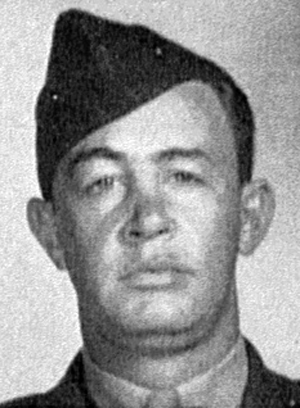
- Unit: 24th Marine Regiment, 1st Battalion, C Company (World War II), 7th Marines, H&S Company (Korean War)
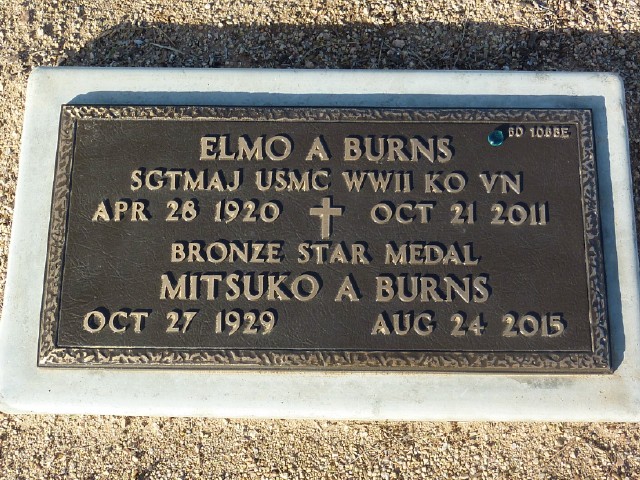
- Date of Birth: April 28, 1920
- Entered the Military: June 3, 1940
- Date of Death: October 21, 2011
- Hometown: Asheville, North Carolina
- Place of Death: Tucson, Arizona
- Award(s): Bronze Star Medal with 1 Star and Combat "V", Purple Heart, Navy Commendation Medal, Good Conduct Medal, Navy Unit Commendation, National Defense Service Medal, Korean Service Medal with 3 stars, Vietnam Service Medal, Vietnam Campaign Medal with Device, Republic of Vietnam Gallantry Cross (Unit) with Palm and Frame, United Nations Service Medal, Korean Presidential Unit Citation
- Cemetery: Section 60, Site 1068. National Memorial Cemetery of Arizona, Phoenix, Arizona
Mentored by Dr. Rebekah West Keur
Herberger Young Scholars Academy
2025/2026
Early Life
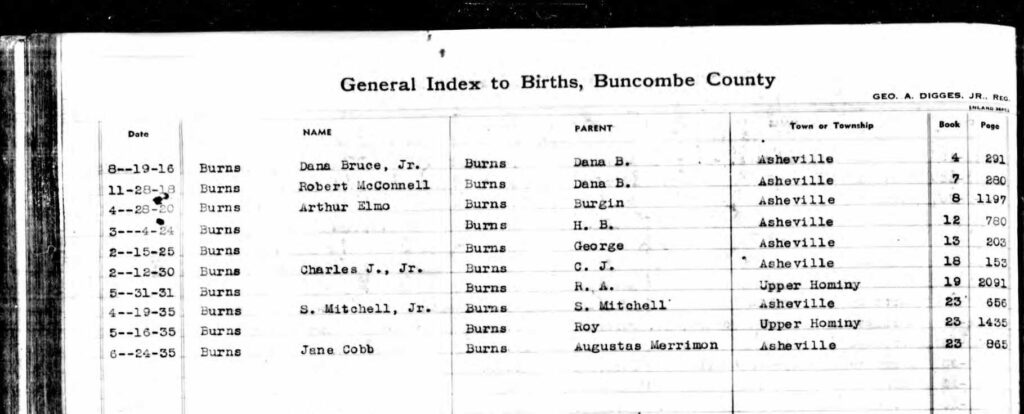
Arthur Elmo Burns was born on April 28, 1920, to Hampton Burgin Burns and Geneva B. (Williams) Burns in the mountain city of Asheville, North Carolina. He was part of a large family, including his parents and his siblings, Lucile, Jeritt, and Helen. In 1930, the family lived in Winston-Salem, and his father worked as a railroad fireman. By 1940, the family had moved to Marion. Both Burns and his younger brother had completed three years of high school and worked full-time in a hosiery mill.


Homefront
During the early twentieth century, North Carolina was the center for hosiery manufacturing in the United States, with over 240 mills by 1939. During the war years, these factories underwent a radical conversion. Instead of producing consumer fashion, output shifted to “war-priority” materials. They manufactured specialized nylon and cotton fabrics for parachutes, military tents, and mountain-grade rope equipment essential to paratroopers and infantrymen.
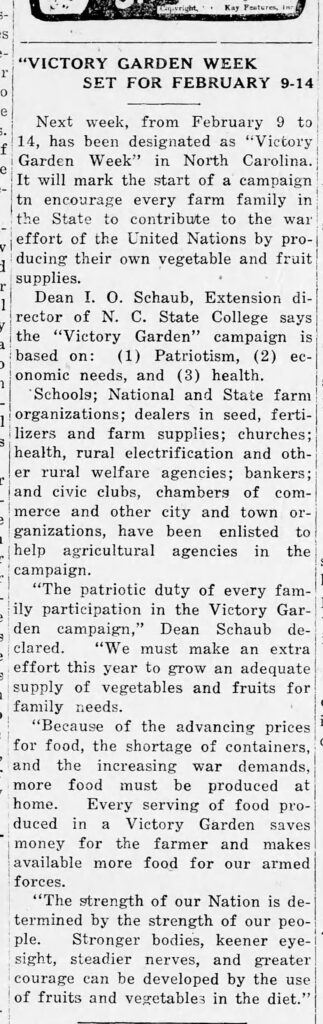
To supplement the national food rationing system, the community embraced the Victory Garden movement. These were not merely hobby gardens; they were a strategic mandate to maximize food production outside of large-scale commercial farms. By turning backyards, vacant lots, and schoolyards into productive plots, the citizens of western North Carolina ensured that commercial crops could be diverted almost entirely to the front lines. At the same time, the local community remained self-sufficient and resilient.
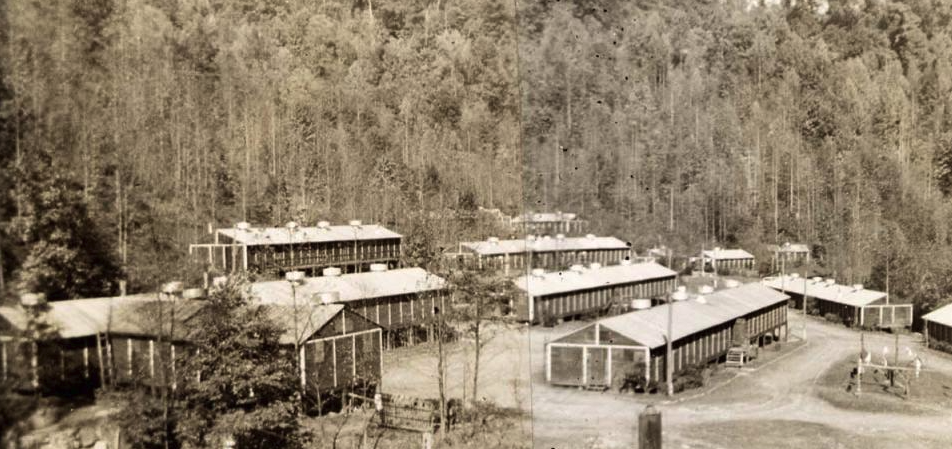
From August 1941 to May 1943, the Buck Creek Civilian Public Service Camp in Marion housed 156 men who had self-identified as conscientious objectors. The camp was run by the American Friends Service Committee. About a third of the men were Quakers. At the camp, the men were put to work building split-rail fences and fighting forest fires. Some of the men petitioned for a “program of training in spiritual development, language study, and cultural appreciation.” In 1943, the camp was combined with another in Gatlinburg, Tennessee, and closed.
The POW Labor Program: The Named Camps of the Blue Ridge
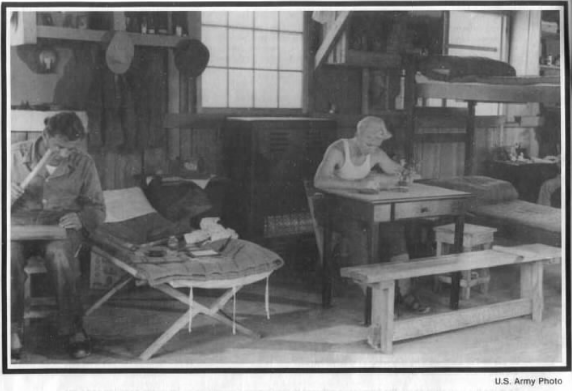
Perhaps the most unique aspect of Hendersonville’s wartime history was the integration of German Prisoners of War (POWs) into the local economy to solve the desperate labor shortage of 1944 and 1945. These captured soldiers, many of whom were from the elite Afrika Korps, were housed in specific, named “Branch Camps” that were strategically located near the work sites.
The Fairgrounds Camp, located at the site of the old WNC Fairgrounds, operated as a branch of Camp Butner, while the Bowen Farm Camp in the Mills River community served as a branch of Camp Forrest in Tennessee. A third high-security compound was established on Haywood Road to house hundreds of additional prisoners. This decentralized “mobile labor” system allowed local farmers to pick up teams of prisoners and a single guard each morning to transport them directly to the fields and factories.
The POWs held a crucial, if unexpected, role in the regional war effort. Their labor was utilized for picking apples, processing timber, and building critical mountain road infrastructure. By utilizing enemy labor to fuel the American “Arsenal,” Hendersonville maintained its agricultural output and infrastructure development while its own young men were occupied in the liberation of the Pacific and Europe. This complex domestic operation ensured that the region remained a production powerhouse until the final victory in 1945.
Military Experience
Elmo Arthur Burns served through World War II, the Korean War, and the Vietnam War, maintaining a military career that lasted over 30 years.
World War II Era (1940–1945)
Burns entered the U.S. military on June 3, 1940. Following his initial training at Parris Island, he was stationed at the Marine Barracks, Naval Air Station, Miami, Florida, from 1941 to 1942. As the war intensified, he was assigned to the 24th Marines, part of the 4th Marine Division. His promotions came rapidly. He was promoted to private first class on October 16, 1940, corporal on February 6, 1942, sergeant on January 19, 1943, and platoon sergeant by September 1, 1943. In this senior noncommissioned role, he was responsible for the tactical employment and welfare of a 40-man platoon, serving as the link between commissioned officers and the enlisted ranks. Burns also proved his proficiency with firearms during training, earning the Expert Badge for the pistol.
During the Pacific Island Hopping campaign, Burns’s division, the Fighting Fourth, made history by becoming the first division to go directly from California to a combat zone without stopping in Hawaii. His first major engagement was at Roi-Namur in 1944, a lightning-fast assault in the Marshall Islands where the 4th Division secured the objective in just 24 hours.
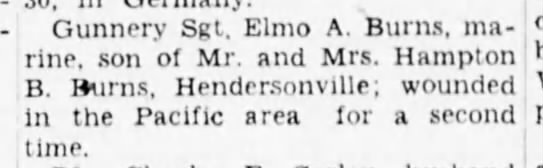
Next came the Battle of Saipan. Often called the Pacific D-Day, it was a brutal 24-day campaign. On Saipan, Burns served in heavy combat operations and was wounded in action. He was awarded his first Purple Heart and, after he recovered, was sent to fight in the Battle of Tinian.
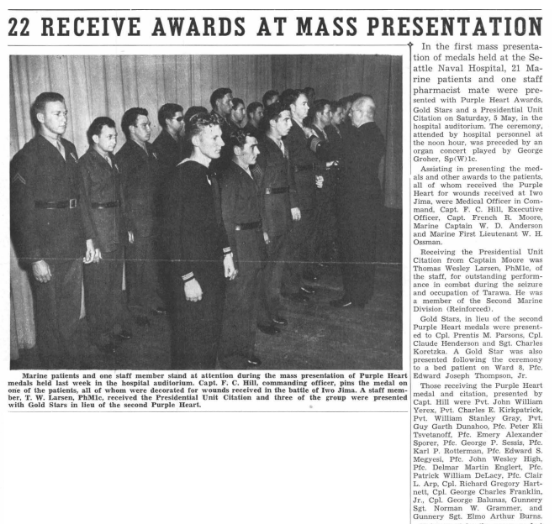
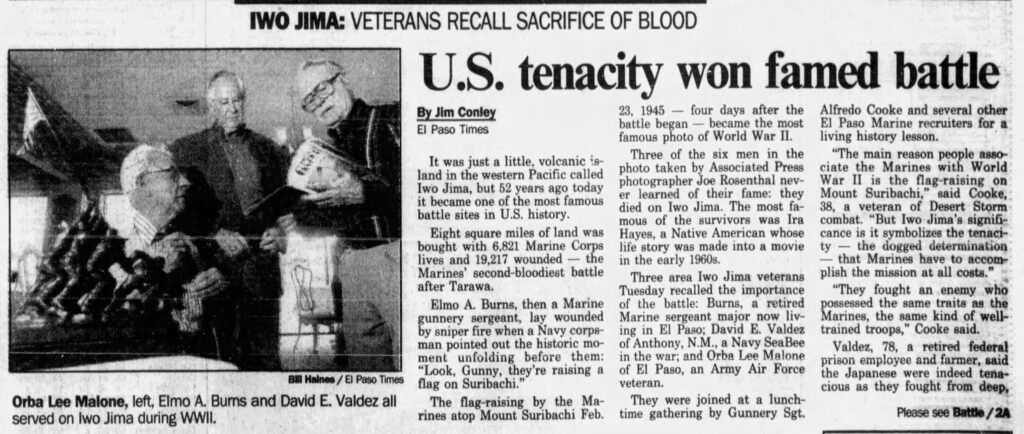
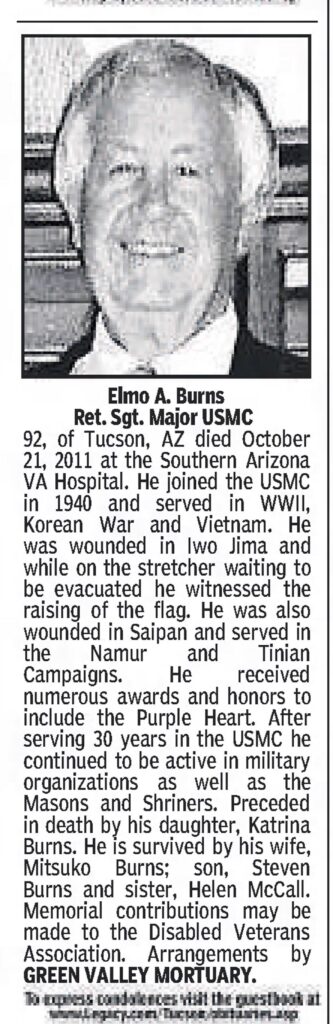
His most historic experience occurred at Iwo Jima in February 1945. Serving as a Rifle Squad Leader, Burns led 12 to 13 men in direct infantry assaults against the heavily fortified island. During this battle, he was wounded a second time. While being evacuated on a stretcher toward the beach, Burns witnessed the iconic American flag being raised on Mount Suribachi, a moment that signaled a psychological victory for the Marines despite weeks of heavy fighting remaining. For his valor and sacrifice, he received a Purple Heart with a Gold Star (denoting the second award) and the Navy Commendation Medal.
Post-War, Reserve Duty, and the Korean War (1948–1953)
After the war, his service continued, but the focus shifted to the massive logistical effort to wind down the war. By 1948, Burns had achieved the rank of technical sergeant. He briefly returned to civilian life and re-entered service via the 6th Marine Corps Reserve District in Atlanta, Georgia. With the outbreak of the Korean War, he was activated and transferred from Atlanta to Camp Pendleton on September 1, 1950. There, he was assigned to the Headquarters Battalion of the Training & Replacement Command.
Having been promoted to master sergeant, he deployed to the Korean War in 1952. Burns initially served with the 2nd Battalion, 2nd Infantry Training Regiment, and the 1st Recruit Training Battalion. In these placements, his role was to shape recruits and recalled reserves into combat-ready Marines.
For his service in this era, he earned the Korean Service Medal with 3 stars representing his participation in three designated campaigns of the war, as well as the United Nations Service Medal and the Korean Presidential Unit Citation.
Between the Korean and Vietnam wars, Elmo served in several leadership roles. A notation in his file from 1954 suggests a temporary Warrant Officer status, though he continued his career in senior enlisted roles. From 1954 to 1956, he was assigned to Company F, Headquarters, U.S. Marine Corps in Washington, D.C., where his primary duty was as a security guard.
In 1957, Burns returned to Camp Pendleton and the HQ Company of the 5th Marines, 1st Marine Division. Here, he served as both regimental and battalion sergeant major. From 1959 to 1962, he was stationed at the Marine Barracks, Naval Ammunition Depot, Hawthorne, Nevada.
Burns’s later career began with a shift to aviation support from 1962 to 1963, where he served with Marine Air Base Squadron 11 and Headquarters & Maintenance Squadron 11, both part of Marine Aircraft Group 11 within the 1st Marine Aircraft Wing. Stationed in San Francisco, he was responsible for the ground-based logistics and technical maintenance infrastructure that kept Marine strike aircraft flight-ready.
From 1964 to 1967, Burns’s expertise was utilized to train personnel required for the expanding war in Southeast Asia. He held continuous high-level leadership roles in California and eventually achieved the rank of sergeant major, the highest rank an enlisted Marine can reach.
Late Career and the Vietnam War (1962–1970)
In 1968 and 1969, Burns deployed overseas for the third major conflict of his career: the Vietnam War. He joined the III Marine Amphibious Force as a force sergeant major. It was an important position because it was the bridge between the Marine high command and troops on the ground.
For his final assignment from 1969 to 1970, Burns returned to Camp Pendleton to join the Marine Light Helicopter Squadron 267. In this placement, he led a squadron that operated UH-1 Huey helicopters.
During the Vietnam War, his uniform continued to reflect his evolving expertise and bravery. For his senior leadership and achievements, he was awarded the Bronze Star Medal with a Gold Star and the Combat “V.” The “V” denotes valor in combat, while the star indicates that he earned it on two separate occasions. His role in the III Marine Amphibious Force also earned him the Republic of Vietnam Gallantry Cross (Unit) with Palm and Frame, a foreign citation for valorous combat achievement.
For his direct participation in Southeast Asian operations, Burns received the Vietnam Service Medal and the Vietnam Campaign Medal with Device, the latter being a specific award from the Republic of Vietnam for service during the war. He also earned the National Defense Service Medal, which recognizes honorable active service during periods of national emergency.
Sergeant Major Burns retired from the Marine Corps on December 31, 1970. His record reflected a high level of professionalism. Throughout his 30 years and 6 months of service, he maintained “Outstanding” conduct ratings (5.0 or 4.9) and proficiency ratings (4.5 to 5.0). This immaculate disciplinary record and his “faithful and honorable” service culminated in the receipt of the Good Conduct Medal for an eighth time.
Veteran Experience
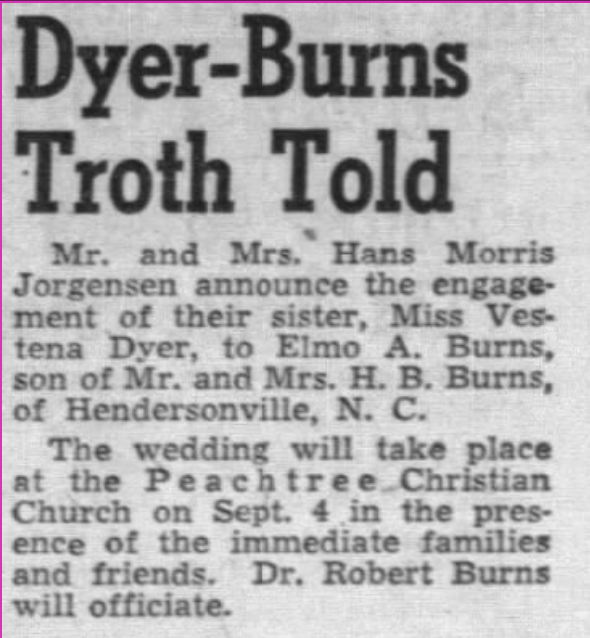
After World War II, Burns began building his family. He married Vestena Dyer on September 4, 1949. Together, they had two children: a daughter, Katrina, and a son, Steven. They lived in the Carlsbad, California area. In 1978, Burns’ 20-year-old daughter, Katrina, died in a car accident. His marriage to Vestena ended in divorce.
Burns moved to El Paso, Texas, and finally to Tucson, Arizona. He married Mitsuko A. Sowell on August 17, 2000. He never stopped serving his community, actively participating as a Mason and a Shriner. These fraternal organizations focus on charitable work, such as supporting children’s hospitals.
Commemoration
Sergeant Major Burns passed away on October 21, 2011, at the Southern Arizona VA Hospital. He was preceded in death by his daughter, Katrina, and was survived by his wife, Mitsuko, and his son, Steven. He was laid to rest at the National Memorial Cemetery of Arizona, in Phoenix, a Silent Hero who will be remembered for his service to his country and his community.
His wife, Mitsuko, passed away in 2015. They are buried together.
Bibliography
Primary Sources
“22 Receive Awards at Mass Presentation,” The Stethescope [Seattle, Washington] Volume 3, Number 21, May 23, 1945. https://archive.org/details/Stethoscope321450523.
“35 Names Added.” Asheville Citizen-Times [Asheville, North Carolina], April 19, 1945. Newspapers.com (198966387).
Arthur Elmo Burns. North Carolina, U.S., Birth Indexes, 1800-2000. Digital Images. https://ancestry.com.
Brownrigg, John C. Letter to Gavin Charles. November 26, 2025.
CPS Camp No. 19, Photograph. Buck Creek, Marion, North Carolina. Raymond & Helen Binford Collected Papers (CDGA), Swarthmore College Peace Collection. https://stcpsarchive.z9.web.core.windows.net/cpsarchive/camps/19/1.html.
“Dyer-Burns Troth Told.” The Atlanta Constitution [Atlanta, Georgia], August 16, 1949. Newspapers.com (398035945).
“Elmo A. Burns, Ret. Sgt. Major USMC.” Arizona Daily Star [Tucson, Arizona], November 16, 2011. Newspapers.com (213941675).
Elmo A Burns. Texas, U.S., Marriage Index, 1824-2021. Digital Images. https://ancestry.com.
Elmo A Burns. U.S. Navy Casualties Books, 1776-1941. Digital Images. https://ancestry.com.
Elmo Arthur Burns, Freedom of Information Act Record, Department of the Navy, National Archives and Records Administration – St. Louis.
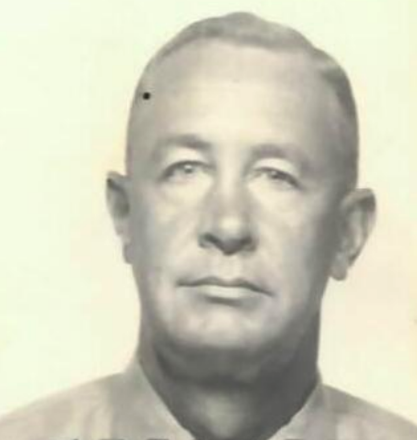
Elmo Arthur Burns. Military Photograph. Department of the Navy, National Archives and Records Administration – St. Louis.
Elmo Arthur Burns, Pay Service Record, Department of the Navy, National Archives and Records Administration – St. Louis.
Elmo Arthur Burns. U.S., World War II Draft Cards Young Men, 1940-1947. Digital Images. https://ancestry.com.
North Carolina. Burke County. 1900 U.S. Census. Digital Images. https://ancestry.com.
North Carolina. Burke County. 1910 U.S. Census. Digital Images. https://ancestry.com.
North Carolina. Forsyth County. 1930 U.S. Census. Digital Images. https://ancestry.com.
North Carolina. McDowell County. 1930 U.S. Census. Digital Images. https://ancestry.com.
North Carolina. McDowell County. 1940 U.S. Census. Digital Images. https://ancestry.com.
“Victory Garden Week Set for February 9-14.” Marion Progress [Marion, North Carolina], February 5, 1942. Newspapers.com (861668058).
Secondary Sources
“1930-1940: The Great Depression.” Steinbeck in the Schools. Accessed November 10, 2025. https://www.steinbeckintheschools.com/historical-context/1930-1940.
“Asheville History: Early Settlement to Downtown Boom.” Romantic Asheville. Accessed April 29, 2026. https://www.romanticasheville.com/History.htm.
Bell, John L., et al. “World War II.” NCpedia, State Library of North Carolina. Updated 2006. Accessed November 7, 2025. https://www.ncpedia.org/world-war-ii.
Brown, Ronald. A Brief History of the 14th Marines. History and Museums Division Headquarters, U.S. Marine Corps, 1990.
Byrd, Travis. Unraveled: The True Story of the 1929 Marion Textile Strike. University of Tennessee Press, 2015.
Chapin, John C. The 4th Marine Division in World War II. Historical Division, Headquarters, U.S. Marine Corps, 1945. www.marines.mil/portals/1/publications/the%204th%20marine%20division%20in%20world%20war%20ii%20%20pcn%2019000412800.pdf.
“Charlie Company.” The First Battalion, 24th Marines in World War II. Accessed August 15, 2025. https://1-24thmarines.com/personnel-2/charlie/.
“Charlie Company and the Massacre.” American Experience, PBS. Accessed April 29, 2026. https://www.pbs.org/wgbh/americanexperience/features/my-lai-charlie-company-and-massacre/.
“Duties and Responsibilities.” U.S. Army. Accessed April 29, 2026. https://www.benning.army.mil/Infantry/DoctrineSupplement/ATP3-21.8/chapter_03/RoleoftheInfantry/DutiesandResponsibilities/index.html.
“Elmo A. Burns.” The First Battalion, 24th Marines in World War II. Accessed April 29, 2026. https://1-24thmarines.com/personnel-2/elmo-a-burns/.
“Elmo Arthur Burns.” Find a Grave. Updated September 28, 2020. Accessed April 29, 2026. https://www.findagrave.com/memorial/128388060/elmo-arthur-burns.
“Elmo Arthur Burns.” Veterans Legacy Memorial, National Cemetery Administration. Accessed April 29, 2026. https://www.vlm.cem.va.gov/ELMOARTHURBURNS/DD02DE2.
“Hayden Flour Mill and Silos.” City of Tempe Government. Accessed November 10, 2025. https://www.tempe.gov/government/community-development/planning/historic-preservation/hayden-flour-mill.
History of the U.S. Marine Corps in WWII Vol IV: Western Pacific Operations. U.S. Marine Corps, 1966. https://www.marines.mil/Portals/1/Publications/History%20of%20the%20U.S.%20Marine%20Corps%20in%20WWII%20Vol%20IV%20-%20Western%20Pacific%20Operations%20%20PCN%2019000262700_4.pdf.
Knighton, Andrew. “8 Things We Need To Know About The Iwo Jima Landings.” War History Online, October 18, 2017. https://www.warhistoryonline.com/world-war-ii/8-things-we-need-to-know-about-the-iwo-jima-landings.html.
“Military Occupational Specialty Codes (MOS) Index.” 134th Infantry Regiment Website. Accessed April 29, 2026. http://www.coulthart.com/134/mos.htm.
Panken, Jaffa. “German POWs at UNC.” History on the Hill Blog, University of North Carolina Libraries, February 8, 2017. https://blogs.lib.unc.edu/hill/2017/02/08/german-pows-at-unc/.
“Rifle Squad Leader Staffing.” Marine Corps Gazette, May 2018. https://www.mca-marines.org/wp-content/uploads/0519-Rifle-Squad-Leader-Staffing.pdf.
“The Roaring Twenties.” HISTORY. Accessed November 7, 2025. https://www.history.com/articles/roaring-twenties-history.
“Roi-Namur Island, Kwajalein Atoll, Republic of the Marshall Islands.” U.S. Geological Survey. Accessed April 29, 2026. https://www.usgs.gov/media/images/roi-namur-island-kwajalein-atoll-republic-marshall-islands.
Rosmer, Christina D. “Great Depression – Social Impact, Unemployment, Poverty.” Encyclopedia Britannica. Accessed November 15, 2025. https://www.britannica.com/topic/Great-Depression/Social-impact.
“Saipan.” Encyclopedia Britannica. Accessed November 15, 2025. https://www.britannica.com/place/Saipan.
“Sergeant Major Thomas J. McHugh.” U.S. Marine Corps. Accessed April 29, 2026. https://www.usmcu.edu/Research/Marine-Corps-History-Division/People/Whos-Who-in-Marine-Corps-History/Mackie-Ozbourn/Sergeant-Major-Thomas-J-McHugh/.
Stevens, Megan. A Missing Mountain Memory: The Marion Manufacturing Mill Strike of 1929. University of North Carolina at Charlotte, 2020. https://ninercommons.charlotte.edu/record/1667?v=pdf.
“Tinian.” Encyclopedia Britannica. Accessed November 15, 2025. https://www.britannica.com/place/Tinian.
U.S. Marines in Vietnam: The Defining Year, 1968. History and Museums Division, Headquarters, U.S. Marine Corps, 1981.
“USMC P41 UNIS Marked X2 WIA Saipan and Iwo Jima.” U.S. Militaria Forum. Updated November 30, 2018. Accessed April 29, 2026. https://www.usmilitariaforum.com/forums/index.php?/topic/319887-usmc-p41-unis-marked-x2-wia-saipan-and-iwo-jima/.
“US Tenacity Won Famed Battle.” El Paso Times [El Paso, Texas], February 19, 1997. Newspapers.com (431792260).
“World War II Propaganda.” American Experience, PBS. Accessed November 10, 2025. https://www.pbs.org/wgbh/americanexperience/features/goebbels-propaganda/.
“The WWII Home Front.” National Park Service. Accessed November 10, 2025. https://www.nps.gov/articles/the-wwii-home-front.htm.
This profile was funded by a grant from the United States Department of Veterans Affairs. The opinions, findings, and conclusions stated herein are those of the author and do not necessarily reflect those of the United States Department of Veterans Affairs.