

Captain Frank Douglas Boll, Jr.
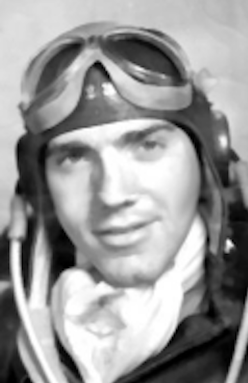
- Unit: First Marine Aircraft Wing, Torpedo Bombing Squadron VMTB-134
- Date of Birth: October 5, 1921
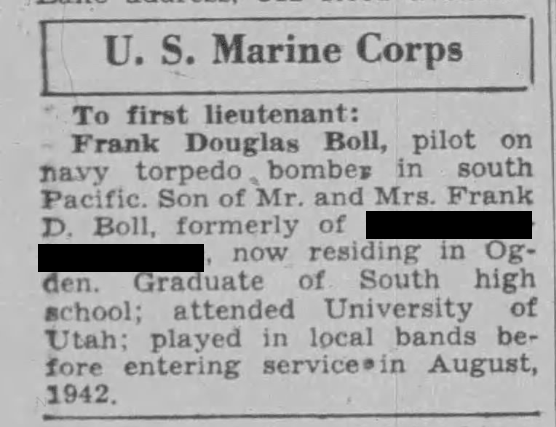
- Entered the Military: August 14, 1942
- Date of Death: September 22, 2009
- Hometown: Salt Lake City, Utah
- Place of Death: Salt Lake City, Utah
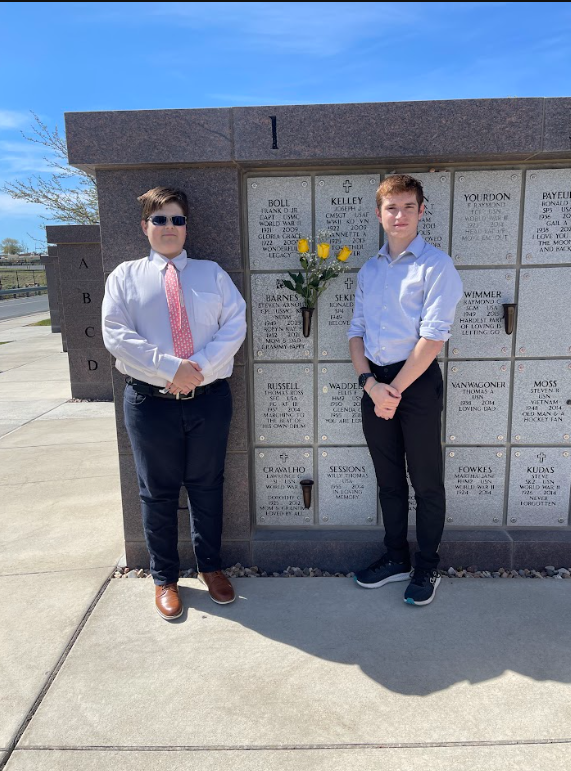
- Cemetery: Section A-2, Row A, Site 1. Utah Veterans Cemetery & Memorial Park, Bluffdale, Utah
Mentored by Mrs. Julia Jane Winslow
Providence Hall High School and Providence Hall Junior High School
2025/2026
Early Life
Frank Douglas Boll Jr. was born on October 15, 1921, to Frank Douglas Boll, Sr., and Frances E. Henger Boll. He was born into a close-knit family that lived in Salt Lake City, Utah. His father was a World War I veteran who set the tradition of service for his son. Frank went by his middle name, Douglas, to be differentiated from his father.
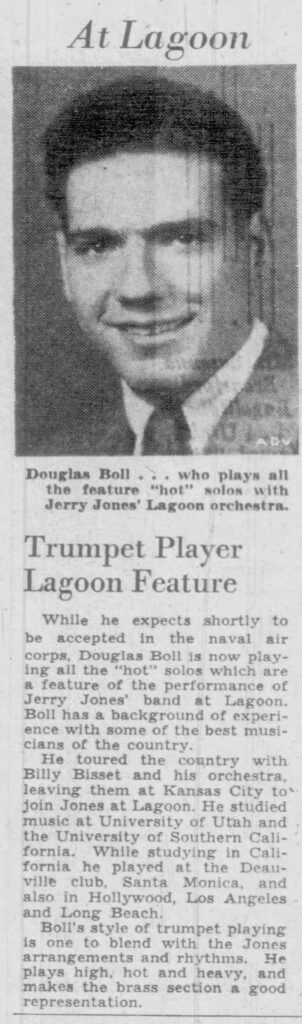
Boll was a natural musician and began playing his trumpet professionally at the age of 11. He played at school dances at South Junior High School throughout middle school and high school. He graduated from South High School in 1937. He continued to play the trumpet professionally during high school, including at the Rainbow Rondeva and the local amusement park, Lagoon, until he was drafted.
In addition to being a professional musician, he worked at Billy Bishop Booking Business, a subsidiary of the Fredrick Brothers of Chicago, Illinois.

Homefront
Boll’s hometown of Salt Lake City, Utah, in the Intermountain West, was home to the Salt Lake Ordnance Plant, also known as the Remington Arms Plant, where small-arms ammunition was produced for the army in the Pacific Theater.
The city was a military supply hub, as it was a great place to gather supplies before they were sent to West Coast bases and then to troops in the Pacific. Federal defense spending spurred the development of the Navy Depot and Fort Kearns, which supported the military with supplies and training. Fort Douglas, which has been a military installation since the 1850s, also expanded to help the war effort. Salt Lake City’s population increased from 555,310 to 688,863.
The women of Salt Lake City found more work and volunteer opportunities during the war effort. The Latter-Day Saints’ Relief Society joined forces with the Red Cross. This partnership provided training for women throughout the valley to help their communities.
Salt Lake City women were also a part of a group known as the Minute Women. The Utah chapter, like the other national chapters, worked to gather the materials needed to make war supplies, including 2 million pounds of household fats such as bacon grease and 242 million pounds of scrap metal and iron.
Local newspapers documented the war and encouraged Salt Lake City citizens to support the war effort.
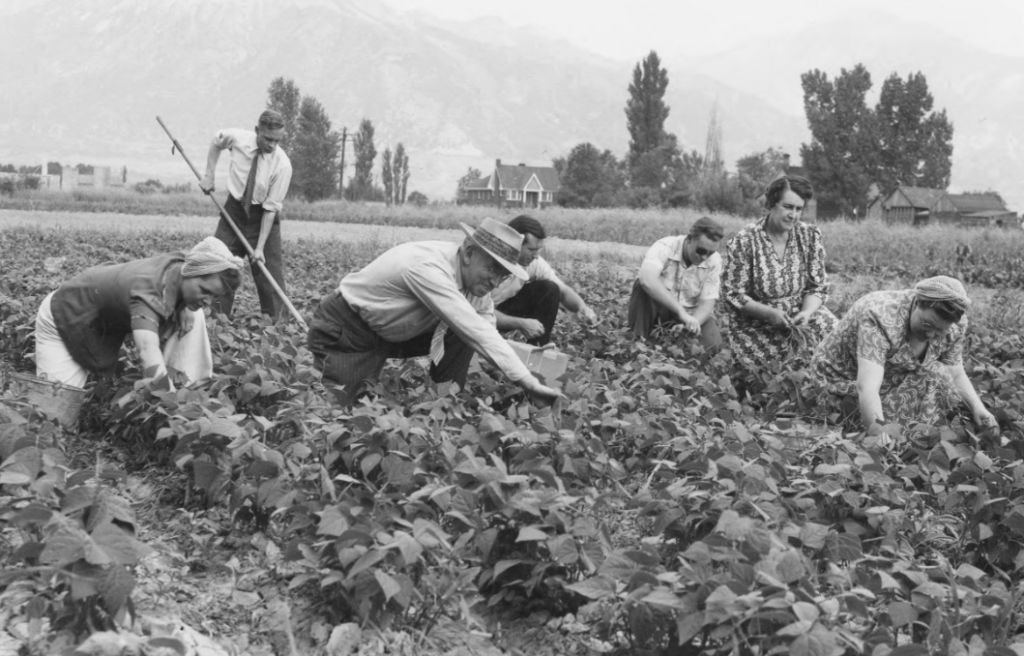
Residents did their part, planting victory gardens across the city and buying war bonds.
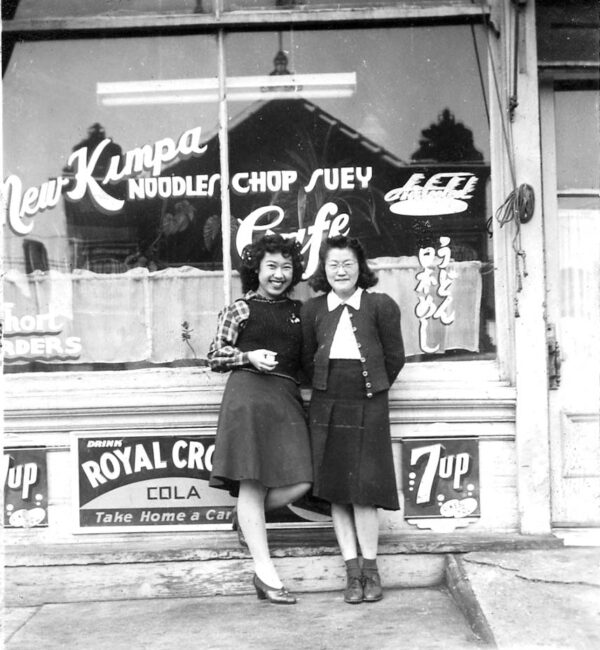
Salt Lake City had a small, yet significant Japanese population living in what was known as Japantown. After the attack on Pearl Harbor, President Franklin D. Roosevelt signed Executive Order 9066. This made the entire West Coast of the United States a military zone. As a result, Japanese and Japanese-American citizens were relocated and incarcerated in internment camps. One of these, Camp Topaz, located 130 miles southwest of Salt Lake, was the fifth largest “city” in Utah between 1942 and 1945.

Military Experience
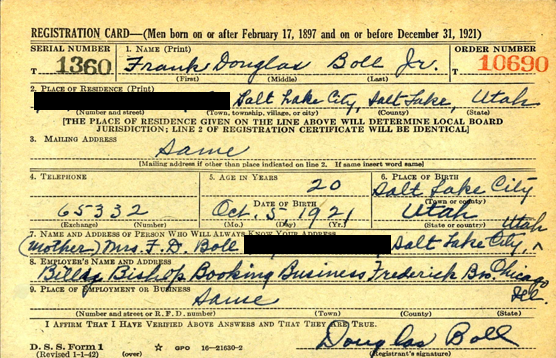
Boll registered for the draft on February 16, 1942, in Salt Lake City. His parents had moved to Ogden, but he was living with his maternal grandmother, Augusta Hanger. He continued to work as a trumpet player until he left for basic training in Oakland, California, on Wednesday, August 12, 1942.
Boll’s flight training was extensive. He spent three months in Oakland, California, and then four months training in Corpus Christi, Texas. Then he was transferred to Jacksonville, Florida, for two more months, followed by two final weeks of training in Glenview, Illinois. After this training, he was activated as a Naval Corps pilot. In early July 1943, he was stationed in Costa Mesa, California. This was the final stop for pilots before being deployed to the Pacific.
Boll flew with the VMTB-134 Torpedo Bombing Squadron, operating a TBF/TBM Avenger Aircraft. These were bombers focused on sinking Japanese warships in the Pacific. They were able to launch off a shortened deck of escort and light carriers. They also had a long fuel range, carrying 325 gallons with a consumption rate of 75 gallons per hour, which was essential for successful missions during the widely dispersed campaigns of the Pacific. Boll’s squadron was originally deployed to Espiritu Santo, New Hebrides, and was assigned to Marine Aircraft Group 11, 1st Marine Aircraft Wing. He would fly with the squadron to support Marine operations on Bougainville, the Bismarck Archipelago, and Peleliu. In each of these brutal land battles, air support was vital for the hard-fought success.
Boll also served as a flight instructor in Jacksonville, Florida, and later in El Toro, California. His flight instructor duties were done in between calls to action, as pilots were more susceptible to battle fatigue due to the high-stress nature of their jobs. He uses his experience as a pilot to help train other torpedo pilots for success.
Boll took leave in June of 1944 to return home and marry the love of his life, Gloria Grace Carter. He returned to active duty by August of 1944.
Boll transitioned to inactive service in November 1945. By then, he had moved into a more permanent position as a flight instructor. He was officially discharged from the Marines in June of 1952.
Veteran Experience
After the war, Boll returned home to Salt Lake City and settled down with his wife, Gloria. Soon after the war, they started their family and had four children: Steven, Susan, Laurie, and Julie.
Boll returned to his role as a trumpet player at the Rainbow Randevi Room in Salt Lake City. He also served as the house band leader in 1946. While working, he attended the University of Utah and earned a degree in music in 1948. Boll became a music teacher and a band leader. Music played a huge part in his life for the rest of his days.
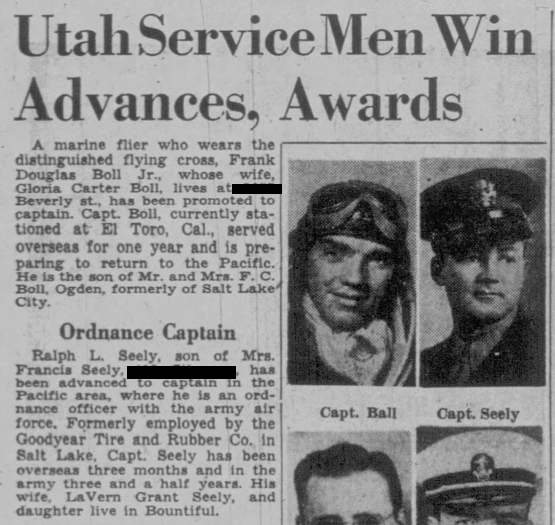
Boll received the Distinguished Flying Cross in 1950. This was awarded for his heroism and achievement during operations in the South Pacific. He was specifically recognized for a low-altitude, direct hit attack on an enemy cargo vessel on March 31, 1944, that he completed despite heavy anti-aircraft fire.
In 1965, Boll began working at Hill Air Force Base. He helped with the logistical side of the Cold War, including negotiating contracts for the supply of missiles built at Hill Air Force Base.
Later, in 1992, he formed his own band of retired musicians. The band was called the Phoenix Jazz and Swing Band. They played jazz and swing music for different social groups throughout the Salt Lake Valley. The band is still active today.


Commemoration
Boll died peacefully, surrounded by his family, on September 22, 2009, at the age of 88. He was laid to rest at the Utah Veterans Cemetery & Memorial Park in Bluffdale, Utah. He was preceded in death by his wife, Gloria Grace Carter Boll. He left behind his four children.
Captain Frank Douglas Boll left a legacy of heroism and service to his country as amember of the United States Marine Corps. He is further remembered for his passion for music and his devotion to his family.
Bibliography
Primary Sources
“At Lagoon,” The Salt Lake Tribune [Salt Lake City, Utah], August 5, 1942. Newspapers.com (195202608).
Defense Bonds–KDYL. Photograph. 1941. Salt Lake Tribune Negative Collection, The University of Utah (560520). https://collections.lib.utah.edu/ark:/87278/s6c55f4q.
Frank D. Boll Jr. U.S. Veterans Gravesites, 1775-2019. Digital Images. http://ancestryclassroom.com.
Frank Douglas Boll Jr., Official Military Personnel File, Department of the Navy. National Archives and Records Administration – St. Louis.
Frank Douglas Boll, Jr., Report of Separation, Department of the Navy, National Archives and Records Administration – St. Louis.
Frank Douglas Boll Jr. World War II Draft Cards Young Men, 1940-1947. Digital Images. http://ancestryclassroom.com.
“Frank D. Boll, Sr.” Arizona Death Certificates, 1887-1968. Digital Images. http://ancestryclassroom.com.
“Frank D. Boll, Sr.,” Ogden Standard Examiner [Ogden, Utah], March 10, 1958. https://newspapers.lib.utah.edu/ark:/87278/s60c9zqq/26197004.
“Frank D. Boll Sr.” Utah, U.S. Veterans with Federal Service Buried in Utah, 1847-1966. Digital Images. http://ancestryclassroom.com.
“General Mum on Letting of S.L. Plant Job,” Salt Lake Telegram [Salt Lake City, Utah], July 7, 1941. https://newspapers.lib.utah.edu/ark:/87278/s6tq78tx/16932003.
“Extra Effort to Win the War,” Salt Lake Telegram [Salt Lake City, Utah], February 3, 1942. https://newspapers.lib.utah.edu/ark:/87278/s6zp5fdr/16977657.
“Minute Women Learn the Importance of Salvage.” Salt Lake Telegram [Salt Lake City, Utah], May 5, 1944. https://newspapers.lib.utah.edu/ark:/87278/s6wt02mr/17131590.
“Victory Garden Limitation.” Salt Lake Telegram [Salt Lake City, Utah], April 1, 1943. https://newspapers.lib.utah.edu/ark:/87278/s6qn7gfv/17849340.
“Population Shifts Heavy Since 1940,” Salt Lake Telegram [Salt Lake City, Utah], October 11, 1944. https://newspapers.lib.utah.edu/ark:/87278/s6w394mr/17072871.
“Relief Society Will Do Red Cross Work,” Pleasant Grove Review [Pleasant Grove, Utah], June 9, 1944. https://newspapers.lib.utah.edu/ark:/87278/s6wt02mr/17131590.
Utah Marriage Indexes 1887-1985. Digital Images. http://ancestryclassroom.com.
Utah. Salt Lake County. 1930 U.S. Census. Digital Images. http://ancestryclassroom.com.
Utah. Salt Lake County. 1940. U.S. Census. Digital Images. http://ancestryclassroom.com.
Utah. Salt Lake County. 1950 U.S. Census. Digital Images. www.ancestryclassroom.com.
“Utah Service Men Win Advances, Awards.” The Salt Lake Tribune [Salt Lake City, Utah], September 8, 1945. Newspapers.com (195189089).
Wesler. Orlob, Harold; Boll, Doug; Baker, D. Carlyle -Shot 1. Photograph. September 9, 1961. University of Utah (1170117). https://collections.lib.utah.edu/ark:/87278/s6xs9d6w.
World War II-Victory Gardens P.1. Photograph. Salt Lake Tribune, August 1943. University of Utah (450299). https://collections.lib.utah.edu/ark:/87278/s6kd27jr.
Secondary Sources
Alexander, Thomas G. and Leonard J. Arrington. “Utah’s Small Arms Ammunition Plant during World War II.” Pacific Historical Review. Volume 34, no.2 (May 1965): pp. 185-196. https://www.jstor.org/stable/3636992.
“Capt Frank Douglas Boll Jr.,” Find A Grave. Updated September 28, 2009. Accessed December 12, 2025. https://www.findagrave.com/memorial/42500495/frank-douglas-boll.
Edwards, Alan. “Phoenix resurrects bug band fever, White-haired retired musicians spin great classics,” Deseret News, January 10, 1999. https://www.deseret.com/1999/1/10/19426120/phoenix-resurrects-big-band-fever-br-white-haired-retired-musicians-spin-great-classics/.
“Frank D. Boll Jr.” Deseret News [Salt Lake City, Utah], September 27, 2009. https://www.legacy.com/us/obituaries/deseretnews/name/frank-boll-obituary?id=28514472.
Kitterman, Katherine. “Utah Women In World War Two.” Utah Women’s History. Updated May 7, 2020. Accessed November 14, 2025. https://utahwomenshistory.org/2020/05/utah-women-in-world-war-two/.
Launius, Roger D. “World War Two In Utah.” History to Go. Accessed November 13, 2025. https://historytogo.utah.gov/wwii-utah/.
Launius, Roger D. “World War Two in Utah.” Utah History Encyclopedia. Accessed November 13, 2025. https://www.uen.org/utah_history_encyclopedia/w/WWII.shtml.
Naywn, Lori L. “Dance Orchestras of ’20s, ’30s Were A Big Hit in Northern Utah,” Deseret News [Salt Lake City, Utah], December 16, 1991. https://www.deseret.com/1991/12/26/18958766/dance-orchestras-of-20s-30s-were-a-big-hit-in-n-utah/.
Potter, Lisa. “Revitalizing Japantown Street.” University of Utah Magazine, summer 2022. https://magazine.utah.edu/issues/summer-2022/restoring-historic-japantown.
“Relief Society and Social Welfare.” Relief Society Women. Updated April 21, 2012. Accessed November 14, 2025. https://www.reliefsocietywomen.com/blog/2012/04/21/relief-society-and-social-welfare/.
“Topaz Museum.” Accessed April 10, 2026. https://topazmuseum.org/.
This profile was funded by a grant from the United States Department of Veterans Affairs. The opinions, findings, and conclusions stated herein are those of the author and do not necessarily reflect those of the United States Department of Veterans Affairs.