

Lieutenant Colonel George Andrew Davis, Jr.
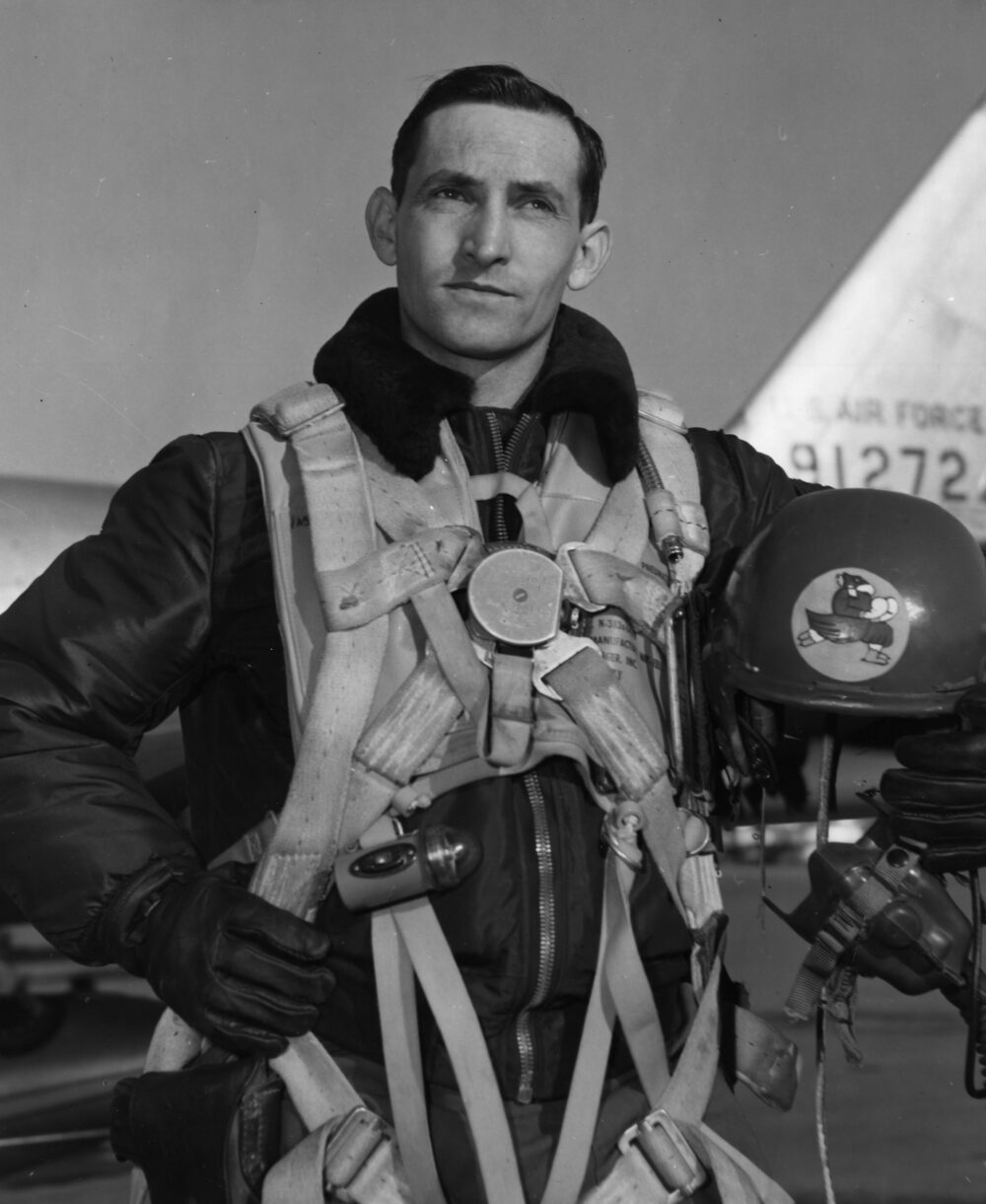
- Unit: 334th Fighter Interceptor Squadron, 4th Fighter Interceptor Wing
- Service Number: O-671514, O-39295
- Date of Birth: December 1, 1920
- Entered the Military: March 21, 1942
- Date of Death: February 10, 1952
- Hometown: Lubbock, Texas
- Place of Death: Sinuiju-yala River area, North Korea
- Award(s): Medal of Honor, Distinguished Service Cross, Silver Star Medal with Two Oak Leaf Clusters, Distinguished Flying Cross with Three Oak Leaf Clusters, Purple Heart, Air Medal with Nine Oak Leaf Clusters
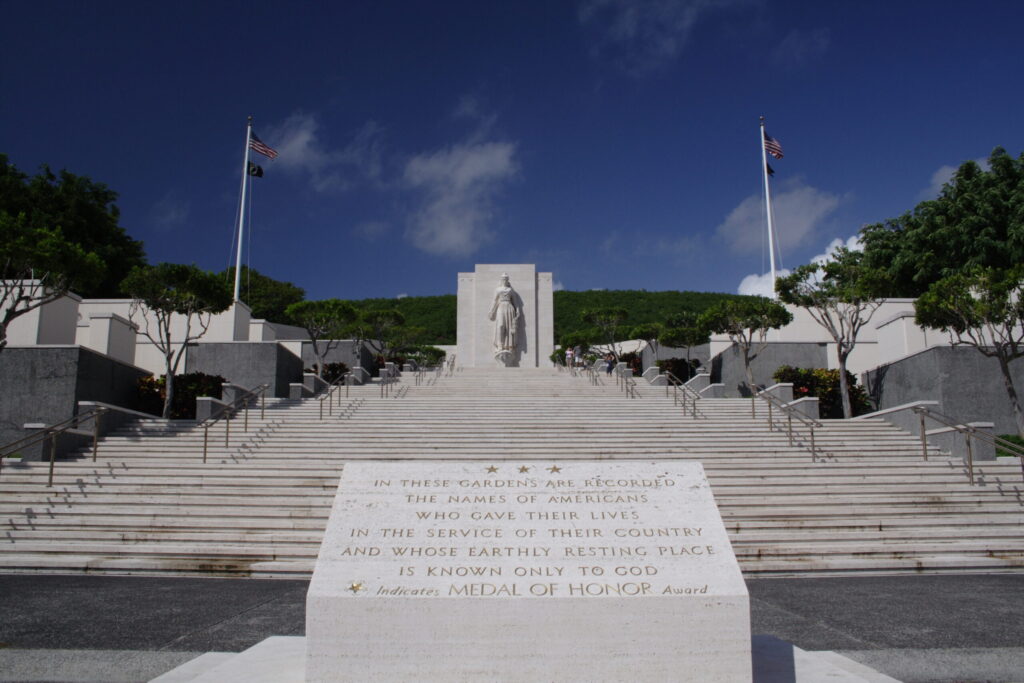
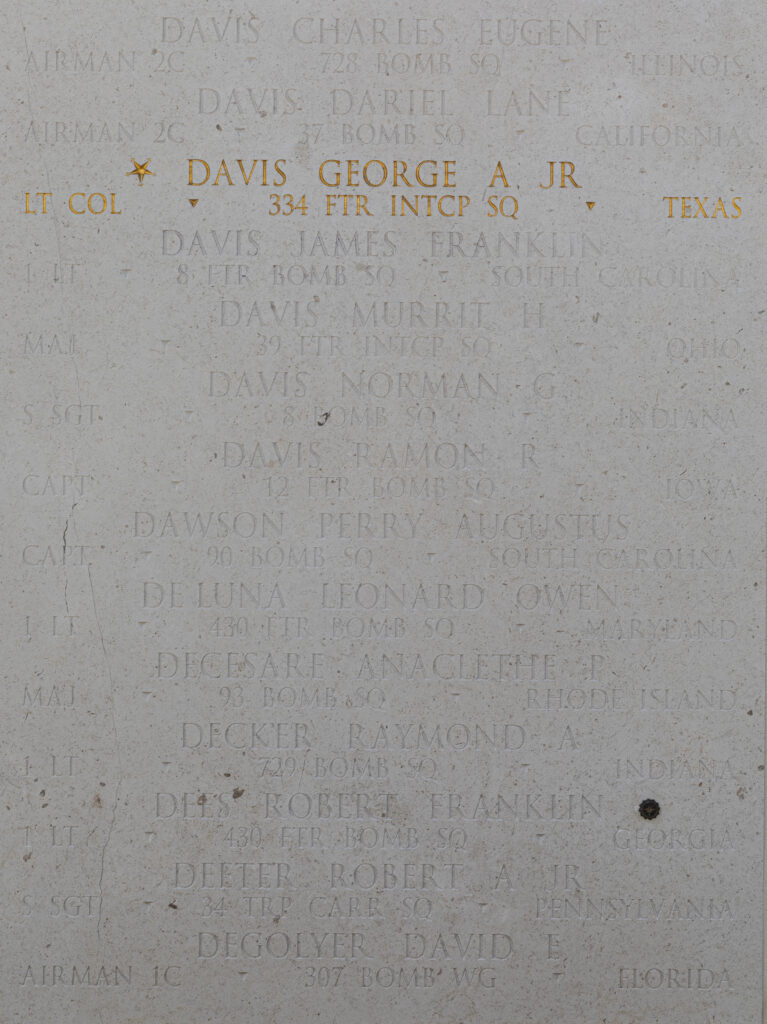
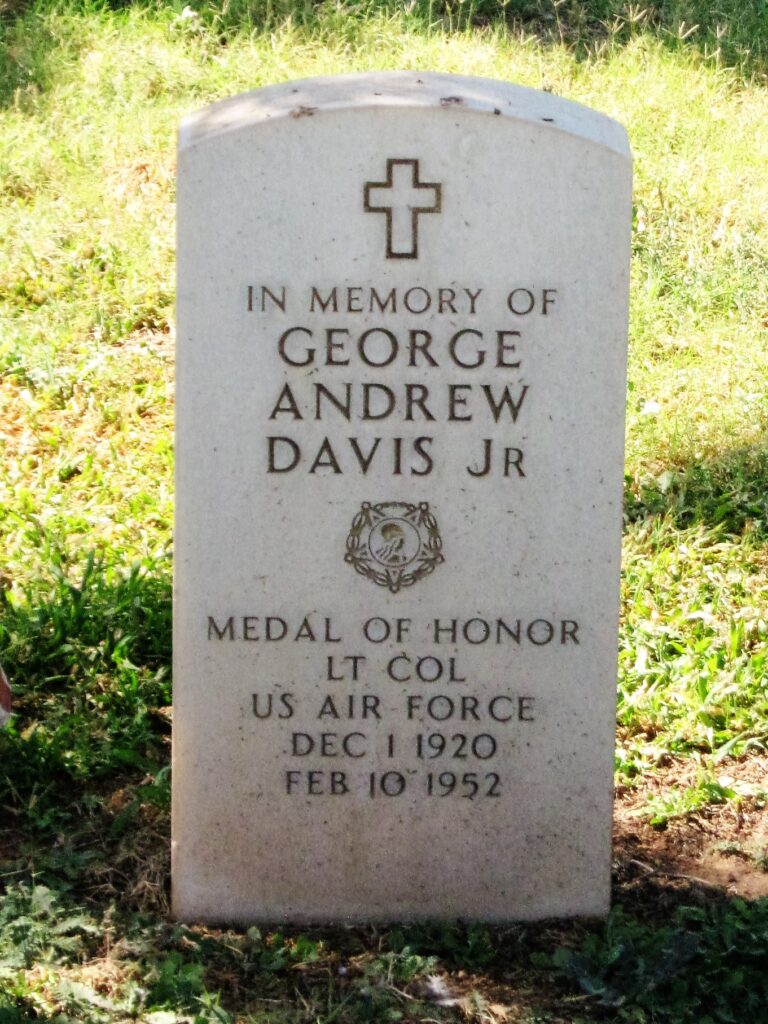
- Cemetery: Court Five, Courts of the Missing, Honolulu Memorial, National Memorial Cemetery of the Pacific, Honolulu, Hawaiʻi. Memorial marker in the City of Lubbock Cemetery, Lubbock, Texas
Llano Junior High, Llano, Texas
2025/2026
Early Life
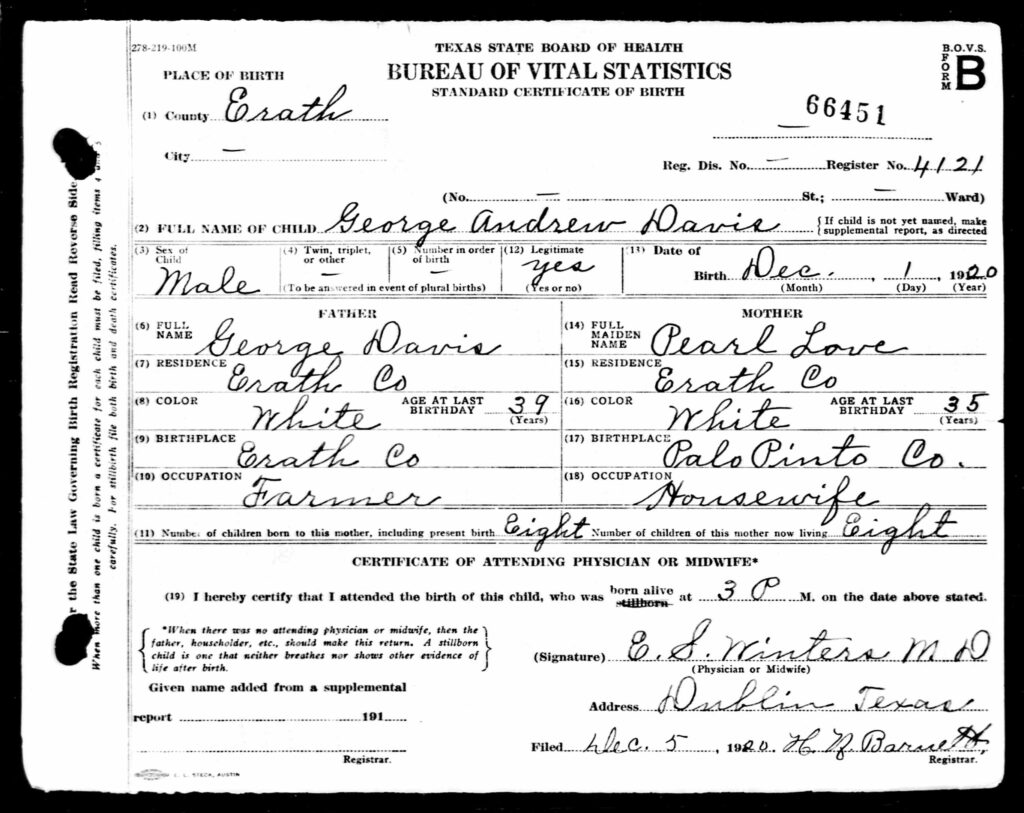
George Andrew Davis, Jr. was born in Dublin, Texas, on December 1, 1920, to George Andrew Davis, Sr. and Pearl Love. George was the eighth of ten children that the couple would have. As was the case with most rural Texans during the 1920s and 1930s, the family worked their small farm to provide for themselves. In 1935, they sought better opportunities and moved to the small town of Maple, Texas, in Bailey County. Maple was a relatively new town, incorporated in 1926 after local ranches were subdivided into family farms. The family attended the local Church of Christ in Maple.
Davis’s lifelong love of aviation was sparked when he was around ten years old after he observed local barnstormers performing aerial acrobatics. As was common at the time, pilots would travel the countryside in farmers’ fields to offer rides for 25 cents. Neither of his parents was too thrilled with the idea of flying, but George was hooked.
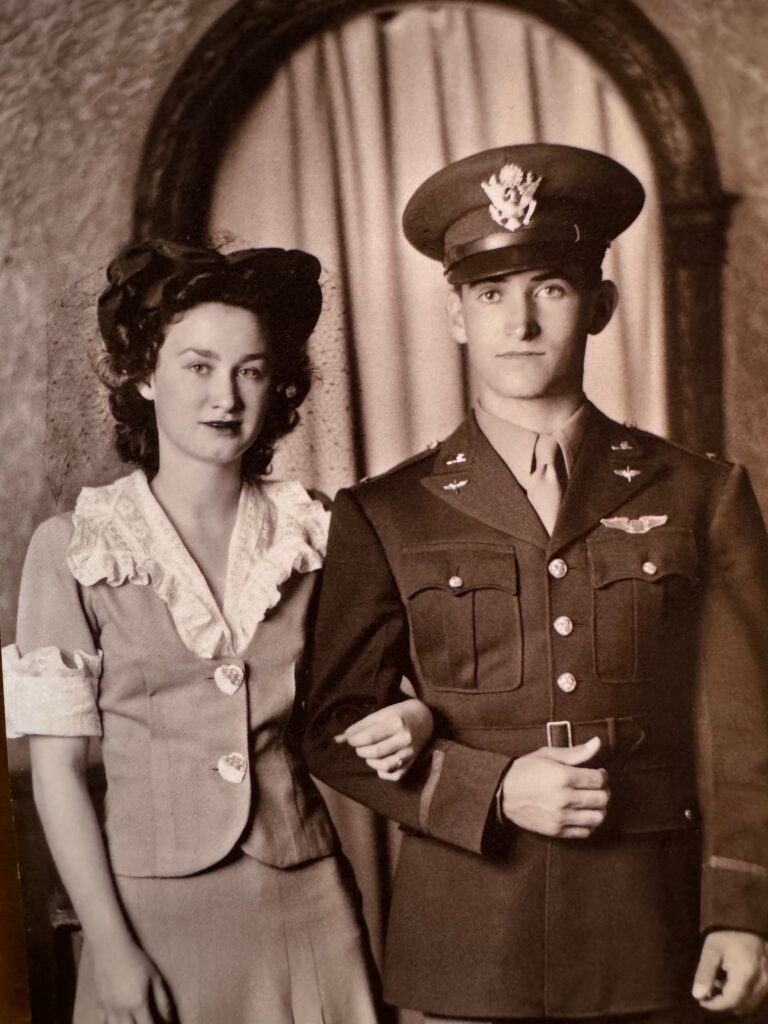
Davis attended elementary school at Wilson Elementary in Maple, but there was no high school there. He attended Morton High School in neighboring Cochran County. To get to school, George sometimes rode his horse, and on one of those rides, he met his future wife, Doris Forgason. She was four years his junior, had skipped a grade, and would ride her own horse with George to school. While at Morton, George excelled at sports and was a football star before graduating in 1938 with a scholarship to Harding College in Searcy, Arkansas.
Although receiving a scholarship, George attended Harding for only one semester before returning home to help his father with the family farm after two of his older brothers enlisted in the military. He continued working on his family farm for several years before enlisting in the U.S. Army Air Forces on March 21, 1942.

Homefront
Lubbock
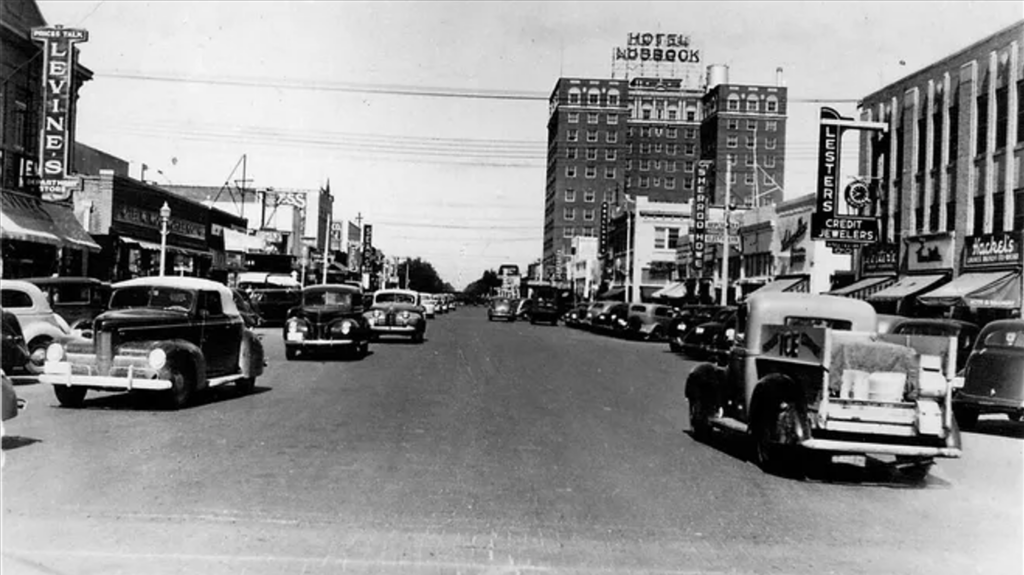
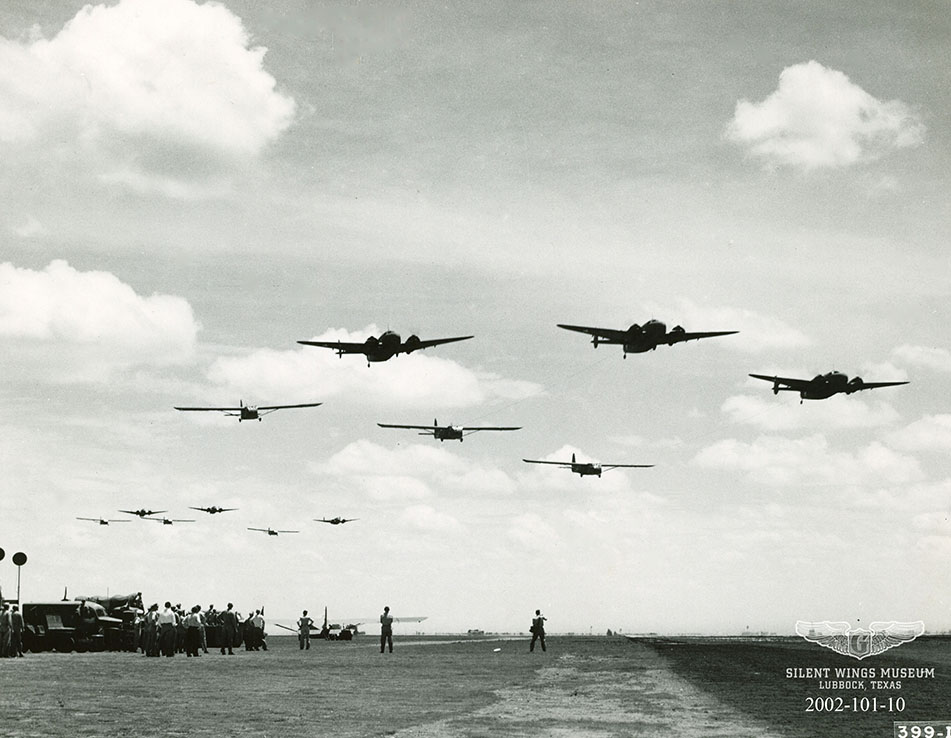
During World War II, Lubbock, Texas, experienced rapid change as the demands of global war reshaped daily life on the South Plains. While far from the front lines, Lubbock played a critical support role through agriculture, transportation, and military training. The county’s cotton production was essential to wartime industries, supplying raw materials for uniforms, tents, and other military needs. Rail lines running through Lubbock helped move troops, equipment, and supplies, reinforcing the city’s strategic importance. Federal investment tied to defense activity brought extreme population growth and economic expansion, permanently altering the city’s trajectory.
Civilians in Lubbock actively participated in the home-front war effort. Residents complied with the rationing of gasoline, sugar, meat, and rubber, organized scrap metal and paper drives, and purchased war bonds to finance military operations. Schools incorporated patriotic instruction, and local newspapers closely followed the progress of the war and the service of area men and women overseas. Women entered the workforce in greater numbers, filling jobs left vacant by enlisted men, while civic organizations coordinated civil defense drills and community aid. These shared sacrifices strengthened community bonds and tied Lubbock’s identity closely to the national war effort.
Reese Air Force Base
Reese Army Air Field during World War II was one of the most significant military installations in West Texas. Established in 1941, the base specialized in advanced flight training for Army Air Forces pilots, particularly those destined for multi-engine aircraft. Its location offered wide-open airspace, favorable flying weather, and minimal congestion, which were ideal conditions for training combat-ready aviators. Thousands of pilots passed through Reese before deploying to Europe and the Pacific, making the base a key contributor to Allied air power.
During the Korean War, the installation, by this time renamed Reese Air Force Base, once again assumed a critical training mission. As the newly independent U.S. Air Force expanded, Reese focused on jet pilot and instructor training to meet the growing demands of the Cold War. Airmen trained at Reese went on to serve in Korea and as part of the broader global deterrence strategy. The base’s continued operation reinforced Lubbock’s role as a military community and ensured that the legacy of World War II service carried forward into the early Cold War era.
Military Experience
Training
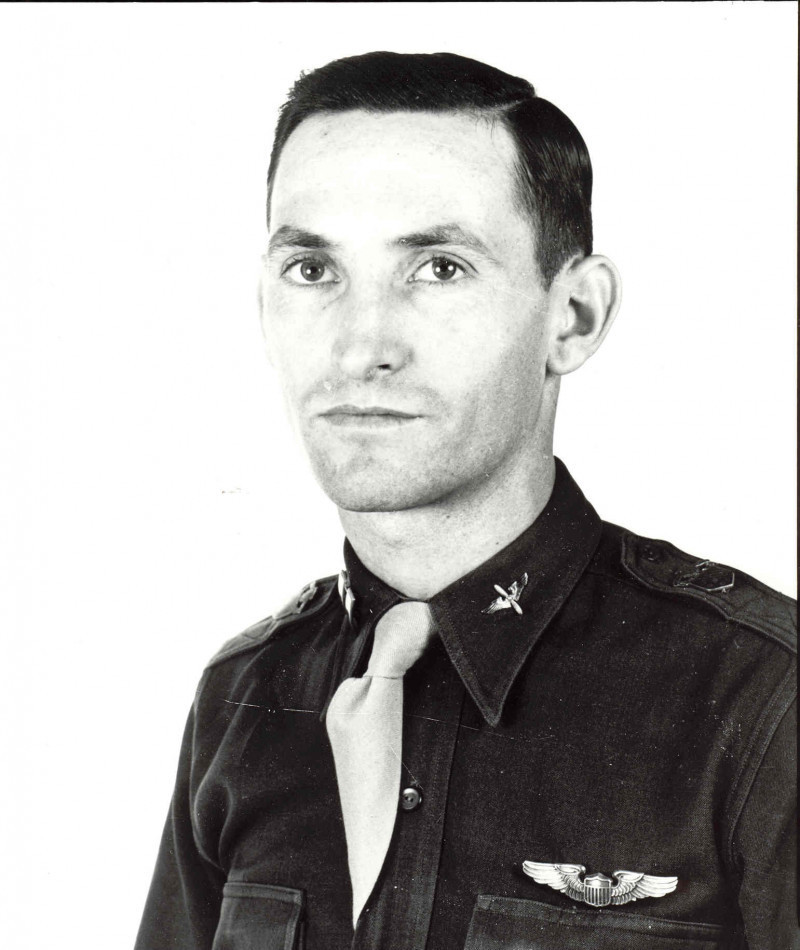
After completing his basic training, George Davis was appointed as an aviation cadet on June 3, 1942, and ordered to Kelly Field, Texas, to start Pre-flight Training. Subsequent training included Primary Flight Training at Jones Field in Bonham, Texas; Basic Flight Training in Waco, Texas; and, finally, Advanced Flight Training at Aloe Field, Texas.
He completed his final flight training and graduated on December 13, 1942, and was commissioned as a second lieutenant in the U.S. Army Air Forces. Second Lieutenant Davis was then assigned to the 312th Bombardment Group, where he was qualified to fly P-40 Warhawk fighters. He spent several months flying training missions before being deployed to the Asiatic-Pacific Theater of Operations in mid-August 1943.
World War Combat
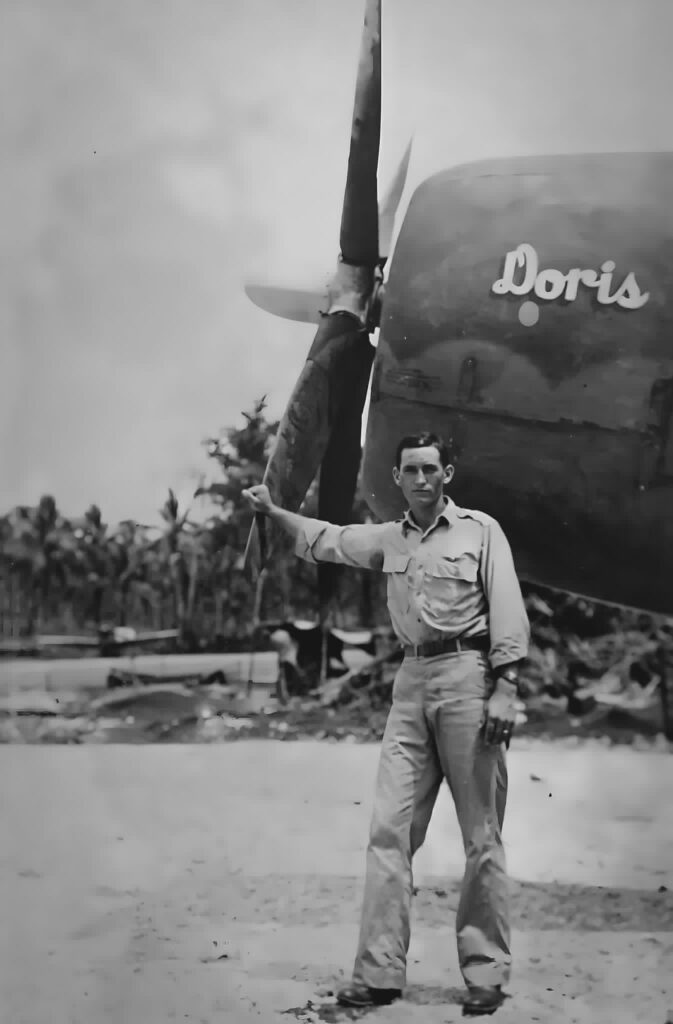
Davis flew to Port Moresby, New Guinea, and was assigned to the 348th Fighter Group, 342nd Fighter Squadron under the umbrella of the Fifth Air Force. The 342nd Fighter Squadron was stationed at Finchhafen, New Guinea. The 348th Fighter Group is unique as it was the first unit to receive and operate the P-47 Thunderbolt fighter in the Pacific shortly before Davis’s arrival. Although fresh to combat operations, Davis was now on the cutting edge of American aviation technology, a far cry from the cloth and wood contraptions that had sparked his imagination as a child.
Davis stayed with the 342nd Fighter Squadron for the entirety of his service in World War II. Over the next two years, the unit conducted fighter-escort missions for bombing runs against the Japanese Empire and continually relocated as the frontlines moved closer to the Japanese homeland. After liberating New Guinea, the unit was relocated to Indonesia in September 1944, then to the Philippines in December, and finally to Okinawa in July 1945. During this time, the unit upgraded from the now-obsolete P-47 Thunderbolt to the new P-51D Mustang in early 1945.
Davis distinguished himself as a superb aviator during this time, advancing from second lieutenant to captain. His tour of duty ended on May 3, 1945, when he was ordered back to the United States to report to Goodfellow Field, San Angelo, Texas. Over the preceding two years, Captain Davis flew 266 combat missions for a total of 705 combat hours and was confirmed to have destroyed seven enemy aircraft, making him an “ace.”
Interwar Years
Captain Davis spent little time at Goodfellow before being reassigned to the 556th Army Air Base at Long Beach, California. Continuing his service despite the rapid reduction in U.S. military forces, he accepted a commission in the U.S. Army on August 24, 1946, and was reduced in rank to first lieutenant. After a brief stint in Memphis, Tennessee, he was attached to the 71st Fighter-Interceptor Squadron at March Field in Riverside, California.
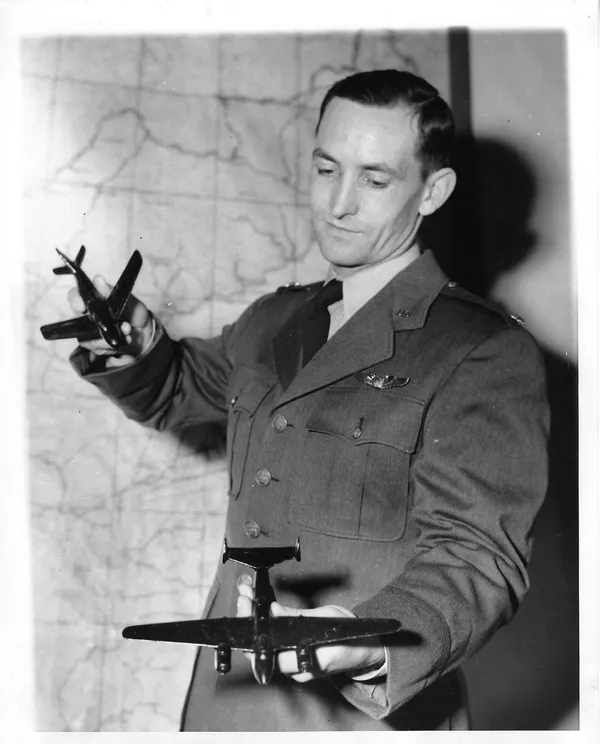
In September 1947, the U.S. Air Force was created as an independent branch of the U.S. Armed Forces, and on June 30, 1948, he again achieved the rank of captain. Noted for his superb flying skills, Captain Davis was selected as one of the early pilots for the Air Force’s jet fighter program. He attended the Air Tactical School at Air University at Tyndall Field (now Tyndall Air Force Base) near Panama City, Florida, where he was rated to fly the new F-86 Sabre.
Returning to California, Davis was known for pushing his Sabres to their limits and for training up-and-coming pilots in best practices. In 1950, he was selected to be one of the few pilots for the “Sabre Dancers” aero-acrobatics team made up of pilots from the 1st Fighter-Interceptor group. In one daring event, Davis and another pilot clipped each other’s wings; had it not been for their incredible flying ability, both would have fatally crashed. The “Sabre Dancers” were disbanded in 1953 when the now-famous U.S. Air Force Thunderbirds acrobatic team was formed.
While stationed with the 71st Fighter-Interceptor Squadron, Davis served as both the flight Commander and Air Inspector. On February 15, 1951, he was promoted to major, finally surpassing the rank he achieved during World War II.
Korean War Combat
In October 1951, Major Davis received orders to deploy to Korea as part of the 4th Fighter-Interceptor Wing. When he informed his wife, Doris, of his orders, she attempted to talk him out of it. In a testament to his character, he simply replied, “I’m no better than anyone else. They need me. They need experienced men, and I’m going.”
After arriving at Kimpo Air Base in Korea, he remained with the wing headquarters until November 9, when he was assigned to the 334th Fighter-Interceptor Squadron, a subordinate unit. He assumed command of the unit the next day.
Major Davis wasted no time in entering combat, and by November 26, he had already downed two MiG-15s with one probable. On November 30, Davis performed the vaunted “Hat Trick”, which to pilots means shooting down three enemy aircraft in one mission. With those three confirmed, Major Davis became a jet “ace” and cemented his place in Air Force history as one of only seven pilots to become “aces” in both World War II and Korea.
Major Davis would down several more aircraft through December, bringing his total to 12 and making him the top “ace” in the Korean War at the time. Also of note, Major Davis never flew a mission that resulted in a downed aircraft, without having downed at least two.
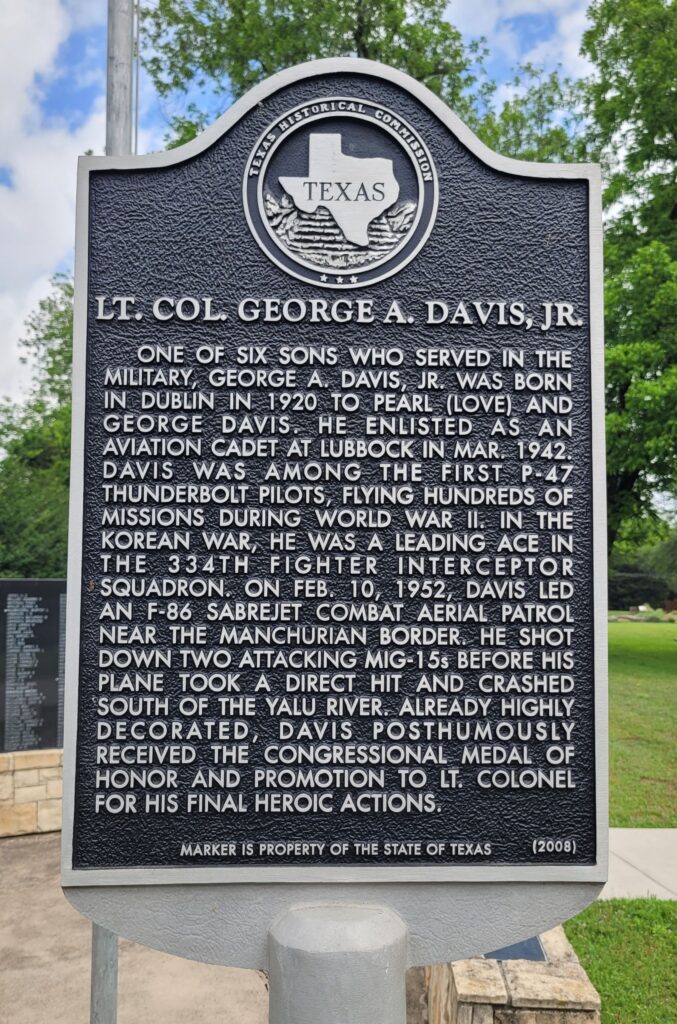
On February 10, 1952, Major Davis flew his fifty-eighth combat mission in Korea. During this mission, Major Davis would sacrifice himself against a numerically superior enemy force to allow friendly fighter-bombers to complete their mission. While leading a formation of four F-86 Sabrejets on an aerial patrol near the Manchurian border, a flight of 12 enemy MiG-15 fighters was spotted flying toward the area where friendly fighter-bombers were conducting raids. Disregarding his own numbers, Davis led a dive into the enemy formation, immediately downing one. Now under fire from the remaining 11, he quickly downed a second. Coming out of the dive, Major Davis elected to slow down and engage an additional enemy aircraft rather than speeding away to regroup. While attacking the third enemy fighter, he was hit by direct fire, lost control, and crashed into a mountain south of the Yalu River.
Major Davis’s bold action sufficiently disrupted the enemy operations long enough to allow the friendly fighter-bombers to complete their raid and escape to safety. For his actions, Major Davis was posthumously promoted to the rank of lieutenant colonel and awarded the Medal of Honor.
Commemoration
On May 14, 1954, George Davis was awarded the Medal of Honor. Doris, his wife, accepted the medal on his behalf. His citation concludes with the statement: “Maj. Davis, by his indomitable fighting spirit, heroic aggressiveness, and superb courage in engaging the enemy against formidable odds exemplified valor at its highest.”
Major Davis left behind his wife, Doris, and three children: Mary Margaret, George, and Charles. Along with his success in combat, he left a legacy as a loving husband and father. Doris never remarried and later said in a 2000 interview with the Lone Star Gazette that “I have never met any man that I could admire as much as him, no one has ever been able to fill that bill.”
George A. Davis’s remains have never been recovered, and his name is inscribed in the Courts of the Missing on the Honolulu Memorial in Honolulu, Hawai‘i. His family placed a memorial marker in the City of Lubbock Cemetery in Lubbock, Texas.
Bibliography
Primary Sources
“Brownfield American Legion Post Honors Veterans.” Lubbock Avalanche-Journal [Lubbock, Texas], March 25, 1953. Newspapers.com (8594753).
California. Riverside County. 1950 U.S. Census. Digital Images. https://ancestry.com.
Davis, Chuck. Email interview. November 3, 2025.
Davis Family Photographs. 1940–1952. Courtesy of Chuck Davis.
George Andrew Davis Jr. World War II Draft Cards Young Men, 1940–1947. Digital Images. https://ancestry.com.
George Andrew Davis, Individual Deceased Personnel File, Department of the Air Force, National Archives and Records Administration – St. Louis.
George Andrew Davis, Individual Deceased Personnel File, Department of the Army, National Archives and Records Administration – St. Louis.
George Andrew Davis, Official Military Personnel File, Department of the Air Force, National Archives and Records Administration – St. Louis.
George Andrew Davis, Jr. Texas, U.S., Birth Certificates 1903-1932. Digital Images. https://ancestry.com.
George Andrew Davis, Jr. U.S. Select Military Registers, 1862–1985. Digital Images. https://ancestry.com.
“Mrs. McLlroy Learns About Radiation.” The Westerner World [Lubbock, Texas], March 10, 1961.
“Need for Civil Defense in Area Stressed.” Lubbock Evening Journal [Lubbock, Texas], June 26, 1952. Newspapers.com (6010699).
[Onlookers observe as CG-4A gliders are towed into the air at South Plains Army Airfield in Lubbock during World War II]. Photograph. c.1942-1945. Silent Wings Museum. https://ci.lubbock.tx.us/departments/silent-wings-museum/a-legacy-remembered.
“Petition calls for return of Dublin 2-time war ace.” The Dublin Citizen [Dublin, Texas], November 20, 2024. https://www.dublincitizen.com/news/petition-calls-return-dublin-2-time-war-ace.
“Students Warned to Contact Draft Board.” Lubbock Evening Journal [Lubbock, Texas], June 24, 1952. Newspapers.com (6009115).
Texas. Bailey County. 1940 U.S. Census. Digital Images. https://ancestry.com.
Texas. Donley County. 1930 U.S. Census. Digital Images. https://ancestry.com.
Texas. Donley County. 1940 U.S. Census. Digital Images. https://ancestry.com.
Texas. Erath County. 1920 U.S. Census. Digital Images. https://ancestry.com.
“Tips Offered on Building Fallout Shelters.” Lubbock Avalanche-Journal, October 15, 1959. Newspapers.com (48378448).
Villa, Dylan. “Initiative looks to bring back local veteran’s remains back to Lubbock.” KCBD, November 7, 2024. https://www.kcbd.com/2024/11/07/initiative-looks-bring-local-veterans-remains-back-lubbock/.
Secondary Sources
Alexander, Thomas E. Wings of Change. Texas A&M University Press, 2014.
“Caprock Chronicles: Lubbock celebrated the end of World War II 75 years ago.” Lubbock Avalanche-Journal [Lubbock, Texas], August 8, 2020. https://www.lubbockonline.com/story/news/local/2020/08/08/caprock-chronicles-lubbock-celebrated-end-of-world-war-ii-75-years-ago/42533229/
Cleaver, Thomas McKelvey. MiG Alley: The US Air Force in Korea, 1950–53. Osprey Publishing, 2019.
Fleming, Elvis E. Texas’ Last Frontier: A New History of Cochran County. Cochran County Historical Commission, 2001.
Gambe, Steven. “Reese Air Force Base.” Handbook of Texas Online, Texas State Historical Association. Accessed February 6, 2026. https://www.tshaonline.org/handbook/entries/reese-air-force-base.
“George Andrew Davis.” Veterans Legacy Memorial, National Cemetery Administration. Accessed February 24, 2026. https://www.vlm.cem.va.gov/GeorgeAndrewDavis/2171A.
“George Andrew Davis Jr.” American Battle Monuments Commission. Accessed November 1, 2025. https://weremember.abmc.gov/s?q=davis&criteria=cemetery=Honolulu%20Memorial~unit_ss=%22334th%20FTR%20INTCP%20Squadron%22&type=0&v=G.
“George Andrew Davis, Jr.” Congressional Medal of Honor Society. Accessed November 10, 2025. https://www.cmohs.org/recipients/george-a-davis.
Graves, Lawrence. “Lubbock, TX.” Handbook of Texas Online, Texas State Historical Association. Accessed February 6, 2026. https://www.tshaonline.org/handbook/entries/lubbock-tx.
Kestner, Laura. “In Memory of a Hero.” Lone Star Gazette [Dublin, TX], May 5, 2001.
“Korean War Veterans Memorial.” Texas State Preservation Board. Accessed December 24, 2025. https://tspb.texas.gov/prop/tcg/tcg-monuments/15-korean-war-veterans/index.html.
“Land Commissioner Buckingham Urges U.S. Department of State and U.S. Department of Defense to Help Bring Home Remains of War Hero Who Served in World War II and Korea.” Texas General Land Office. Updated December 19, 2024. Accessed February 24, 2026. https://www.glo.texas.gov/about-glo/press-releases/land-commissioner-buckingham-urges-us-department-state-and-us-department.
Lange, Katie. “Medal of Honor Monday: Air Force Maj. George Andrew Davis Jr.” U.S. Department of War News, January 27, 2020. https://www.war.gov/News/Feature-Stories/story/Article/2074577/medal-of-honor-monday-air-force-maj-george-andrew-davis-jr/.
Leatherwood, Art. “Davis, George Andrew, Jr.” Handbook of Texas Online, Texas State Historical Association. Accessed November 10, 2025. https://www.tshaonline.org/handbook/entries/davis-george-andrew-jr.
“LTC George Andrew Davis Jr.” Find a Grave. Updated May 24, 2009. Accessed February 24, 2026. https://www.findagrave.com/memorial/37469816/george-andrew-davis.
“LTC George Andrew ‘Curly’ Davis Jr.” Find a Grave. Updated June 2, 2000. Accessed February 24, 2026. https://www.findagrave.com/memorial/9678/george-andrew-davis.
“Lt. Col. George A. Davis, Jr.” The Historical Marker Database. Accessed February 24, 2026. https://www.hmdb.org/m.asp?m=246265.
“Lt. Col. George A. Davis Jr.” Military Hall of Honor. Accessed February 6, 2026. https://militaryhallofhonor.com/honoree-record.php?id=87.
“Lt. Col. George A. Davis Jr.” National Museum of the United States Air Force. Accessed January 4, 2026. https://www.nationalmuseum.af.mil/Visit/Museum-Exhibits/Fact-Sheets/Display/Article/196353/lt-col-george-a-davis-jr/.
“Lt. Col. George Andrew Davis, Jr.” Defense POW/MIA Accounting Agency. Accessed January 4, 2026. https://dpaa-mil.sites.crmforce.mil/dpaaProfile?id=a0Jt000000HUdo8EAD.
Oliver, William E. The Inner Seven: The History of Seven Unique American Combat “Aces” of World War II and Korea. Turner Publishing Company, 1999.
This profile was researched and created through the Researching Silent Heroes program, sponsored by the American Battle Monuments Commission.