

Sergeant George Elias Addison
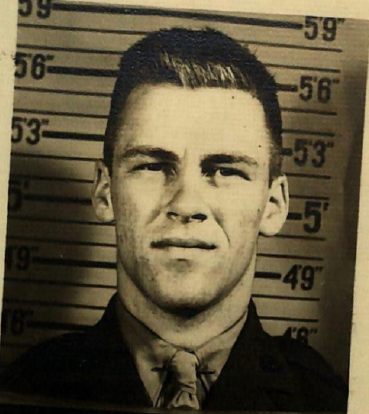
- Unit: 2nd Marine Division
- Date of Birth: October 29, 1924
- Entered the Military: April 22, 1943
- Date of Death: May 19, 2019
- Hometown: Red Oak and Le Mars, Iowa
- Place of Death: Des Moines, Iowa
- Award(s): Asiatic-Pacific Award with one star, World War II Victory Medal, Presidential Unit Citation
- Cemetery: Wall 6, A17. Iowa Veterans Cemetery, Adel, Iowa
Mentored by Ms. Cheryl Smith
Johnston High School
2025/2026
Early Life
George Elias Addison was born on October 24, 1924, in Oakland, Iowa. He was the third son of Edward Leroy Addison, born on May 20, 1903, and Helen Charlotte Addison, who was born circa 1903. Edward only attended school until eighth grade, and he married Helen on June 6, 1921. George’s father was a truck driver for the Rendering Works, and his mother was a housewife. Their firstborn was Edward Addison Jr., who died in childbirth in 1921; the second was Max Wendell Addison, born in 1923.
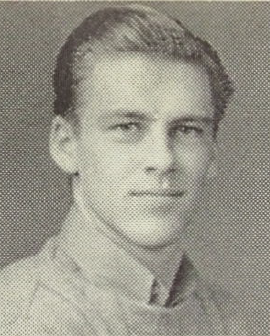
George Addison’s elementary school was a two-room schoolhouse on the southern edge of Council Bluffs, Iowa. He attended Red Oak High School and was a member of the Future Farmers of America Club.
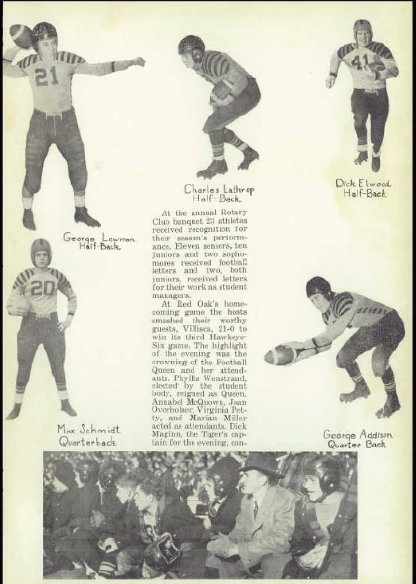
Addison was an active member of his school’s sports teams. He was a letter-winning quarterback for the Hawkeye Six Champions football team in 1942. Under his leadership, the 1942 Tigers won eight games and lost one, outscoring their opponents 236 to 40. They were the first team in school history to win a sole-possession conference grid crown in the Hawkeye Six. He was also a member of the track team. His track team competed at the Drake Relays in 1941. Addison was part of the two-mile relay team, finishing in an impressive 9:01.5.

Homefront
Red Oak
Red Oak, Iowa, is a small town in southwest Iowa. Despite the town’s small size, community members came together to contribute what they could to the war effort. Red Oak had scrap drives for guns and weapons during the war.
Red Oak’s biggest contribution to the war effort was almost certainly growing food for the troops. The production value of Iowa’s farms went from approximately $560 million in 1940 to $1.2 billion in 1945. Red Oak also had a mandatory nightly blackout to prevent being seen in case of a German attack.
Red Oak lost more of its sons, per capita, than any other community in the United States during the war. They lost more than fifty from a community of 5,763. A ship was named SS Red Oak Victory in their honor. It was commissioned in 1944 and served as an auxiliary cargo ship until approximately 1968, becoming one of the last surviving World War II Victory ships.
Prisoners of War
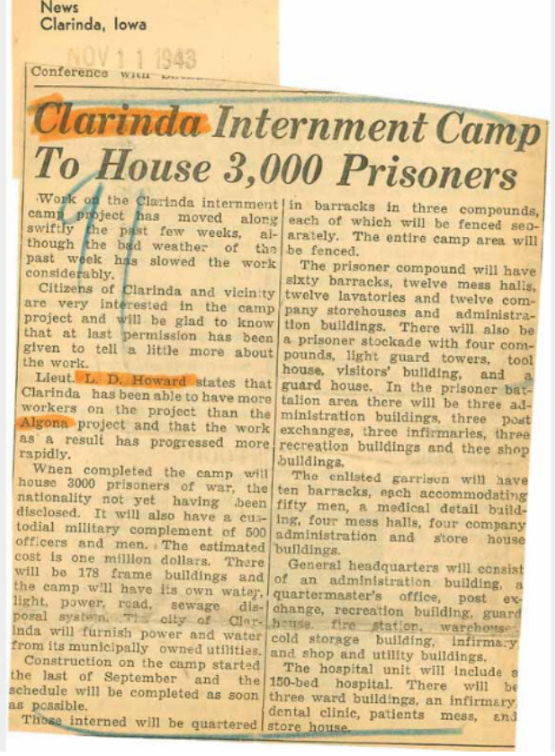
A few thousand Axis Prisoners of War (POWs) worked on farms in nearby Clarinda, Iowa. 250 Italian POWS assisted Iowa farmers with chores like shocking oats (harvested oats are stood upright in piles called shocks), detasseling hybrid corn (taking tassels off of corn), or with other farm tasks that they learned quickly. In 1943, some of the prisoners had been away from home for as long as six years, and had been in the United States for six months. One guard mentioned there was little risk of any danger since the prisoners were happy, well-fed, and better off in America than they had been in Italy.
Iowa’s Impact
Iowa residents rationed products such as sugar, eggs, and butter during the war. The war ended the depression in Iowa. Factories turned out planes, ships, and ammunition. Many factories, including the Army Ordnance Plant near Burlington, a converted John Deere Factory near Ankeny, and the Solar Aircraft factory in Des Moines, among others, made planes, ships, and ammunition for the war.
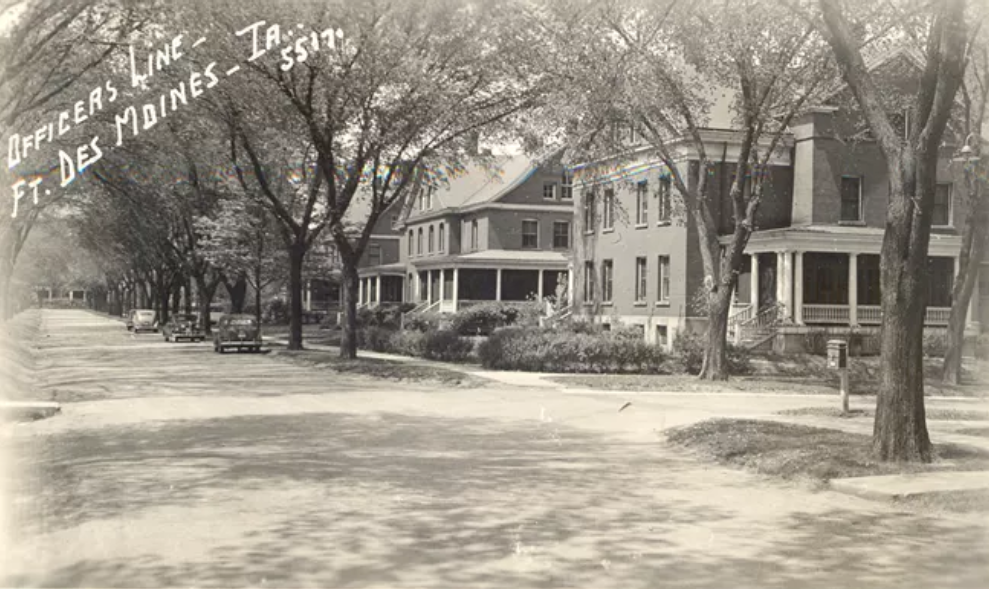
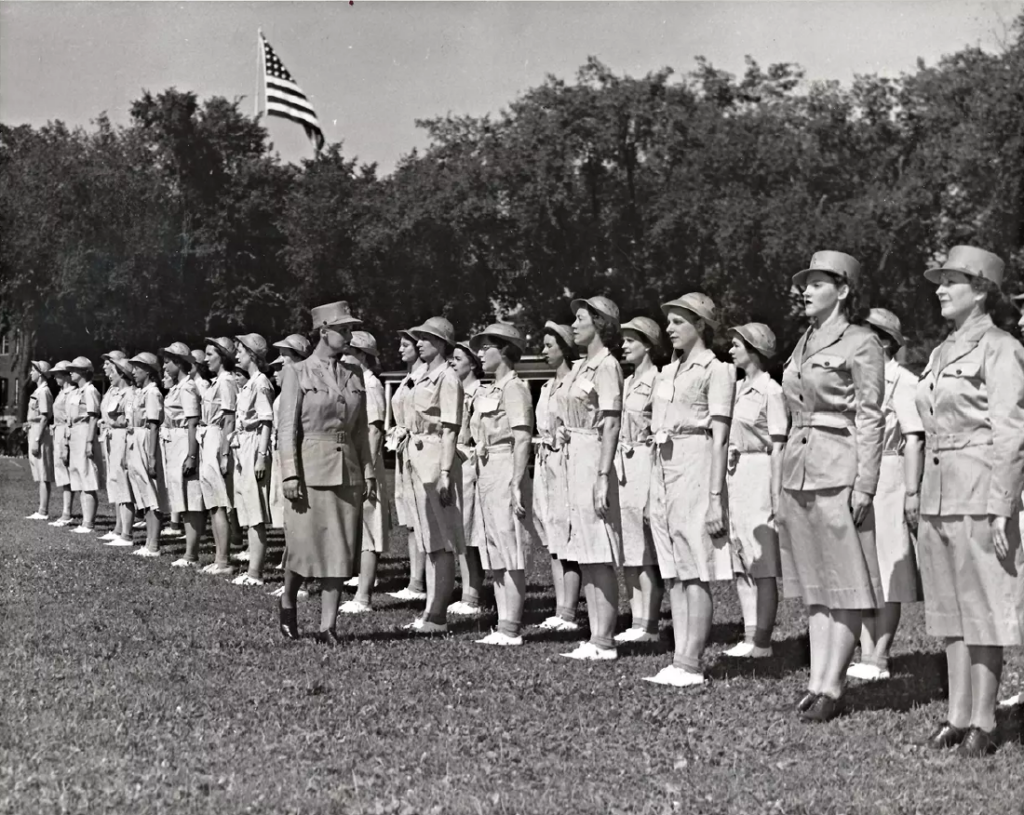
Farmers could once again grow larger crops to feed the troops overseas, and millions of others found jobs supporting the war effort. The Women’s Army Auxiliary Corps, the Women’s Army Corps, and Black officers were trained at Fort Des Moines, approximately two hours away from Red Oak.
Military Experience
World War II
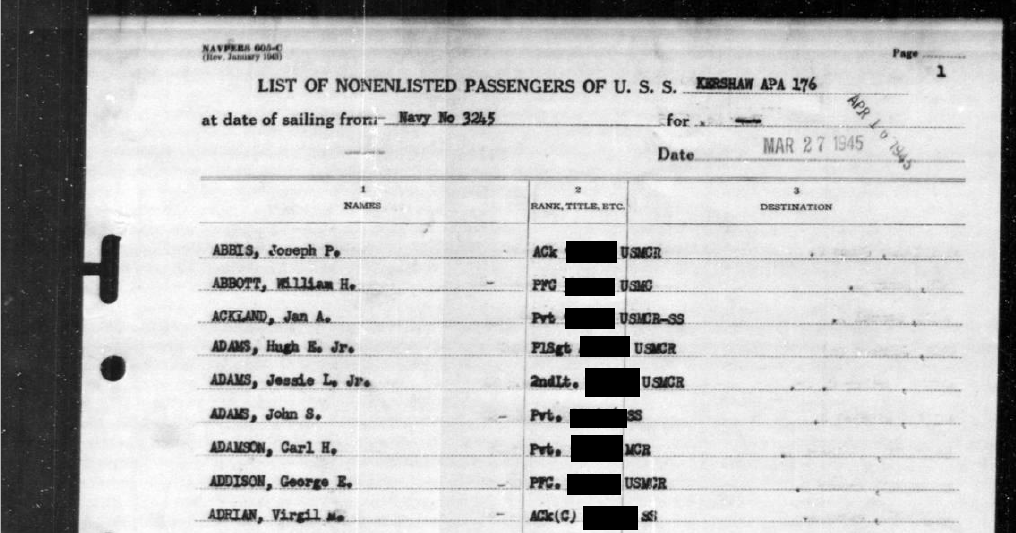
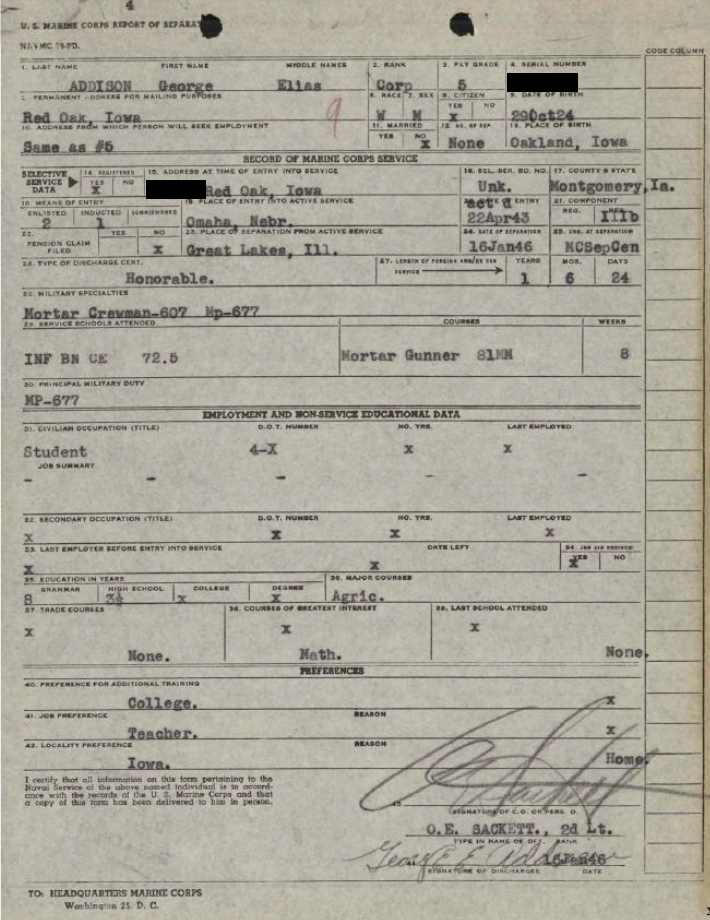
After George Addison graduated from high school, he enlisted in the Marine Corps on April 22, 1943. He went to basic training in Mare Island, California, and departed from the United States on May 31, 1944. He was a member of the Military Police Company of the 2nd Marine Division and was sent to the Marianas Islands.
Saipan and Tinian
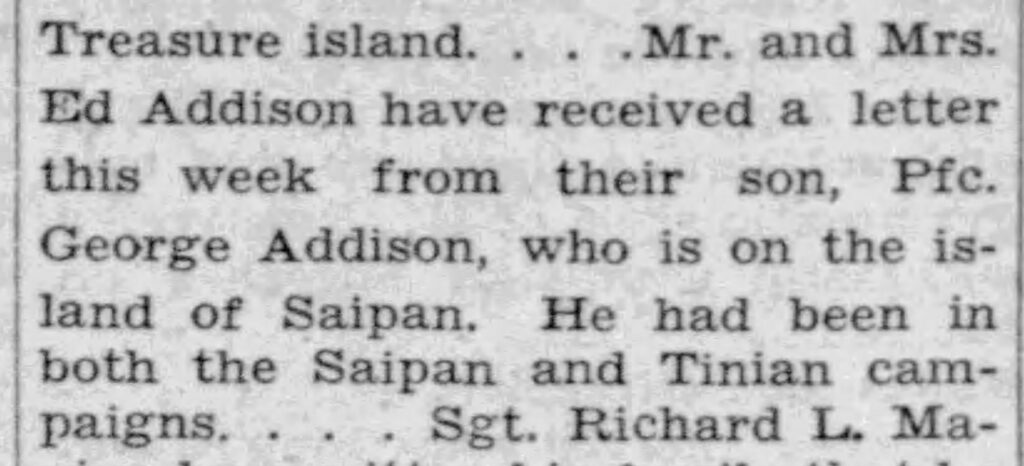
Addison joined the 2nd Marine Division at the Sea of Saipan. The 2nd Marines faked a diversionary landing on June 15, 1944, in the Tanapag area. They then operated in support of the main landing force. On July 2, the regiment attacked Garapan and took the town within two days. From July 6 to July 11, the Marines continued to advance, and Saipan was declared secure on July 9.
On July 24, the 2nd Marines faked another landing, this time off of Tinian Town. The next day, the regiment landed and advanced rapidly. Tinian was declared secured on August 1. The 2nd Marines then returned to Saipan and stayed there for the next seven months while training.
Okinawa
Elements of the 2nd Marines helped the Tenth U.S. Army in the invasion of Okinawa. While it is unclear what he was doing, Addison was among these Marines. Afterward, the 2nd Marines returned to Saipan to train and prepare for an invasion of the Japanese mainland.
Occupation of Japan
After the dropping of the atomic bombs, Addison was in Nagasaki, Kyushu Island, Japan, working as a military police officer walking the streets of what was left of the town. He had taken a ten-week course on basic spoken Japanese in December 1944, which gave him the ability to talk with Japanese civilians and locate the whereabouts of other civilians who had not surrendered. On December 8, 1945, Addison left Japan on USS Sarasota and arrived in San Diego, California, on December 24, 1945.
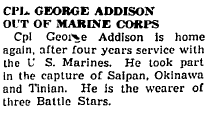
Addison was awarded the Presidential Unit Citation for heroic accomplishments while serving in temporary duty with the Fourth Marine Division in the Marianas Islands. He was also awarded the Asiatic-Pacific Award with 1 star and the World War II Victory Medal. He was discharged on January 16, 1946, in Great Lakes, Illinois. His rank at the end of World War II was corporal.
Interwar Years
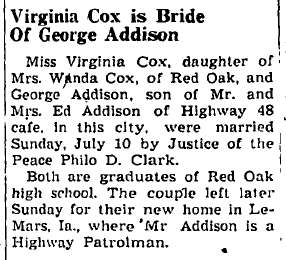
After returning home from World War II, Addison joined the U.S. Marine Corps Reserve and the Iowa Highway Patrol in 1947 and was stationed in LeMars, Iowa. While there, he met Virginia Cox, and the two were wed on July 10, 1949.
Korean War
Addison was called up to serve in Korea. However, the Iowa Highway Patrol wrote a letter posted on September 11, 1950, asking to defer his deployment to Korea, citing the challenges their department would face without him:
This man is a member of the Iowa Highway Safety Patrol, stationed in LeMars, Iowa . . . If a total war should develop with Russia, we feel there would be a great need to have a well-trained peace officer group ready to help prevent and hold down sabotage that probably will be committed or attempted by Communists in this country . . . We are now short 5 men due to the fact that our reserve list is depleted. Even at full strength, we do not have enough men, as it is quite generally agreed that we need at least 100 more men. Should we lose a considerable number of men, our value in an emergency would be lessened . . . We have also found that on the average, it takes a new man about 2 years to develop into a competent officer – that is, one who can handle any situation that comes along. For the above reasons, we respectfully request that you give deferment for the consideration of the aforementioned man.
Addison was deferred for approximately one month, until he reported for active duty on October 26, 1950. During this time, he lived in Laguna Beach, California, and was an amphibious vehicle mechanic. He wanted to be a commissioned officer and wrote a statement on why he believed he should be commissioned:
I believe that I am qualified for a commission in the Marine Corps because of several reasons. I have a high school education plus two years of college. I have been and still am a member of the Iowa Highway Safety Patrol. Since my discharge from the Corps in January of 1946, I have had ample opportunity to make acquaintances with many different people. It is through these various acquaintances that I have come to know people and their temperaments, and know that I can get along with any one of them. The financial aspect is not to be overlooked. I can well afford any extra money that goes with it.
In reality, it all boils down to the same reasons that a man changes jobs in civilian life.
A. Want of a change of environment.
B. Chance to better my position.
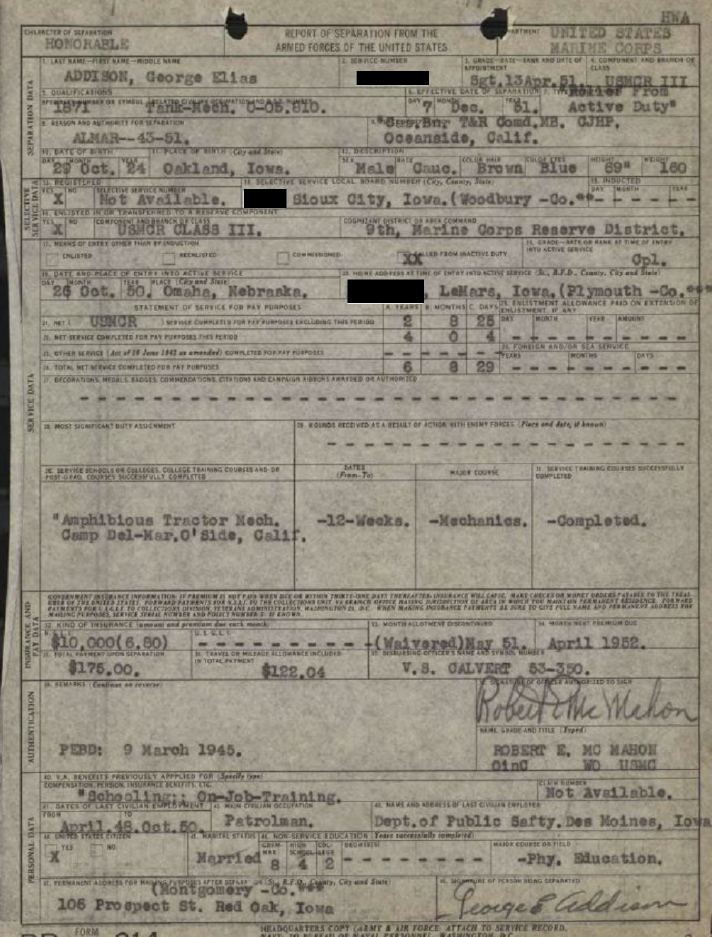
He was recommended by the majority of his superiors for appointment to the rank of second lieutenant, but was ultimately deemed unqualified for educational reasons. On December 7, 1951, he was released from active duty. His rank at the end of the Korean War was sergeant.
Veteran Experience
After George Addison was discharged from the Korean War, he returned to Iowa with his wife and resumed his work as a Highway Patrolman. He “did accident investigation, traffic control, court procedures, made arrest[s]. Did general duties of State Highway Patrolman.”
Their first child, Mark, was born in 1953, and their second, Sandra, in 1960. In 1962, Addison was promoted to sergeant in the Highway Patrol and oversaw District 14 at Ottumwa, Iowa.
Following Mr. Addison’s retirement from the Highway Patrol in 1980, he worked other jobs, one for Guardian Photo from Mason City as a contract courier and the other for the Wapello County Veterans Affairs office.


Commemoration
In August 2016, George and Virginia Addison moved to Homestead Assisted Living in Osceola. Mr. Addison was preceded in death by his daughter, who died in 2014, and his wife, who died in 2018.
George Addison passed away on May 19, 2019, in EveryStep Hospice Kavanagh House in Des Moines, Iowa. He was 94 years old, and he is inurned at wall 6, A17, Iowa Veterans Cemetery, in Adel, Iowa.
Mr. Addison was an inspiration to many people in his community, and he surely had a profound impact on their lives.


Bibliography
Primary Sources
Addison Family Photographs, 1924-2019. Courtesy of James Porter.
Addison Family Records, 1921. Courtesy of Travis Addison.
“Addison Reports he’s well on Saipan.” Red Oak Express [Red Oak, Iowa], September 7, 1944. https://redoak.advantage-preservation.com/viewer/?k=george%20addison%20reports%20he&i=f&d=01051942-12311950&m=between&ord=k1&fn=red_oak_express_usa_iowa_red_oak_19440907_english_8&df=1&dt=10.
“Born To–.” Le Mars Globe-Post [LeMars, Iowa], May 28, 1953. Newspapers.com (32023977).
“Clarinda Camp to Be ’activated’ on December 15th — Army.” World War II Iowa Press Clippings, University of Iowa (190265). https://digital.lib.uiowa.edu/node/192065.
“Clarinda Internment Camp to House 3,000 Prisoners.” World War II Iowa Press Clippings, University of Iowa (730461). https://digital.lib.uiowa.edu/node/730461.
Clifton, C. C. “Iowa’s Biggest Farm–10 Whole Sections” Des Moines Register [Des Moines, Iowa], July 25, 1943. Newspapers.com (2098424239).
“Coach to Take 10 to Clarinda Meet on Friday Night.” The Red Oak Express [Red Oak, Iowa], May 1, 1941. https://redoak.advantage-preservation.com/viewer/?k=%22george%20addison%22&i=f&d=01011940-12311989&m=between&ord=k1&fn=red_oak_express_usa_iowa_red_oak_19410501_english_5&df=51&dt=60.
“Cpl. George Addison Out of Marine Corps.” The Red Oak Express [Red Oak, Iowa], January 24, 1946. https://redoak.advantage-preservation.com/viewer/?k=%22george%20addison%22&i=f&d=01011940-12311989&m=between&ord=k1&fn=red_oak_express_usa_iowa_red_oak_19460124_english_6&df=1&dt=10.
Foughty Personal Records. 1955-2011. Courtesy of Vern Foughty.
Foughty, Vern. Interview with the author. December 15, 2025.
George Elias Addison. BIRLS Death File, 1850-2020. Digital Images. https://ancestryclassroom.com.
George Elias Addison. Birth Record. Digital Images. https://ancestryclassroom.com.
George Elias Addison. DD-214, Department of the Navy. National Archives and Records Administration – St. Louis.
George Elias Addison. Iowa, U.S., County Marriage Records, 1880-1949. Digital Images. https://ancestryclassroom.com.
George Elias Addison. Iowa, U.S., WWII Bonus Case File, 1947–1954. Digital Images. http://ancestryclassroom.com.
George Elias Addison. Official Military Personnel File, Department of the Navy. National Archives and Records Administration – St. Louis.
George Elias Addison. Report of Separation, Department of the Navy. National Archives and Records Administration – St. Louis.
George Elias Addison. U.S. Korean War Era Draft Registration Cards, 1948-1959. https://fold3.com.
George Elias Addison. World War II Draft Cards Young Men, 1940-1947. Digital Images. https://ancestryclassroom.com.
George Elias Addison. World War II Navy Muster Rolls, 1938-1949. Digital Images. https://ancestryclassroom.com.
“How the Nation’s Wars Proved Iowa’s Mettle and Spurred Her Growth.”Des Moines Register [Des Moines, Iowa], June 23, 1946. Newspapers.com (2102648180).
Iowa. Pottawattamie County. 1930 U.S. Census. Digital Images. http://ancestryclassroom.com.
Iowa. Montgomery County. 1940 U.S. Census. Digital Images. http://ancestryclassroom.com.
“Miss Cox Wed.” The Daily Nonpareil [Council Bluffs, Iowa], July 12, 1949. Newspapers.com (960669105).
“Patrol Loses Second Man in Reserve Call.” Iowa City Press-Citizen, October 24, 1950.
“Prisoners of War Shock Montgomery County Oats.” World War II Iowa Press Clippings, University of Iowa (81257). https://digital.lib.uiowa.edu/node/81257.
“Red Oak Contributions Help Buy Wheat for Food Train.” World War II Iowa Press Clippings, University of Iowa (676019). https://digital.lib.uiowa.edu/node/676019.
“Red Oak High School Tigers Hawkeye Six Champions–1942 Season.” The Red Oak Express [Red Oak, Iowa], November 19, 1942. https://redoak.advantage-preservation.com/viewer/?k=%22george%20addison%22&i=f&d=01011940-12311989&m=between&ord=k1&fn=red_oak_express_usa_iowa_red_oak_19421119_english_1&df=61&dt=70.
Red Oak High School Yearbook. Red Oak Public Schools, 1942.
“Smaller Sugar Ration Likely.” Des Moines Register [Des Moines, Iowa], January 27, 1942. Newspapers.com (2098376459).
“Suicide Bridge.”Le Mars Globe-Post [LeMars, Iowa], August 10, 1953. Newspapers.com (32024830).
“Suspend, Demote Veteran State Highway Patrolman.” Iowa City Press-Citizen [Iowa City, Iowa], April 13, 1962. Newspapers.com (262294977).
“To Accelerate Return Axis War Prisoners Nebraska Beet and Potato Growers Meanwhile Plan on Using POW Labor.” The Stockman’s Journal [Omaha, Nebraska], September 13, 1945. Newspapers.com (866293681).
“To Spend Holidays in the East.” Estherville Daily News [Estherville, Iowa], December 13, 1951. Newspapers.com (671639).
“Virginia Cox is Bride of George Addison.” The Red Oak Express [Red Oak, Iowa], July 11, 1949. https://redoak.advantage-preservation.com/viewer/?k=%22george%20addison%22&i=f&d=01011940-12311989&m=between&ord=k1&fn=red_oak_express_usa_iowa_red_oak_19490711_english_3&df=1&dt=10.
“WAC School at Fort D.M. Ends; It Trained 65,076.” Des Moines Register [Des Moines, Iowa], December 16, 1945. Newspapers.com (2098310020).
“What Prisoner of War Is Wearing.” World War II Iowa Press Clippings, University of Iowa (841056). digital.lib.uiowa.edu/node/841056.
Secondary Sources
“2d Marine Regiment.” United States Marine Corps. Last modified 2026. Accessed January 17, 2026. https://www.2ndmarines.marines.mil/History/.
Crawford, Danny J., et al. The 2d Marine Division and its Regiments. History And Museums Division Headquarters, U.S. Marine Corps: 2001. https://www.usmcu.edu/Portals/218/THE%202D%20MARINE%20DIVISION%20AND%20ITS%20REGIMENTS%20%20PCN%2019000319300.pdf.
“Fort Des Moines: A Series of Firsts in Wartime Service.” National Park Service. Last modified March 19, 2025. Accessed November 6, 2025. https://www.nps.gov/articles/000/fort-des-moines-a-series-of-firsts-in-wartime-service.htm.
Gallagher, Robert F. “Chapter 28 – Military Police Duty.” Last modified 2015. Accessed January 9, 2026. https://gallagherstory.com/ww2/chapter28.html.
“George Elias Addison.” Find a Grave. Accessed October 29, 2025. https://www.findagrave.com/memorial/199362503/george-elias-addison.
“George Elias Addison.” Kale Funeral Home. Last modified May 2019. Accessed October 30, 2025. https://www.kalefuneralhome.com/obituaries/George-Elias-Addison?obId=4427259.
“George Elias Addison.” Veterans Legacy Memorial, National Cemetery Administration. Accessed March 31, 2026. https://www.vlm.cem.va.gov/GEORGEELIASADDISON/972e4d.
“The Great Depression Ends.” Iowa Public Television. Last modified 1979. Accessed November 11, 2025. https://www.iowapbs.org/iowapathways/artifact/1615/great-depression-ends.
Guepet, Haley. “The Women’s Army Corps (WAC).” The National WWII Museum. Last modified December 23, 2024. Accessed November 11, 2025. https://www.nationalww2museum.org/war/articles/womens-army-corps-wac-world-war-ii.
“Invasion of Tinian.” National Museum of the U.S. Navy. Last modified 2026. Accessed January 17, 2026. https://www.history.navy.mil/content/history/museums/nmusn/explore/photography/wwii/wwii-pacific/mariana-islands/tinian.html.
“Iowa: Victory at Sea.” Time, March 11, 1966. https://time.com/archive/6834059/iowa-victory-at-sea/
Laurie, Clayton. “Goebbels’s Iowan: Frederick W. Kaltenbach and Nazi Short-Wave Radio Broadcasts to America, 1939-1945.” The Annals of Iowa 53(3), (1994): 219-245. https://doi.org/10.17077/0003-4827.9815.
“Red Oak Victory.” Last modified 2026. Accessed March 18, 2026. https://redoakvictory.us.
Stechkein, Heather. “Workers’ Control and Militancy in an Iowa Labor Movement: The Use of Wildcat Strikes at the Des Moines Firestone Tire and Rubber Company, 1950-1959.” The Annals of Iowa 63(1), (2005): 246-265. https://doi.org/10.17077/0003-4827.10914.
Williamson, Zach. “Red Oak’s sacrifice in WWII remembered 80 years later: More sons lost per capita than any town in the U.S.” CBS 3 News Now, March 7, 2023. https://www.3newsnow.com/news/mission-service/red-oaks-sacrifice-in-wwii-remembered-80-years-later-more-sons-lost-per-capita-than-any-town-in-the-u-s.
“World War II Prisoners of War in Iowa.” Iowa PBS. Accessed November 7, 2025. https://www.iowapbs.org/iowapathways/mypath/2585/world-war-ii-prisoners-war-iowa.
“WWII Seeds of War.” Iowa PBS. Accessed November 6, 2025. https://www.iowapbs.org/iowapathways/mypath/2555/world-war-ii.
This profile was funded by a grant from the United States Department of Veterans Affairs. The opinions, findings, and conclusions stated herein are those of the author and do not necessarily reflect those of the United States Department of Veterans Affairs.