

Private First Class (USMC), Staff Sergeant (USAF) Georgia Marybelle McMahon Rogers
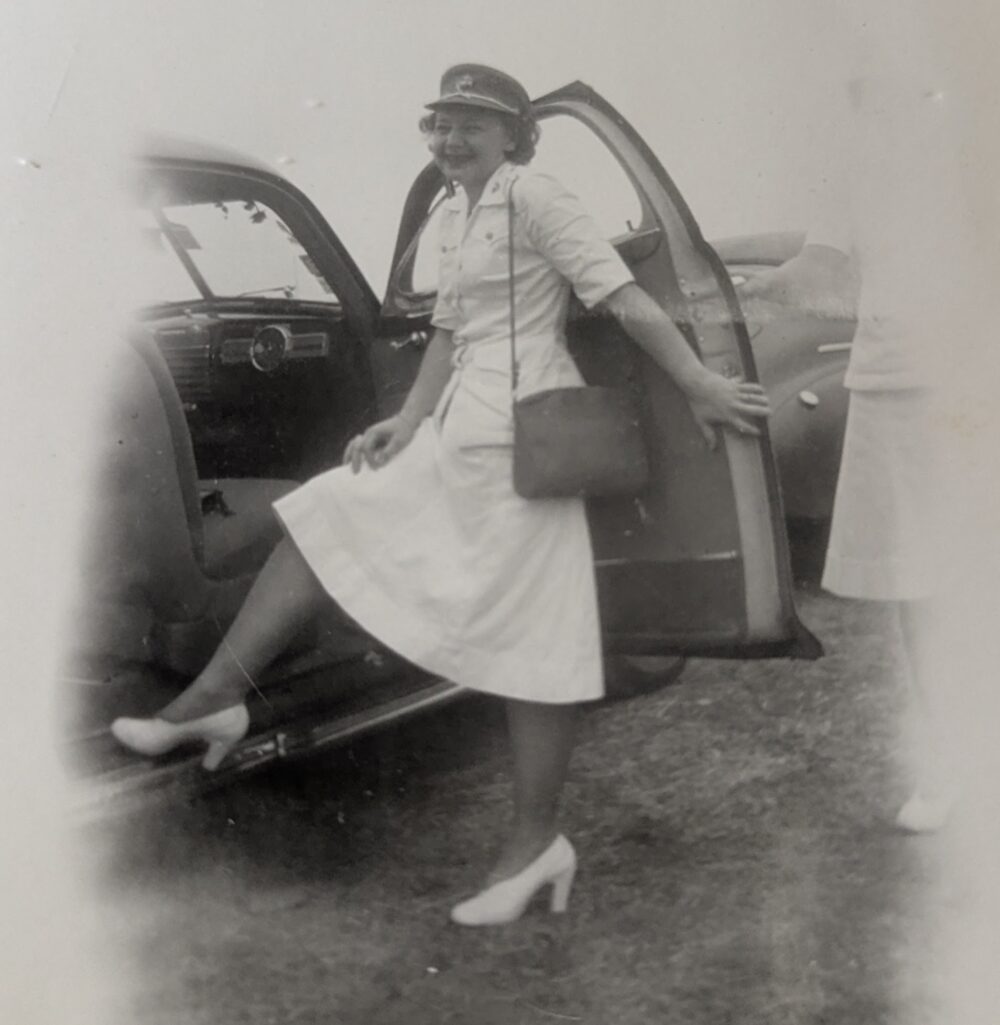
- Unit: Marine Corps Air Depot, Aviation Women’s Reserve Squadron 5
- Date of Birth: January 26, 1924
- Date of Death: December 29, 2003
- Hometown: Lewiston, Idaho
- Place of Death: Wrightstown, New Jersey
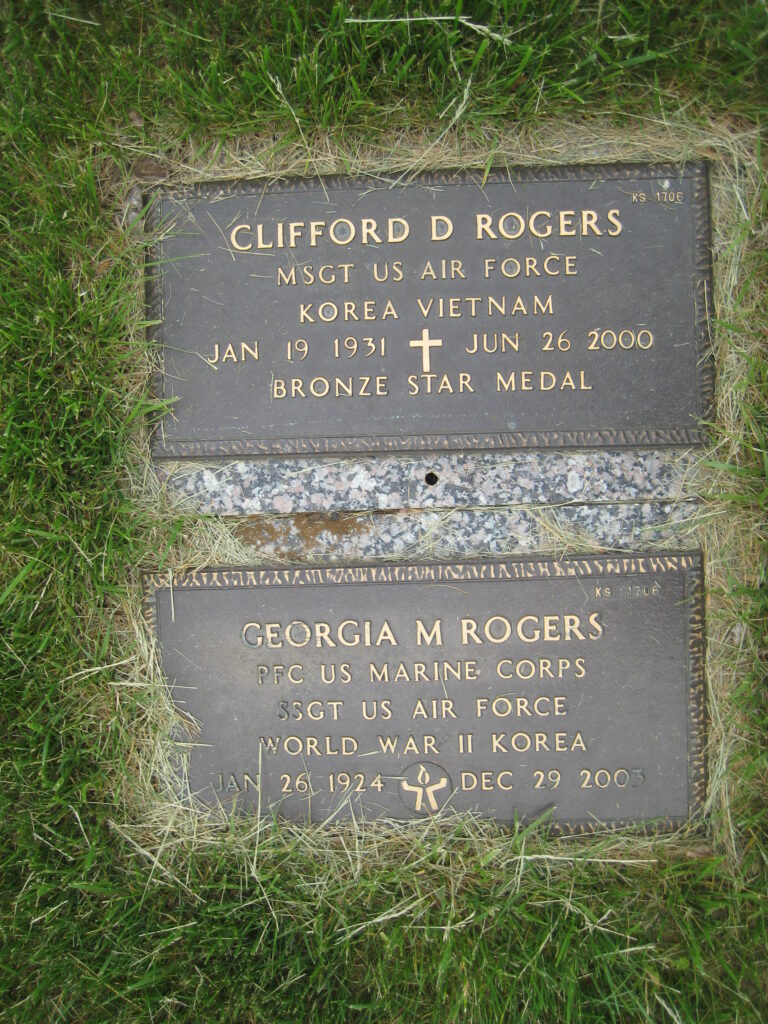
- Cemetery: Section KS, grave 1706. Brigadier General William C. Doyle Memorial Cemetery, Arneytown, New Jersey
Early Life
Georgia Marybelle McMahon was born on January 26, 1924, in Lewiston, Idaho, to Frank McMahon and Belle (Wheeler) McMahon.
The Barlow Brothers Circus
Belle Wheeler’s parents, Sam and Ethel, owned a small family circus called “The Barlow Brothers Circus.” They traveled the same route yearly, by horse, throughout the Midwest. Frank McMahon ran away from home to join the circus, and he met Belle when she was fifteen years old.
During World War I, Georgia’s father, Frank, enlisted in the United States Naval Reserve. He served in both Colorado and Idaho as a storekeeper second class. While serving, Frank married Belle Wheeler on October 18, 1918. After Frank’s discharge on January 28, 1919, the couple created their own circus performing company called McMahon & Wheeler Circus Attractions.
The McMahon & Wheeler Circus
When Georgia was only six weeks old, the couple started bringing her on the road. By two, she made appearances on stage with her father, where he would wow the crowd by balancing her on his head. At five, she performed a solo tumbling act, and at 12, she was doing aerial work. During the school year, Georgia’s parents would leave her with family in various states, while they continued to travel with the circus. At a young age, Georgia developed a love for writing as she corresponded with her family for nine months a year.
Frank passed away on June 1, 1934, when Georgia was only ten years old. At the time of his death, the family lived in Portland, Oregon. By 1938, McMahon’s mother, Belle, had remarried and moved to California. She married Donald Leroy Hammond, another circus performer.
Georginanna
After Georgia graduated from the eighth grade, her mother needed a partner for her circus act. Georgia volunteered for the job. Her mother agreed, fearing she might run away if not allowed to join. As a young woman, she worked as a trapeze artist under the name “Georgianna.” She also did wirewalking, trampoline, rings, web, horizontal bars, and general acrobatics.
When the United States entered World War II, her stepfather, Donald, was drafted into the U.S. Army, and her stepuncle joined the U.S. Navy. A few months before she turned twenty, Georgia decided to enlist as well. She wanted to enlist in the United States Marine Corps Women’s Reserve (USMCWR) because she thought the uniforms were the best. Georgia’s mother did not want to sign the paperwork, but Georgia told her she would forge her mother’s signature if she did not sign.




Homefront
The circus was an important part of the World War II home front as a distraction from wartime austerity. Often full of patriotic undertones, the circus provided a morale boost to spectators. Strict gasoline rationing and train travel restrictions created frequent delays and disruptions for traveling shows. Some shows even reverted to using horses to transport their equipment.
Circuses, large and small, continued throughout the war, recognizing that their performances served an important psychological need for audiences. Circuses also sold war bonds and promoted blood drives during their performances. President Franklin D. Roosevelt, recognizing their importance, actually granted Ringling Brothers and Barnum & Bailey special rail privileges during the war.
The war, however, took a heavy toll on the circus industry. The circus suffered from labor shortages, as experienced performers were called to service. The circus also took a blow after a terrible tent fire on July 6, 1944, in Hartford, Connecticut, at a Ringling Brothers and Barnum & Bailey event. One hundred sixty-seven people were killed in the fire, and safety standards were scrutinized.
Smaller traveling circuses, such as the one McMahon was part of, operated on much thinner margins than the larger companies, so wartime strains hurt them even more. Yet, these smaller outfits kept touring, bringing the circus to communities that rarely saw the large national shows. For those who were a part of the circus, it wasn’t just entertainment, but a way of life—a kind of self-contained community.

Military Experience
On April 12, 1944, McMahon graduated from Camp Lejeune, North Carolina. In April 1945, McMahon received a promotion to private first class with the Aviation Women’s Reserve Squadron 5, at the Marine Corps Air Depot in Miramar, California. Standing only 5’ 1” tall, McMahon was randomly chosen to run the obstacle course for the visiting Congressional committee, which was on base to investigate complaints that the women couldn’t do the work. She was in such great shape because of the circus that she performed terrifically on the course. The base leadership “randomly” chose her for every subsequent Congressional review.
McMahon served as a postal clerk, a sales clerk, and in food service with the ambulance service in Oakland, California. As a postal clerk, she would have been responsible for receiving, sorting, and distributing mail, as well as issuing and cashing money orders, and selling stamps and other postal supplies. As a sales clerk, Private McMahon was responsible for taking inventory, keeping stock, and selling merchandise, including, notably, doughnuts she made. She also had to learn to ride horses because her supervisor was worried that alternative transportation would be necessary for deliveries if Japan bombed the area.
After the war, McMahon continued performing with her mother and stepfather in the circus. In addition to her own trapeze act, she also developed a double trapeze act with her mother. Additionally, she and her stepfather developed a horizontal bar routine. This continued for four years, until McMahon decided she needed a change. She decided to earn her GED and completed her coursework at the Merritt School in Oakland, California, in only six months.
McMahon then enrolled at San Francisco City College, where she earned an associate’s degree in journalism. She then got her first “real” job as managing editor for a Jewish newspaper, the Jewish Star.
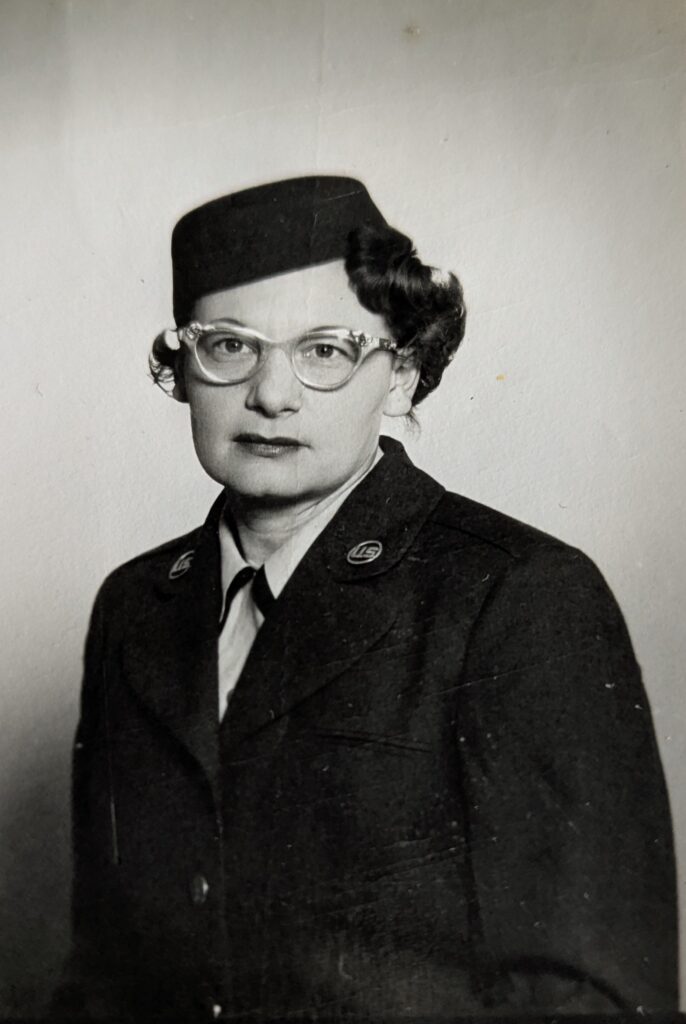
When the Korean War broke out, McMahon decided to join the U.S. Air Force, where she eventually rose to the rank of staff sergeant. She worked as a writer for Air Force publications, doing publicity while stationed in St. Louis. Two years later, this squadron disbanded, and McMahon applied to become a flight attendant on Air Force transport aircraft, where she traveled the world, including Saudi Arabia, Morocco, Rio de Janeiro, and Wake Island. McMahon recalled that she never got to see many of these places, only becoming acquainted with the airfields themselves.
While serving, Airman First Class Clifford Davis Rogers was assigned to be her assistant. The two were married on February 28, 1959. Two days after their wedding, Clifford was promoted to staff sergeant. Georgia stated later, “Everyone swore that he was promoted because he married his boss.” McMahon, now Rogers, left the military in 1959, a few months away from giving birth to her first child, Erin. Rogers said, “Erin arrived with a lot of flying time.”


Veteran Experience
Erin’s arrival brought on a new role for Georgia—housewife. She also decided to use the GI bill to attend classes through the University of Maryland’s mail correspondence program. In 1961, Georgia and Clifford had a son, also named Clifford. In 1962, Clifford was transferred to Offutt Air Force Base in Nebraska. While there, Georgia earned her bachelor’s degree in journalism and photography with honors from the University of Nebraska. At her graduation in 1964, at the age of 39, she was cheered on by her husband, Clifford, her two children, her mother, and her stepfather.
Professionally, Rogers worked for the American Red Cross in Omaha, Nebraska, from 1963 to 1968 as a photojournalist. Her job involved traveling around the area, photographing, and promoting the Red Cross’s work. This was particularly challenging during the year her husband served overseas in Vietnam, as she was still expected to travel with two small children.
When Clifford returned from Vietnam, the couple moved to New Jersey, where Georgia became a founder of the state equine program. She eventually served as secretary to the State Equine Advisory Board and chief of the Bureau of Equine Programs for the New Jersey Department of Agriculture until she retired at age 65. She was also the associate editor of the Equine Industry News.
In her retirement, Georgia became heavily involved in the Bordentown Community Players as an actor. She also wrote many freelance pieces for various publications, including Threads magazine.
Clifford Rogers predeceased Georgia on June 26, 2000.


Commemoration
Georgia Marybelle McMahon Rogers passed away on December 29, 2003, in Wrightstown, New Jersey. She is buried alongside her husband Clifford at the Brigadier General William C. Doyle Memorial Cemetery, Arneytown, New Jersey. The couple left behind two children and grandchildren.
Bibliography
Primary Sources
California. Contra Costa County. 1950 U.S. Census. Digital Images. https://ancestryclassroom.com/.
California. Los Angeles County. 1930 U.S. Census. Digital Images. https://ancestryclassroom.com/.
California. Santa Barbara County. 1940 U.S. Census. Digital Images. https://ancestryclassroom.com/.
“Corcoran Special Correspondence.” The Hanford Sentinel [Hanford, California], February 19, 1938. Newspapers.com (559024285).
“Ex-aerialist Retires From State Post.” Asbury Park Press [Asbury Park, New Jersey], February 5, 1989. Newspapers.com (144188106).
“Excitement Too Much for Circus Performer.” Omaha World-Herald [Omaha, Nebraska], June 2, 1964. Newspapers.com (885005250).
Ferretti, Fred. “In Jersey, Horses Are Big Business.” New York Times [New York, New York], July 9, 1972. https://www.nytimes.com/1972/07/09/archives/in-jersey-horses-are-big-business-for-jersey-horses-are-a-big.html.
Frank C. McMahon. U.S., Headstone Applications for Military Veterans, 1861-1985. Digital Images. https://ancestryclassroom.com/.
Frank Charles McMahon. Oregon, U.S., State Deaths, 1864-1971. Digital Images. https://ancestryclassroom.com/.
Frank McMahon. Oregon, U.S., Death Index, 1898-2008. Digital Images. https://ancestryclassroom.com/.
Georgia M. McMahon. California, U.S., Marriage Index, 1949-1959. Digital Images. https://ancestryclassroom.com/.
Georgia M. McMahon. U.S., Marine Corps Muster Rolls, 1798-1958. Digital Images. https://ancestryclassroom.com/.
Georgia Marybelle McMahon. Idaho, U.S., Birth Records, 1861-1924, Stillbirth Index, 1872-1974. Digital Images. https://ancestryclassroom.com/.
“Georgia Rogers Receives Degree Following Circus, Service Careers.” The South Omaha Sun [Omaha, Nebraska], June 11, 1964. Newspapers.com (741412234).
“Girl on the Flying Trapeze.” Omaha World-Herald [Omaha, Nebraska], August 27, 1967. Newspapers.com (885199986).
“McMahon-Wheeler.” The Sacramento Bee [Sacramento, California], October 19, 1918. Newspapers.com (616743508).
Minnesota. Nicollet County. 1930 U.S. Census. Digital Images. https://ancestryclassroom.com/.
Rogers, Erin. Telephone interview with the author. November 9, 2025.
Rogers Family Records, 1924-2003. Courtesy of Erin Rogers.
Washington. Whitman County. 1920 U.S. Census. Digital Images. https://ancestryclassroom.com/.
Secondary Sources
“056 – Postal Clerk.” The Military Yearbook Project. Accessed May 12, 2026. https://militaryyearbookproject.org/references/old-mos-codes/wwii-era/usmc-wwii-codes/postal/056-postal-cler.
“373 – Sales Clerk.” The Military Yearbook Project. Accessed May 12, 2026. https://militaryyearbookproject.org/references/old-mos-codes/wwii-era/usmc-wwii-codes/miscellaneous/373-sales-clerk.
“Frank Charles McMahon.” Find a Grave. Accessed November 1, 2025. https://www.findagrave.com/memorial/169149929/frank-charles-mcmahon.
Friedman, Jordan. “How a Deadly Circus Fire on the ‘Day the Clowns Cried’ Traumatized a Community—and Led to Lasting Safety Reforms.” Smithsonian Magazine, July 3, 2025. https://www.smithsonianmag.com/history/how-a-deadly-circus-fire-on-the-day-the-clowns-cried-traumatized-a-community-and-led-to-lasting-safety-reforms-180986888/.
“Georgia M. Rogers.” Veterans Legacy Memorial. Accessed May 13, 2026. https://www.vlm.cem.va.gov/GEORGIAMROGERS/6de6de.
“Georgia Marybelle McMahon Rogers.” Find a Grave. Accessed November 1, 2025. https://www.findagrave.com/memorial/21569893/georgia-marybelle-rogers.
“Ringling Bros. and Barnum & Bailey Combined Shows.” Encyclopedia Britannica. Accessed May 12, 2026. https://www.britannica.com/topic/Ringling-Bros-and-Barnum-and-Bailey-Combined-Shows/Ringling-Bros-and-Barnum-Bailey-Combined-Shows.
This profile was funded by a grant from the United States Department of Veterans Affairs. The opinions, findings, and conclusions stated herein are those of the author and do not necessarily reflect those of the United States Department of Veterans Affairs.