
Corporal Gerard “Jerry” Francis Jansen
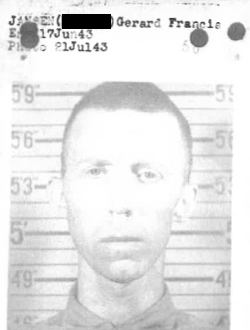
- Unit: 2nd Marine Division, 17th Antiaircraft Artillery Battalion
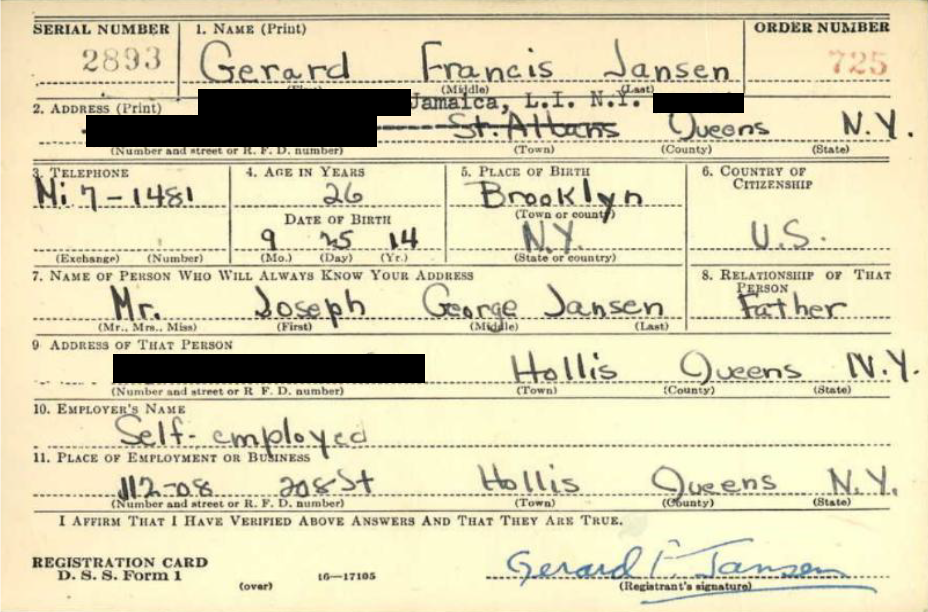
- Date of Birth: September 25, 1914
- Entered the Military: June 17, 1943
- Date of Death: January 17, 2007
- Hometown: New York, New York
- Place of Death: New York, New York
- Award(s): Bronze Service Star, American Campaign Ribbon
- Cemetery: Section AI, Row D, Site 169. Long Island National Cemetery, Farmingdale, New York
Mentored by Mr. Patrick D. Sprinkle
New York City Lab School for Collaborative Studies
2025/2026
Early Life
Before World War II, Gerard Francis Jansen, nicknamed “Jerry,” lived a typical working-class life in New York City. He was born in Brooklyn on September 25, 1914, to Joseph George Jansen, a house painter from the Netherlands, and Irene O’Meara Jansen, whose parents hailed from Tipperary, Ireland. He grew up as the oldest of seven children in a large immigrant family.
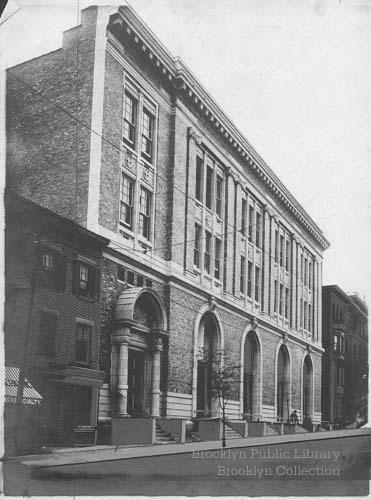
Jansen attended St. James High School, where he was described as a strong student. He did not go to college; instead, he entered the workforce, eventually working as a painter for the New York City Housing Authority while also doing some self-employed work.
In 1938, he married his first wife, Elizabeth. They had two children, Marie and Paul.

Homefront
During World War II, New York was transformed by the demands of total war. The city became a major center of production and mobilization, with factories shifting to produce military uniforms, weapons, and medical supplies. The Brooklyn Navy Yard employed tens of thousands of workers and played a critical role in building and repairing ships for the war effort. At the same time, everyday life changed for civilians as rationing, increased work demands, and a sense of shared national purpose shaped their daily experiences in the city.
New Yorkers actively supported the war effort in a variety of ways. Many citizens volunteered through organizations like the Red Cross or participated in civil defense groups, while others contributed by knitting supplies for soldiers or helping transport military personnel. Victory Gardens became a widespread movement, with hundreds of thousands of gardens producing food to support both families and the war effort. Public events, such as parades and war bond drives, also helped build morale and unity, encouraging people to feel personally connected to the war overseas and to soldiers like Gerard Jansen.
However, the home front was not without challenges and tensions. The war accelerated migration into the city, increasing diversity but also contributing to overcrowding and housing shortages. Women entered the workforce in large numbers, taking on industrial and military-related jobs, though many were pushed out after the war ended. At the same time, racial discrimination and inequality persisted, leading to protests like the Double V campaign and highlighting contradictions between fighting for freedom abroad and inequality at home. Overall, the home front experience shows how World War II reshaped New York City socially, economically, and politically while deeply affecting the lives of its residents.

Military Experience
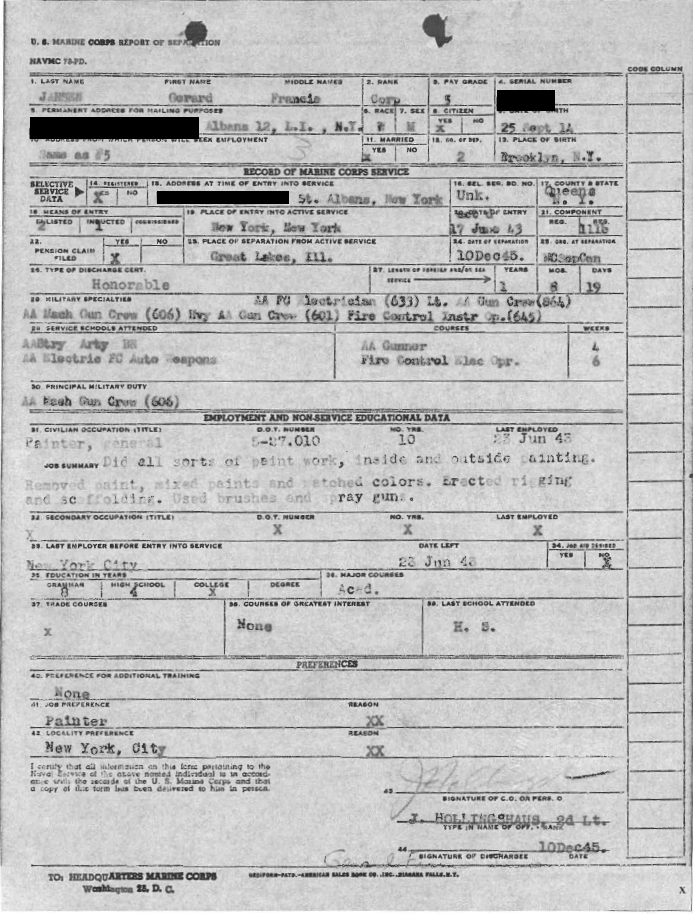
Gerard Jansen enlisted in the United States Marine Corps on June 17, 1943, in New York during the height of World War II. After basic training at Parris Island, South Carolina, he attended the Antiaircraft Artillery School at Camp Davis, North Carolina, where he completed the course in December 1943 and was promoted to corporal (fire control) in January 1944.
His training prepared him to help operate and coordinate anti-aircraft defenses designed to protect important American bases and airfields from enemy aircraft. In August 1944, Jansen departed the United States for the Pacific theater. His personnel record shows that he sailed from San Francisco aboard the transport ship USS Sea Panther on August 19, 1944, heading toward the Pacific war zone.
Jansen served with the 7th Antiaircraft Artillery Battalion, Fleet Marine Force Pacific, which was responsible for defending key American positions from Japanese air attacks. His unit participated in the invasions of Kwajalein, Eniwetok, and Saipan.
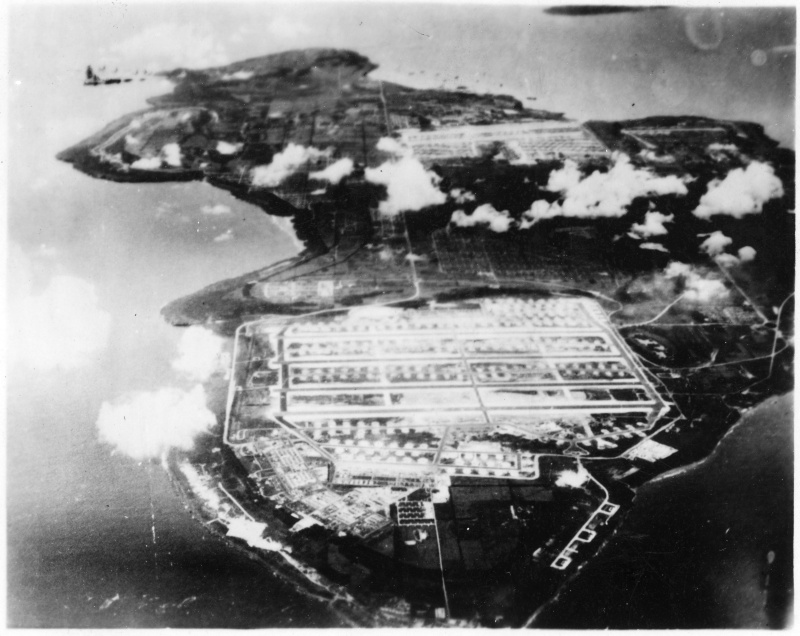
His battalion was stationed on Tinian in the Mariana Islands during the final phase of the war. Tinian was one of the most important bases in the Pacific because it contained the large airfields used by B-29 Superfortress bombers launching missions against Japan. Because of this strategic importance, Japanese forces attempted to bomb the island multiple times, and anti-aircraft units like Jansen’s played a critical role in defending the base and protecting the bombers and crews stationed there. Jansen remained in the Pacific until after the war ended. His unit sailed aboard USS Griggs on November 1, 1945, arriving in San Diego on November 15. He returned to the United States and was honorably discharged on December 10, 1945, after more than two years of service in the Marine Corps. His service defending key Pacific bases helped support the air campaign that ultimately brought World War II to a close.
Veteran Experience
After World War II, Gerard Jansen built a life that blended family, work, public service, and personal passion. Returning to New York City, he resumed his career as a painter. He was a painter and union leader in the Painters Union. He worked for the New York Housing Authority from 1939 to 1942 and from 1945 to 1951. He drew the attention of the McCarthy hearings, refusing to name other union members for their associations with the Communist Party. His marriage to Elizabeth ended, but he remarried Lillian Stein, a labor activist, in 1950.
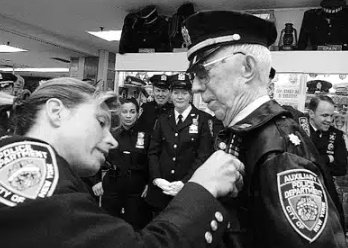
In addition to his work with the union, Jansen continued his commitment to serving others as an auxiliary police officer. In 2005, he was honored for 33 years of volunteer service to the Sixth Precinct’s Auxiliary Police Unit.
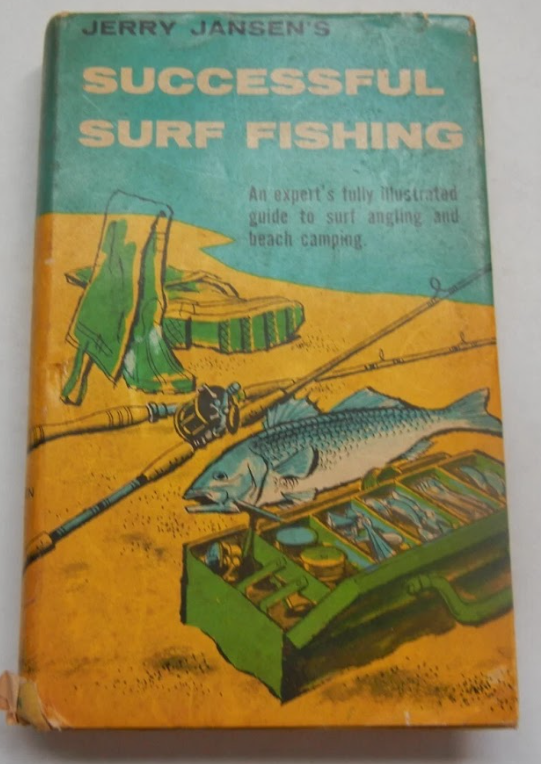
At the same time, he developed a deep love for boating and surf fishing, spending much of his free time along the water. This passion eventually led him to write Successful Surf Fishing, a guide that shared his expertise with fellow anglers. He was inducted into the Martha’s Vineyard Fishing Derby Hall of Fame.
Jansen’s love of boating and surf fishing became one of the most important parts of his identity in the decades after the war. Whether fishing from the shore or out on a boat, he developed a deep understanding of the craft, building both skill and reputation within the fishing community.
Commemoration
Gerard Francis “Jerry” Jansen passed away in 2007 at the age of 92 and is buried at Long Island National Cemetery. His life story reflects the lasting impact of ordinary individuals who answered the call to serve and continued to contribute meaningfully long after the war ended.

Bibliography
Primary Sources
Aerial view of Tinian Island. Photograph. 1945. National Archives and Records Administration (NAID: 348729885).
Gerard Jansen. New York, New York, U.S., Birth Index, 1910–1965. Digital Images. https://ancestry.com.
Gerard Jensen. New York, New York, U.S., Marriage License Indexes, 1907-2018. Digital Images. https://ancestry.com.
Gerard Jansen. World War II Draft Cards Young Men, 1940–1947. Digital Images. https://ancestry.com.
Gerard Francis Jansen, Official Military Personnel File. Department of the Navy. National Archives and Records Administration – St. Louis.
Gerard Francis Jansen, Report of Separation. Department of the Navy. National Archives and Records Administration – St. Louis.
Gerard Francis Jansen. World War II Navy Muster Rolls, 1938–1949. Digital Images. https://ancestry.com.
Navy Yard, Brooklyn, New York. Photograph. 1918. Naval History and Heritage Command (NH 117794). https://www.history.navy.mil/content/history/nhhc/our-collections/photography/numerical-list-of-images/nhhc-series/nh-series/NH-117000/NH-117794.html.
New York. Brooklyn County. 1920 U.S. Census. Digital Images. https://ancestry.com.
New York. Nassau County. 1950 U. S. Federal Census. Digital Images. https://ancestry.com.
New York. Queens County. 1930 U.S. Census. Digital Images. https://ancestry.com.
New York State. New York City. 1915 New York State Census. Digital Images. https://ancestry.com.
St. James Diocesan High School. Photograph. 1931. Brooklyn Visual Heritage Project (SCH 0585). http://www.brooklynvisualheritage.org/home/st-james-diocesan-high-school-0.html.
Secondary Sources
“1940–1945 NYC: Wartime Transformation, Cultural Resilience & The Global Impact.” History 101 NYC. Last modified October 4, 2014. Accessed March 24, 2026. https://www.history101.nyc/nyc-history-from-1940-to-1945.
Amateau, Albert. “Jerry Jansen, 92, ex-Marine and auxiliary policeman.” amNY, January 30, 2007. https://www.amny.com/news/jerry-jansen-92-ex-marine-and-auxiliary-policeman/.
Amateau, Albert. “Reeling in the years, ex-Marine takes a look back.” amNY, November 3, 2004. https://www.amny.com/news/the-villager-endorses-john-kerry-for-president-14/.
Amateau, Albert. “Serving as an auxiliary officer was a badge of honor.” amNY, April 12, 2005. https://www.amny.com/news/serving-as-an-auxiliary-officer-was-a-badge-of-honor/.
Bower, Melanie. “World War II Brought 400,000 Victory Gardens to Manhattan.” Edible Manhattan, September 2, 2010. https://ediblemanhattan.com/food-for-thought/manhattans-victory-gardens/.
Building Brooklyn: Women on the Waterfront. Podcast. October 6, 2021. Brooklyn Public Library. https://www.bklynlibrary.org/podcasts/building-brooklyn-women.
“The Civilian War Effort in New York City During World War I and World War II.” Blog. February 3, 2015. Museum of the City of New York. https://blog.mcny.org/2015/02/03/the-civilian-war-effort-in-new-york-city-during-world-war-i-and-world-war-ii/.
Dean, Clarence. “Navy Yard, Fort Jay, and Army Terminal Played Major Roles in Nation’s History.” The New York Times [New York, New York], November 20, 1964. https://www.nytimes.com/1964/11/20/archives/navy-yard-fort-jay-and-army-terminal-played-major-roles-in-nations.html.
“The Garment Industry’s History of Retooling During National Crises.” Blog. April 27, 2020. New York Historical. https://www.nyhistory.org/blogs/the-garment-industrys-history-of-retooling-during-national-crises.
“Gerard F. Jansen.” Find a Grave. Updated October 8, 2010. Accessed March 24, 2026. https://www.findagrave.com/memorial/59762754/gerard-f-jansen.
“Gerard F. Jansen.” Veterans Legacy Memorial, National Cemetery Administration. Accessed March 24, 2026. https://www.vlm.cem.va.gov/GERARDFJANSEN/69C872F.
Goldstein, Richard. “Answers About World War II in New York, Part I, II, and III.” The New York Times [New York, New York], October 4, 2010. https://archive.nytimes.com/cityroom.blogs.nytimes.com/2010/10/04/answers-about-world-war-ii-in-new-york-part-iii/.
Goldstein, Richard. Helluva Town: The Story of New York City During World War II. Free Press, 2013.
“Hall of Fame.” Martha’s Vineyard Striped Bass and Bluefish Derby. Updated May 8, 2024. Accessed March 24, 2026. https://mvderby.com/history/halloffame.php.
Roberts, Sam. “New York 1945; The War Was Ending. Times Square Exploded. Change Was Coming.” The New York Times [New York, New York], July 30, 1995. https://www.nytimes.com/1995/07/30/nyregion/new-york-1945-the-war-was-ending-times-square-exploded-change-was-coming.html.
Rothstein, Edward. “Over There, and Here as Well.” The New York Times [New York, NY], October 4, 2012. https://www.nytimes.com/2012/10/05/arts/design/wwii-nyc-at-the-new-york-historical-society.html.
This profile was funded by a grant from the United States Department of Veterans Affairs. The opinions, findings, and conclusions stated herein are those of the author and do not necessarily reflect those of the United States Department of Veterans Affairs.