

Captain Gordon Harris Gray
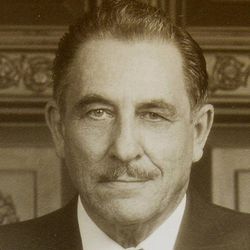
- Unit: Signal Battalion
- Date of Birth: March 22, 1924
- Entered the Military: December 11, 1942
- Date of Death: April 12, 2012
- Hometown: Lamesa, Texas
- Place of Death: Abilene, Texas
- Award(s): American Campaign Medal, World War II Victory Medal
- Cemetery: Section A2, Row A, Site 8. Texas State Veterans Cemetery, Abilene, Texas
Mentored by Mrs. Heather McCormick, Mr. Kelly Moore, Ms. Judy Garza
Snyder Junior High School, Snyder, Texas
2025/2026
Early Life
Gordon Harris Gray was born in Lamesa, Texas, on March 22, 1924, to Bainard and Jessie Gray. The family later moved to Socorro, New Mexico. He was the oldest of five children: three brothers, Glen, Bainard, Jr., and Roger, and the youngest, a sister named Kathleen.
Gray graduated from high school at age 16. While attending Colorado College, he worked as a truck driver and then as a telegraph operator for the Santa Fe Railroad.


Homefront
During World War II, Gray’s hometown of Lamesa, Texas, was a vibrant agricultural community deeply affected by the war. Dawson County, where Lamesa is located, earned national recognition for providing more men per capita to the armed services than any other county in Texas. This high enlistment rate was a point of pride for residents and reflected a strong sense of civic duty.
The local economy was built on cotton, dairy, and oil. Wartime demands led to significant changes in daily life. Families participated in rationing programs, limiting their use of gasoline, sugar, coffee, and other goods to support the troops overseas. The community took part in frequent war bond drives and was regularly reminded of its patriotic responsibilities through newspaper campaigns and advertisements.
One of the most significant changes in Lamesa was the establishment of Lamesa Field in 1942. The airfield was constructed to provide glider pilot training, bringing soldiers and new families to the area. This influx of people shifted the population and required schools, businesses, and farms to adapt quickly. Despite a shortage of farm laborers due to so many young men leaving for service, the community worked together to meet or exceed every agricultural quota set by the government.
Social life in Lamesa also reflected the times. Community and service organizations became even more important as families supported one another through uncertainty and loss. The war effort brought people together, whether through drives for scrap metal and rubber, organizing care packages, or supporting local soldiers and their families. Even children were encouraged to help by collecting materials and participating in school campaigns.
Rationing and shortages meant families learned to make do with less, grow their own food, and share resources. Yet, the spirit of cooperation and resilience helped Lamesa thrive during the war years, ensuring that the community not only endured but also contributed significantly to the national war effort.


Military Experience
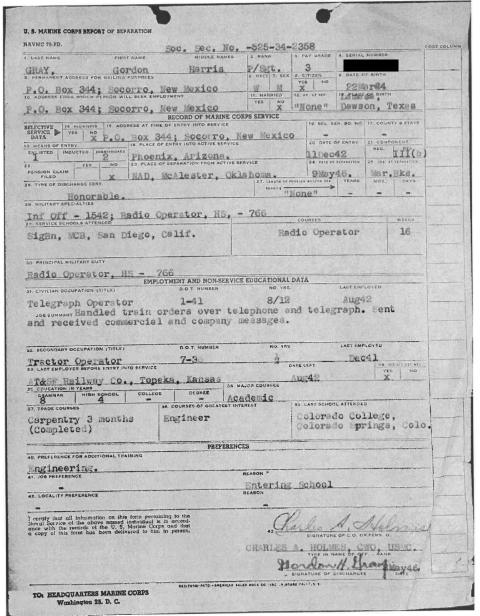
Gordon Harris Gray enlisted in the United States Marine Corps on December 11, 1942, in Phoenix, Arizona. He began his training at the 6th Recruit Battalion in San Diego, California, and was subsequently assigned to several units, including Headquarters Company Signal Battalion and multiple Radio Companies in San Diego. His specialized training included time at Arizona State Teachers College in Flagstaff and Colorado College in Colorado Springs through the Navy V-12 program, which was designed to quickly prepare officers for wartime service.
Gray’s official roles in the Marines included High Speed Radio Operator (HS-766) and Infantry Officer (1542). His daily duties focused on sending and receiving critical messages using Morse code, which required great speed and accuracy to ensure clear communication for Marine operations and training. He earned several promotions during his service: starting as a private, advancing to private first class, then platoon commander, and finally platoon sergeant by September 11, 1945. His last duty station during World War II was in McAlester, Oklahoma. He was awarded the American Campaign Medal and World War II Victory Medal.
According to his family, Gray did not speak much about his military service, and many details remain private or unconfirmed. The family believes that he was involved in covert activities, which may have contributed to his reluctance to discuss his service years. After the declassification law was passed in 1981, Gray expressed anxiety about the potential risks to himself and his family, as some of his missions had taken place in regions where vendettas were possible.
Family stories recount Gray’s participation in a secret mission to Argentina to sabotage a refinery supplying fuel to German boats—a story he later wrote about in his unpublished book, Just Short of War. He also once met the actor Clark Gable during his service, whom he remembered as “a nice guy.”
Gray was discharged from the Marine Corps on May 9, 1946, but was recalled for service again on May 9, 1951, and finally discharged on July 5, 1952.

Veteran Experience
After completing his military service, Gordon Harris Gray settled in Abilene, Texas, where he became a prominent figure in the petroleum industry for over 60 years. Drawing on his degree from the New Mexico School of Mines (now New Mexico Tech) and continuing education in petroleum engineering and geology, Gray worked as a petroleum engineer—a professional responsible for designing and developing methods for extracting oil and gas from deposits below the earth’s surface, as well as finding new ways to extract resources from older wells. This role required a deep understanding of geology, engineering, and project management, and was critical to the growth and success of the oil industry in West Texas.
Gray helped found and lead several successful companies, including McDonald and Gray, Gray Engineering, and Bluebonnet Exploration. Through these ventures, he contributed to the technological advancement and economic vitality of the regional oil and gas sector. He also worked in consulting and arbitration, bringing his expertise to resolve complex industry disputes.
His professional and social life in Abilene was rich and active. Gray was a proud and dedicated member and officer of the Abilene Petroleum Club, a key organization for leaders in the local energy sector. He was also a member of MENSA, reflecting his exceptional intellect and curiosity; family recollections emphasize his photographic memory and passion for reading. He often participated in studies on memory and aging and was known for his ability to recall facts and sources precisely, sometimes even citing the exact book and page.
Beyond his work, Gray enjoyed bridge and was a master of the game, even knowing Charles Goren, a bridge legend. He was also known as a wine connoisseur, enjoyed painting, and maintained his gentlemanly demeanor throughout his life. Even after a stroke led him to assisted living, staff remembered him for his kindness, sharp dress, and generosity.

Commemoration
Gordon Harris Gray died on April 12, 2012, in Abilene, Texas. He was inurned at the Texas State Veterans Cemetery. His family, professional colleagues, and friends remember him as a gentleman, a devoted worker, and a man of intellect and integrity.


Bibliography
Primary Sources
California. Los Angeles County. 1930 U.S. Census. Digital Images. https://ancestryclassroom.com.
Gordon Harris Gray, Official Military Personnel File, Department of the Navy, National Archives and Records Administration – St. Louis.
Gordon Harris Gray, Report of Separation, Department of the Navy, National Archives and Records Administration – St. Louis
Gordon Harris Gray. Texas, U.S., Birth Index, 1903-1997. Digital Images. https://ancestryclassroom.com.
Gordon H Gray. Texas, U.S., Divorce Index, 1968-2015. Digital Images. https://ancestryclassroom.com.
Gordon H Gray. World War II Draft Cards Young Men, 1940-1947. Digital Images. http://ancestryclassroom.com.
Gray, Lavera. Email interview with daughter-in-law. February 27, 2026.
“How Well Do You Know Your War Bonds?” The Odessa American [Odessa, Texas], March 22, 1943. Newspapers.com (300246368).
“Institutional Users Register Today for Coffee.” The Odessa American [Odessa, Texas], November 23, 1942. Newspapers.com (300290349).
Jane Britain. Texas, U.S., Marriage Index, 1824-2021. Digital Images. https://ancestryclassroom.com.
New Mexico. Socorro County. 1940 U.S. Census. Digital Images. http://ancestryclassroom.com.
“Odessa’s Opinion on Rationing of Gas Given.” The Odessa American [Odessa, Texas] September 11, 1942. Newspapers.com (300281326).
“Ration Stamp Guide.” Lubbock Avalanche-Journal [Lubbock, Texas], December 12, 1943. Newspapers.com (14206834).
“Remember Last December– Bond Day is Monday.” The Odessa American [Odessa, Texas], December 6, 1942. Newspapers.com (300291185).
Texas. Jones County. 1950 U.S. Census. Digital Images. http://ancestryclassroom.com.
“Thursday Will Be ‘A’ Day In Lamesa.” Lubbock Avalanche-Journal [Lubbock, Texas], December 12, 1943. Newspapers.com (14206834).
“To The People of This Community.” The Odessa American [Odessa, Texas], January 19, 1944. Newspapers.com (300246042).
“Total of 2,475 Register for Gas” The Odessa American [Odessa, Texas], November 23, 1942. Newspapers.com (300290349).
“War Board To Tighten Up On Deferements.” Lubbock Avalanche-Journal [Lubbock, Texas], December 12, 1943. Newspapers.com (14206834).
“Why Should I Buy War Bonds?” The Odessa American [Odessa, Texas], March 9, 1943. Newspapers.com (300244946).
Secondary Sources
Davis, Charles G. “Lamesa, Texas: History and Growth of Dawson County’s County Seat.” Texas State Historical Association. Accessed November 26, 2025. https://www.tshaonline.org/handbook/entries/lamesa-tx-dawson-county.
Gelin, Leona M. and Mark Odintz. “Dawson County: History, Geography, and Economy.” Texas State Historical Association. Accessed November 26, 2025. https://www.tshaonline.org/handbook/entries/dawson-county.
“Gordon Harris Gray.” Find a Grave. Accessed October 3, 2025. https://www.findagrave.com/memorial/88941951/gordon-harris-gray.
“Gordon Harris Gray.” Legacy. Accessed November 30, 2025. https://www.legacy.com/us/obituaries/reporternews/name/gordon-gray-obituary?id=13562759.
“Gordon Harris Gray.” Veterans Legacy Memorial, National Cemetery Administration. Accessed May 13, 2026. https://www.vlm.cem.va.gov/GORDONHARRISGRAY/832411.
“Lamesa’s Impact On History.” KCBD News, December 12, 2014. https://www.kcbd.com/story/1363861/lamesas-impact-on-history/.
“Lamesa WWII History.” KCBD News, July 22, 2016. https://www.kcbd.com/story/32509499/lamesa-wwii-history/.
This profile was funded by a grant from the United States Department of Veterans Affairs. The opinions, findings, and conclusions stated herein are those of the author and do not necessarily reflect those of the United States Department of Veterans Affairs.