
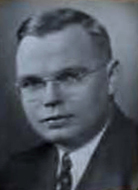
Sergeant Halsey Jenkins Miller
- Unit: Battery B, 285th Field Artillery Observation Battalion
- Service Number: 32561864
- Date of Birth: September 18, 1914
- Entered the Military: October 6, 1942
- Date of Death: December 17, 1944
- Hometown: Nutley, New Jersey
- Place of Death: Malmedy, Belgium
- Award(s): Prisoner of War Medal, Purple Heart
- Cemetery: Plot A, Row 9, Grave 45. Henri-Chapelle American Cemetery, Henri-Chapelle, Belgium
Woodrow Wilson Middle School, Edison, New Jersey
2025/2026
Early Life
Halsey Jenkins Miller was born on September 18, 1914, in East Orange, New Jersey. He was the only child of Mrs. Eva Miller, a school principal in Nutley, and Mr. David Miller, a cashier. The family resided in Nutley, New Jersey, where they were members of Vincent Methodist Church.
Miller attended Nutley schools and graduated from Nutley High School in 1931. In his yearbook, he was voted second place in the Who’s Who for both “Our Bachelor” and “Most Innocent.” His “alias” was “Hossey,” and his “fate” in the Senior Slams was “engineer.” In high school, he met his fiancée, Edith Scharling, who was in his graduating class. They did not announce their engagement until August 27, 1942.
After High School, Miller attended Newark College of Engineering, now known as New Jersey Institute of Technology (NJIT), graduating in 1935. After graduation, he worked as an electrical engineer at the Richardson Scale Company in Clifton, New Jersey.
Miller registered for the draft on October 16, 1940, and enlisted in October 1942, at the age of 28, during the midst of World War II. After induction, he trained at Camp Carson and Camp Hale, both in Colorado.



Homefront
Miller’s hometown was Nutley, New Jersey, a rapidly growing suburban community in the 1920s and 1930s. Nutley experienced a major population boom, growing from about 9,400 residents in 1920 to over 20,500 by 1930, largely due to immigration, especially from Italian families.
Neighborhoods became known for strong community ties, gardening, and cultural traditions. Despite rapid growth during the Jazz Age and the challenges of the Great Depression, Nutley maintained a balance between suburban development and green spaces.
While Nutley itself was not a major weapons producer, it played an important role in the World War II home-front economy through its proximity to nearby industrial centers. In 1929, Hoffmann-La Roche relocated its U.S. operations to Nutley, eventually expanding into a large pharmaceutical complex. During World War II, the plant produced synthetic vitamins and medicinal chemicals, essential for both civilian and military health, making Nutley a contributor to the national war effort.
Nutley was also surrounded by key wartime manufacturers. Nearby Bloomfield housed the Westinghouse Lamp Plant, which produced uranium for early nuclear research, and Delco-Remy (part of General Motors), which manufactured batteries for military vehicles and aircraft. Air Associates’ facilities in Belleville and Lodi supplied aircraft parts under War Department contracts. Together, these industries placed Nutley within a dense and strategically important wartime industrial network.
World War II brought workforce and population shifts to the region as people moved to North Jersey for defense-related jobs. Women entered factories and laboratories in large numbers, taking on roles as assemblers, inspectors, technicians, and clerical workers, reflecting the Rosie the Riveter movement. Women also led volunteer efforts through the Red Cross, church groups, and community organizations.
Minority workers gained greater access to industrial jobs, contributing to long-term social and economic changes, though progress remained uneven.
After the war, returning service members fueled suburban growth and the pursuit of the American dream. Infrastructure projects such as Route 3 and the Garden State Parkway further accelerated development.
Nutley’s proximity to New York City, less than an hour by public transportation, has made it a desirable suburban community and remains one of its most defining features.
Military Experience
Halsey Miller was drafted into the U.S. Army in October 1942. He was classified as 1-A, meaning fully fit for service and eligible for the draft.
Upon entering the Army, he was assigned to the 285th Field Artillery Observation Battalion, Battery B. The battalion’s mission was to locate enemy artillery positions using sound-and-flash ranging techniques, a specialized method first developed during World War I.
Miller trained at several military installations, including Camp Carson and Camp Hale in Colorado, Fort Sill, Oklahoma, and Camp Edison in Sea Girt, New Jersey. The training prepared him for artillery observation and field operations. He ultimately attained the rank of sergeant, and records indicate he was previously promoted from corporal, though the exact date of promotion is unknown.
In August 1943, Miller participated in the re-occupation of Kiska Island in Alaska after Japanese forces had withdrawn. Following this mission, he returned to the United States for additional training. In August 1944, he deployed overseas to England, and by December 1944, he was stationed in Belgium.
On December 17, 1944, during the Battle of the Bulge, Sergeant Miller was captured by Waffen-SS troops near Malmedy, Belgium. While held as a Prisoner of War, American troops were lined up in a field, and German SS troops opened fire. This event became known as the Malmedy Massacre, one of the most infamous war crimes committed against American soldiers in Europe. Halsey and 84 other American soldiers were killed in the massacre.


Commemoration
In recognition of his service and sacrifice, Sergeant Miller was posthumously awarded the Purple Heart and the Prisoner of War Medal. His legacy stands as a reminder of the dangers faced by soldiers and the atrocities of war.
The Malmedy Massacre and the Battle of the Bulge highlight the great risks faced by soldiers during this pivotal time in the war to ward off the Nazis and the German soldiers, and the sheer brutality that soldiers faced in the European theatre.
Sergeant Miller’s remains were recovered and identified. He is buried at the Henri-Chapelle American Cemetery in Belgium. His name is also listed on the Memorial Wall in Nutley, New Jersey. His grave reminds us of the great sacrifices made by many who never returned home.


Bibliography
Primary Sources
The Attic. Nutley High School, 1933. https://nutleyarchives.org/NHS/1933/Yearbook/Jun/.
Brodie, Howard. [Malm dy]. Print. 1945. Library of Congress (2004661783). https://www.loc.gov/item/2004661783.
Halsey J. Miller. New Jersey, U.S., Birth Index, 1848-1878, 1901-1929. Digital Images. https://ancestry.com.
Halsey J. Miller. World War II Army Enlistment Records, 1938-1946. https://ancestry.com.
Halsey Jenkins Miller. World War II Draft Cards Young Men, 1940-1947. Digital Images. https://ancestry.com.
New Jersey. Essex County 1930 U.S. Census. Digital Images. https://ancestry.com.
New Jersey. Essex County 1940 U.S. Census. Digital Images. https://ancestry.com.
Secondary Sources
“Battle of the Bulge, 1944-1945.” U.S. Army. Accessed January 10, 2026. https://www.army.mil/botb/.
“Halsey J. Miller.” Veterans Legacy Memorial, National Cemetery Administration. Accessed March 25, 2026. https://www.vlm.cem.va.gov/HalseyJMiller/28880.
“Halsey Jenkins Miller.” Honor States. Accessed January 10, 2026. https://www.honorstates.org/profiles/84797/.
Huxen, Keith. “The Battle of the Bulge.” The National WWII Museum. Accessed December 18, 2019.
https://www.nationalww2museum.org/war/articles/battle-of-the-bulge.
Lengel, Ed. “The Malmedy Massacre.” The National WWII Museum. Updated January 14, 2020. Accessed January 10, 2026. https://www.nationalww2museum.org/war/articles/malmedy-massacre.
“Miller, Halsey J.” Traces of War. Accessed January 10, 2026. https://www.tracesofwar.com/persons/89583/Miller-Halsey-J.htm.
Parker, Danny S. Fatal Crossroad: The Untold Story of the Malmédy Massacre at the Battle of the Bulge. Grand Central Publishing, 2012.
Reynolds, Major General Michael. The Malmédy Massacre and the Battle of the Bulge. Warfare History Network, November 2005. Accessed March 25, 2026. https://warfarehistorynetwork.com/article/the-malmedy-massacre-and-the-battle-of-the-bulge/.
“Sgt. Halsey Jenkins Miller.” Find a Grave. Updated August 6, 2010. Accessed March 25, 2026. https://www.findagrave.com/memorial/56283794/halsey-jenkins-miller.
Viermester, Ian. Email interview with the author. November 20, 2025.
This profile was researched and created through the Researching Silent Heroes program, sponsored by the American Battle Monuments Commission.