
First Lieutenant Harry Chapman Franklin
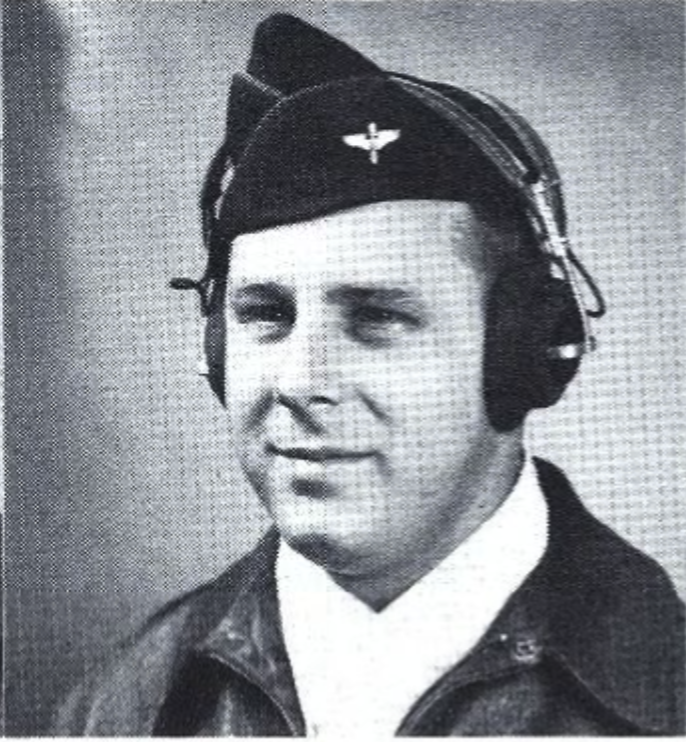
- Unit: 408th Bomber Squadron, 22nd Bomber Group (Heavy)
- Service Number: 0-747247
- Date of Birth: December 9, 1921
- Entered the Military: February 16, 1942
- Date of Death: April 16, 1944
- Hometown: Anchorage, Kentucky; Birmingham, Alabama; Brighton, Massachusetts
- Place of Death: New Guinea
- Award(s): Air Medal and Purple Heart
- Cemetery: Tablets of the Missing. Manila American Cemetery, Manila, Philippines.
Holliston High School, Holliston, Massachusetts
2025/2026
Early Life
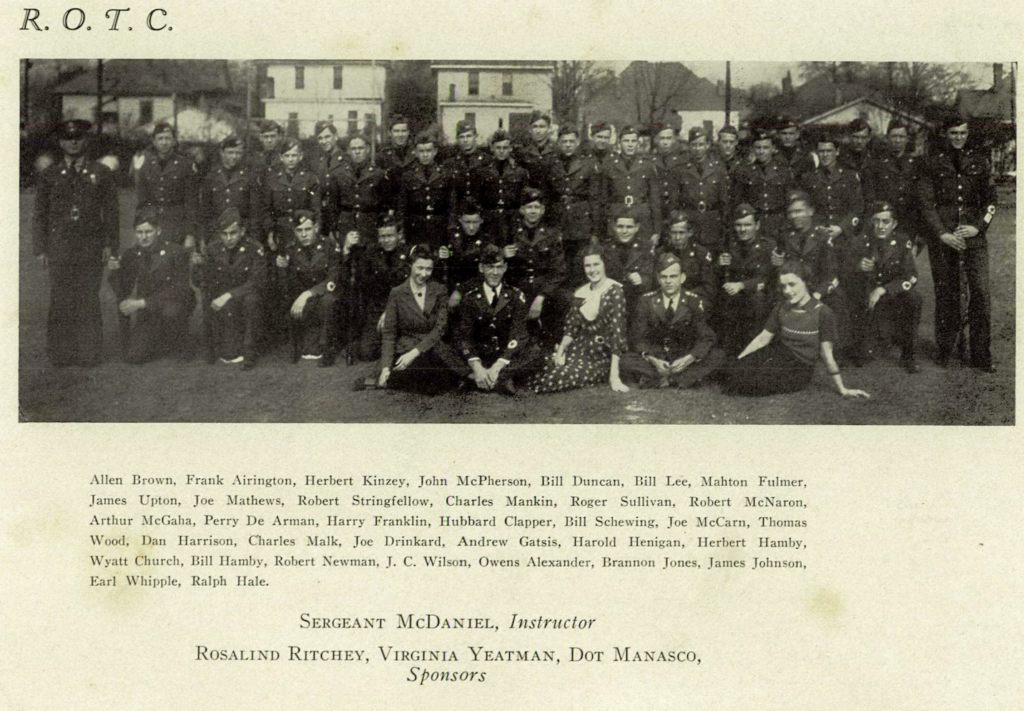
On December 9, 1921, Harry Chapman Franklin was born to Robert Bruce Franklin and Alberta (Wilde) Franklin in Anchorage, Jefferson County, Kentucky. He had one brother, Bruce Franklin, who was eight years older than him. His father was an investigator with the U.S. Post Office. The family moved several times in Franklin’s youth. From Anchorage, the family moved to Birmingham, Alabama, where Franklin went to Woodlawn High School. In his early high school years, Franklin was a member of the Junior Reserve Officers’ Training Corps (JROTC).
Move to Massachusetts
The family’s final move to Massachusetts before Franklin’s deployment was likely due to the Great Depression, when Birmingham was hit hard by high unemployment rates, and there was opportunity for manufacturing work in northern cities. By 1940, Robert, Alberta, Franklin, and his mother’s sister, Anna, had moved to Bellvista Road in Brighton. Franklin completed at least three years of high school before beginning work at Clifford Manufacturing Company in South Boston, Massachusetts.
Marriage
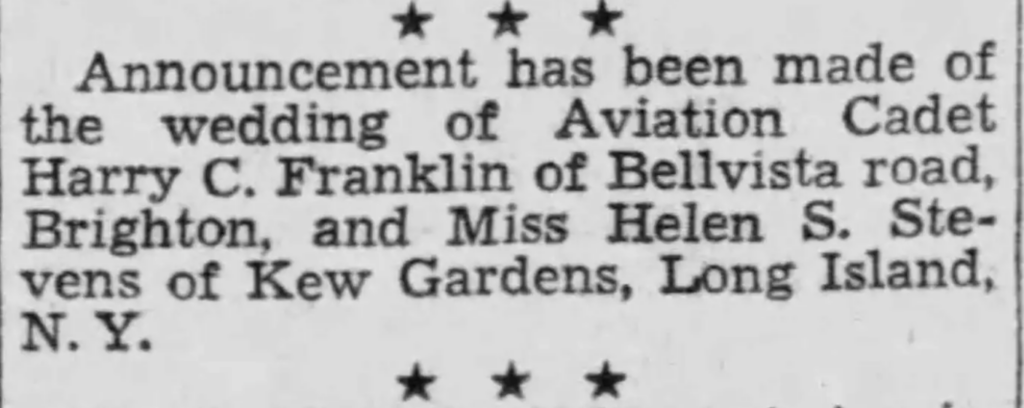
Franklin married Helen Sayre Stevens at age 21. Helen was originally from Kew Gardens, Long Island, New York. The two married when Franklin was an aviation cadet.

Homefront
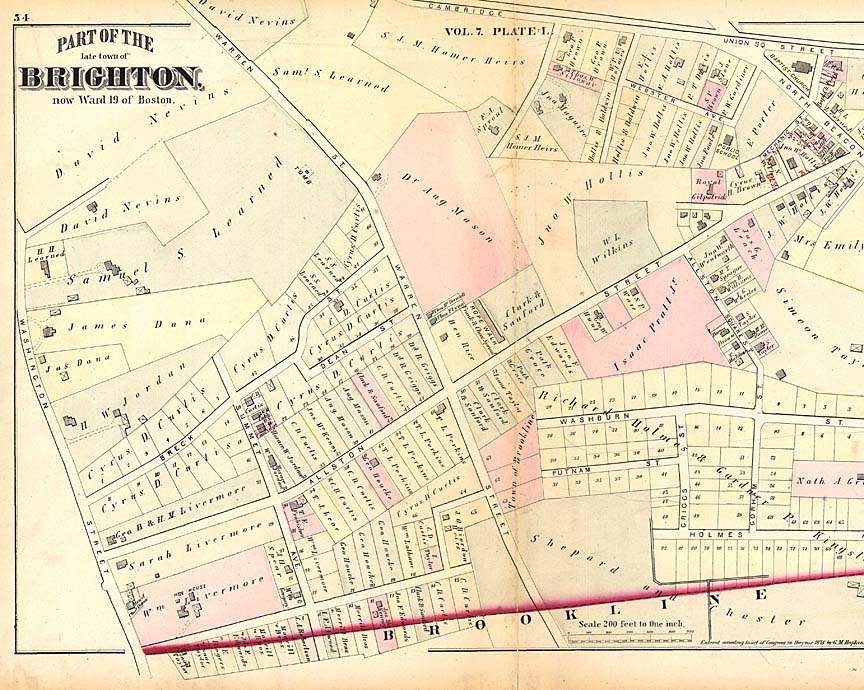
Brighton, a short ten miles from Boston, was a bustling town both before and during the war. In the 1880s, Brighton experienced extensive urbanization; the land was unsuitable for farming due to poor soil, and, with the development of Commonwealth Avenue, hunted game eventually disappeared from the area. In 1909, an electric streetcar service was introduced in this area, further increasing the city’s population. Commonwealth Avenue, just minutes from Franklin’s house, was home to the “Auto Mile,” created by Alvan Tufts Fuller, which housed 54 car dealerships by 1932. Although Brighton itself did not have manufacturing facilities, it was located near many, and its inhabitants commuted for work.
War Effort
Boston used print media and radio to boost the war effort at home by promoting the need for materials and rationing, and to stop the spread of misinformation. Victory gardens were popular in the area, and competitions were held for cash prizes. Schools hosted scrap drive competitions where children brought scrap metal to school, and the total was recorded. Many items were rationed, including coal and sugar, and for those that were not, such as gasoline, radio broadcasts urged citizens to do their part and consider the men fighting overseas by using less gas.
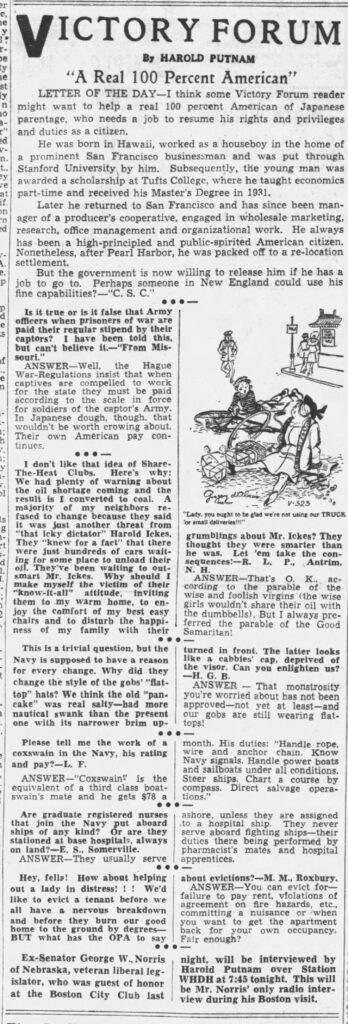
The Office of Price Administration set price ceilings on certain goods. The Boston Herald and The Boston Globe both ran columns to separate rumor from fact about World War II. The Boston Globe called theirs the “Victory Forum.” One example story they ran was about the pay and rating scales for the U.S. Navy. They also ran stories about how a person could help Japanese Americans who were unfairly sent to internment camps as part of Executive Order 9066.
Women in War
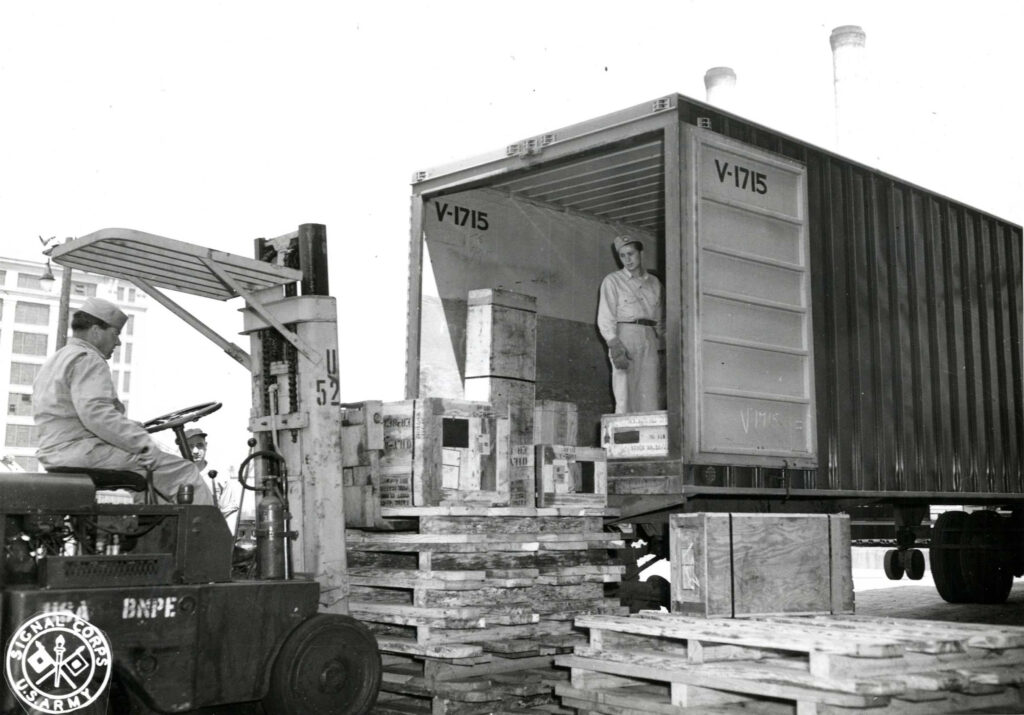
Women had fewer employment opportunities than men, yet remained vital to industrial work in the area. Automotive classes were offered at Brighton High School specifically for women to develop the skills needed for necessary wartime manufacturing jobs. Many women worked at Watertown Arsenal, operating heavy machinery and assembling munitions on industrial assembly lines.
Changing Population
The Black population in Boston increased during the Great Depression and the Great Migration, rising from 20,574 in 1930 to 51,568 by 1950. Many of these people moved from Virginia to Roxbury, a nearby neighborhood of Brighton, in search of better-paying industrial jobs. Many of these people worked at the Charlestown Navy Yard as shipbuilding increased during World War II.
After the war ended, Boston saw an influx of Jewish refugees and war brides, too.
Italian Internment Camps
Italian prisoners of war were sent to Camp McKay in South Boston to support the war effort. Italian Service Units (ISUs) housed these prisoners of war in areas where there was a lack of labor. Camp McKay was a large camp, indicating that Boston struggled to find the manpower to support the war effort, despite migration from southern to northern cities. The presence of Camp McKay increased tensions between residents and Italian immigrants in the area, as many perceived them as potential threats to national security, not unlike Japanese Americans at this time.
Military Experience
Training
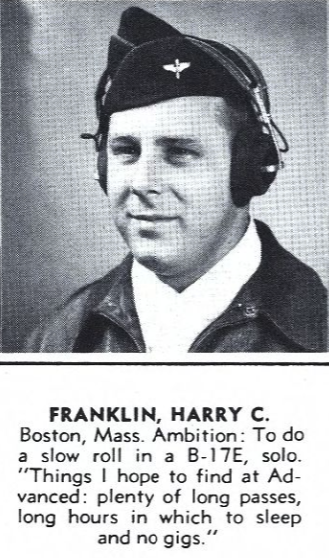
Upon entering the U.S. Air Force, Franklin trained at Chico Army Flying School in California in April 1943. During his training, he was a part of Squadron 13. His training included learning to fly B-17s and attending additional courses, such as a weather course. At the end of his training, he stated that his long-term goal after graduating was to perform a slow roll in a B-17E.
After Training
In September 1943, Franklin was stationed at La Junta, Colorado; however, he was soon deployed, and by November, he was stationed in the Southwest Pacific Area. Based in Queensland, Australia, he primarily conducted missions in Papua New Guinea. He was a part of the 408th Bomber Squadron, 22nd Bomber Group, Heavy, where he flew long-range missions, predominantly in four-engine planes like B-24s.
Franklin took part in campaigns in New Britain, Lae, and, most notably, the Bombing of Hollandia, which resulted in some of the highest recorded losses for pilots on the Pacific (theater) during World War II.
Harry’s Final Mission
On April 16, 1944, also known as “Black Sunday,” Franklin flew his final mission. On this day, 70 planes were unaccounted for after the mission; not from fighting, but from an unexpected weather front in New Guinea as they were flying back to base from Hollandia.
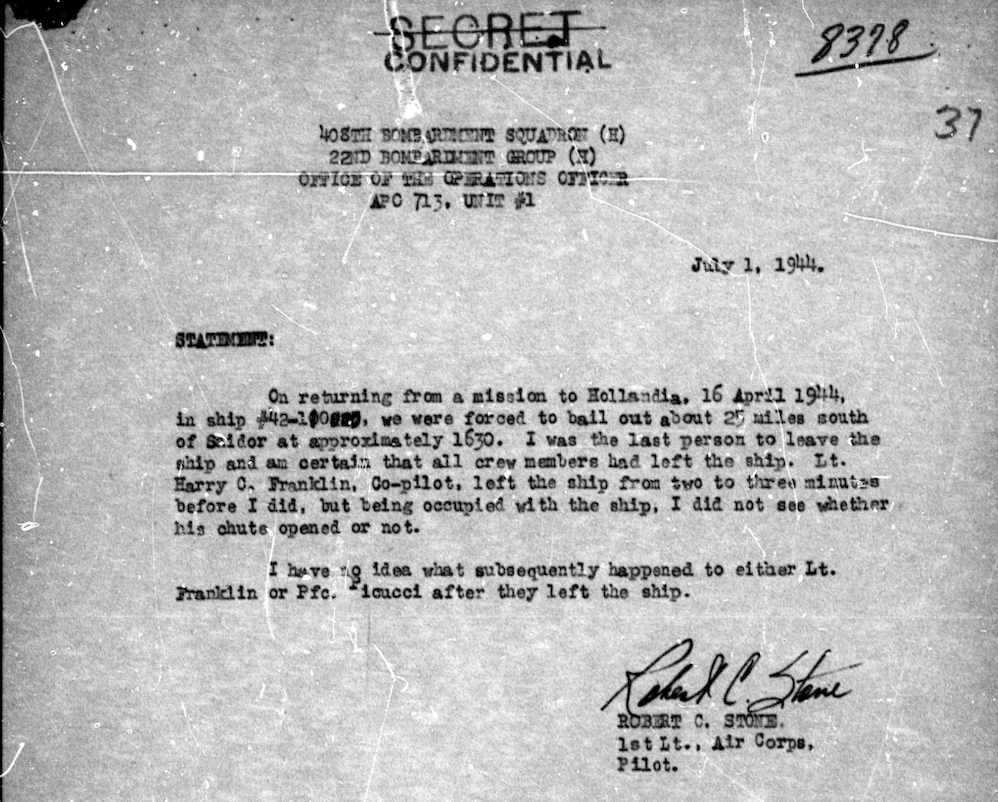
First Lieutenant Robert C. Stone was the pilot of the Blonde Bomber in this mission; Franklin was his co-pilot. Stone left the formation when bad weather hit, after almost colliding with another plane. At 4:30 p.m., the crew bailed out over Astrolabe Bay on the North Coast of New Guinea. Stone was the final man to bail from the plane; Franklin left two to three minutes earlier. Stone did not see whether Franklin’s chute opened or not, and none of the surviving crewmen had any idea what happened to Lieutenant Franklin or Private First Class Picucci, who was also on board the plane.
This likely means that Franklin’s chute did not deploy, he was grievously injured, or succumbed to exposure. He was not officially declared dead until February 26, 1946.

Commemoration
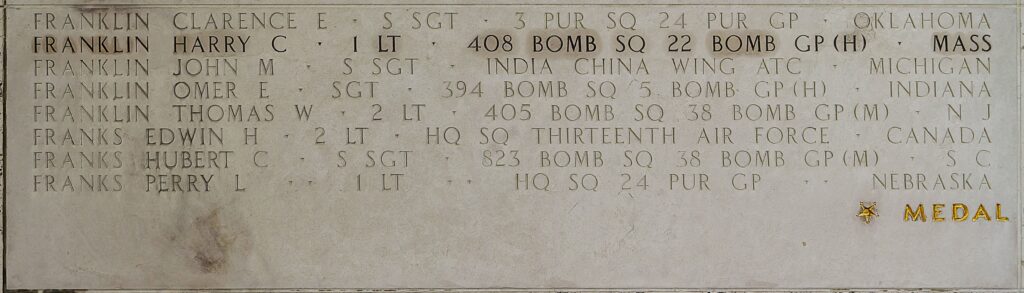
Harry Chapman Franklin is honored on the Tablets of the Missing at the Manila American Cemetery in the Philippines. His remains was never found after his bailout on April 16, 1944. His wife, Helen Franklin, remarried years later. Following his death, Franklin was awarded the Purple Heart and the Air Medal.
Harry Chapman Franklin sacrificed his life at the age of 22 for the betterment of his country and the safety of those abroad. His life was tragically cut short in the line of service, but his efforts, and those of millions who also paid the ultimate sacrifice during World War II, are honored and thanked to this day.
Bibliography
Primary Sources
The Adjutant General’s Office. World War II Honor List of Dead and Missing Army and Army Air Forces Personnel from Massachusetts, 1946. Washington, D.C: War Department, 1946. https://www.archives.gov/research/military/ww2/army-casualties/massachusetts.html.
Alabama. Birmingham County. 1930 U.S. Census. Digital Images. http://ancestry.com.
Beam. Chico, California: Chico Army Air Field, 1943. http://archives.csuchico.edu/digital/collection/coll17/id/61/rec/5.
“Clifford Job Advert.” The Boston Globe [Boston, Massachusetts], May 10, 1943. Newspapers.com. (185806751). https://www.newspapers.com/article/the-boston-globe-clifford-job-advert/185806751/.
“Clifford Manufacturing Co Job Advert” The Boston Globe [Boston, Massachusetts], February 13, 1944. Newspapers.com (432124252).
“Draft article for the Boston Post by Charles E. Folsom.” December 14, 1943. Homefront Exhibit, National Archives and Records Administration. https://www.archives.gov/files/boston/exhibits/homefront/4.11-boston-post.pdf.
“Future Army Pilots.” The Boston Globe [Boston, Massachusetts], April 6, 1943.
“The Guardian. (Boston, MA).” March 8, 1947. The Guardian 1901-1960 Collection, sn83045863, Library of Congress. https://www.loc.gov/item/sn83045863/1947-03-08/ed-1/.
Harry Chapman. U.S., Newspapers.com Marriage Index, 1800s-current. Digital Images. https://ancestry.com.
Harry C. Franklin. U.S. Rosters of World War II Dead, 1939-1945. Digital Images. https://ancestryclassroom.com.
Harry Chapman. U.S., WWII Jewish Servicemen Cards, 1942-1947. Digital Images. https://ancestryclassroom.com.
Harry Chapman Franklin. World War II Draft Cards Young Men, 1940-1947. Digital Images. https://ancestry.com.
Indiana. Cass County. 1900 U.S. Census. Digital Images. https://ancestry.com.
Kentucky. Jefferson County. 1900 U.S. Census. Digital Images. https://ancestry.com.
Massachusetts. Suffolk County. 1940 U.S. Census. Digital Images. http://ancestry.com.
“Missing Air Crew Report number 8378”. 1944. War Department. Record Group 92: Records of the Office of the Quartermaster General. 91052961. National Archives. https://catalog.archives.gov/id/91052961
“Morning Reports for April 1944: Roll 461.”1944. Records of the Office of the Quartermaster General, Missing Air Crew Reports, National Archives and Records Administration, College Park, Maryland. https://catalog.archives.gov/search?page=1&q=O-747247.
“Scrap Drive in Brighton schools” The Boston Globe [Boston, Massachusetts], October 17, 1942. Newspapers.com (185805768).
“Victory Forum.” The Boston Globe [Boston, Massachusetts], January 14, 1943. Newspapers.com (186062913).
“Victory Garden Contest.” The Boston Globe [Boston, Massachusetts], March 23, 1943. Newspapers.com (185817860).
“Women Workers.” The Boston Globe [Boston, Massachusetts], February 13, 1944. Newspapers.com. (185806561).
Woodlog. Woodlawn High School, 1937.
Secondary Sources
“1Lt Harry Chapman Franklin.” Find a Grave. Accessed December 30, 2025. https://www.findagrave.com/memorial/56760347/harry-chapman-franklin.
“408th Squadron, 22nd Bomb Group Mission Targets By Airfield.” Red Dirt Research. Accessed January 5th, 2025. https://reddirtresearch.org/tag/408th-bomb-squadron/.
“B-24J-125-CO Liberator Serial Number 42-110000.” Pacific Wrecks. Accessed December 29, 2025. https://pacificwrecks.com/aircraft/b-24/42-110000.html.
“The Boston Herald Rumor Clinic.” New England Historical Society. Accessed November 30, 2025. https://newenglandhistoricalsociety.com/the-boston-herald-rumor-clinic-of-world-war-ii/.
Drea, Edward. New Guinea: The US Army Campaigns of WWII. Center of Military History, 2019. https://history.army.mil/Portals/143/Images/Publications/Publication%20By%20Title%20Images/C%20Img/campaigns-wwii/pdf/24.pdf.
“First Lieutenant Harry Chapman Franklin, O-747247.” Fold3. Accessed January 1, 2026. https://www.fold3.com/memorial/664299215/harry-c-franklin#stories.
“From the Great Migration to Boston’s Charlestown Navy Yard.” National Park Service. Accessed December 2, 2025. https://www.nps.gov/articles/great-migration-to-charlestown-navy-yard.htm#_ftn20.
“Harry C. Franklin.” American Battle Monuments Commission. Accessed January 5, 2026. https://weremember.abmc.gov/sq=*&criteria=title%3DFranklin~unit_ss%3D%22408th%20Bomber%20Squadron%22&type=16&v=G.
“Harry C. Franklin.” Veterans Legacy Memorial, National Cemetery Administration. Accessed February 26, 2026. https://www.vlm.cem.va.gov/HarryCFranklin/48203.
“Harry Chapman Franklin.” Honor States. Accessed January 3, 2026. https://www.honorstates.org/profiles/55232/.
“Italian Service Units of Boston.” National Park Service. Accessed November 28, 2025. https://www.nps.gov/articles/000/italian-service-units-of-boston.htm.
“The Italian Service Units of World War II in Boston.” National Archives. Accessed November 30, 2025. https://prologue.blogs.archives.gov/2020/07/21/the-italian-service-units-of-world-war-ii-in-boston/#_ftnref3.
Kenney, General George C. General Kenny Reports: A Personal History of the Pacific War. University of Michigan Library, 1949.
Robinson, Richard. The Marauder: A Book of the 22nd Bomb Group -During World War Two. Halstead Press Pty Ltd, 1944.
“U.S. Army Ranks.” U.S. Army. Accessed January 7, 2026. https://www.army.mil/ranks/.
This profile was researched and created through the Researching Silent Heroes program, sponsored by the American Battle Monuments Commission.