First Lieutenant Henry Ashton
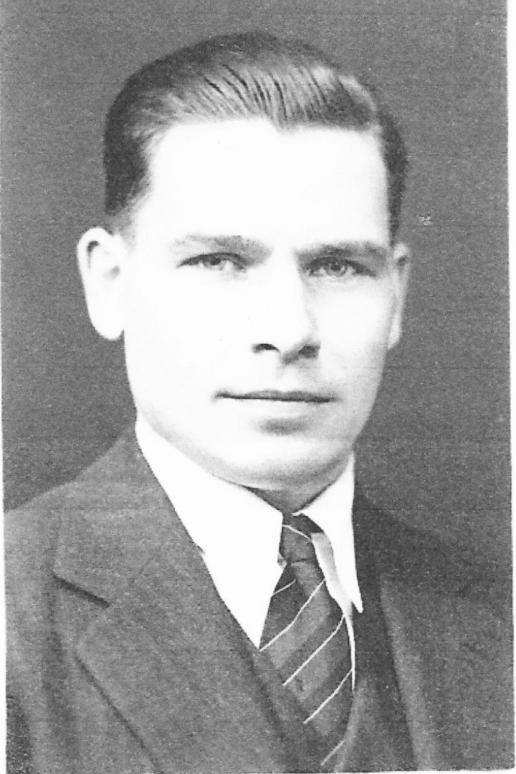
- Unit: Battery F, 24th Field Artillery Regiment (Philippine Scouts)
- Service Number: O-334549
- Date of Birth: January 12, 1912
- Entered the Military: January 12, 1926
- Date of Death: August 24, 1942
- Hometown: Boston, Massachusetts
- Place of Death: Cabanatuan Prison Camp, Philippines
- Cemetery: Walls of the Missing. Manila American Cemetery, Manila, Philippines
Canyon Springs High School, North Las Vegas, Nevada
2025/2026
Early Life
Henry Ashton was born on January 12, 1908, in Winthrop, Massachusetts, to Mary and Henry “Harry” Ashton. Despite records listing his date of birth as January 12, 1908, military records conflict, listing his birthdate as January 8, 1912. Ashton’s mother, Mary, was born in Ireland and immigrated to the United States. He had an older sister named Vina. He spent his early life in the Boston area and grew up in a working-class family. His father worked as a skilled industrial laborer during this time.
In the late 1910s, Ashton’s father separated from his mother, Mary, and moved to New York City with Henry and his sister, where he worked as a tutor. During their time in New York City in the 1920s, Ashton’s father remarried a French governess named Charlotte Schneider.
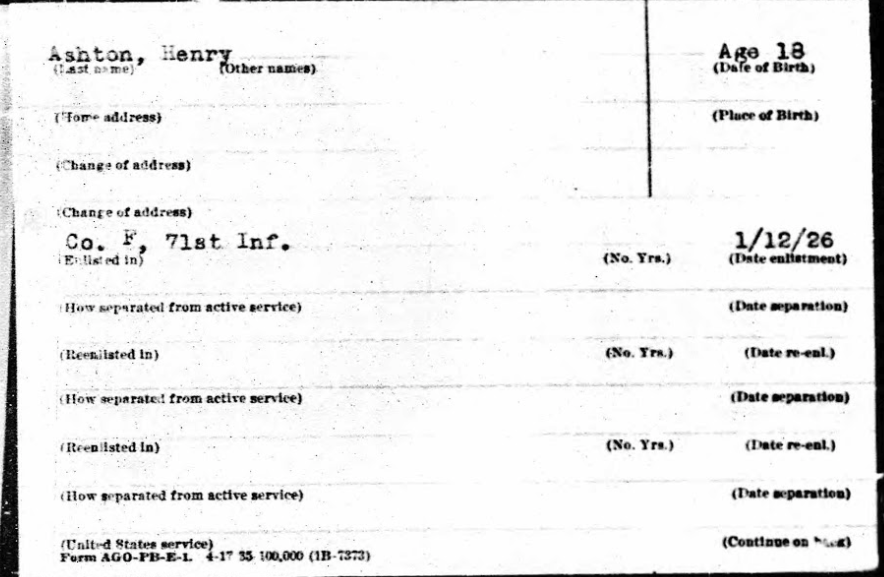
Ashton joined the New York National Guard on January 12, 1926. He lived on his own in New York City during the Great Depression and worked as a collector for an electric utility company before he moved to Ithaca, New York, in 1931 to attend Cornell University.
At Cornell University, Ashton was a member of the Reserve Officers’ Training Corps (ROTC) to earn his bachelor’s degree while becoming a commissioned officer. He was stationed at Madison Barracks, New York, for training during the summer of 1935, after graduating from Cornell University with degrees in Teaching and Instructing and Business Administration. He then enrolled at the New York State Teachers College in Albany, New York, for one year in 1936, but did not graduate.
Ashton worked as an instructor at the New York State School of Agriculture from 1936 to 1937. He then worked as an instructor at Culver Military Academy from 1938 to 1939. During both of these positions, Ashton continued his field artillery training in the United States Army Reserves at Camp Dix in New Jersey in 1936, Madison Barracks in New York in 1937, and Pine Camp in New York in 1938. During this time, he was promoted from second lieutenant to first lieutenant in September 1938.
Eventually, Ashton joined the Civilian Conservation Corps, starting as a junior officer at the Fort Douglas District in Utah. He worked as a mess officer and camp exchange officer. He then moved to Panaca, Nevada, and continued to work with the Civilian Conservation Corps as an Army Reservist through the summer of 1941.
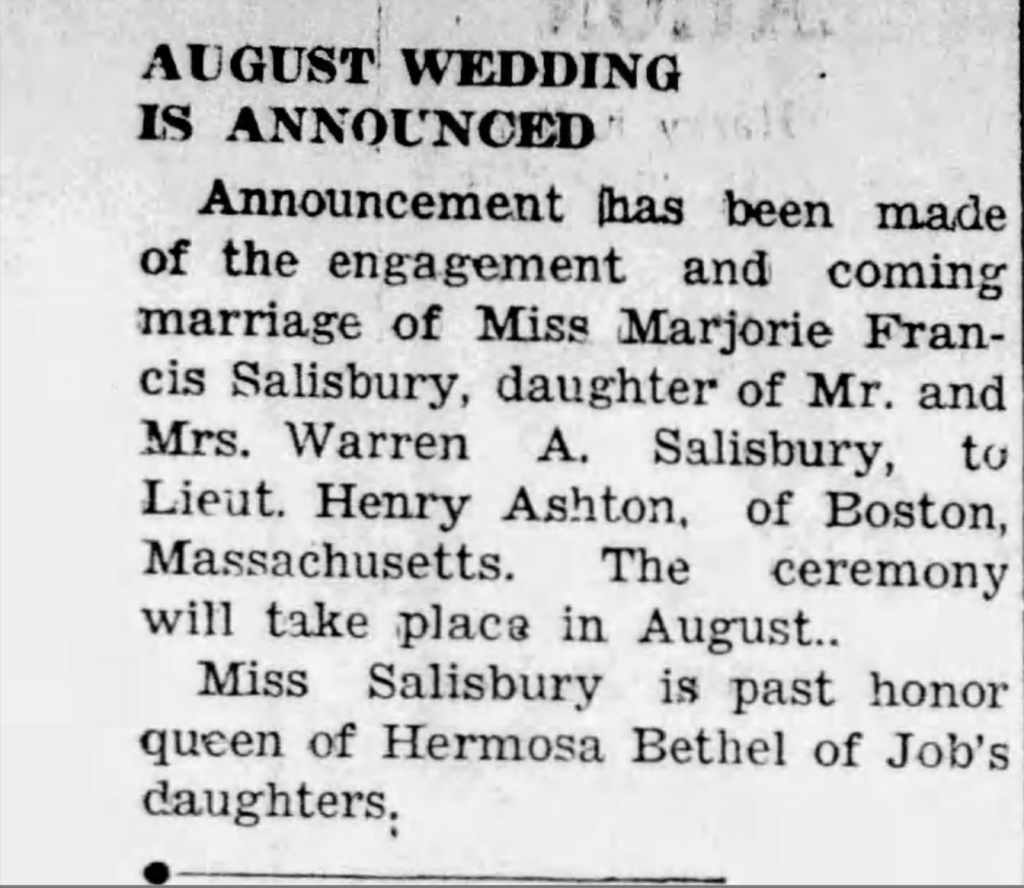
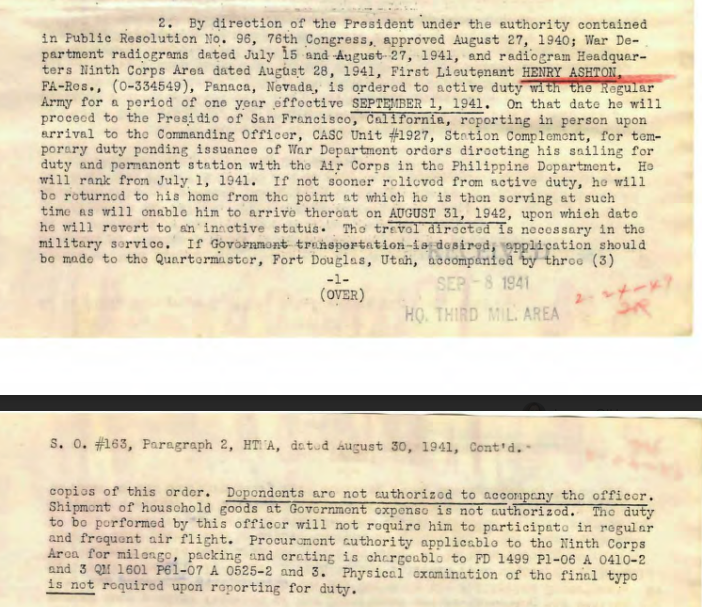
During his time in Nevada, Ashton married Marjorie Frances Salisbury in Las Vegas, Nevada, on August 1, 1941. He received special orders on August 30, 1941, which were a result of President Franklin D. Roosevelt’s Executive Order 8756. This executive order placed units and members of the United States National Guard into active duty for a period of one year, beginning on September 1, 1941.
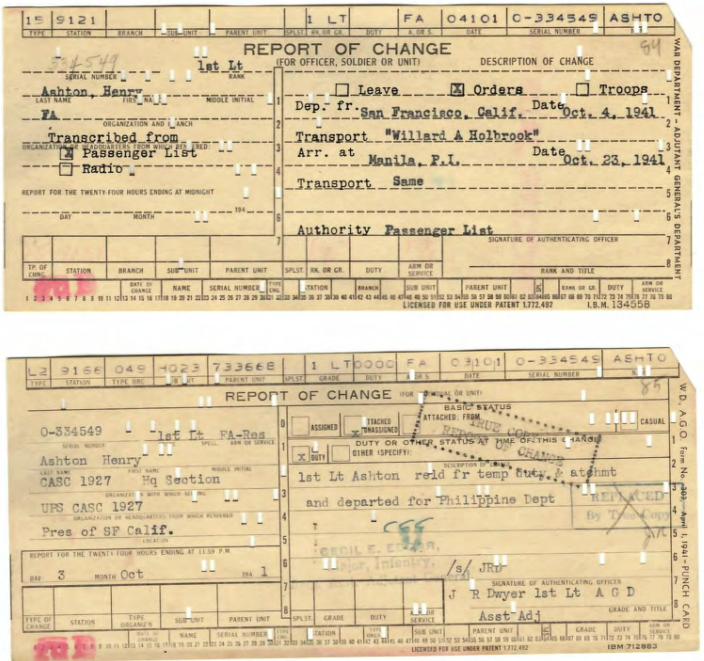
Ashton was ordered to report to the Presidio of San Francisco for temporary duty until he received orders from the United States War Department for his permanent station overseas. He served as an assistant prison and police officer in the Presidio of San Francisco. Ashton’s permanent orders were issued on October 3, 1941, directing him to serve as an officer in the Field Artillery with the United States Army Air Corps, Philippine Division.
Ashton and his wife, Marjorie, were married for less than a month before he received his special orders for active duty on August 31, 1941. Ashton maintained his residency in Nevada while Majorie lived in Redondo Beach, California, during Ashton’s overseas active-duty service. The couple’s brief marriage reflects the urgency and uncertainty many families faced as tensions escalated across Asia and Europe before the United States’ entry into World War II.

Homefront
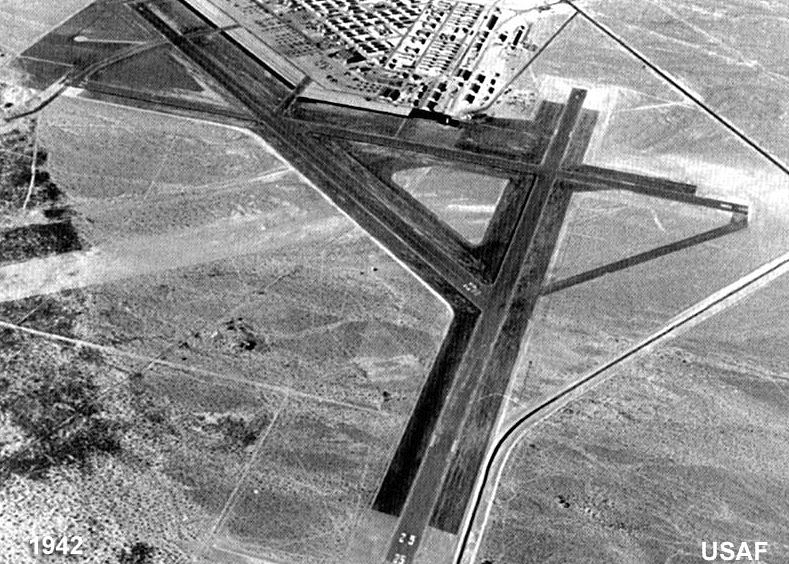
When the Hoover Dam was completed in 1936, Las Vegas quickly changed from a small railroad town into a strategic military training hub by the start of the 1940s. It was a rapidly growing town in the Mojave Desert. Las Vegas Army Air Field, now known as Nellis Air Force Base, supported aircraft maintenance, training, and the distribution of supplies. It also served as a base for ongoing nuclear research. Las Vegas hosted United Service Organizations (USO) shows to entertain troops, held war bond rallies, and conducted planned blackout drills through the Office of Civilian Defense.
One of the most dramatic population booms in the United States occurred in Las Vegas during this time. The population increased from 8,000 in 1940 to 16,000 by 1945. The Las Vegas Army Air Field, which provided jobs in the community, helped drive population growth in the area. Entire city blocks popped up throughout the Las Vegas valley. Those who lived in Las Vegas would take the bus to the Nevada Test Site for work.
Women worked in many support roles, including hospitality and federal offices. Many African Americans were banned from working in casinos, but found employment in the areas of construction, transportation, and other military support jobs.
Nevada also faced labor shortages with the rapid population growth. There were disputes over housing for military families and defense workers. Las Vegas was also known as “the Mississippi of the West” because of the racial tensions in housing and segregated communities. Despite organized crime having a large influence in Las Vegas, gambling and tourism conflicted with federal rationing and blackout rules.
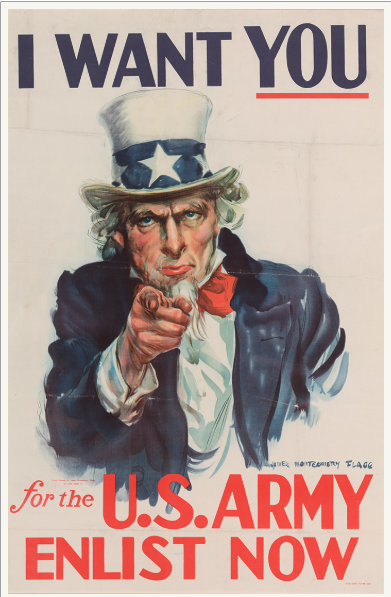
War propaganda was also featured throughout the community of Las Vegas. War bond posters were placed in post offices, train stations, and schools. Patriotic film reels were also shown before movies, and radio broadcasts encouraged food rationing and enlistments. Military installations and traveling United Service Organization entertainers promoted troop morale during this time.

Military Experience
First Lieutenant Henry Ashton was on active duty serving in the Air Corps in the Philippines as a Field Artillery officer when Japan attacked Pearl Harbor in Hawai’i on December 7, 1941. The United States declared war on Japan on December 8, 1941, which is the same day that Japan destroyed two-thirds of the American aircraft in a surprise attack on Luzon, an island in the Philippines.
Luzon was home to the Filipino capital, Manila, and the headquarters of the United States Army Forces in the Far East. Field artillery officers were tasked with leading soldiers to destroy, neutralize, or suppress enemy forces. Field artillery officers must also be experts in coordinating and integrating all fire support from the Army, joint, and multinational armed forces in their operations. Unfortunately, it was on December 8, 1941, that Japanese forces captured First Lieutenant Henry Ashton in Bataan as a prisoner of war, following the American surrender.
In late December 1941, United States Army Forces in the Far East commander General Douglas MacArthur issued War Plan Orange-3, which called for withdrawing Allied forces from the Bataan Peninsula stronghold by the start of 1942. During this time, thousands of United States soldiers were taken as prisoners of war by the Japanese from December 7, 1941, through May 8, 1942.
The largest of the prisoner of war camps was Cabanatuan Prison Camp, where First Lieutenant Harry Ashton was held. This prison camp held around 8,000 American and Filipino prisoners of war at its peak during and after the Fall of Bataan. Overcrowding increased significantly after the arrival of Allied prisoners who surrendered from Corregidor in May 1942.
Prisoners of war under the Japanese received horrible treatment. Conditions at Cabanatuan Prison Camp were poor, with food and water extremely limited. This led to widespread malnutrition and outbreaks of malaria and dysentery. Ashton was noted as a prisoner of war from December 8, 1941, until May 5, 1942. He was then identified as missing in action until March 11, 1943.
Commemoration
Mrs. Marjorie Ashton, Henry’s wife, first received a telegram on March 13, 1943, that her husband was a prisoner of war of the Japanese government in the Philippines. Ashton’s sister, Vina, who lived in Fall River, Massachusetts, was also notified by telegram on the same date. Vina was unaware that her brother was married until she received a letter from Majorie in late 1942, after he was declared missing in action on May 7, 1942.
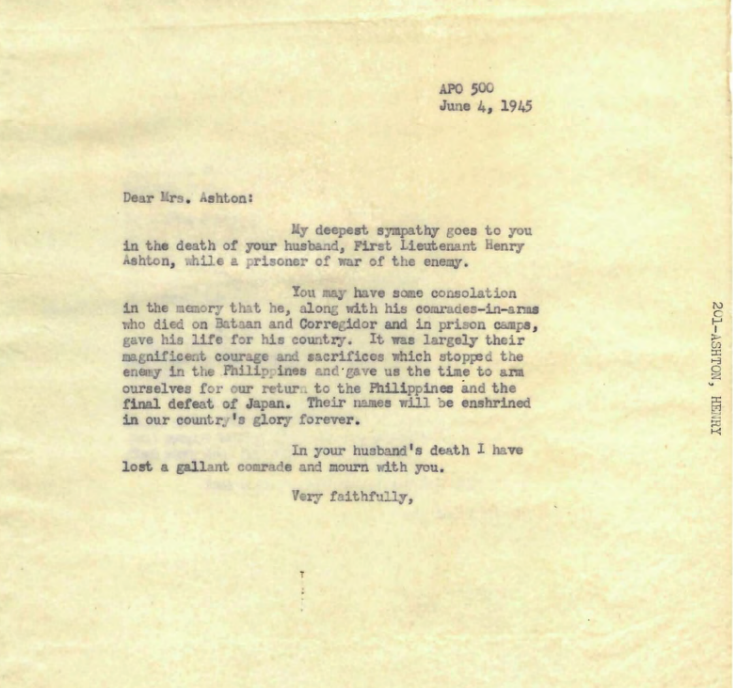
It was not until June 17, 1943, that Majorie received notification from the United States War Department stating that Ashton, who was initially reported as a prisoner of war, then missing in action, was estimated to have died on June 11, 1943, in the Philippines.
Almost two years later, on May 9, 1945, months before the surrender of Japan in World War II, Majorie was then notified of Ashton’s confirmed date of death after conflicting reports from the United States Army. His confirmed date of death was August 24, 1942, due to dysentery and beriberi. His remains were never recovered. First Lieutenant Henry Ashton was memorialized on the Walls of the Missing at the Manila American Cemetery, in Taguig City, Philippines.


Bibliography
Primary Sources
“August Wedding is Announced.” The Redondo Reflex [Redondo, California], August 1, 1941. Newspapers.com (621306382).
“Fun for the Whole Family.” Las Vegas Age [Las Vegas, Nevada], June 6, 1941. University of Nevada, Las Vegas Special Collections and Archives (sn86076141_19410606_14). https://special.library.unlv.edu/node/643829.
Henry Ashton. Individual Deceased Personnel File, Department of the Army. National Archives and Records Administration – St. Louis.
Henry Ashton. New York National Guard Service Cards, 1917-1954. Digital Images. https://ancestryclassroom.com.
Henry Ashton. Official Military Personnel File, Department of the Army. National Archives and Records Administration – St. Louis.
“Husband of Former Redondo Girl Dies in Jap Prison.” The Daily Breeze [Torrence, California], June 29, 1943. Newspapers.com (1093279861).
“I Want You For The U.S. Army Enlist Now.” National Archives and Records Administration (NAID: 513533) https://catalog.archives.gov/id/513533.
Photograph Collection. Las Vegas Age [Las Vegas, Nevada], June 6, 1941. University of Nevada, Las Vegas Special Collections and Archives (sn86076141_19410606_07). https://special.library.unlv.edu/node/643822.
Massachusetts. Suffolk County. 1910 U.S. Census. Digital Images. https://ancestryclassroom.com.
Nevada. Lincoln County. 1940 U.S. Census. Digital Images. https://ancestryclassroom.com.
New York. New York County. 1920 U.S. Census. Digital Images. https://ancestryclassroom.com.
New York. New York County. 1930 U.S. Census. Digital Images. https://ancestryclassroom.com.
Secondary Sources
“1LT Henry Ashton.” Find a Grave. Accessed March 24, 2026. https://www.findagrave.com/memorial/56786686/henry-ashton.
“Executive Order 8756.” The American Presidency Project. Accessed March 27, 2026. https://www.presidency.ucsb.edu/documents/executive-order-8756-amendment-executive-order-no-8633-january-14-1941-ordering-certain.
“Field Artillery Branch.” United States Army. Accessed March 30, 2026. https://api.army.mil/e2/c/downloads/2024/04/03/1cf69906/field-artillery-da-pam-600-3.pdf.
“Henry Ashton.” American Battle Monuments Commission. Accessed March 24, 2026. https://weremember.abmc.gov/s?q=ashton&v=G&type=16.
“Henry Ashton.” Fold3. Accessed March 26, 2026. https://www.fold3.com/memorial/657818629/henry-ashton#gallery.
“Henry Ashton.” Veterans Legacy Memorial, National Cemetery Administration. Accessed April 16, 2026. https://www.vlm.cem.va.gov/HenryAshton/38915.
“The Home Front During WWII.” National World War II Museum. Accessed March 26, 2026. https://www.nationalww2museum.org/sites/default/files/2017-07/home-front-fact-sheet.pdf.
“The Last Days of Bataan.” National Museum of the United States Air Force. Accessed March 30, 2026. https://www.nationalmuseum.af.mil/Visit/Museum-Exhibits/Fact-Sheets/Display/Article/196798/the-last-days-on-bataan/.
“Powers of Persuasion.” National Archives. Accessed March 26, 2026. https://www.archives.gov/exhibits/powers-of-persuasion.
“Rosie the Riveter.” History Channel. Accessed March 30, 2026. https://www.history.com/articles/rosie-the-riveter.
“Rosie the Riveter and Benny the Bungler: WWII Propaganda at Work.” National World War II Museum. Accessed March 30, 2026. https://www.nationalww2museum.org/war/articles/wwii-propaganda.
“Service Member 1st Lt. Henry Ashton.” Defense POW/MIA Accounting Agency. Accessed March 30, 2026. https://dpaa-mil.sites.crmforce.mil/dpaaProfile?id=a0Jt0000000Xg4GEAS.
“Take a Closer Look: America Goes to War.” The National World War II Museum. Accessed March 26, 2026. https://www.nationalww2museum.org/students-teachers/student-resources/research-starters/america-goes-war-take-closer-look.
“U.S. Casualties and Burials at Cabanatuan POW Camp #1.” Defense POW/MIA Accounting Agency. Accessed March 30, 2026. https://dpaa-mil.sites.crmforce.mil/WWII/Cabanatuan.
“Women in World War II.” National Park Service. Accessed March 26, 2026. https://www.nps.gov/articles/000/women-in-world-war-ii.htm.
“World War II left its mark on Las Vegas.” Las Vegas Review-Journal [Las Vegas, Nevada], December 29, 2014. Accessed March 27, 2026. https://www.reviewjournal.com/local/local-las-vegas/world-war-ii-left-its-mark-on-las-vegas/.
This profile was researched and created through the Researching Silent Heroes program, sponsored by the American Battle Monuments Commission.