Staff Sergeant Humberto Acosta-Rosario
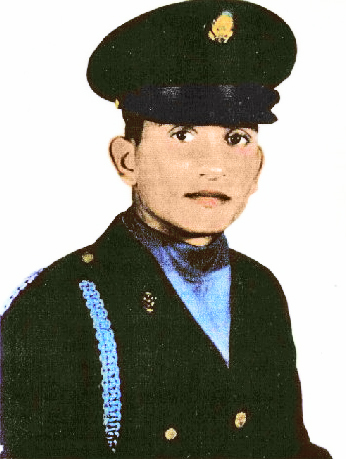
- Unit: Company B, 1st Battalion, 5th Infantry Regiment, 25th Infantry Division
- Service Number: 584100836
- Date of Birth: January 15, 1947
- Date of Death: March 1, 1978
- Hometown: Mayagüez, Puerto Rico
- Place of Death: Near the Ben Cui Rubber Plantation, Vietnam
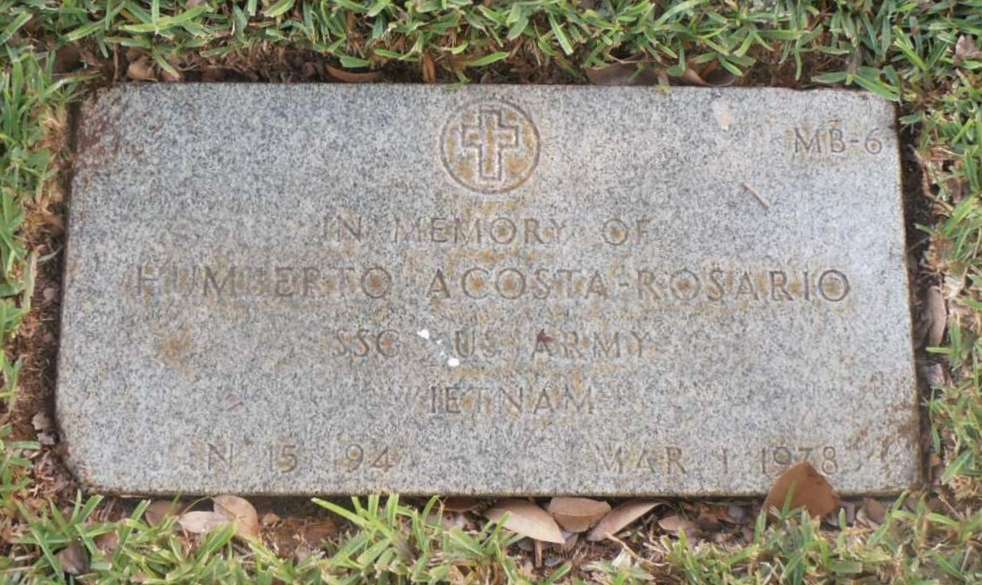
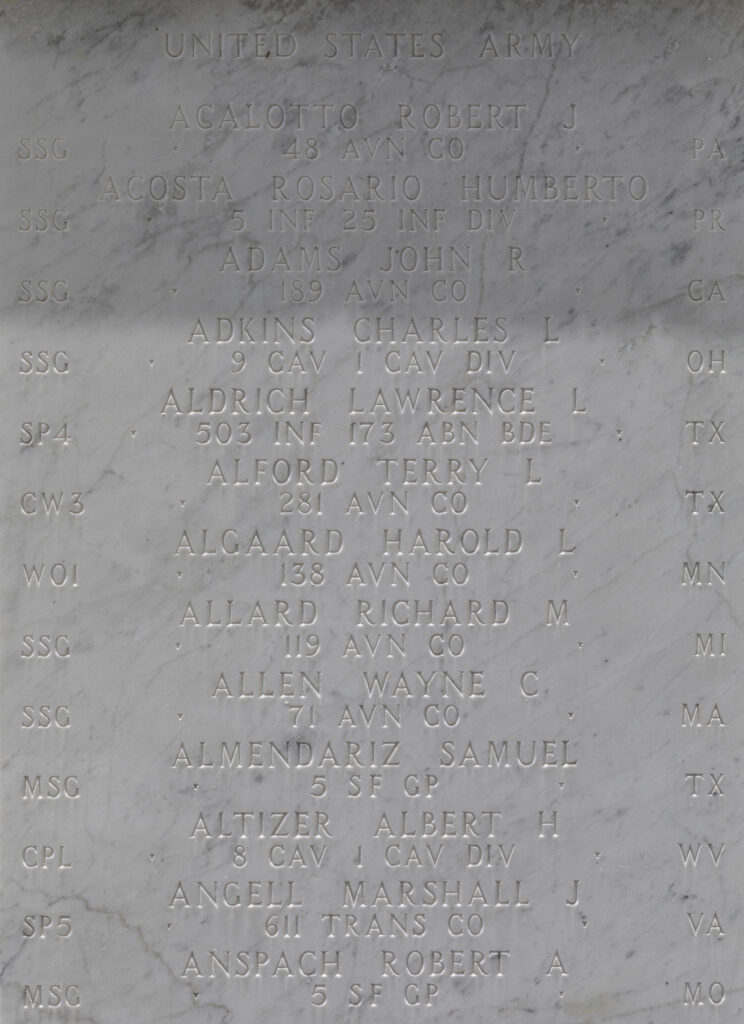
- Cemetery: Court B, Courts of the Missing. Honolulu Memorial, National Memorial Cemetery of the Pacific, Honolulu, Hawaiʻi and a memorial marker at Section MB, Site 6, Puerto Rico National Cemetery, Bayamon, Puerto Rico
Constitution High School, Philadelphia, Pennsylvania
2025/2026
Early Life
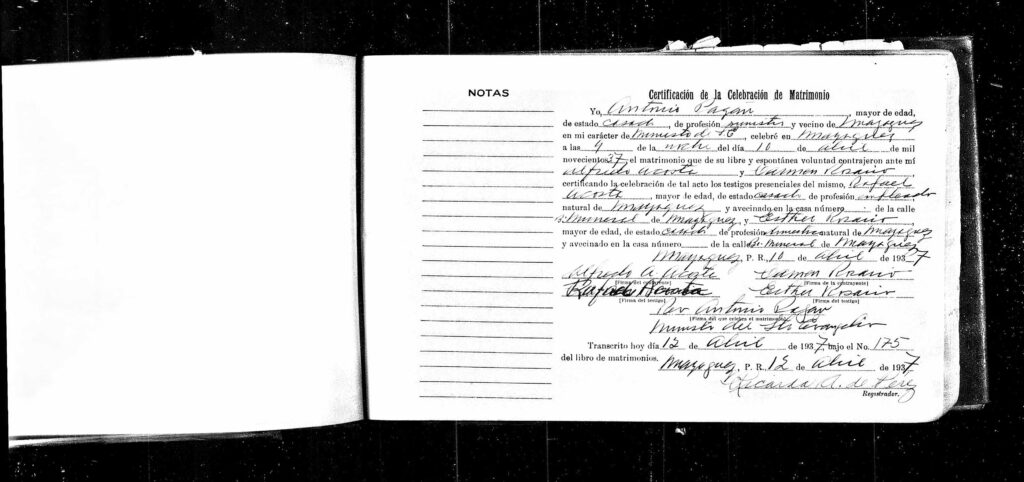
Humberto Acosta-Rosario was born in Mayagüez, Puerto Rico, on January 15, 1947. His parents’ names were Alfredo Acosta y Acosta and Carmen Rosario (maiden name) de Acosta (married name). Carmen’s last name indicates both her maiden name and her married name, a common practice in many Spanish-speaking countries. Humberto’s father worked as a factory laborer and later as a brewery worker.
Acosta-Rosario was active in his community prior to leaving for Vietnam. He loved sports, in particular, basketball. He also volunteered at a recreation center, coached baseball, and sponsored a local Cub Scout group.

Homefront
Mayagüez, Puerto Rico
Mayagüez has always been important to Puerto Rico’s economy, as the land there is very fertile, and many agricultural businesses are centered there. Textile businesses used to be in this area, including one that manufactured uniforms for U.S. soldiers.
In Mayagüez, life was impoverished. The largest employer was the Bumble Bee Tuna cannery. This plant was established in 1962 and operated for 50 years before shutting down. In the 1960s, most of the population was native-born, and the median income was $1,341. Of the 21,111 households in the community, 12% did not have electricity, 40% lacked a septic tank, 71% did not own a car, and 65% lived in wooden-framed homes. The area was not as developed as the mainland of the United States or even certain parts of San Juan. Workers in Puerto Rico earned significantly less than workers on the United States mainland during the 1970s. The average Puerto Rican resident earned $1.60 per hour, while mainland workers earned $2.42 per hour.
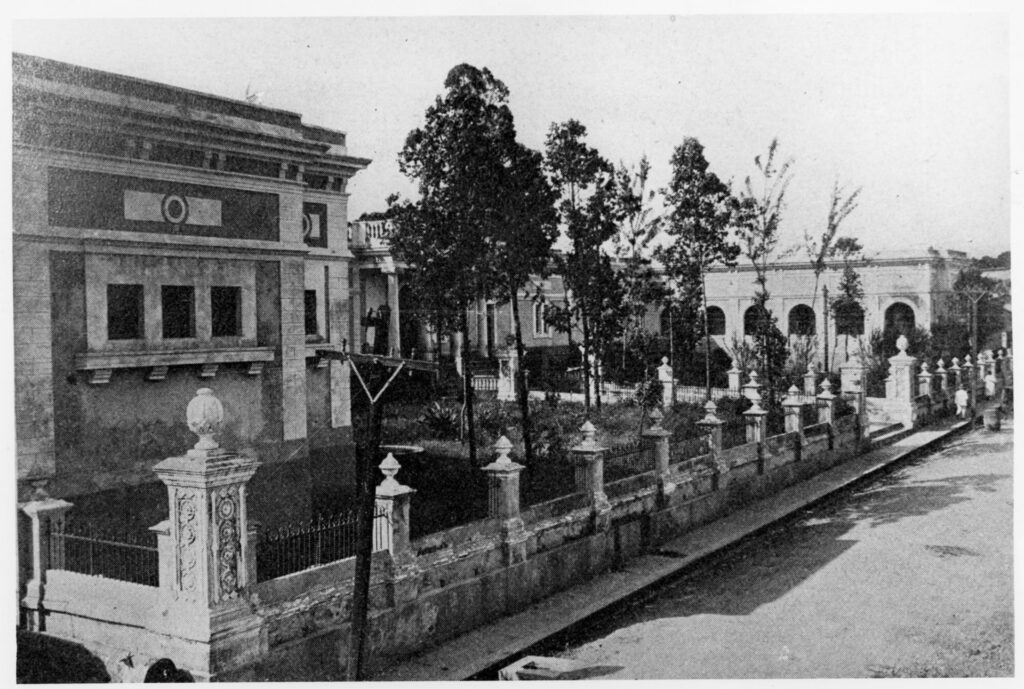
Mayagüez was home to the Asilo de Pobres, or the Municipal Poor Asylum, founded in the 1800s and operating into the 1970s. According to the National Register of Historic Places, the Municipal Poor Asylum was originally formed to help deal with the “problem of loose poor or mentally deranged people in the city.” The building itself also stands as an example of architectural achievement in Puerto Rico, showing specific elements of the Mayagüez Area.
University of Puerto Rico at Mayagüez
From the 1940s through the 1960s, the University of Puerto Rico expanded its Mayagüez campus to make college more accessible to citizens across the island. Their goal was to eliminate obstacles that prevented students from all backgrounds and neighborhoods from attending college.
As the Vietnam War escalated, the attitude on campus changed to one of protest. Young men who were likely to be drafted began to protest and felt the pressure of the war at home. Like other students, they had to leave campus for basic training immediately. Private universities on the United States mainland had more room for protest, but the University of Puerto Rico at Mayagüez, which was solely dependent on federal funding, cracked down on student-led protests.
The Vietnam Draft
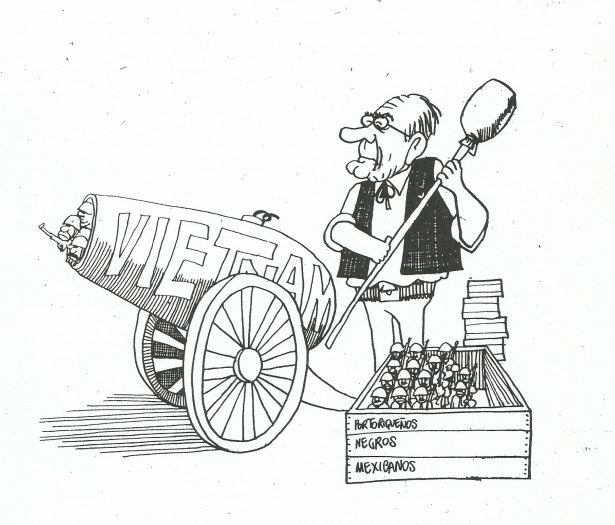
Despite lacking voting representation in Congress (Puerto Ricans elect a representative who serves in Congress but does not have a vote), Puerto Ricans were eligible to be drafted into the Vietnam War. Puerto Ricans made up only 1% of the U.S. population at this time, but comprised 3.5% of the soldiers drafted.
In 1965, a young Puerto Rican man named Sixto Alvelo refused to be drafted. On August 6, 1966, Alvelo spoke at a rally in Times Square, New York City, attended by 25,000 people. Through a translator, he asked:
Se preguntarán ustedes cómo, si no soy norteamericano, si ni siquiera sé hablar nada en inglés, cómo es posible que intenten obligarme a mí a ingresar en el ejército norteamericano. ¿Cómo es posible que en ejérticto extranjero, invasor de mi Patria, me quiera utilizar de carne de cañon para ir a luchar contra otro pueblo que, al igual que el nuestro, está luchando por su Independencia?
You may wonder how, if I am not American, if I cannot even say anything in English, how they can try to force me to join the U.S. Army. How is it possible that a foreign army, the invader of my country, wants to use me as cannon fodder to go to fight another people who, just like ours, are fighting for independence?
After this speech, Avelo became a figurehead of resistance across the island. On Mother’s Day 1967, mothers of drafted men held a protest in San Juan. Many Puerto Ricans condemned the war and specifically the draft as being immoral and unfair.
Visits from Afar
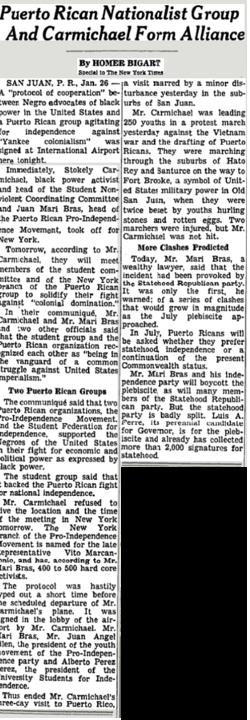
Stokely Carmichael, leader of the Student Nonviolent Coordinating Committee (SNCC), visited Puerto Rico in January 1967 to meet with locals to discuss his opposition to the war and the draft. He spent three days travelling across the island and speaking on college campuses. He noted that Puerto Ricans and African Americans faced similar challenges with the U.S. government. Both groups wanted agency, respect, and freedom from oppression. He blamed the issues of both communities on U.S. imperialism and saw the Vietnam War as another example.
Protest Songs
Roy Brown, a Puerto Rican activist and musician, wrote protest songs during the Vietnam War. His most famous protest song was called “Monon,” and it discussed Americans bombing Vietnam. Some of the lyrics, translated to English, include, “And the children are frightened because the man of destiny, He who never came, goes about throwing bombs. Goes about digging graves with his electronic forces, with their nuclear minds, they dig a well in Lares. They drop bombs in Vietnam, they drop bombs in Nigeria.”
Ongoing Struggles for Independence
The 1960s and 1970s also saw an increasing debate over whether Puerto Rico should be an independent nation, a U.S. state, or a commonwealth. A plebiscito (plebicite or referendum), held on July 23, 1967, asked voters to choose among three political status options for Puerto Rico: Commonwealth (Estado Libre Asociado), Statehood (Estadidad), or Independence (Independencia). The majority of Puerto Ricans voted for a commonwealth status.
The independence movement was often linked to the anti-war movement, and Reserve Officer Training Corps (ROTC) programs at universities were targeted for protest. Some were vandalized, and others faced bomb threats. Clashes continued between police and protesters, and the FBI investigated activities in Puerto Rico, including protests and flag burnings.


Military Experience
Humberto Acosta-Rosario graduated from high school and briefly attended college in San Germán, Puerto Rico, before being drafted into the U.S. Army. He was assigned as a machine gunner in Company B, 1st Battalion, 5th Infantry Regiment, 25th Infantry Division.
Each company of about 150 men had eight M60 machine guns. The M60 was nicknamed “the pig” because of its size, weight, and the sound of the gun. The enemy greatly feared this weapon because of its firepower. The gun weighed 24 pounds and was 43.5 inches long. It was stabilized by two legs and could fire 550-650 rounds per minute. Soldiers were told in training that machine gunners were the enemy’s targets and that the average machine gunner lasted only seven seconds in battle.
Vietnam
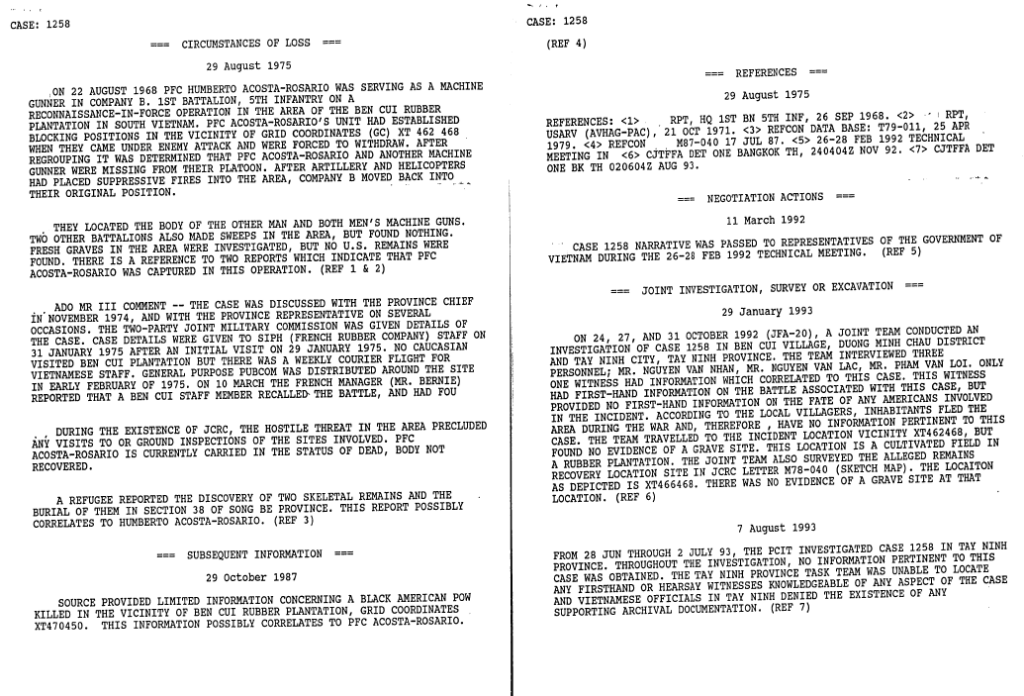
Acosta-Rosario deployed to Vietnam in March 1968. On August 22, 1968, his unit was stationed near the Ben Cui Rubber Plantation, owned by Michelin, a tire manufacturer. At 6:40 a.m., Company B departed Dau Tieng through an area of dense jungle. Shortly after 9:00 a.m., the group found North Vietnamese Army (NVA) hand grenades and web gear and came under heavy fire a few minutes later. The unit was forced to withdraw and called in airstrikes, artillery attacks, and helicopter support.
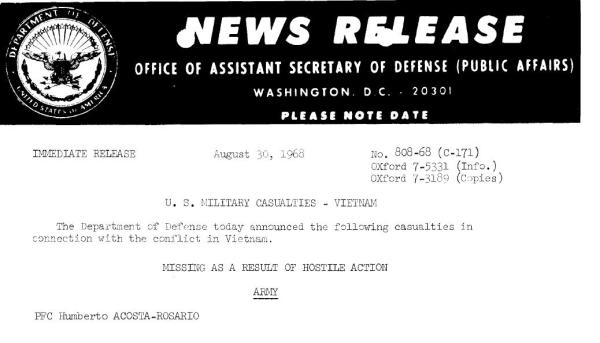
Once the company regrouped, they realized that two machine gunners were missing: Humberto Acosta-Rosario and Philip DiLorenzo, Jr. That afternoon, the unit returned to the area. DiLorenzo’s remains were recovered, and several wounded soldiers were evacuated for treatment. Acosta-Rosario’s remains were not found.
Conflicting reports indicated that Acosta-Rosario may have been taken as a Prisoner of War, but those were never confirmed, and his status was never changed to reflect that. He was last seen wearing a white t-shirt, jungle fatigue pants, a steel helmet, and a gold watch.

Commemoration
Humberto Acosta-Rosario was officially declared dead on March 1, 1978. Of the eighteen Puerto Ricans listed as Missing in Action during the Vietnam War, he is the only one whose remains have not been recovered.
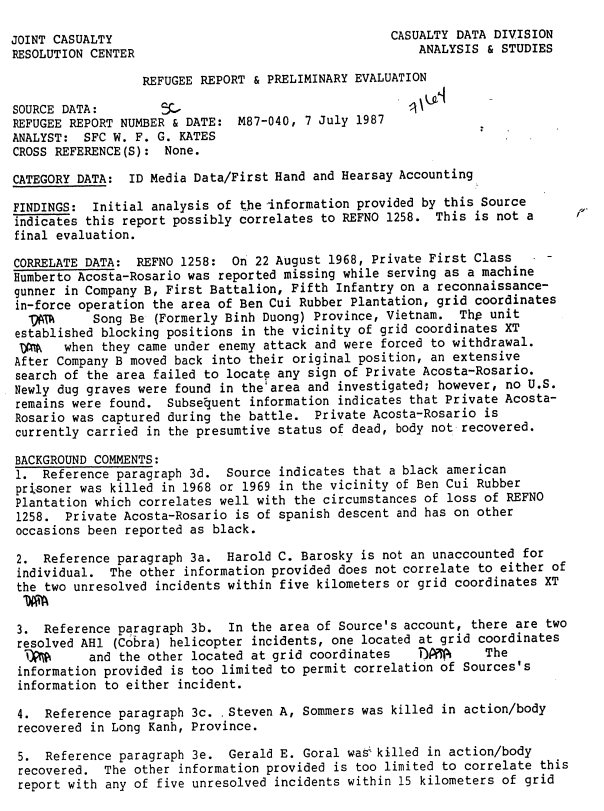
Extensive searches were conducted looking for Acosta-Rosario’s remains. Investigators from the Joint Casualty Resolution Center (JCRC) conducted a search in August 1975. The investigation continued through the 1990s, interviewing local villagers and Vietnamese refugees, and searching for graves. In 1987, investigators followed leads from a source, but were unable to identify any remains from this information.
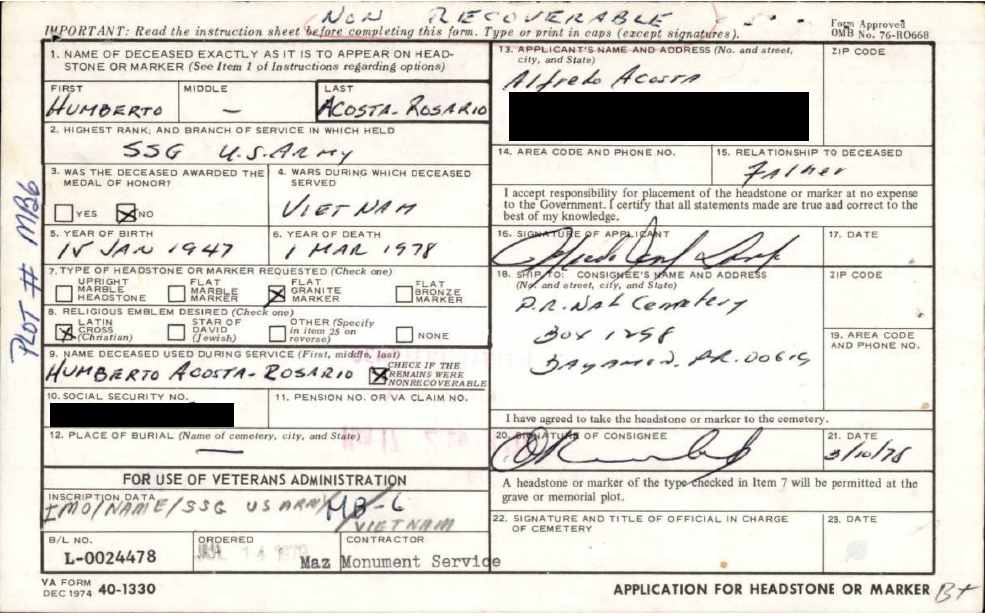
Humberto Acosta-Rosario was posthumously promoted to the rank of staff sergeant. His name is engraved on panel 47 of the Vietnam Memorial in Washington, D.C., and is listed on the El Monumento de la Recordación (the Memorial Monument) in San Juan, Puerto Rico. His name is memorialized on Court B of the Courts of the Missing at the Honolulu Memorial at the National Memorial Cemetery of the Pacific in Honolulu, Hawai‘i. Ten days after he was officially declared dead, his father requested that a memorial marker be placed at the Puerto Rico National Cemetery in Bayamon, Puerto Rico.
A recreation center in Mayagüez has been renamed in his honor.

Bibliography
Primary Sources
Alfredo Acosta and Carmen Rosario. Puerto Rico, Civil Registrations, 1885-2001. Digital images. https://ancestry.com.
“Asilo de Pobres.” National Register of Historic Places Inventory Nomination Form. U.S. Department of the Interior, National Park Service, 1985.
Asilo de Pobres. Photograph. 1923. Fundación Luis Muñoz Marín (85003087). https://prahadigital.org/s/flmm/item?uid=cf1111df-2938-11ef-a756-0242ac190002.
Atiles, Antonio. Supervisión de cosecha en una de las fincas del Colegio de Agricultura y Artes Mecánicas de Mayagüez. Photograph. 1955. University of Puerto Rico (1043020). https://upr.contentdm.oclc.org/digital/collection/ELM4068/id/1257/rec/10.
Avilés-Santiago, Manuel G. “From Sugar Fields to Rice Fields: An Oral History of Puerto Ricans from the Vietnam War Generation.” Journal of Veterans Studies 10(1): 2024, 48–63. https://journal-veterans-studies.org/articles/10.21061/jvs.v10i1.303.
Bigart, Homer. “Puerto Rican Nationalist Group and Carmichael Form Alliance.” The New York Times [New York, NY], January 27, 1967. https://www.nytimes.com/1967/01/27/archives/puerto-rican-nationalist-group-and-carmichael-form-alliance.html.
Brown Ramírez, Roy. “Monon.” Song lyrics. 1969. Vanguardia Disco Libre. https://genius.com/Roy-brown-ramirez-monon-lyrics.
Census Tracts: Mayaguez, P.R. Report. 1962. U.S. Census Bureau. https://censo.estadisticas.pr/sites/default/files/Decenal/USCB_CensusofPopulationandHousingPHC1-178CensusTractsMayaguez_1960.pdf.
“Humberto Acosta-Rosario. The Coffelt Database, December 2005 Update.” National Archives and Records Administration. https://aad.archives.gov/aad/record-detail.jsp?dt=1806&mtch=8615&cat=all&tf=F&q=B&bc=48&rpp=10&pg=9&rid=125&rlst=125.
“Humberto Acosta-Rosario. Combat Casualty Files, 6/8/1956-1/21/1998.” National Archives and Records Administration. https://aad.archives.gov/aad/record-detail.jsp?dt=197&mtch=1&cat=WR28&tf=F&q=acosta+rosario%2C+humberto&bc=,sl,sd&rpp=10&pg=1&rid=37995.
Humberto Acosta-Rosario. Manuscript/Mixed Material. Library of Congress (PWMASTER_114674). https://www.loc.gov/item/powmia/pwmaster_114674/.
Padilla, Victor. “Protestan Servicio Militar; Guerra Vietnam.” El Mundo [San Juan, PR], October 31, 1968. https://gpa.eastview.com/crl/elmundo/newspapers/mndo19681031-01.1.95.
Papleta Plebiscito. Model Ballot. 1967. José Celso Barbosa Statehood Library. https://www.scribd.com/doc/101231719/Papeleta-Plebiscito-1967.
Puerto Rico. Mayaguez. 1940 U.S. Federal Census. Digital images. https://ancestryclasroom.com.
Secondary Sources
“Acosta-Rosario, Humberto.” POW Network. Updated 2020. Accessed February 16, 2026. https://www.pownetwork.org/bios/a/a002.htm.
Black, Ashley Leane. “From San Juan to Saigon: Shifting Conceptions of Puerto Rican Identity during the Vietnam War.” The University of British Columbia, 2012. https://open.library.ubc.ca/media/stream/pdf/24/1.0072836/1.
Born, Kevin M, and Alexander F. Barnes. Desert Uniforms, Patches, and Insignia of the US Armed Forces. Schiffer Military History, 2016.
Cruz Mejias, Coraly. “Same War, Same Traumas: Vietnam Veterans Demand Better Treatment.” Global Press Journal [Washington, D.C.], October 24, 2022. https://globalpressjournal.com/americas/puerto-rico/war-traumas-vietnam-veterans-demand-better-treatment/.
“The First Battalion (Mechanized) Fifth Infantry Twenty-Fifth Infantry Division in the Viet Nam War 1966-1971.” 5th Infantry Regiment Association. Accessed February 16, 2026. https://classic.bobcat.ws/history1968.html.
Foley, Michael Stewart. “How the Vietnam War Prepared Puerto Ricans to Confront Crisis.” Waging Nonviolence. Updated October 6, 2017. Accessed February 16, 2026. https://wagingnonviolence.org/2017/10/puerto-rico-vietnam-war-hurricane-maria-independence/.
“Humberto Acosta-Rosario.” 5th Infantry Regiment Association. Accessed February 16, 2026. https://bobcat.ws/deceased-members/12423.
“Humberto Acosta-Rosario.” American Battle Monuments Commission. Accessed February 16, 2026. https://weremember.abmc.gov/s?q=*&type=16&criteria=title%3Dacosta-rosario&b=0&a=c&v=G.
“Humberto Acosta-Rosario.” Veterans Legacy Memorial, National Cemetery Administration. Accessed February 16, 2026. https://www.vlm.cem.va.gov/HumbertoAcostaRosario/48E50.
“Humberto Acosta-Rosario.” The Wall of Faces, Vietnam Veterans Memorial Fund. Accessed February 16, 2026. https://www.vvmf.org/Wall-of-Faces/167/HUMBERTO-ACOSTA-ROSARIO/.
“Humberto Acosta.” International Missing Persons Wiki. Accessed February 16, 2026. https://int-missing.fandom.com/wiki/Humberto_Acosta.
Kantrow-Vazquez, Michelle. “Bumble Bee Closing Mayagüez Plant after 50 Years, Leaving 260 Jobless.” News is My Business. Updated May 1, 2012. Accessed February 16, 2026. http://newsismybusiness.com/bumble-bee-closing-mayaguez-plant-after-40-years-leaving-200-jobless/.
Martinez, Andrew, and Nichole M. Garcia. “#HuelgaUPR: The Kidnapping of the University of Puerto Rico, Students Activism, and the Era of Trump.” Frontiers in Education 3 (September 2018). https://doi.org/10.3389/feduc.2018.00084.
“Mayagüez, Puerto Rico (2025 Guide) – All You Need to Know.” PuertoRico.com. Updated May 15, 2023. Accessed February 16, 2026. https://www.puertorico.com/mayaguez.
Renza, Victor. “‘No. 1 Gun’: An M60 Machine Gunner in Vietnam Tells His Story.” HistoryNet. Updated October 6, 2021. Accessed February 16, 2026. https://www.historynet.com/no-1-gun-an-m60-machine-gunner-in-vietnam-tells-his-story/.
“Staff Sgt. Humberto Acosta-Rosario.” Defense POW/MIA Accounting Agency. Accessed February 16, 2026. https://dpaa-mil.sites.crmforce.mil/dpaaProfile?id=a0Jt0000000KYY3EAO.
“SSgt Humberto Acosta-Rosario.” Find a Grave. Updated June 2, 2012. Accessed February 16, 2026. https://www.findagrave.com/memorial/91238900/humberto-acosta-rosario.
“SSgt Humberto ‘Cuco’ Acosta-Rosario.” Find a Grave. Updated February 25, 2000. Accessed February 16, 2026. https://www.findagrave.com/memorial/255124/humberto-acosta_rosario.
Staudenmaier, Michael. “Puerto Rican Independence Movement, 1898-Present.” In International Encyclopedia of Revolution and Protest. Immanuel Ness, Ed. Blackwell Publishing: 2009: 2766-2774. https://www.marxists.org/history/erol/ncm-8/history-independence-movement.pdf.
This profile was researched and created through the Researching Silent Heroes program, sponsored by the American Battle Monuments Commission.