

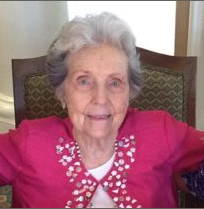
Corporal Inez Riley Moss
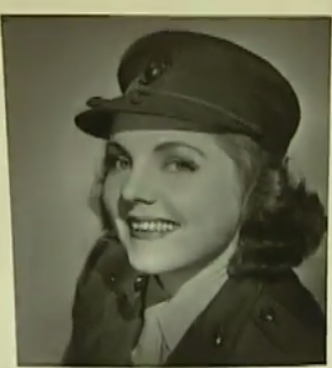
- Unit: Aviation Women’s Reserve Squadron-7
- Date of Birth: July 10, 1922
- Entered the Military: July 24, 1943
- Date of Death: June 9, 2014
- Hometown: Andalusia, Alabama
- Place of Death: Roswell, Georgia
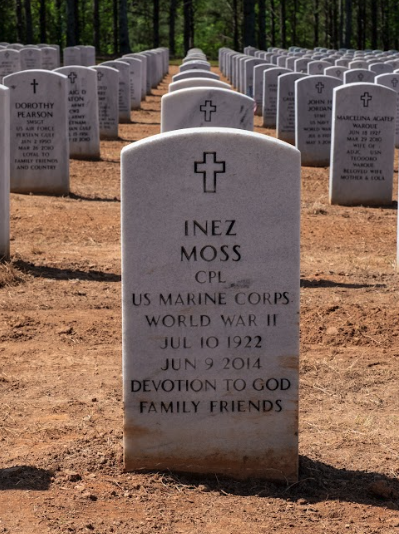
- Cemetery: Section 1, Site 1095. Georgia National Cemetery, Canton, Georgia
Mentored by Ms. April Balenger
Arts and Innovation Magnet Program, Winder, Georgia
2025/2026
Early Life
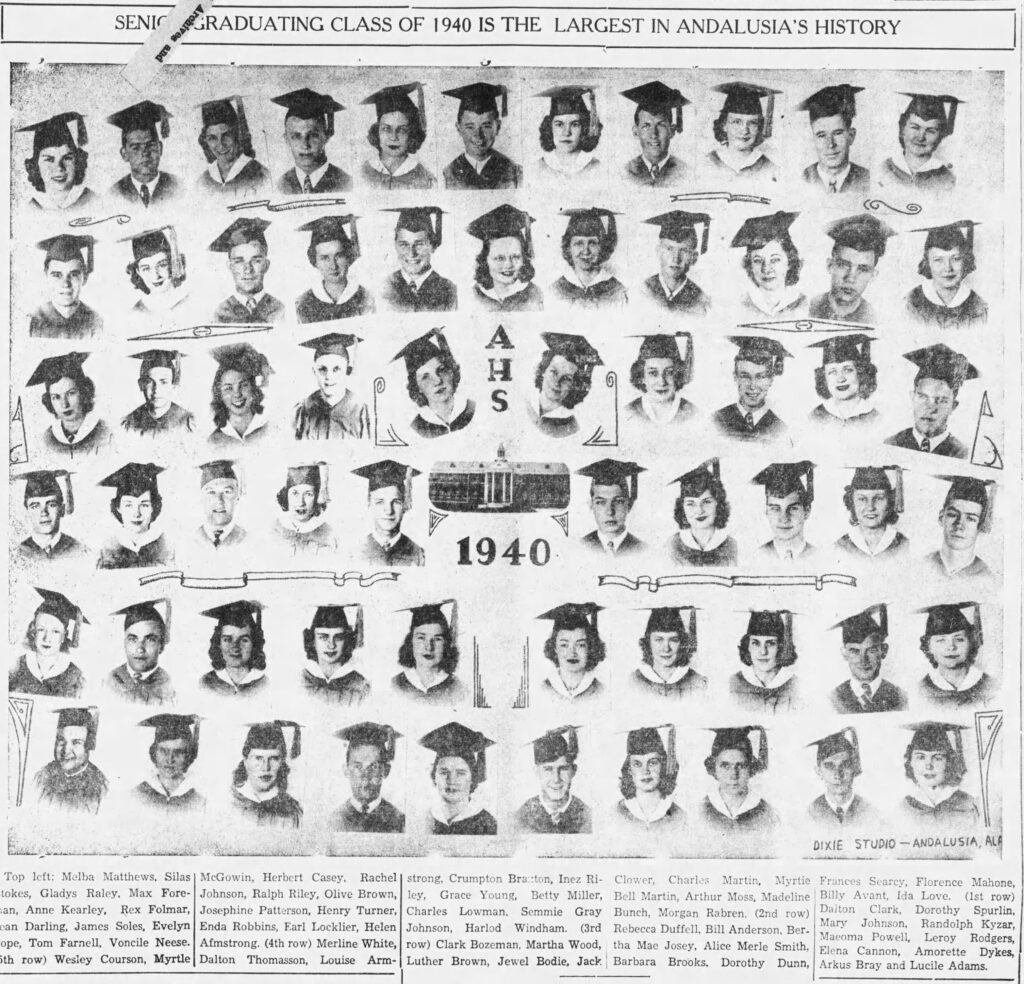
Inez Riley Moss was born on July 10, 1922, in Andalusia, Alabama, to John Daniel Riley and Inez Preston Riley. She had two younger sisters, Anna and Jonnie. Around the time she graduated from high school, the family was living in the same home as her maternal grandparents, Dr. A. J. and Ella Preston, and paternal grandmother, Anna Moss.
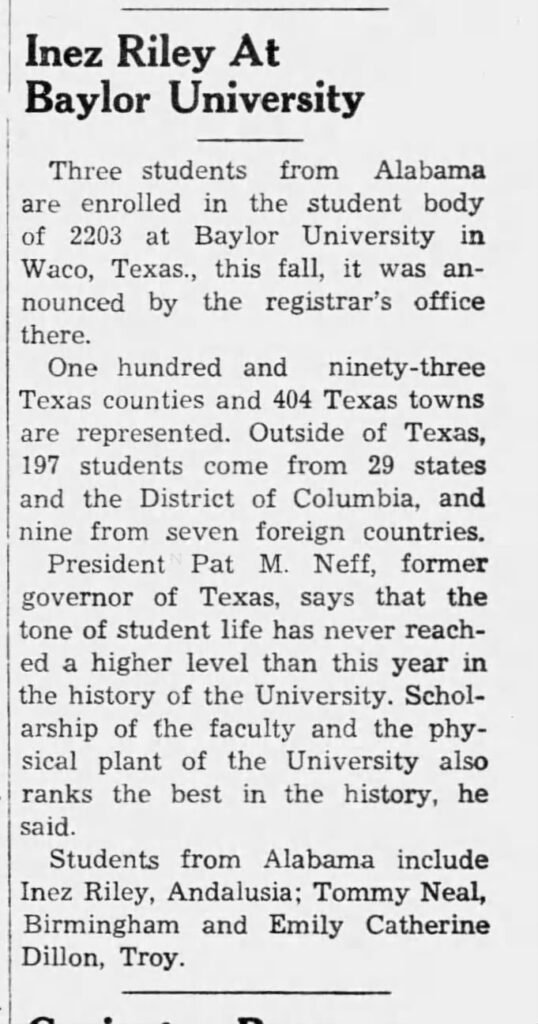
Riley graduated from Andalusia High School in 1940 and attended Mary Washington College in Fredericksburg, Virginia, for one year before transferring to the pre-med program at Baylor University in Waco, Texas. After passing out during an operation, she decided that being a doctor was not for her. During this time, she met a Marine, Paul Moss, and became engaged.

Homefront
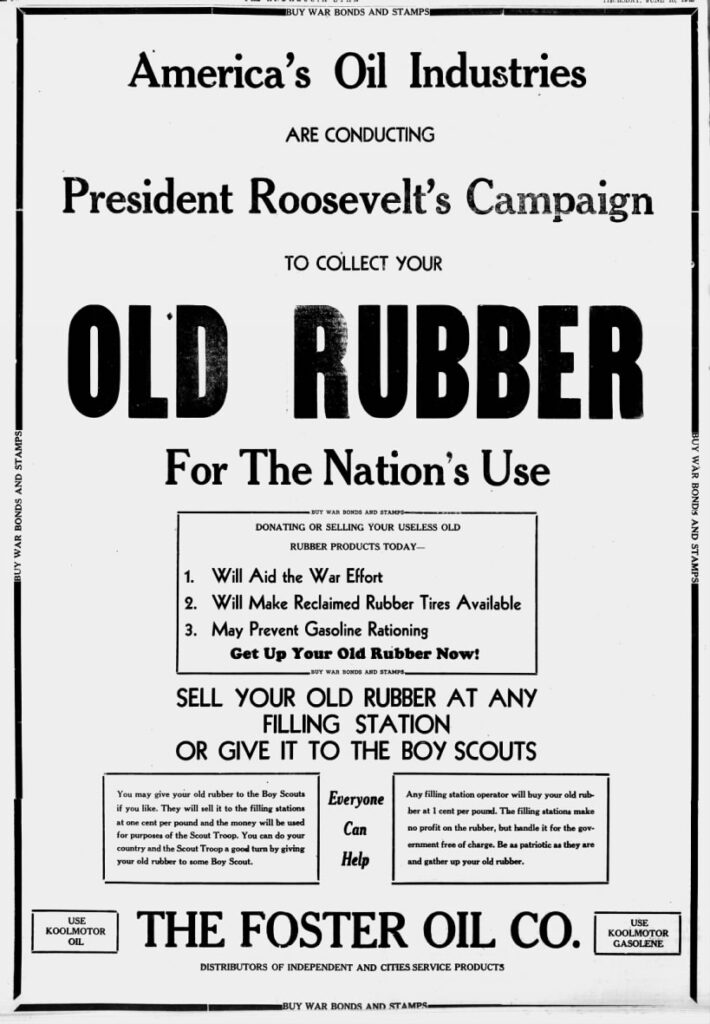
Andalusia, Alabama, is located about 100 miles south of Montgomery and 130 miles northeast of Mobile. In 1940, the population of the small town was just under 7,000. The state of Alabama made many significant contributions throughout World War II. Alabama manufacturing plants produced needed aluminum, textiles, and forestry products. Like most Americans, the citizens of Andalusia and the state of Alabama rationed food and other supplies needed for the war effort. They also held scrap drives to collect metals, iron, and steel.
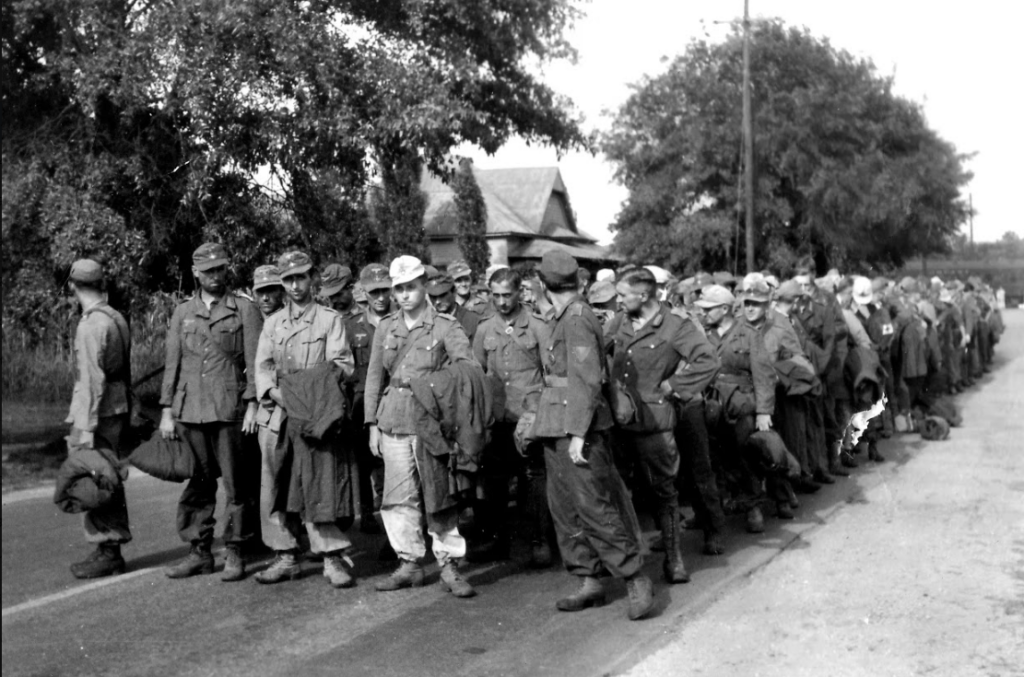
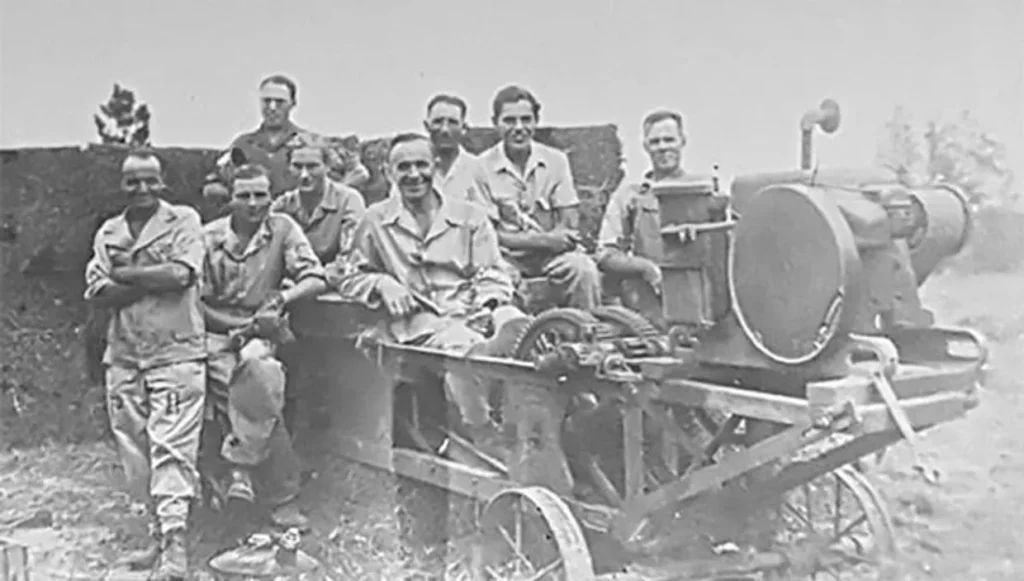
In addition, 24 prison camps were constructed in Alabama during the war. Approximately 16,000 German Prisoners of War (POWs) were detained in these camps. The largest of these was Camp Aliceville. The POWs provided agricultural labor, replacing workers who had left the South for better jobs in Northern manufacturing cities. The camps also established schools, and many of the prisoners took courses in math, science, and history as well as vocational training.
Military Experience
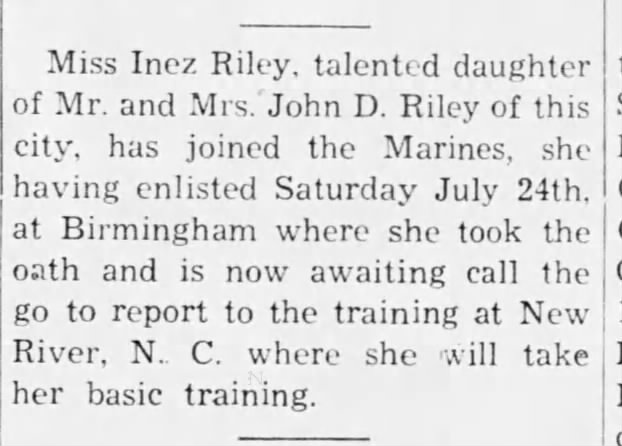
The surge of patriotism and national pride after America entered the war was one of the reasons Riley decided to enlist with the United States Marine Corps Women’s Reserve. There were no boys in her family, so as the oldest daughter, she wanted to represent Alabama.
The United States Marine Corps Women’s Reserve (USMCWR) was officially formed in February 1943. Its purpose was to free up men in stateside positions for combat overseas by replacing them with women. About 23,000 women served in the USMCWR during World War II.
Riley enlisted at the same time as another young woman from Andalusia, Annie Ruth Beasley. Together, they reported to Camp Lejeune, North Carolina, in September 1943. They participated in boot camp training that included physical exercises and drills. The women’s training was separate from the men’s, but they did have a dinner and dance to celebrate the Marine Corps’s birthday in November.
After boot camp, Riley and seven other women were sent to Lakehurst, New Jersey, for aerology training, a field of meteorology. From there, they were sent to the Marine Corps Air Station in El Toro, California, in February 1944. She worked in a weather office where she coded weather maps, recorded weather and wind data, and helped launch weather balloons to support military aviation.
While stationed in California, she stated in an oral history that she loved being so close to Hollywood, where she could spot celebrities. Also, she said that she, along with some other members of the USMCWR, were asked to be extras in the opera. They were told that they just had to move their lips.
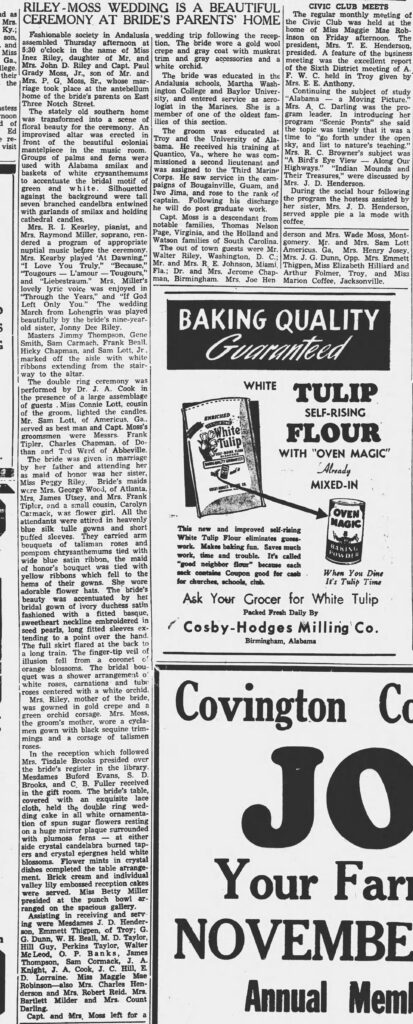
In May 1945, she was transferred to Cherry Point, North Carolina. She was in Washington, D.C. with her fiancé, Captain Paul Moss, on Victory in Japan Day (V-J Day) celebrations in September 1945. Corporal Inez Riley and Captain Paul Moss were married on November 1, 1945, in Andalusia. Their honeymoon was spent back at Cherry Point so she could leave the military. The custom at the time was that married women weren’t allowed to stay in the service.
Veteran Experience
After Riley, now Moss, left the military, the couple settled in Atlanta, Georgia. Moss had three children: a son, Grady, and two daughters, Anadora and Penny. In the 1950s and 1960s, she advocated to integrate students with visual and hearing disabilities into mainstream classes in Atlanta Public Schools. The family was active in the Second Ponce de Leon Baptist Church.
When her youngest daughter went to college, Moss began a career in real estate with Northside Realty and Buckhead Brokers that lasted over 20 years. In 1975, she and her husband, Paul, moved to Roswell, where they became involved in the Roswell Historical Society. Moss also belonged to the Daughters of the American Revolution (DAR), the Bridge Club, and the Alabama Club.
Moss credited the Marines with instilling in her a lifelong sense of adventure. She and her husband attended the dedication of the World War II Memorial in Washington, D.C. in 2004.

Commemoration
Corporal Inez Riley Moss passed away on June 9, 2014. She was interred at the Georgia National Cemetery next to her husband, Captain Paul Moss, who passed away in 2011.
Moss’s service in the United States Marine Corps Women’s Reserve provided critical weather information to support military operations. She continued to serve her community in Atlanta and Roswell as a civilian. Her dedication to her country, her family, and her community reflects a life of service, strength, and lasting impact.
Bibliography
Primary Sources
Alabama. Coventry County. 1930 U.S. Census. Digital Images. https://ancestry.com.
Alabama. Coventry County. 1940 U.S. Census. Digital Images. https://ancestry.com.
“America’s Oil Industries.” The Andalusian Star News [Andalusia, Alabama], June 18, 1942. Newspapers.com (196491842).
Georgia. Fulton County. 1950 U.S. Census. Digital Images. https://ancestry.com.
“Inez Riley at Baylor University.” The Andalusian Star News [Andalusia, Alabama], December 18, 1941. Newspapers.com (196490145).
“Miss Inez Riley.” The Andalusia Star-News [Andalusia, Alabama], July 29, 1943. Newspapers.com (196490482).
Oral History Interview of Inez Moss Riley. Oral history. February 4, 2004. Veterans History Project, Digital Library of Georgia. https://dlg.usg.edu/record/geh_vhpohr_268.
“Riley-Moss Wedding is a Beautiful Ceremony at Bride’s Parents’ Home.” The Andalusian Star News [Andalusia, Alabama], November 8, 1945. Newspapers.com (196490293).
Senior Graduating Class of 1940 is Largest in Andalusia’s History. Photograph. The Andalusian Star News [Andalusia, Alabama], May 30, 1940. Newspapers.com (196491368).
Secondary Sources
“Andalusia, Alabama Facts for Kids.” Kiddle Encyclopedia. Accessed May 9, 2026. https://kids.kiddle.co/Andalusia,_Alabama.
Gerlach, Michele. “German POWS Worked Here During WW II.” Andalusia Star-News [Andalusia, Alabama], August 26, 2016. https://www.andalusiastarnews.com/news/german-pows-worked-here-during-wwii-272873.
Hutchinson, Daniel. “World War II POW Camps in Alabama.” Encyclopedia of Alabama, August 1, 2024. https://encyclopediaofalabama.org/article/world-war-ii-pow-camps-in-alabama/.
“Inez Moss.” Veterans Legacy Project, National Cemetery Administration. Accessed May 8, 2026. https://www.vlm.cem.va.gov/INEZMOSS/0463328.
“Inez Riley Moss.” Find a Grave. Accessed May 8, 2026. https://www.findagrave.com/memorial/131142350/inez-moss.
“Mrs. Inez Riley Moss.” Northside Chapel. Accessed December 15, 2025. https://www.northsidechapel.com/obituaries/Inez-Moss/#!/TributeWall.
This profile was funded by a grant from the United States Department of Veterans Affairs. The opinions, findings, and conclusions stated herein are those of the author and do not necessarily reflect those of the United States Department of Veterans Affairs.