Private First Class Jack Jones
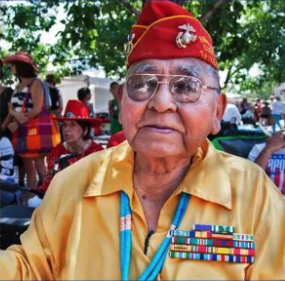
- Unit: 1st Marine Division
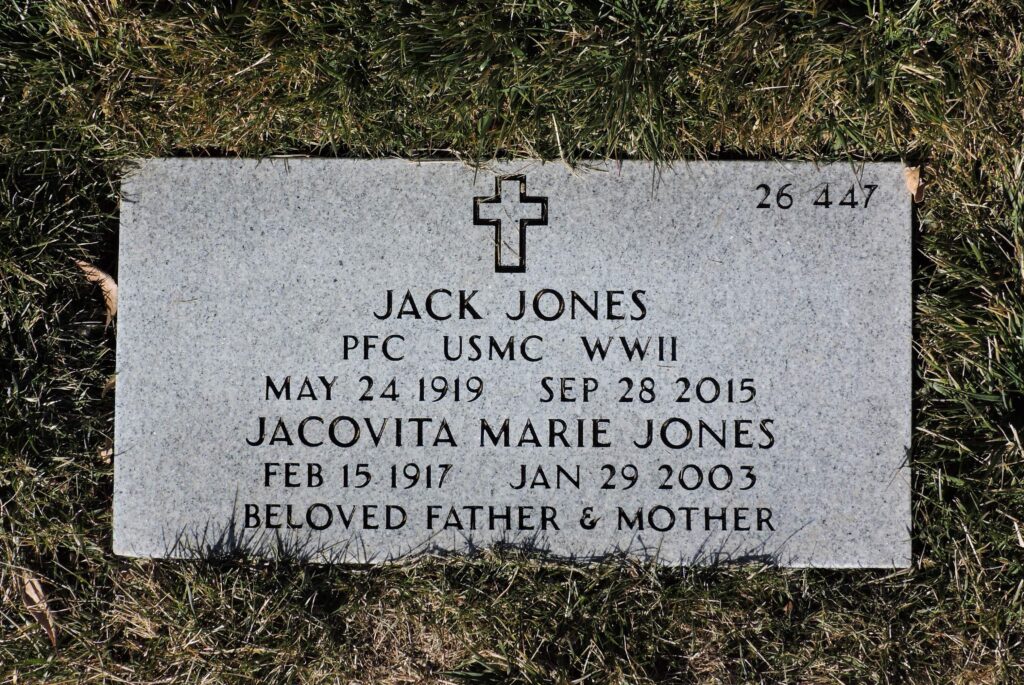
- Date of Birth: May 24, 1919
- Date of Death: September 28, 2015
- Hometown: Montezuma Creek, Utah
- Place of Death: Espanola, New Mexico
- Award(s): Congressional Gold Medal
- Cemetery: Section 26, Grave 447. Santa Fe National Cemetery, Santa Fe, New Mexico
Early Life
Jack Jones was born on May 24, 1919, near Montezuma Creek, Utah, in his family’s home. His mother gave Jack the name “nihíłka,” Navajo for “he came.”
His father, Albert Jones, was a sheepherder. His mother was given the name “John Red’s Sister” and was later listed in the 1933 and 1934 U.S. Indian Census Rolls as “Jones, Albert’s Wife.” It was common during this time for Census takers to list Native American women relationally, rather than by a personal name.
Jones was from the Tahneszahnii Dine’e (Tangle People) clan. They were originally from Monument Valley, but eventually moved to Montezuma Creek.
At age seven, Jones attended a boarding school about 60 miles away, in Shiprock, New Mexico. His parents were given a date and location to deliver him. They had to bring him down a canyon on horseback, about 25 miles to the meeting place. When his father got down off the horse, Jack stayed on. The gate made a loud noise and spooked the horse, which bolted with Jack on top. He eventually fell off farther down the road.
After all the students gathered at the trading post, they loaded onto the back of a truck together. At the school, there were students from Arizona, New Mexico, and Utah. Jones did not speak any English, but students were not allowed to speak Navajo. If he were caught speaking it, he would have to stand in line all day on Saturday and Sunday with other students who had also broken the rule. When the students went into the outdoor areas away from the school, they could play and speak their own language.
The school was organized in a military style. Students were required to wear uniforms and drill. Jones would later find the military transition easy because of this early training. Half the day was academic, and half was vocational training.
The students did get to go home for summer vacation.
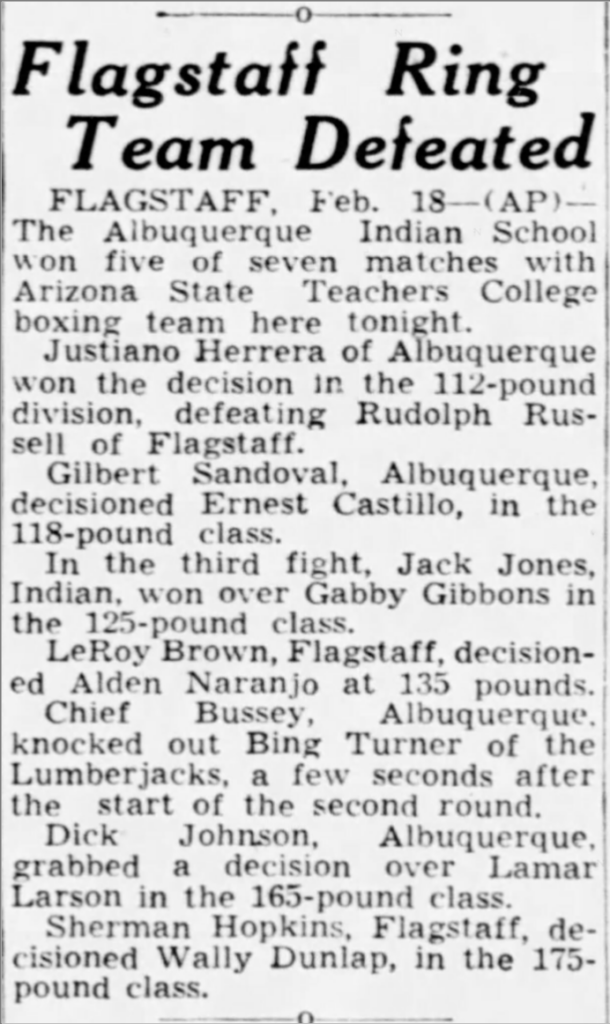
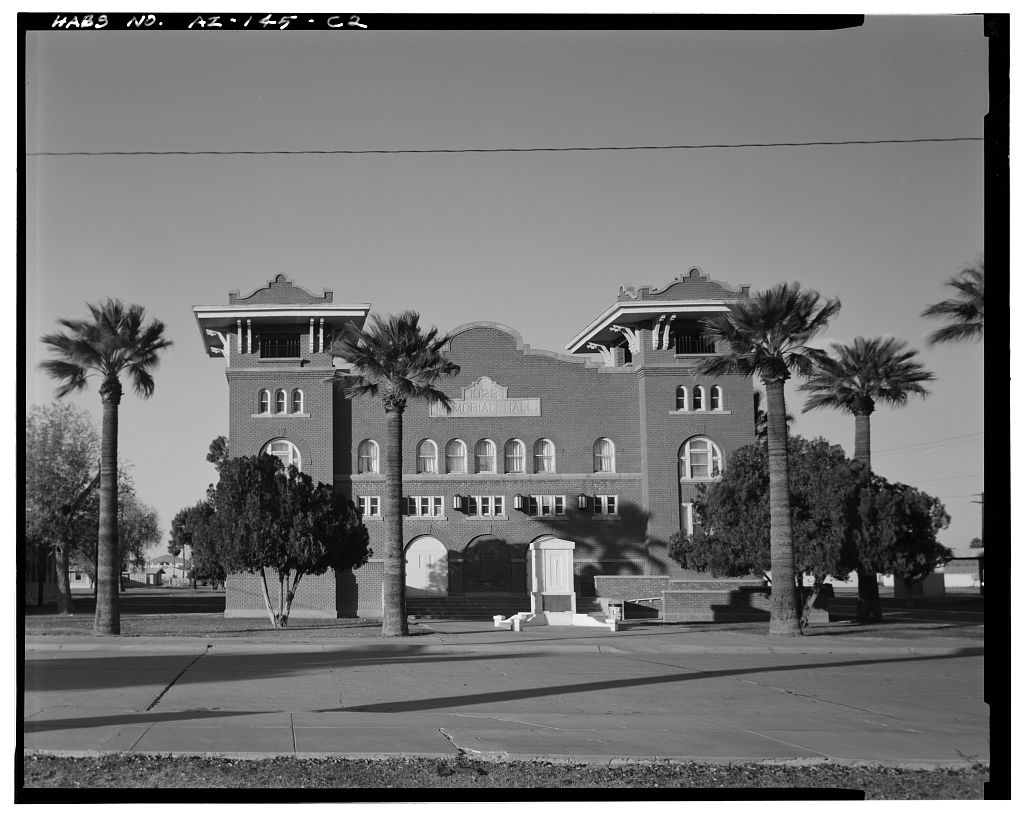
For his high school years, Jones attended the Phoenix Indian School, another boarding school, with Natives from other tribes. Jones stated that he learned to behave himself and was successful. He was a featherweight boxing champion there. He also participated in football and basketball. Jones graduated in 1937.
After leaving school, Jones worked as a house painter in many places. He later went to San Francisco, California, to work at a shipyard.

Homefront
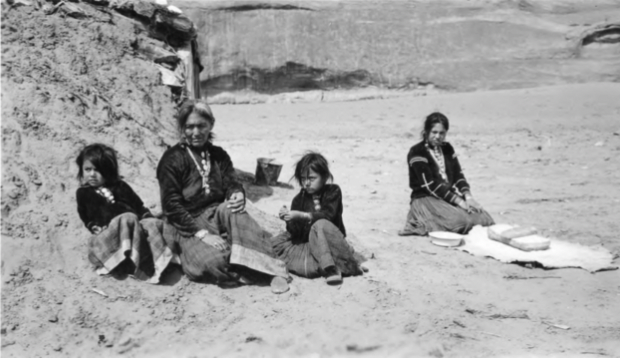
Monument Valley straddles the Arizona-Utah border and is part of the Navajo Nation. The Diné call it Tsé Bii Ndzisgaii, meaning “Valley of the Rocks.” The land is considered deeply sacred. For hundreds of years, the Navajo raised sheep and other livestock and farmed small quantities of crops in the valley. Montezuma Creek, where Jones was born, sits at the confluence of the San Juan River and the Montezuma Creek in San Juan County, Utah. The San Juan River was a traditional geographic boundary between the Navajo and the Ute territories. The area was contested in the early twentieth century, with White livestock owners pushing back on Native inhabitants until the lands were officially added to the reservation in March 1933.
Phoenix, Arizona, where Jones went to high school, was impacted greatly by the New Deal programs created in response to the Great Depression. During the late 1930s, men were employed through the Civilian Conservation Corps to work on infrastructure jobs, building and maintaining forestry infrastructure, and other natural resources jobs. The Works Progress Administration worked to feed students in Phoenix’s schools, set up day care centers for Black families, as well as relief gardens and soup kitchens. The agricultural industry would not rebound until the mid-1940s.
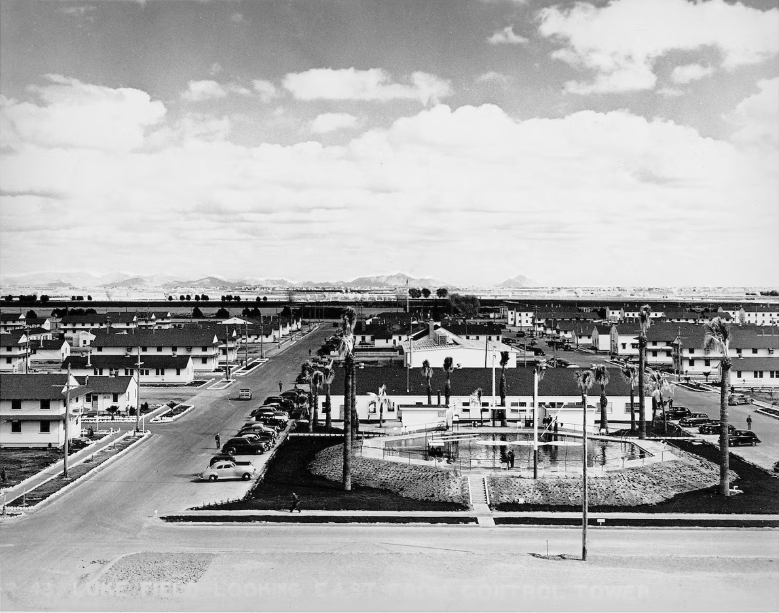
The area also received government funding for copper and uranium mining. Phoenix also leased land to the War Department to create the Litchfield Park Air Base, renamed Luke Field in 1941, and Luke Air Force Base in 1951. This air base brought in numerous military jobs, such as flight instructors, aircraft mechanics, administrative staff, and medical personnel. Luke Field was the largest single-engine advanced fighter pilot training base in the Army Air Forces during the war. Between 1941 and 1946, it graduated more than twelve thousand fighter pilots. Women Airforce Service Pilots (WASPs) were also assigned to Luke Field, where they served as test pilots, ensuring that aircraft were airworthy before male pilots flew them. Across their wartime service, WASPs flew more than sixty million miles and delivered over twelve thousand aircraft of seventy-eight different types.
Military Experience
Jack Jones enlisted in the United States Marine Corps in 1943. He completed boot camp in San Diego, California. Jones then joined the 1st Marine Division for the New Britain Campaign as a Navajo Code Talker. On land, he helped to communicate and coordinate efforts that would be unusable by the enemy.
After New Britain, Jones went to the Russell Islands to prepare for the next operation. The Russell Islands served as a training area where they drilled and perfected their code talking. While there, they connected with the land and animals, but they could not make contact with the Natives.
After this training, Jones participated in the Battle of Peleliu in September 1944. He landed with the third wave and met heavy resistance on the beach. He recalled there being many mines on the beach as well as many fallen comrades floating in the water. He said they had to run and walk their way up the beach. Once on the island, they used their Navajo Code to bring in air support and naval gunfire support for the Marines to continue their advance.
During this battle, Jones was injured when a Japanese artillery round exploded close to him. The blast rendered him unconscious, and he had no memory of what followed until he woke up in a medical facility. He was evaluated at a naval medical facility on Guadalcanal and then sent back to the United States in 1944. There, Private Jones was hospitalized at the Naval Hospital in San Francisco for a week before being moved to the Naval Hospital in Oceanside, California, where he was treated for injuries to his eyes and ears, as well as injuries that nearly cost him his teeth.
Throughout his service, Jones remained a private first class. When asked about it during an interview, he said, “We mingled with Anglo people and other nationalities, but if you had dark skin, you didn’t get any promotion. There was discrimination involved — that’s what held us down.” He did recall that as code talkers, they were treated as professionals and they felt very appreciated by their commanding officers.
In November 1945, Jones was honorably discharged at Puget Sound Naval Shipyard in Bremerton, Washington.
Veteran Experience
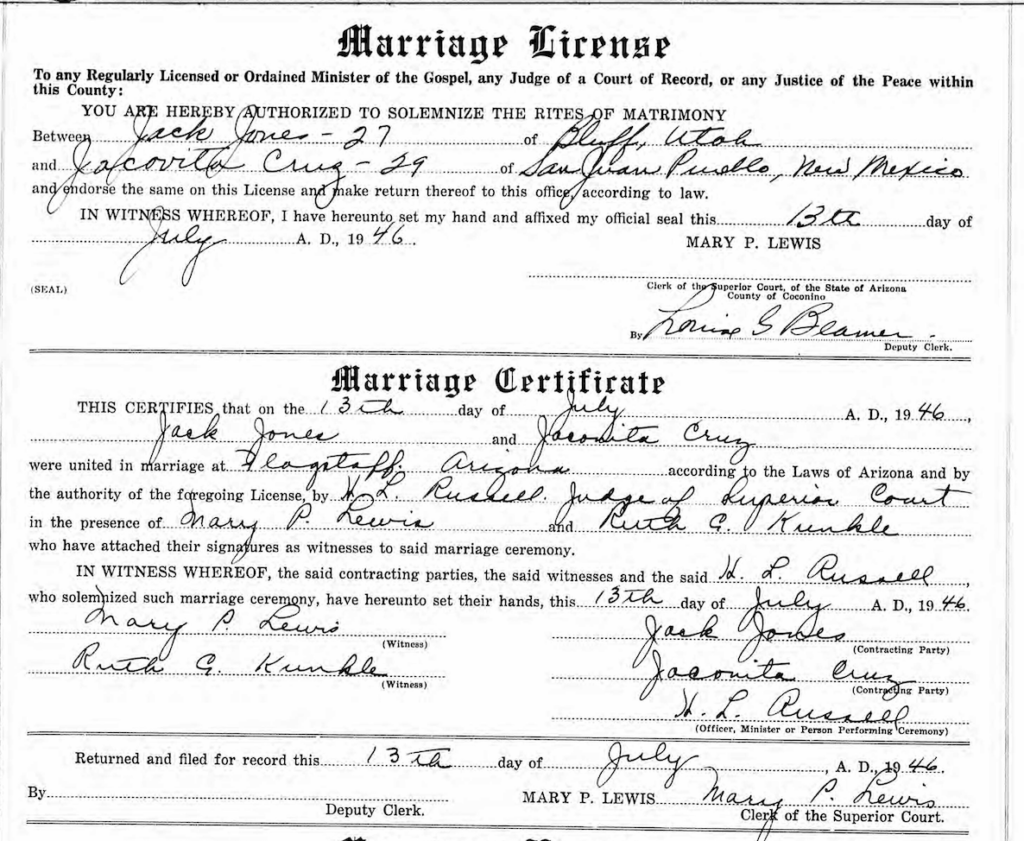
Jones married Jacovita Marie Cruz on July 13, 1946, in Coconino, Arizona. They had a daughter, Irene, in 1948 and lived in Rio Arriba, New Mexico. They eventually had another daughter, named Antionette.
In 1950, Jones worked as a self-employed painter and was a member of the local union. After moving back to his homeland and reconnecting with his family, he became involved in a legal battle to restore Navajo land rights in the Montezuma Creek area of Utah. They wanted to restore land to the Kaayellii Dine people who lived in Montezuma Creek before Utah became a state in 1896.
Jones participated in various Code Talker sessions across the region, as well as powwows. He also gave an address to the Clovis chapter of the American Association of Retired Persons, where he discussed the Native American struggle to receive recognition for their service. For instance, he shared that after he returned from service, he was told he could not vote in the upcoming elections.
In 1982, President Ronald Reagan declared August 14 as “National Navajo Code Talkers Day.” Later, in 2001, the original 29 Navajo Code Talkers were honored with Congressional Gold Medals. The Code Talkers Recognition Act of 2008 honored all Native American code talkers.
Jones lost his wife, Jacovita, on January 29, 2003.

Commemoration
Jack Jones passed away on September 28, 2015. He was buried with his wife at Santa Fe National Cemetery in Santa Fe, New Mexico.
Bibliography
Primary Sources
“Code talker shares experiences.” The Eastern New Mexico News [Clovis, New Mexico], September 23, 2005. https://www.easternnewmexiconews.com/story/2005/09/23/news/code-talker-shares-experiences/102541.html.
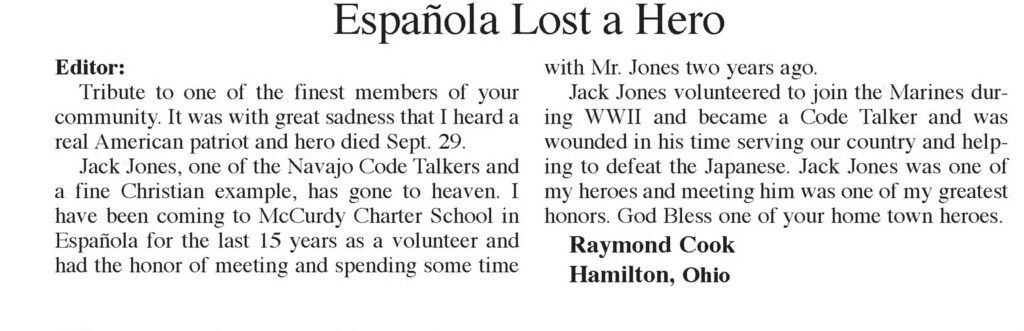
“Española Lost a Hero.” Rio Grande Sun [Espanola, New Mexico], October 8, 2015. Newspapers.com (550244139).
“Flagstaff Ring Team Defeated.” The Arizona Republic [Phoenix, Arizona], February 19, 1939. Newspapers.com (116844832).
Jack Jones. Arizona, U.S., County Marriage Records, 1865-1972. Digital images. http://ancestryclassroom.com.
Jack Jones. Photograph. Veteran of the Day, VA News. https://news.va.gov/64236/veteranoftheday-marine-veteran-jack-jones.
Jack Jones. U.S., Indian Census Rolls, 1885-1940. Digital Images. http://ancestryclassroom.com.
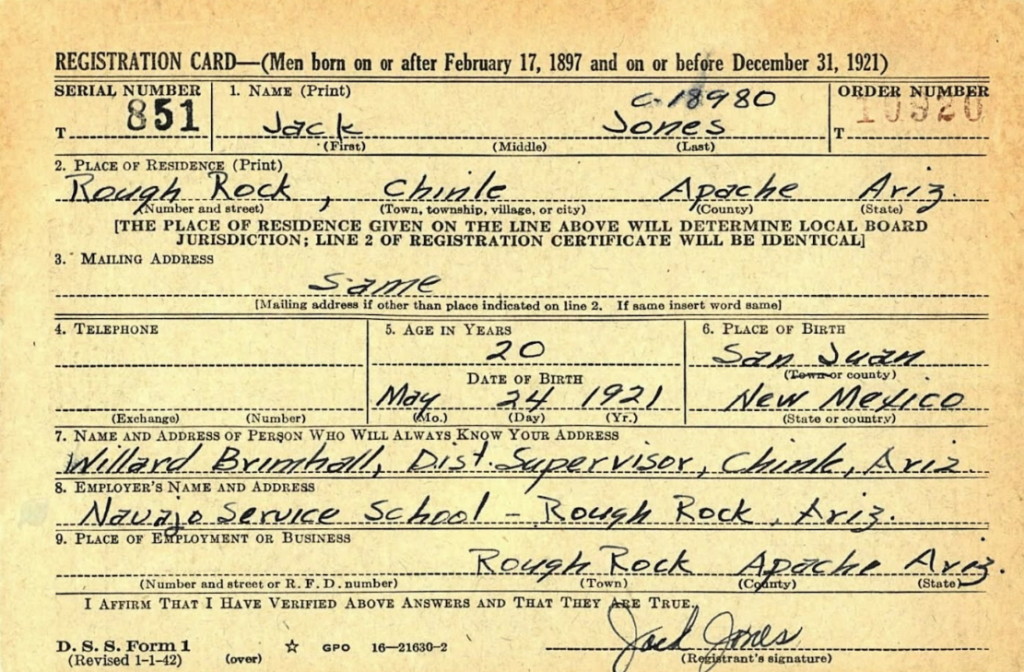
Jack Jones. U.S., World War II Draft Cards Young Men, 1940-1947. Digital Images. http://ancestryclassroom.com.
Jones, Jack. “Personal Narrative.” Interview by Don Chalmers Ford, Warren C. Solomon, and Carol Ellison Fleming. June 2, 2004. Veterans History Project. Library of Congress, https://www.loc.gov/item/afc2001001.52526/#item-service_history.
“Luke Air Force Base.” Air Education and Training Command. Accessed May 14, 2026. https://www.aetc.af.mil/About-Us/Fact-Sheets/Display/Article/558879/luke-air-force-base/.
“Luke Field History.” Luke Field Arizona. Accessed May 14, 2026. https://lukefieldaz.com/luke-field-history/.
New Mexico. Rio Arriba. 1950 U.S. Census. Digital Images. http://ancestryclassroom.com.
“Seek Racial Safeguards in National Hospital Act.” The Phoenix Index [Phoenix, AZ], March 9, 1940. https://azmemory.azlibrary.gov/nodes/view/104854?keywords=Master+list+of+state+government+programs&type=all&highlights=WyJNYXN0ZXIiLCJsaXN0Iiwib2YiLCJzdGF0ZSIsImdvdmVybm1lbnQiLCJwcm9ncmFtcyJd#idx383086.
South Facade from South – Phoenix Indian School… Photograph. Historic American Buildings Survey Collection, Library of Congress. https://www.loc.gov/pictures/item/az0413.photos.180639p/.
Secondary Sources
“75 Years of AETC: Luke’s Role in the Mission.” Luke Air Force Base. Accessed May 15, 2026. https://www.luke.af.mil/News/Article-Display/Article/1112412/75-years-of-aetc-lukes-role-in-the-mission/.
“Arizona and the Great Depression.” The Square PHX. Last modified February 1, 2024. Accessed December 7, 2025. https://thesquarephx.org/news/arizona-and-the-great-depression/.
“Copper State, Red Lines: The Long Battle Against Racial Injustice in Phoenix.” Phoenix Magazine. Last modified August 19, 2020. Accessed December 7, 2025. https://www.phoenixmag.com/2020/08/19/copper-state-red-lines/.
“Jack Jones.” Find a Grave. Accessed November 1, 2025. https://www.findagrave.com/memorial/153113139/jack-jones.
“Jack Jones.” Veterans Legacy Memorial, National Cemetery Administration. Accessed November 1, 2025. https://www.vlm.cem.va.gov/JACKJONES/FE704D9.
“Jacovita Marie Jones.” Find a Grave. Accessed November 12, 2025. https://www.findagrave.com/memorial/17562782/jacovita_marie-jones.
“Navajo Indians.” History to Go. Utah. Accessed November 29, 2025. https://historytogo.utah.gov/uhg-first-peoples-navajo-indians/.
Tohe, Laura. Code Talker Stories. Tucson: Rio Nuevo Publishers, 2012.
“World War II- Reclamation, Arizona, and Hoover Dam.” U.S. Department of Interior. Accessed December 7, 2025. https://www.usbr.gov/lc/phoenix/AZ100/1940/index.html.
This profile was funded by a grant from the United States Department of Veterans Affairs. The opinions, findings, and conclusions stated herein are those of the author and do not necessarily reflect those of the United States Department of Veterans Affairs.