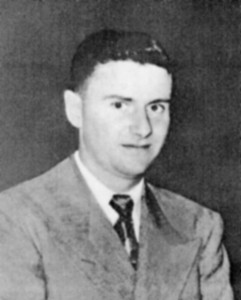
Corporal Jacob “Bill” William Allmaras
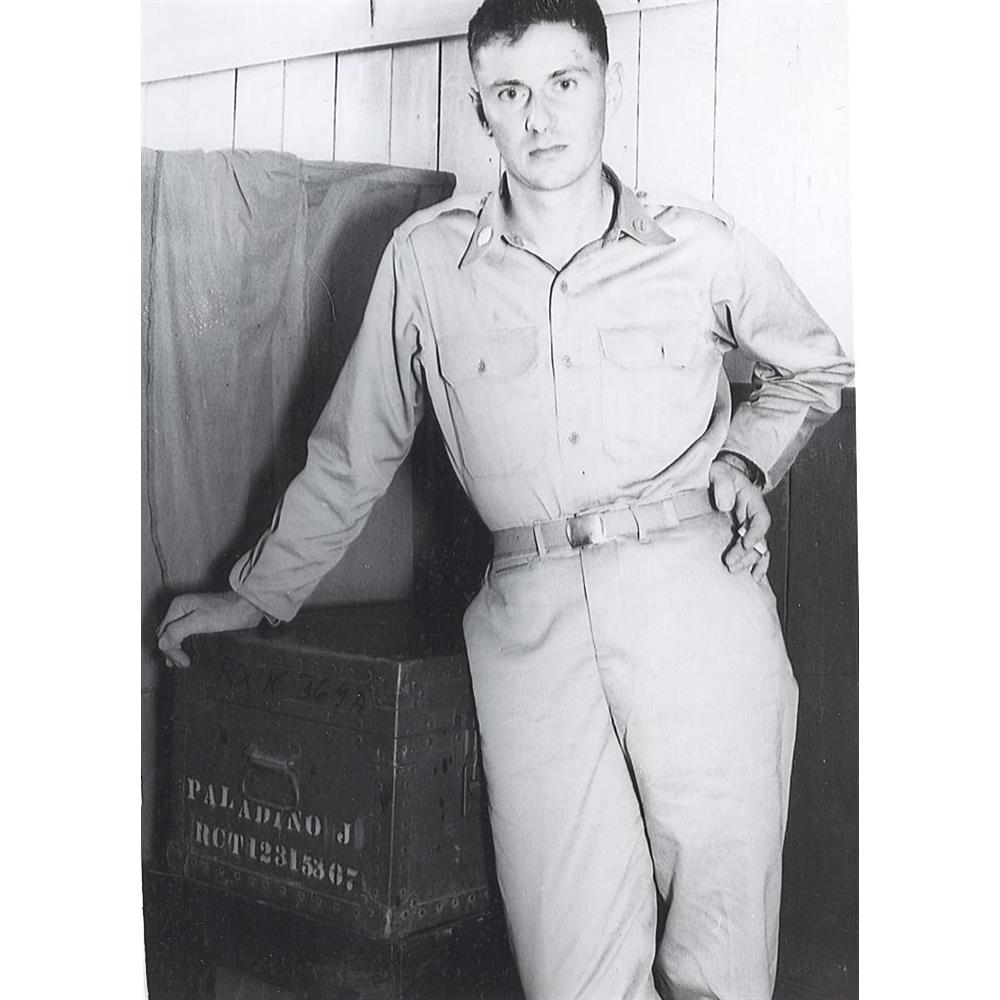
- Unit: 2nd Infantry Division, 38th Infantry Regiment, 3rd Battalion, Company K
- Service Number: 55012723
- Date of Birth: February 8, 1942
- Entered the Military: January 4, 1949
- Date of Death: June 1, 1953
- Hometown: New Rockford, North Dakota
- Place of Death: Kiwaji-Mal, South Korea
- Award(s): Army Occupation Medal of Japan, Purple Heart with Oak Leaf Cluster, Combat Infantryman Badge, Korean Service Medal, United Nations Service Medal, National Defense Service Medal, Korean Presidential Unit Citation, and the Republic of Korea War Service Medal
- Cemetery: Court of the Missing, Court Four, National Memorial Cemetery of the Pacific, Honolulu, Hawai‘i. and Plot B, Site 003, North Dakota Veterans Cemetery, Mandan, North Dakota
Heritage Middle School, Horace, North Dakota
2025/2026
Early Life
Jacob Allmaras, known to his family and friends as Bill, found himself driving an oil truck through Eddy country in rural North Dakota in August 1950 when his military orders arrived, notifying him that he would be going to Korea. Bill was the child of first-generation Americans and grew up on a homestead near his German immigrant grandparents. Their family was no different from many around them—they left Germany in the late 1880s and resettled in the fertile plains of North Dakota to achieve the American Dream one summer growing season at a time.
The Allmaras family is described by Bill’s daughter, Jean, as “ . . . very Catholic. We’ve got nuns and priests in this family. They’re very Catholic.” Like many Catholic families, Bill’s parents, William and Katherine Allmaras, focused on their family. Together, they had ten children that they raised on their homestead in rural Eddy County near William’s parents, Jacob and Mary Allmaras. In birth order, the children were: Elizabeth, Catherine, Bill, Theodore, Edward, Helen, Donald, Alfred, Avis, and Lawrence. In the 1940 census, the children ranged in age from five to eighteen years old.
Schooling
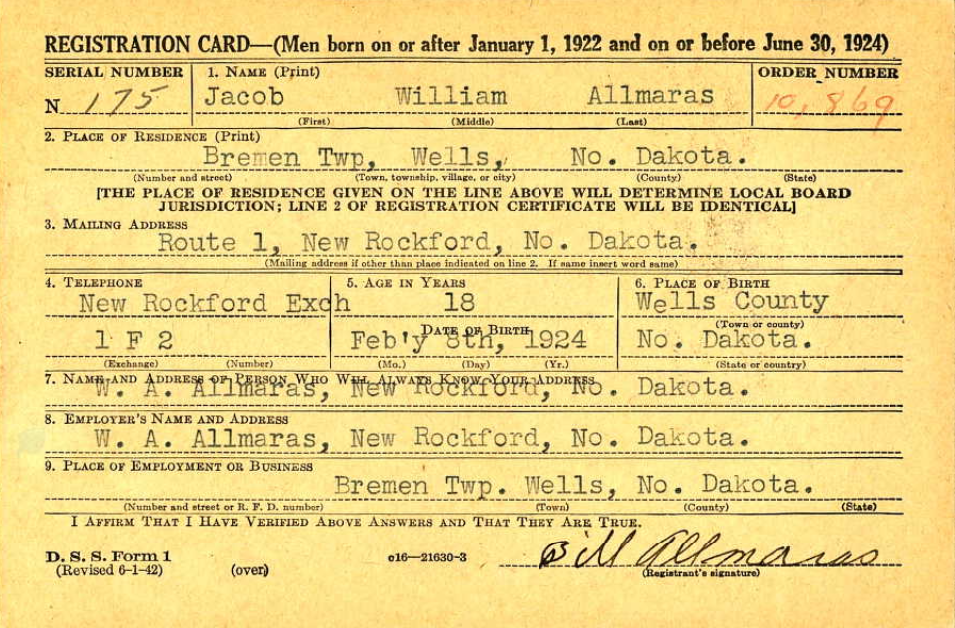
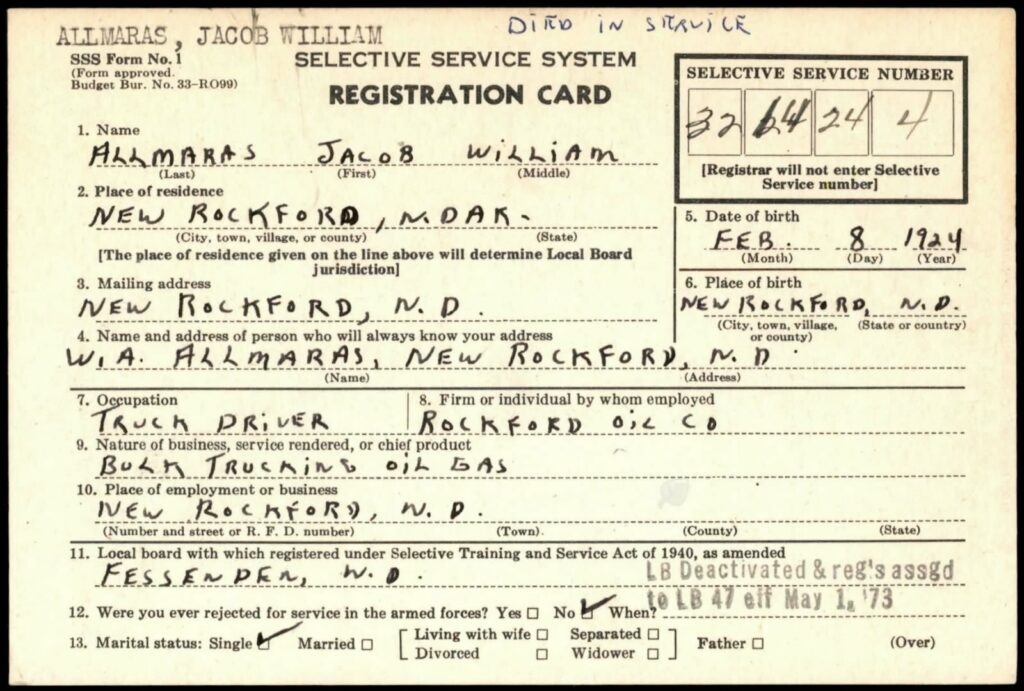
While the opportunity existed to send their children to the local Catholic school, William and Katherine instead sent them through the public school system. In turn, Bill graduated from New Rockford Public School in 1942, just six months after the Japanese bombing of Pearl Harbor. Bill celebrated his eighteenth birthday in February of his senior year of high school with a draft card. However, his job as an oil truck driver was deemed essential and kept him from being drafted.
After graduating and starting his career, Bill moved in with his grandparents, who were advancing in age. During this time, he met a young woman named Alice O’Connor who caught his eye. While Alice finished her own education at St. James Academy, Bill patiently waited for her. After completing high school, Alice moved into her own apartment and became a stenographer in a local doctor’s office. While she did not know it at the time, her touch of independence at such a young age would follow her her entire life.
Cold War Era
Later, the Cold War fostered fear among Americans. In 1948, President Harry S. Truman enacted the Selective Service Act, establishing the first peacetime draft. Bill Allmaras, a man whose job had been deemed essential to the home front in World War II, completed yet another draft card on September 3, 1948.
Even though Japan surrendered to the United States on September 2, 1945, the United States maintained a strong presence in the country. On January 4, 1949, Allmaras enlisted in the U.S. Army and served in the occupation force in Japan.
Alice and Bill were married on June 27, 1950, in a ceremony at St. John’s Catholic Church in New Rockford, North Dakota, just two days after the United States made its intentions in Korea known. Less than two months into their marriage, Allmaras prepared for a two-day trip to Fargo, North Dakota. On August 29, 1950, he received orders to report to Fargo for a final physical examination. The Cold War was getting hot, and he was about to be sent to the front lines.
On September 4, 1950, Allmaras arrived in Fargo, North Dakota, to undergo his physical examination and returned to New Rockford on September 6. He was given a short 21 days to get his affairs in order and a small travel stipend of $23.46 for his time away from home.
While their time together was short, Alice and Bill created one of the most precious things in the world – a daughter. Alice and Bill’s daughter, Jean Allmaras, was born in May 1951.
Homefront
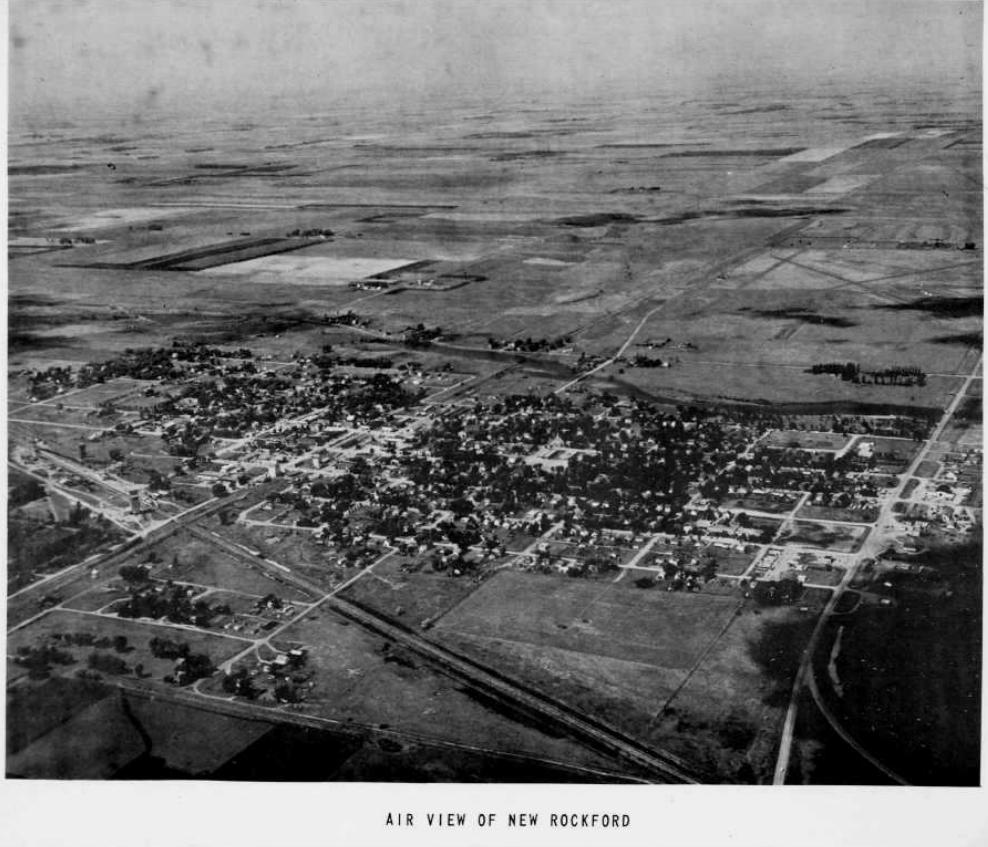
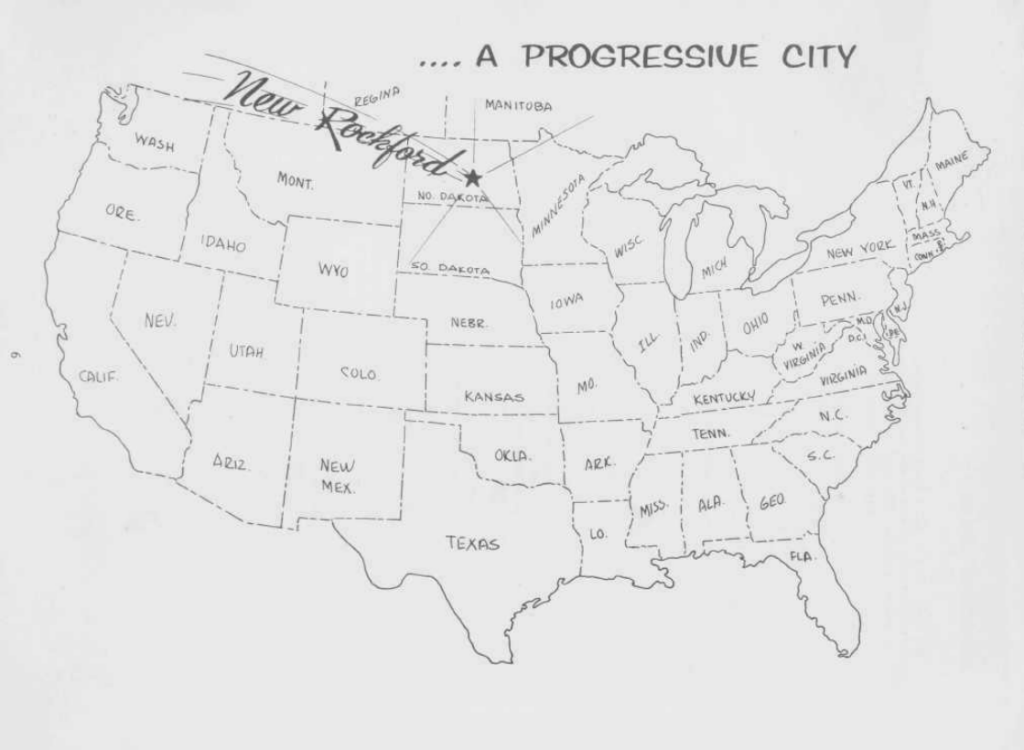
New Rockford, North Dakota, is the quintessential North Dakota town. Nestled in the plains of central North Dakota in rural Eddy County, the railroad and the local grocery store are the busiest places in town. New Rockford did not pop up overnight. Rather, the area was surrounded by homesteads and farms that eventually adopted more mechanized farming methods. As a result, the rural population declined, and New Rockford’s population began to steadily grow in the 1940s. By 1965, New Rockford had a population of about 2,600.
Following World War II, New Rockford started to blossom in many industries. The turkey industry showed strong growth as many experienced farm workers moved into the area. The area ranked twentieth in the nation in turkey production, largely due to the presence of a Swift poultry plant.
While many flocked to the town, agriculture did not suffer. Corn, sugar beets, and wheat production continued to expand in the area. This was aided by the railroad, which consisted of the meeting of two major lines, a mail distribution center, and a switchover point, which earned New Rockford the nickname “Midway City.” The opportunities felt endless in New Rockford, and if not, residents could always catch a train to Chicago, Illinois. But the city often found itself with more workers than available jobs.
New Rockford boasted a large number of realtors, 11 car dealerships and repair locations, and seven bulk oil agents. They had a weekly publication, The New Rockford Transcript, and citizens of New Rockford could purchase daily newspapers, including the Fargo Forum, the Minot Daily News, or the Minneapolis Tribune. While their physical geography may have kept the people of New Rockford secluded, they remained well-informed and engaged in the world around them.
North Dakota and The Cold War
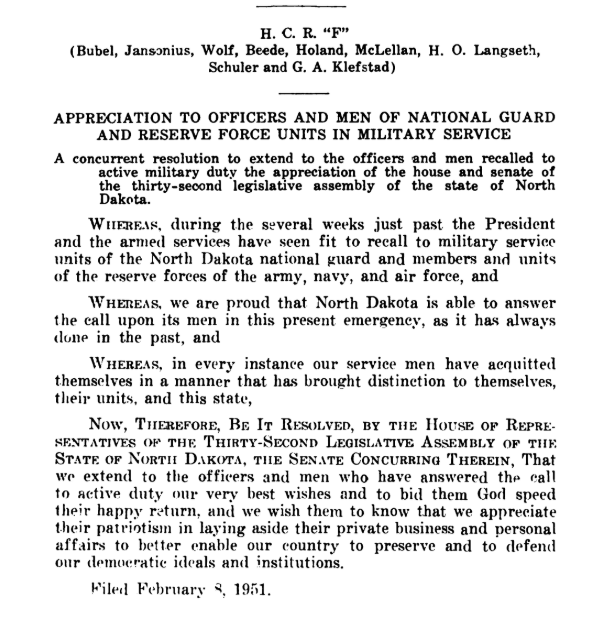
As the war in Korea raged on, the North Dakota legislature crafted their own response.
In January 1951, a few months after Allmaras was called up to active duty, the North Dakota legislature convened its regular session. North Dakota’s legislature meets every other year unless a special session is called. 1951 was a regular session; the docket was full of resolutions and bills to discuss.
North Dakota has consistently been considered a conservative state, voting for the Republican candidate in 28 of the 34 presidential elections it has participated in. In the 1951 regular session, the North Dakota legislature passed four resolutions concerning the conflict in Korea.
The first resolution, titled A concurrent resolution to extend to the officers and men recalled to active military duty the appreciation of the house and senate of the thirty-second legislative assembly of the state of North Dakota, showed the state’s appreciation to the soldiers who answered the call to service stating, “ . . .our best wishes and to bid them God speed their happy return, and we wish them to know that we appreciate their patriotism in laying aside their private business and personal affairs to better enable our country to preserve and to defend our democratic ideals and institutions.”
The second resolution was pushed by the Agriculture Committee to ask that the draft allow deferments to “essential farm help in the state of North Dakota” and that “no farm boys or farm help be drafted or inducted into the service of the United States where such draft will materially reduce the operation of farm units . . . ”
The third called for sympathy and support for men in the armed forces. “ . . . sorrow came to many homes in our state because their sons went forth to war, never to return to their parents.”
The fourth, A Withdrawal of Troops from Korea, asked that the president and Congress remove all troops and military personnel from Korea, recognized that this conflict had not been approved by Congress, and disassociated the state from Korea.
While North Dakota’s lawmakers opposed the United States’ involvement in Korea, they did not waver in supporting the brave men of North Dakota who answered the call to duty. In New Rockford alone, three men from the community were killed in Korea.
If the Cold War were to turn hot in the United States, the state of North Dakota wanted its citizens to be prepared. Jean, Bill Allmaras’s daughter, recalled participating in air-raid drills at her school in Valley City, North Dakota. The state of North Dakota also volunteered to run a 24-hour watch program called “Operation Skywatch,” which required about 300 volunteers to observe the skies. Additionally, many North Dakotans were encouraged to have access to a fallout shelter in case of a nuclear attack. In a 1967 survey, only 31% of the state’s population lacked this access.
Military Experience
World War II
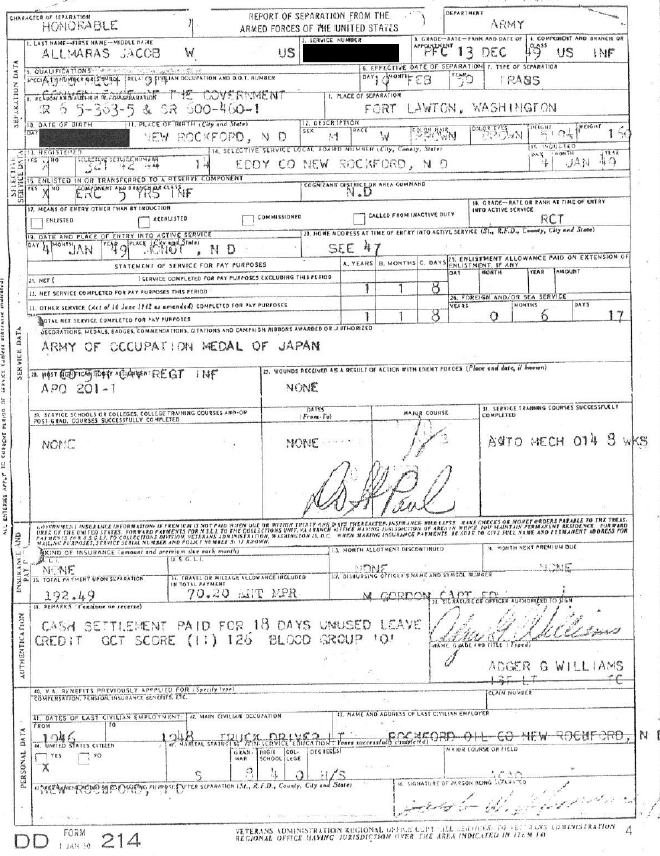
When Allmaras enlisted in the U.S. Army in 1949, he completed basic training and additional auto-mechanic training. His work as an oil truck driver in New Rockford prepared him to support the U.S. Army by repairing vehicles. After completing training, Allmaras was sent to Japan, where he spent a six months and 17 days as part of the U.S. occupation force.
In February 1950, the United States began drawing down its forces in Japan, and so Allmaras was sent home. He was separated at the government’s convenience. His time in Japan was enough to earn him the Army Occupation Medal of Japan. Upon his return home, Allmaras entered the U.S. Army Reserve, resumed his job as an oil truck driver, and married his wife.
Korean War
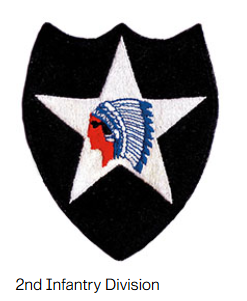
Allmaras was recalled to duty in August 1950 and assigned to the 2nd Infantry Division, 38th Infantry Regiment, 3rd Battalion, Company K. The 2nd Infantry Division became the most decorated Division in the Korean War.
The 2nd Infantry Division was the first U.S. unit to reach Korea directly from the United States. They were also unique in that an agreement titled Korean Augmentation to the United States Army (KATUSA) allowed South Korean soldiers to serve directly alongside U.S. soldiers.
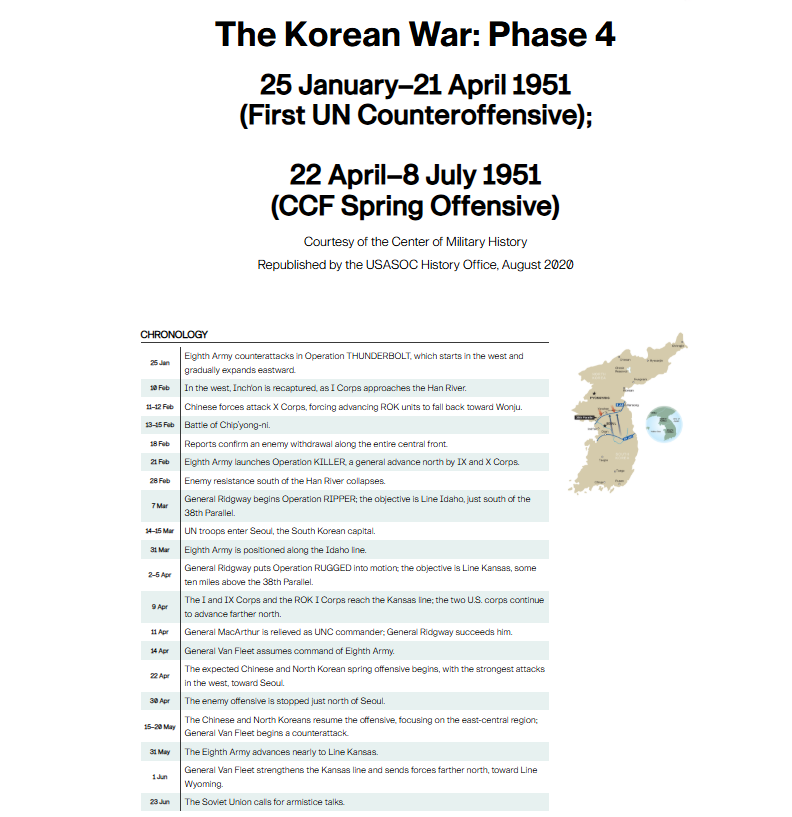
The 2nd Infantry Division was instrumental in stopping the Communist Spring Offensive in April and May 1951. During the first six months of 1951, they were on the ground and advancing the U.S. front lines.
Line Idaho
In 2006, Sergeant Thomas Whitten, who led a platoon that included Company K, sat for an oral history interview. His timeline in Korea aligns with Allmaras—both arrived in Korea in February. Whitten said, “ . . . we slept on the ground when it was 20 below.” When asked how the soldiers survived, he just chuckled and said, “You have to.”
Company K was very active upon its arrival, but they were not the soldiers the leadership sought. A note from the Commanding Officer of the 38th Infantry to Headquarters in San Francisco, California, stated that the new soldiers were helpful, but “ . . . replacements received were anything but what had been requisitioned. Only a small percentage of some 900 replacements were riflemen or had any experience as riflemen.” The replacements would be learning on the job.
It was during this on-the-job training that Allmaras was struck by a missile at Line Idaho. The battle at Line Idaho was part of a larger operation, Operation Ripper, which pushed back Chinese and North Korean forces. Allmaras was struck on March 15, 1951, just as United Nations forces entered Seoul, the South Korean capital. He was removed from the front lines but later returned to service on March 19, 1951.
Hill 800
Company K gained notoriety for its bravery in holding Hill 800, known as Bunker Hill. In May 1951, the company was assigned to Hill 800 and directed to dig bunkers, cut pine trees, scan the area, and conduct foot patrols to watch for Chinese Communist Forces (CCF) intelligence believed to be arriving soon. Sergeant Whitten recalled seeing hordes of Chinese soldiers swarming towards their location on Hill 800. He was shocked at how quickly and brazenly they were advancing. The conflict between the two sides turned into a multi-day battle that lasted through May. In early June 1951, most of the 38th Infantry Regiment was withdrawn from front lines to rest, recover, and provide proper training to the remaining replacement troops who had arrived in March.
Commemoration
On May 13, 1951, Bill Allmaras was declared Missing in Action. As the battle with the CCF raged, he was disoriented as he returned from his platoon command. Unfortunately, he stepped on a landmine. Friendly troops located his body in a minefield. The Army Graves Registration Unit was sent to safely recover his remains, but before they could, the area was again overrun by CCF soldiers, and the Graves Registration Unit had to turn back. When the area again came back under Allied control, his remains could not be found.
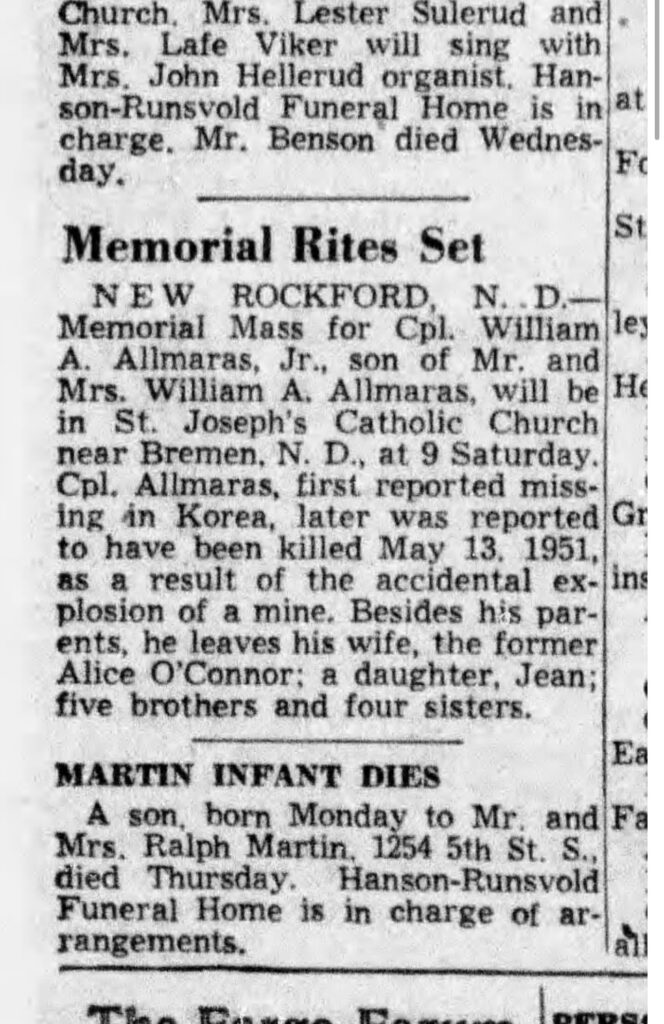
Allmaras was designated as Missing in Action until June 1, 1953, when the investigation into his disappearance and eventual death was closed. His wife, Alice, received the letter just a month after their daughter’s second birthday. A notice posted in The Fargo Forum in December 1953 alerted the public to Burial Rites being held later that month.
New Rockford Community Response
When asked, many in the community recall attending Bill Allmaras’s funeral. One man who attended the funeral as a teenager said he recalled asking his father why there was a flag draped over a metal box instead of a casket. His dad told him that there was no body because he had been “blown to bits.” The moment shocked not only the young man but also rattled the New Rockford community as a whole.
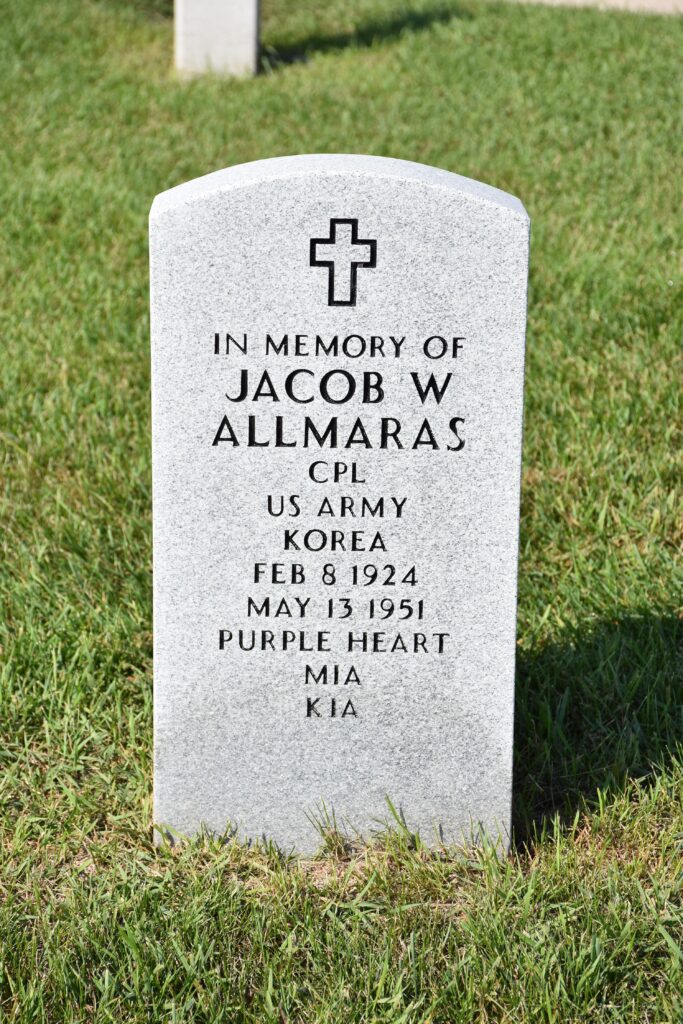
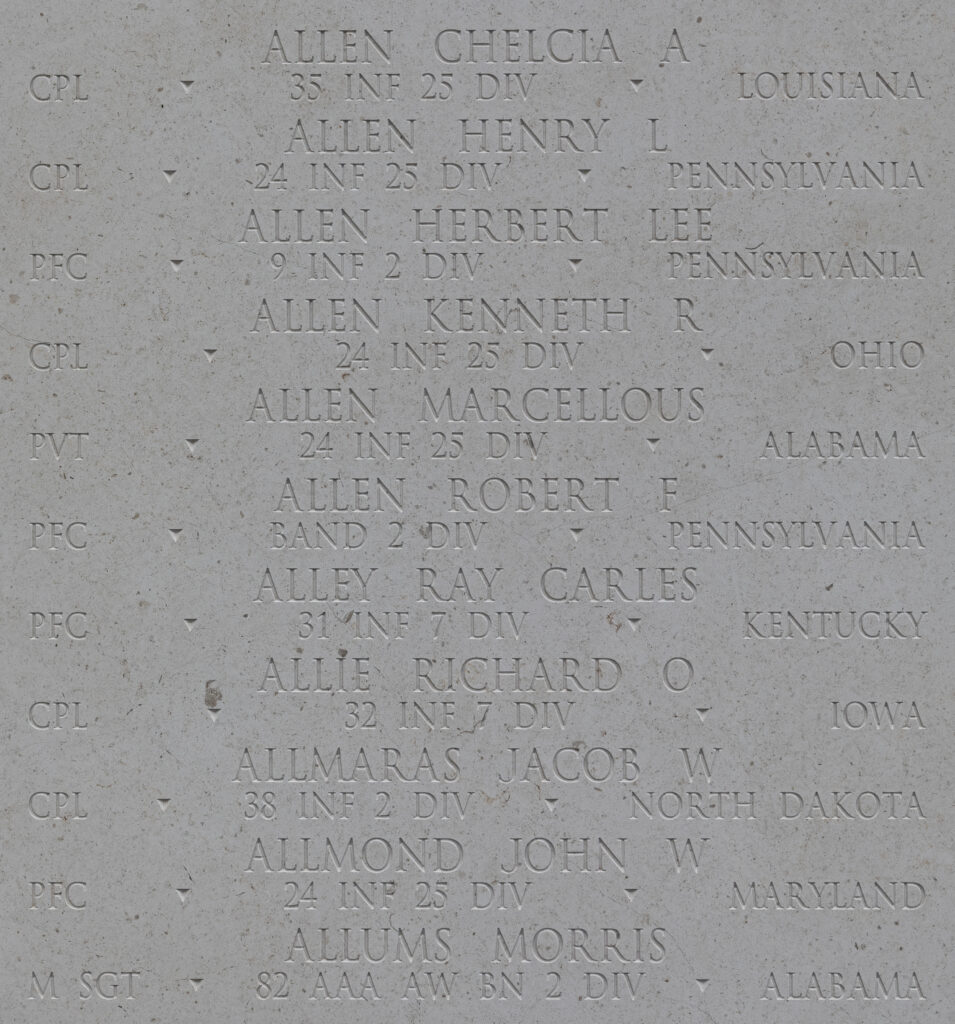
Today, Bill Allmaras is memorialized at the Courts of the Missing at the Honolulu Memorial and the Korean War Memorial in Washington, D.C. In 1995, Alice submitted paperwork to the North Dakota State Veterans Cemetery in Mandan for a memorial marker in his honor.
Legacy
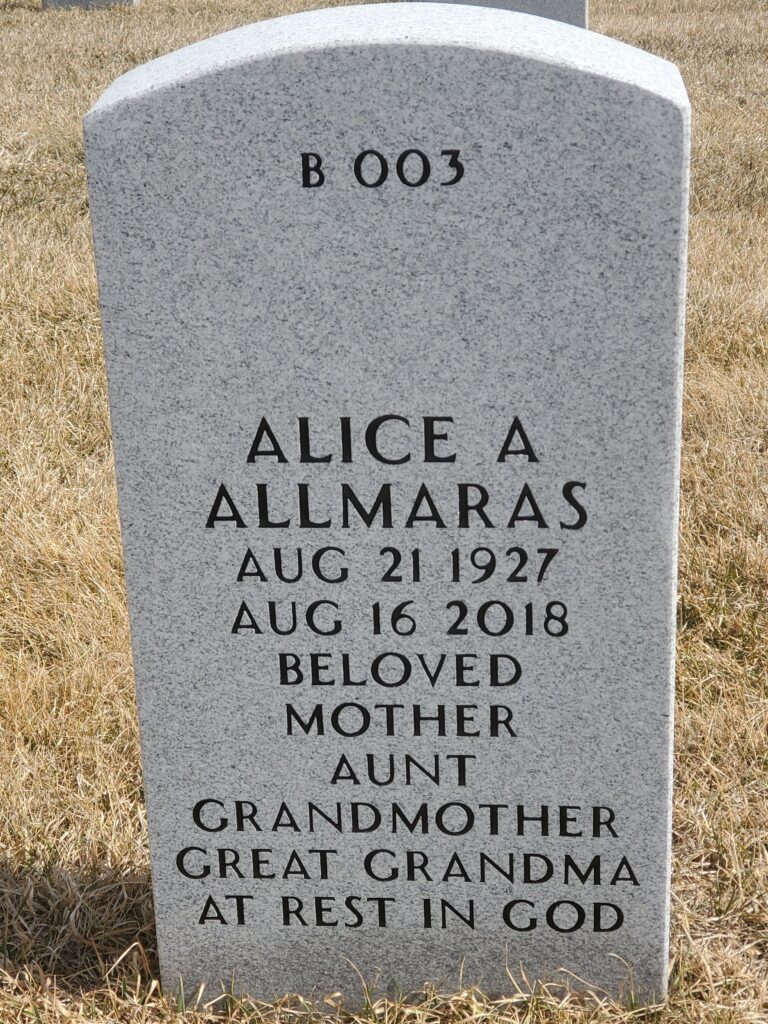
In 2018, Alice O’Connor Allmaras, who never remarried, died at the age of 90. A headstone bearing her name is situated next to her husband’s memorial marker at the North Dakota Veterans Cemetery. According to their daughter Jean, Alice had completed all of the necessary paperwork for her to be buried there long before her death.
It is worth noting that Bill Allmaras’s legacy as a North Dakotan, husband, and father lived on. His wife, Alice, raised their daughter, Jean, while attending school full-time at Valley City State University in Valley City, North Dakota. When Jean was asked about her mom being a single mom in the 1950s, she said, “she realized it was up to her and no one else.” Later, Alice returned to the New Rockford community and continued to advocate for the remembrance of her husband and others lost in the Korean War.
Their daughter, Jean, also embodied her parents’ “must do” attitude. She grew up and attended the University of North Dakota, where she earned a nursing degree. She spent her career serving various communities across the country and landed in Charleston, South Carolina. Today, she has three children. Her son also served the U.S. Army, just like his grandfather. In 2017, she welcomed a grandchild, Jacob, named for her father, whom she never got the chance to meet.
Bibliography
Primary Sources
38th Infantry Regiment – Command Report – March 1951. Korean War Project. https://www.koreanwar.org/html/2011-2id-korean-war-records-unit.html?pid=4.
38th Infantry Regiment – Command Report – May 1951. Korean War Project. https://www.koreanwar.org/html/2011-2id-korean-war-records-unit.html?pid=4
Allmaras, Alice. “The Korean War.” In A Century of Sowers, A Harvest of Heritage: New Rockford, North Dakota. Arntson, Edgar M., Isabelle Aslakson, and Thordis K. Danielson, Eds. Centennial Committee of Rockland, 1983: 322-323.
Appreciation to Officers and Men of National Guard and Reserve Force Units in Military Service. 32nd Legislative Regular Session, North Dakota State Legislature, 1951.
Bill Seiler. Email to the author. November 8, 2025.
A Community Fact Survey New Rockford North Dakota. North Dakota Economic Development Committee and Otter Tail Power Company, 1965.
“Home Fallout Shelter Survey Begins in N.D.” The Forum [Fargo, North Dakota], August 25, 1967. Newspapers.com (1130324644).
Houser, Jean. Telephone interview with the author. November 24, 2025.
Jacob W. Allmaras. DD-214, Department of the Army. Courtesy of the Purple Heart Hall of Honor.
Jacob W. Allmaras. Final Pay Voucher, Department of the Army. National Archives and Records Administration – St. Louis.
Jacob William Allmaras. Korean War Era Draft Registration Cards, 1948-1959. https://fold3.com.
Jacob William Allmaras. World War II Draft Cards Young Men, 1940-1947. Digital Images. https://ancestry.com.
Jacob W. Allmaras and Alice O’Connor. Marriage Record. June 27, 1950. North Dakota Heritage Center and State Museum. https://statemuseum.nd.gov/marriages/details?UNIQUE%20ID=811300de05a811f19cb200224843a3b6.
“Memorial Rites Set.” The Fargo Forum [Fargo, North Dakota], December 4, 1953. Newspapers.com (1130975119).
“Memorial Rites Today .” The Fargo Forum [Fargo, North Dakota], December 5, 1953. Newspapers.com (1127127329).
Natalie Becker. Email message to author. December 2, 2025.
“N.D. Ground Observers on 24-Hour Duty.” The Forum [Fargo, North Dakota], April 25, 1952. Newspapers.com (1127449797).
North Dakota. Eddy County. 1940 U.S. Census. Digital images. https://ancestry.com.
North Dakota. Eddy County. 1950 U.S. Census. Digital images. https://ancestry.com.
Sgt. Thomas Whitten, 38th Infantry, 2nd Infantry Division, Korea, 1950-1951. Oral history interview by Larry Cappetto. Lest They Be Forgotten, National Military History Online Museum. May 26, 2006. https://www.youtube.com/watch?v=ED6soMKfPRg.
Sympathy and Support for Men in the Armed Forces. 32nd Legislative Regular Session, North Dakota State Legislature, 1951.
Urging Minimum Draft of Essential Agricultural Labor. 32nd Legislative Regular Session, North Dakota State Legislature, 1951.
Withdrawal of Troops from Korea. 32nd Legislative Regular Session, North Dakota State Legislature, 1951.
Secondary Sources
“About Us: History.” 2nd Infantry Division (2ID) – Korea. Accessed December 30, 2025. https://www.2id.korea.army.mil/About-Us/History/.
“Alice A. O’Connor Allmaras.” Find a Grave. Updated July 25, 2019. Accessed January 6, 2026. https://www.findagrave.com/memorial/201497663/alice_a-allmaras.
Butcher, Carole. “North Dakota Poultry.” Prairie Public NewsRoom. Updated June 12, 2022. Accessed November 16, 2025. https://news.prairiepublic.org/show/dakota-datebook-archive/2022-06-12/north-dakota-poultry.
“Corp. Jacob William ‘Bill’ Allmaras.” Find a Grave. Updated March 25, 2014. Accessed October 6, 2025. https://www.findagrave.com/memorial/126894538/jacob-william-allmaras.
“Cpl. Jacob William Allmaras.” Defense Personnel POW/MIA Accounting Agency. Accessed October 3, 2025. https://dpaa-mil.sites.crmforce.mil/dpaaProfile?id=a0Jt00000004q1OEAQ.
“CPL Jacob William ‘Bill’ Allmaras.” Find a Grave. Updated April 8, 2009. Accessed October 6, 2025. https://www.findagrave.com/memorial/35649914/jacob-william-allmaras.
“Jacob W. Allmaras.” National Purple Heart Hall of Honor. Last updated January 14, 2026. Accessed January 12, 2026. https://www.thepurpleheart.com/roll-of-honor/profile/default?rID=6487f1db-803c-4faa-ada0-b095ff2be8d2.
“Jacob W. Allmaras.” Veterans Legacy Memorial, National Cemetery Administration. Accessed February 13, 2026. https://www.vlm.cem.va.gov/JACOBWALLMARAS/710750.
“Jacob William Allmaras.” American Battle Monuments Commission. Accessed October 31, 2025. https://weremember.abmc.gov/s?q=allmaras&v=G&type=16.
“Jacob William Allmaras.” Veterans Legacy Memorial, National Cemetery Administration. Accessed February 13, 2026. https://www.vlm.cem.va.gov/JacobWilliamAllmaras/1F880.
This profile was researched and created through the Researching Silent Heroes program, sponsored by the American Battle Monuments Commission.