

Sergeant Johnie Ervin Branch, Jr.
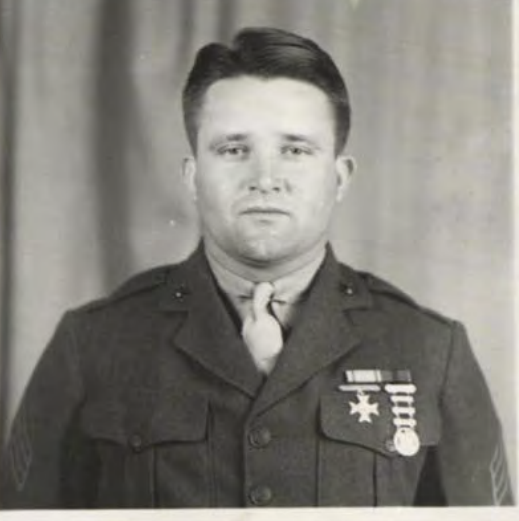
- Unit: 4ᵗʰ Marines, 1ˢᵗ Battalion, Headquarters Detachment
- Date of Birth: September 26, 1917
- Entered the Military: May 17, 1939
- Date of Death: July 4, 1996
- Hometown: Bogalusa, Louisiana
- Place of Death: Baton Rouge, Louisiana
- Award(s): Good Conduct Medal
- Cemetery: Section 9, Site 3-A. Baton Rouge National Cemetery, Baton Rouge, Louisiana
Mentored by Mr. Paul Valdezco
Glasgow Middle School
2025/2026
Early Life
Johnie Ervin Branch was born on September 26, 1917, in Bogalusa, Louisiana, to John and Hazel Ray (Wheat) Branch. His maternal grandmother, Orah Wheat, lived with the family. In 1920, his father worked for the city police department. Branch’s younger brother, Rutherford, was born in 1928. In 1930, his cousin, Kathleen, lived with the family, and his father had been promoted to Fire Chief for the city of Bogalusa. These early years shaped Branch’s sense of duty.
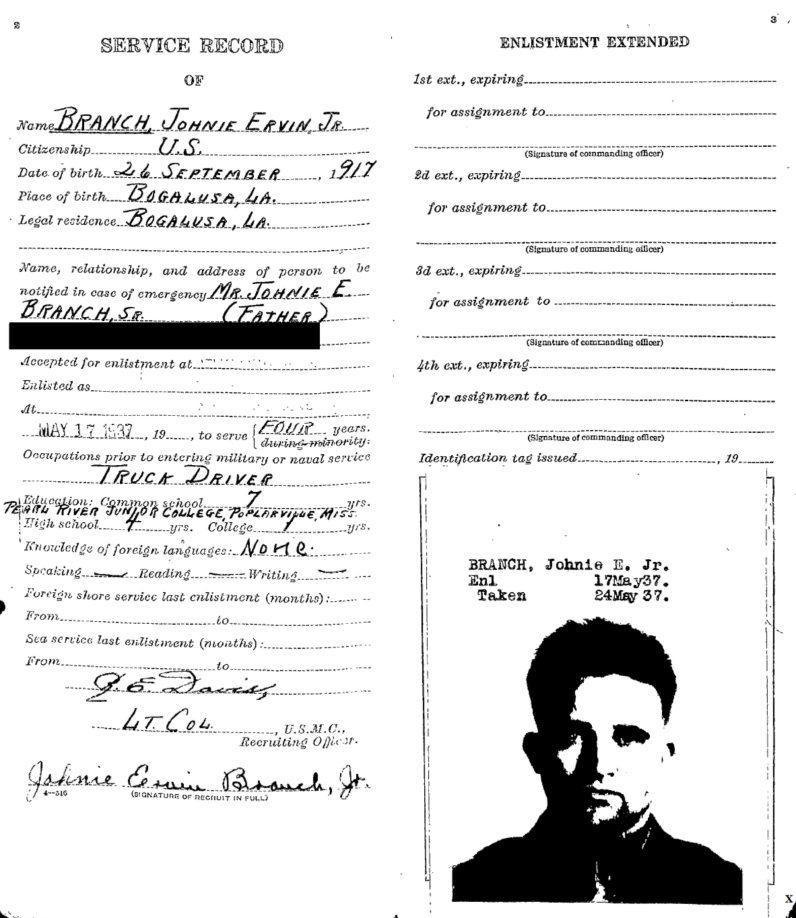
Education played an important role in Branch’s life, as records show he completed 14 years of schooling. He graduated from Bogalusa High School in 1933 and attended Pearl River Junior College in Poplarville, Mississippi, on an athletic scholarship. According to his service record, Branch worked as a truck driver. He volunteered for military duty on May 17, 1937, beginning his path of service even before World War II officially began.


Homefront
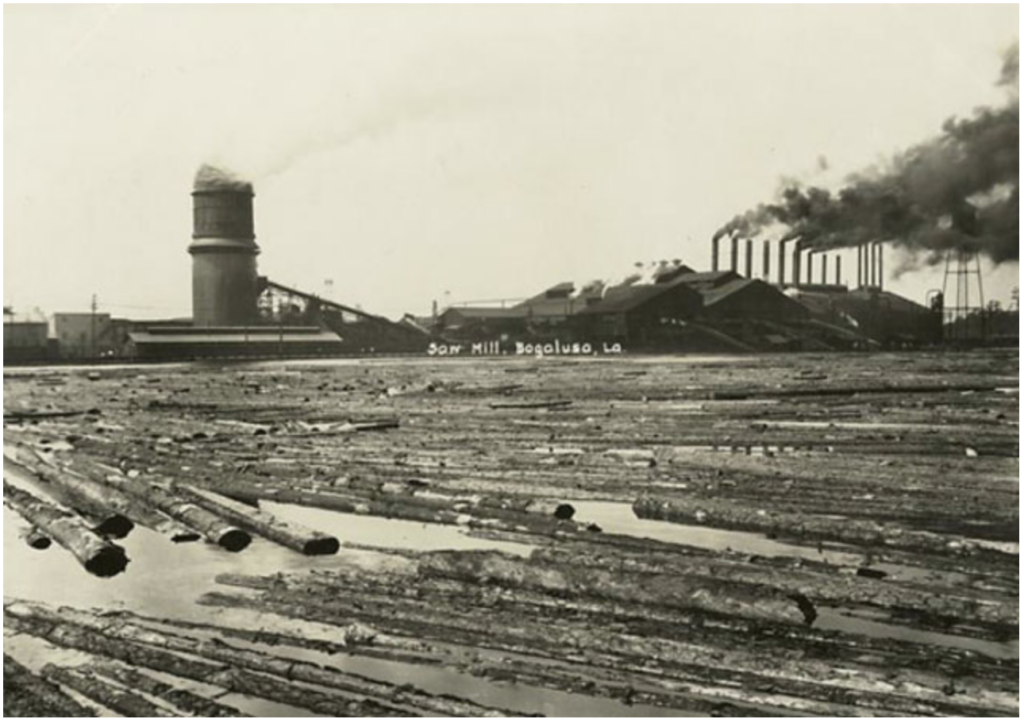
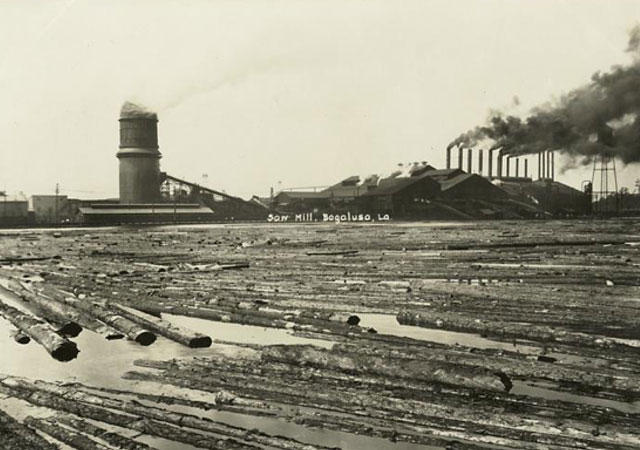
Bogalusa, part of Washington Parish, Louisiana, is a small but resilient town shaped by industry and labor. Founded in 1906 as a company town, it grew rapidly around the Great Southern Lumber Company, which operated what was once the world’s largest sawmill, employing about 1,200 workers and producing massive amounts of lumber daily. Built to house and support its workforce, Bogalusa was promoted as a model industrial community, though conditions were often tightly controlled by company leadership. When the sawmill closed in 1938 after local pine resources were exhausted, the city faced economic hardship, but it endured by relying on its remaining paper mill industry, which became the backbone of the local economy as the nation moved closer to World War II.
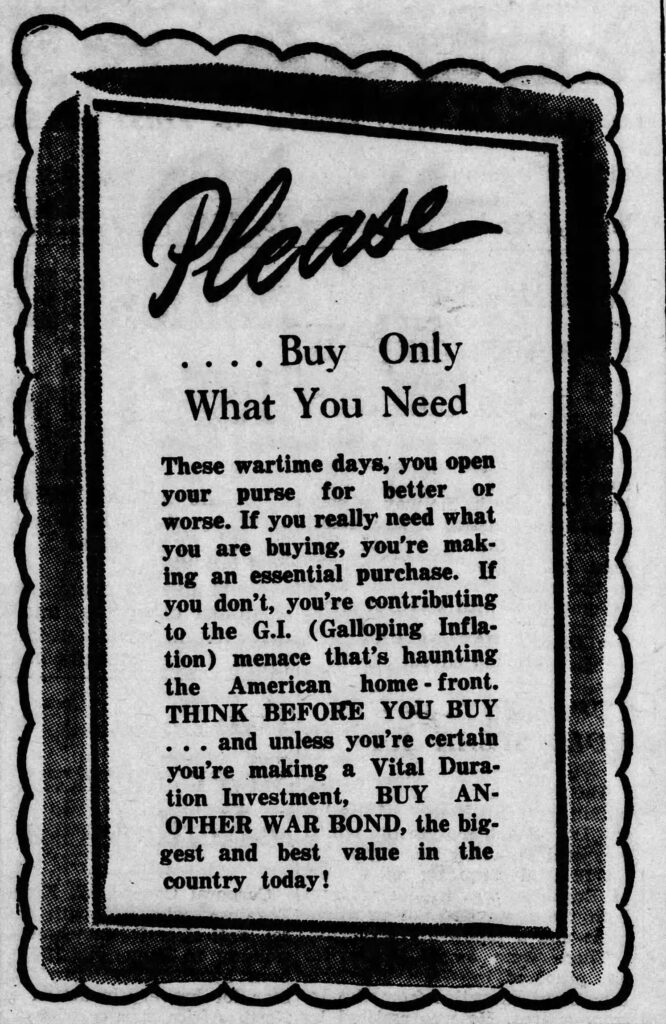
During the war, Bogalusa supported the national effort through steady industrial production and community resilience. The paper mill remained essential, keeping workers employed and supplying materials needed for wartime production. Local newspapers urged citizens not to waste resources and to buy war bonds to support the war effort.
At the same time, the town’s earlier history reflected the struggles of industrial labor in the South, including tensions over wages, union efforts, and unequal treatment of workers, particularly African Americans who often faced forced labor practices and discrimination. Despite these challenges, Bogalusa adapted and continued to grow, becoming more diverse as new families, including Jewish business owners, settled in the area. Though far from the front lines, the town played a meaningful role on the home front, contributing to the war effort through industry, perseverance, and a shared sense of duty.

Military Experience
Johnie Ervin Branch volunteered for military service on May 17, 1937, choosing a path of duty years before World War II began. Soon after enlisting, he departed the United States aboard the USS Chaumont, traveling from San Diego to Shanghai, China, where he was stationed during a tense and dangerous period in the early stages of the Sino-Japanese conflict. While in Shanghai, Branch helped defend the International Settlement, conducting security patrols, guarding key checkpoints, and maintaining order amid rising violence and uncertainty. His role as a military policeman placed him on the front lines of maintaining stability in a city under constant threat.
He later served in Guam as part of the Insular Patrol, where his duties included coastal security, monitoring local activity, and protecting U.S. military installations, before returning to the United States in late 1940. For his service during this time, Branch was awarded the Good Conduct Medal. When his four-year enlistment period was up, Branch returned to civilian life in Bogalusa.
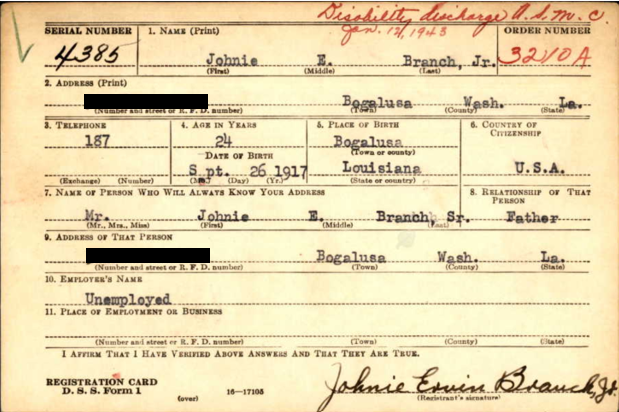
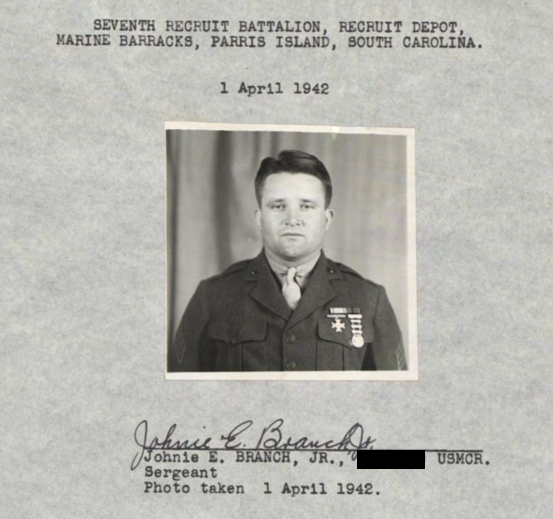
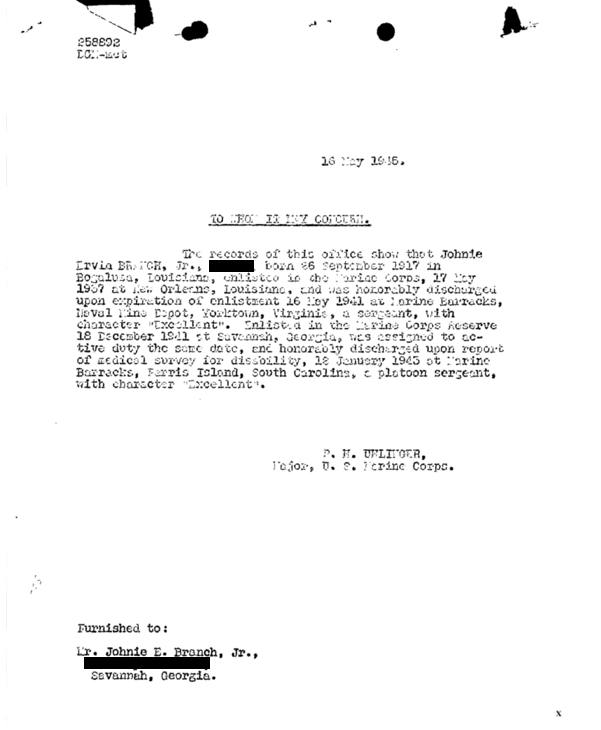
Branch registered for the draft in May 1941, just days after he arrived home. After the attack on Pearl Harbor, he reenlisted in the Marine Corps Reserve for the duration. He was called to active duty on December 18, 1941, in Savannah, Georgia. From January 1942 to January 1943, Branch served at Parris Island, South Carolina, as a Marine Corps platoon sergeant. He left active duty on January 12, 1943, due to a medical disability and was honorably discharged.

Veteran Experience
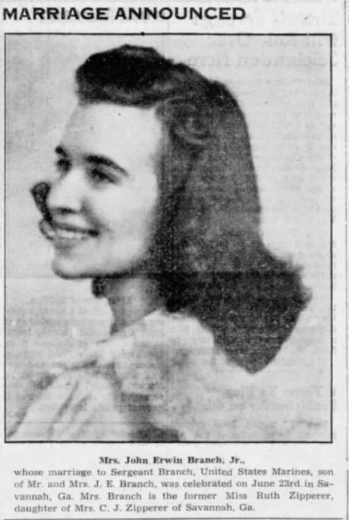
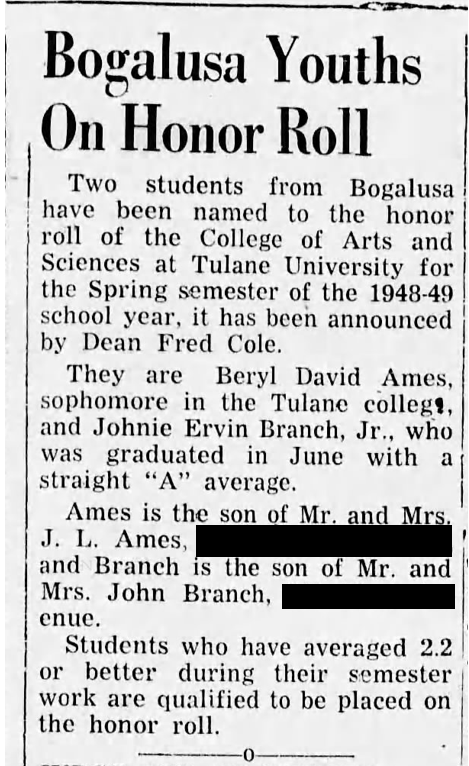
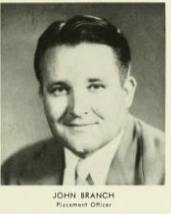
Johnie Ervin Branch began building his life at home even before his military service ended. On June 23, 1942, he married Ruth Zipperer in Savannah, Georgia. After his honorable discharge on January 12, 1945, he attended Armstrong Junior College in Savannah and Tulane University, where he graduated with honors in 1949. Branch continued his studies at Loyola Law School. He graduated and passed the bar exam in 1956.
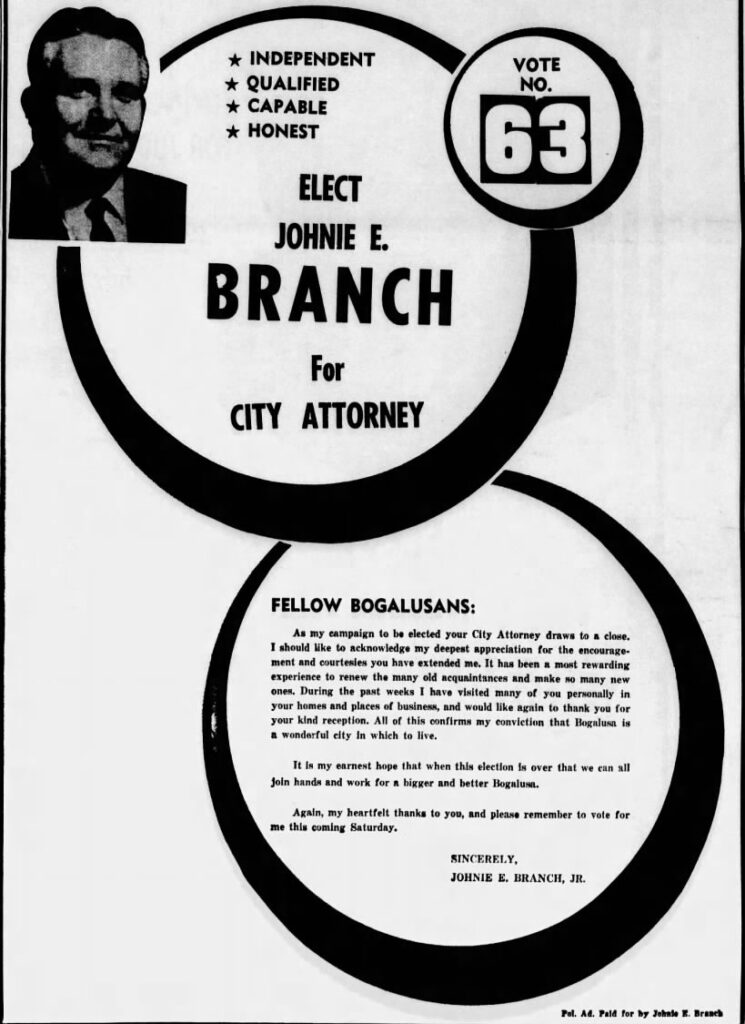
While attending school and working as a placement officer at Tulane, Branch and his wife had three children: Carol, Emily, and Stephen. Demonstrating his strong commitment to his public service in the community, Branch taught English and social studies at Bogalusa Junior High School. He was elected to the post of Bogalusa city attorney in 1962 and later worked as an attorney for the Louisiana Office of Highways.

Commemoration
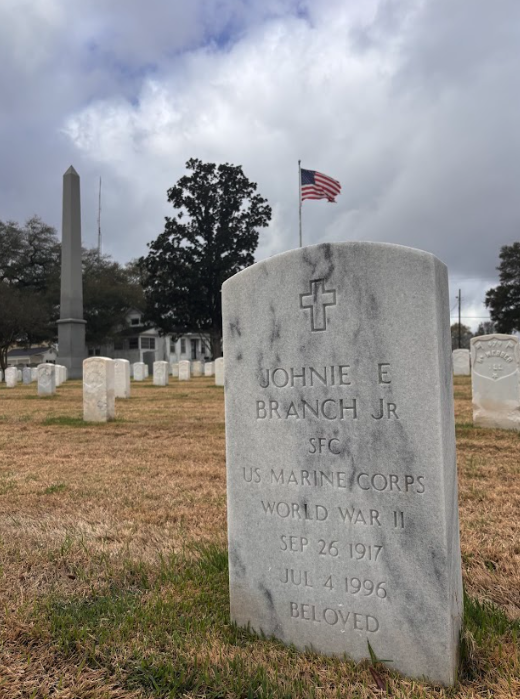
Johnie Ervin Branch passed away on July 4, 1996, in Baton Rouge, Louisiana, and was laid to rest at the Baton Rouge National Cemetery, a final honor reserved for those who served their country in the armed forces. His burial in a national cemetery reflects the nation’s recognition of his military service and sacrifice.
As a veteran of the United States Marine Corps, he is honored at this solemn resting place, where fellow servicemen and women are remembered for their dedication to duty. Though his life was marked by quiet service rather than public recognition, his legacy endures through his family, his contributions to his community, and the respect he received as a member of the nation’s armed forces.
Bibliography
Primary Sources
Bogalusa, the Magic City. Advertisement. Bogalusa Enterprise [Bogalusa, Louisiana], July 1, 1915. https://www.loc.gov/resource/sn88064054/1915-07-01/ed-1/?sp=1&r=-0.908,0.315,2.817,1.342,0.
“Bogalusa Youths on Honor Roll” Daily News [Bogalusa, Louisiana], July 25, 1949. Newspapers.com (1034968953).
Great Southern lumber mill in Bogalusa, Louisiana. Photograph. 1919. New York Public Library. https://www.internationalist.org/bogalusalumbermill1919.jpg.
Guam. Agana. 1940 U.S. Federal Census. Digital Images. https://ancestry.com.
J E Branch Jr. Louisiana, U.S., State Birth Records, 1911-1923. Digital Images. https://ancestry.com.
Johnie E. Branch Jr., Discharge Special Order, Department of the Navy. National Archives and Records Administration – St. Louis.
Johnie E. Branch Jr., Official Military Personnel File, Department of the Navy. National Archives and Records Administration – St. Louis.
Johnie E. Branch Jr., Report of Separation, Department of the Navy. National Archives and Records Administration – St. Louis.
Johnie E. Branch Jr. World War II Draft Cards Young Men, 1940-1947. Digital Images. https://ancestry.com.
Louisiana. Orleans Parish. 1950 U.S. Federal Census. Digital Images. http://ancestry.com.
Louisiana. Washington Parish. 1920 U.S. Federal Census. Digital Images. http://ancestry.com.
Louisiana. Washington Parish. 1930 U.S. Federal Census. Digital Images. http://ancestry.com.
Louisiana. Washington Parish. 1940 U.S. Federal Census. Digital Images. http://ancestry.com.
“Marriage Announced.” Bogalusa Enterprise and American [Bogalusa, Louisiana], July 3, 1942. Newspapers.com (844128150).
“Please…Buy Only What You Need,” The Bogalusa News [Bogalusa, Louisiana], September 13, 1943. Newspapers.com (1034872850).
“Murders in Bogalusa.” The New York Times [New York, New York] November 23, 1919.
Tulane University Yearbook. Digital Images. http://ancestry.com.
“Vote No. 63.” The Daily [Bogalusa, Louisiana] July 27, 1962. Newspapers.com (195670312).
Secondary Sources
“Bloody Bogalusa, 1919: When Four White Unionists Died Defending Their Black Comrades.” The Internationalist, February 2012. https://www.internationalist.org/bloodybogalusa19191202.html.
“Bougalusa: A Historical Overview.” Encyclopedia of Southern Jewish Communities. Accessed November 8, 2025. https://www.isjl.org/louisiana-bogalusa-encyclopedia.html.
“China Marines.” California State University, Northridge. Updated September 24, 2013. Accessed March 24, 2026. https://library.csun.edu/sca/peek-stacks/china-marines.
“The China Marines.” Oregon Public Broadcasting. Last Modified 2014. Accessed March 24, 2026. https://www.pbs.org/opb/historydetectives/feature/the-china-marines/.
Conner, Owen Linlithgow, Ed. Always Faithful: The U.S. Marines in China. U.S. Marine Corps University Press. https://www.usmcu.edu/Outreach/Marine-Corps-University-Press/Books-by-topic/MCUP-Titles-A-Z/Always-Faithful/.
“History.” Bogalusa Rebirth. Accessed November 7, 2025. https://bogalusarebirth.com/bogalusa-history/.
“Johnie Ervin Branch, Jr.” Find a Grave. Updated February 25, 2000. Accessed April 17, 2026. https://www.findagrave.com/memorial/401650/johnie-ervin-branch.
“Johnie Ervin Branch, Jr.” Veterans Legacy Memorial, National Cemetery Administration. Accessed April 17, 2026. https://www.vlm.cem.va.gov/JOHNIEERVINBRANCHJR/7F2D81B.
Sanson, Jerry P. “World War II Industrialization in Louisiana.” 64 Parishes. Updated October 27, 2023. Accessed November 8, 2025. ttps://64parishes.org/entry/world-war-ii-industrialization-in-louisiana?utm.
“This ca. 1912 photograph shows a pine mill in Bogalusa, Louisiana. . .” Hagley Vault. Last modified April 6, 2022. Accessed March 24, 2026. https://www.hagley.org/research/news/hagley-vault/ca-1912-photograph-shows-pine-mill-bogalusa-lousiana.
“Welcome to Bogalusa.” City of Bogalusa. Accessed November 7, 2025. https://www.bogalusa.gov/page/about-the-city.
This profile was funded by a grant from the United States Department of Veterans Affairs. The opinions, findings, and conclusions stated herein are those of the author and do not necessarily reflect those of the United States Department of Veterans Affairs.