

Private Joseph Bird Gatewood
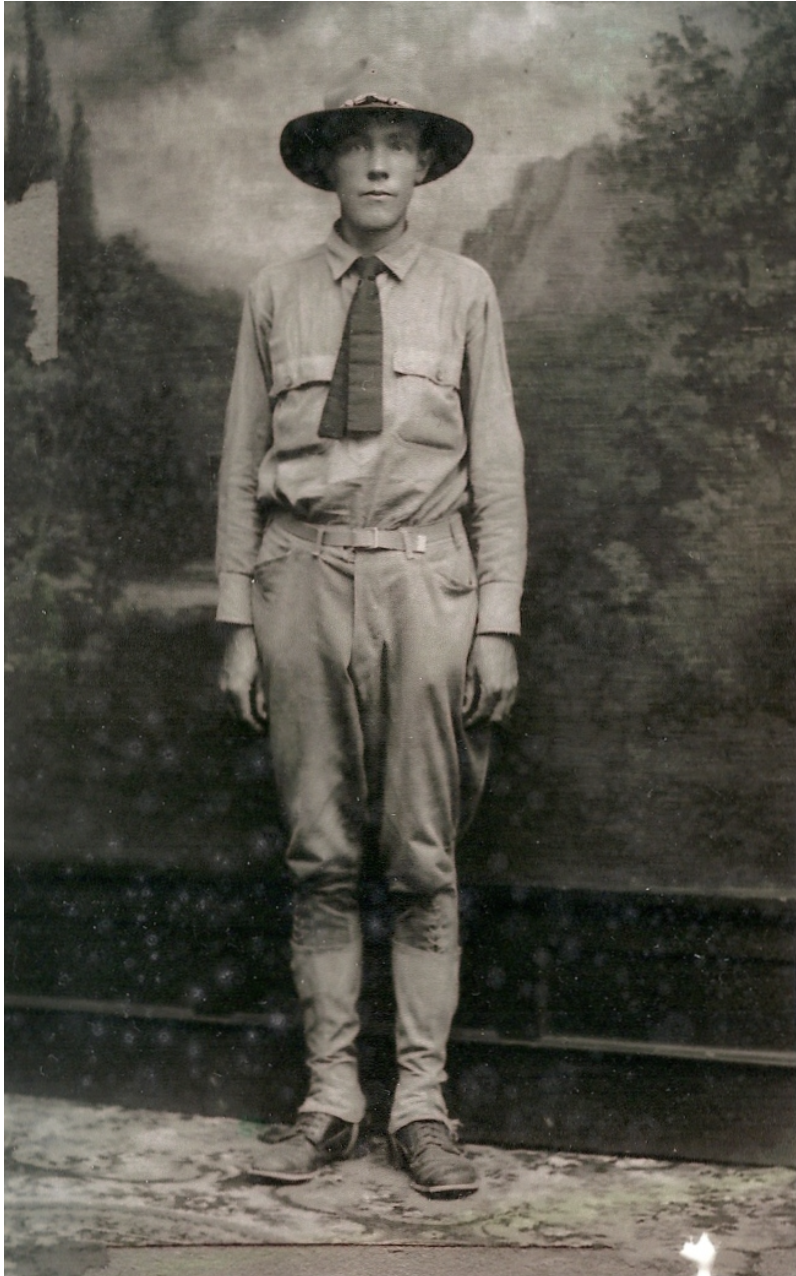
- Unit: U.S. Army 8th Veterinary Hospital
- Date of Birth: August 27, 1892
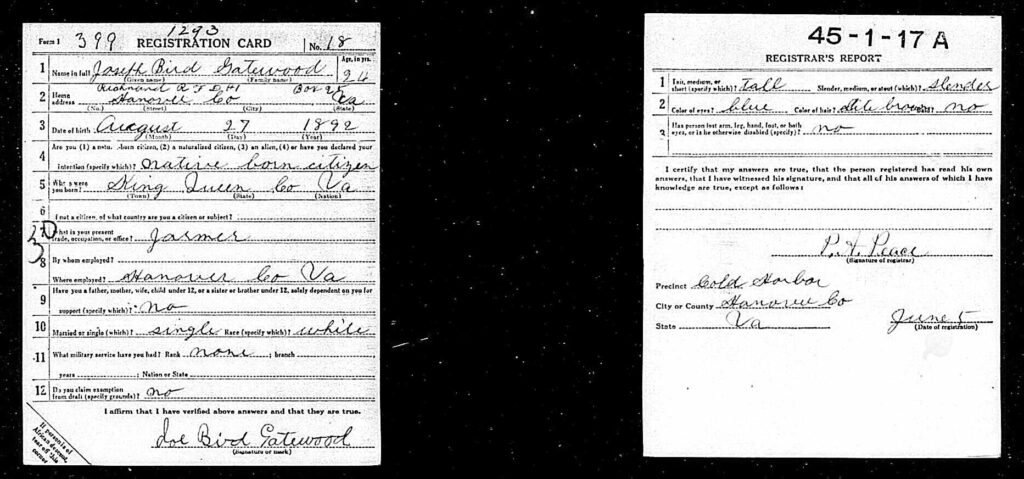
- Entered the Military: June 13, 1918
- Date of Death: September 20, 1918
- Hometown: Henry, Virginia
- Place of Death: Château-Thierry, France
- Cemetery: Plot B, Row 3, Grave 3. Aisne-Marne American Cemetery, Belleau, France
Stone Bridge High School, Ashburn, Virginia
2025/2026
Early Life
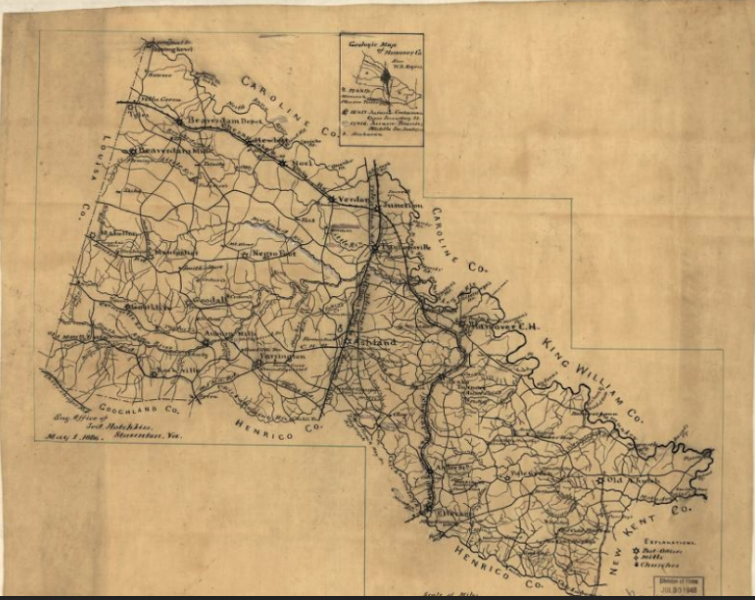
Joseph Bird Gatewood was born on August 27, 1892, in King and Queen County, Buena Vista District, Virginia. His parents were Muscoe Gatewood and Minnie Lunsford Gatewood, who married in 1887 at the New Bridge Baptist Church. King and Queen County was a rural part of Virginia, located about 50 miles east of Richmond. Gatewood had five siblings: Addie, Rubin, Elmore, Albert, and Albert’s twin sister, who died before she was a year old. In the family Bible, she is only known as “Girlie,” and her family buried her on her first birthday. Family records do not list a cause of death.
Gatewood’s family had lived in Virginia for several generations. His paternal grandfather, Joseph B. Gatewood, after whom his parents named him, was born around 1825 and served as a private in the 9th Battalion, Virginia Reserves, in the Confederate Army. His paternal grandparents were farmers and owned real estate valued at $1,500.00 in 1860, with a personal estate valued at $3,080, which placed them within the middle range of property owners in their county.
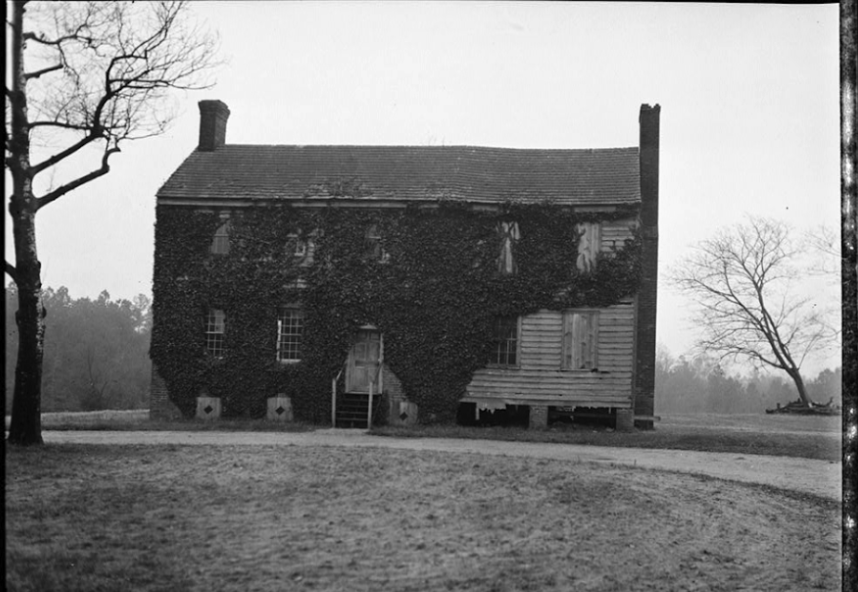
His maternal grandfather, James Elisha Yarbrough III, was born in Hanover County in 1835. He was a farmer, and his real estate was valued at $700 in 1860. He married Adeline R. Gatewood around 1859. According to family history, Gatewood’s mother was from Cold Harbor in Hanover County. Union forces used the Garthright House as a hospital during the Civil War battle of Cold Harbor in 1864. His mother’s aunt hid in the basement during the battle with her children. A battlefield marker outside the house mentioned her. According to the family, Gatewood’s mother was born in that house.
Gatewood’s parents, Muscoe and Minnie Gatewood, were also farmers. It is unclear exactly what crop they farmed, but farmers in this area of Virginia commonly grew corn. At some point between 1900 and 1910, the Gatewood family moved from King and Queen County to Hanover County, Virginia. Gatewood attended school, but it is unclear whether he was homeschooled or attended a public school. By the age of 18, he could read and write and worked on his family’s farm. Gatewood never married and had no children.

Homefront
Munitions Factories
By the start of World War I, Gatewood’s family had moved to Hanover, Virginia, about 25 miles outside the capital city of Richmond. Communities around Richmond became involved in the war effort. Tredegar Ironworks in Richmond, once known as the “iron maker of the Confederacy,” operated as a shell foundry and produced arms for shipment to Europe. Contractors built several other munitions plants near Richmond.
The most notable were the Seven Pines Loading Plant Number 3 in modern-day Sandston, Virginia, and Plant Number 37 in Penniman, Virginia. E. I. du Pont de Nemours & Company, a major munitions supplier to the Allied powers during World War I, owned and operated both of these plants. At both plants, the DuPont Company built temporary kit houses to shelter its workers.
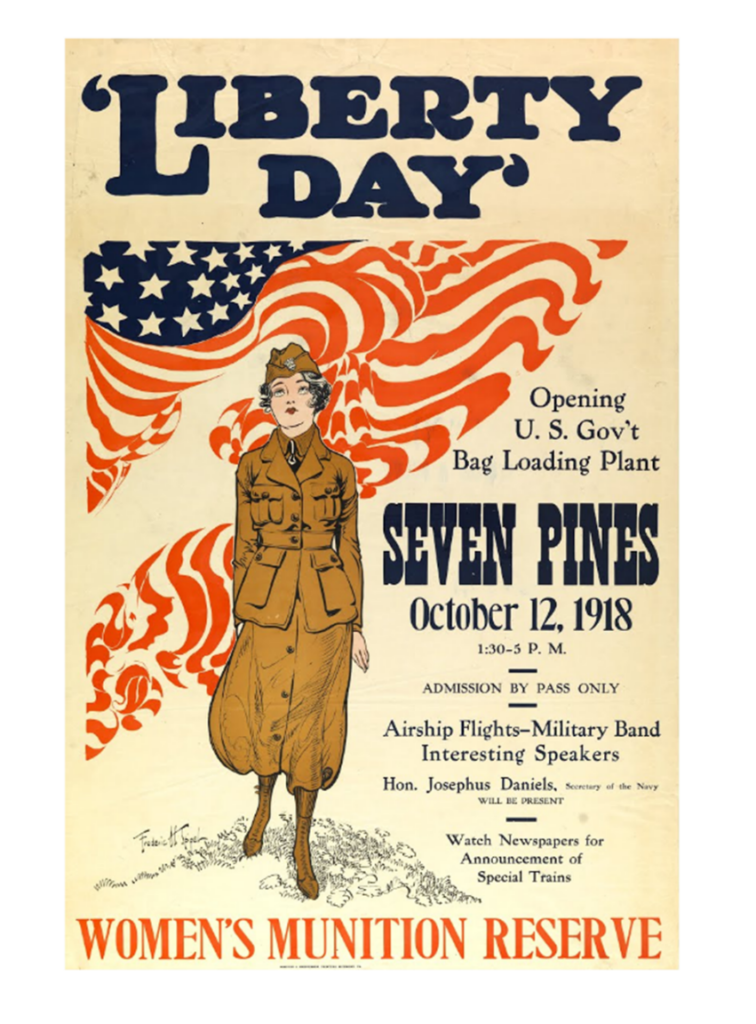
Seven Pines opened in the spring of 1918 to assist in sewing silk bags for gunpowder. The Penniman Plant Number 37 opened as a munitions factory near Williamsburg, Virginia. The area around this plant became a “boom town.” Nearly overnight, workers transformed it into a thriving city with churches, a YMCA for African Americans, and other amenities. At its peak, the plant employed 15,000 people, six times the population of Williamsburg.
The majority of workers at both plants were women. These women had finished high school and, in some cases, college, and had the dangerous task of loading shells with TNT, the dust of which could cause fires. Virginia’s First Lady, Marguerite Davis, visited Seven Pines Loading Plant and helped fill bags with gunpowder. Skirts posed too great a danger around highly flammable material, so DuPont created longer pants, specifically designed for women, known as “womanalls” and “trouserettes” for them to wear.
The Front Royal Remount Quartermaster Depot
Virginia had one of the largest equine quartermaster supply depots during World War I. Located in Front Royal, Virginia, in the northern Shenandoah Valley, the Front Royal Remount Quartermaster Depot served as an essential breeding and training facility for horses and mules shipped to Europe to supply the U.S. Army and its allies. This remount depot was so essential to the war effort that in 1915, German agents devised a plot to poison the horses there using a contagious disease known as glanders. Anton Dilger, a native of Front Royal, organized this act of biological warfare. The plot failed, and he eventually fled to Spain, where he died of influenza in October of 1918. The U.S. Army had purchased and shipped nearly one million American horses and mules by 1918. Most of the horses Gatewood later worked with in France were American.
Local Colleges Join the War Effort
In October of 1917, Randolph-Macon College, located in Hanover, Virginia, mandated that all students take a course in military studies. This aided the men’s readiness to go to war if needed. Every afternoon at precisely 3:50 p.m., all students reported to the athletic field, clad in khaki, to participate in military-style drilling.
The federal government converted the campuses of Richmond College and Westhampton College, located outside the city of Richmond, into Debarkation Hospital No. 52. On June 1, 1918, the government placed both campuses under federal control for 13 months in exchange for $150,000.00 annually. Richmond was a prime location for transporting wounded from Europe to a stateside hospital. The rail line from the port city of Norfolk ended at the colleges, which was the second-busiest port during World War I. Military officials sent convalescing soldiers returning from Europe there to recover. Administrators temporarily relocated the students at these colleges to other campuses in the city. Medical staff used campus classrooms as operating rooms while men recovered in dormitories. By December 1918, 950 soldiers, 60 nurses, 325 enlisted men of the medical department, and 25 officers occupied the campuses.
Influenza Outbreak
In 1918, the world fought a war and battled a pandemic. Known as the Spanish Flu, this influenza outbreak took the lives of over 675,000 Americans. Despite its name, historians believe it originated in Fort Riley, Kansas. This was a U.S. Army training facility that prepared the First Division for deployment to France. The outbreak started in March of 1918 and quickly spread to other states, including Virginia.
The Virginia State Board of Health estimated that over 8,000 Virginians died from the flu and flu-related pneumonia. The illness struck quickly. Symptoms resembled other influenza strains (sore throat, fever, chills, body aches, and fatigue), but this flu ravaged patients’ lungs. Sometimes, within hours, patients succumbed to complete respiratory failure. Few doctors practiced in counties like Hanover and King and Queen, and those that did were overworked, traveling miles to see their rural patients. Fear gripped rural Virginia. Residents avoided large gatherings, church leaders canceled services, and officials closed schools. Administrators sent the women of Westhampton College in Richmond home due to fears of contagion.
The pandemic was worse in large cities like Richmond, where streets seemed completely deserted. Gatewood’s older sister, Addie Boyd, died of Spanish flu on October 26, 1918. She had married Dr. John Russel Boyd in 1914 and briefly worked as a nurse in the City Hospital in Richmond. She had a son, John Gatewood Boyd, in 1915. As her family prepared to bury her, they received the news that her brother, Joseph B. Gatewood, had died of influenza and pneumonia while serving in France.
Military Experience
Camp Lee, Virginia
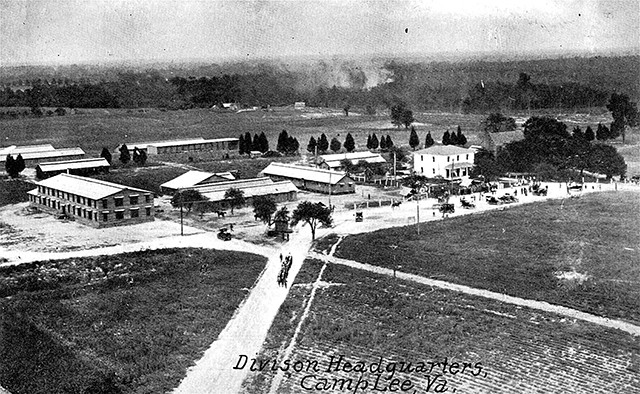
Private Joseph Bird Gatewood entered the U.S. Army in June 1918. He trained at Camp Lee in Virginia. Camp Lee was one of three Army Veterinary Corps training camps in operation from April 12, 1918, to November 11, 1918. It focused on organizing, equipping, and training veterinary units for overseas service. The school trained 393 officers and 7,968 enlisted men during its seven months of operation.
Shipped Overseas
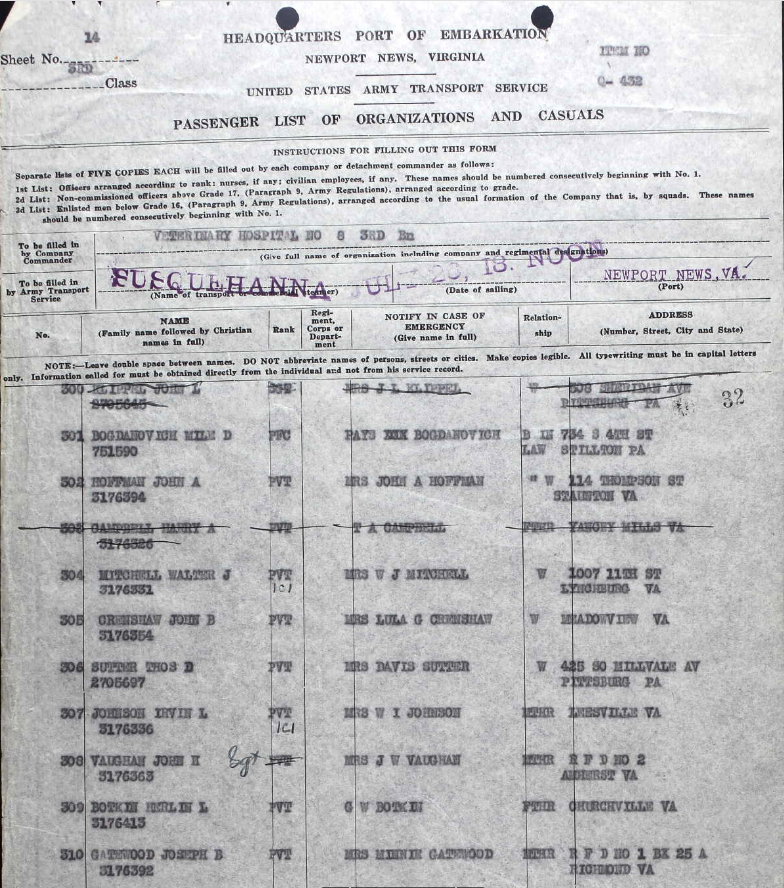
Gatewood left Newport News, Virginia, for France on July 26, 1918. The ship that carried him overseas was USS Susquehanna. The Susquehanna and SS Rhein, originally German ocean liners, were seized, along with all other German ships in port, when the U.S. declared war on Germany in April 1917. She made eight trips through the North Atlantic and transported over 18,000 U.S. troops to France. Gatewood arrived in Brest, France, on August 10, 1918.
Veterinary Hospital Number 8
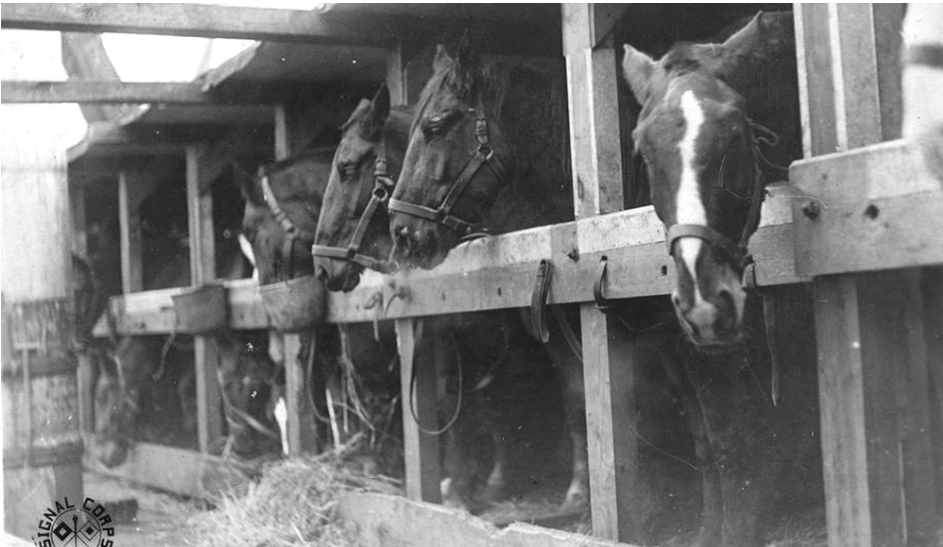
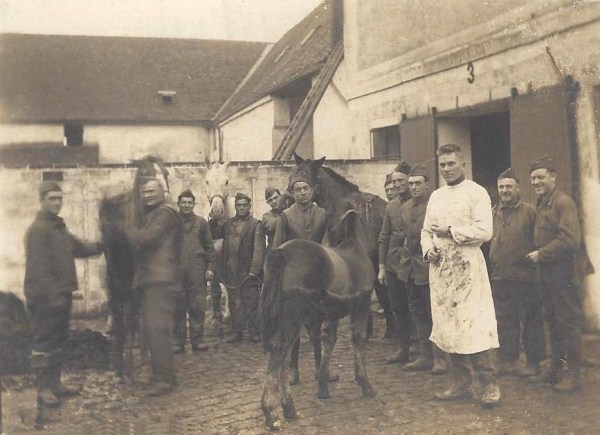
Private Gatewood was a non-combatant soldier assigned to Veterinary Hospital Number 8. The Army established this hospital at Claye-Souilly, France, on August 8, 1918, between the Marne Valley and Paris. The Army organized, equipped, and deployed 15 veterinary hospital units to Europe, each consisting of seven veterinary officers and 300 enlisted men. The goal of these hospitals was to care for wounded or sick horses, rehabilitate them, and return them to the remount depots.
The most common injuries to the horses were from shrapnel. The most common illness was a disease called thrush, a bacterial infection exacerbated by the wet and dirty living conditions in the camps. If a horse could not be rehabilitated within 30 days, the animal was destroyed. The French then purchased these animals for their hides and meat.
It is unclear what job Gatewood had at the hospital. Enlisted men working in the Veterinary Hospital brought horses to remount depots under the cover of darkness. They attached 80 horses together on a line and led two to three lines of horses at a time.
Château-Thierry
American commanders sent troops to reinforce French colonial units, including a Senegalese Division, near the small town of Château-Thierry. While Gatewood worked at Veterinary Hospital Number 8, they supported the effort to hold back the German offensive launched in the spring of 1918. On August 11, 1918, commanders ordered two officers and 100 men to Château-Thierry to convoy a train of wounded animals to Claye-Souilly. The squad camped in a wheat field there from August 15 to 25. During this time, they evacuated about 2,000 animals.
Commemoration
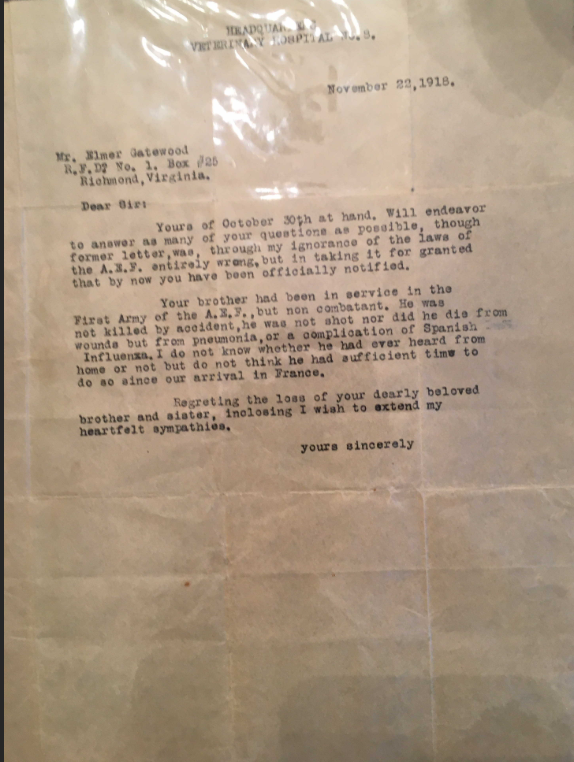
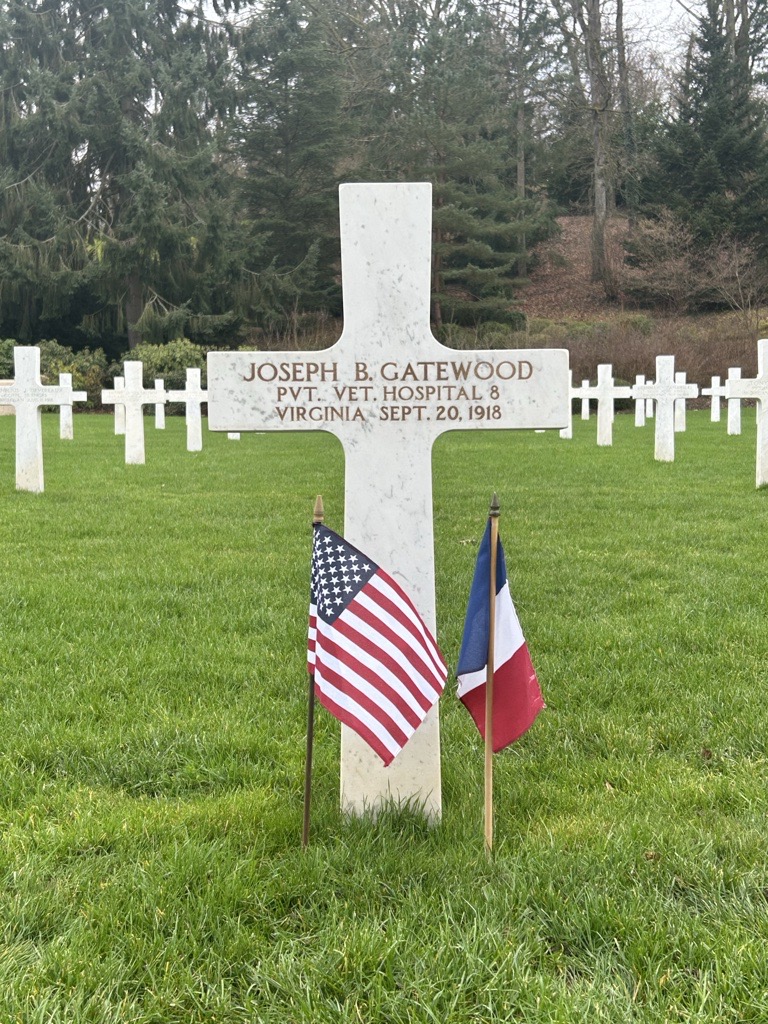
Joseph Bird Gatewood died on September 20, 1918, of bronchial pneumonia, a complication of the Spanish Flu. He had only been in France for a little over one month. He was buried in plot B, row 3, grave 3, in the Aisne-Marne American Cemetery in Belleau, France.
His mother, Minnie Gatewood, was invited to go on the Gold Star Mother Pilgrimage in 1929. She indicated that she would like to go at a later date. According to the family, she never went on the pilgrimage.
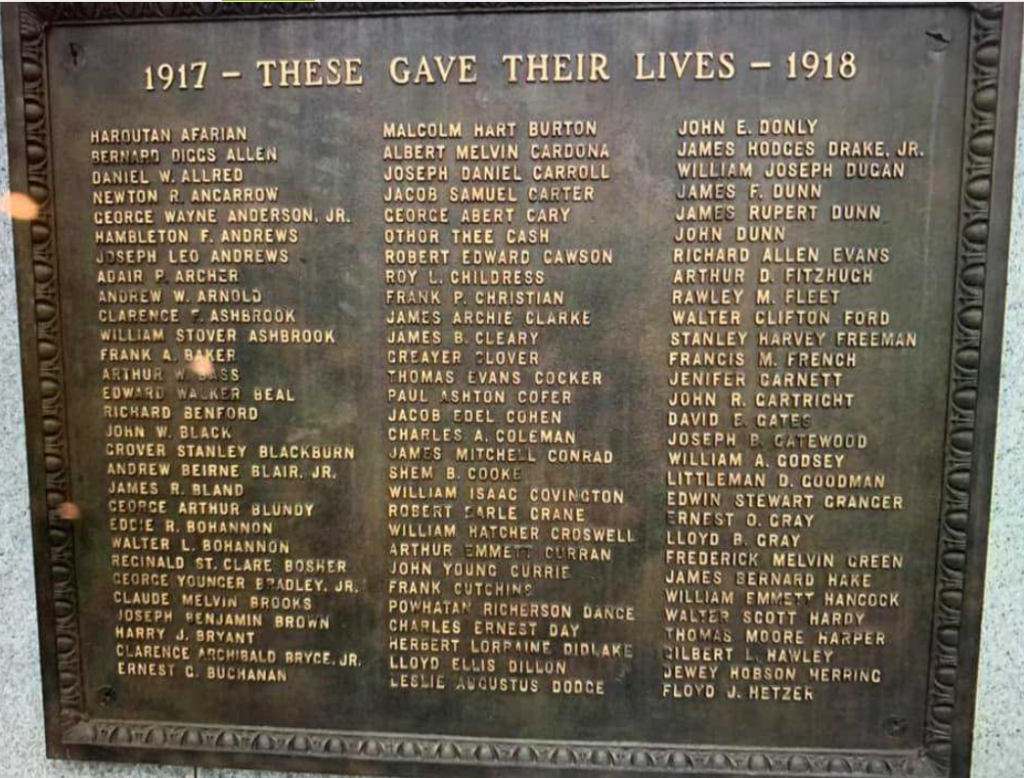
Gatewood’s name appears on a plaque on the “For God and Country” World War I Memorial in Richmond, Virginia. Gatewood’s family received the Richmond, Virginia, World War I Service Medal on his behalf. Since the United States did not have an official national service medal for World War I, many states issued their own commemorative medals.
Bibliography
Primary Sources
Addie Gatewood Boyd. Photograph. Digital image. https://ancestry.com.
“American College Men and the War.” Yellow Jacket Record [Ashland, Virginia], October 24, 1917. https://www.virginiachronicle.com/?a=d&d=YJR19171024.1.2.
“Ballots for Both.” Evening Journal [Richmond, Virginia], March 31, 1917. https://www.virginiachronicle.com/?a=d&d=TEJ19170331.1.3.
“Believe End in Sight.” Richmond Times-Dispatch [Richmond, Virginia], December 10, 1918. https://www.virginiachronicle.com/?a=d&d=RTD19181210.1.12.
Brocke, Frank. “‘We Had to Be So Careful’ A German Farmer’s Recollections of Anti-German Sentiment in World War I.” Interview by the Latah County Historical Society. George Mason University. https://historymatters.gmu.edu/d/3/.
“Camp Lee Veterinary Hospital Soon to Open.” The Richmond Times Dispatch [Richmond, Virginia], September 13, 1918.
Dick, John A.E.I. du Pont de Nemours & Co., Inc., Penniman Shell Loading Plant Panoramic Photographs. Photograph. 1918. Audiovisual Collections Repository, Hagley Museum. https://findingaids.hagley.org/repositories/2/resources/82.
“Editorial and Literary Department.” Richmond Times-Dispatch [Richmond, Virginia], August 25, 1918. https://www.virginiachronicle.com/?a=d&d=RTD19180825.1.33.
“Equal Suffragists in Fifth Annual Meeting.” Richmond Virginian [Richmond, Virginia], December 9, 1918. https://www.virginiachronicle.com/?a=d&d=RIV19151209.1.3.
“Every Broke Patient at Westhampton will Receive Allowance of at Least $5.” News Leader [Richmond, Virginia], December 19, 1918. https://www.virginiachronicle.com/?a=d&d=NEL19181219.1.1.
“Extra Daylight.” Richmond Virginian [Richmond, Virginia], October 27, 1918. https://www.virginiachronicle.com/?a=d&d=RIV19181027.1.5.
“Federal Food Administration of Virginia.” Northern Neck News [Warsaw, VA], November 29, 1918. https://www.virginiachronicle.com/?a=d&d=NNN19181129.1.1.
Food Conservation Registration Poster. Poster. c.1917. Margaret E. K. Kern Records, 1917-1920, The Library of Virginia (3057141). https://rosetta.virginiamemory.com/delivery/DeliveryManagerServlet?dps_pid=IE3609708.
“For Victory Gardens.” Richmond Times-Dispatch [Richmond, Virginia], March 25, 1918. https://www.virginiachronicle.com/?a=d&d=RTD19180325.1.10.
“Garden Tools.” Richmond Times-Dispatch [Richmond, Virginia], June 14, 1918. https://www.virginiachronicle.com/?a=d&d=RTD19180614.1.10.
“Gardens Increase Food Production.” Evening Journal [Richmond, Virginia], January 23, 1918. https://www.virginiachronicle.com/?a=d&d=TEJ19180123.1.3.
Garthright House, Route 156, Old Cold Harbor, Hanover County, VA. Photograph. c.1933. Historic American Buildings Survey, Library of Congress (HABS VA-76). https://www.loc.gov/resource/hhh.va0501.photos/?sp=1.
“The German Who was ‘Different’.” Richmond Virginian [Richmond, Virginia], March 3, 1918. https://www.virginiachronicle.com/?a=d&d=RIV19180303.1.10.
“Girls-Wanted.” Richmond Times-Dispatch [Richmond, Virginia], October 29, 1918. https://www.virginiachronicle.com/?a=d&d=RTD19181029.1.11.
“Help Fight the War in the Cornfield.” Southern Planter [Richmond, Virginia], July 1, 1918. https://www.virginiachronicle.com/?a=d&d=SPT19180701.1.34
Hotchkiss, Jedediah. Map of Hanover County, Virginia. Map. 1886. Library of Congress (2003683403). https://www.loc.gov/resource/g3883h.cwh00294/?st=text&r=-0.147,0.327,0.678,0.378,0.
John R. Boyd & Mary A Gatewood. West Virginia, U.S., Marriages Index. https://ancestry.com.
Joseph B. Gatewood. Official Cause of Death Letter. Digital images. https://ancestry.com.
Joseph B. Gatewood. U.S. Army Transport Service Arriving and Departing Passenger Lists, 1910-1939. Digital images. https://ancestry.com.
Joseph B. Gatewood. U.S. Civil War Service Index Card. https://www.fold3.com.
Joseph B. Gatewood. U.S., Headstone and Interment Records for U.S. Military Cemeteries on Foreign Soil, 1942-1949. https://www.fold3.com.
Joseph B. Gatewood. Virginia, U.S. Birth Registers, 1853-1911. Digital images. https://ancestry.com.
Joseph B. Gatewood. World War I, World War II, and Korean War Casualty Listings. https://ancestry.com.
Joseph Bird Gatewood. Family Bible. Digital images. https://ancestry.com.
Joseph Bird Gatewood. U.S. World War I Draft Registration Cards 1917-1918. Digital Images. https://www.fold3.com.
Krenzelok, Greg. Veterinary Hospital No. 8, A.E.F., WW1. Video [19:02]. August 12, 2014. https://www.youtube.com/watch?v=IyFvPrQ5Vqk.
Letter to Muscoe Gatewood. May 7, 1887. Digital images. https://ancestry.com.
“Military.” Yellow Jacket Record [Ashland, Virginia], November 7, 1917. https://www.virginiachronicle.com/?a=d&d=YJR19171107.1.3
“Military.” Yellow Jacket Record [Ashland, Virginia], October 24, 1917. https://www.virginiachronicle.com/?a=d&d=YJR19171024.1.1.
“Ministers Will Call Attention to Bonds.” Richmond Times-Dispatch [Richmond, Virginia], June 3, 1917. https://www.virginiachronicle.com/?a=d&d=RTD19170603.1.5.
Minnie Gatewood. U.S., World War I Mothers’ Pilgrimage, 1929. Digital images. https://ancestry.com.
Minnie Yarborough Gatewood with Son Albert Gordon Gatewood. Photograph. c.1913. Digital images. https://ancestry.com.
“Opines the Springfield Republican.” News Leader [Richmond, Virginia], April 30, 1918. https://www.virginiachronicle.com/?a=d&d=NEL19180430.1.4.
“Perpetuate Corps of Women Workers.” Richmond Times-Dispatch [Richmond, Virginia], November 30, 1918. https://www.virginiachronicle.com/?a=d&d=RTD19181130.1.3.
“Personals.” Warren Sentinel [Front Royal, Virginia], March 15, 1918. https://www.virginiachronicle.com/?a=d&d=WST19180315.1.1.
Postcard—Cemetery Where Joe B. Gatewood Buried. Digital images. https://ancestry.com.
“Remember That This is not Only a War . . . ” Warren Sentinel [Front Royal, Virginia], October 4, 1918. https://www.virginiachronicle.com/?a=d&d=WST19181004.1.3.
“Representative Women of Virginia on Equal Suffrage.” Evening Journal [Richmond, Virginia], July 7, 1916. https://www.virginiachronicle.com/?a=d&d=TEJ19160707.1.2.
“Soldiers of the Soil.” Richmond Virginian [Richmond, Virginia], September 27, 1918. https://www.virginiachronicle.com/?a=d&d=RIV19180927.1.6.
“South Boston.” Richmond Times-Dispatch [Richmond, Virginia], October 27, 1918. https://www.virginiachronicle.com/?a=d&d=RTD19181027.1.24.
“Stave off Old Man Time by Eating Garden Crops.” Warren Sentinel [Front Royal, Virginia], October 4, 1918. https://www.virginiachronicle.com/?a=d&d=WST19181004.1.3.
“Suffrage Advocates Appear with Candidates.” Richmond Times-Dispatch [Richmond, Virginia], August 1, 1915. https://www.virginiachronicle.com/?a=d&d=RTD19150801.1.3.
Suffrage Rally, May 1, 1915, Richmond, Va. [photographs]. Photograph. May 1, 1915. , Social Welfare History Project Image Portal, Virginia Commonwealth University Libraries. https://images.socialwelfare.library.vcu.edu/items/show/562.
“Take Germany off our Map.” Virginian-Pilot and the Norfolk Landmark [Norfolk, Virginia], June 28, 1918. https://www.virginiachronicle.com/?a=d&d=VPTNL19180628.1.6.
“To the Fishermen Who Have not Bought Bonds.” News Leader [Richmond, Virginia], April 30, 1918. https://www.virginiachronicle.com/?a=d&d=NEL19180430.1.2.
U.S. Army Veterinarian and enlisted men in front of Ward No. 3. Photograph. Hutchinson Family Collection, U.S. Army Veterinary Corps Historical Preservation Group. https://freepages.rootsweb.com/~gregkrenzelok/genealogy/veterinary%20corp%20in%20ww1/johnhutchinsonww1.html.
Virginia. Hanover County. 1840 U.S. Census. Digital images. https://ancestry.com.
Virginia. Hanover County. 1850 U.S. Census. Digital images. https://ancestry.com.
Virginia. Henrico County. 1860 U.S. Census. Digital images. https://ancestry.com.
Virginia. Henrico County. 1880 U.S. Census. Digital images. https://ancestry.com.
Virginia. King and Queen County. 1900. U.S. Census. Digital images. https://ancestry.com.
Virginia. King and Queen County. 1910. U.S. Census. Digital images.https://ancestry.com.
“What Victory Bread Is.” News Leader [Staunton, Virginia], March 8, 1918. https://www.virginiachronicle.com/?a=d&d=NEL19180308.1.6.
“When Will the War End.” Yellow Jacket Record [Ashland, Virginia], November 7, 1917. https://www.virginiachronicle.com/?a=d&d=YJR19171107.1.1.
“Will Detail Speaker to Local Theater.” Richmond Times-Dispatch [Richmond, Virginia], June 3, 1917. https://www.virginiachronicle.com/?a=d&d=RTD19170603.1.5.
Secondary Sources
“Arming the ‘Boys:’ The Women’s Munition Reserve Seven Pines Bag Loading Plant, Penniman, Virginia.” Fragile Like a Bomb. Accessed November 22, 1918. https://fragilelikeabomb.com/2018/09/10/arming-the-boys-the-womens-munition-reserve-seven-pines-bag-loading-plant-penniman-virginia/.
Bowes, Lori. Telephone interview. November 12, 2025.
“Chateau Thierry.” Army Heritage Center Foundation. Accessed January 5, 2026. https://www.armyheritage.org/soldier-stories-information/chateau-thierry/.
“Cold Harbor.” American Battlefield Trust. Accessed December 3, 2025. https://www.battlefields.org/learn/civil-war/battles/cold-harbor.
Dec, Stacey. “Uncle Sam wants U(R).” University of Richmond Magazine, May 7, 2018. https://magazine.richmond.edu/article/-/15355/uncle-sam-wants-ur.html.
“‘Fit to Fight’: The Second Virginia Council of Defense.” The Uncommonwealth Blog: Voices from the Library of Virginia. Accessed November 23, 2025. https://uncommonwealth.lva.virginia.gov/blog/2017/07/12/fit-to-fight-the-second-virginia-council-of-defense/.
Ford, Joseph H. The Medical Department of the United States Army in the World War Volume II. United States Government Printing Office, 1927. https://achh.army.mil/history/book-wwi-vetserviceaef.
“Garthright House.” Virginia is for Lovers. Accessed November 12, 2025. https://www.virginia.org/listing/garthright-house/25790/.
Gray, Louise Eubank. A Patchwork Quilt: Lifestyle in King and Queen County, Virginia, 1910-1920. King and Queen Historical Society, 2002.
“Hanover County, Virginia Genealogy.” Family Search. Accessed November 6, 2025. https://www.familysearch.org/en/wiki/Hanover_County,_Virginia_Genealogy.
“History.” Historic District Sandston. Accessed November 22, 2025. https://historicsandston.com/history/.
“History of Fort Riley and 1st Infantry Division.” U.S. Army. Accessed January 13, 2026. https://home.army.mil/riley/about/history.
“In the Trenches.” UR Now, November 8, 2021. https://urnow.richmond.edu/features/article/-/20544/in-the-trenches.html.
“Joseph B. Gatewood.” American Battle Monuments Commission. Accessed October 31, 2025. https://weremember.abmc.gov/s?q=*&type=16&criteria=title%3Dgatewood&b=0&a=c&v=G.
“Joseph B. Gatewood.” Veterans Legacy Memorial, National Cemetery Administration. Accessed February 20, 2026. https://www.vlm.cem.va.gov/JosephBGatewood/C9A2.
“King and Queen County, Virginia Genealogy.” Family Search. Accessed November 6, 2025. https://www.familysearch.org/en/wiki/Hanover_County,_Virginia_Genealogy.
“Mary-Cooke Branch Munford.” Dictionary of Virginia Biography, The Library of Virginia. Accessed November 30, 2025. https://old.lva.virginia.gov/public/dvb/bio.asp?b=Munford_Mary-Cooke_Branch.
“‘Our Share in the War is No Small One’: Virginia Women and World War I, Part II.” The Uncommonwealth Blog: Voices from the Library of Virginia. Summer 2021. https://uncommonwealth.lva.virginia.gov/blog/2018/03/21/our-share-in-the-war-is-no-small-one-virginia-women-and-world-war-i-part-ii/.
“Penniman, the Lost Williamsburg-Area WWI Boom Town.” Daily Press. August 12, 2019. https://www.dailypress.com/2018/06/16/penniman-the-lost-williamsburg-area-wwi-boom-town/.
“Purple Death: The Great Flu of 1918.” Pan American Health Organization. Accessed January 31, 2026. https://www.paho.org/en/who-we-are/history-paho/purple-death-great-flu-1918.
“Pvt. Joseph Bird Gatewood.” Find a Grave. Accessed October 11, 2025. https://www.findagrave.com/memorial/55950324/joseph-bird-gatewood.
“Richmond Anzeiger.” Virginia Chronicle, Library of Virginia. Accessed November 30, 2025. https://www.virginiachronicle.com/?a=cl&cl=CL2.1862.04&sp=RA&.
“Richmond, Virginia’s History Timeline 1900.” The Valentine Museum. Accessed November 30, 2025. https://thevalentine.org/explore/richmond-stories/interactive-timeline/#event-richmonds-population-reached-85-050.
“Richmond, Virginia’s History Timeline: 1914-1918 World War I.” The Valentine Museum. Accessed November 23, 2025. https://thevalentine.org/explore/richmond-stories/interactive-timeline/#event-world-war-i.
“Sandston Historic District.” The Virginia Department of Historic Resources. Accessed November 22, 2025. https://www.dhr.virginia.gov/historic-registers/043-6271/.
“Spies and Slackers: The Bureau of Investigation’s Search for Enemy Aliens and Draft Dodgers in Alexandria County, 1917-1919.” Arlington Historical Society. Accessed November 30, 2025. https://arlhist.org/wp-content/uploads/2020/02/2016-2-Spies.pdf.
“The Three Lives of Fort Lee, Virginia: World War I.” U.S. Army. Accessed January 4, 2026. https://www.army.mil/article/189328/the_three_lives_of_fort_lee_virginia_world_war_i.
“Time Period: 1876 to 1924 A New Virginia.” Virginia Museum of History and Culture. Accessed November 30, 2025. https://virginiahistory.org/learn/story-of-virginia/chapter/new-virginia-0.
“Tredegar Ironworks During World War I.” Encyclopedia of Virginia. Accessed November 22, 2025. https://encyclopediavirginia.org/681hpr-1c1352bf7b837ea/.
“United States Navy Temporary Auxiliary Ships World War I.” Ship Scribe. Accessed December 27, 2026. https://www.shipscribe.com/usnaux/ww1/ships/id3016.htm.
“U.S. Veterinary Hospital No. 8, Claye Souilly, France, A.E.F. WW1.” U.S. Army Veterinary Corps Historical Preservation Group. Accessed January 5, 2026. https://freepages.rootsweb.com/~gregkrenzelok/genealogy/veterinary%20corp%20in%20ww1/vhno8ww1.html.
“The Veterinary Corps: Caring and Curing.” The United States World War One Centennial Commission. Accessed December 27, 2025. https://www.worldwar1centennial.org/index.php/brookeusa-veterinary-corps.html.
“War Horses Remembered.” Middleburg Life & Hunt Country. Accessed November 29, 2025. https://www.middleburglife.com/war-horses-remembered/.
“War Stories: Commemorating the Centennial of World War I.” Virginia Museum of History and Culture. Accessed November 22, 2025. https://virginiahistory.org/learn/war-stories-commemorating-centennial-world-war-i.
“We Demand: Women’s Suffrage in Virginia.” Library of Virginia. Accessed November 23, 2025. https://www.lva.virginia.gov/events/exhibitions/we-demand.
“Woman Suffrage in Virginia.” Encyclopedia of Virginia. Accessed November 23, 2025. https://encyclopediavirginia.org/entries/woman-suffrage-in-virginia/.
“World War I Camp Lee.” Veteran Vices Military Research. Accessed December 27, 2025. https://veteran-voices.com/world-war-i-training-camps/camp-lee/.
“World War I Poster Collection.” Library of Virginia. Accessed November 23, 2025. https://multipleexposure.virginiamemory.com/2020/04/20/world-war-i-poster-collection/.
“World War I: Related to Williamsburg.” Libraries of William & Mary Special Collections Research Center. Accessed November 22, 2025. https://scrc-kb.libraries.wm.edu/world-war-i.
This profile was researched and created through the Researching Silent Heroes program, sponsored by the American Battle Monuments Commission.