Staff Sergeant Joseph Gulya
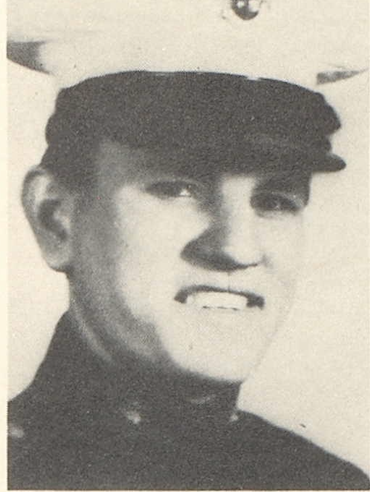
- Unit: 4th Marine Aircraft Wing, Marine Aircraft Group 11, Air Warning Squadron Two
- Date of Birth: April 19, 1925
- Entered the Military: January 29, 1943
- Date of Death: May 27, 2014
- Hometown: Raritan, New Jersey
- Place of Death: Florida
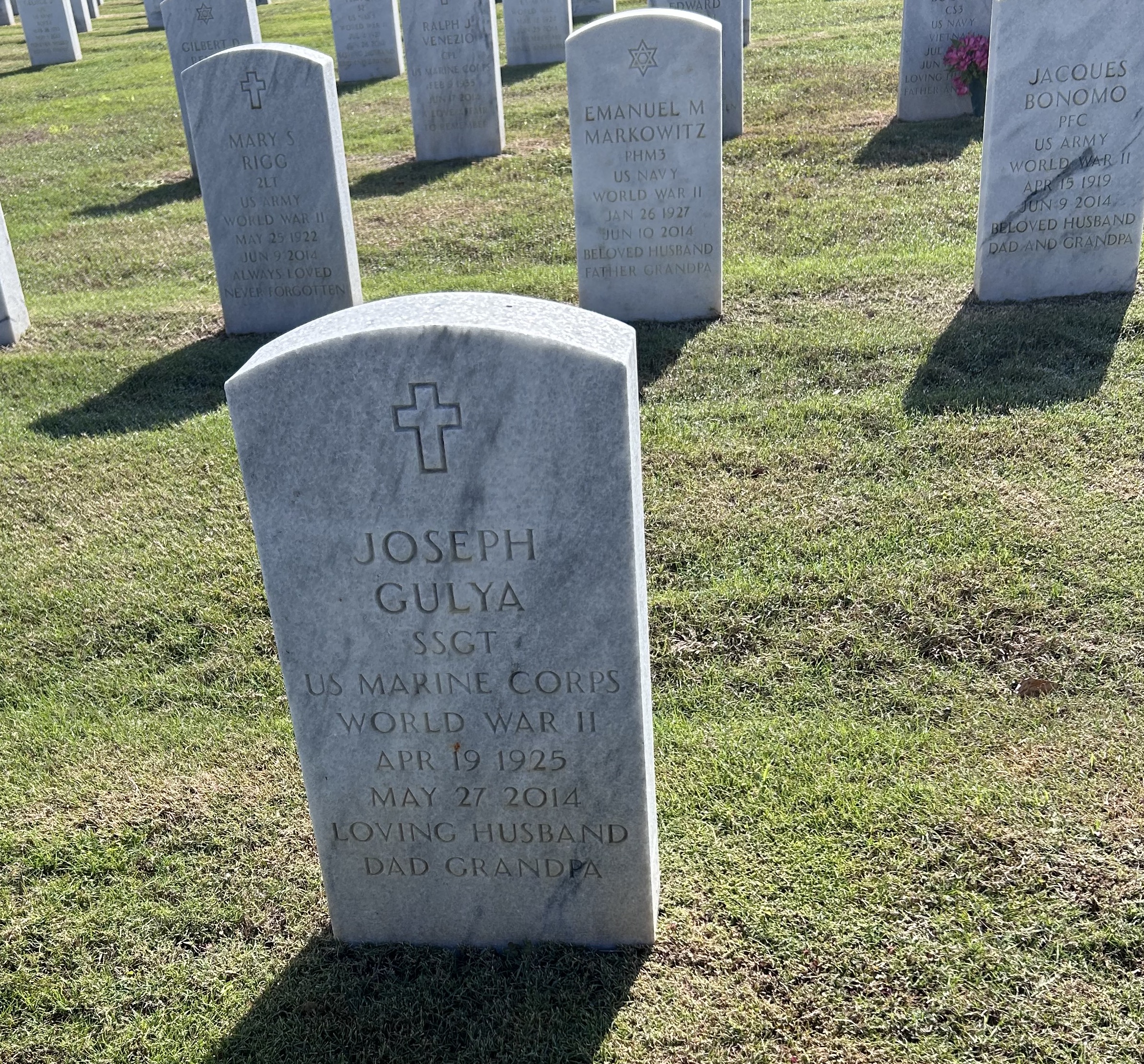
- Cemetery: Section 20, grave 1929. South Florida National Cemetery, Lake Worth Beach, Florida
Mentored by Mrs. Mercedes Cortes
Pembroke Pines Charter Middle School, Pembroke Pines, Florida
2025/2026
Early Life
Joseph Gulya was born on April 19, 1925, in Raritan, New Jersey, to George and Julia Gulya. The couple was Polish Catholic and had three other children: two sons, John and William, and one daughter, Helen.
During his childhood, Gulya recalled that his father built a home for $2,500, but later lost it because he could not find a job. Gulya’s upbringing was very poor and humble. He described a time when his mother would send him to get “bones” from a grocer for dogs, but his family never had a dog. He remembered his mother using these bones to make soup.
Gulya’s dad managed to find odd jobs during the Great Depression. One job in a shipping yard paid $50 a day once, and Gulya thought his dad had struck it “rich.” Growing up, Gulya also worked to help his family.
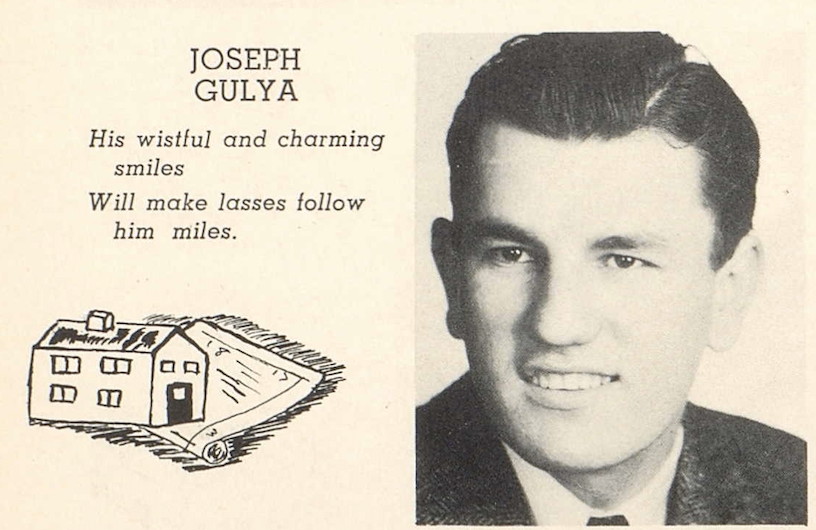
In 1942, while a student at Perth Amboy High School, Gulya accompanied a friend to the military recruitment office. Gulya didn’t intend to sign up, and wasn’t able to because he was only seventeen years old. During their meeting, though, Gulya decided that he wanted to enlist in the U.S. Marines. He convinced his parents to sign the enlistment form so he wouldn’t have to wait until the end of the school year.
Before he left for boot camp, Gulya’s family threw him a party, and he remembered them crying. With that farewell, his military journey began.

Homefront
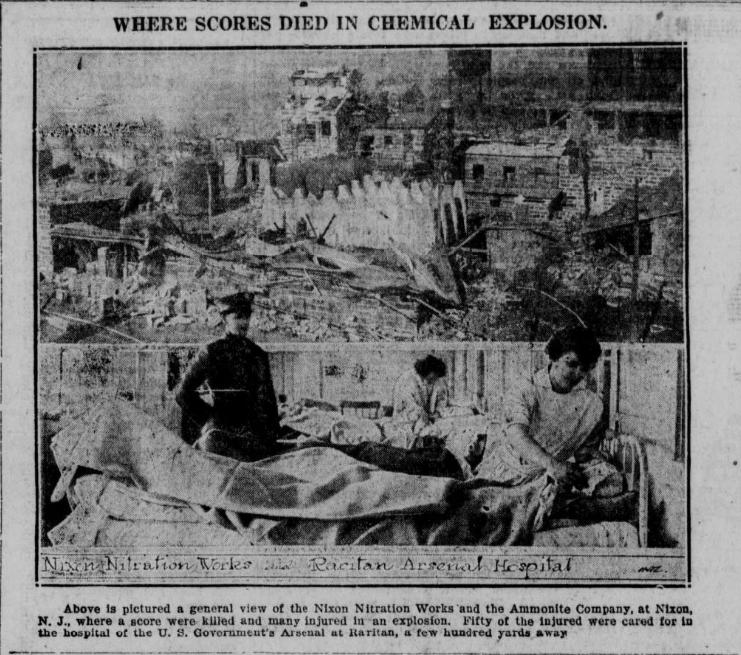
Nixon Nitration Works
In 1924, the Nixon Nitration Works, located on the Raritan River in nearby Nixon (now part of Edison), blew up. The explosion destroyed forty buildings and killed twenty people. It also released toxic substances into the air, contaminating nearby waterways and soil. Even though the explosion was a disaster, they rebuilt the Nixon factory.
Originally, the company was founded in 1915 to produce cellulose nitrate and other war materials for World War I. When the war ended, the company remained open to salvage the contents of artillery shells for use as agricultural fertilizer.
After the explosion, the company pivoted to producing special plastics. These plastics were very important because they were used to make gears for the soldiers in World War II.
By the time World War II began, these “special plastics” became a critical strategic resource. Metal was in short supply because it was needed for tanks, planes, and ships. The Nixon factory filled the gap by perfecting plastic formulas that were durable enough to replace steel in high-stress components. These plastics were used in self-lubricating precision gears for military equipment, on covers for cockpit gauges and radio equipment, on bayonet handles, and more.
Changing Demographics
During the war, everything changed. As soldiers left to fight and families moved frequently in search of better jobs, the area saw housing shortages, overcrowding, schools overwhelmed with new students, women entering the workforce, and rationing affecting daily life. Factories actively recruited African Americans from the South to fill labor shortages. While they were needed for essential war work, they still faced housing discrimination and segregation in the North.
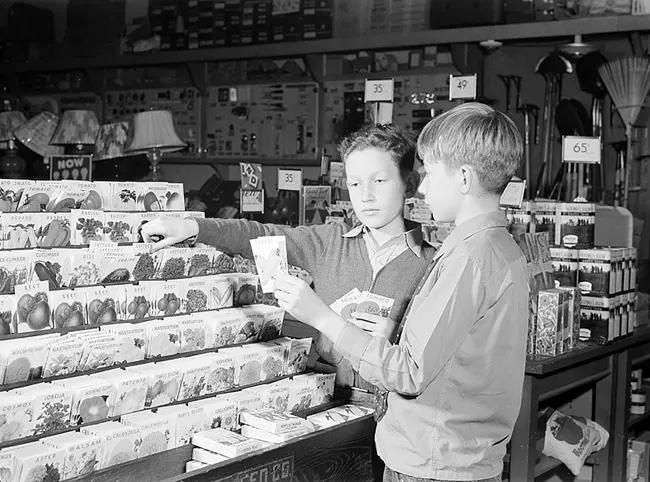
Victory Gardens
By 1944, nearly 20 million Victory Gardens were planted across the U.S., producing roughly 40% of all vegetables consumed in the country. For a family like the Gulyas, who lived in a high-density industrial corridor in New Jersey, these gardens were a vital source of fresh produce and a major point of patriotic pride.
Military Experience
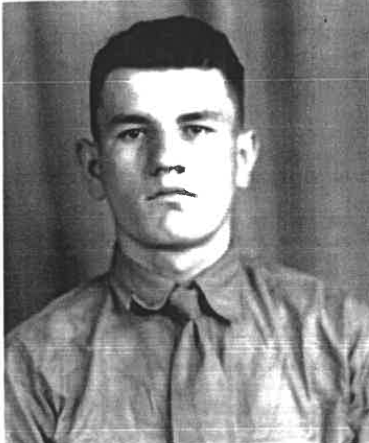
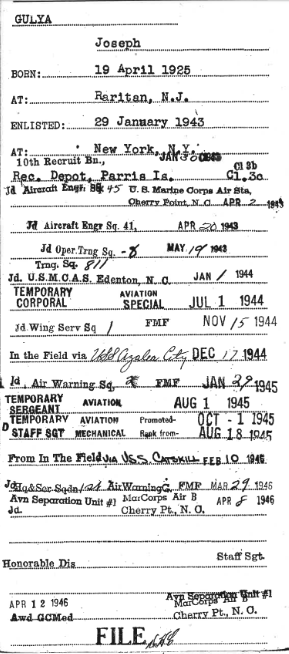
Joseph Gulya enlisted in the U.S. Marine Corps on January 29, 1943. He attended boot camp at Parris Island, South Carolina, in February 1943. In April 1943, he was assigned to the Aircraft Engineering Squadron 45 at Cherry Point, North Carolina, where he worked in aircraft maintenance. Every morning, he would go to his assigned plane and check it over, looking for oil leaks, body cracks, and any imperfections. He recorded all his information on a piece of paper. He was checking to see that the aircraft was safe for use. Then a lieutenant would come by to sign his paper and check it over so he could use that plane to teach students.
In January 1944, Joseph was selected to undergo specialized training to become a radar operator at United States Marine Corps Air Station Edenton in South Carolina. This school focused on the science of radio waves and the operation of top-secret radar equipment. After completing this training, Gulya was promoted to corporal.
By November 1944, Gulya was again promoted to sergeant and was transferred to Wing Service Squadron 1, Fleet Marine Force. On December 17, 1944, he was aboard USS Azalea City to the Pacific theater. In January 1945, Gulya was a member of the Air Warning Squadron Two, Marine Aircraft Group 11, 4th Marine Aircraft Wing, Fleet Marine Force, likely based in Okinawa. His new job involved monitoring a radar scope to track unidentified aircraft and providing real-time coordinates to guide interceptor pilots through difficult conditions such as darkness or heavy cloud cover. Gulya excelled in this high-pressure environment, leading to another promotion to staff sergeant. On February 10, 1946, Gulya left the Pacific aboard USS Catskill. He was honorably discharged from the Marine Corps on April 12, 1946, at Cherry Point, North Carolina.
Veteran Experience
After the war, Gulya moved back home and lived with his parents. In the 1950 Census, he worked as a carpenter.
In October 1954, Joseph Gulya married Frances L. Przybylski. Together, they had a daughter, Jaqueline Francis. Gulya continued to work in construction, opening a homebuilding company in New Jersey with his brother, John.
Mr. and Mrs. Gulya moved to Florida in 1988 and lived in West Palm Beach, Stuart, and Lake Worth. In Florida, they opened a business, Jupiter Chemical Provisioners, Inc.

Commemoration
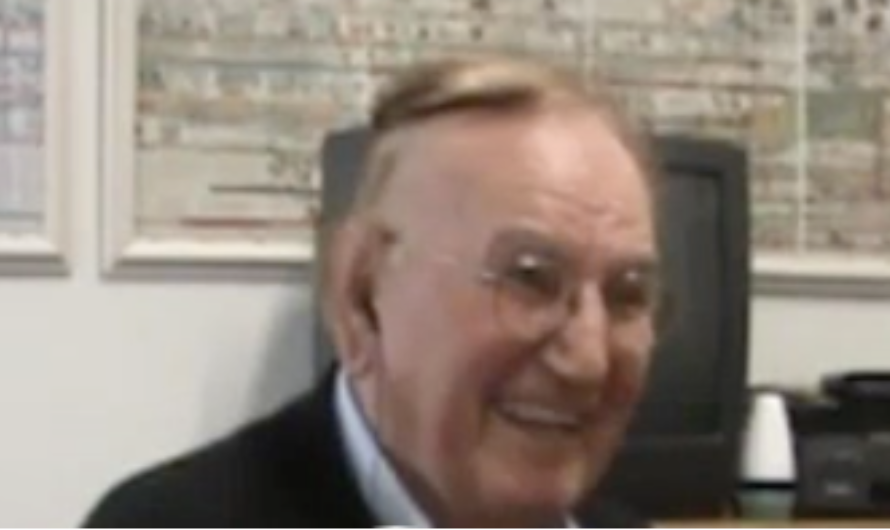
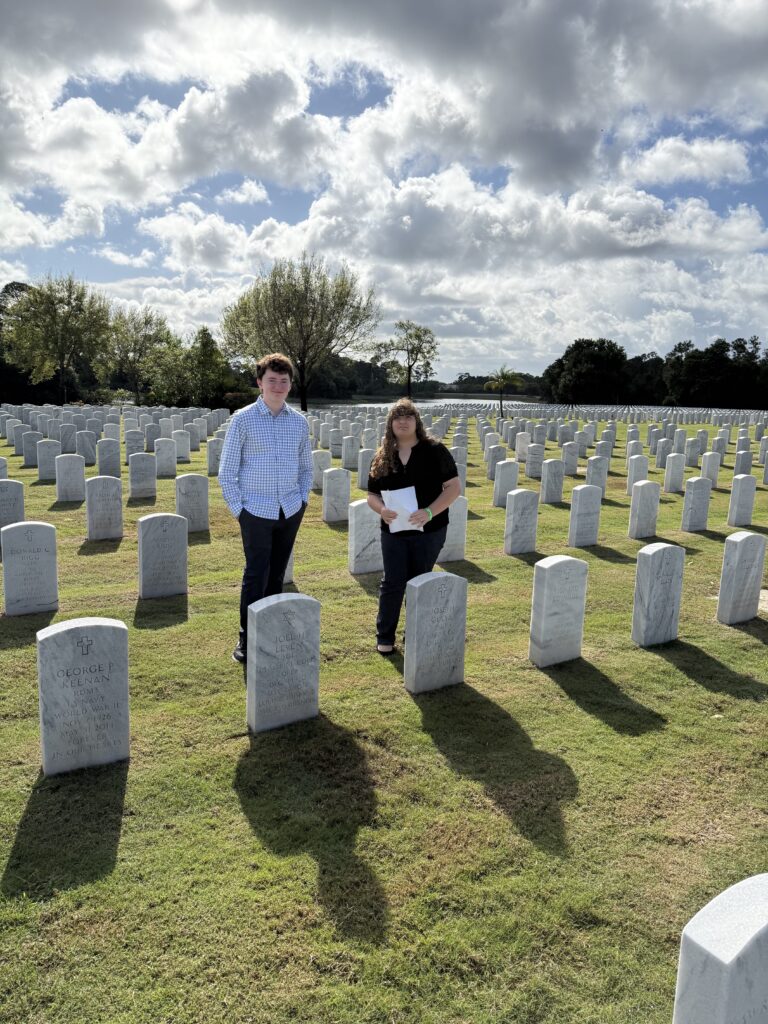
Gulya passed away on May 27, 2014. He was laid to rest in the South Florida National Cemetery.
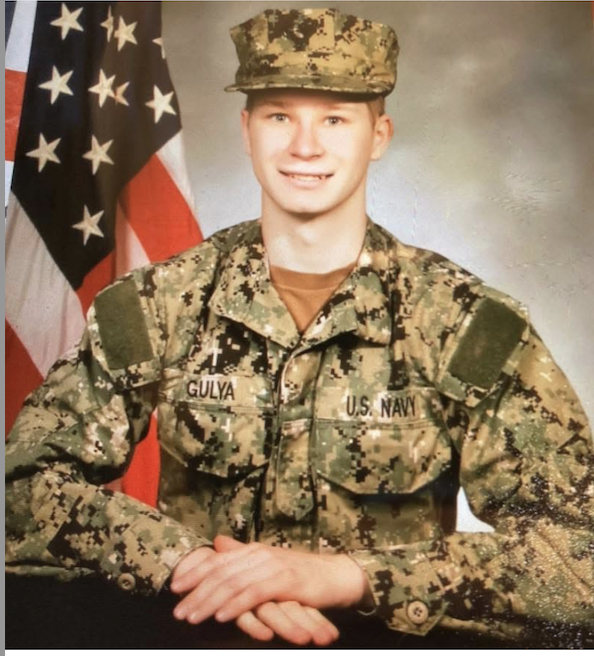
His grandson, Andrew, decided to follow in Gulya’s military footsteps and joined the Navy. His grandson said Gulya was one of a kind, that he was so kind, and that his humanity was like no other. His motto was “Live life to the fullest.” While he was mostly private and not a huge socialite, he is remembered as a jokester who worked hard and always wanted to secure provisions for his family.

Bibliography
Primary Sources
“Engagements – Gulya-Rodriquez.” The Palm Beach Post [West Palm Beach, Florida], April 23, 1995. Newspapers.com (137807574).
Family Records, 2000-2018. Courtesy of Helen and Andrew Gulya.
Gulya, Joseph. “Joseph Gulya Collection.” Interview by Milidonis, Dave J. Veterans History Project, American Folklife Center, Library of Congress. December 11, 2010. https://www.loc.gov/item/afc2001001.76306/.
Joseph Gulya. Florida, U.S., Arriving and Departing Passenger and Crew Lists, 1898-1963. Digital Images. https://www.ancestryclassroom.com/.
Joseph Gulya. New Jersey, U.S., Marriage Index, 1901-2016. Digital Images. https://www.ancestryclassroom.com/.
Joseph Gulya, Official Military Personnel File, Department of the Navy, National Archives and Records Administration – St. Louis.
Joseph Gulya, Report of Separation, Department of the Navy, National Archives and Records Administration – St. Louis.
Joseph Gulya. U.S., School Yearbooks, 1900-2016. Digital Images. https://www.ancestryclassroom.com/.
“Phoenix Children Honored at Party.” The Central New Jersey Home News [New Brunswick, New Jersey], December 23, 1937. Newspapers.com (314537601).
New Jersey. Middlesex County. 1930 Census. Digital Images. https://www.ancestryclassroom.com/.
New Jersey. Middlesex County. 1940 Census. Digital Images. https://www.ancestryclassroom.com/.
New Jersey. Middlesex County. 1950 Census. Digital Images. https://www.ancestryclassroom.com/.
United States Office of War Information. Americans Will Always Fight For Liberty. Poster. 1943. David and Zelda Silberman Collection, United States Holocaust Memorial Museum. https://collections.ushmm.org/search/catalog/irn521001.
“Where Scores Died in Chemical Explosion.” The Alaska Daily Empire [Juneau, Alaska], March 12, 1924. Library of Congress (sn84020657).
Secondary Sources
Becker, Samantha. “War Bond Rallies Helping to Fund Allies’ Fight.” Seton Hall University. Accessed November 13, 2025. https://blogs.shu.edu/ww2-0/1942/07/19/war-bond-rallies-helping-to-fund-allies-fight/.
Donohue, Kate. “Personally Speaking – Weddings and Engagements.” Sunday Star-Ledger [Newark, NJ], April 20, 1997.
“History: 1940s.” New Jersey State Police. Accessed November 12, 2025. https://www.nj.gov/oag/njsp/about/history/1940s.shtml.
“History of the Borough of Victory Gardens.” Borough of Victory Gardens. Accessed November 14, 2025. https://www.victorygardensnj.gov/history/index.html.
“Joseph Gulya.” Find a Grave. Accessed March 1, 2026. https://www.findagrave.com/memorial/130949288/joseph-gulya.
“Joseph Gulya Obituary.” Legacy. Updated June 4, 2014. Accessed November 1, 2026. https://www.legacy.com/us/obituaries/palmbeachpost/name/joseph-gulya-obituary?id=17102795.
“Joseph Gulya.” Veterans Legacy Memorial. Accessed December 1, 2025. https://www.vlm.cem.va.gov/JOSEPHGULYA/B813F48.
“Labor Movement History – 1950s.” New Jersey Almanac. Accessed November 12, 2025. https://www.newjerseyalmanac.com/labor-movement-history-1950s.html.
Moy, Jeffrey V. “Selling the War: Patriotism, Propaganda, and the Public Response.” Morristown Green. June 13, 2017. Accessed November 13, 2025. https://morristowngreen.com/2017/06/13/selling-the-war-patriotism-propaganda-and-the-public-response/.
“The Nixon Nitration Explosion.” Discovering the 1920s. Accessed April 7, 2026. https://dhwordpress.ramapo.edu/discovering1920s/blog/2025/02/26/the-nixon-nitrationexplosion/#:~:text=On%20March%201%2C%201924%2C%20an%20explosion%20occurred,and%20the%20need%20for%20better%20safety%20measures.
“Nixon Nitration Works.” Syracuse University Libraries. Accessed November 1, 2026. https://digitalcollections.syr.edu/Documents/Detail/nixon-nitration-works/287322.
“Remembering World War II New Jersey: Then & Now.” PBS. Accessed November 12, 2025. https://wgvu.pbslearningmedia.org/resource/remembering-world-war-2-video-gallery/new-jersey-then-and-now/.
Rosener, Ann. Victory Gardens—for Family and Country. Photograph. 1943. Farm Security Administration/Office of War Information Black-and-White Negatives Collection, Library of Congress. https://www.loc.gov/pictures/item/2017696705/.
Springate, Megan E. “Victory Gardens on the World War II Home Front.” National Park Service. Accessed November 14, 2025. https://www.nps.gov/articles/000/victory-gardens-on-the-world-war-ii-home-front.htm.
Tollefson, James W. “Draft Resistance and Evasion.” Encyclopedia.com. Accessed November 13, 2025. https://www.encyclopedia.com/history/encyclopedias-almanacs-transcripts-and-maps/draft-resistance-and-evasion.
“Victory Gardens on the World War II Home Front.” National Park Service. Accessed February 19, 2025. https://www.nps.gov/articles/000/victory-gardens-on-the-world-war-ii-home-front.htm.
“World War II Ration Book.” New Jersey Women’s History. Accessed November 1, 2026. https://www.njwomenshistory.org/Period_5/ration.htm.
This profile was funded by a grant from the United States Department of Veterans Affairs. The opinions, findings, and conclusions stated herein are those of the author and do not necessarily reflect those of the United States Department of Veterans Affairs.