
Captain Joseph James Loughlin
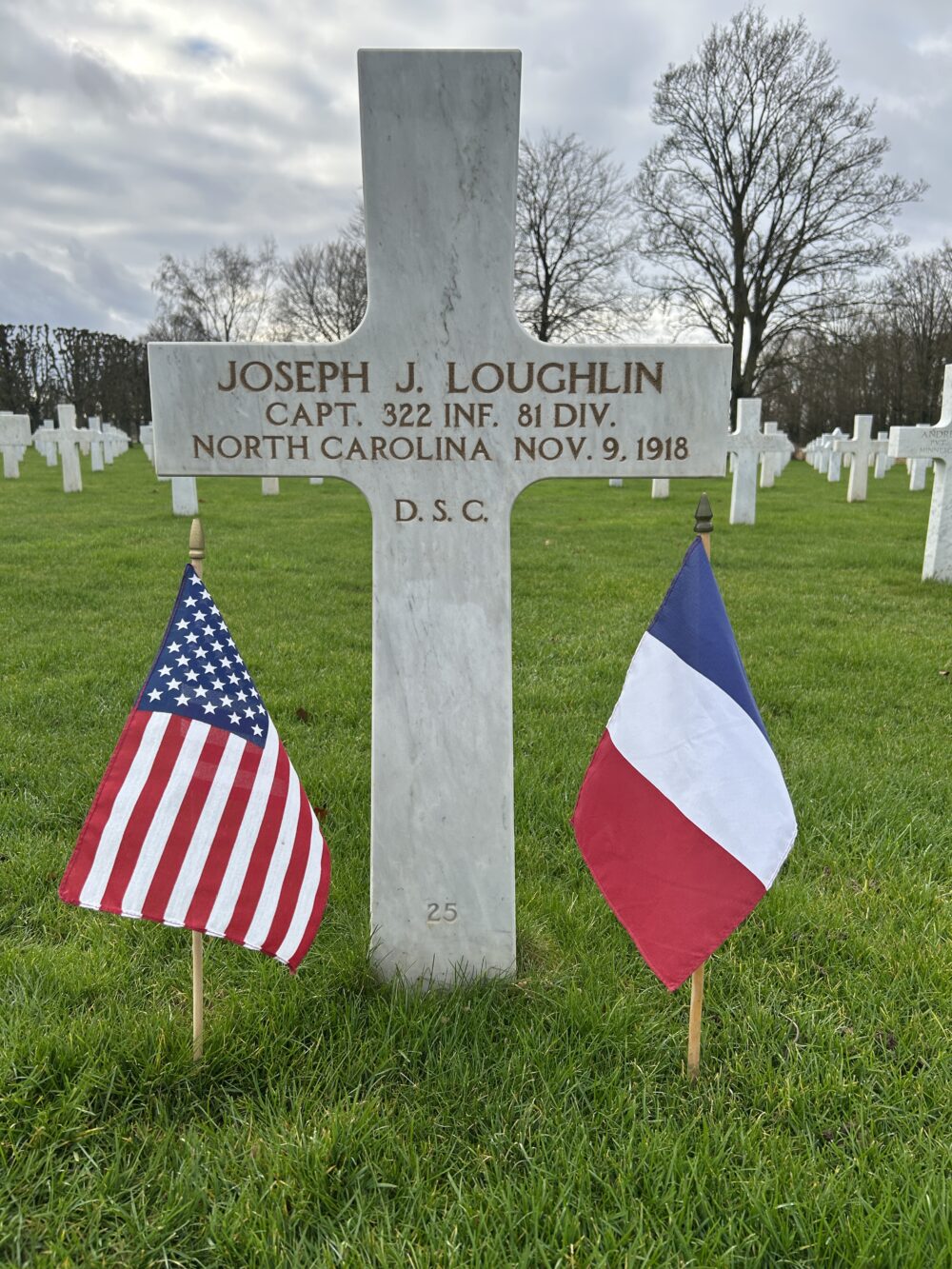
- Unit: Headquarters Company, 322nd Infantry Regiment, 81st Division
- Service Number: 1222444
- Date of Birth: March 20, 1880
- Entered the Military: August 15, 1917
- Date of Death: November 9, 1918
- Hometown: Wilmington, North Carolina
- Place of Death: Near Moranville, France
- Award(s): Distinguished Service Cross
- Cemetery: Plot D, row 11. Saint Mihiel American Cemetery, Thiaucourt-Regniéville, France
North Gaston High School, Dallas, North Carolina
2025/2026
Early Life
Swansboro
Joseph James Loughlin was born on March 20, 1880, in Swansboro, North Carolina. He was the second son of James Loughlin and Mariah Ward Loughlin, and the third of four children overall. His father, James, was born in New York to Irish immigrants Peter Loughlin and Margaret Gray. His mother, Mariah, was from North Carolina.
Joseph’s father fought in the Civil War for the Union. He moved to New Bern after the war. While in New Bern, his father worked in both the cotton and turpentine businesses. His mother worked as a housekeeper.
Wilmington
Loughlin’s family moved to Wilmington, North Carolina, around 1900. Loughlin received business training from the office of Colonel Walker Taylor, where he was employed for many years. He then left to work as a postal clerk around 1900 and joined the Boys Brigade in 1901. Leaders modeled this group after the interdenominational Christian youth group founded in Scotland years before. The organization required boys to attend Sunday school. They met weekly to drill with wooden rifles and swords, wearing uniforms of blue jerseys, white pants, white caps, and white shoes. The program also offered clubs in track and field, basketball, baseball, drama, and debate, as well as vocational training. Loughlin served as captain of this brigade before leaving.
Career
After working at the post office for five years, Loughlin left to learn real estate from A. W. Pate. Loughlin and Pate purchased an interest in the New Hanover Transit Company, where he served as secretary and treasurer. This company was a primary developer of Carolina Beach, near Wilmington.
On September 25, 1907, Joseph married Eleanor Pearson King in Wilmington. They had three children together: Joseph Jr., Charles, and Eleanor.


Homefront
History of Wilmington
Wilmington is a port city located at the mouth of the Cape Fear River. The area surrounding Wilmington was originally home to various indigenous groups.
Wilmington played a role in both the American Revolution and the Civil War. Patriot and Loyalist forces fought the Battle of Moore’s Creek, twenty miles northwest of Wilmington. During the Civil War, Confederate forces used nearby Fort Fisher to protect the city. The Union Army captured the fort and Wilmington on January 15, 1865.
During Reconstruction, African Americans came to the city, started businesses, and ran for public office. Wilmington was a majority-Black city in the 1890s. Pushing back on this, a group of White supremacists overthrew the legitimately elected biracial government on November 10, 1898, in an event later called the Wilmington Insurrection or the Wilmington Massacre. The men also burned down The Daily Record offices and murdered several hundred residents. After the riot, White supremacists drove approximately 2,000 African Americans out of the city, giving it a White majority again.
The Military Connection
During World War I, due to steel shortages, the Liberty Shipyard constructed two experimental concrete ships. The shipyard was located on Greenfield Street. In October 1917, Wilmington Shipbuilders also built a large schooner for the war named Hoppauge. This marked the first ship constructed in Wilmington in 100 years.
During World War I, the U.S. Army mobilized engineer units to support the American Expeditionary Forces in France. These engineers constructed bridges, repaired roads, and performed survey and construction work on the front lines. Company A of the North Carolina Engineers, commanded by Captain George W. Gillette, was mobilized in 1917 in Lumberton, North Carolina, before serving overseas as part of the 105th Engineers.
Community Efforts
Community members supported the war effort in Wilmington during World War I. Many people raised money for the Food Conservation Committee of New Hanover. The Red Cross put together boxes of linens for the Navy League. The Scott Hills School had a savings stamp campaign. War bonds were continually advertised in The Wilmington Morning Star. Newspapers also published essays to encourage women to conserve meat and other food to help Allied soldiers. Performers staged a play titled ‘Womanhood, the Glory of the Nation’ at the Victoria Theater. Organizers produced the play to recruit women for the war effort.
German POWs
During the war, federal authorities classified certain Germans as enemy aliens and sent them to the Mountain Park Hotel in Holly Springs, North Carolina. The owners leased the hotel grounds to the government for the war effort. Authorities detained workers from a German ship and immigrants who had been held at Ellis Island since the start of the war. They held approximately 2,500 Germans at the luxury hotel. The camp quickly outgrew the hotel’s available space, so the government began constructing barracks for the prisoners to live in, and the German prisoners eventually assisted with construction. The prisoners built a small village, including a church.


Military Experience
Joseph James Loughlin joined the military in 1917 at the age of 37. Loughlin attended the Officers’ Training Camp at Fort Oglethorpe, Georgia. He received his commission as first lieutenant in August 1917 and was subsequently assigned to Camp Jackson for duty until June 1918.
Loughlin joined Company C, 322nd Infantry Regiment, 81st Division, also known as “The Wildcats.” The Army formed the division in 1917 at Camp Jackson, South Carolina. The Army filled the division with draftees from surrounding states.
While at Camp Jackson, Loughlin lost his eye in a training accident. A gun, fired by a member of his company, exploded. The man who fired the gun lost an arm, and Loughlin lost sight in his right eye. Loughlin was allowed to remain in the military.
The U.S. Army sent the company overseas with the American Expeditionary Force in July 1918. Loughlin served for three weeks in this company before the Army promoted him to captain and transferred him to the headquarters company on October 16, 1918.
The 81st Division first saw combat in France in the latter part of World War I as part of the Meuse-Argonne Offensive. This offensive secured critical victories and hastened the armistice that ended the war in November 1918. The Meuse-Argonne Offensive was the deadliest campaign in American history to that date, with more than 26,000 American soldiers killed. More than one million American troops participated in the campaign.
On November 9, 1918, Captain Joseph James Loughlin led his company near Moranville, France. He went forward through heavy machine-gun fire to locate a nest of enemy machine guns. This nest was holding up the advance of his regiment. While attempting to locate the nest so he could order a 37mm infantry gun to destroy it, the enemy machine-gun fire killed him. Captain Loughlin died just two days before the armistice. He was posthumously awarded the Distinguished Service Cross for his bravery that day.


Commemoration
In December 1918, the War Department notified Captain Loughlin’s mother that her son had died. However, the War Department could not confirm the date of his death, so the family hoped it was a mistake. The next day, The Wilmington Morning Star confirmed that Captain Loughlin had died in France. Captain Loughlin was buried at llot D, row 11 of the St. Mihiel American Cemetery in Thiaucourt-Regniéville, France.
Captain Loughlin’s name is also inscribed on the World War I Monument in Wilmington. At his home at 513 Front Street, a historical placard details his life and service to his country.


Bibliography
Primary Sources
“Buy Liberty Bonds.” The Wilmington Morning Star [Wilmington, North Carolina], October 1, 1918. Newspapers.com (55295407).
“Confirm Death of Captain Loughlin.” The Wilmington Morning Star [Wilmington, North Carolina], December 6, 1918. Newspapers.com (55429845).
“Engineers Need Recruits.” The Wilmington Morning Star [Wilmington, North Carolina], May 20, 1917. Newspapers.com 55274127.
German Internment Camp, WWI, Hot Springs, NC, 1918. Photograph. 1918. General Negatives, State Archives of North Carolina. https://www.flickr.com/photos/north-carolina-state-archives/35076385034/in/album-72157683468860084.
“Grandma Is For Suffrage.” The Wilmington Morning Star [Wilmington, North Carolina], May 26, 1919. Newspapers.com (55583959).
Joseph J Loughlin. U.S Navy Casualties Book, 1776-1941. Digital Images. https://www.ancestry.com.
Joseph J Loughlin. World War I Service Cards, 1917-1919. Digital Images. https://www.ancestry.com.
Joseph James Loughlin Jr. San Diego, California, 1937. Digital Images. https://www.ancestry.com.
Joseph James Loughlin. New Hanover, North Carolina Marriage Register, 1741-2011. Digital Images. https://www.ancestry.com.
Joseph James Loughlin. World War 1 Draft Registration Cards, 1917-1918. Digital Images. https://www.ancestry.com.
“Lend To Liberty.” The Wilmington Morning Star [Wilmington, North Carolina], May 20, 1917. Newspapers.com (55274127).
“A Loan Was Our First Act Of War.” The Wilmington Morning Star [Wilmington, North Carolina], May 20, 1917. Newspapers.com (55274128).
Looking Toward Grimaucourt During World War I. Photograph. 1918. Papers of Harry S. Truman Pertaining to Family Business and Personal Affairs, Harry S. Truman Library & Museum. https://www.trumanlibrary.gov/photograph-records/82-213-99.
“Money Need To Help In Food Campaign.” The Wilmington Morning Star [Wilmington, North Carolina], May 20, 1917. Newspapers.com (55274125).
North Carolina. New Hanover County. 1880 U.S. Census. Digital Images. https://www.ancestry.com.
North Carolina. New Hanover County. 1900 U.S. Census. Digital Images. https://www.ancestry.com.
“Obituary for James Captain.” The Wilmington Dispatch [Wilmington, North Carolina], May 15, 1912. Newspapers.com (132864100).
“The Red Cross Bulletin.” The Wilmington Morning Star. [Wilmington, North Carolina], May 20, 1917. Newspapers.com (55274128).
“Relief Work Goes On At Rapid Pace.” The Wilmington Morning Star. [Wilmington, North Carolina], October 1, 1918. Newspapers.com (55295407).
“Rural Schools Organizing.” The Wilmington Morning Star. [Wilmington, North Carolina], January 25, 1918. Newspapers.com (5583137).
“War Department Has Not Been Notified.” The Wilmington Morning Star [Wilmington, North Carolina], December 5, 1918. Newspapers.com (55429827).
“Wilmington’s Bit Towards The Merchant Marine.” The Wilmington Morning Star [Wilmington, North Carolina], October 8, 1917. Newspapers.com (55423322).
“Wilmington Boy Loses Eyesight in Accident.” The Wilmington Morning Star [Wilmington, North Carolina], January 28, 1918. Newspapers.com (190698344).
“Womanhood Comes Monday.” The Wilmington Morning Star [Wilmington, North Carolina], May 20, 1917. Newspapers.com (55274129).
“Women Can Help Win War.” The Wilmington Morning Star. [Wilmington, North Carolina], May 20, 1917. Newspapers.com (55274132).
Secondary Sources
“1898 Wilmington Coup.” NC Department Of Natural and Cultural Resources. Accessed November 25, 2025. https://www.dncr.nc.gov/1898-wilmington-coup.
“A Buried Coup d’Etat In The United States.” The New Yorker [New York City, NY]. Accessed November 25, 2025. https://www.newyorker.com/magazine/2016/09/19/a-buried-coup-detat-in-the-united-states.
“Capt Joseph James Louglin.” American Battle Monuments Commission. Accessed October 15, 2025. https://weremember.abmc.gov.
“Captain Joseph James Loughlin.” Find A Grave. Accessed December 23, 2025. https://www.findagrave.com/memorial/56340941/joseph_james-loughlin.
“Historic Swansboro.” Swansboro Historical Association, Inc. Accessed November 25, 2025. https://www.visitswansboro.org/culture/historic-swansboro/.
“Historical Overview.” History of Wilmington. Accessed November 25, 2025. https://www.wilmingtonandbeaches.com/about/area-information/historical-overview/.
“History of the 81st Infantry Division.” 81st Infantry Division Archive. Accessed December 22, 2025. https://www.81stdivisionarchive.com/history-of-the-division.
“James Loughlin Hall of Valor.” Military Times. Accessed December 22, 2025. https://valor.militarytimes.com/recipient/recipient-13225/.
“Joseph J. Loughlin.” Veterans Legacy Memorial, National Cemetery Administration. Accessed March 6, 2026. https://www.vlm.cem.va.gov/JosephJLoughlin/153FD.
“Joseph Loughlin House.” Historical Marker Database. Accessed December 22, 2025. https://www.hmdb.org/m.asp?m=263571.
McFarland, Ebone. Why Whites Riot: The Race Riot Narrative and Demonstrations of Nineteenth Century Black Citizenship. Paper presented at The University of North Carolina at Greensboro, 2011. https://libres.uncg.edu/ir/uncg/f/McFarland_uncg_0154M_10692.pdf.
“The Meuse-Argonne Offensive.” National Archives. Accessed December 22, 2025. https://www.archives.gov/research/military/ww1/meuse-argonne.
“A Moving Monument—Wilmington’s World WarI Memorial.” New Hanover County Cape Fear Museum. Accessed November 7, 2025. https://www.nhcgov.com/609/A-Moving-Monument-Wilmingtons-World-War-.
“Most People in North Carolina Don’t Know About Our Old German POW Camp.” Only in Your State. Accessed December 22, 2025. https://www.onlyinyourstate.com/state-pride/north-carolina/german-pow-camp-hot-springs-nc.
“New Hanover County World War I Memorial, Wilmington.” Commemorative Landscapes. Accessed December 22, 2025. https://docsouth.unc.edu/commland/monument/676/.
“What is the Brigade Boys’ Club?” StarNews Online. Accessed February 26, 2026. https://www.starnewsonline.com/story/news/2011/03/15/myreportercom-what-is-the-brigade-boys-club/30857620007/.
“World War I Left Enduring Mark on Southeastern N.C.” StarNews Online. Accessed February 27, 2026. https://www.starnewsonline.com/story/news/2014/10/30/world-war-i-left-enduring-mark-on-southeastern-nc/30970559007/
This profile was researched and created through the Researching Silent Heroes program, sponsored by the American Battle Monuments Commission.