

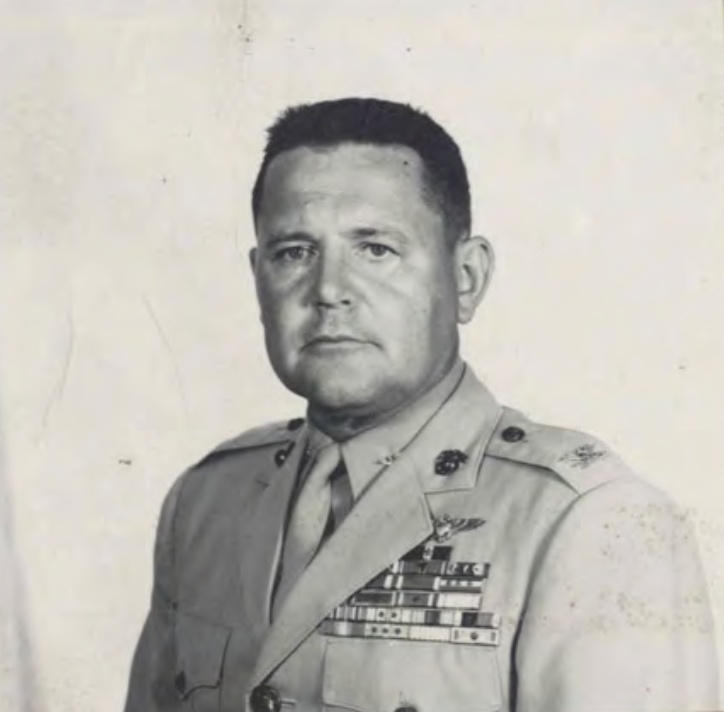
Colonel Kenneth Lyle Reusser
- Unit: 1st Marine Aircraft Wing, Marine Aircraft Group 16 (MAG-16)
- Date of Birth: January 27, 1920
- Entered the Military: August 23, 1941
- Date of Death: June 20, 2009
- Hometown: Cloverdale, Oregon
- Place of Death: Clackamas, Oregon
- Award(s): Navy Cross with 1 Gold Star, Distinguished Flying Cross with Gold Stars, Bronze Star with Combat "V", Air Medal with 18 Gold Stars, Purple Heart Medal with 2 Gold Stars, Presidential Unit Citation with 3 stars, Navy Unit Commendation, Army Distinguished Unit Emblem, American Defense Service Medal, American Campaign Medal, Asiatic-Pacific Campaign Medal with 2 stars, World War II Victory Medal, Navy Occupation Service Medal, National Defense Service Medal with 1 star, Korean Service Medal with 3 stars, United Nations Service Medal, Korean Presidential Unit Citation, Legion of Merit with Combat "V", Vietnam Campaign Medal with device, Armed Forces Expeditionary Medal, Navy Commendation Medal wth Combat "V"
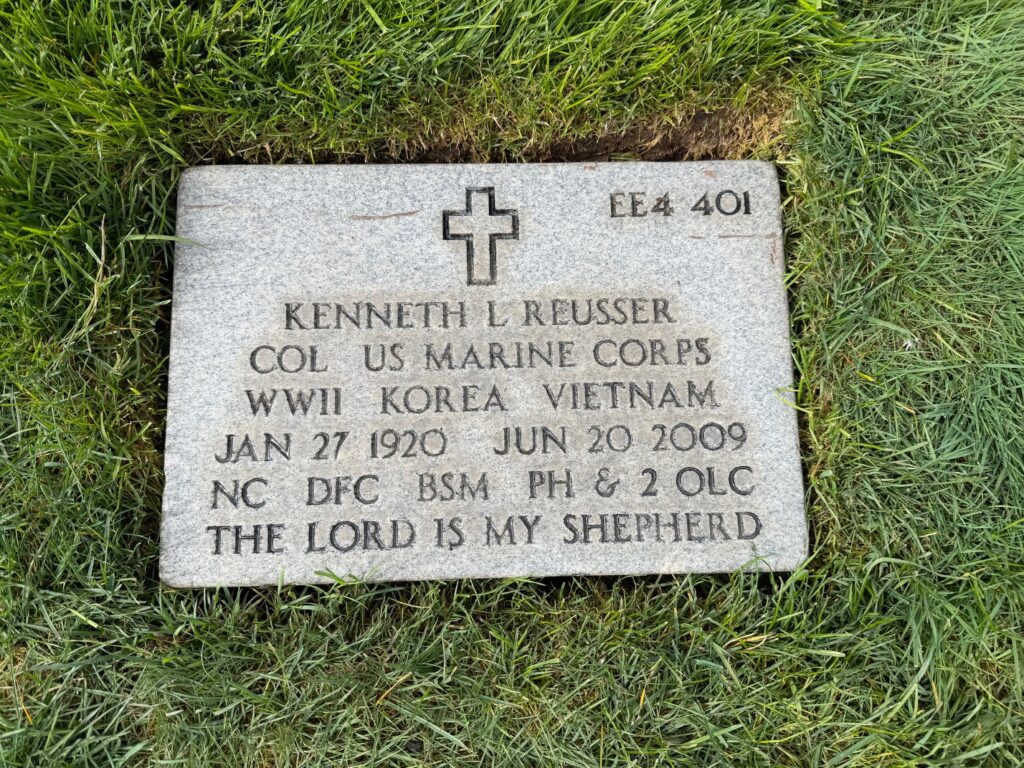
- Cemetery: Section EE4, Grave 401. Willamette National Cemetery, Portland, Oregon
Mentored by Mrs. Stefanie Spivey
Heppner High School, Heppner, Oregon
2025/2026
Early Life
Kenneth Lyle Reusser was born on January 27, 1920, in Cloverdale, Oregon, to Fred Carl Reusser, a dairy farmer, and Etta Velma Reusser, a homemaker. His father, Fred, was a World War I Veteran whose own parents immigrated from Switzerland. Kenneth’s mother came from a family rooted in Texas and Virginia.
Kenneth was the oldest of four children, growing up alongside his sister, Betty Belle, and his brothers, Carl Joseph and Robert Lowell. After living in Cloverdale for the first six years of his life, Kenneth and his family moved to Lynwood, California, in 1926, where he spent his elementary years. Here, Fred worked as a Baptist minister.
During the Great Depression, the Reussers returned to farming in Cloverdale. Kenneth attended Nestucca Union High School and graduated in 1938. During his high school years, Kenneth played four years of football and also participated in the Glee Club. He also achieved a somewhat rebellious reputation as a jokester. For instance, he once put a cow in his principal’s office.
After high school, the Reusser family moved to Portland, Oregon, where Fred got another job as a minister in a Baptist church. According to a biography written by Ralph Harvey, Kenneth attended Oregon State University for a brief period before transferring to Linfield University. Military records show he also attended Multnomah College in Portland. Even in college, Kenneth’s adventurous spirit never faded. He loved motorcycles and learned how to repair them himself, all while racing them for money. In his spare time, Kenneth started learning to fly planes and worked hard to be accepted into the government’s Civilian Pilot Training program.


Homefront
During World War II, the small agricultural town of Cloverdale, Oregon, was very lively and played a small but significant role in the war effort. Cloverdale, as a whole, was mainly focused on dairy production, while community members participated in rationing and buying war bonds. Throughout this period, women in Oregon also shifted out of their traditional roles and began taking jobs on farms, in dairies, and in food processing plants to replace the men who went to war.
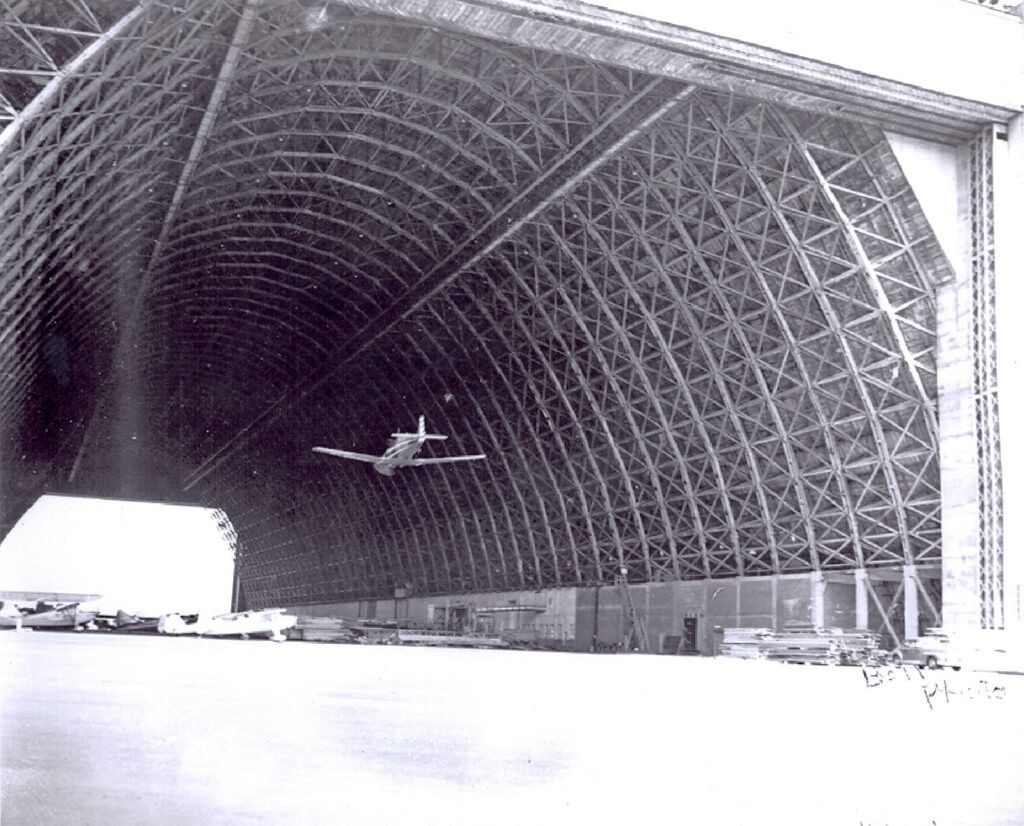
In Tillamook County, Naval Air Station Tillamook was built in 1942 to house blimps that patrolled the Oregon Coast for enemy submarines. The station was the base of operations for Squadron ZP-33, with eight K-class blimps that patrolled the coastline. These blimps would cover 13,000 square miles during a single day’s patrol.
The base’s huge wooden hangars were made from local timber, reflecting the county’s logging and lumber industries, which supplied the materials needed for the war. Each hangar required more than two million board feet of lumber, mostly supplied by fifty local lumber companies. This wooden construction saved more than 2,000 tons of steel per hangar, which was then used for ships, tanks, and other war equipment.
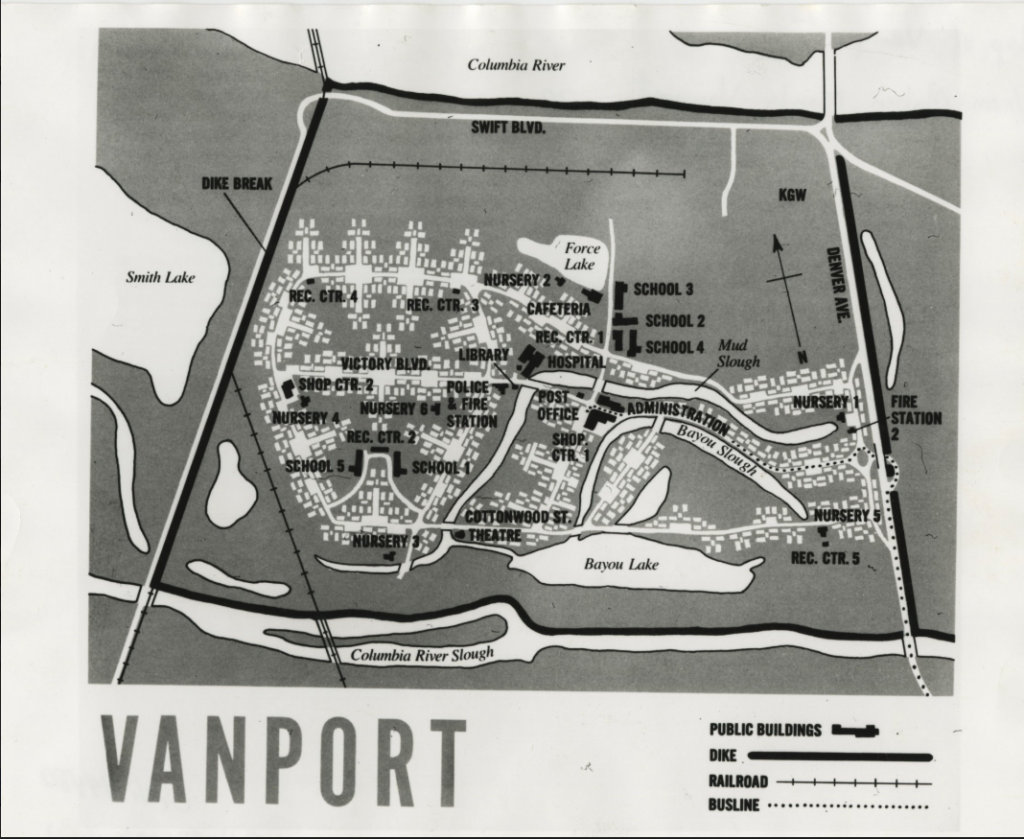
When the United States entered World War II, the city of Portland, Oregon, became one of the country’s most important industrial centers. The Kaiser shipyards in Portland employed close to 100,000 workers. To house the flood of new workers pouring into the city, Kaiser built Vanport City, north of Portland, in 1942, and by 1944, it was briefly Oregon’s second-largest city.

Military Experience
Training
On August 23, 1941, Kenneth Reusser entered the Naval Aviation Cadet Program at the Naval Air Station in Seattle, Washington, where he was later commissioned in the U.S. Marine Corps. Prior to Pearl Harbor, the United States Navy had accepted only about 40 enlisted aviation cadet applicants per month; after the attack, the number of accepted applicants grew rapidly.
Reusser was transferred to the Naval Air Station in Jacksonville, Florida, where he completed his primary flight training in February 1942. He continued on to advanced fighter training at Naval Air Station Miami from February to April, where he received his commission as a second lieutenant. From April until September, Reusser was assigned to Naval Air Station San Diego, where he completed his operational preparation before deployment.
Marine Fighting Squadron 122
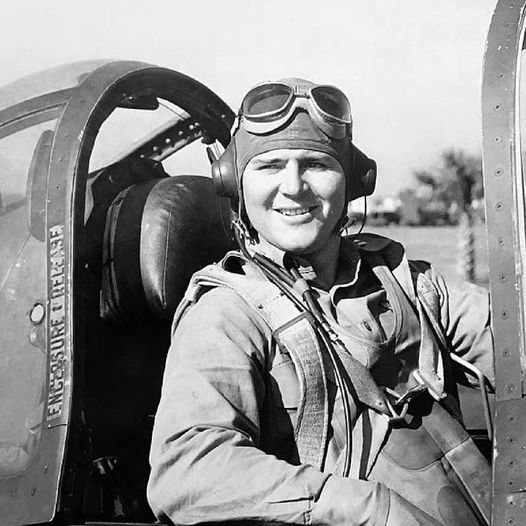
In October 1942, Reusser was assigned to Marine Fighting Squadron 122 (VMF-122). He served in the Pacific for approximately six months in a combined naval aviator and communications officer role. As a naval aviator, Reusser flew the F4F Wildcat fighter plane on many high-risk missions, including one over Guadalcanal, where he was shot down by enemy forces and presumed dead. He survived, but he was severely injured in the crash, including damage to one of his eyes, which contributed to the nickname “One-Eyed Miracle.”
Stranded in enemy-controlled territory, he was rescued by local islanders who hid and cared for him despite the danger. After several days, the Marines successfully recovered him. After this incident, in April 1943, Reusser returned to California, where he was hospitalized for three months. While back in the United States, Reusser married Patricia Taylor. The couple had a daughter, Patricia Jo, born on October 17, 1944. Two boys quickly followed, Kenneth Jr. and Richard.
Marine Fighting Squadron 312
In June 1943, Reusser was assigned to Marine Fighting Squadron 312 (VMF-312), known as the “Checkerboards.” He deployed with them for 24 months overseas as an operations officer and three months as a personnel officer. He also served as a division leader with the squadron. By 1945, Reusser was stationed at Kadena Airfield, Okinawa Shima, where he earned two major awards.
On April 21, 1945, during an enemy Japanese artillery bombardment of Kadena, Reusser saw a parked F4U aircraft take a direct hit from enemy artillery. He left the security of his foxhole, ran more than 400 yards under continuous shellfire, and taxied an undamaged aircraft to safety. He then came back, with the help of Corporal Bazoon, to try to salvage the plane that had been hit and was on fire. They attempted to extinguish the plane by packing mud into the wing structure and around the guns. The entire action took thirty minutes, during which both men were continuously exposed to flying shell fragments and exploding .50-caliber ammunition. For this action, Reusser was awarded the Bronze Star.
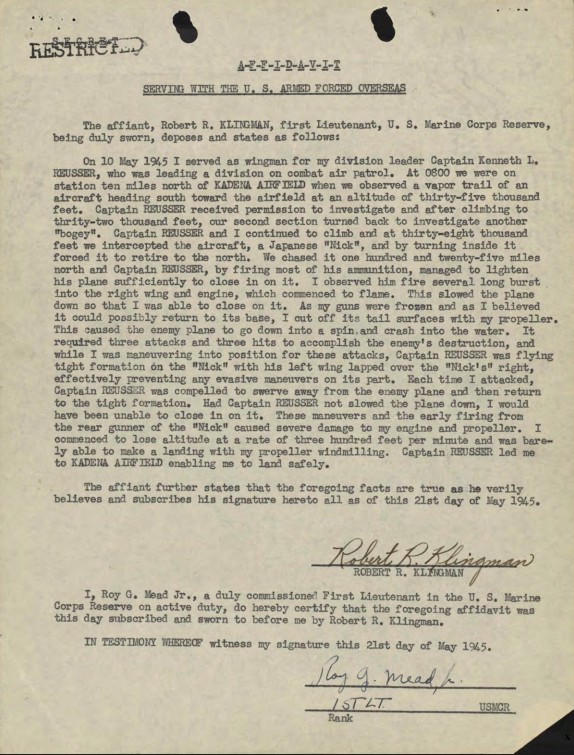
On May 10, 1945, while on a combat air patrol, Reusser spotted the vapor trail of an enemy reconnaissance aircraft headed toward Kadena Airfield. Reusser gave pursuit with his wingman, First Lieutenant Klingman. Reusser took out the right wing and right engine of the enemy plane before running out of ammunition. Klingman’s guns had frozen at altitude. Reusser obstructed the enemy pilot’s evasionary tactics by positioning his wingtip against the aircraft, while Klingman cut off the enemy plane’s tail with his propeller. The enemy aircraft crashed into the water, and both Reusser and Klingman landed safely. For this action, Reusser received a Navy Cross.
Reusser received several other awards for his World War II service, including the Distinguished Flying Cross and two Air Medals. Reusser left the VMF-312 in June 1945. He then spent a brief period at Headquarters Squadron, Personnel Group, in Miramar, California, before proceeding to the Marine Air Infantry School in Quantico, Virginia.
Post-World War II Service
After World War II ended in 1945, Reusser remained in the Marine Corps. In November 1945, Reusser was assigned to the Aircraft Engineering Squadron 46 (AES-46) at Marine Corps Air Station, Cherry Point, North Carolina, as a pilot and ordnance officer. He was released from active duty as a captain on July 13, 1946, at Cherry Point, North Carolina. From 1946 to 1949, Reusser served as an instructor in various roles in Jacksonville, Florida. He then served in multiple administrative/staff roles in Miami, Florida, and Atlanta, Georgia.
The Korean War
On November 23, 1949, Reusser joined the VMF-214, where he served as a pilot, logistics officer, operations officer, and executive officer for over a year. The VMF-214 deployed to Korea aboard USS Sicily.
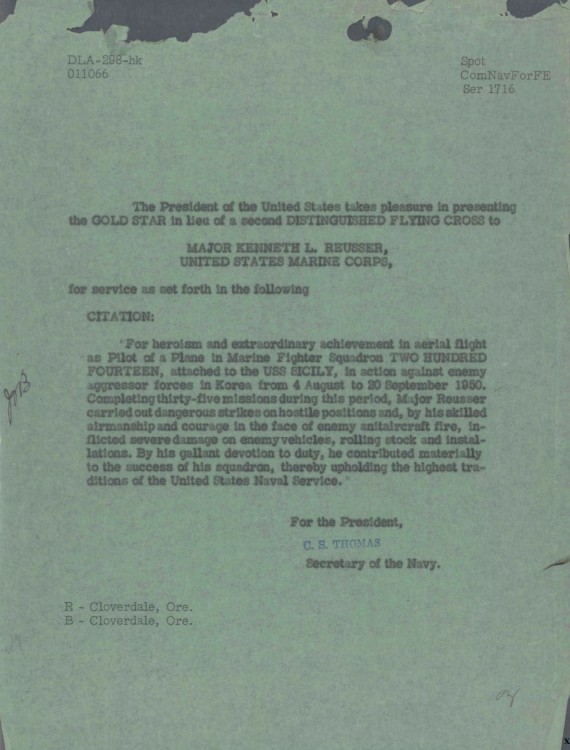
One of his most famous missions took place near Inchon on August 5, 1950. After spotting what looked like a factory, he led a low-level attack under heavy anti-aircraft fire. He discovered the building was actually assembling enemy tanks and vehicles. Even after his aircraft was damaged, he returned with napalm and rockets and destroyed the factory, six tanks, and four trucks. Later, he attacked a camouflaged oil tanker at an extremely low altitude. The explosion from the ship nearly destroyed his own plane, but he managed to fly it back to the carrier. This action earned him a Gold Star in lieu of a second Navy Cross.
Reusser was wounded multiple times in Korea, and he received Purple Hearts for these injuries. Despite being wounded, he continued flying combat missions. He also earned six more Gold Stars in lieu of Air Medals.
Post-Korean Staff and Command Assignments
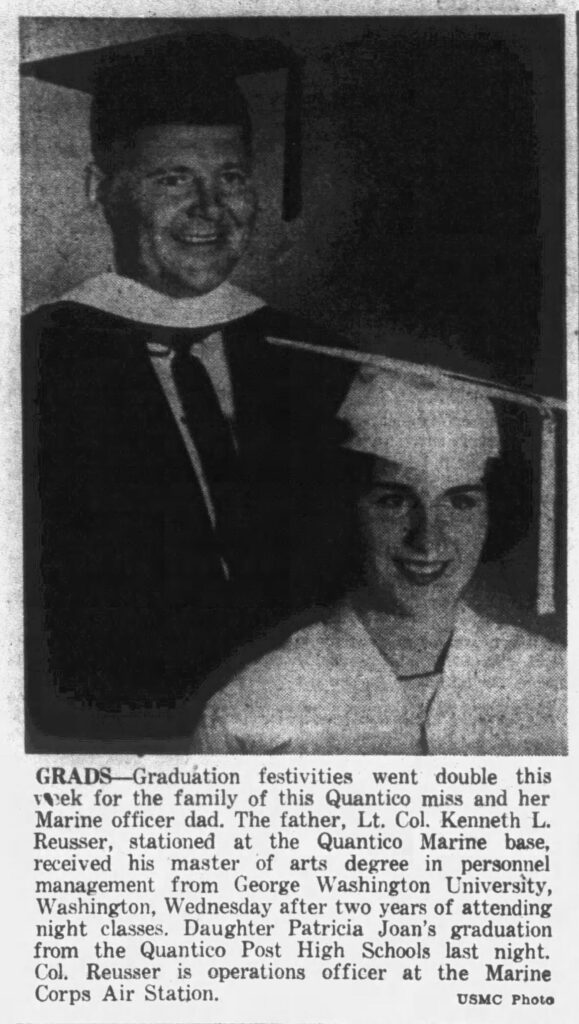
Following the Korean War, Reusser continued his career in the Marine Corps during the 1950s and early 1960s. During this period, he served in a variety of stateside and leadership roles, helping train new pilots and contributing to aviation development. He was also assigned as the commanding officer of the Aviation Engineering Squadron 12 at Marine Corps Air Station Quantico. As he gained experience and seniority, Reusser moved into higher leadership positions and helped improve Marine aviation readiness during the Cold War. In 1962, Reusser earned his Master of Arts in personnel management from George Washington University, after two years of attending night classes.
In 1964, Reusser was nominated for Marine Aviator of the Year for his work with Marine Aircraft Group 26. He increased their total flight hours and total carrier landings, reduced aircraft accident rates, and oversaw the training of ninety-two transitioning pilots and sixty-eight new pilots.
From August 10, 1965, to July 29, 1966, Reusser was a student at the Canadian National Defense College in Ontario, Canada.
The Vietnam War
During the Vietnam War, Reusser served in leadership roles, including as Commanding Officer of Marine Aircraft Group 16. In November 1966, while flying as a copilot in a UH-1E helicopter, the aircraft was shot down by enemy fire. The helicopter crashed and burst into flames. Reusser was trapped briefly inside the burning aircraft until his vest harness burned through. Even after escaping while on fire, he attempted to rescue the aerial gunner. For this action, he received the Navy Commendation Medal with Combat “V.”
Reusser was evacuated immediately to Da Nang, where he was treated for a week before being flown to the U.S. Naval Hospital in Bethesda, Maryland. He was treated for second and third-degree burns over 35 percent of his body. He also had gunshot wounds on his right forearm and left thigh, and was suffering from a serious infection. By June 1967, Reusser had recovered enough to return to full duty. His final assignment was as an assault aircraft project manager with Company A, Headquarters Battalion, at Naval Air Systems Command in Maryland.
Retirement
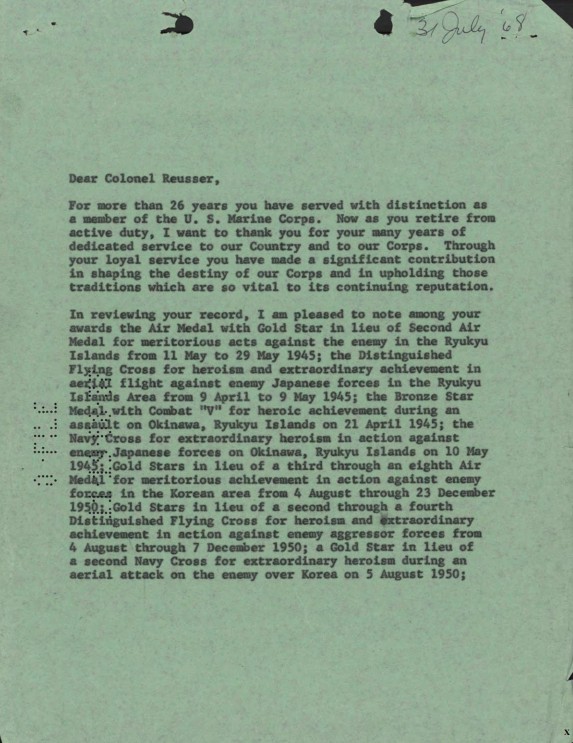
After nearly 27 years of service, Reusser retired from the United States Marine Corps on July 31, 1968, with the rank of colonel. Over his career, Reusser flew 253 combat missions, spanning three major wars. He left the military as the most decorated Marine aviator in Marine Corps history.
Veteran Experience
Lockheed Aircraft
During his service, the family moved to Santa Ana, California. After Reusser’s retirement, he worked in the aviation industry at Lockheed Aircraft. Reusser worked in roles related to aircraft development and testing, where his firsthand combat experience as a pilot helped improve aircraft performance and safety. He provided insight into how aircraft functioned in real combat situations, which was valuable to engineers and designers.
In January 1972, Reusser and his wife, Patricia, divorced. A few years later, on November 16, 1975, Reusser married Gertrude Palm Grieb in Alexandria, Virginia.
Piasecki Helicopter Corporation
Reusser then worked with Piasecki Helicopter Corporation in Sharon Hill, Pennsylvania, where he contributed to helicopter development and consulting, with a focus on rotary-wing aircraft. His experience flying helicopters in combat made his input especially valuable in improving helicopter design and mission effectiveness.
At the age of 66, while working for Piasecki Aircraft, Reusser participated in an experimental aircraft project that combined four old Navy helicopters with a blimp. This aircraft, known as the Heli-Stat, was intended to remove timber from inaccessible areas. During the test flight, while only 40 feet off the ground, the ten-story Heli-Stat aircraft was caught in a gust of wind that caused uncontrollable shimmying. This caused a vibration, leading to the structural failure of the starboard rear helicopter. It broke its mounting and crashed to the ground. The pilot died. The other pilots, including Reusser, were injured but survived.
Home to Oregon
Reusser lived much of his later life in the Portland, Oregon area. Though he had traveled all over the world during his service, Oregon remained home. Family, friends, and fellow Veterans remembered him as direct, brave, and confident. He never bragged about his accomplishments despite being the most decorated Marine aviator in history.



Commemoration
Kenneth Reusser died on June 20, 2009, at the age of 89 in Clackamas, Oregon. He has been featured in many military history articles and aviation publications. Ralph Harvey detailed his combat experiences in the book, The Forgotten Hero.
What makes Reusser’s legacy powerful is not just the number of medals he received, but the fact that he survived extreme danger over and over again. He was shot down, wounded, burned, and nearly killed multiple times. Yet he continued to serve. Today, Reusser is buried among other veterans at Willamette National Cemetery.

Bibliography
Primary Sources
California. Orange County. 1950 U.S. Census. Digital Images. https://ancestryclassroom.com.
Etta Velma Reusser. Oregon, U.S., State Deaths, 1864-1971. Digital Images. https://ancestryclassroom.com.
“Experimental blimp-type airship crashed and burns, killing one.” St. Petersburg Times [St. Petersburg, Florida], July 2, 1986. Newspapers.com (321055630).
Fred C Reusser. Oregon, U.S., Death Index, 1898-2008. Digital Images. https://ancestryclassroom.com.
Gertrude Palm Grieb. Virginia, U.S., Marriage Records, 1936-2014. Digital Images. https://ancestryclassroom.com.
“Grads.” The Free Lance-Star [Fredericksburg, Virginia], June 8, 1962. Newspapers.com (866932978).
K1 Kenneth Reusser. U.S. Navy and Marines Awards and Decorations, 1924-1994. Digital Images. https://ancestryclassroom.com.
Kenneth L. Reusser, Official Military Personnel File, Department of the Marines. National Archives and Records Administration – St. Louis. Accessed 20 Feb. 2026.
Kenneth Lyle Reusser. Oregon, U.S., State Births, 1842-1924. Digital Images. https://ancestryclassroom.com.
Map of Vanport, Oregon. Map. Vanport Collection, Oregon Historical Society Research Library. https://gallery.multcolib.org/image/map-vanport-oregon.
Melrose Hall, 1932. Photograph. 1932. Oregon Historical Society Research Library. https://www.oregonencyclopedia.org/articles/linfield_college/.
NAS Tillamook, airplane flying through. Photograph. Tillamook County Pioneer Museum Collection, Oregon Historical Society. https://www.oregonencyclopedia.org/articles/naval_air_station_tillamook_tillamook_air_museum/.
NAS Tillamook, blimps inside hangar. Photograph. Tillamook County Pioneer Museum Collection, Oregon Historical Society. https://www.oregonencyclopedia.org/articles/naval_air_station_tillamook_tillamook_air_museum/.
Patricia M. Taylor. California, U.S., Divorce Index, 1966-1984. Digital Images. https://www.ancestryclassroom.com.
Portland. Multnomah County. 1940 U.S. Census. Digital Images. https://www.ancestryclassroom.com.
“Schools at War Program to Help Smash Dictators.” The Willamina Times [Willamina, Oregon], November 26, 1942. https://oregonnews.uoregon.edu/lccn/2025240345/1942-11-26/ed-1/seq-4/.
“Shell Frankly Answers the Question: How Will Rationing Affect the Service I’ve Learned to Expect from My Gasoline Dealer?” The Willamina Times [Willamina, Oregon], November 5, 1942. https://oregonnews.uoregon.edu/lccn/2025240345/1942-11-05/ed-1/seq-3/.
“Willamina Under a Quota in Scrap.” The Willamina Times [Willamina, Oregon], October 29, 1942, https://oregonnews.uoregon.edu/lccn/2025240345/1942-10-29/ed-1/seq-1/.
“Women’s Land Army.” Oregon Encyclopedia. Last Modified May 12, 2023. Accessed February 20, 2026. https://www.oregonencyclopedia.org/articles/women_s_land_army/.
Secondary Sources
“Clover’s Day.” Oregon Coast TODAY. Last Modified June 27, 2023. Accessed March 15, 2026. https://www.oregoncoasttoday.com/home/clovers-day-is-back-get-moo-vinge.
“Confidence Amidst the Crises of Depression and World War II.” Oregon Blue Book. Last Modified 2019. Accessed March 15, 2026. https://sos.oregon.gov/blue-book/Pages/facts/history1/confidence.aspx.
Engeman, Richard H. “World War II Opens New Doors.” Oregon History Project. Accessed April 23, 2026. https://www.oregonhistoryproject.org/narratives/wooden-beams-and-railroad-ties-the-history-of-oregons-built-environment/international-northwest-and-cryptic-styles/world-war-ii-opens-new-doors/.
“Fighters on the Farm Front: Oregon’s Emergency Farm Labor Service, 1943–1947.” Small Farms Program of Oregon State University. Last Modified Fall 2010. Accessed February 20, 2026. https://smallfarms.oregonstate.edu/smallfarms/fighters-farm-front-oregons-emergency-farm-labor-service-1943-1947.
Harvey, Ralph. The Forgotten Hero: Col. Kenneth L. Reusser, Highly Decorated Marine Corps Pilot of Three Wars. On-Demand Publishing, LLC, 2018.
“Kenneth L. Reusser.” Find a Grave. Accessed November 1, 2026. https://www.findagrave.com/memorial/39421565/kenneth-l-reusser.
“Kenneth L. Reusser.” Military Times Hall of Valor. Last Modified 2024. Accessed March 15, 2026. https://valor.militarytimes.com/recipient/recipient-5890/.
“Kenneth L. Reusser.” Oregon Military Museum Project. Accessed February 20, 2026. https://oregonmilitarymuseumproject.org/veteran-profiles/kenneth-l-reusser.
“Kenneth L. Reusser.” Veterans Legacy Memorial, National Cemetery Administration. Accessed February 20, 2026. https://www.vlm.cem.va.gov/KENNETHLYLEREUSSER/AD6A617.
“Kenneth Reusser Was a Veteran Combat Pilot.” The Bend Bulletin. Last Modified July 4, 2009. Accessed March 15, 2026. https://bendbulletin.com/2009/07/04/kenneth-reusser-was-a-veteran-combat-pilot/.
“Most Decorated Marine Pilot Dies at 89.” General Aviation News. Last Modified June 29, 2009. Accessed March 15, 2026. https://generalaviationnews.com/2009/06/29/most-decorated-marine-pilot-dies-at-89/.
“Naval Air Station Tillamook (Tillamook Air Museum).” Oregon Encyclopedia. Last Modified May 19, 2025. Accessed February 20, 2026. https://www.oregonencyclopedia.org/articles/naval_air_station_tillamook_tillamook_air_museum/.
“Navy Cross Recipients.” The Korean War Educator. Accessed February 20, 2026. https://thekwe.org/topics/p_navy_cross_recipients.htm.
“Take a Visual History Tour of Cloverdale.” Tillamook Coast. Last Modified July 6, 2021. Accessed March 15, 2026. https://tillamookcoast.com/blog/take-a-visual-history-tour-of-cloverdale/.
Toll, William. “Depression and the New Deal.” Oregon History Project. Last Modified 2014. Accessed March 15, 2026. https://www.oregonhistoryproject.org/narratives/commerce-climate-and-community-a-history-of-portland-and-its-people/recovery-energy-and-war/depression-and-the-new-deal/.
Toll, William. “War Housing and Vanport.” Oregon History Project. Accessed April 23, 2026. https://www.oregonhistoryproject.org/narratives/commerce-climate-and-community-a-history-of-portland-and-its-people/recovery-energy-and-war/war-housing-and-vanport/.
This profile was funded by a grant from the United States Department of Veterans Affairs. The opinions, findings, and conclusions stated herein are those of the author and do not necessarily reflect those of the United States Department of Veterans Affairs.