

Captain Larry Fletcher Potts
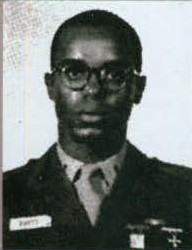
- Unit: Sub Unit One, 1st Air Naval Gunfire Liaison Company, Fleet Marine Force
- Service Number: 0110128
- Date of Birth: April 7, 1947
- Entered the Military: April 9, 1968
- Date of Death: April 7, 1972
- Hometown: Smyrna, Delaware
- Place of Death: Near Quang Tri, South Vietnam
- Award(s): Purple Heart, Bronze Star with V device, Air Medal with one bronze star, Vietnam Service Medal with three bronze stars, National Defense Service Medal
- Cemetery: Court A, Courts of the Missing, Honolulu Memorial, National Memorial Cemetery of the Pacific, Honolulu, Hawai’i. Odd Fellows African American Cemetery, Smyrna, Delaware. Vietnam Veterans Memorial in Washington, D.C.
The Bayard School, Wilmington, Delaware
2025/2026
Early Life
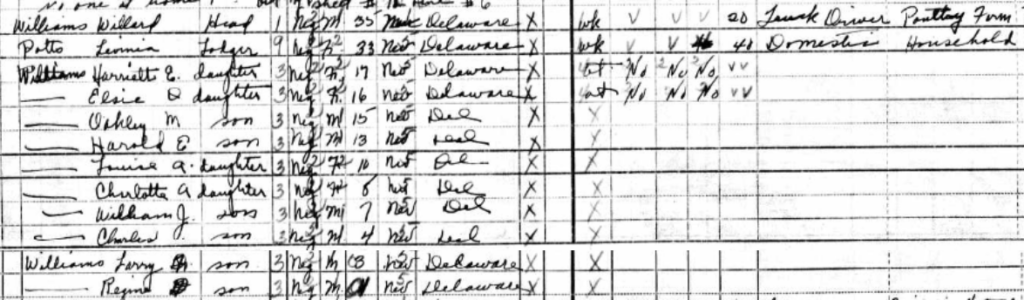
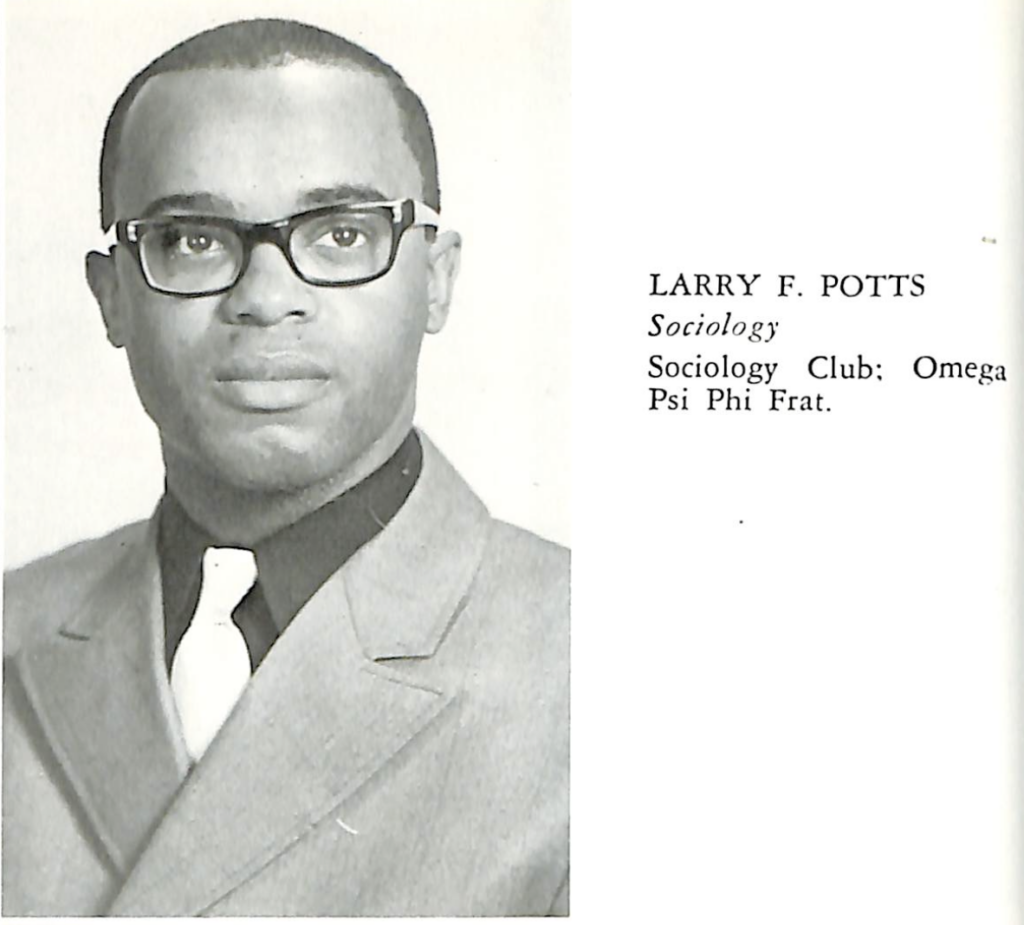
Larry Fletcher Potts was born April 7, 1947, in Smyrna, Delaware, to Lavinia Potts and Willard Williams. He had nine brothers and sisters. His mother worked as a maid in private homes, while his father worked as a truck driver for the booming poultry industry in lower Delaware.
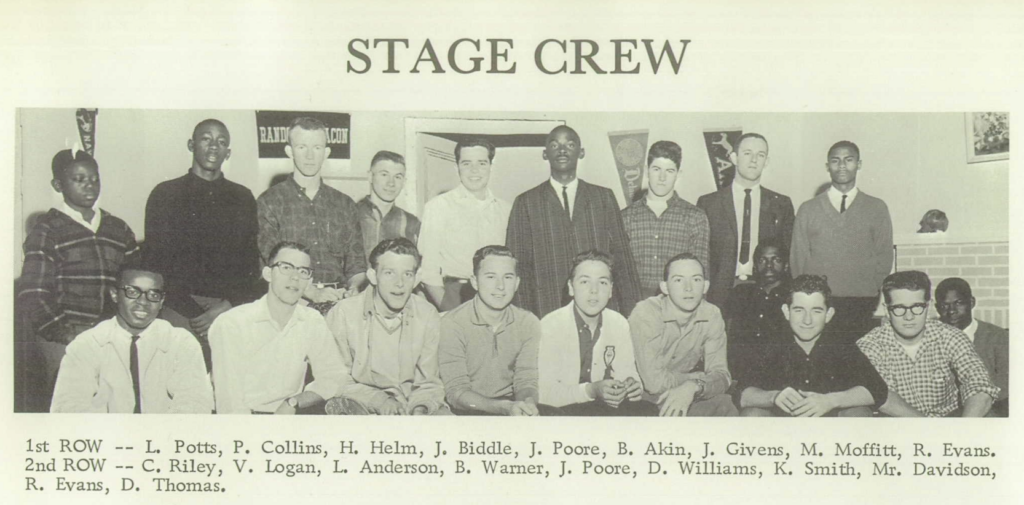
He attended Moore High School in Delaware, where he was involved in the stage crew. Potts graduated in 1965.
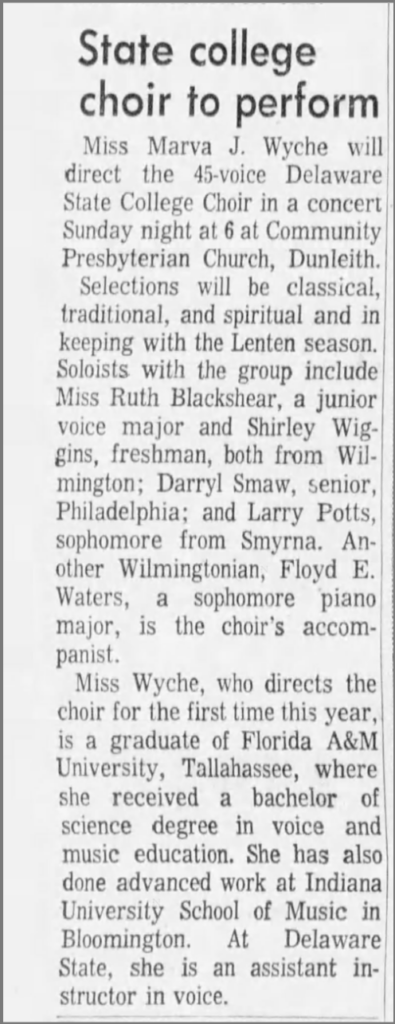
From there, he went on to attend Delaware State College, where he majored in Sociology. While there, Potts also performed with the college choir.
His best friend, Charles “Butch” Hammond, remembered Potts as being “very studious.” He also said, “You couldn’t say a bad thing about him. He was very mild-mannered.” The two friends decided to explore joining the United States Marine Corps after graduation. They found out they could do their basic training in the summer of 1968 and then return to finish their degrees.
Homefront
Smyrna, Delaware, was a rural community known for farming crops such as corn, soybeans, and wheat, as well as raising poultry and dairy.
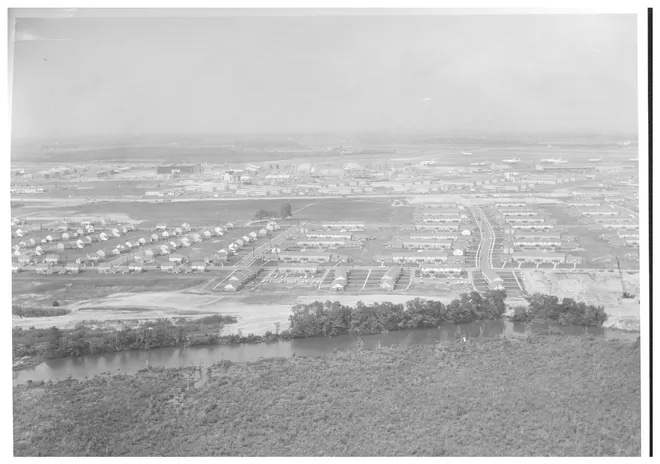
Dover Air Force Base
Smyrna is very close to the Dover Air Force Base (AFB). Construction of Dover Air Force Base began in 1941. Dover Air Force Base brought about major changes in the area. It first started as a coastal patrol base before becoming a major hub for the Air Mobility Command. The base led to steady population growth in the surrounding towns.
Additionally, Dover received the remains of more than 20,000 American soldiers who died during the Vietnam War. The military mortuary there handled the remains of all those returned whose hometown was east of the Mississippi River. The images of hundreds of caskets being unloaded at Dover evolved into what some called the “Dover Test” — the question of whether the nation’s support for the war could survive seeing the cost of it.
Military Production
The community shifted from a farming community to a commuter community, with many residents working at Dover AFB and in the Wilmington and Newark areas in the chemical and automotive industries. DuPont, in nearby Wilmington, supplied the military with Nomex, a flame-resistant fabric that protected pilots and aircrew from cockpit fires. DuPont was also one of eight companies contracted by the government to produce Agent Orange, the powerful herbicide that American forces used to raze the Vietnamese jungles. Nearby, Hercules Inc. produced rocket fuel, anti-personnel weapons, and napalm. These military contracts provided steady employment to the area. The widening of Route 13, locally known as the DuPont Highway, helped make this possible. This road ran directly through Smyrna, connecting it to industrial jobs in the north and Dover AFB in the south.
Protests
In the nearby towns of Dover and Wilmington, protests against the war were common, especially among college students, some of whom faced mandatory ROTC requirements. Many students questioned the presence of the military on college campuses. Protests also took place over the struggle of school desegregation. Delaware was one of the seventeen states that required segregated schools. Delaware schools were part of the famous Brown v. Board of Education case that mandated school integration in 1954.
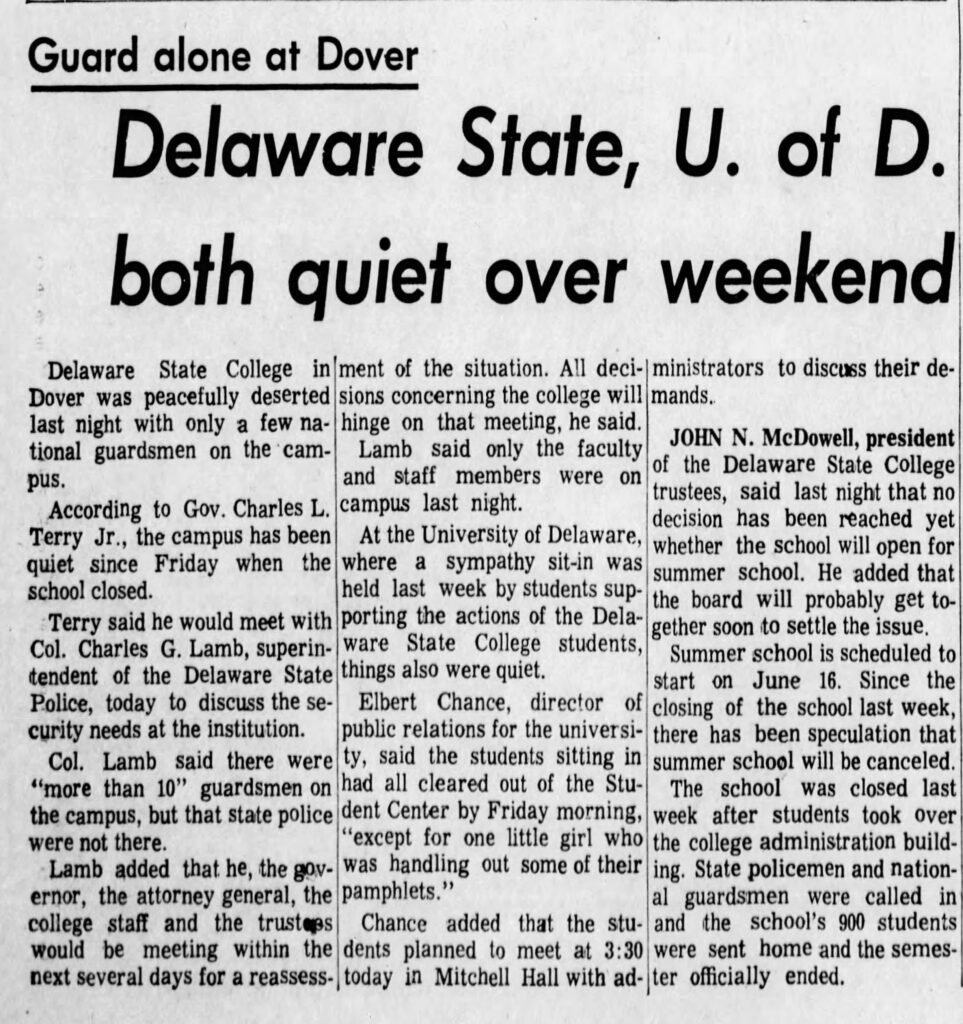
Delaware State College, a historically Black institution in Dover that Potts attended, experienced student protests in 1968. They began as protests regarding dormitory visitation rights, library hours, and the presence of rodents in residence halls, and intensified following Dr. King’s assassination on April 4. These protests were significant enough that Governor Charles Terry sent in the National Guard, after which university president Luna Mishoe canceled the remainder of the semester, including final exams and commencement ceremonies, to ensure the Guard’s removal.

Military Experience
Training
Potts entered the United States Marine Corps in Philadelphia, Pennsylvania, on April 9, 1968, as part of the Platoon Leaders Class (PLC) program. This was a commissioning path for college students who completed Officer Candidate School (OCS) during their summers, rather than after graduation. His first assignment was OCS at Marine Corps Base Quantico, Virginia, where he attended the PLC Junior course through June 1, 1969.
On September 13, 1969, Potts reported to The Basic School at Marine Corps Base Quantico, Virginia. After completing this training in February 1970, he attended the Officer Basic Artillery Course at Fort Sill, Oklahoma, from March 2 through May 28, 1970.
Stateside Service
Following his time at Fort Sill, Second Lieutenant Potts reported to the 2nd Marine Division, Fleet Marine Force at Camp Lejeune, North Carolina. There, he served in multiple batteries of the 5th Battalion, 10th Marines, the division’s artillery regiment. He served in multiple capacities, including motor transport officer, engineer officer, range safety officer, and logistics/security officer, before advancing from assistant executive officer to executive officer to commanding officer of Battery R, a significant progression in just over a year.
From October 14 to November 9, 1971, now a First Lieutenant, Potts was assigned as a student to Headquarters Company, Landing Force Training Command, U.S. Naval Amphibious Base, San Diego, California, where he prepared for his next assignment.
Vietnam Service
Starting on November 11, 1971, First Lieutenant Potts served as an air/naval gunfire spotter with Sub Unit One, 1st Air Naval Gunfire Liaison Company, Fleet Marine Force in Vietnam. These teams were deployed forward to call in naval gunfire, artillery, and close air support. In Vietnam, these teams were attached to the Republic of Vietnam Army and Marine units.
First Lieutenant Potts was a field artillery officer who helped to coordinate support for ground troops. While airborne, he directed fire from U.S. Navy ships onto enemy targets.
Final Mission
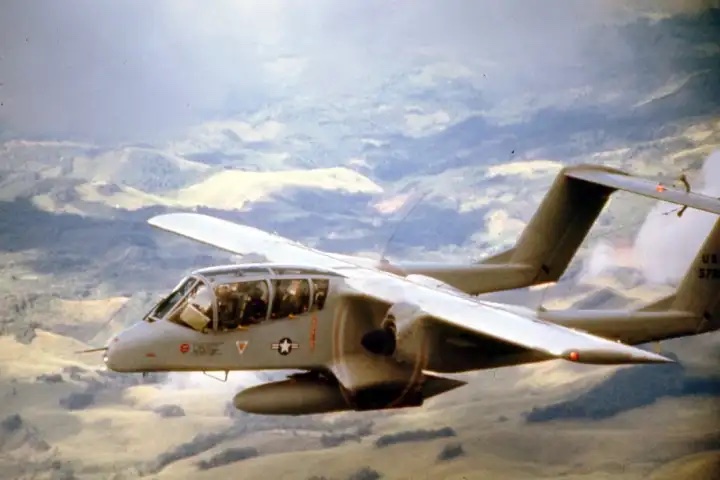
April 7, 1972, Potts’s birthday, would be his final mission. He and another crew member, U.S. Air Force pilot Bruce Charles Walker, were aboard an OV-10A Bronco aircraft on a naval gunfire-spotting mission in the vicinity of Quang Tri, South Vietnam. During the flight, a surface-to-air missile struck their aircraft north of Dong Ha. The two men ejected from the aircraft.
There are conflicting reports on whether Potts made radio contact after the ejection, but Walker did. Walker used his survival radio to direct air strikes on enemy positions for days after his plane was shot down. A survival kit was dropped for him, and he was told to make his way to the coast for an attempted rescue, but Walker’s last radio transmission to search and rescue was to tell them not to attempt a rescue because the enemy was closing in. He is believed to have evaded capture for 11 days before being captured.
After being shot down on his twenty-fifth birthday, Potts is believed to have been captured and brought to Quang Binh prison, where he later died. Search-and-rescue teams launched missions but were unable to locate either crew member. Both men remain unaccounted for today.
While listed as Missing in Action in October 1973, the U.S. Marine Corps promoted Potts to captain in absentia.
Commemoration
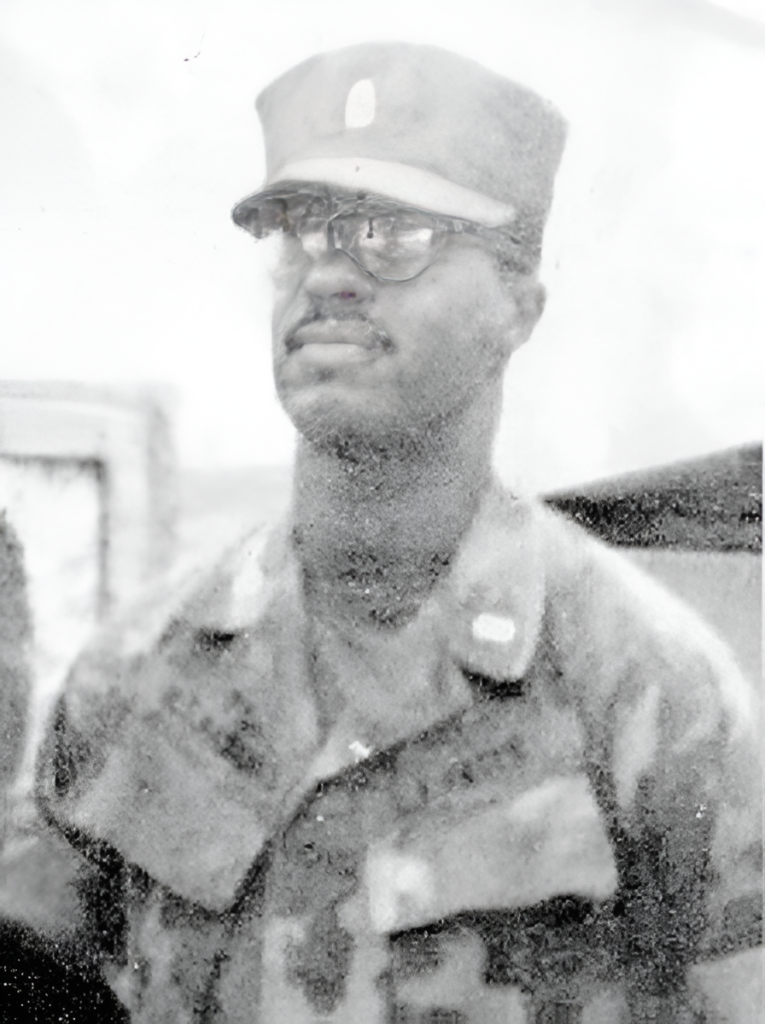
On January 31, 1979, the Department of Defense reclassified Captain Potts as “Hostile, died while missing.” He was the only Delaware State University graduate to die in the Vietnam War. His childhood friend, Charles “Butch” Hammond, who went on to have more than a two-decade career in the Marine Corps, dedicated a scholarship in his friend’s name for Delaware State students.
His community remembers Potts as a trailblazer, one of only a few Marine Corps officers of color. A Basic School officer classmate, Dana Shreve, remembered the impression Potts made, “whether in uniform or in civilian clothes, his athleticism, and his bearing. He had a quiet confidence about himself.”
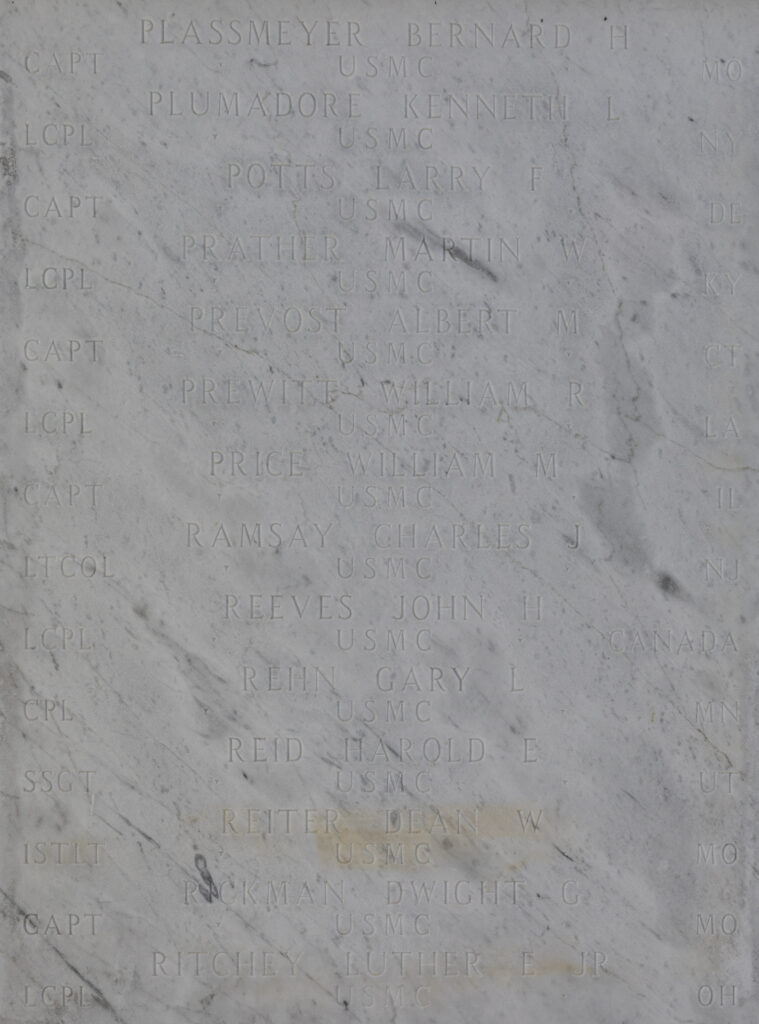
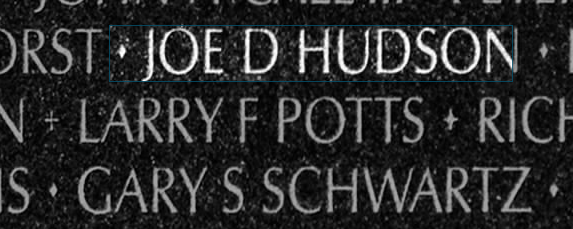
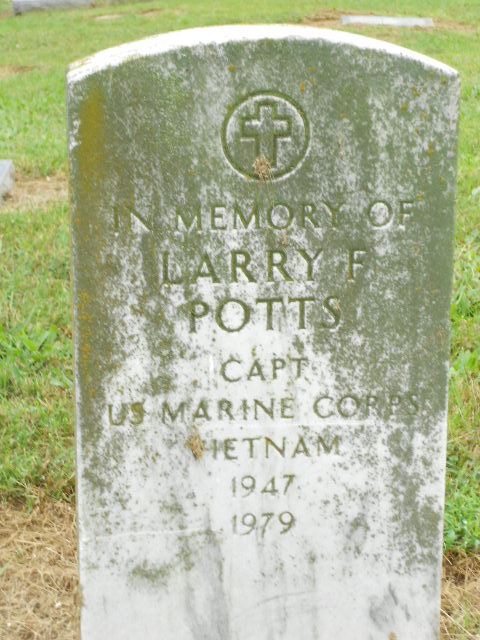
Captain Larry Potts is memorialized on the Courts of the Missing, National Memorial Cemetery of the Pacific, Honolulu, Hawaiʻi, as well as the Vietnam Veterans Memorial in Washington, D.C. Additionally, a memorial marker was laid in his honor at the Odd Fellows African American Cemetery in his hometown of Smyrna, Delaware.
Bibliography
Primary Sources
Delaware. Kent. 1950 U.S. Census. Digital Images. https://www.ancestryclassroom.com/.
“Guard Alone at Denver.” The Morning News [Wilmington, Delaware], May 20, 1968. Newspapers.com (155926764).
Joint Casualty Resolution Center. Addendum to Detailed Report of Investigation. Bangkok, Thailand. October 4, 1990. Library of Congress (PWMASTER_64295).
Joint Task Force-Full Accounting. Biographic/Site Report/Update for Refno: 1820. August 15, 1993. Library of Congress (PWMASTER_115372).
Joint Task Force-Full Accounting. Updated Biographic/Site Reports – October 1994. Library of Congress (PWMASTER_157984).
Larry F. Potts. U.S., Social Security Death Index, 1935-2014. Digital Images. https://www.ancestryclassroom.com/.
Larry Fletcher Potts, Freedom of Information Act Request, Department of the Navy, National Archives and Records Administration – St. Louis.
Larry Fletcher Potts. U.S., School Yearbooks, 1900-2016. Digital Images. https://www.ancestryclassroom.com/.
“Protest and Counter Protest.” The News Journal [Wilmington, Delaware], March 28, 1966. Newspapers.com (165488937).
“Route 13 and Construction,” posted by Delaware Public Archives, YouTube, 22:07. https://www.youtube.com/watch?v=AYB6mBRvnzE&t=8s.
“State College Choir to Perform.” The Morning News [Wilmington, Delaware], March 17, 1967. Newspapers.com (154771702).
The Statesman. Dover, Delaware: Delaware State College, 1969. https://desu.dspacedirect.org/items/04a8f304-a87f-47bf-81e2-25602b1c3a99.
“Welmaid Ironing Cover and Pad.” The Morning News [Wilmington, Delaware], August 05, 1966. Newspapers.com (154708669).
Secondary Sources
“Capt Larry Fletcher Potts.” Find a Grave. Accessed March 30, 2026. https://www.findagrave.com/memorial/7454672/larry-fletcher-potts.
“Captain Larry Fletcher Potts”. Find a Grave. Accessed October 18, 2025. https://www.findagrave.com/memorial/134547044/larry_fletcher-potts/photo.
Cutler, Thomas J. “Lest We Forget: Larry Fletcher Potts; VF-126.” Accessed October 30, 2025. https://www.usni.org/magazines/proceedings/2004/september/lest-we-forget-larry-fletcher-potts-vf-126.
“Dover Air Force Base Through the Years.” Delaware Online. Accessed April 1, 2026. https://www.delawareonline.com/picture-gallery/news/local/2018/09/18/dover-air-force-base-through-years/1344477002/.
“Dover Test.” A Way with Words. Accessed April 1, 2026. https://waywordradio.org/dover_test_1/.
“DSU Black History; Capt. Larry Potts, only Del State Grad Killed in Vietnam.” Delaware State University. Updated February 27, 2026. Accessed April 1, 2026. https://www.desu.edu/news/2026/02/dsu-black-history-capt-larry-potts-only-del-state-grad-killed-vietnam.
Ebner, Allison, and Carlett Spike. “Delawareans Remember 1968.” University of Delaware. Updated December 20, 2018. Accessed April 1, 2026. https://www.udel.edu/udaily/2018/december/1968-voices-oral-history-project-heterodoxical-times/.
“Friday 7 April 1972.” Aviation Safety Network. Accessed March 30, 2026. https://aviation-safety.net/wikibase/60162.
“Guard Alone at Dover.” The Morning News [Dover, Delaware], May 20, 1968. Newspapers.com (155926764).
Humphrey, Theresa. “Armed Forces’ Mortuary Base: Debriefings Ease Stress of Dealing with Dead.” Los Angeles Times [Los Angeles, California], October 23, 1988. https://www.latimes.com/archives/la-xpm-1988-10-23-mn-262-story.html.
“Larry Fletcher Potts.” American Battle Monuments Commission. Accessed October 15, 2025. https://weremember.abmc.gov/s?q=*&type=16&criteria=title%3Dpotts&b=0&a=c&v=G.
“Larry Fletcher Potts.” Defense Personnel POW/MIA Accounting Agency. Accessed October 11, 2025. https://dpaa-mil.sites.crmforce.mil/dpaaProfile?id=a0Jt0000000Ka6oEAC.
“Larry Fletcher Potts.” Veterans Legacy Memorial, National Cemetery Administration. Accessed April 5, 2026. https://www.vlm.cem.va.gov/LarryFletcherPotts/4956B.
“Larry Fletcher Potts.” Vietnam Veterans Memorial Fund. Accessed October 15, 2025. https://www.vvmf.org/Wall-of-Faces/41421/LARRY-F-POTTS/.
“Letter to the Editor: Remembering Military Hero Larry Potts.” Bay to Bay News. Accessed November 1, 2025. https://baytobaynews.com/stories/letter-to-the-editor-remembering-military-hero-larry-potts,79863.
“OV-10 Bronco Was the Right Weapon for Vietnam.” Defense Media Network. Accessed March 30, 2026. https://www.defensemedianetwork.com/stories/ov-10-bronco-was-the-right-weapon-for-vietnam/.
Palmer, Steve. “Return of the Fallen.” Arizona Funeral, Cemetery, and Cremation Association. Updated October 30, 2018. Accessed April 1, 2026. https://azfcca.org/return-of-the-fallen-part-1-of-3/.
“Piece of 1968 History: Students Protest Lead to Police, Dogs Occupying Delaware State Campus.” Delaware Live. Accessed April 1, 2026. https://delawarelive.com/piece-of-1968-history-student-protests-lead-to-police-dogs-occupying-delaware-state-campus-2/.
This profile was researched and created through the Researching Silent Heroes program, sponsored by the American Battle Monuments Commission.