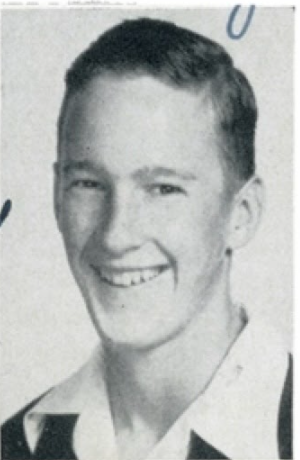
Fire Controlman Third Class Leo Karll Ballenger, Jr.
- Unit: USS Bismarck Sea
- Service Number: 7339593
- Date of Birth: July 21, 1925
- Entered the Military: May 13, 1943
- Date of Death: February 21, 1945
- Hometown: Payette, Idaho
- Place of Death: USS Bismarck Sea, Iwo Jima, Asiatic-Pacific
- Cemetery: Court 5, Courts of the Missing, Honolulu Memorial,. National Memorial Cemetery of the Pacific, Honolulu, Hawaiʻi
Riverstone International School Boise, Idaho
2025/2026
Early Life
On July 21, 1925, Leo Karll Ballenger and Janet Naomi Hayer welcomed their second-born into the world. Named after his father, Leo Karll Ballenger, Jr., grew up in Payette, Idaho. He spent his childhood in the same house on 5th Avenue with his older sister, Barbara Elaine.
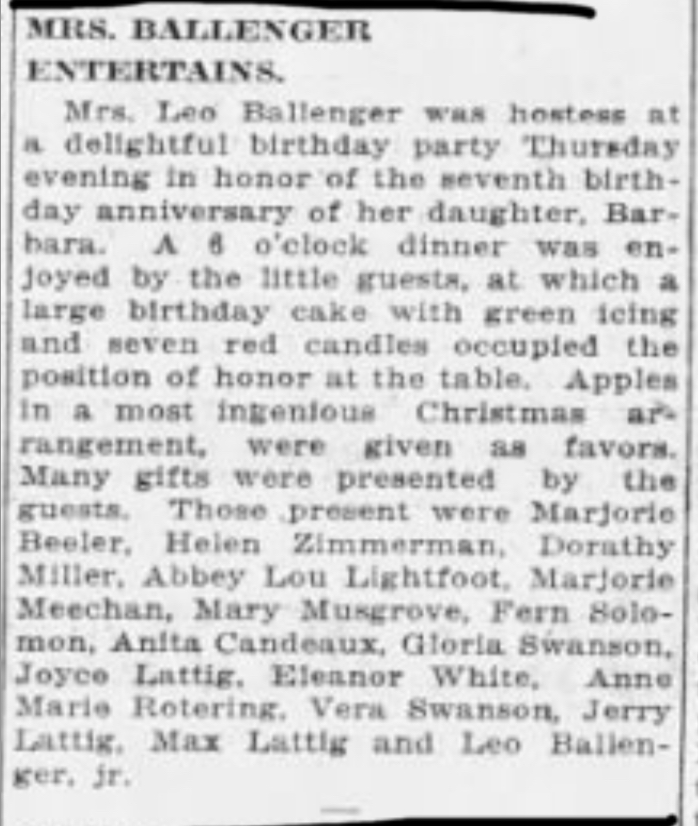
The Ballenger family was active in the Payette community. Both Mr. and Mrs. Ballenger attended various social gatherings. The Ballenger children attended their peers’ birthday parties. The entire Ballenger family also welcomed the community into their home on 5th Avenue for various types of celebrations.
Education
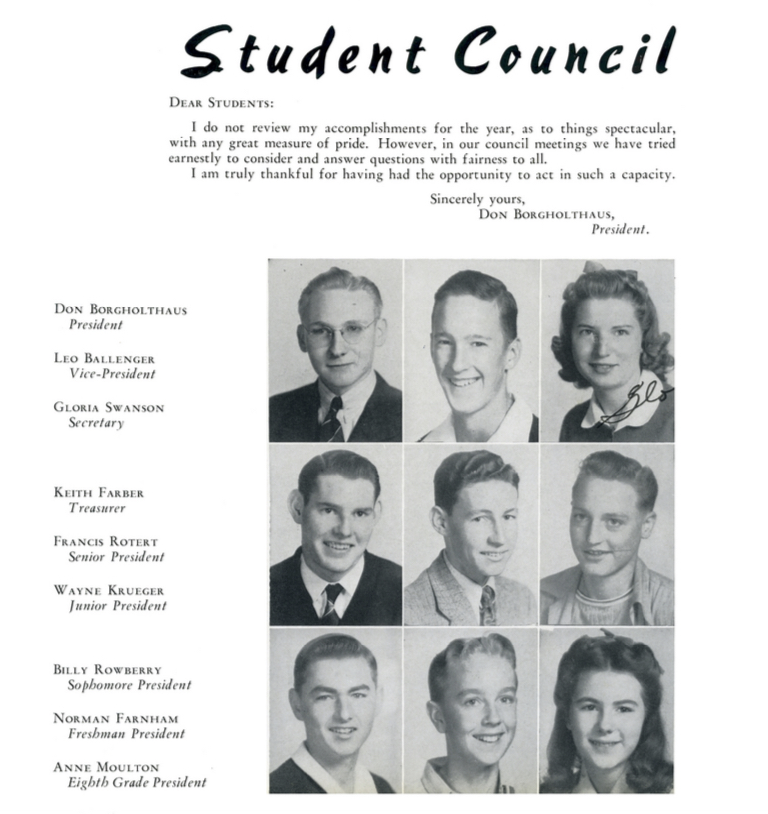
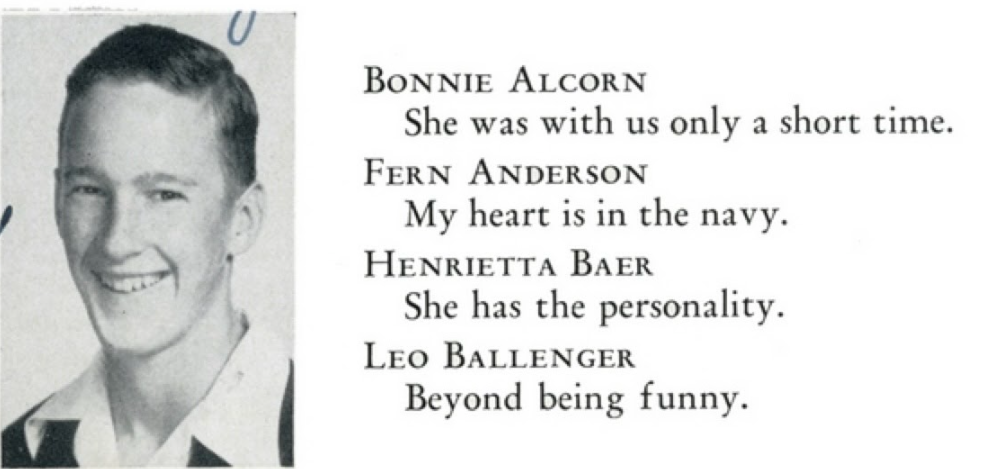
In 1940, Ballenger began his freshman year at Payette High School. He was described in his school yearbooks as a “Second String whiz,” “Being beyond funny,” and a “Broken-hearted lover.” He also participated in many extracurricular activities, including the Chess Club, the Nature and Latin Clubs, and the “P” Club. This club took an interest in high school affairs, such as presenting the school with an electric clock for the gym. He also ran track and played on the varsity basketball team. During his junior year, he was the vice president of Student Council.
Homefront
Wartime in Payette
Payette is located in southwest Idaho. It is surrounded by forest and the Payette and Snake Rivers. Though a small town, it felt the effects of the Second World War. Rationing began in 1942 and continued throughout the war.
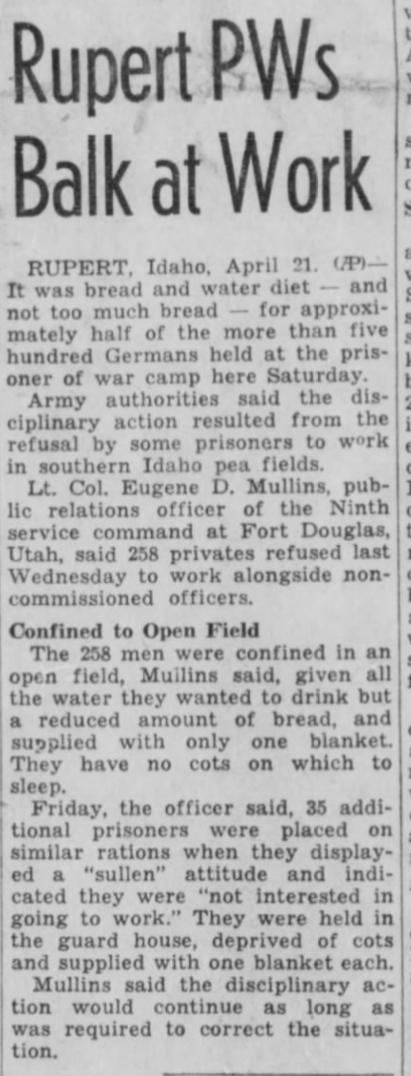
In the latter half of the war, Italian and German Prisoners of War (POWs) were brought to the United States. This was done to help relieve European Prison Camps. The POWs were sent to camps in the United States to assist with farm labor. Payette was home to one of those branch camps in 1945.
Wartime in Idaho
Idaho also saw the construction of two new military installations during the war. Gowen Field near Boise was a medium-sized bomber training facility. Mountain Home Army Air Field, later Mountain Home Air Force Base, was a B-24 Liberator training facility.
During the war, timber farming increased throughout the state. Along with an increase in the state’s most well-known crop, potatoes. There was also an increase in mining production in the Payette National Forest. Antimony and tungsten were mined from 1941 to 1945.
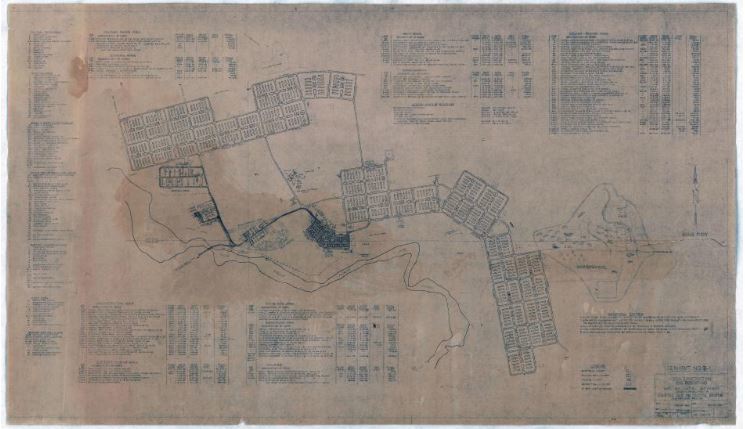
From 1942 to 1945, the Minidoka Internment Camp in Jerome, Idaho, held over 13,00 Japanese, Japanese Americans, and those of Japanese descent after President Franklin D. Roosevelt’s Executive Order 9066 was put into action. Those who were held in the camp were forced to endure harsh living conditions, unfair treatment, and tough weather conditions.
Military Experience
May 1943 to May 1944
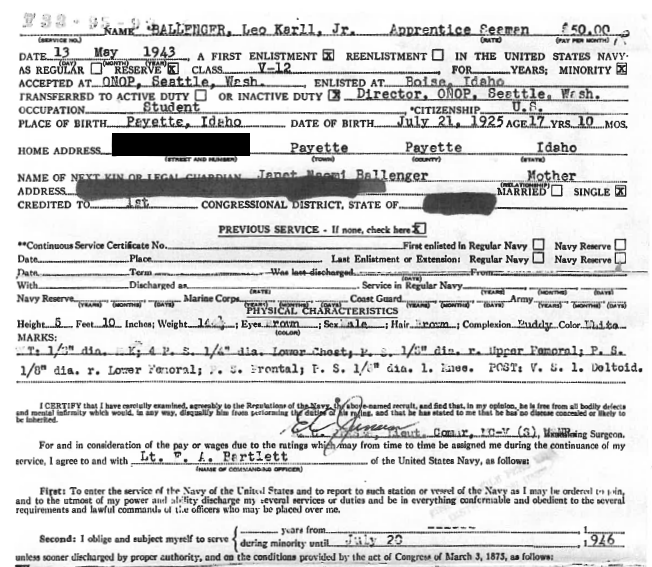
On May 13, 1943, Leo Ballenger went to Boise to enlist in the United States Navy. He enlisted as a reserve apprentice seaman. Soon after, he was sent to the Office of Naval Officer Procurement in Seattle, Washington.
After a short stint in Washington, Ballenger was sent to the V-12 Officer Training Program in Caroll College in Helena, Montana. This program helped enlisted men become officers quickly.
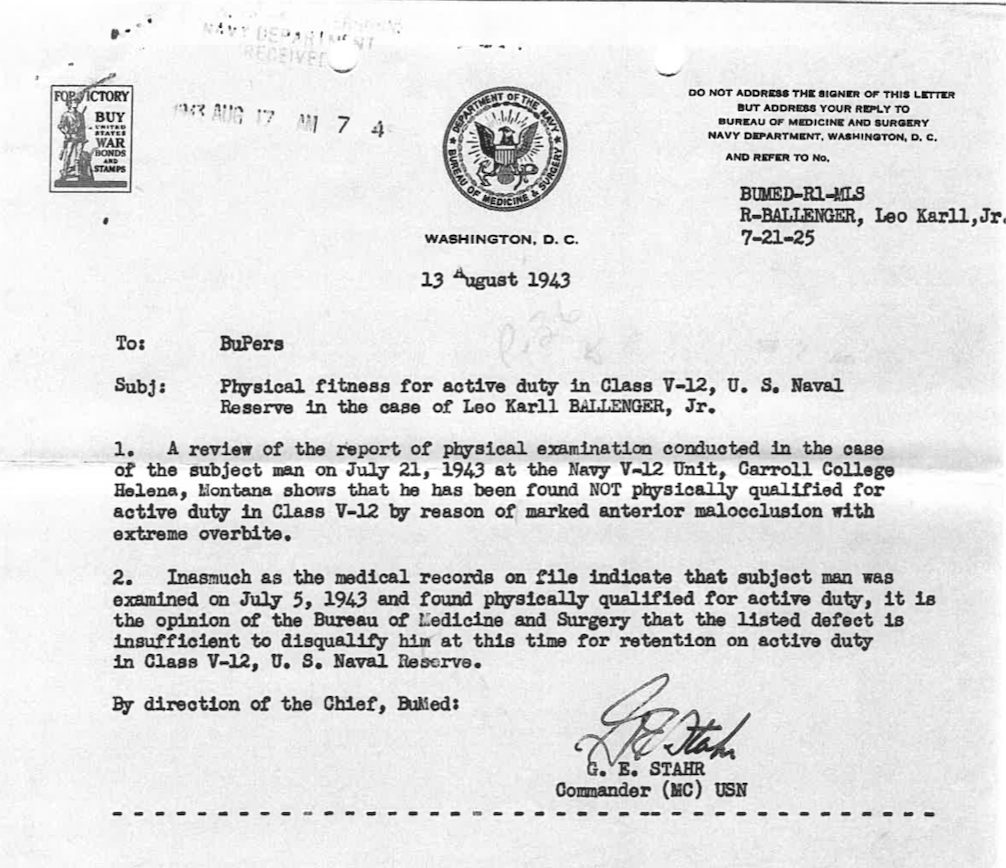
On July 21, 1943, Ballenger received his physical examination for the V-12 Program. The results of this physical were normal, but for an Anterior Malocclusion with a “Severe Over-bite.” This initially disqualified him from active-duty service. Correspondence was sent concerning this issue from the commanding officer of the Navy, V-12 Unit at Caroll College in Helena. On August 20, 1943, the Chief of Naval Personnel responded via letter. The decision was that the listed abnormalities did not disqualify Ballenger from active-duty service or from the V-12 Officer Training Program.
May 1944 to January 1945
Seaman First Class Fire Control Officer (FCO) Ballenger was assigned to the USS Bismarck Sea (CVE-95) on the day of its commission, May 20, 1944. This was a Casablanca-class escort carrier. His role would have involved maintaining and operating the ship’s guns and firing systems.
Between July and September 1944, the Bismarck Sea traveled from California, Hawaii, the Marshal Islands, and then back to California to drop off and receive aircraft.
After continued training in California from September to October, the Bismarck Sea was sent to the Seventh Fleet near the Enewetak Atoll in the Pacific. After a short stint with the Seventh Fleet, the Bismarck Sea was moved to Task Group 77.4 in the Admiralty Islands. Further training continued starting in November 1944.
On December 1, 1944, Ballenger was promoted to Fire Controlman Third Class. Soon after this, the Bismarck Sea was tasked with assisting in the invasion of Luzon.
After the invasion of Luzon, preparations for the invasion of Iwo Jima ramped up.
The Battle of Iwo Jima
The United States wanted to take Iwo Jima because of its location. Once Iwo Jima was captured, the plan was to move on to Okinawa. The end goal was to increase pressure on Japan to gain an eventual surrender. Ending the war that had already cost so many lives.
On February 16, 1945, the Bismarck Sea arrived 50 miles from Iwo Jima. The landing on Iwo Jima took place three days later, on February 19. Throughout the fighting, the Bismarck Sea provided anti-aircraft and anti-submarine protection as part of the Escort Carrier Support Force.
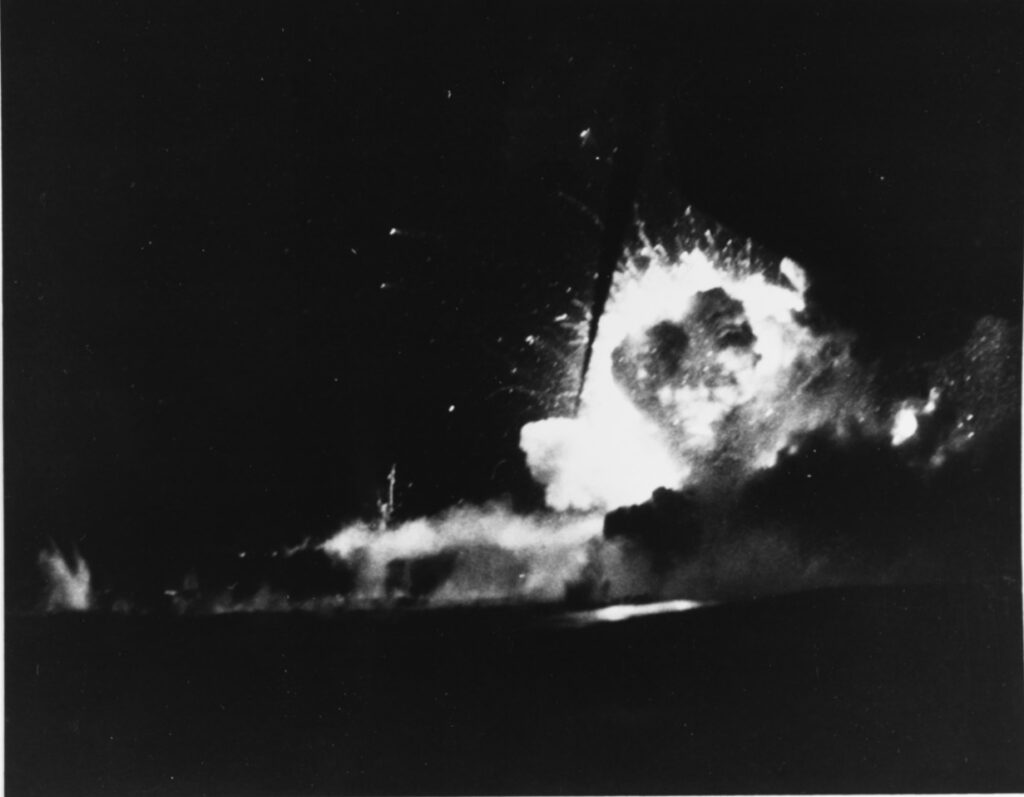
Late on February 21, two kamikaze bombers crashed into the Bismarck Sea. The first strike caused massive damage and started a fire. After the second crash, the ship was abandoned.
Commemoration
Many sailors were injured during the initial crashes aboard the Bismarck Sea. Others were wounded or drowned during the abandonment of the ship. It is unclear when Leo Karll Ballenger, Jr. was killed. He was officially marked as “Missing” on February 21, 1945.
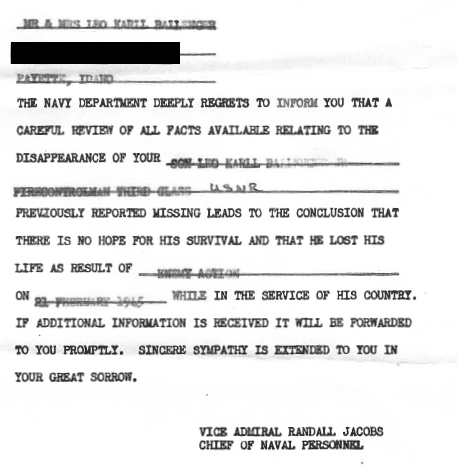
Mr. and Mrs. Ballenger received a telegram on March 3, 1945, informing them that their son was Missing in Action. A month later, on April 3, 1945, another telegram was sent. This one confirmed that their son had lost his life serving his country.
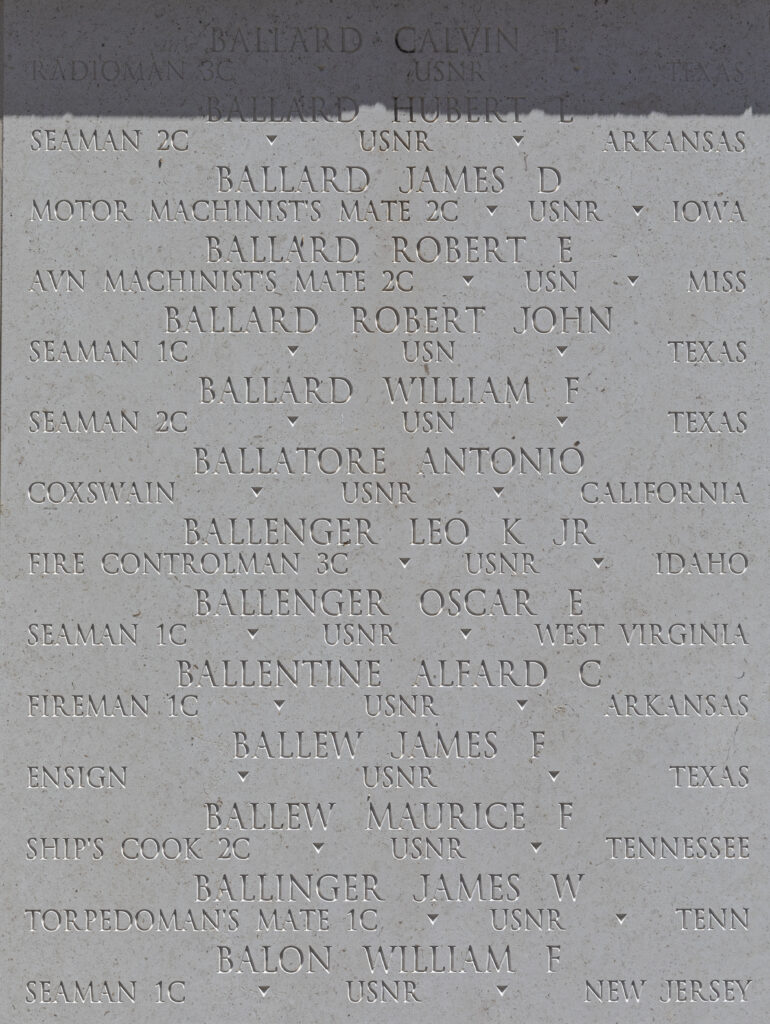
Leo Karll Ballenger, Jr., is memorialized on the wall of Court Five of the Courts of the Missing at the National Memorial Cemetery of the Pacific in Honolulu, Hawaiʻi.
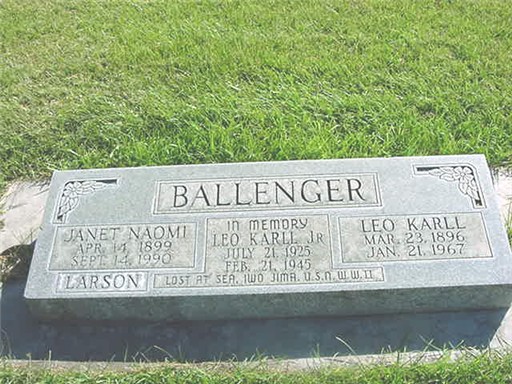
Additionally, Mr. and Mrs. Ballenger placed a memorial marker at Riverside Cemetery in their hometown of Payette, Idaho. This became the grave marker for subsequent family deaths.
Bibliography
Primary Sources
“A Surprise Party.” Payette Enterprise [Payette, Idaho], December 11, 1924. Newspapers.com (891082349).
The Axe. Payette, Idaho: Payette High School, 1940. https://payettecounty.info/phsy/1940/.
The Axe. Payette, Idaho: Payette High School, 1941. https://payettecounty.info/phsy/1941/.
The Axe. Payette, Idaho: Payette High School, 1942. https://payettecounty.info/phsy/1942/.
“First Women Justice.” The Post-Register [Idaho Falls, Idaho], April 27, 1938. Newspapers.com (74449365).
“Idaho’s Minute Maid Idea Spreads to 39 States.” The Post Register [Idaho Falls, Idaho], January 21, 1943. Newspapers.com (81841109).
Idaho. Payette County. 1920 U.S. Census. Digital images. https://ancestryclasroom.com.
Idaho. Payette County. 1930 U.S. Census. Digital images. https://ancestryclasroom.com.
Idaho. Payette County. 1940 U.S. Census. Digital images. https://ancestryclasroom.com.
Leo Karll Ballenger. US, World War II Navy Muster Rolls, 1938-1949. Digital images. https://fold3.com.
Leo Karll Ballenger, Jr., Official Military Personnel File (partial), Department of the Navy, National Archives and Records Administration – St. Louis.
Leo K. Ballenger, S., World War II Navy, Marine Corps, and Coast Guard Casualties, 1941-1945. Digital image. https://ancestryclasroom.com.
“Mrs. Ballenger Entertains.” The Idaho Statesman [Boise, Idaho], December 22, 1929. Newspapers.com (74449365).
“Rationing Chief Lauds Public for Cooperation” Caribou County Sun [Soda Springs, Idaho], August 20, 1942. Newspapers.com (33429796).
“Rupert PW’s Balk at Work” The Post Register [Idaho Falls, Idaho], April 12, 1945. Newspapers.com. (74412752 ).
USS Bismarck Sea. Photograph. February 21, 1945. Naval History and Heritage Command (80-G-335103). https://www.history.navy.mil/content/history/nhhc/our-collections/photography/numerical-list-of-images/nara-series/80-g/80-G-330000/80-G-335103.html.
Idaho – Minidoka – WRA Construction and Remodeling. Map. c.1942-1945. Records of the War Relocation Authority (RG 210). National Archives and Records Administration (NAID 27813978). https://catalog.archives.gov/id/27813978.
“Women Working On Ordinary Aid War Effort.” The Post Register [Idaho Falls, Idaho], October 26, 1943. Newspapers.com (89342037).
Secondary Sources
“The Battle of Iwo Jima.” The National Museum of the Pacific War. Accessed on January 7, 2026. https://www.pacificwarmuseum.org/learn/articles/battle-of-iwo-jima.
“Bismarck Sea (CVE-95).” Naval History and Heritage Command. Accessed January 5, 2026. https://www.history.navy.mil/research/histories/ship-histories/danfs/b/bismarck-sea-cve-95.html.
“Boise’s Minute Maids Art and Photographs.” Idaho Depot of Arts and History. Accessed on November 13, 2025. https://collections.boiseartsandhistory.org/explore-collections/list/collections/18.
“Casablanca Class, U.S Escort Carriers.” Pacific War Online Encyclopedia. Accessed January 7, 2026. http://pwencycl.kgbudge.com/C/a/Casablanca_class.htm.
“Fc3 Leo K. Ballenger Jr.” Find a Grave. Accessed February 11, 2026. https://www.findagrave.com/memorial/56114589/leo-karll-ballenger.
“Fire Controlman Careers.” U.S. Navy. Accessed January 6, 2026. https://www.navy.com/careers-benefits/careers/electronics-technology/fire-controlman.
Hook, Susan. “Nazis on the Homefront.” In The Other Idahoans: Forgotten Stories of the Boise Valley by Todd Shallat, 84-93. Investigate Boise Community Research Series, Boise State University. https://scholarworks.boisestate.edu/cgi/viewcontent.cgifilename=12&article=1480&context=fac_books&type=additional.
“Leo K. Ballenger Jr.” Find a Grave. Accessed October 3, 2025. https://www.findagrave.com/memorial/17153930/leo-karll-ballenger.
“Leo K. Ballenger Jr.” Veterans Legacy Memorial, National Cemetery Administration. Accessed February 11, 2026. https://www.vlm.cem.va.gov/LeoKBallenger/35DF6.
“Lumber in the Boise Region.” Idaho State Historical Society. Accessed November 11, 2025. https://history.idaho.gov/wp-content/uploads/0173.pdf.
“Mountain Home AFB: History.” Mountain Home Housing. Accessed November 17, 2025. https://www.mountainhome.af.mil/About-MHAFB/.
“Our History.” Idaho State National Guard. Accessed on November 17, 2025. https://www.imd.idaho.gov/idaho-national-guard/our-history/.
“Potato Processing.” Idaho Potato Museum. Accessed November 11, 2025. https://www.idahopotatomuseum.com/potato-processing/.
“Prisoners of War Camps – Axis POW’s in the Inland Northwest.” Spokane Historical Society. Accessed November 9, 2025. https://spokanehistorical.org/items/show/863.
“Stibnite Mine Dormant but Not Dead.” Intermountain Histories. Accessed November 11, 2025. https://www.intermountainhistories.org/items/show/625.
“The V-12 Officer Training Program.” Naval History and Heritage Command. Accessed January 14, 2026. https://www.history.navy.mil/browse-by-topic/wars-conflicts-and-operations/world-war-ii/manning-the-us-navy/v-12-program.html.
This profile was researched and created through the Researching Silent Heroes program, sponsored by the American Battle Monuments Commission.