

Corporal Lepe Sesepasara
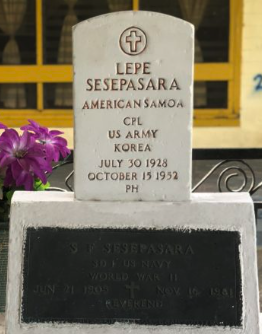
- Unit: Company F, 2nd Battalion, 31st Infantry Regiment, 7th Infantry Division
- Service Number: ER 10105290
- Date of Birth: July 30, 1928
- Entered the Military: July 10, 1951
- Date of Death: October 15, 1952
- Hometown: Pago Pago, American Samoa
- Place of Death: Kumhwa, Korea
- Award(s): Purple Heart
- Cemetery: Private family burial, Pago Pago, American Samoa
Early Life
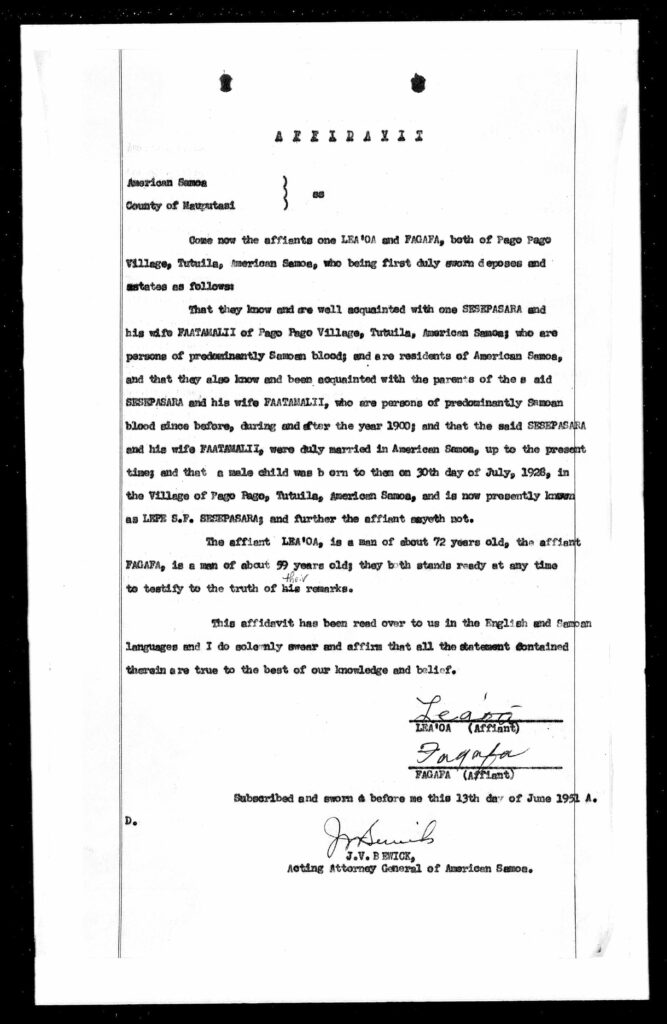
Malepelepe “Lepe” Sesepasara was one of 16 children, born on July 30, 1928, in Pago Pago, American Samoa, to his father, Sese, and his mother, Fa’atamali’i. Sese, Lepe’s father, enlisted in the U.S. Navy on November 18, 1927, and served as a seaman and was a farmer. Fa’atamali’i worked as a weaver. According to the 1930 census, the family initially lived with the relatives of Fa’atamali’i in Pago Pago, American Samoa, when Lepe was just under two years old.
In 1940, the Sesepasara family lived together with Fa’atamali’i’s mother, Sulu, and other family relatives in Pago Pago. Sese completed a petition of naturalization for his family to become U.S. citizens on January 18, 1946, after having served in the U.S. Navy and receiving lawful admission into the United States at Pearl Harbor in Honolulu, Hawaiʻi, on USS Ontario on November 15, 1941, just under a month before the Japanese attacked Pearl Harbor in December 1941.
According to the 1950 census, when Sesepasara was 21 years old, the highest grade he completed was the eighth grade. The Sesepasara family lived on the family farm with Sese as head of the household. Lepe was listed as a farm laborer. Eventually, Lepe married Malaea and had one son, Lepe Jr., and later a daughter, Daiana.
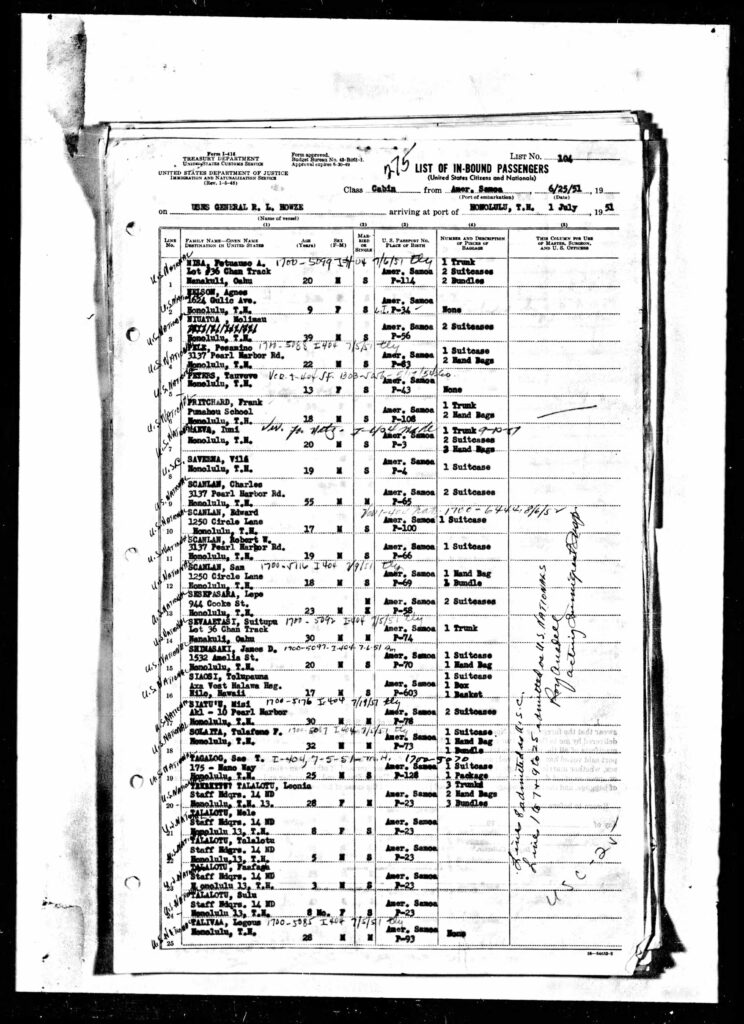
Lepe and his small family left American Samoa on June 25, 1951, with only two suitcases, bound for Honolulu, Hawaiʻi. The family arrived on July 1, 1951. According to the Honolulu Star-Bulletin, Lepe took the oath of enlistment on July 10, 1951, shortly after his arrival. The family paid their own way and moved to Hawaiʻi so that Lepe could join the United States Army, staying with relatives and friends, while citizenship and enlistment applications were being processed.


Homefront
Pago Pago, American Samoa, is a major port and the administrative capital of American Samoa on Tutuila Island in the south-central Pacific Ocean. The island lies about 1,600 miles northeast of New Zealand and 2,200 miles southwest of Hawaiʻi.
American Samoa’s military importance declined after World War II, when the U.S. Naval Station Tutuila was still open and served as the headquarters of the Samoan Defense Group, which included several island groups and was the largest of the Pacific defense groups during the war.
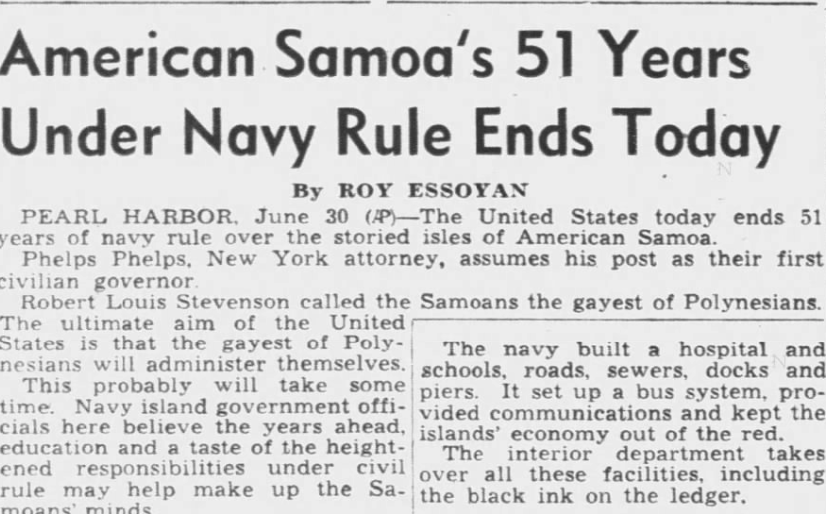
In 1951, American Samoa was transferred to the Department of the Interior, which continues to control the island today. After this change in 1952, more than 200 Samoan military families relocated to Hawaiʻi, beginning a trans-Pacific migration centered on United States naval bases.
Fishing and Agriculture
The fishing industry also helped keep the economy afloat, which included Japanese and Korean fishermen. As a result, canneries opened in the years after World War II, such as the Van Camp Seafood Company. These companies made significant contributions to American Samoa’s economy, creating new employment opportunities and attracting individuals from Western Samoa. The community also established the Satala Korean Fishermen Cemetery to honor the sacrifices of the region’s fishermen.
Agriculture in Pago Pago was transitioning from a subsistence-based economy to a commercial, industry-focused model after the closure of the naval base in 1951. Many residents relied on taro, yams, breadfruit, bananas, papayas, and other fruit to survive. Agricultural development on the island is limited due to its mountainous terrain.
Copra, which is dried coconut, was the primary export of American Samoa during the Korean War. Other sources of income were from handicrafts such as laufala floor mats, woodcrafts, and tapa cloth.
The Cold War
To support the Korean War effort, residents had a high enlistment rate. American Samoa had the highest enlistment rate in the United States Army among all states from 1950 to 1953. Local communities also showed appreciation by honoring the sacrifices of the “Toa o Samoa” (Warriors of Samoa) who served in the war. Around 100 American Samoans served; four never returned home.
In the midst of the Cold War during this time, the United States used whole islands to perform 66 nuclear tests. Even though American Samoans were spared this, the islands maintained their strategic significance to prevent the Soviets and other foreign influences in the South Pacific, thereby reinforcing the United States’s security commitment to the region.

Military Experience
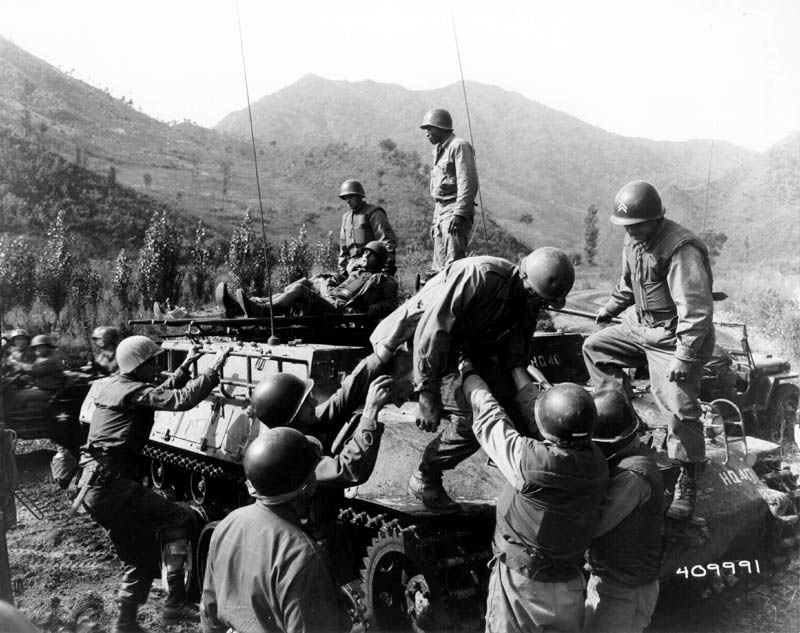
According to military records, Lepe Sesepasara arrived in Korea on August 20, 1951. He was assigned to F Company, 2nd Battalion, 31st Infantry Regiment, 7th Infantry Division. This unit was part of the first amphibious landings in Inchon, Korea, during the Korean War in September 1950, and also took part in operations around the Chosin Reservoir in November 1950. After Lepe joined this unit in 1951, the 31st Infantry Regiment took part in some of the heaviest fighting of the war, which included the Battle of Triangle Hill in October 1952.
Sesepasara was a corporal in the United States Army. There was no specific information on how he reached the rank of corporal, but corporals are non-commissioned officers who serve as team leaders of the smallest Army units. They are responsible for individual training and the personal appearance and cleanliness of soldiers in their unit. As a member of an infantry unit, Sesepasara served in the field, capturing, destroying, and deterring enemy forces; assisting in missions; and helping mobilize troops and weapons to support them as part of the ground combat force.
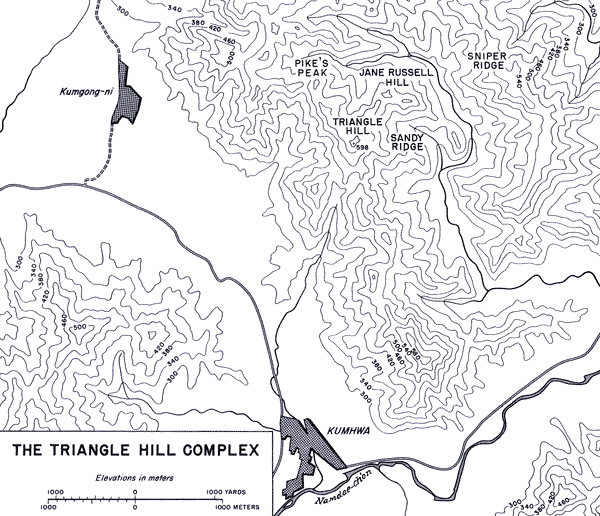
According to military records, Sesepasara was last located in the vicinity of Kumhwa, Korea, where the Battle of Triangle Hill took place. The Battle of Triangle Hill was also known as Operation Showdown. This battle was an attempt to gain control of the “Iron Triangle,” which included Triangle Hill, a forested bridge of high ground near the Korean Demilitarized Zone.
This battle included the United States Army’s 31st Infantry Regiment against Chinese forces supporting North Korea. Within 48 hours of the start of this battle, Lepe lost his life on October 15, 1952, to severe wounds sustained during the battle. Over the course of the entire battle, approximately 1,500 U.S. forces from the 7th Infantry Division were killed, wounded, or captured.


Commemoration
Corporal Lepe Sesepasara’s remains were found during combat, and Mrs. Malaea Sesepasara was notified of her husband’s death in November, 1952. Malaea was living back in American Samoa with her children and Lepe’s father, Sese. The family decided to bury Lepe in the Sesepasara family plot in Pago Pago. Lepe’s personal effects were sent to Malaea and to his father following his death.
He is memorialized on the Honolulu Memorial at the National Memorial Cemetery of the Pacific in Honolulu, Hawaiʻi.


Bibliography
Primary Sources
“American Samoa’s 51 Years Under Navy Rule Ends Today.” Honolulu Star-Bulletin [Honolulu, Hawai’i], June 30, 1951. Newspapers.com (24278371).
Eastern District. Mauputasi County. 1920 U.S. Census. Digital Images. https://ancestryclassroom.com.
Eastern Tutuila. Mauputasi County. 1930 U.S. Census. Digital Images. https://ancestryclassroom.com.
Eastern Tutuila. Mauputasi County. 1940 U.S. Census. Digital Images. https://ancestryclassroom.com.
Lepe Sesepasara. Affidavit of Birth, 1946. Digital Images. https://ancestryclassroom.com.
Lepe Sesepasara. Application for Headstone or Marker. August 1, 1960. https://ancestryclassroom.com.
Lepe Sesepasara. Casualty Files, Department of the Army. National Archives and Records Administration – St. Louis.
Lepe Sesepasara. Individual Deceased Personnel File, Department of the Army. National Archives and Records Administration.
“Malepelepe S.F. Sesepasara.” Honolulu Star-Advertiser [Honolulu, Hawai’i], July 5, 2015. http://obits.staradvertiser.com/2015/08/08/malepelepe-s-f-sesepasara/.
“Medical corpsmen assist wounded infantrymen of the 31st Infantry Regiment, following the fight for Hill 598.” U.S. Army Center of Military History. Accessed May 6, 2026. https://history.army.mil/photos/Korea/kor1952/SC409991.jpg.
S.F. Sesepasara. United States of America Petition for Naturalization. January 18, 1946. https://ancestryclassroom.com.
Tutuila. Mauputasi County. 1950 U.S. Census. Digital Images. https://ancestryclassroom.com.
U.S. Pacific naval station in harbor at Pago-Pago, Tutuila, Samoan Is. Photograph. Stereograph Cards Collection, Library of Congress. https://www.loc.gov/pictures/resource/stereo.1s36647/.
“War in Korea: Bloodshed in the Hills.” Time Magazine. October 27, 1952. https://time.com/archive/6825441/war-in-korea-bloodshed-in-the-hills/.
Secondary Sources
“The 31st Infantry Regiment.” The Army Historical Foundation. Accessed May 6, 2026. https://armyhistory.org/31st-infantry-regiment/.
“Battle of Triangle Hill: American Gold Star Veterans.” Honor States. Accessed May 5, 2026. https://www.honorstates.org/features/1219-intro/.
Droessler, Holger. “Whose Pacific? U.S. Security Interests in American Samoa from the Age of Empire to the Pacific Pivot.” Pacific Asia Inquiry. Volume 4, (Number 1, 2013): pp. 58-65. https://www.uog.edu/_resources/files/schools-and-colleges/college-of-liberal-arts-and-social-sciences/droessler_whose-pacific.pdf.
“Infantry Man 11B.” U.S. Army. Accessed May 6, 2026. https://www.goarmy.com/careers-and-jobs/ground-forces/firearms-ammunition/11b-infantryman.
“Jurisdiction Project: American Samoa.” Island Studies Journal. Accessed April 29, 2026. https://islandstudies.com/files/2016/11/American-Samoa.pdf.
“Korean War Project Rememberance: CPL Malepelepe Sesepasara Sr.” Korean War Project. Accessed May 5, 2026. https://www.koreanwar.org/html/27038/korean-war-project-samoa-er10105290-cpl-malepelepe-sesepasara-sr.
“Pago Pago, American Samoa.” Britannica. Accessed May 4, 2026. https://www.britannica.com/place/Pago-Pago.
“Pago Pago, American Samoa – United States (Territory).” Korean War Memorials. Accessed April 29, 2026. https://koreanwarmemorials.com/memorial/pago-pago-american-samoa-united-states-territory.
“A Park Program for American Samoa.” National Park Service. Accessed May 4, 2026. https://www.nps.gov/npsa/learn/management/upload/Fs65StdyA.pdf.
“Sesepasara Sepetaio.” Family Search. Accessed May 4, 2026. https://ancestors.familysearch.org/en/GB6M-SH7/sesepasara-sepetaio-1905-1981.
“To Europe and Far East: A brief history of the Coast Guard’s Pacific Area.” National Coast Guard Museum. Accessed April 29, 2026. https://nationalcoastguardmuseum.org/articles/europe-and-far-east/.
“The Triangle Hill Complex.” U.S. Army Center of Military History. Accessed May 6, 2026. https://history.army.mil/books/korea/truce/map6.gif.
“U.S. Amy Ranks.” U.S. Army. Accessed May 6, 2026. https://www.army.mil/ranks/
This profile was researched and created through the Researching Silent Heroes program, sponsored by the American Battle Monuments Commission.