

Private Louis Ferdinand Brown
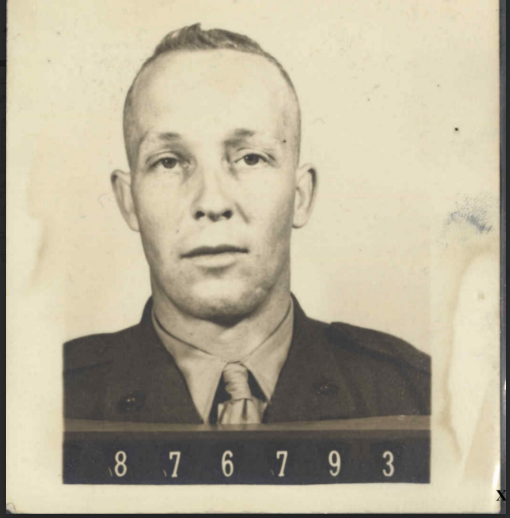
- Unit: Fleet Marine Force Aviation Service Squadrons
- Date of Birth: April 20, 1917
- Entered the Military: December 23, 1943
- Date of Death: July 14, 1975
- Hometown: Little Rock, Arkansas
- Place of Death: Little Rock, Arkansas
- Cemetery: Section 16, Site 1162. Little Rock National Cemetery, Little Rock, Arkansas
Mentored by Mrs. Katy Wellborn
Pulaski Academy, Little Rock, Arkansas
2025/2026
Early Life
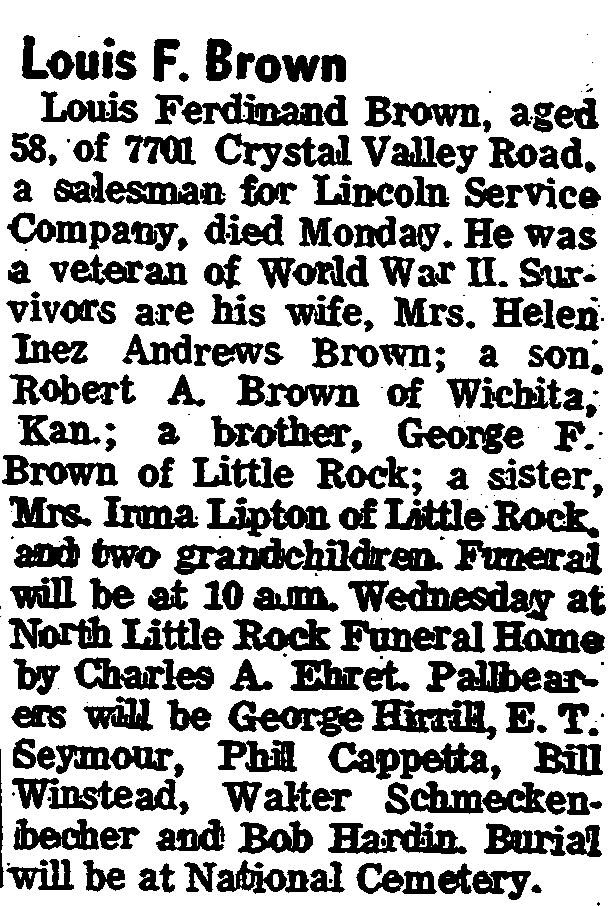
Louis Ferdinand Brown was born on April 20, 1917, in Union, Pulaski County, Arkansas, to George Franklin Brown, a carpenter, and Lucy Katherine Brown, a homemaker from Saline County, Arkansas. He had two siblings, George J. R. Brown and Irma Brown (later Lipton). Louis completed tenth grade at Mabelvale High School, where he showed interest in math and English and was an amateur swimmer in his youth.
On November 4, 1936, Brown married Helen Inez Andrews in Benton, Arkansas. Together, they had one son, Robert Andrews Brown, born in 1938 in Sweet Home, Arkansas.
Louis worked a variety of jobs before World War II. In 1937, he was an attendant at an auto service station, and in 1940, he was a stationary fireman for a mining company.
On December 23, 1943, he joined the United States Marine Corps.


Homefront
Louis Brown’s hometown of Little Rock, Arkansas, experienced significant change during World War II. The reactivation of Camp Joseph T. Robinson led to a population boom and housing shortages as thousands of soldiers arrived for training. Located along the Arkansas River, Little Rock benefited from expanded hydroelectric and steam-generated power, which helped supply the massive electricity demands of wartime industry. The growth of defense facilities helped shift Arkansas away from its heavy dependence on agriculture.
Arkansas became an important center for wartime manufacturing and training because of its remote location, mild climate, and natural resources. Ordnance plants near Little Rock produced detonators, fuses, bombs, and other explosive materials, with space for testing and chemical storage. At the same time, agriculture remained vital. Farmers increased production of livestock, cotton, and rice, while many families planted Victory Gardens. However, low industrial wages caused many Arkansans to leave the state for better-paying jobs elsewhere.
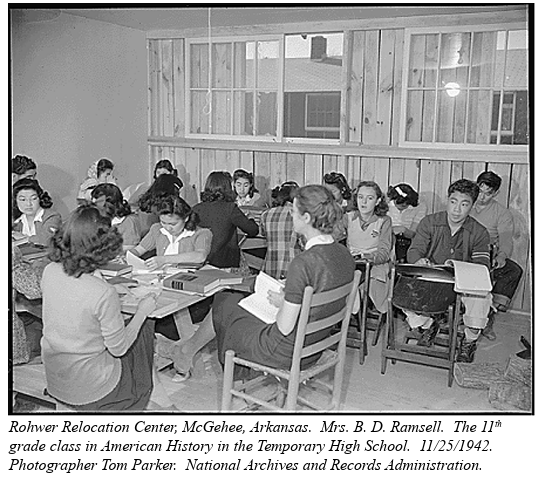
The war also reshaped daily life. Rationing limited access to goods such as meat and tires, while scrap drives and war bond purchases supported the military financially. Following Executive Order 9066, two Japanese American incarceration camps—Rohwer War Relocation Center and Jerome Relocation Center—were established in southeastern Arkansas. Surrounded by barbed wire and guard towers, these camps confined thousands of Japanese Americans, primarily from California. Meanwhile, Camp Robinson, in North Little Rock, expanded into a major U.S. Army basic training center and also held a prisoner of war compound with a capacity of 4,000 German prisoners. World War II ultimately connected Arkansas more closely to the rest of the nation, transforming its economy, population, and social structure.


Military Experience
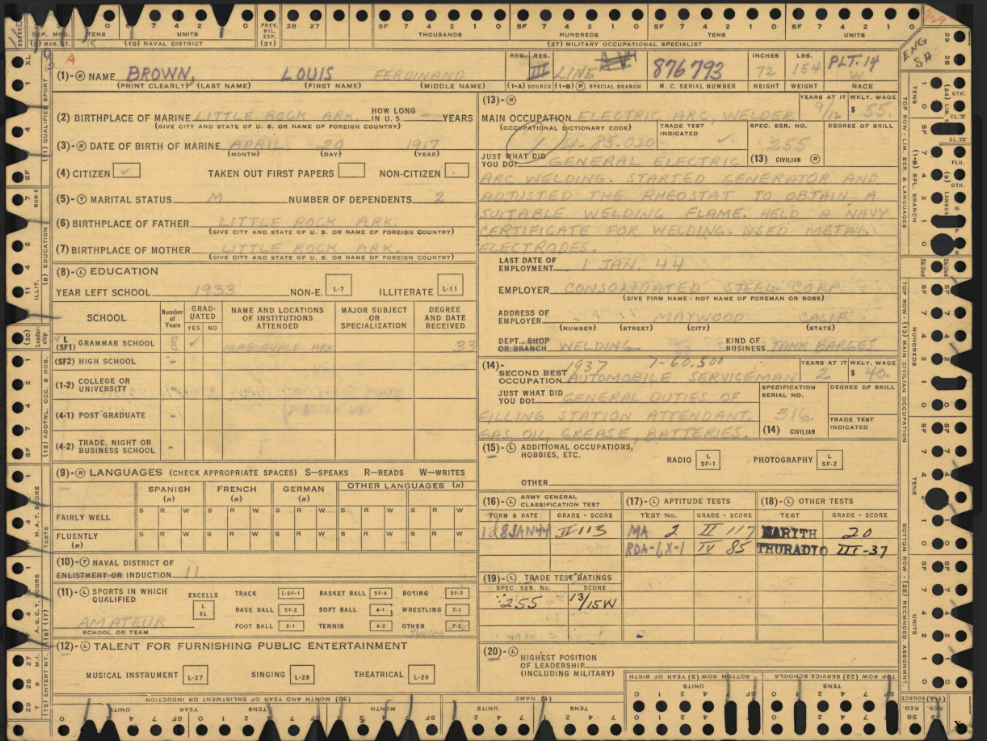
Louis Brown attempted to join the U.S. Navy but was rejected because he was underage. Later at the age of 26, he enlisted through the Selective Service and entered military service in Los Angeles, California, on December 23, 1943.
At the time of his enlistment, Brown had been working as a general electric arc welder, a job he had held until January 1, 1944. His work involved starting generators and adjusting rheostats to create the proper welding flame while welding tank barges. Industrial sources such as The Log and U.S. Steel News note that workers at the Maywood Plant in California built landing craft during World War II, and that their engines and hulls were tested in a large on-site water tank.
When Brown enlisted, he was classified as a heavy truck driver. In this role, he would have operated large trucks with at least 2 ½-ton capacity used to transport supplies, equipment, fuel, or personnel. The job required knowledge of military traffic rules, convoy procedures, map reading, and vehicle maintenance. Drivers also needed to navigate difficult terrain and blackout conditions, and sometimes assist with cargo loading.
During his service as a private in the U.S. Marine Corps, Brown trained at Marine Corps Air Station Miramar beginning on April 1, 1944. He also attended an eight-week auto-mechanic course in wheel-vehicle repair at Fort Crook in Nebraska.
Brown spent his entire military career within the United States. Before Japan surrendered, Brown was part of the Carrier Air Service Detachment, where he was responsible for aircraft carrier maintenance.
After the war ended, he continued working for the Motor Transport Battalion at Camp Pendleton, California, where he oversaw the massive logistical task of processing returning Marines. He maintained vehicles for returning troops and transported personnel and equipment for decommissioning.
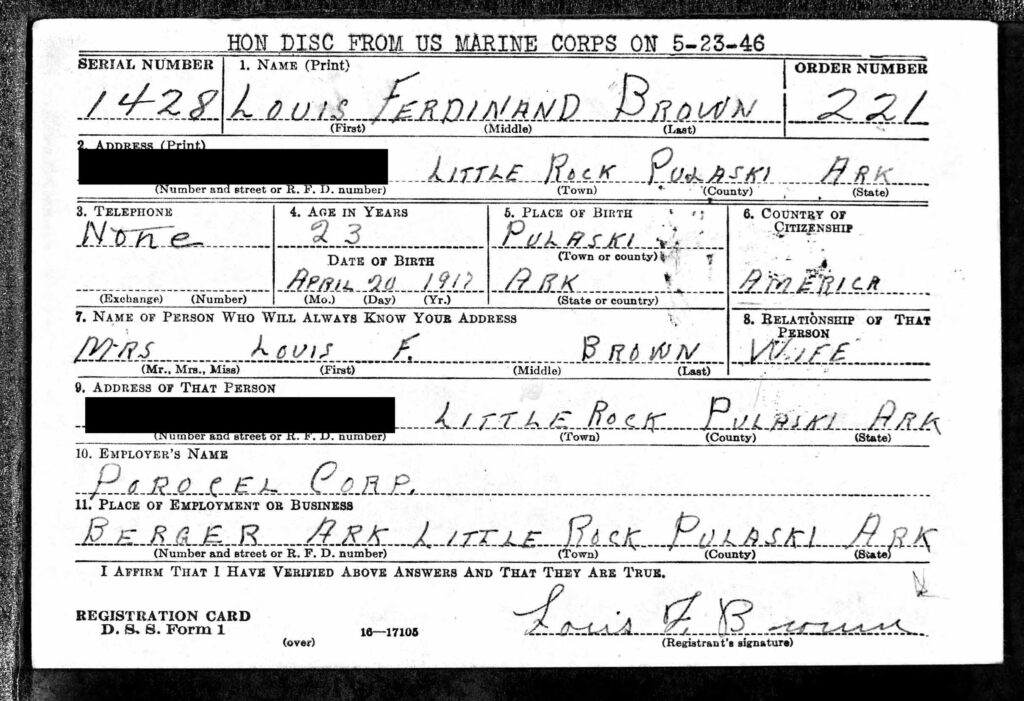
Brown completed his service with good conduct and was honorably discharged on May 23, 1946. His separation from active duty took place at Camp Pendleton.

Veteran Experience
After Brown’s military service, Louis returned to civilian life with his family in rural Pulaski County, Arkansas, with hopes of going into some type of sales position. In 1950, he worked as a life insurance agent, helping clients plan for their financial futures.
Louis’s son, Robert Brown, followed in his father’s military footsteps. He served in the U.S. Air Force from 1956 to 1967.

Commemoration
Louis Brown passed away on July 14, 1975, and was laid to rest at Little Rock National Cemetery, honoring his service as a Marine.

Bibliography
Primary Sources
Arkansas. Pulaski County. 1920 U.S. Census. Digital Images. http://ancestryclassroom.com.
Arkansas. Pulaski County. 1930 U.S. Census. Digital Images. http://ancestryclassroom.com.
Arkansas. Pulaski County. 1940 U.S. Census. Digital Images. http://ancestryclassroom.com.
Arkansas. Pulaski County. 1950 U.S. Census. Digital Images. http://ancestryclassroom.com.
Arkansas State Press. (Little Rock, AR), Jan. 1, 1943. Library of Congress (sn84025840).
Arkansas State Press. (Little Rock, AR), Nov. 17, 1944. Library of Congress (sn84025840).
Arkansas, U.S. Birth Certificates, 1914-1924. Digital Images. https://www.ancestryclassroom.com.
Dickson L. Flake. Interview for the Arkansas Memories Project. November 19, 2010. Pryor Center for Arkansas Oral & Visual History, University of Arkansas. https://pryorcenter.uark.edu/videoplayer.php?c=1&dir=projects/Arkansas%20Memories/FLAKE-Dickson-574&video=FLAKE-Dickson-20101119-Final&title=Victory%20Gardens&playhead=1345.
The Log. Vol. 39. New York: Miller Freeman Publications, 1944.
Louis Ferdinand Brown. Arkansas, U.S., County Marriage Records, 1865-1972. Digital Images. https://ancestryclassroom.com.
Louis Ferdinand Brown, Discharge Special Order, Department of the Navy. National Archives and Records Administration – St. Louis.
Louis Ferdinand Brown. World War II Draft Cards Young Men, 1940-1947. Digital Images. https://ancestryclassroom.com.
Mr. Ferdinand Brown. Arkansas, Marriage Certificates, 1917-1972. Digital Images. https://ancestryclassroom.com.
Sanborn Fire Insurance Map from Little Rock, Pulaski County, Arkansas, Vol. 3. Sanborn Map Company, 1939. Map. Library of Congress Geography and Map Division. https://www.loc.gov/item/sanborn00285_009/.
Van Tassel, Gretchen. Barracks at Rohwer concentration camp, Arkansas, Dec. 9, 1943. Photograph. National Archives and Records Administration (538199), Densho Encyclopedia. https://encyclopedia.densho.org/sources/en-denshopd-i37-00541-1/.
War Ration Book Four. Japanese American National Museum eMuseum, object no. 76955. https://janm.emuseum.com/objects/76955/war-ration-book-four.
Secondary Sources
Afsordeh, Danielle. “Arkansas Women: The Great War and World War II.” Roberts Library, Central Arkansas Library System. Accessed November 13, 2025. https://robertslibrary.org/blog/arkansas-women-the-great-war-and-world-war-ii/.
“American Red Cross.” Encyclopedia of Arkansas. Updated March 19, 2024. Accessed November 1, 2025. https://encyclopediaofarkansas.net/entries/american-red-cross-3380/.
“Arkansas History (Grades 7-8).” Life Interrupted Center for Arkansas History and Culture. Accessed November 10, 2025. https://ualrexhibits.org/lifeinterrupted/education/arkansas-history-grades-7-8/.
“Camp Joseph T. Robinson.” Encyclopedia of Arkansas. Accessed October 8, 2025. https://encyclopediaofarkansas.net/entries/camp-joseph-t-robinson-2262/.
“High School Life at Rohwer War Relocation Center.” The National WWII Museum. Accessed October 8, 2025. https://www.nationalww2museum.org/war/articles/high-school-life-rohwer-war-relocation-center.
“History of the Post-World War II | Arkansas National Guard Museum.” Arkansas National Guard Museum. Updated January 20, 2017. Accessed November 13, 2025. https://arngmuseum.com/history/history-of-the-post/world-war-ii/.
Hope, Holly. “We’ve Gotta Get Tough”: History of World War II Home Front Efforts in Arkansas, 1941–1946. Little Rock: Arkansas Historic Preservation Program, 2008.
“Louis F. Brown.” Veterans Legacy Memorial, National Cemetery Administration. Accessed March 30, 2026. https://www.vlm.cem.va.gov/LOUISFBROWN/1B73999.
“Louis Ferdinand Brown.” Find a Grave. Accessed October 5, 2025. https://www.findagrave.com/memorial/55736116/louis-ferdinand-brown.
Niiya, Brian. “Rohwer,” Densho Encyclopedia. Accessed November 13, 2025. https://encyclopedia.densho.org/Rohwer/.
“Robert Andrew Brown.” Find a Grave. Accessed October 8, 2025. https://www.findagrave.com/memorial/85507135/robert_andrew-brownhttps://www.nationalww2museum.org/war/articles/high-school-life-rohwer-war-relocation-center.
“World War II.” Encyclopedia of Arkansas. Accessed October 8, 2025. https://encyclopediaofarkansas.net/entries/world-war-ii-2402/.
“World War II Ordnance Plants,” Encyclopedia of Arkansas. Accessed August 21, 2025. https://encyclopediaofarkansas.net/entries/world-war-ii-ordnance-plants-373/.
This profile was funded by a grant from the United States Department of Veterans Affairs. The opinions, findings, and conclusions stated herein are those of the author and do not necessarily reflect those of the United States Department of Veterans Affairs.