

Technical Sergeant Pete George
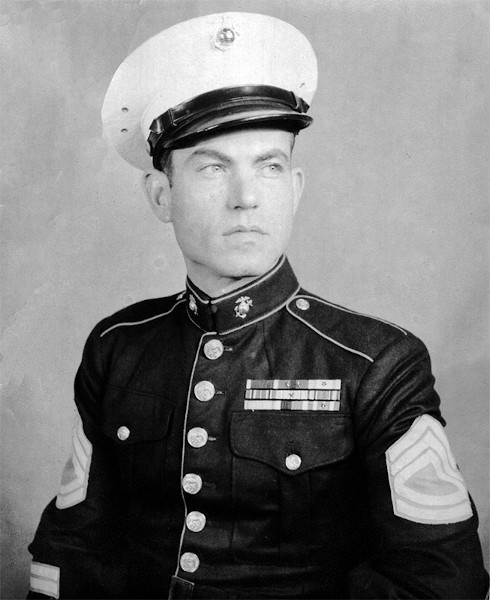
- Unit: 4th Marine Regiment, 2nd Battalion, Company F
- Date of Birth: October 18, 1918
- Entered the Military: December 4, 1939
- Date of Death: November 30, 1953
- Hometown: Dallas, Texas
- Place of Death: Flower Mound, Texas
- Award(s): Good Conduct Medal with two stars, Purple Heart, Asiatic Pacific Campaign Medal with one bronze campaign star, American Defense Service Medal with one service star, China Service Medal, World War II Victory Medal, Philippine Defense Medal, Army Distinguished Unit Citation with 1 cluster, and the Navy Occupation Service Medal with Asia Clasp
- Cemetery: Section 106, Grave 197. Dallas-Fort Worth National Cemetery, Dallas, Texas
Mentored by Mrs. Michele Santosuosso
St. Mark’s School of Texas, Dallas, Texas
2025/2026
Early Life
Pete George was born on October 18, 1919, near Exall Park in southwest Dallas, Texas. His parents, Nick and Mary George, were both immigrants from Greece. At the time, the George family owned a restaurant east of downtown Dallas.
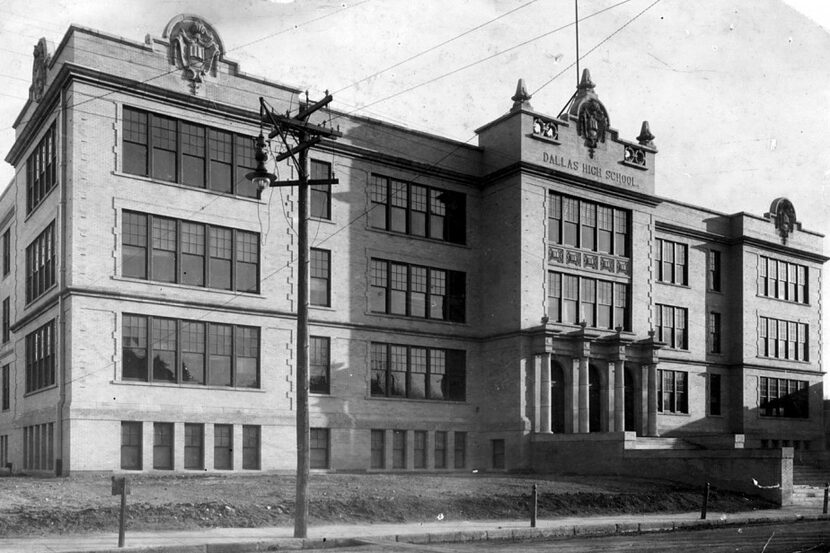
George grew up playing baseball and riding trolley cars with friends and three brothers, Mike, Tony, and George. He attended Dallas High School, later known as Crozier Technical High School, but dropped out early to support his family’s restaurant during the Great Depression.

Homefront
Early History
From the late 1880s to the early 1900s, Dallas was primarily rural and agricultural, and after 1920, it became much more industrialized, with a focus on manufacturing. Its economic transformation positioned the city as a critical contributor to wartime manufacturing production.
The Great Depression
The arrival of electric power in the late 1930s brought modernity to remote areas of Texas. Texas celebrated the one hundredth anniversary of its independence from Mexico in 1936, boosting the state’s economy and spirit. Also, the Texas Centennial Exposition (World’s Fair) drew over six million people to Fair Park in Dallas, home of the Texas State Fair Grounds. The revenue generated and jobs created helped Dallas recover from the worst of the Great Depression.
World War II
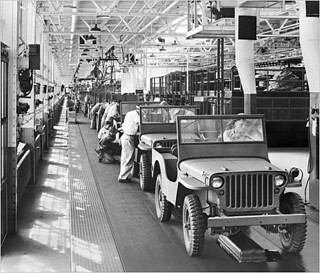
The Dallas Ford assembly plant manufactured over 93,000 Jeeps and thousands of military cargo trucks, while North American Aviation produced trainers, fighters, and bombers, delivering nearly 19,000 aircraft to the front lines.
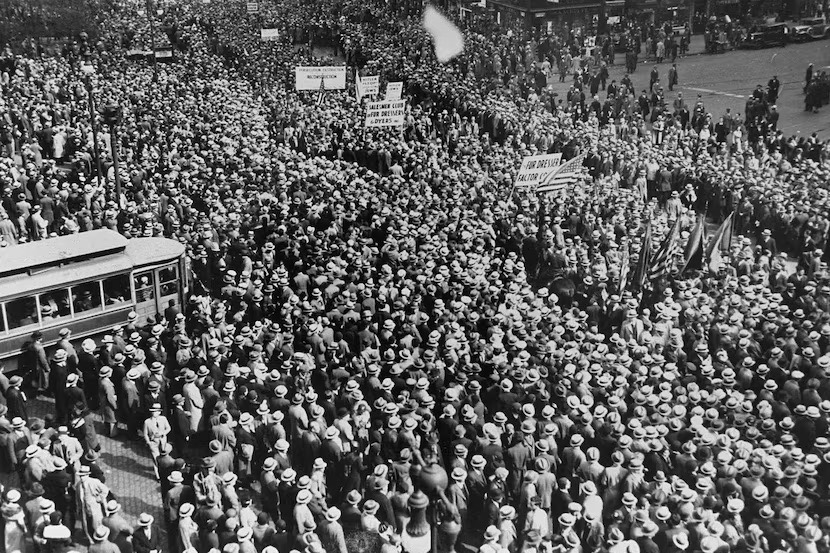
On the home front, civilians participated extensively in rationing systems that regulated crucial items such as gasoline, meat, sugar, and rubber, and in victory gardens that supplemented food supplies. Scrap-metal drives, bond campaigns, and patriotic school programs reinforced collective civic responsibility. Furthermore, citizens organized mass rallies at Fair Park to publicly express their sincere opposition to Nazi Germany.
The war also accelerated demographic and social transformations across the city.
Between 1920 and 1950, Dallas’s population more than doubled to almost half a million, becoming overwhelmingly urban. Hundreds of thousands migrated from rural areas, filling expanding industrial labor markets.
Women and minority workers entered skilled factory positions, including welding and assembly-line operations, that had previously reserved for men. The fictional “Rosie the Riveter” became a cultural icon for women workers during the time.
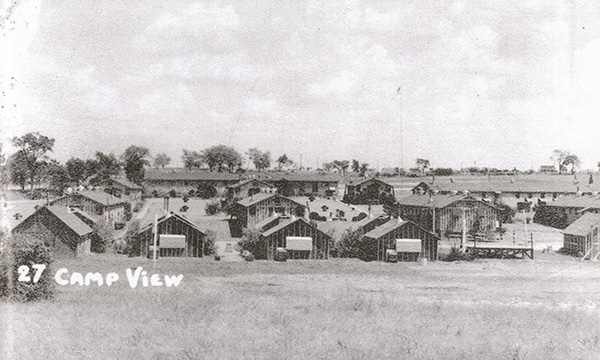
Additionally, roughly 80,000 German and Italian prisoners of war (POW) were shipped to Texas. Approximately 300 German POWs were held at White Rock Lake in Dallas.
Military Experience
Enlistment and Training
George enlisted in the United States Marine Corps on December 4, 1939, in Dallas, Texas. After completing boot camp at the Recruit Depot in San Diego, he was transferred to a Barracks Detachment at Mare Island, California.
Second Sino-Japanese War
In June of 1940, he departed San Francisco as part of Company F, 2nd Battalion, 4th Marine Regiment, known as the China Marines, aboard USS Chaumont for Shanghai, China. The unit arrived on July 26, 1940. Stationed in Shanghai’s International Settlement, George’s unit safeguarded American interests amid rising Japanese presence in Asia, ensuring order for foreign nationals during the Second Sino-Japanese War. His early service centered on guarding key locations, including Standard Oil facilities and a naval hospital, while maintaining strict drill routines during off-duty days.
Their mission reflected broader U.S. efforts to maintain stability and protect citizens overseas before the U.S. formally entered World War II. As tensions escalated into open conflict, George’s service shifted from protective duties to active combat in the Pacific theater.
Corregidor Island
On November 30, 1941, George arrived in the Philippine Islands aboard SS President Madison. This is where he learned of the attack on Pearl Harbor and the official start of the war. From there, he moved to Mariveles, Bataan, and by December 28, he was on Corregidor. On March 17, 1942, George was promoted to corporal.
On May 5, 1942, while fighting the Japanese on Corregidor Island in the Philippines, George suffered a shrapnel wound in his leg and stomach from an artillery shell. The leg wound required surgery, which was completed without anesthesia, but the shrapnel in his stomach stayed with him until after the war. The next day, American resistance collapsed, and his unit surrendered.
Prisoner of War
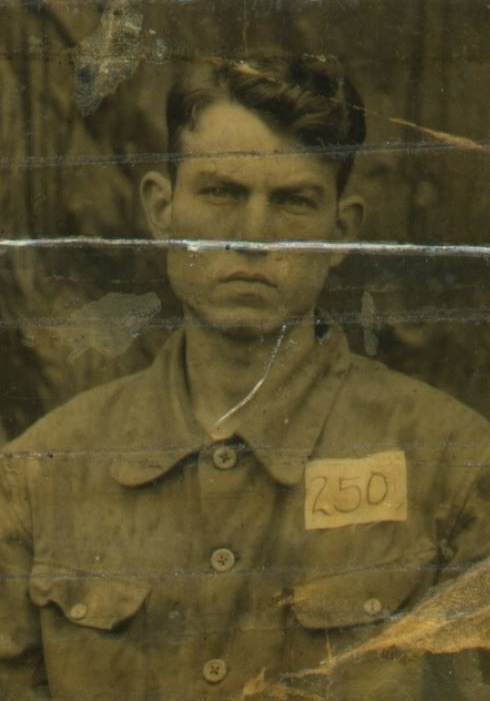
Following this surrender, George became a Prisoner of War (POW). After a 30-day stay in the hospital for his shrapnel wounds, his Japanese captors transported him to Manila by ship and forced him to walk roughly five miles on his wounded leg to Bilibid Prison. Only the most severely wounded or ill stayed at Bilibid. The rest were sent to Cabanatuan Prison by boxcar.
At Cabanatuan Prison Camp Number 1, he endured extreme conditions: starvation rations, disease, brutal treatment, forced labor, and witnessing executions. He learned to adapt, taking care of himself while staying out of trouble.
In an online oral history, George recalled the “Hell Ship” voyage to other locations in Japan. He told how prisoners were transported on unmarked cargo vessels with 300 men in a single cargo hold. He also told of an American submarine that fired two torpedoes at his ship, but luckily missed. They arrived in Osaka in April 1944, and Japanese authorities paraded them through the streets as propaganda.
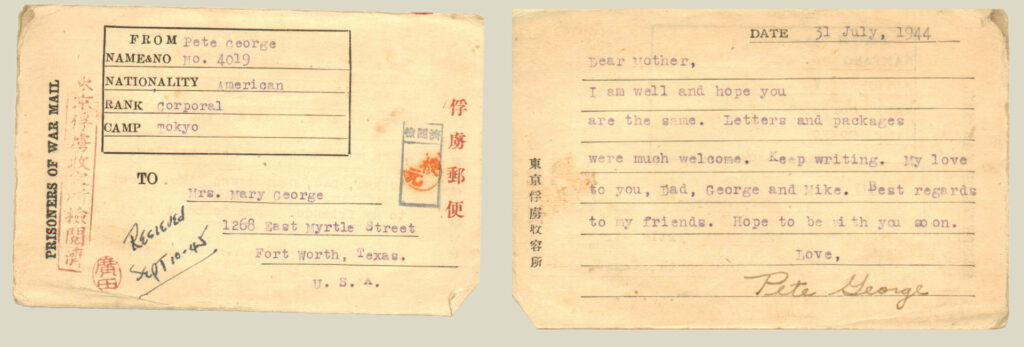
Later, he was transported to numerous Japanese camps, including Hitachi and Matsushima, where malnutrition and forced labor further tested his endurance. In Hitachi, George worked in a copper mine. In Matsushima, he worked to build a hydroelectric plant. Throughout this time, he sent several postcards home to his family to let them know he was safe.
Liberation
After the bombings of Hiroshima and Nagasaki, the prisoners never received an announcement that Japan had surrendered, but they pieced it together from clues, including the fact that B-29 raids over nearby areas had become constant, and work details had become minimal.
The prisoners had no way to contact the American forces, so a British doctor devised a scheme to get the prisoners out of the camp. He had a prisoner fake an illness, and the doctor convinced the Japanese that the patient needed to get to the American medical facilities, or his death would be on the Japanese’s hands. The man was sent to Tokyo on a train, and when he arrived, he told American forces exactly where the camp was.
An American aircraft carrier in the area responded by sending six aircraft loaded with supplies (food, clothing, cigarettes, and candy). The Japanese then marched the prisoners to a train station and loaded them onto a passenger train, not a boxcar. After an eight-hour ride, an American sailor stuck his head into the car and shouted, “Hey, you guys, you want to go back to the States?” George described the feeling as having 10,000 pounds lifted from his shoulders all at once.
After Navy personnel took the men to a hospital ship to be photographed, showered, deloused, and fed, they separated out the original 125 surviving China Marines and transported them to Yokosuka. There, commanders staged a full battle dress parade — something normally reserved for Marines with thirty years of service — with a commanding general present, a full band, and a feast of steak and chicken. George said there was no way to hold back his tears. After three and a half years, his nightmare was over.
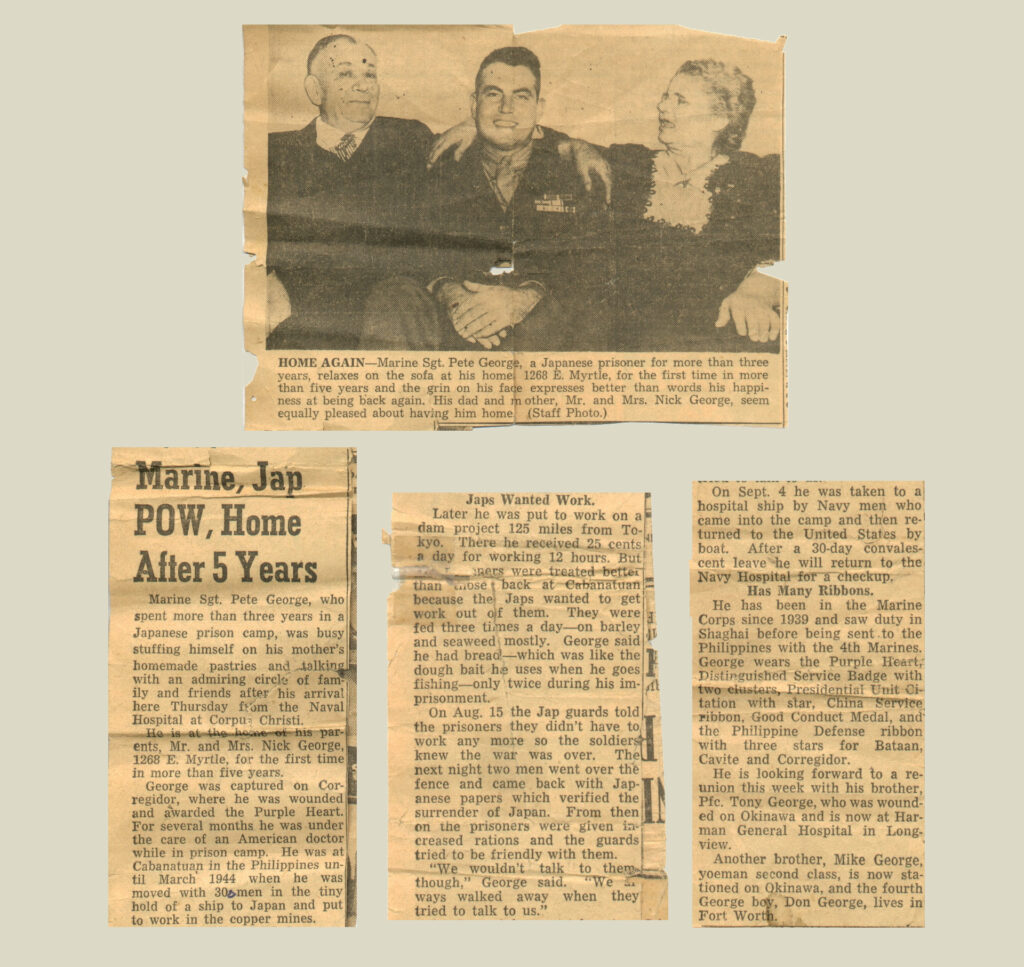
On September 8, 1945, he departed Yokosuka aboard USS Ozark for the Navy Hospital in Oakland, California, where many returning POWs were processed. At the time of liberation, George weighed less than 100 pounds. By the time he arrived at the Navy Hospital, he was back up to 170 pounds.
On November 1, 1945, George was promoted to the rank of sergeant. On April 2, 1946, he was honorably discharged in Corpus Christi, Texas, having received several awards, including a Purple Heart for the wounds he received on Corregidor.
Reenlistment
On May 2, 1946, George reenlisted in Dallas, Texas, and was appointed to the temporary rank of staff sergeant. A few weeks later, he married Juanita Elizabeth McCarthy in Dallas, Texas. On June 1, 1946, he joined the Guard Company, Guard Battalion, in San Diego, California. By August, he was sent to Ordnance Training School at Marine Barracks, Quantico, Virginia.
George graduated from Ordnance School on March 5, 1947, with the rank of technical sergeant. From here, he served with several companies at Camp Lejeune, North Carolina, before being honorably discharged as a technical sergeant on December 20, 1947.
Third Enlistment
On December 31, 1947, George reenlisted and was assigned to the Marine Supply Depot at Camp Pendleton, California, where he worked as an Ammunition Technician.
On August 24, 1950, George embarked aboard USNS Sgt. Sylvester Antolak in San Francisco, California, for Yokohama, Japan. They arrived on September 7, 1950, and joined the Marine Barracks, Yokosuka. There, he served as a leader of a light anti-aircraft artillery group.
From December 18, 1950, until September 27, 1951, George was hospitalized at the U.S. Navy Hospital with an unknown illness. By January 1, 1952, he was granted retirement due to a physical disability. George was honorably discharged for the last time in Washington, D.C., on November 30, 1953.
Veteran Experience
Following his service in the Korean War, Pete George returned permanently to civilian life in Dallas in 1953 and remained in the Dallas area for the rest of his life. He and Juanita grew their family to include nine children and later welcomed twenty-three grandchildren and seventeen great-grandchildren.
George worked primarily in residential and commercial construction. He partnered with his brother-in-law, Ed McCarthy, to build homes in the Dallas area. He later worked on apartment complexes in Little Rock, Arkansas; 7-11 stores in Missouri; and projects within Eckerd Corporation’s construction division in Texas. His career centered on large-scale building and development projects.
George was raised in the Greek Orthodox Church and converted to Catholicism after his marriage. He became a longtime member of St. Luke Catholic Church in Irving beginning in 1952 and remained active in his church community for decades. Family members described him as honest and devoted to his role as a father.


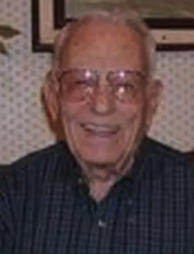
Commemoration
Pete George passed away peacefully on September 8, 2013, in Flower Mound, Texas, at the age of 93. He was predeceased by his wife, Juanita, on May 6, 2009.
George was laid to rest at the Dallas-Fort Worth National Cemetery with military honors, including a rifle salute and flyover. He is survived by three daughters, four sons, 23 grandchildren, and 17 great-grandchildren.
Bibliography
Primary Sources
California. San Diego County. 1950 Federal Census. Digital Images. https://ancestry.com.
George, Pete. “Journey to Shanghai: Words and Memories by Pete George.” China Marines. Accessed October 16, 2025. https://chinamarines.com/PeteGeorge/shanghai.html.
Pete George. Marine Corps Muster Rolls, 1798–1958. Digital Images. https://ancestry.com.
Pete George. Official Military Personnel File, Department of the Navy. National Archives and Records Administration – St. Louis.
Pete George. Polk’s Irving City Directory, 1966. Digital Images. https://ancestry.com.
Pete George. Texas, U.S., County Marriage Records, 1837–1965. Digital Images. https://ancestry.com.
Pete George. U.S., City Directories, 1822-1995. Digital Images. https://ancestry.com.
Pete George. World War II Draft Cards Young Men, 1940–1947. Digital Images. https://ancestry.com.
Pete George. World War II Prisoners of the Japanese, 1941–1945. Digital Images. https://ancestry.com.
Texas. Dallas County. 1930 U.S. Census. Digital images. https://ancestry.com.
Secondary Sources
Allen, Ruth A., George N. Green, and James V. Reese. “History of Labor Strikes in Texas: A Comprehensive Overview.” Texas State Historical Association. Accessed November 13, 2025. https://www.tshaonline.org/handbook/entries/strikes.
Anderson, Jennifer. “The History of Ford Motor Company in Dallas.” City of Dallas Preservation. Accessed November 13, 2025. https://cityofdallaspreservation.wordpress.com/category/dallas-during-wwi-ii/.
“Chaumont (AP-5).” Naval History and Heritage Command. Accessed January 15, 2026. https://www.history.navy.mil/research/histories/ship-histories/danfs/c/chaumont.html.
Cummings, Brigitte. “Members Of Hitler’s Army On The Shores Of White Rock Lake.” CBS News [Dallas, Texas], March 21, 2014. https://www.cbsnews.com/texas/news/members-of-hitlers-army-on-the-shores-of-white-rock-lake/.
Brown, Steve. “Downtown’s Historic Dallas High School Ready to Sell for Redevelopment.” Dallas News [Dallas, Texas], June 11, 2015. https://www.dallasnews.com/business/2015/06/11/downtowns-historic-dallas-high-school-ready-to-sell-for-redevelopment.
Hammons, Carlyn. “The Great Depression and World War II.” Texas Our Texas. Accessed November 13, 2025. https://texasourtexas.texaspbs.org/the-eras-of-texas/great-depression-ww2/.
Hickman, Kennedy. “World War II: Battle of Corregidor.” ThoughtCo. May 25, 2025. https://www.thoughtco.com/world-war-ii-battle-of-corregidor-2361467#:~:text=Key%20Takeaways,American%20forces%20in%20the%20Philippines.
Maxwell, Lisa C. “Dallas County, Geography, History, and Economy.” Texas State Historical Association. Accessed November 13, 2025. https://www.tshaonline.org/handbook/entries/dallas-county.
“Pete George.” City of Carrollton. Accessed December 11, 2025. https://www.cityofcarrollton.com/residents/veterans-military-service/u-s-marine-corps/george-pete.
“Pete George.” Colonial Funeral Home of Irving. Accessed December 11, 2025. https://www.colonialofirvingfuneral.com/obituaries/Pete-George?obId=33888146.
“Pete George.” Find a Grave. Accessed December 11, 2025. https://www.findagrave.com/memorial/117000449/pete-george.
“Pete George.” Veterans Legacy Memorial, National Cemetery Administration. Accessed March 30. 2026. https://www.vlm.cem.va.gov/PETEGEORGE/57AE461/.
Procter, Ben H. “The Impact of World War II on Texas: Social, Economic, and Political Changes.” Texas State Historical Association. Accessed November 13, 2025. https://www.tshaonline.org/handbook/entries/world-war-ii.
Simnacher, Joe. “Pete George, World War II Marine Who Was a POW for 42 Months, Dies at 93.” The Dallas Morning News [Dallas, Texas], September 20, 2013. https://www.dallasnews.com/news/obituaries/2013/09/21/pete-george-world-war-ii-marine-who-was-a-pow-for-42-months-dies-at-93/.
Stone, Rachel. “The P.O.W. Camps of White Rock Lake.” Accessed November 13, 2025. https://lakehighlands.advocatemag.com/2016/07/27/p-o-w-camps-white-rock-lake/.
This profile was funded by a grant from the United States Department of Veterans Affairs. The opinions, findings, and conclusions stated herein are those of the author and do not necessarily reflect those of the United States Department of Veterans Affairs.