
Private First Class Raymond Norbert Dickes
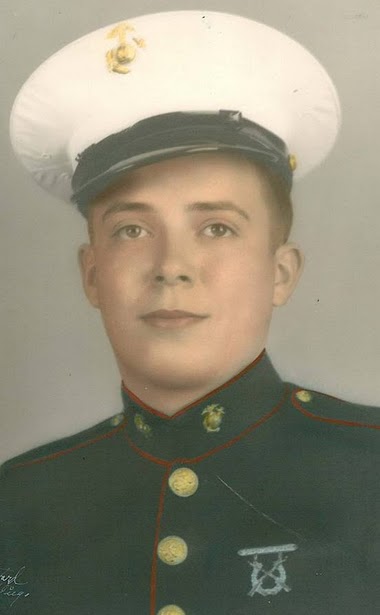
- Unit: 2nd 155mm Artillery Battalion
- Date of Birth: March 24, 1924
- Entered the Military: November 7, 1942
- Date of Death: December 31, 2011
- Hometown: Osmond, Nebraska
- Place of Death: Mason City, Iowa
- Award(s): Asiatic Pacific Theater with two stars
- Cemetery: Section 3, Site 15. Iowa Veterans Cemetery at Adel, Adel, Iowa
Mentored by Ms. Cheryl Smith
Johnston Middle School
2025/2026
Early Life
Raymond Norbert Dickes was born in Osmond, Nebraska, on March 24, 1924, to Frank H. Dickes and Mable E. Link. He grew up on his family’s farm with his five brothers. As a child growing up during the Great Depression, his family did not have much money, so he learned to entertain himself the best he could, like pretending to be a lion tamer, by chasing tumbleweeds and rolling a tire rim with a stick.
Raymond Dickes, known as “Ray,” attended Coleridge High School, studying academic courses such as Geometry, Chemistry, and Woodshop. In high school, he was a multi-sport athlete, competing in track, baseball, football, softball, boxing, and wrestling. Shortly after graduating in May of 1942, his father, Frank, insisted that he leave home and go to work, so Ray left the farm and headed to Omaha, Nebraska. In Omaha, he entered trade school on May 12, 1942, through the National Youth Administration, studying blueprint reading and welding, and began working as a welder at Omaha Steel Works.
On June 30, 1942, Ray, who had recently turned 18, registered for the military. Later that year, on September 5, he married the love of his life, Bonnie Jordan, who had grown up on a neighboring farm. Bonnie’s father did not approve of the marriage, as Bonnie was only 17, even going so far as to have Bonnie arrested after the wedding, but this did not derail Ray and Bonnie’s desire to be together. They lived together on 53rd Street in Omaha, Nebraska, until Ray was called into service in November.


Homefront
Omaha, Nebraska, served a critical role in the American war effort, as an entry point for agricultural production and as an industrial hub for wartime machinery. Before the late 1930s, Omaha’s economy was defined by massive meatpacking plants and stockyards, which processed livestock from across the Great Plains. However, as the United States transitioned from the Great Depression into World War II, the city underwent a dramatic transformation, evolving from a regional rail center into a powerhouse of military aviation and global food production.
Omaha’s most significant industrial contribution was the Glenn L. Martin Bomber Plant. This facility was a marvel of wartime fabrication, producing the B-26 Marauder and the B-29 Superfortress. The planes that dropped the two atomic bombs, Enola Gay and Bockscar, were both built in the Omaha factory.
While Dickes was serving away from home, his bride, Bonnie, became an essential part of the war effort, working as a clerk in the plant’s administrative offices. For women like Bonnie Dickes, the war represented a significant social shift. As men deployed overseas, women filled roles previously closed to them, moving into factory production and clerical positions essential to the war’s bureaucracy.
On the agricultural front, the Nebraska Seed Company led campaigns to encourage Nebraskan families to grow Victory Gardens for the domestic food supply. The community also supported the Crop Corps, mobilizing millions of teenagers and women to replace the 27% of the farm labor force lost to military service. To address critical labor shortages, Nebraska even utilized Italian Prisoners of War (POWs) from regional branch camps, such as the one in Grand Island, to work the fields.
The war triggered demographic shifts in Omaha. The promise of high-paying factory jobs at the Martin Plant and other industries drew thousands of African Americans from the South as part of the Great Migration. This influx prompted the Omaha Urban League to expand social services, improving the quality of life for the Black community and opening new economic doors, even though the shifts sometimes brought underlying social tensions to the surface.
Omaha residents were unified through civil defense and propaganda campaigns. The government used posters, films, and local newspapers to encourage resource conservation, the purchase of war bonds, and recruitment. However, the home front was not without its controversies. Labor strikes occurred at the Atlanta POW branch camp in Grand Island, where prisoners protested working conditions; however, these strikes were short-lived, and the focus remained on the accelerated schedule for shipping food and materials to the troops.
By the early 1940s, the droughts and poor soil of the Great Depression were a memory, replaced by a booming economy and a unified civilian defense. Omaha’s unique contribution, building the planes that flew over Japan while feeding the Allied world, solidified its Re-Declaration of Independence and pledge to the country to protect “Lives, Fortunes, and sacred Honor.”


Military Experience
On November 7, 1942, at just 18 years old, Ray Dickes answered the call to service. With his parents’ written consent, he enlisted in the military in Coleridge, Nebraska, and transferred to Des Moines on November 19, where he volunteered as a private in the United States Marine Corps. Dickes brought his Midwestern work ethic, having spent his high school years playing sports and then as a welder at Omaha Steel Works, a background that likely contributed to his mechanical aptitude during training.
Dickes received initial training in San Diego, where he specialized in field communications. From January 16 to February 26, 1943, he mastered general communications, electricity, magnetism, and the intricate wire systems required for battlefield coordination. His military occupation was field lineman (Fld TP Man-641). This dangerous but essential role required Dickes to lay telephone wire using heavy spools across combat zones and maintain communication lines under fire. In addition to communication duties, Ray was responsible for loading and firing artillery. Between March and June 1943, he was promoted to private first class.
Following a brief final furlough home in April 1943, Dickes departed from San Diego aboard SS Luis Aguello on May 10, destined for the South Pacific. In a letter published in his local paper in July 1943, he described the tension of the voyage: the “dizzy headaches” of sea travel, the monotony of abandon ship drills, and the immense relief of seeing a Navy patrol bomber with the “star shining on the side” as they neared land. He arrived in Noumea, New Caledonia, for advanced artillery training, describing the islands as “pretty on the mountains” but “swampy in the valley” with mosquitoes “as big as dive bombers.”
Dickes’s service record reads like a guide to the most pivotal campaigns in the Pacific.
Bougainville
Serving with the 2nd 155mm Artillery Battalion, Dickes arrived at Empress Augusta Bay on November 23, 1943. He described the area as a “hot spot,” alluding to a “play-by-play account” of the action in letters home while maintaining the vital communication wires for his artillery unit.
Guam
After returning to Guadalcanal to regroup, Dickes embarked on USS Harry Lee on June 4, 1944. He disembarked at Beach White on July 22 for the Second Battle of Guam. This campaign was essential for establishing airstrips to strike the Japanese mainland. Dickes participated in intense offensive and defensive actions until August 10.
Okinawa
In early 1945, now assigned to the 7th 155mm Gun Battalion, 3rd Corps Artillery, Dickes moved toward the Ryukyu Islands. He disembarked at Okinawa on April 2, 1945, participating in the action against the enemy until June 21. He was part of the force that set foot on Le Shima (Ie Shima) Island for the invasion of Okinawa, where they encountered fierce resistance from thousands of Japanese defenders.
Service in the Pacific was not only a battle against the enemy but also against the environment. Following the Guam campaign in September 1944, Dickes contracted dengue fever, a testament to the grueling conditions field linemen faced in the jungle.
Awards
For his service across these major theaters, Dickes was awarded the Asiatic-Pacific Campaign Medal with two stars, representing his participation in these critical operations. His record also indicates two Presidential Unit Citations, a high honor awarded to units for extraordinary heroism against an armed enemy. However, upon returning to the United States, he reportedly threw his medals into the ocean in excitement. His son, Steve, explained this by saying, “My opinion is that my Dad tossed his medals overboard for two reasons: the joy of returning to the US and to discard the reminder of how horrible the experience was. But he was definitely very proud of his service and for helping to fight in a very important war.”
Discharge
As the war drew to a close, Dickes began his journey home and was honorably discharged from the military on September 29, 1945. He left the Marine Corps as a seasoned combat veteran, having transitioned from an 18-year-old Nebraska welder to an essential part of the communication chain that helped secure victory in the Pacific.


Veteran Experience
On September 29, 1945, Raymond Dickes received an honorable discharge at his final duty station in Okinawa. He returned to Nebraska a changed man, trading the heavy spools of communication wire for the tools of a civilian trade. While the war in the Pacific was over, Dickes carried its physical toll with him; in February 1949, he was hospitalized with a severe intestinal illness that doctors believed was a lingering effect of his service in the tropical South Pacific.
After returning from war, Dickes began training to be a butcher through the G.I Training program. In 1947, at the age of twenty-three, he took a bold step into entrepreneurship by purchasing his own business: Ray’s Northside Market. His ingenuity as a “groceryman” was soon recognized on a national scale. He designed a self-contained locker plant behind his store that was so innovative it was featured in the trade magazine, Locker Management.
Though he eventually sold his store, his experience in the food industry led to a successful career with Armour and Company. His professional journey was marked by a series of promotions that saw the Dickes family move across the region, eventually settling in Mason City, Iowa, where Dickes would leave his most lasting mark.
For Dickes, the peace he helped win was best spent at home. When the Korean War broke out, many of his former brothers-in-arms re-enlisted for financial incentives or out of a sense of duty. Dickes, however, chose to stay. To him, no sum of money was worth more than the time spent with his wife, Bonnie, and their growing family. By 1950, the couple had four children: Allen, Barbara, Lawrence, and Bruce, and would eventually include Raymond Jr. and Steven.
Dickes was a “present” father in every sense of the word. He was a regular fixture at his children’s sports games and a devout member of the Catholic Church. His life was a testament to the quiet stability that many veterans sought after the chaos of the front lines.
Dickes’s leadership extended far beyond his own doorstep. In Mason City, he served as the president of the Country Club and was a dedicated volunteer for the Parks Department. His passion for business and mentorship led him to work with Junior Achievement, where he helped high school students understand the complexities of the business world, sharing the wisdom he had gained since buying his first store at twenty-three.
He also served on the Mason City Recreational Board, ensuring that the community had the same vibrant spaces for play and connection that he valued for his own family.


Commemoration
Raymond Dickes passed away on December 31, 2011, six months after his wife, Bonnie. He left behind a legacy that was both public and private: a community in Nebraska and Iowa that benefited from his volunteerism, and a large, devoted family who remembered him as a man who chose them above all else. His story is one of a “Silent Hero” who fought a loud war in the Pacific so that he could live a meaningful, quiet life of service on the American home front.
They are buried together at the Iowa Veterans Cemetery in Adel, Iowa.


Bibliography
Primary Sources
“Births.” The Pilot-Tribune [Blair, Nebraska], March 25, 1948. Newspapers.com (671539292).
“Croudy Sells North Side Store.” The Enterprise [Blair, Nebraska], March 20, 1947. Newspapers.com (671130302).
“Dickes Buys Croudy Store.” The Pilot-Tribune [Blair, Nebraska], March 27, 1947. Newspapers.com (671537374).
Dickes Family Records. 1924-2011. Courtesy of Steve Dickes.
Dickes, Steven, and Lawrence Dickes. Zoom interview with the authors. December 4, 2025.
Dickes, Steven. Telephone interview with the author. November 3, 2025.
Gerdes, Lou. “Nebraska Goes to War.” The Sunday World-Herald Magazine [Omaha, Nebraska], July 4, 1943.
Morrow, Edward. “Martin Bombers Roll Off Production Line on Time.”The Sunday World-Herald Magazine [Omaha, Nebraska], July 4, 1943.
Nebraska. Pierce County. 1930. U.S. Census. Digital Images. http://ancestryclassroom.com.
Nebraska. Pierce County. 1940. U.S. Census. Digital Images. http://ancestryclassroom.com.
Nebraska. Washington County. 1950. U.S. Census. Digital Images. http://ancestryclassroom.com.
“Our Boys in Service.” The Hartington Herald [Hartington, Nebraska]. July 29, 1943. Newspapers.com (700126560).
“Ray Dickes Ill with War Service Affliction.” The Pilot-Tribune [Blair, Nebraska], February 3, 1949. Newspapers.com (671563550).
“Ray Dickes Writes Letter from Bougainville Island.” The Coleridge Blade [Coleridge, Nebraska], January 13, 1944. Newspapers.com (673705205).
Raymond Norbert Dickes, Official Military Personnel File, Department of the Navy. National Archives and Records Administration – St. Louis.
Raymond Norbert Dickes, Report of Separation, Department of the Navy, National Archives and Records Administration – St. Louis.
Raymond Norbert Dickes. World War II Draft Cards Young Men, 1940-1947. Digital Images. https://ancestryclassroom.com.
“Trade Magazine Features Ray’s North Side Store.” The Pilot-Tribune [Blair, Nebraska], December 8, 1949. Newspapers.com (671565892).
USS Hunter Liggett. Photograph. c.1944. United States Coast Guard. https://www.history.uscg.mil/Browse-by-Topic/Assets/Water/All/Article/2488223/uss-hunter-liggett-apa-14/.
“Viewing the War with Cedar County Soldiers and Sailors.” The Cedar County News [Hartington, Nebraska], April 22, 1943. Newspapers.com (700242365).
Welcome Folks! Advertisement. The Pilot-Tribune [Blair, Nebraska], March 27, 1947. Newspapers.com (671537353).
Secondary Sources
“Battle of Guam.” National Park Service. Accessed January 6, 2026. https://www.nps.gov/wapa/learn/historyculture/battle-of-guam.htm.
“Bonnie Y. Jordon Dickes.” Find a Grave. Updated May 17, 2013. Accessed April 1, 2026. https://www.findagrave.com/memorial/110703146/bonnie_y-dickes.
“History of Nebraska.” EBSCO Knowledge Advantage. Last modified 2024. Accessed November 4, 2025. https://www.ebsco.com/research-starters/history/history-nebraska#full-article.
“Join the Crop Corps-A World War II Story.” Nebraska State Historical Society. Last modified November 13, 2023. Accessed November 11, 2025. https://history.nebraska.gov/publications_section/join-the-crop-corps-a-world-war-ii-story/.
Larson, George, “Nebraska’s World War II Bomber Plant: The Glenn L Martin-Nebraska Company.” Nebraska History 74 (1993): 32-43. http://www.nebraskahistory.org/publish/publicat/history/full-text/NH1993BomberPlant.pdf.
O’Brian, Cyril J. “Liberation: Marines in the Recapture of Guam.” Marine Corps Historical Center. Accessed January 6, 2026. https://www.ibiblio.org/hyperwar/USMC/USMC-C-Guam/index.html.
“Okinawa Campaign: Pre-Landing Bombardments: March-April 1945.” Naval History and Heritage Command. Accessed January 6, 2026. https://www.history.navy.mil/content/history/museums/nmusn/explore/photography/wwii/wwii-pacific/okinawa/pre-landing-bombardments.html.
“Operation Forager: The Battle of Saipan.” Naval History and Heritage Command. Accessed January 6, 2026. https://www.history.navy.mil/browse-by-topic/wars-conflicts-and-operations/world-war-ii/1944/saipan.html.
“Raymond Dickes.” Legacy. Accessed October 25, 2025. https://www.legacy.com/us/obituaries/desmoinesregister/name/raymond-dickes-obituary?id=20901965
“Raymond Norbert Dickes.” Find a Grave. Updated July 7, 2020. Accessed October 29, 2025. https://www.findagrave.com/memorial/212523980/raymond-norbert-dickes.
“Raymond Norbert Dickes.” Veterans Legacy Memorial, National Cemetery Administration. Accessed April 2, 2026. https://www.vlm.cem.va.gov/RAYMONDNORBERTDICKES/82fcac.
“Old Dodge School – World War II POW Branch Camp.” Explore Nebraska History. Accessed November 14, 2025. https://mynehistory.com/items/show/263.
Rentz, John N. Bougainville and the Northern Solomons. The Battery Press, 1989. https://www.usmcu.edu/Portals/218/Rentz_Bougainville%20and%20the%20Northern%20Solomons.pdf.
“Women Workers during World War II.” Nebraska State Historical Society. Last modified November 13, 2023. Accessed November 11, 2025. https://history.nebraska.gov/publications_section/women-workers-during-world-war-ii/.
“World War II and the Transformation of the Omaha Urban League.” Nebraska History 60 (1979): 401-423. http://www.nebraskahistory.org/publish/publicat/history/full-text/1979-3-WWII_Omaha_UL.pdf.
“World War II – Omaha Citizens’ Defense Corps.” Nebraska State Historical Society. Last modified November 13, 2023. Accessed November 11, 2025. https://history..vvvvv.gov/publications_section/world-war-ii-omaha-citizens-defense-corps/.
This profile was funded by a grant from the United States Department of Veterans Affairs. The opinions, findings, and conclusions stated herein are those of the author and do not necessarily reflect those of the United States Department of Veterans Affairs.