

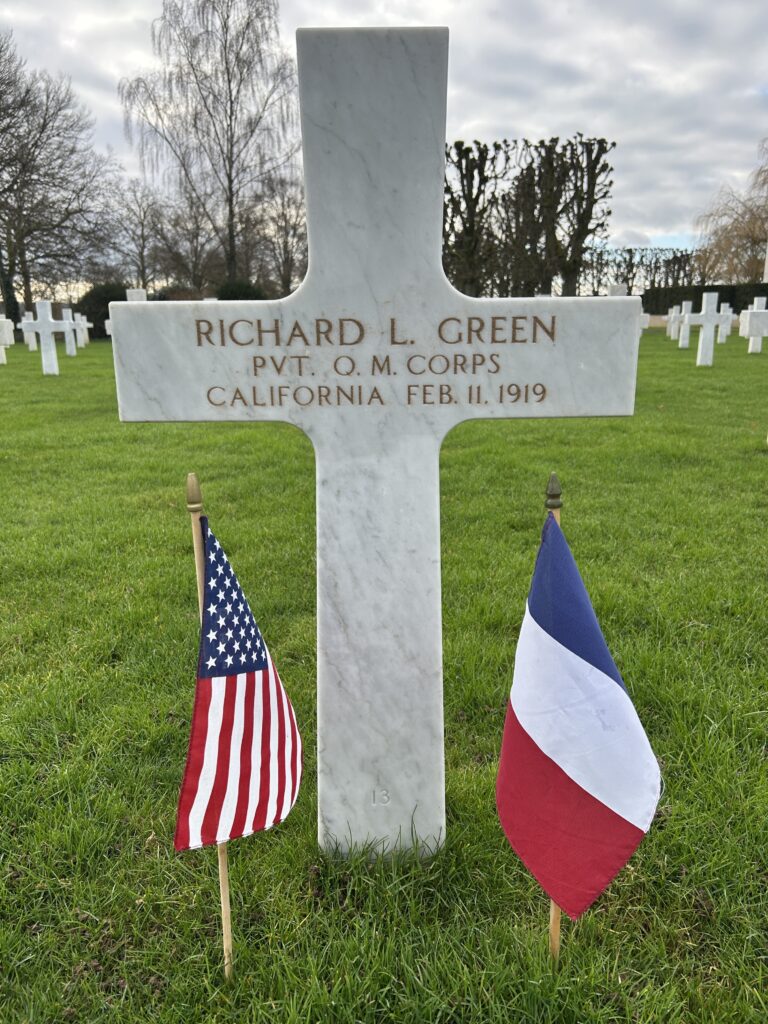
Private Richard Lee Green
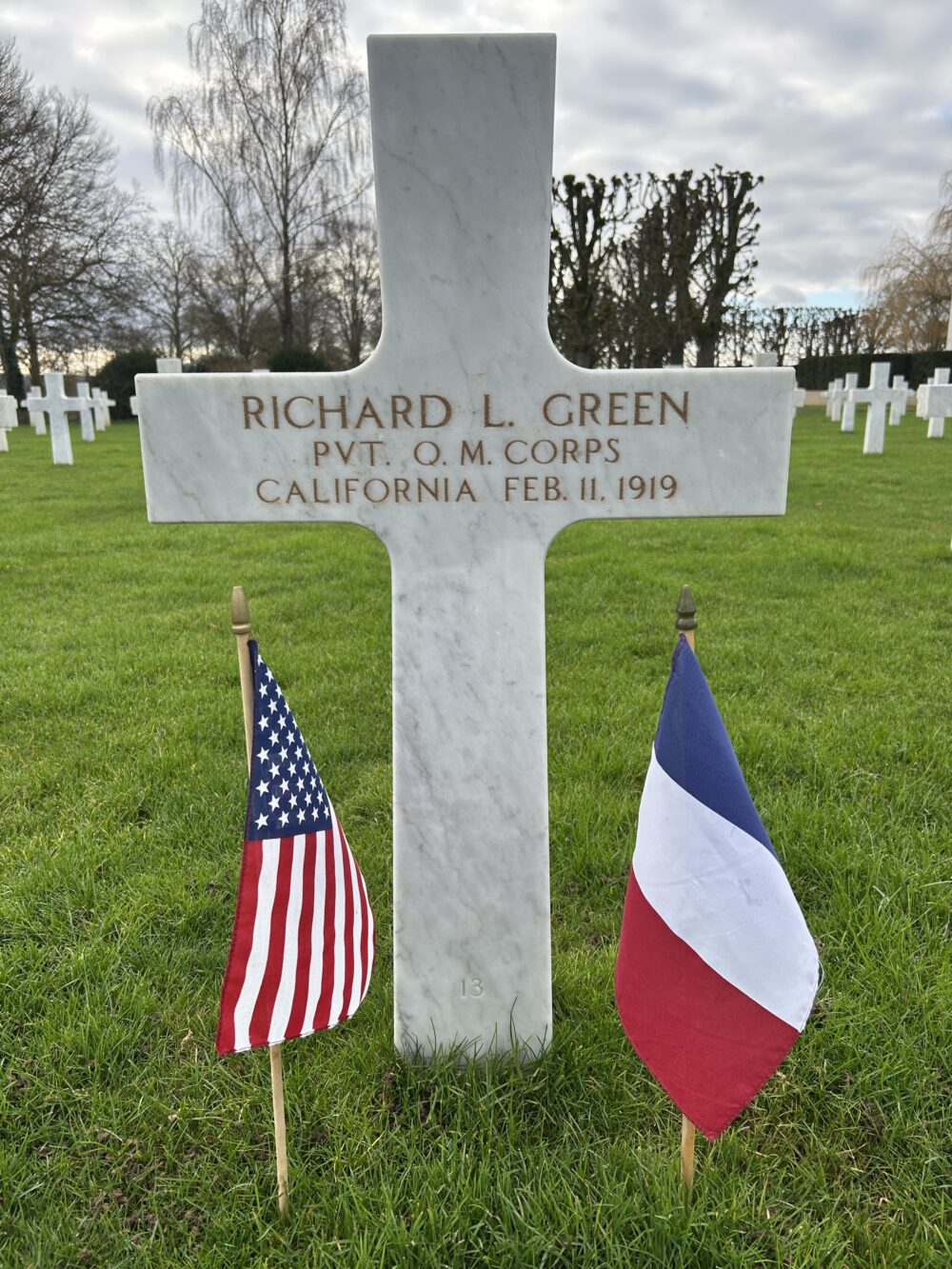
- Unit: Quartermaster Corps
- Service Number: 219473
- Date of Birth: November 25, 1894
- Entered the Military: June 5, 1917
- Date of Death: February 11, 1919
- Hometown: Portland, Oregon, and San Francisco, California
- Place of Death: France
- Cemetery: Plot C, Row 20, Grave 13. St. Mihiel American Cemetery, Thiaucourt, France
Toby Johnson Middle School, Elk Grove, California
2025/2026
Early Life
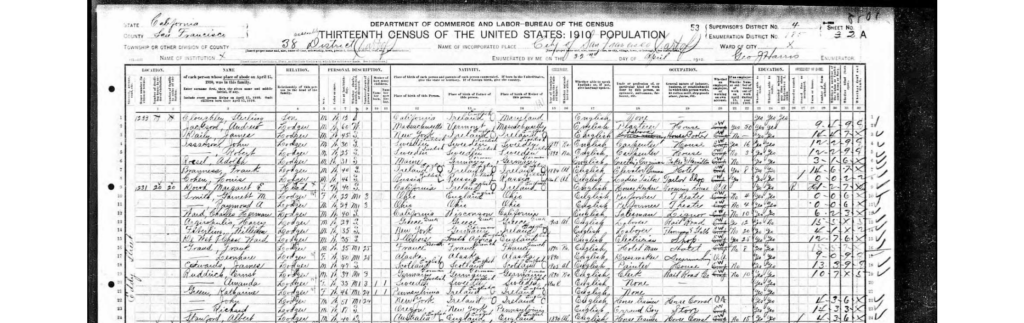
Richard Lee Green was born in Portland, Oregon, on November 25, 1894. Green was the only child of John and Katharine Green. The 1910 census shows his father, John, was born in New York in 1859, and his mother, Katharine, was born in Pennsylvania in 1864. Both sets of Richard Green’s grandparents were Irish immigrants.
In 1910, Green and his parents lived as lodgers in a boarding house at 1231 Eddy Street, in a working-class neighborhood of San Francisco, California. Their landlady, Margaret Dowd, had 15 lodgers living in her household. The Green family lived in San Francisco during a time of rapid transition as the city rebuilt from the destructive 1906 earthquake and fire.
With the construction of the Golden Gate Bridge still two decades in the future, San Franciscans could only cross the bay by ferry. In the city itself, streetcars, cars, and horses coexisted. John Green worked as a horse trainer at a horse corral alongside one of his fellow lodgers. Seventeen-year-old Richard Green earned wages working as an errand boy for a local store.
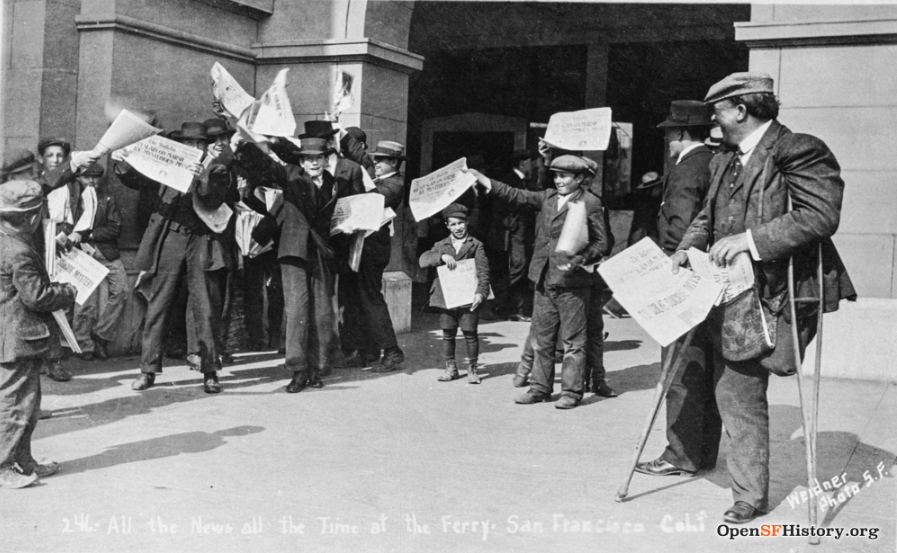
Age 24 when he completed his draft card, Richard Green was short and stout with brown eyes and red hair. By this time, Green lived on Sutter Street and worked as a newsboy for the San Francisco Examiner on Market Street.

Homefront
San Francisco is located on a peninsula in Northern California with the San Francisco Bay on one side and the Pacific Ocean on the other. In 1917, San Francisco’s population numbered approximately 500,00 people.
In 1915, San Francisco hosted the Panama-Pacific International Exposition. It commemorated two major events: the opening of the Panama Canal and the rebuilding of San Francisco after the devastating 1906 earthquake and fire. Newspaper articles about the Panama-Pacific International Exposition were surrounded by articles detailing the Great War raging in Europe.
Employed as a newsboy by The San Francisco Examiner, Richard Green would have been aware of the daily headlines as the United States grew closer to entering World War I. On the morning of April 7, 1917, the headline read in part, “Wilson to Draft Army of Half-Million Men.” In two short months, Green would find himself among the men drafted to serve in the United States Army.
Wartime Manufacturing
California had several shipyards devoted to wartime manufacturing. In August 1917, the shipyards at Potrero Point in San Francisco were commandeered by the U.S. Navy to help with the war effort. By the war’s end, the Potrero yards had rolled out 66 destroyers and 18 submarines. The Mare Island Naval Shipyard in Vallejo, California, still holds an unbroken record for shipbuilding speed, finishing the destroyer USS Ward in 17-and-a-half days.
Recruitment and Training
A poster used by the San Francisco Army Recruiting District depicted Germany as a gorilla with a bloodied club in one hand and a woman clutched in the other hand. The poster’s caption read, “Destroy this Mad Brute, Enlist.”
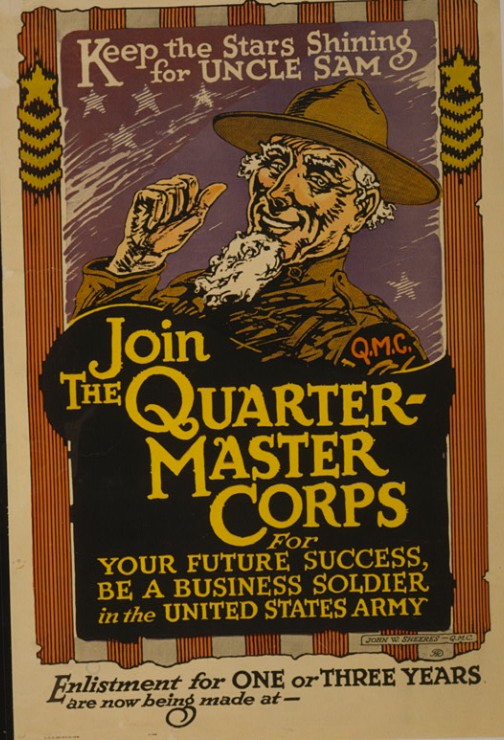
Another recruitment poster showed Uncle Sam wearing the uniform of a Quartermaster. This poster was meant to appeal to young men considering their futures beyond the war. The headline on the poster read, “Join the Quartermaster Corps for Your Future Success, Be a Business Soldier in the United States Army.”
Camp Fremont was designed as a training camp for California recruits as the country mobilized for World War I. Located south of San Francisco, near Stanford University, Camp Fremont operated for about 18 months.
Sacrifices at Home
Once the United States entered World War I, California formed the California State Council of Defense, which set policies to stimulate food production and conserve the food produced. War Gardens and School Gardens were heavily promoted around the state.
A 1917 booklet entitled All for America: What California Schools Can Do in the Present Crisis was published by the State Board of Education of California. Copies of the booklet were distributed to all California schools. Children were encouraged to do their part in supporting America’s war efforts in World War I and to take pride in their country during the time of crisis.
Anti-German sentiment was reflected in state mandates to distance schools from Germany’s language and culture. At the request of the California State Board of Education, German clubs stopped meeting in schools, German language classes and German songs were eliminated from the curriculum.
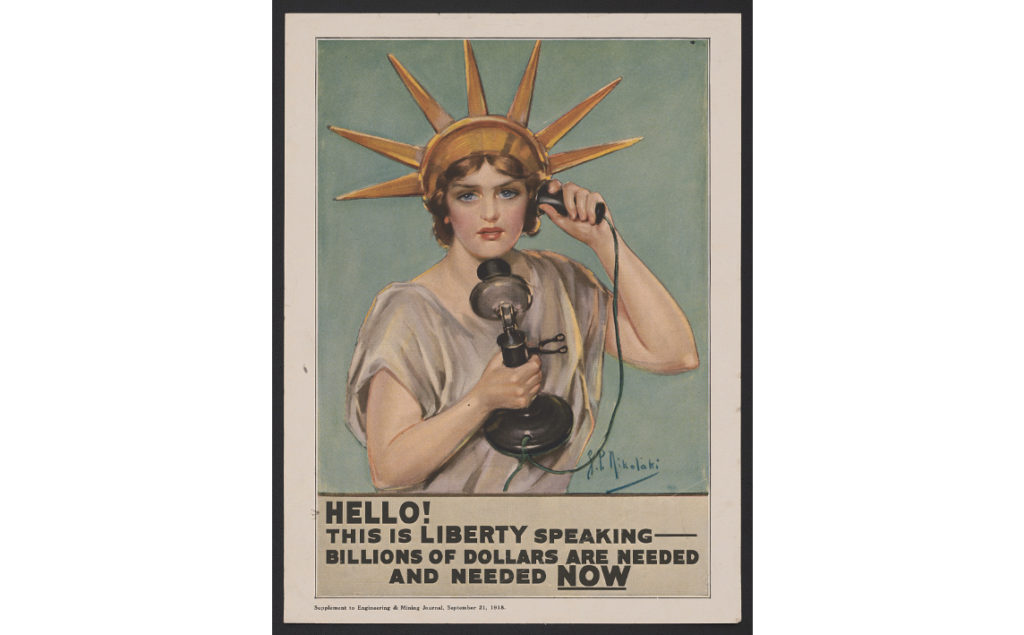
The San Francisco Federal Reserve coordinated the Liberty Loan campaigns for the 12th district which covered nine western states. Officials organized local volunteers to promote and sell Liberty Loan Bonds to the public. The San Francisco Chronicle’s January 17, 1917, headline proclaimed, “San Francisco Must Sell Liberty Bond Subscriptions by 12,000,000 in Four Days.”
New Roles for Women
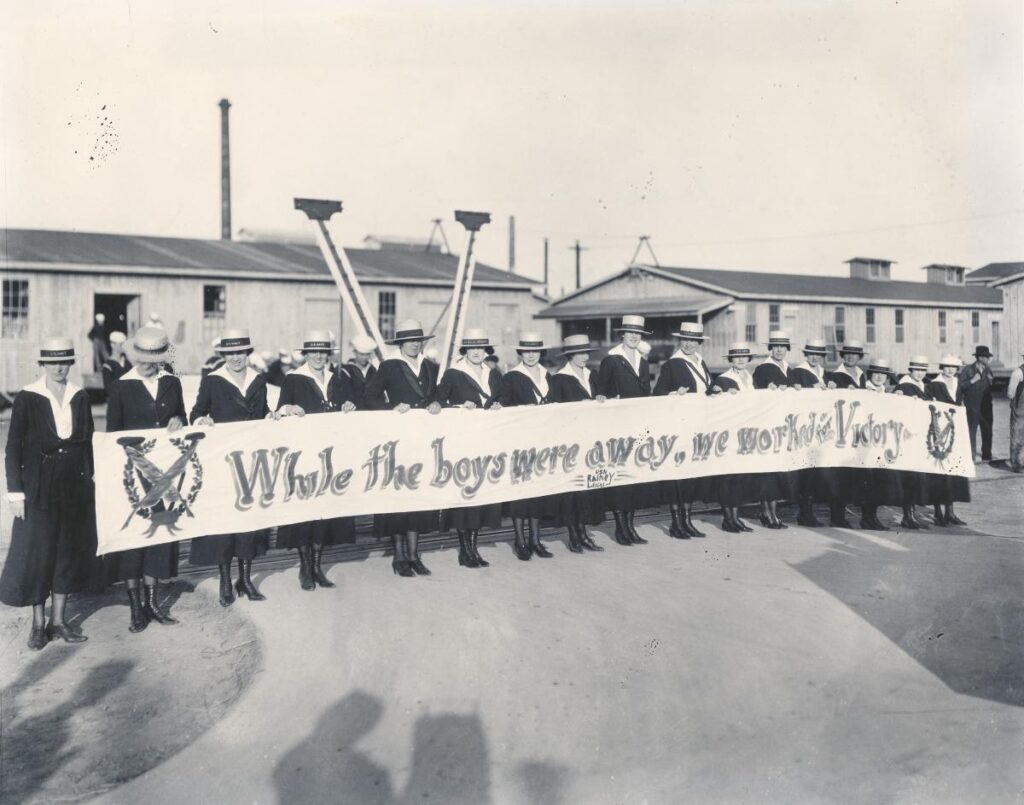
Due to wartime mobilization, women entered the workforce through agriculture, the military, and industrial settings such as the Central Pacific’s railroad shops.
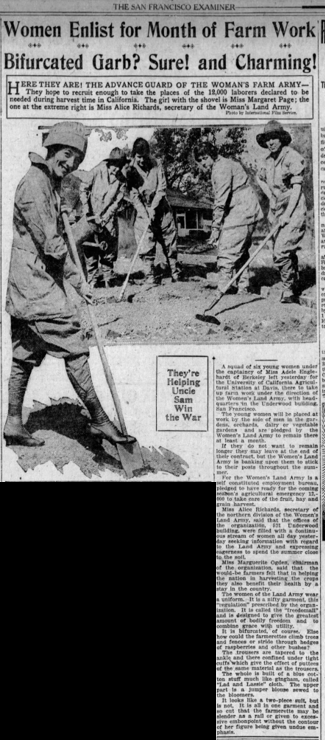
The Women’s Land Army (WLA) was based on the Women’s Land Army of Britain. After food riots occurred in several U.S. cities in the winter of 1917, middle-class women in New York founded the WLA. The premise was to use women’s labor to address food shortages caused by the war. California found great success with the program.
Yeomanettes were the first women permitted to enlist in the U.S. Navy. Most of the Yeomanettes served in clerical positions and remained in the United States during World War I. About 150 Yeomanettes were stationed at Mare Island, Vallejo, California.

Military Experience
Crossing the Atlantic
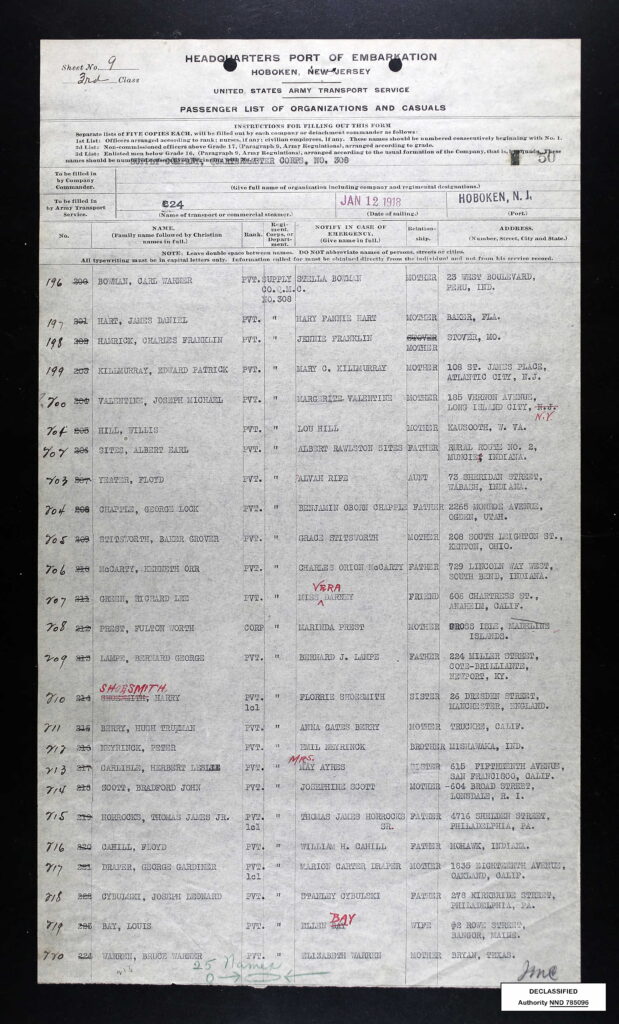
Private Richard Green left Hoboken, New Jersey, on January 12, 1918, as a member of Supply Company, Quartermaster Corps, No. 308.
Another troop transport ship, SS Tuscania, left Hoboken later that same month. The ship’s passengers included the 6th Battalion, 20th Engineers, many of whom were San Francisco residents. The Tuscania was sunk by German submarine UB-77 en route to Liverpool, United Kingdom, on February 5, 1918. Over 200 men lost their lives in the attack. The fate of the Tuscania illustrates one of the dangers U.S. soldiers faced crossing the Atlantic.
Quartermaster Corps
The U.S. Army’s Quartermaster Corps was trained and mobilized in Jacksonville, Florida, at Camp Joseph E. Johnston. When World War I began, the Quartermaster Corps consisted of 227 officers and 6,000 enlisted personnel. By the war’s end, the Corps numbered 13,500 officers, 230,000 enlisted men, and 100,000 civilians.
The functions of the Quartermaster Corps in World War I included supplying soldiers with food, clothing, and personal and housekeeping supplies. The Quartermaster Corps was involved in laundry, salvage, bathing, disinfection, and the identification and care of the dead. Soldiers’ pay also fell under the responsibilities of the Quartermaster. Even sheet music and musical instruments were procured by the Quartermasters.
By the end of World War I, American troops in France were eating about 9,000,000 pounds of food every day. England and France were already rationing their civilian populations and could not do much to supply the American Expeditionary Forces with food. American forces were required to purchase practically all food in America and transport it across the Atlantic Ocean to Europe.
St. Mihiel Salient
Green was stationed near the St. Mihiel salient when he reached France in 1918. A salient is a bulge in the front line, with enemy forces on three sides.
The American Expeditionary Forces’s push to reduce the St. Mihiel salient took place from September 12 – 16, 1918. Fourteen American and four French divisions were assigned to this effort.
Allied forces involved in the offensive numbered more than 650,000. In support of the attack, the First Army had over 3,000 guns, 400 French tanks, and 1,500 airplanes. Colonel William Mitchell directed the air force, composed of British, French, Italian, Portuguese, and American units, in what proved to be the largest single air operation of the war.
This first major operation undertaken by the U.S. Army under its own command took 16,000 prisoners at a cost of 7,000 casualties and was considered a major success.
As a member of the Quartermaster Corps, Private Green’s support of this offensive would have been invaluable.
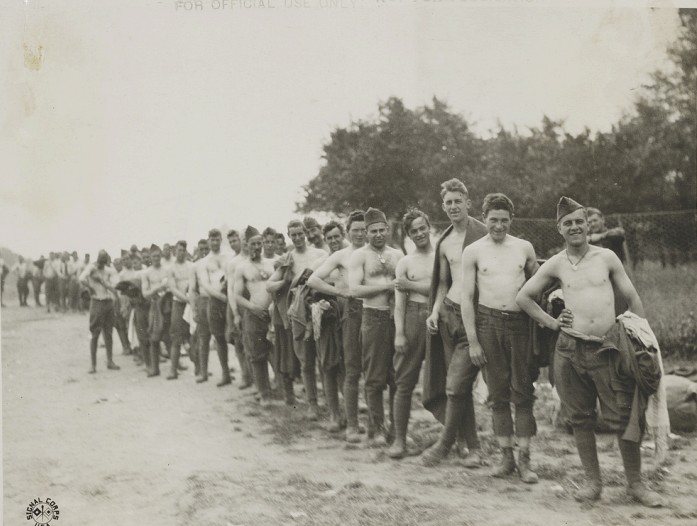
Army records indicate Private Green served within the Justice Hospital Group, a division that operated medical camps in the field. As a member of the Quartermaster Corps, Private Green’s support of the St. Mihiel offensive would have been invaluable.


Commemoration
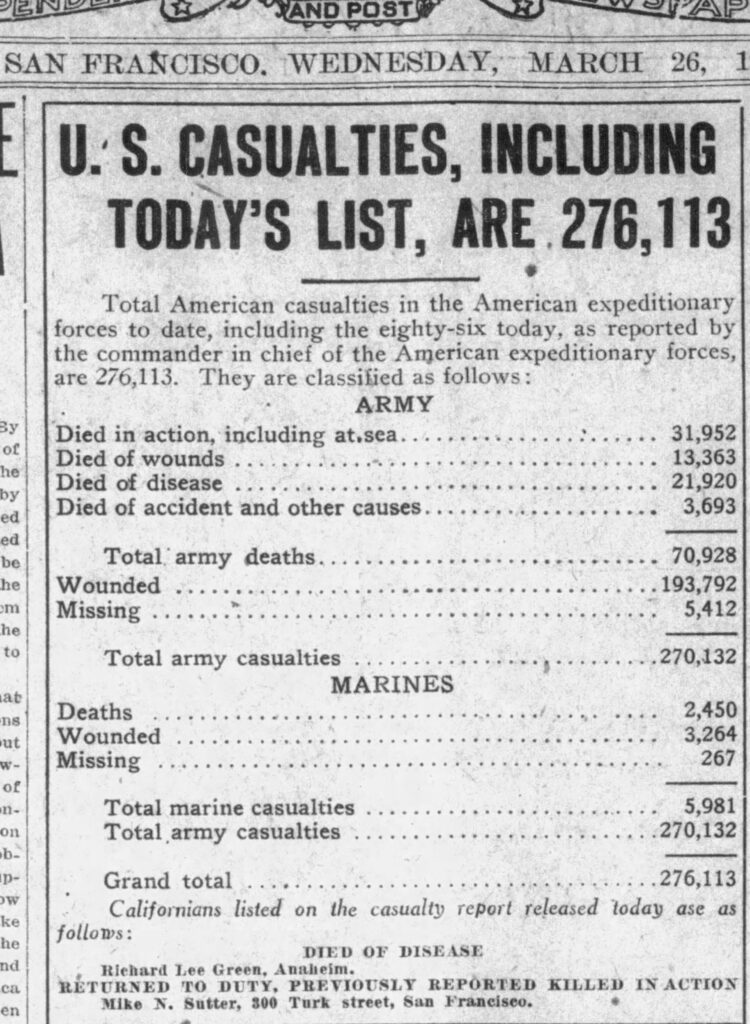
Private Richard Lee Green died on February 11, 1919, due to bronchial pneumonia. Private Green’s initial burial took place on February 14, 1919.
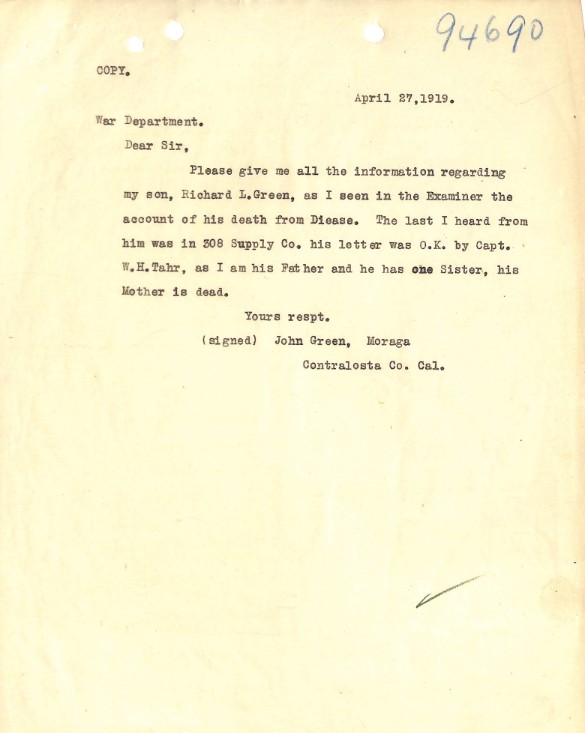
The War Department attempted to notify Private Green’s next of kin, Mrs. Vera Darney (his sister), of his death on March 18, 1919; however, she was in Hawaii at the time. Private Green’s father, John, read of his son’s death in a San Francisco newspaper. Mr. Green then wrote to the War Department requesting additional information about Private Green’s death.
On August 5, 1922, Private Green’s remains were permanently interred in St. Mihiel American Cemetery in Thiaucourt, France.
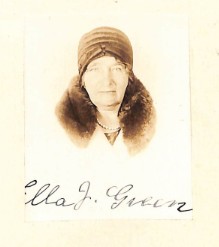
Mrs. Ella Green’s name was noted as Richard Green’s mother on his reburial card. Richard Green’s father, John, had remarried between the 1910 census and 1922. The card listed John and Ella Green as living in Contra Costa County, California.
The Gold Star Mother pilgrimage was a government program that paid for the travel expenses of mothers and widows whose husbands and sons had died overseas as members of the American Expeditionary Forces during World War I. On June 4, 1930, a widowed Ella Green set sail from America to pay her respects to her stepson and honor his sacrifice in the Great War.

Bibliography
Primary Sources
American Express Money Order. Photograph. c.1918-1919. Library of Congress (2014710042). https://www.loc.gov/item/2014710042/.
California. Contra Costa County. 1920 U.S. Federal Census. Digital Images. https://ancestryclassroom.com.
California. Contra Costa County. 1930 U.S. Federal Census. Digital Images. https://ancestryclassroom.com.
California. San Francisco County. 1910 U.S. Federal Census. Digital Images. https://ancestryclassroom.com.
“Call Appeals to All Patriots to Make Smashing Start on War Gardens.” The San Francisco Call Bulletin [San Francisco, California], March 15, 1918. Newspapers.com (1228573860).
De-cootieized and happy These men of B Battery, 102nd F.A., have had their baths, their cresol solution, their fresh underclothing, new or disinfected O.D. clothing, their “cooties” are gone and they are going “home” as merry as small boys from a school picnic. Photograph. August 10, 1918. Library of Congress (2013649050). https://www.loc.gov/item/2013649050/.
“Fate of S.F. Boys Made Known to Anxious Parents.” San Francisco Chronicle [San Francisco, California], February 9, 1918. Newspapers.com (1235147426).
“Federal Authorities Request Conservation of Food this Week.” Truckee Republican [Truckee, California], November 1, 1917.
Female employees of the Southern Pacific Railroad Sacramento Shops. Photograph. July 4, 1918. California State Railroad Museum Library. https://www.sacramentohistory.org/search.php?imageid=62#google_vignette.
Ferry Building. Photograph. c.1910 Open SF History (wnp37.01971). https://opensfhistory.org/Display/wnp37.01971.jpg.

Fire at Van Ness & Eddy. Photograph. April 17, 1910. Open SF History (wnp15.1175). https://opensfhistory.org/Display/wnp15.1175.jpg.

A group of young members of the National Woman’s Party before the Capitol. They are about to invade the offices of the senators and congressmen from their states, to ask them to vote for Equal Rights. In the foreground is Miss Anita Pollitzer, secretary of the National Woman’s Party, instr. Photograph. 1923. Library of Congress. https://www.loc.gov/item/mnwp000193/ .
Halpern, Carl. Camp Joseph E. Johnston, Florida, March 4th, 1918. Photograph. March 4, 1918. Library of Congress (2007664485). https://www.loc.gov/item/2007664485/.
Hopps, Harry R. Destroy This Mad Brute, Enlist—U.S. Army. Propaganda poster. C.1918. Library of Congress (2010652057). https://www.loc.gov/item/2010652057/.
Men from front lined up to turn in their clothing for replacement and disinfection at disinfecting plant no. 2, of the 26th Division. The men shown here are of Battery F. 102d F.A. Photograph. August 10, 1918. Library of Congress (2013648399). https://www.loc.gov/item/2013648399/.
Miss Maude Younger of California, Chairman Legislative Committee National Woman’s Party. Photograph. c.1919-1920. Library of Congress. https://www.loc.gov/item/mnwp000067/ .
New York. Dutchess County. 1870 U.S. Federal Census. Digital images. https://ancestryclassroom.com.
Nokolaki, Z. P. Hello! This is liberty speaking – billions of dollars are needed and needed now. Poster. 1918. Library of Congress (93502270). https://www.loc.gov/item/93502270.
The open air kitchen used by German prisoners while a new mess hall and kitchen is being erected Camp Miramas, near Marseilles, France / / Signal Corps U.S.A. Photograph. August 19, 1918. Library of Congress (2014647458). https://www.loc.gov/item/2014647458/.
“Organizing Forces for Liberty Drive.” Stockton Independent [Stockton, California], February 22, 1918.
Packing shipment of Matzoths i.e. matzos for the 77th Division . . . Photograph. April 9, 1919. Library of Congress (00652973). https://www.loc.gov/item/00652973/.
Photo shows general view of the Preparedness Day parade at San Francisco in 1916 . . . Photograph. July 22, 1916. Library of Congress (2016651585). https://www.loc.gov/item/2016651585/.
Q.M. warehouses destroyed in Paris air raid – Saint-Denis. Photograph. September 19, 1918. Library of Congress (2008676706). https://www.loc.gov/item/2008676706/.
Richard L. Green. Card Register of Burials of Deceased American Soldiers. National Archives and Records Administration (NAID: 109036010). https://catalog.archives.gov/id/109036010?objectPage=1065.
Richard Lee Green. World War I Burial Case File, Department of the Army. National Archives and Records Administration – St. Louis.
Richard Lee Green. World War I Draft Registration Cards, 1917-1918. Digital Images. https://ancestryclassroom.com.
“Run it up!” Only a few days remain in which your shop can win the honor of the honor flag. . . Poster. c1918-1919. Hoover Institution Library & Archives (XX343.23743). https://digitalcollections.hoover.org/objects/33367/run-it-up–only-a-few-days-remain-in-which-your-shop-can.
Sanborn Fire Insurance Map from San Francisco, San Francisco County, California. Maps. 1914. Library of Congress. https://www.loc.gov/resource/g4364sm.g4364sm_g00813191406/?st=gallery.
“San Francisco Must Sell Liberty Bond Subscriptions by 12,000,000 in Four Days.” The San Francisco Chronicle [San Francisco, California], January 12, 1917. Newspapers.com (1235169970).
“S.F. Trade with China is Topic of Addresses.” The San Francisco Call Bulletin [San Francisco, California], May 8, 1915. Newspapers.com (1228683958).
Sheeres, John W. Keep the stars shining for Uncle Sam – Join the Quartermaster Corps. Poster. 1919. Library of Congress (2002722553). https://www.loc.gov/item/2002722553/.
Spiker, W. G. Officers of the Quartermaster Corps Training & Mobilization Camp at Camp Joseph E. Johnston, Jacksonville, Florida, Colonel Frederick L. Munson, Quartermaster Corps, commanding, March 5, 1918. Photograph. March 5, 1918. Library of Congress (2007664457). https://www.loc.gov/item/2007664457/.
St. Mary’s Cathedral. Photograph. c.1910. Open SF History (wnp27.7812). https://opensfhistory.org/Display/wnp27.7812.jpg.

Supply Department Yeomanettes posed in front of their barracks. US Navy Yard, Mare Island, CA. Photograph. 1918, National Archives and Records Administration (NAID: 296899). https://catalog.archives.gov/id/296899.
Tobacco for the boys. Q.M. tobacco warehouse depot no. 1, base section no. 1, Montoir. Photograph. June 24, 1918. Library of Congress (94502438). https://www.loc.gov/item/94502438/.
“US Ambassador Dines Jap Admiral Departing for S.F.” The San Francisco Call Bulletin [San Francisco, California], January 11, 1915. Newspapers.com (1228712229).
“U.S. Casualties, Including Today’s List, Are 276,113.” The San Francisco Call Bulletin [San Francisco, California], March 26, 1919. Newspapers.com (1228587577).
Van Ness Near Eddy. c.1910. Open SF History (wnp37.02776). https://opensfhistory.org/Display/wnp37.02776.jpg

“Washington Hopeful Only Few Died on S.S. Tuscania.” San Francisco Chronicle [San Francisco, California], February 7, 1918. Newspapers.com (1235146067).
“Wilson to Draft Army of Half-Million Men” The San Francisco Examiner [San Francisco, California], April 7, 1917. Newspapers.com (457385458).
“Women Enlist for a Month of Farm Work.” The San Francisco Examiner [San Francisco, California], May 14, 1918. Newspapers.com (457868097).
Woman’s Land Army of Calif. Photograph. c.1915-1920. Library of Congress (2014707161). https://www.loc.gov/item/2014707161/ .
Your work means victory. Build another one. Poster. c.1917-1918. Hoover Institution Library & Archives (XX343.27523). https://digitalcollections.hoover.org/objects/37147/your-work-means-victory–build-another-one-.
YWCA Hostess House, Camp Fremont. Photograph. 1918. California State University, San Luis Obispo. https://calisphere.org/item/257d66984d3796ed9d42ede38d169b1d/.
Secondary Sources
Beyerly, Carol. Fever of War: The Influenza Epidemic in the U.S. Army During World War I. New York University Press, 2005.
“California Goes to War: World War I and the Golden State.” The California State Archives. Accessed October 25, 2025. https://artsandculture.google.com/story/california-goes-to-war-california-state-archives/agXRW5Q6KBX4IA?hl=en.
“California in WWI.” The United States World War One Centennial Commission. Accessed October 25, 2025. https://www.worldwar1centennial.org/index.php/california-in-ww1-welcome.html.
DeWilde, Amanda G., and James C. Scott. World War I and the Sacramento Valley: Special Collections of the Sacramento Public Library. Arcadia Publishing Inc., 2016.
Hamon, Caitlin. “SS Tuscania sinking by U-boat in 1918 kills 200 Americans.”The United States World War I Centennial Commission. Accessed January 4, 2026. https://www.worldwar1centennial.org/index.php/communicate/press-media/wwi-centennial-news/3988-ss-tuscania-sinking-by-u-boat-in-1918-kills-200-americans.html.
Issel, William, and Robert W. Cherny. San Francisco, 1865-1932: Politics, Power, and Urban Development. University of California Press, 1986.
Potter, Constance. “World War I Gold Star Mothers Pilgrimages, Part I.” Prologue, Summer 1999. https://www.archives.gov/publications/prologue/1999/summer/gold-star-mothers-1.html.
“Pvt. Richard Lee Green.” Find a Grave. Updated August 7, 2010. Accessed October 23, 2025. https://www.findagrave.com/memorial/56340070/richard-lee-green.
“Quartermaster Corps: Show Me the Bacon!” The National WWI Museum. Accessed December 22, 2025. https://www.theworldwar.org/learn/about-wwi/spotlight-quartermaster-corps-show-me-bacon.
“Quartermaster History Timeline 1775 to Present.” U.S. Army Quartermaster Museum. Accessed January 3, 2026. https://qmmuseum.army.mil/research/history-heritage/general-history/Quartermaster-History-Timeline-1775-to-Present.html.
“Quartermaster Supply in the AEF, 1917-1918.” Army Quartermaster Foundation. Accessed December 22, 2025. https://quartermasterfoundation.org/quartermaster-supply-in-the-aef-1917-1918/.
“Richard L. Green.” American Battle Monuments Commission. Accessed October 27, 2025. https://weremember.abmc.gov/s?q=*&criteria=title%3DGreen~first_name%3DRichard~middle_name%3DL.~entry_state%3DCalifornia~branch%3DU.S.%20Army~war%3DWWI~unit%3DQuartermaster%20Corps&type=16&v=G.
“Richard L. Green.” Veterans Legacy Memorial, National Cemetery Administration. Accessed February 25, 2026. https://www.vlm.cem.va.gov/RichardLGreen/D14B.
Sharpe, Henry G. The Quartermaster Corps in the Year 1917 in the World War. The Century Co., 1921. Library of Congress (21015121). https://www.loc.gov/item/21015121/.
Stewart, Richard W., Editor. American Military History Volume II: The United States Army in a Global Era, 1917-2008. U.S. Army Center of Military History, 2010. https://history.army.mil/Publications/Publications-Catalog-Sub/Publications-By-Title/American-Military-History-Volume-II-The-United-States-Army-In-A-Global-Era-1917-2008/.
The Tenderloin Museum. Accessed October 30, 2025. https://www.tenderloinmuseum.org/.
Weiss, Elaine F. “Before Rosie the Riveter, Framerettes Went to Work: During WWI, the Woman’s Land Army of America Mobilized Women into Sustaining American Farms and Building National Pride.” Smithsonian Magazine, May 28, 2009. https://www.smithsonianmag.com/history/before-rosie-the-riveter-farmerettes-went-to-work-141638628/.
Wilcox, B. World War I Army Training by San Francisco Bay: The Story of Camp Fremont. Arcadia Publishing, 2016.
“Women Inspire.” California Women Changing Our World, Part 1: Drive for Equality. Accessed December 4, 2025. https://artsandculture.google.com/story/women-inspire-california-women-changing-our-world-part-1-drive-for-equality-california-museum/PgVRCn5ZZvyHJg?hl=en.
“World War I Campaigns.” U.S. Center of Military History. Accessed December 30, 2025. https://history.army.mil/Research/Reference-Topics/Army-Campaigns/Brief-Summaries/World-War-I/#stmihiel.
“World War I: Two Soldiers Write Home.” La Peninsula: The Journal of the San Mateo County Historical Society. Volume XIV, Issue No. 2, (winter 2017).
This profile was researched and created through the Researching Silent Heroes program, sponsored by the American Battle Monuments Commission.