

First Lieutenant Robert Daniel Gaskill
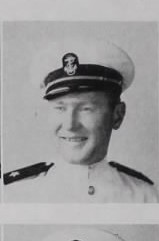
- Unit: 4th Marine Air Wing
- Date of Birth: January 22, 1918
- Entered the Military: January 7, 1942
- Date of Death: June 19, 2013
- Hometown: Des Moines, Iowa
- Place of Death: Ames, Iowa
- Cemetery: Wall 2, D38. Iowa Veterans Cemetery, Adel, Iowa
Mentored by Ms. Cheryl Smith
Johnston High School
2025/2026
Early Life
Robert Daniel Gaskill was born on January 22, 1918, in Indianola. He was the son of Bessie and Bennett Mitchell Gaskill, both of whom worked as musicians for the Ringling Brothers Circus. His father played the cornet and trumpet, but personally discouraged Robert from pursuing music. Robert Gaskill had one brother, Howard. He grew up in Iowa, where his early environment included exposure to music through his parents and a structured, disciplined household.
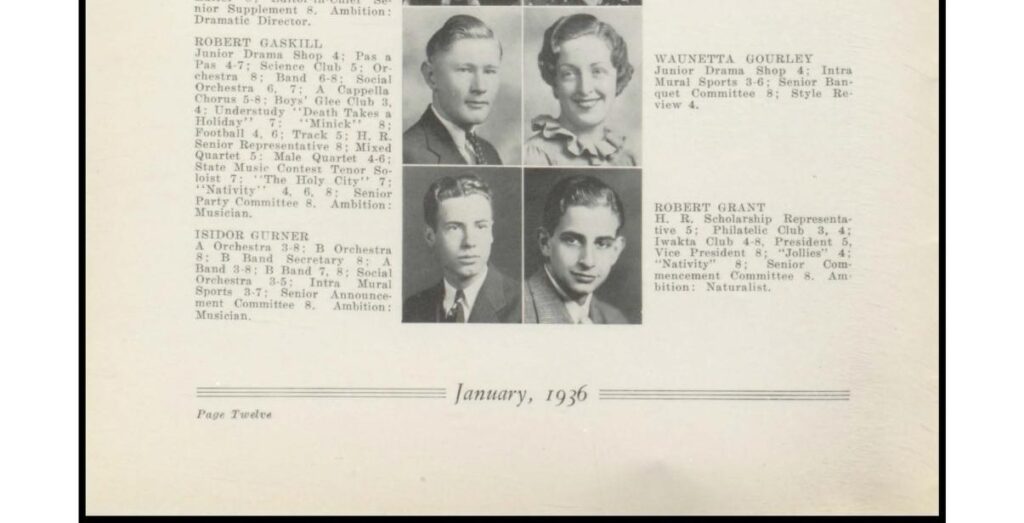
Robert Gaskill attended North High School in Des Moines, where he participated in band, orchestra, and drama activities. During his time there, he also composed music, including a quartet piece for a school production. After graduating in January 1936, he enrolled at the University of Iowa and completed a degree in music in 1939. By the end of his education, he had experience performing multiple instruments and singing, with a specialty in the French horn.
Gaskill’s teaching career spanned multiple grade levels and subjects. His first teaching position began in 1940 in the Atkins School District, west of Cedar Rapids, where he taught Band and Speech at the high school level and seventh- and eighth-grade science and history. As a non-expert in science and history, he stayed one page ahead of the class. The next year, Gaskill moved on to teach Band and Speech at Mechanicsville, Iowa, a town about 34 miles away, and provided private lessons to band students. Under his direction, the band won second place at the State Band competition.

Homefront
Robert Daniel Gaskill grew up in Des Moines, Iowa’s state capital. During the years leading up to and during World War II, the city and surrounding areas became increasingly involved in wartime production and support. Iowans contributed to manufacturing efforts at locations such as the Army Ordnance Plant in Ankeny, which produced .30- and .50-caliber ammunition, and Solar Aircraft in Des Moines.
Also in Iowa, about 40 miles from Des Moines, the Ames Project at Iowa State University played a major role in producing uranium for the Manhattan Project, supplying over two million pounds before industrial production expanded in 1945. During this time, agriculture remained essential, as Iowa farmers supported the “Food for Freedom” campaign by producing large quantities of crops and livestock for both U.S. forces and Allied nations.
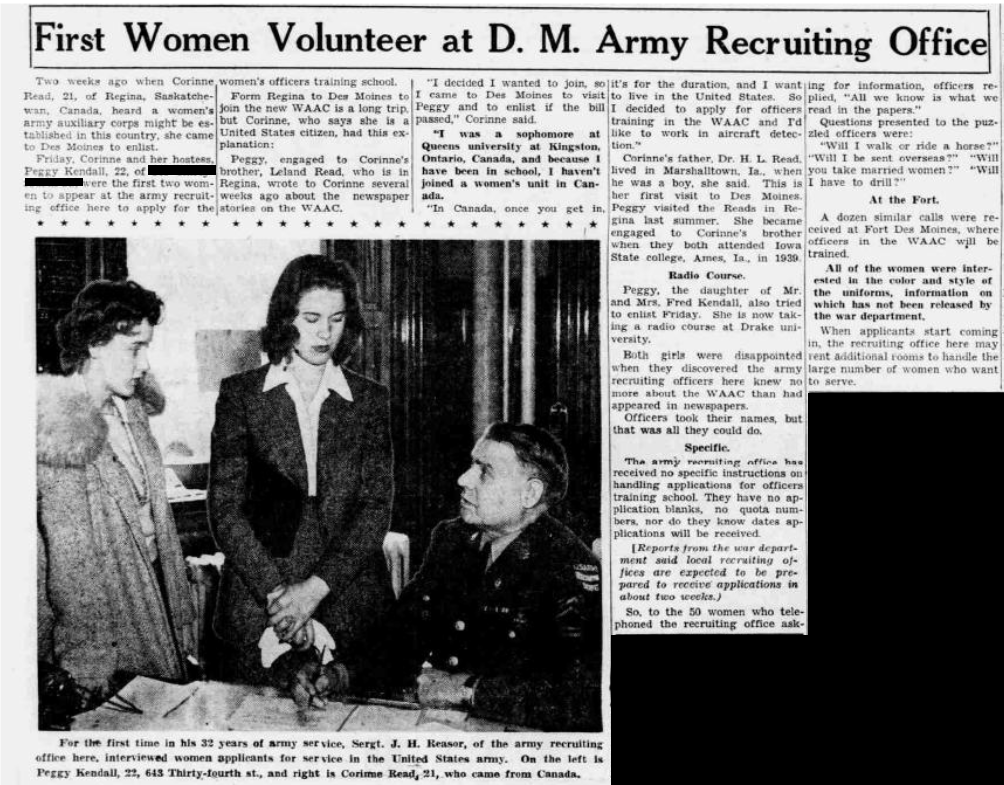
Daily life on the home front involved widespread civilian participation in the war effort. Youth organizations such as 4-H encouraged children to grow and preserve food, while others collected scrap materials and milkweed floss for the production of war materials and jacket stuffing, respectively. Families displayed service flags in their homes to represent relatives serving in the armed forces. Social changes also occurred, particularly with the establishment of the Women’s Army Auxiliary Corps training center at Fort Des Moines, where hundreds of women trained for non-combat roles beginning in 1942.
A local Des Moines business, Younkers Department Store, served as a tool for civilians to support war efforts. In April 1942, Liberty Hall was created as a space in the store to serve as a clearinghouse for information on the World War II program and civilian defense. Various civic organizations met there to coordinate support for civilian war efforts.
Younkers’s management, while generating patriotic enthusiasm, was able to project an image of sacrifice and civic engagement while simultaneously creatively planning for the postwar years. Not only did Younkers adapt to the rationing and price controls commonly associated with American businesses during the war, but the store also engaged in the kinds of promotion and activities retailers sponsored as pillars of their local communities.


Military Experience
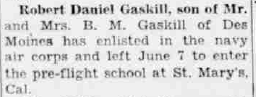
Robert Daniel Gaskill enlisted in the United States Marine Corps on June 7, 1942, in Atkins, Iowa, after previously applying to the U.S. Army Air Forces and being denied due to sinus issues. He was accepted into the Marine Corps aviation program after completing a three-day evaluation, in part because he held a college degree. On the same day he enlisted, he was sent to begin pre-flight training. His initial training took place at St. Mary’s College in Oakland, California.
Following pre-flight training, Gaskill attended flight school in Livermore, California, from September through December 1942. He began flight training and completed his first solo flight after about ten hours of instruction. After completing this phase, he was transferred to Naval Air Station Corpus Christi, where he was stationed from June 7, 1942, through December 31, 1942, as part of the Naval Aviation Cadet Units under the Fourth Marine Air Wing. During his service, he held the rank of second lieutenant and served as a station officer, working primarily as a pilot responsible for transporting personnel and cargo.
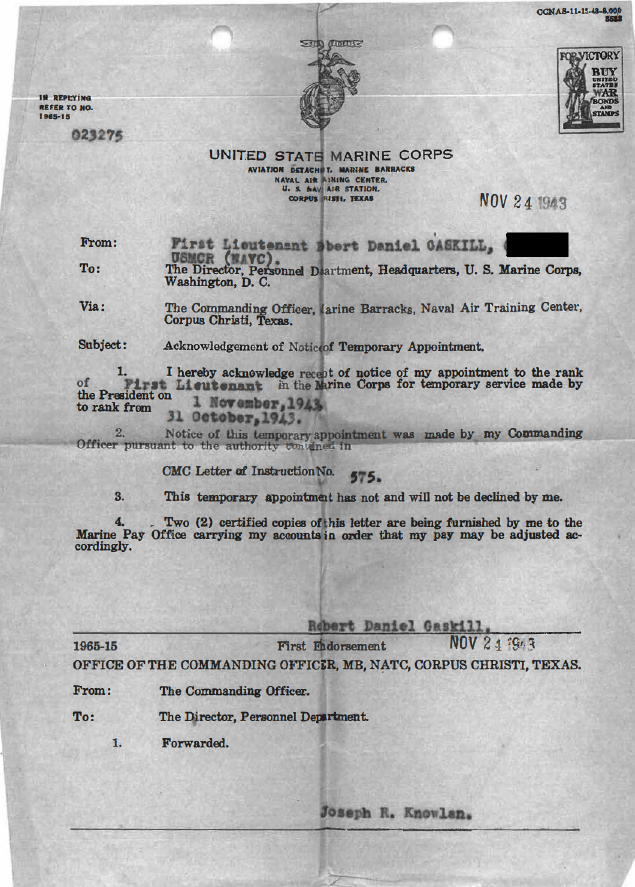
In the summer of 1943, Gaskill attended a social, wearing a nametag that said “Iowa.” Mary Elizabeth Head, who was working in Corpus Christi with the Campfire Girls, introduced herself to him and noted that she had previously lived in Ottumwa, Iowa. They began dating every night for three months and married on October 5, 1943. On November 24, 1943, he was promoted to first lieutenant.
In January 1945, Lieutenant Gaskill was transferred from Corpus Christi and later mustered in California before beginning overseas service in the Pacific. On April 25, 1945, he recorded his first flight outside the United States, flying an R4D-5 aircraft from Guam to Saipan. On July 4, 1945, he was involved in an emergency water landing near Guam alongside First Lieutenant Donald J. Garin, fortunately sustaining no injuries. He continued flight operations throughout July, including routes between Guam, Saipan, Iwo Jima, and Okinawa, as well as to other Pacific locations such as Ulithi, Eniwetok, Kwajalein, and Majuro. Although not assigned to direct combat, his presence in areas such as Okinawa during active operations qualified him for additional service points toward discharge.
In November 1945, Lieutenant Gaskill recorded flights at the U.S. Naval Air Station in Chicago as he transitioned out of active service. To be discharged, servicemen were required to accumulate a certain number of points; Gaskill reached 75 points, with additional credit awarded for time spent in designated combat zones. He continued flying until October 15, 1945, and was officially discharged on November 26, 1945, in Rock Island, Illinois.

Veteran Experience
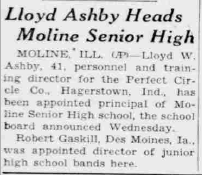
After his discharge from military service, Robert and Mary Elizabeth Gaskill returned to civilian life. Robert Gaskill resumed his career in music and education. He returned to the University of Iowa on the G.I. Bill to earn his Master’s Degree in music. In 1946, he was appointed band director of junior high school bands in Moline, Illinois.
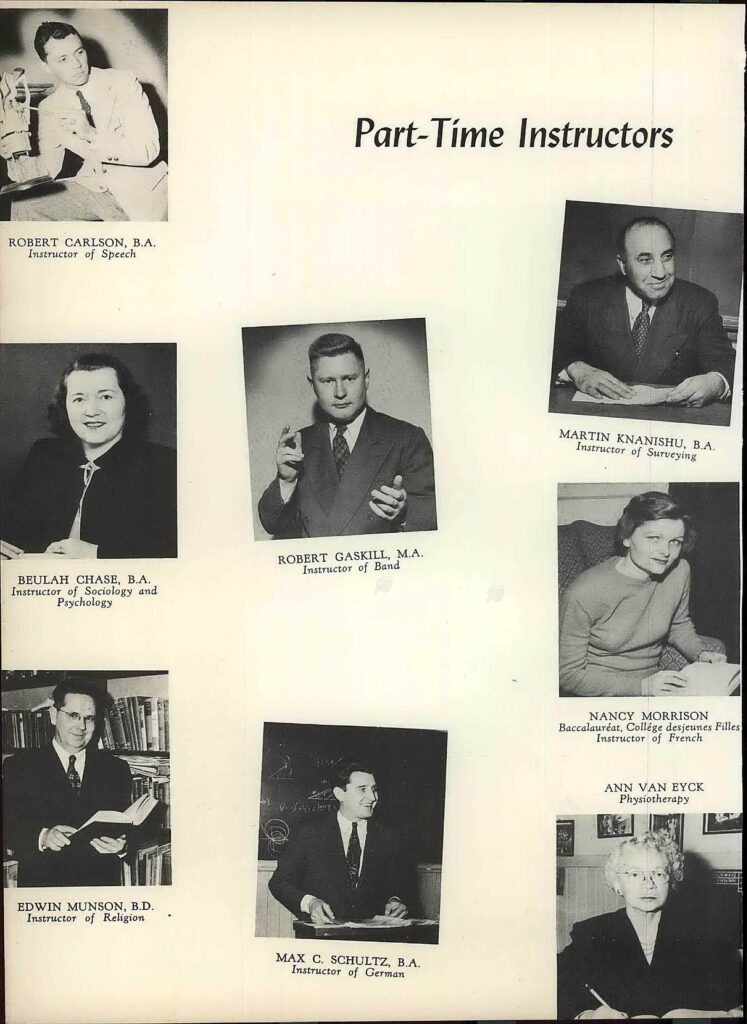
By 1950, the family moved to Rock Island, Illinois, where Gaskill began directing the band at Augustana College. Their family had expanded to include three children: Phillip, Karl, and Elizabeth “Betty”. Gaskill continued to build his career as a music educator and performer, taking on roles in both public schools and higher education. On February 26, 1954, he was appointed assistant professor of music and band director at the University of Omaha.
In addition to teaching, he performed professionally; on January 21, 1955, he was noted as playing French horn in the Omaha Symphony Orchestra under Dr. James Peterson. On March 6, 1957, he directed a large concert involving 213 junior and senior high school students, working alongside other music educators.
Throughout his postwar career, Gaskill worked as a musician, conductor, and teacher in the Quad Cities, Omaha, Wichita, and Des Moines. His professional work included conducting school bands and performing in orchestras, particularly as a French horn player. He and Mary Elizabeth ultimately divorced.
He later married Ada on August 12, 1967, while living in Des Moines and working for Des Moines Public Schools. The couple divorced on September 13, 1975, then remarried and divorced a second time over the next two years. Accounts from family members indicate that Gaskill had a difficult relationship with his parents, spouse, and children, yet he maintained a long career in music education and performance after his military service.


Commemoration
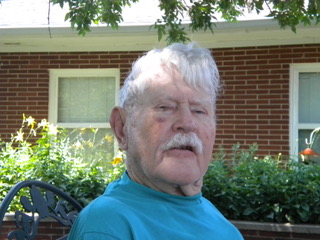
Robert Daniel Gaskill lived to 95, passing away on June 19, 2013, at Bethany Manor, the nursing home in Story City, where he had been under care for three years. He was laid to rest in the Iowa Veterans Cemetery, located in Van Meter, Iowa.

Bibliography
Primary Sources
AFSC Hostel at 2150 Grand Avenue in Des Moines. Photograph. The Iowan, spring 1990. https://www.bleedingheartland.com/2021/04/06/an-iowa-nice-story-worth-recalling/.
“First Women Volunteer at D.M. Army Recruiting Office.” Des Moines Register [Des Moines, Iowa], May 16, 1942. Newspapers.com (2098324172).
“Former Residents Are Guests of Fowlers.” Des Moines Register [Des Moines, Iowa], June 21, 1942. Newspapers.com (2098310450).
Gaskill Family Records, 1918-2011. Courtesy of Betty and Phillip Gaskill.
Gaskill, Phillip. Email interview. November 2, 2025.
Gaskill, Phillip. Interview with the author. December 13, 2025.
Gaskill, Phillip. Telephone interview with the author. December 22, 2025.
The Hawkeye. Iowa City: University of Iowa Yearbooks. 1939.
Huge Map Shows Progress of War. Photograph. Des Moines Register [Des Moines, IA], April 8, 1942. Newspapers.com (2098325734).
Illinois. Rock Island County. 1950 U.S. Census. Digital Images. http://ancestryclassroom.com.
Iowa. Cerro Gordo County. 1920 U.S. Census. Digital Images. http://ancestryclassroom.com.
Iowa. Polk County. 1930 U.S. Census. Digital Images. http://ancestryclassroom.com.
Iowa. Polk County. 1940 U.S. Census. Digital Images. http://ancestryclassroom.com.
“Lieut. And Mrs. Robert D. Gaskill . . . ” Des Moines Register [Des Moines, Iowa], September 22, 1944. Newspapers.com (2098297349).
Lindbergh, Charles A. “The Text of Lindbergh’s Address in Des Moines Coliseum.” Des Moines Tribune [Des Moines, Iowa], September 12, 1941. https://newspapers.ushmm.org/historical-article/1941-the-text-of-lindberghs-address-in-des-moines-coliseum-35757.
“Lloyd Ashby Heads Moline Senior High.” Des Moines Register [Des Moines, Iowa], August 15, 1946. Newspapers.com (2103109070).
“OU Instructors in Symphony.” The Gateway [Omaha, Nebraska], January 21, 1955. Newspapers.com (866969939).
“Present Play for Kiwanis.” Iowa City Press-Citizen [Iowa City, Iowa]. February 13, 1940. Newspapers.com (363708472).
“Regents List Faculty Jobs.” The Gateway [Omaha, Nebraska], February 26, 1954. Newspapers.com (866978504).
“Robert D. Gaskill has enlisted . . . ” Des Moines Register [Des Moines, Iowa], June 21, 1942. Newspapers.com (2098310450).
Robert Daniel Gaskill Flight Log. 1918-2011. Courtesy of Phillip Gaskill.
Robert Daniel Gaskill Personal Records. 1918-2011. Courtesy of Phillip Gaskill.
Robert Daniel Gaskill. Separation documents, Department of the Navy. National Archives and Records Administration – St. Louis.
Robert Daniel Gaskill. Texas, U.S., Select County Marriage Records, 1837-1965. Digital Images. https://ancestryclassroom.com.
Robert Daniel Gaskill. U.S. Navy Cruise Books. 1943. Digital Images. https://ancestryclassroom.com.
Robert Daniel Gaskill. U.S., School Yearbooks, 1900-2016. Digital Images. https://ancestryclassroom.com.
Robert Daniel Gaskill. World War II Bonus Case File, 1947–1954. Digital Images. https://ancestryclassroom.com.
Robert Daniel Gaskill. World War II Draft Cards Young Men, 1940-1947. Digital Images. https://ancestryclassroom.com.
Robert Daniel Gaskill. World War II Navy Muster Rolls, 1938-1949. Digital Images. https://ancestryclassroom.com.
Robert Gaskill. Des Moines City Directory. Digital Images. https://www.ancestryclassroom.com/.
“Sophomore Brings Mascot to Life for Ma-ie Parade.” The Gateway [Omaha, Nebraska], May 11, 1956. Newspapers.com (866982855).
“Youth Symphonies Plan Public Concert Sunday.” Evening Eagle [Wichita, Kansas], March 6, 1957. Newspapers.com (720871501).
Secondary Sources
“Douglas R4D-5 ‘Skytrain.’” United States Coast Guard. Last modified June 3, 2022. Accessed January 4, 2026. https://www.history.uscg.mil/Browse-by-Topic/Assets/Air/All/Article/3051586/douglas-r4d-5-skytrain/.
“Fort Des Moines: A Series of Firsts in Wartime Service.” National Park Service. Last modified March 19, 2025. Accessed November 14, 2015. https://www.nps.gov/articles/000/fort-des-moines-a-series-of-firsts-in-wartime-service.htm.
“Heartland Cool: Teenage Boys in Iowa, 1945.” LIFE. Accessed November 17, 2025. https://www.life.com/history/heartland-cool-teenage-boys-in-iowa-1945/.
“In the Barn: Des Moines Ordnance Plant.” Ankeny Area Historical Society. Accessed November 8, 2025. https://www.ankenyhistorical.org/old-current-exhibits.
Lindaman, Matthew. “First the War, Then the Future: Younkers Department Store and the Projection of a Civic Image during World War II”. The Annals of Iowa 73(1), (2014): 1-27. https://doi.org/10.17077/0003-4827.12033.
“Manhattan Project Roots.” Ames Laboratory. Accessed November 8, 2025. https://www.ameslab.gov/about-ames-laboratory/manhattan-project-roots.
“Robert Daniel Gaskill.” Grandon Funeral and Cremation Care. Accessed October 30, 2025. https://www.grandonfuneralandcremationcare.com/obituary/116596/Robert-Daniel-Gaskill/.
“Robert Daniel Gaskill.” Nationwide Gravesite Locator, National Cemetery Administration. Accessed October 30, 2025. https://gravelocator.cem.va.gov/ngl/index.jsp.
Strentz, Herb. “An ‘Iowa Nice’ Story Worth Recalling.” Bleeding Heartland, July 31, 2025. Accessed November 3, 2025. https://www.bleedingheartland.com/2021/04/06/an-iowa-nice-story-worth-recalling/.
“Wartime 4-H Support – World War II.” National 4-H History Preservation Team. Accessed November 8, 2025, https://4-hhistorypreservation.com/History/WW-II_Support/.
“World War II: Iowans on the Home Front.” Iowa PBS. Accessed November 8, 2025. https://www.iowapbs.org/iowapathways/mypath/2614/world-war-ii-iowans-home-front.
“World War II Rationing on the Homefront.” Ames History Museum. Accessed November 16, 2025. https://ameshistory.org/content/world-war-ii-rationing-us-homefront.
This profile was funded by a grant from the United States Department of Veterans Affairs. The opinions, findings, and conclusions stated herein are those of the author and do not necessarily reflect those of the United States Department of Veterans Affairs.