

Corporal Ross Dimas
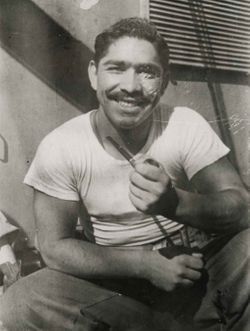
- Unit: 5th Marine Division, 27th Marines, Company B
- Date of Birth: November 25, 1925
- Entered the Military: October 14, 1943
- Date of Death: October 26, 2010
- Hometown: Albuquerque, New Mexico
- Place of Death: Albuquerque, New Mexico
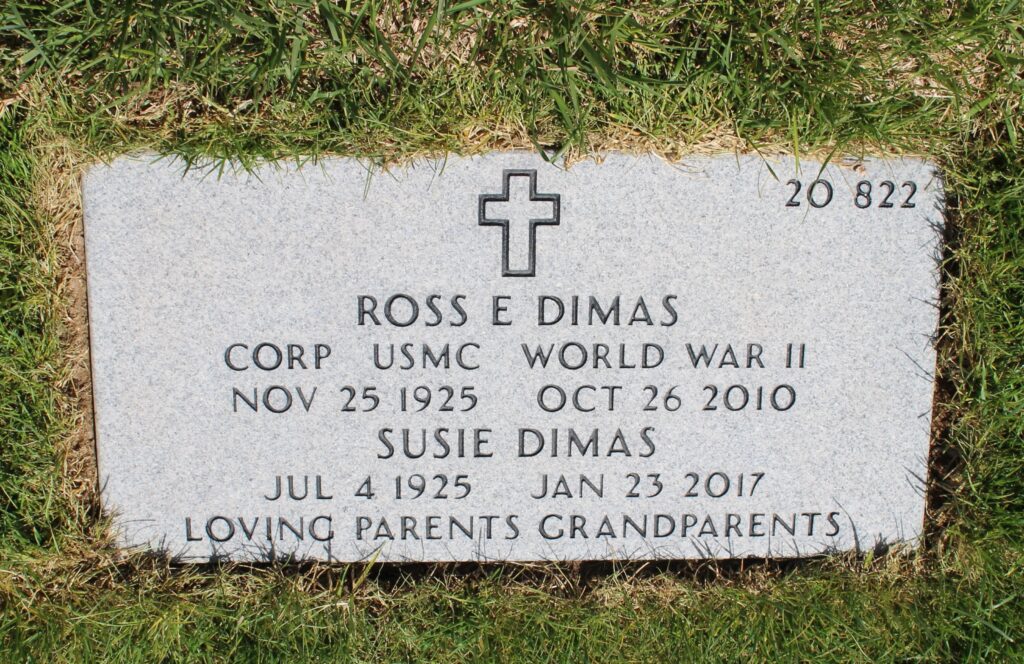
- Cemetery: Section 20, Grave 822. Sante Fe National Cemetery, Sante Fe, New Mexico
2025/2026
Early Life
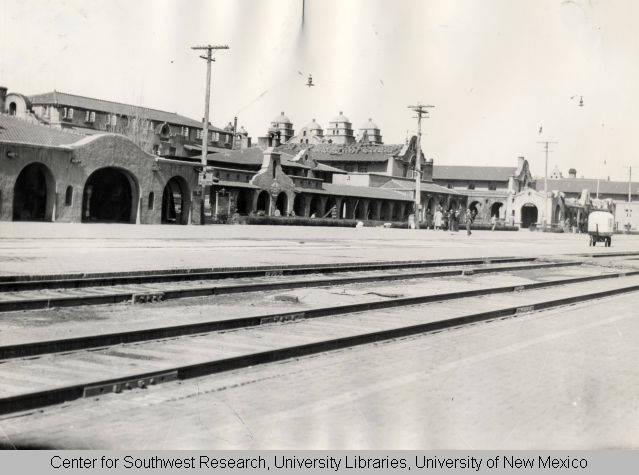
Ross Dimas was born on November 25, 1925, in Albuquerque, New Mexico, to Ben and Anita Dimas. The couple married in 1920, and before they had children, Anita did laundry at the Alvarado Hotel, while Ben worked as a carpenter. Together, they had twelve children, three of whom died during infancy. Ross was their third child. During Ross’ childhood, Ben became a master carpenter at the Sash and Door Company, and Anita was a homemaker. Ben used his skills as a carpenter to build the couple’s home on North 4th Street. He also built the kids’ toys, which were the envy of the neighborhood.
Even though the couple did not have a lot, they were generous to everyone. Their house was near the Atchison, Topeka & Santa Fe Railway tracks, and drifters would often come through during the Great Depression. Anita would always give them something to eat, even when they did not have much to spare.
Neither Ben nor Anita finished high school, but Ross graduated from Albuquerque High School in 1943. In high school, he participated in football, basketball, softball, boxing, wrestling, and swimming. After graduation, he took courses in chemistry, physics, and radio operation. He also worked part-time on a farm. On October 14, 1943, he enlisted in the U.S. Marine Corps.

Homefront
From 1940 to 1950, Albuquerque’s population tripled from roughly 35,000 to 96,000. This was caused by a variety of factors, including annexation, new housing projects, and the deployment of troops to new military bases in the area. During the 1940s, the city limits increased from 11 square miles to 48 square miles when the city annexed a large tract of land on East Mesa, west of the Rio Grande River.
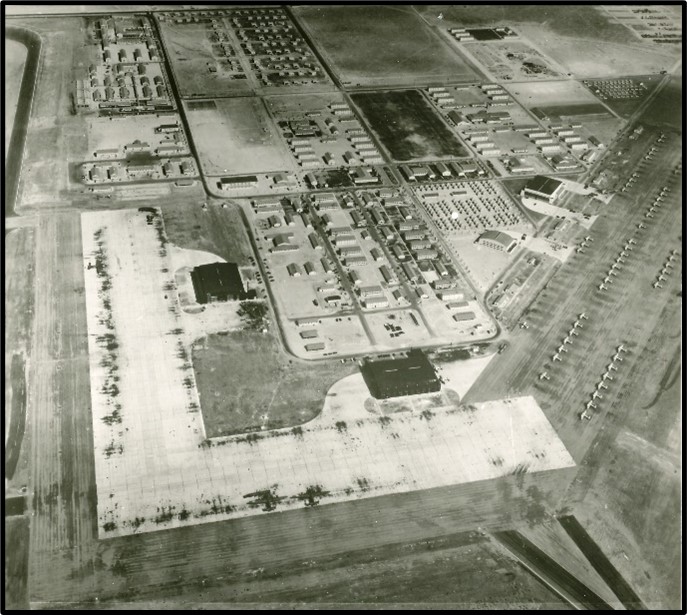
Kirtland Army Air Force Base was a primary training base for thousands of soldiers. The Sandia Base was a supplemental location for the work happening on the Manhattan Project at Los Alamos. In 1949, it became the Sandia National Laboratories when it was taken over by the University of California. Both locations were major drivers of the massive population increase.
Children’s Contributions
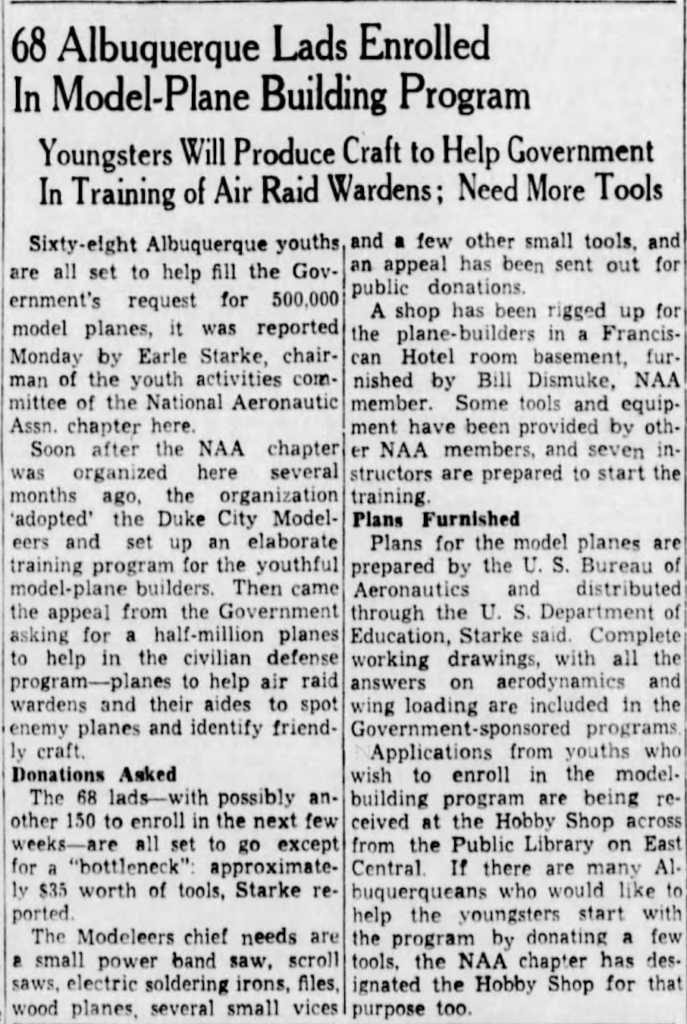
The community’s children assisted the war effort in multiple ways. First, the Boy Scouts and workers from the Works Progress Administration volunteered to grow various produce items for food demonstrations. Boys were also part of the Garden Guard, while girls participated in the Sunbonnet Girls, both groups promoting gardening efforts. The Department of Education and the U.S. Bureau of Aeronautics also sponsored a model-plane building project to supply the government with 500,000 model planes for the Civilian Defense Program (CDP). These models were designed to help CDP members learn to distinguish enemy aircraft from friendly aircraft. At least sixty-eight young men from Albuquerque were chosen to participate in the program, with the government providing plans and a local business, the Hobby Shop, providing tools.
Military Experience
Training
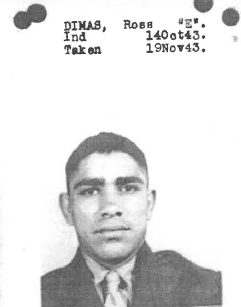
Ross Dimas enlisted in the U.S. Marine Corps in October 1943. He reported to the Infantry Battalion Training Center at Camp Elliott, San Diego, California. Dimas said in a newspaper interview that growing up poor made boot camp easy for him. He was used to walking or running everywhere, so the physical training of boot camp was “like eating Cracker Jacks.” He said he loved every minute of it. “I liked it. But when we graduated, we were men. That’s the secret, you know. Discipline is the difference between a boy and a man.”
In January 1944, he trained with the 10th Recruit Battalion as a private. He then spent 18 weeks in intelligence school with the 5th Division, after which he was assigned the military specialty of Intelligence Man. This role would have included collecting and reporting on enemy activity, building and maintaining situation maps, and coordinating and supervising scouting and reconnaissance crews.
After this training, he was promoted to corporal with the 27th Marines, 5th Marine Division, Fleet Marine Force, in the Pacific.
By the next year, Dimas was introduced to his first combat assignment—Iwo Jima. There, he spent 33 days working between 20 and 100 yards in front of the frontline Marine units working in a reconnaissance platoon that infiltrated the Japanese positions. Their job was to call in backup support. He said the hardest part was not being able to stop for his friends when they were hit. “We weren’t allowed to stop by for the wounded and dying. It’s the hardest part, remembering those boys who were wounded and we . . . we couldn’t stop to help them. They wouldn’t let us stop. The lieutenants and sergeants hollered, ‘Move!’ ‘Move!’ and we kept going forward. If the lieutenants went down, the sergeants took over, and if the sergeants went down, the buck privates took over. We kept moving forward.”
Ultimately, Dimas was one of only five of the original members of his platoon to come off of Iwo Jima alive. The worst injury he suffered while there was to his feet. After 30 days of not being able to change his socks, when he finally was able to, his skin came off with them.
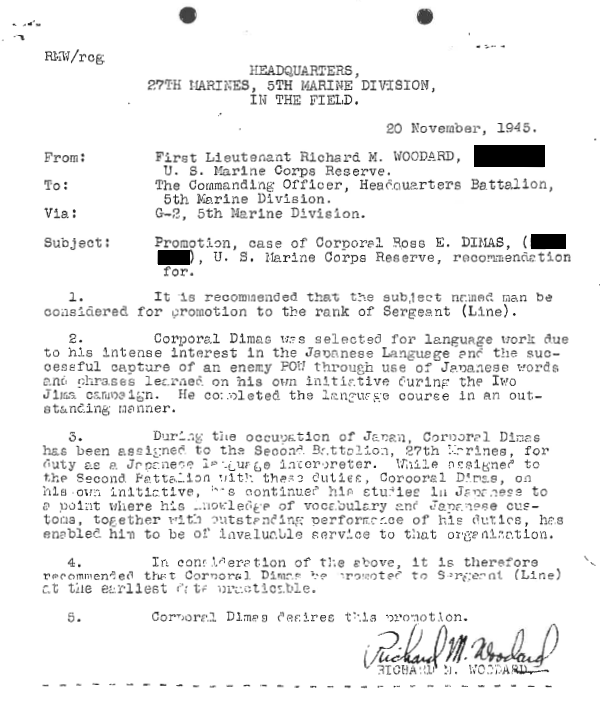
After Iwo Jima, Dimas spent 14 weeks taking Japanese language classes in Hawaiʻi. He was selected for this language work because of an intense interest in Japanese and because he successfully captured an enemy prisoner of war on Iwo Jima using Japanese words and phrases he had learned on his own.
After this training, Dimas traveled aboard the USS Ouster, which left Hawaiʻi at the end of August 1945 and arrived in Sasebo, Kyushu, Japan at the end of September. He then participated in the occupation of the Sasebo area until April 18, 1946, when he was assigned to the 2nd Battalion, 27th Marines, as a Japanese-language interpreter. During his time, Dimas continued to learn the language and customs of the Japanese people on his own, which enabled him to “be of invaluable service to” the U.S. Marine Corps. Because of his work, he was recommended for promotion to sergeant.
It is unclear why that promotion didn’t go through. Dimas was discharged on May 14, 1946, in San Diego, California.
Veteran Experience
Before Ross Dimas left for the war, he met Susie Benavidez, and the two had their first child, a daughter, Dolores, about a year later. When Dimas returned from the war, the two married on July 16, 1947, and their son, Ross, Jr., was born in December of that same year. Ross would go on to follow in his father’s footsteps, joining the Marine Corps. The couple had one more daughter, Theresa, and two more sons, Todd and Russ. Susie stayed home with the kids, while Ross became a bookkeeper for the Fire Clay Company.
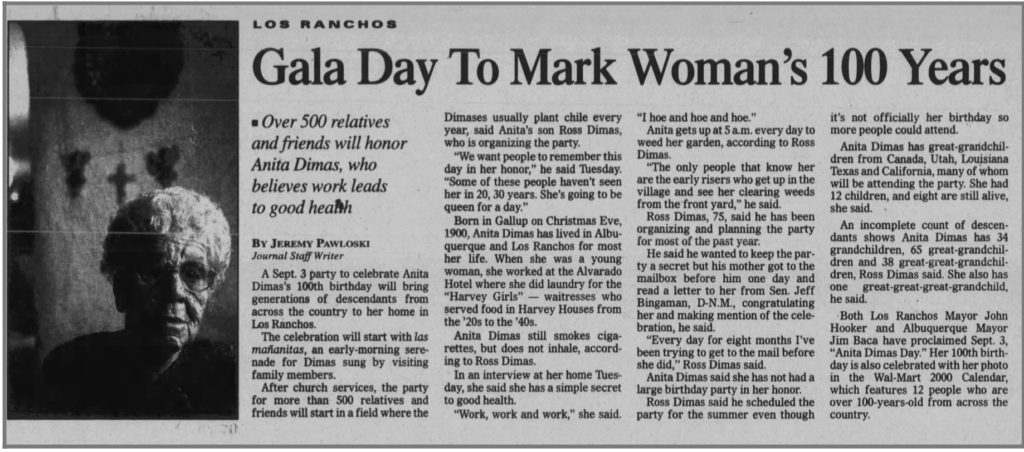
While the kids were growing up, Dimas was also on the board of the Traffic Club in Albuquerque and ran unsuccessfully for city council in 1965. Once the children were out of the house, Dimas devoted his life to caring for his mother, Anita, who lived to 108! Because of his and his siblings’ help, she was able to stay in the house her husband Ben built for the family until she passed away. She was always proud that five of her sons served in World War II and Korea, and they all came home healthy.
Dimas planned a huge 100-year birthday party for her and helped arrange for her to speak with local classrooms about her life. He also spoke to local classes about his experiences in the Marine Corps, sometimes staying up to two hours at a time. He said the students could not get enough of his stories, but he always reiterated, “We did what we had to do. I don’t think of myself as exceptional.”
Commemoration
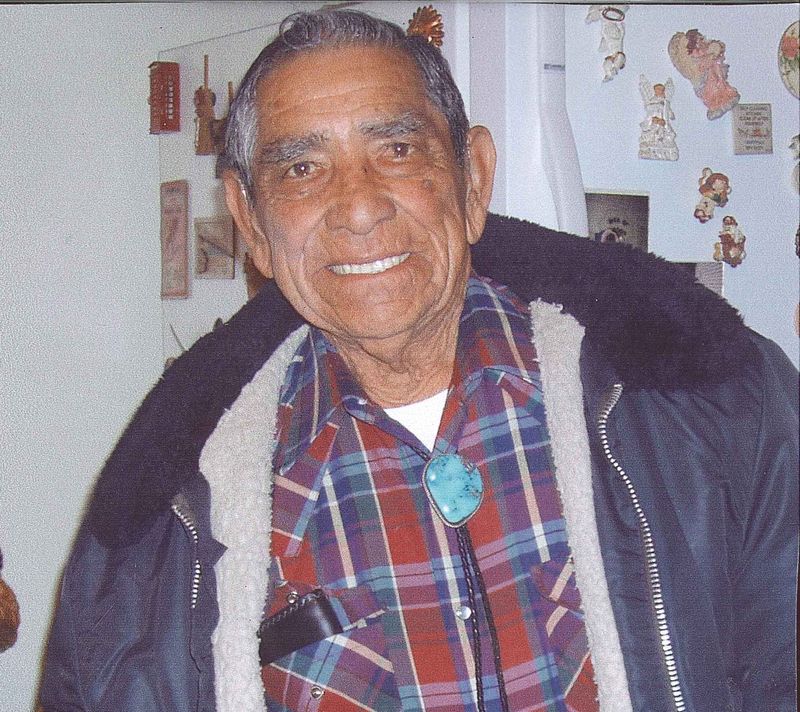
Ross Dimas passed away on October 26, 2010. He lived to be 84 years old, surviving only two years after his mother. He and Susie had been married for 62 years, and the two created a family that included five children, six grandchildren, twelve great-grandchildren, and ten great-great-grandchildren.
He is buried in Section 20, Grave 822 at the Santa Fe National Cemetery in Santa Fe, New Mexico.
Bibliography
Primary Sources
“68 Albuquerque Lads Enrolled in Model-Plane Building Program.” Albuquerque Journal [Albuquerque, NM], March 17, 1942. Newspapers.com (157027405).
Albright, Emma L. Alvarado Hotel. Photograph. C.1930. Cobb Memorial Photography Collection, The University of New Mexico. https://nmdc.unm.edu/digital/collection/CobbMem/id/827/rec/12.
“Annexation Board Candidates Conduct Short, Intense Drive.” Albuquerque Journal [Albuquerque, New Mexico], January 3, 1965. Newspapers.com (157019807).
“Annexation Board Vote May Cost City $5000.” Albuquerque Journal [Albuquerque, New Mexico], January 7, 1965. Newspapers.com (157029891).
Belshaw, Jim. “History and Its Makers.” Albuquerque Journal [Albuquerque, New Mexico], July 14, 1999. Newspapers.com (328596428).
Belshaw, Jim. “Vet Brings History of War Home.” Albuquerque Journal [Albuquerque, New Mexico], October 6, 2006. Newspapers.com (206266033).
Dahl, Pat. “Former Marine Recalls Hell on Iwo Jima 20 years ago.” The Albuquerque Tribune [Albuquerque, New Mexico], February 19, 1965. Newspapers.com (783161785).
“Dimas in Marines.” The Albuquerque Tribune [Albuquerque, New Mexico], October 6, 1967. Newspapers.com (783123551).
“Engineers’ Staff Here Increased to 450 With Addition of 20 Workers.” Albuquerque Journal [Albuquerque, NM], March 17, 1942. Newspapers.com (157027405).
“Garden for Victory.” Albuquerque Journal [Albuquerque, NM], January 30, 1942. Newspapers.com (157033498).
“Head Traffic Club.” Albuquerque Journal [Albuquerque, New Mexico], December 13, 1960. Newspapers.com (156575674).
“Model Victory Garden Exhibits Prepared For Victory Harvest Show at Hilton Hotel.” Albuquerque Journal [Albuquerque, NM], October 16, 1942. Newspapers.com (156812702).
New Mexico. Bernalillo County. 1930 U.S. Census. Digital images. https://ancestryclassroom.com.
New Mexico. Bernalillo County. 1940 U.S. Census. Digital images. https://ancestryclassroom.com.
New Mexico. Bernalillo County. 1950 U.S. Census. Digital images. https://ancestryclassroom.com.
Pawloski, Jeremy. “Gala Day to Mark Woman’s 100 Years.” Albuquerque Journal [Albuquerque, New Mexico], August 23, 2000. Newspapers.com (351176820).
Ross Dimas. World War II Draft Cards Young Men, 1940-1947. Digital images. https://ancestryclassroom.com.
Ross E. Dimas. Bernalillo, New Mexico. U.S., Marriage Index, 1888-2017. Digital images. https://ancestryclassroom.com.
Ross E. Dimas. Muster Roll of Officers and Enlisted Men of the U.S. Marine Corps. HQ & SERV CO, 27th Marines, 5th MARDIV, ℅ Fleet Post Office, San Francisco, CA. January 1945. https://Fold3.com.
Ross E. Dimas. Muster Roll of Officers and Enlisted Men of the U.S. Marine Corps. H&S CO, 27th Marines, 5th MARDIV, FMF, Camp Joseph H. Pendleton, Oceanside, CA. January 10-31, 1944. https://Fold3.com.
Ross E. Dimas. Muster Roll of Officers and Enlisted Men of the U.S. Marine Corps. Tenth Recruit Battalion, Transient Regiment, Recruit Depot, MCB, San Diego, CA. January 1944. https://Fold3.com.
Ross E. Dimas. New Mexico, U.S., World War II Records, 1941-1945. https://ancestryclassroom.com.
Ross E. Dimas, Official Military Personnel File, Department of the Navy, National Archives and Records Administration – St. Louis.
Ross E. Dimas, Report of Separation, Department of the Navy, National Archives and Records Administration – St. Louis.
Ross E. Dimas. U.S., Department of Veterans Affairs BIRLS Death File, 1850-2020. Digital images. https://ancestryclassroom.com.
Simoni, Arthur. “A Century of Traditions.” The Albuquerque Tribune [Albuquerque, New Mexico], December 18, 2004. Newspapers.com (786539195).
“Sunbonnet Girls To Do Garden Work.” Albuquerque Journal [Albuquerque, NM], March 25, 1942. Newspapers.com (157033498).
“Thanksgiving Day 1943.” November 1943. James Allen Scott Collection, Veterans History Project, Library of Congress. https://www.loc.gov/resource/afc2001001.86524.pm0026001/?sp=1&st=image&r=-0.803,-0.139,2.606,1.561,0.
“Victory Garden Planters Warned Against Waste.” Albuquerque Journal [Albuquerque, NM], March 17, 1942. Newspapers.com (157027405).
Secondary Sources
Butler, John A. “1/27 on Iwo.” Marine Corps Association. Accessed January 7, 2026. https://www.mca-marines.org/leatherneck/1-27-on-iwo/.
“History of the Albuquerque District.” US Army Corps of Engineers. Accessed November 29, 2025. https://www.spa.usace.army.mil/About/History/.
“The History of Kirtland Air Force Base.” United States Air Force Website. Accessed January 7, 2026. https://www.kirtland.af.mil/About-Us/Kirtland-AFB-History/Base-History/.
Lovas, Nancy. “How ‘Shop Class’ Helped Win the War: The ‘Model Aircraft Project’ of World War II.” Library of Congress Blog. Accessed January 7, 2026. https://blogs.loc.gov/inside_adams/2017/12/how-shop-class-helped-win-the-war/.
“Raising History.” Albuquerque Journal [Albuquerque, New Mexico], October 1, 2006. Newspapers.com (206236282).
“Ross E. Dimas.” Find a Grave. Accessed January 7, 2026. https://www.findagrave.com/memorial/148208264/ross_e-dimas#view-photo=157758902.
“Ross E. Dimas.” Legacy. Accessed January 6, 2026. https://www.legacy.com/obituaries/name/ross-dimas-obituary?pid=178493572.
“Ross E. Dimas.” Veterans Legacy Memorial, National Cemetery Administration. Accessed February 7, 2026. https://www.vlm.cem.va.gov/ROSSEDIMAS/8BD24E7.
“Susan Dimas Obituary.” Albuquerque Journal. Accessed November 12, 2025. https://www.legacy.com/us/obituaries/abqjournal/name/susie-dimas-obituary?id=16407367.
“World War II and New Mexico.” Atomic Heritage Foundation. Last modified June 5, 2014. Accessed November 29, 2025. https://ahf.nuclearmuseum.org/ahf/history/world-war-ii-and-new-mexico/.
This profile was funded by a grant from the United States Department of Veterans Affairs. The opinions, findings, and conclusions stated herein are those of the author and do not necessarily reflect those of the United States Department of Veterans Affairs.