
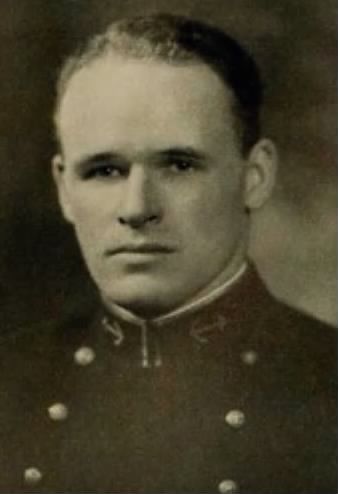
Brigadier General Russell “Whitey” Lloyd
- Unit: 2nd Marines
- Date of Birth: February 13, 1906
- Entered the Military: June 5, 1930
- Date of Death: March 26, 1969
- Hometown: New York, New York, and Chatham, New Jersey
- Place of Death: Wailuku, Hawaiʻi
- Award(s): Silver Star, Bronze Star, Legion of Merit, Presidential Unit Citation
- Cemetery: Grave 654. Maui Veterans Cemetery, Makawao, Hawaiʻi
Mentored by Ms. Janyce Omura
Maui High School
2025/2026
Early Life
Russell “Whitey” Lloyd first drew breath on February 13, 1906. He was the second child of Edward Grey Lloyd and Isabelle Russell Lloyd. He was born in New York, but when he was a young child, the family moved to Chatham, New Jersey, where his father worked as a paper salesman.
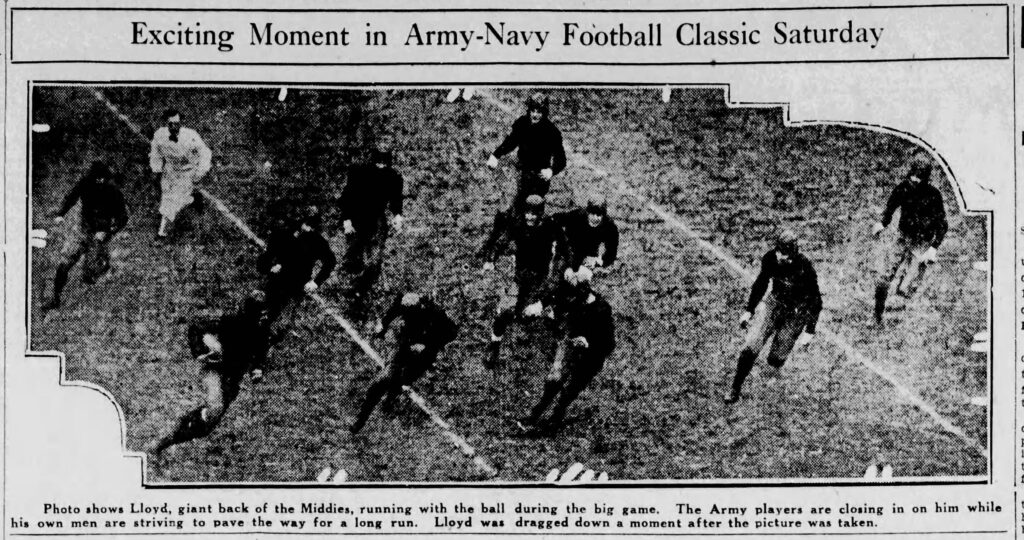
Russell possessed strong athletic abilities, excelling in high-energy sports including track, football, and basketball. Over his six years at The Peddie School in New Jersey, he earned nine varsity letters. In three years, the basketball team went 55-9 and won the state championship in 1925. He also led his team to back-to-back state track and field championships in 1924 and 1925.
Russell attended the U.S. Naval Academy at Annapolis, Maryland. As a freshman, he was cited as a star in Navy’s victories over Princeton and Colgate Universities.
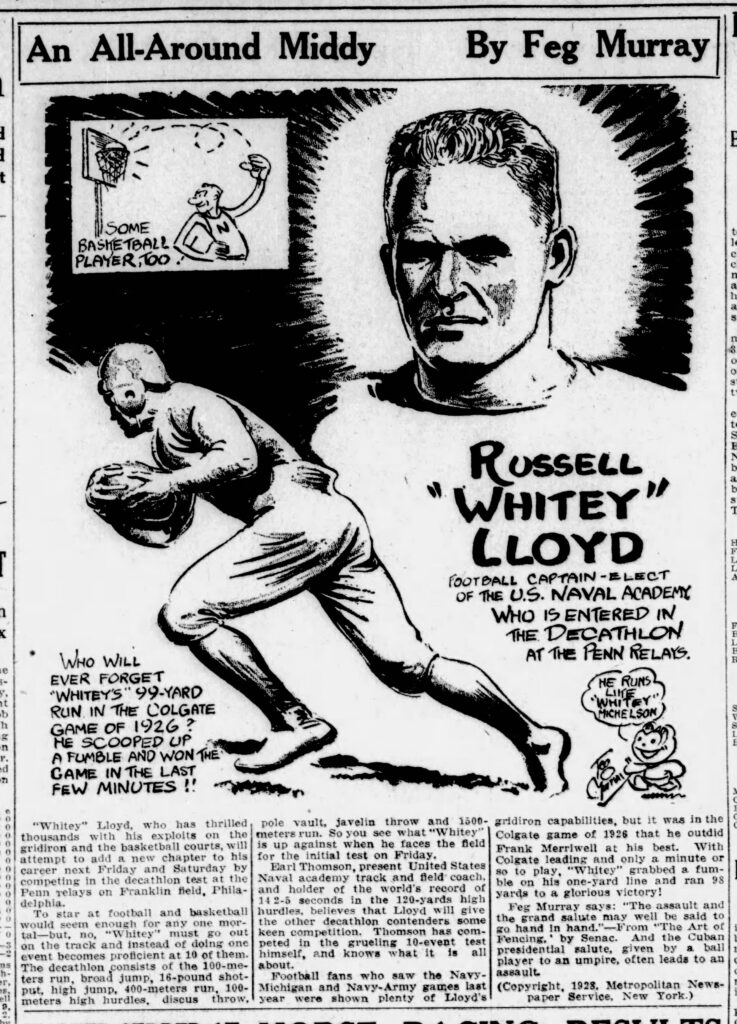
In the spring of 1928, Lloyd ran several races at the Penn Relays and competed for a spot on the U.S. Olympic team. He competed in the 400-meter low hurdles but lost to Johnny Gibson, who set a world record. He also competed in the decathlon at the Penn Relays, where he won the 100-meter run, but failed to qualify for the Olympic Team.
As a junior, he was named captain of the Naval Academy’s track and field team. In the spring of 1930, he returned as part of Navy’s team competing in a spring relay and a one-mile relay.
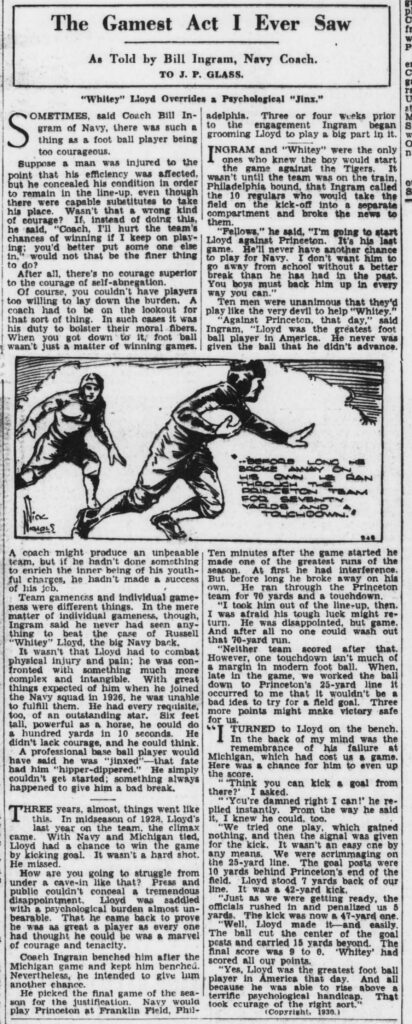
After Lloyd’s graduation from the Naval Academy, football coach Bill Ingram described Lloyd as “the greatest football player in America. He was never given the ball that he didn’t advance.”
Upon graduation from the Naval Academy, he was commissioned as a second lieutenant in the U.S. Marine Corps.
Homefront
World War II brought critical changes to New York City. As the most densely populated borough in the country, New York became a major hub of wartime industry, with its factories and shipyards converting to war production, manufacturing uniforms, equipment, and supplies for Allied forces.
New York’s connection to the Manhattan Project was administrative rather than industrial — the Army Corps of Engineers office that gave the top-secret atomic bomb program its name was headquartered at 270 Broadway. While the actual research and production took place at sites across the country, the project’s origins were rooted in Manhattan’s scientific community, as key early meetings between government officials and physicists such as J. Robert Oppenheimer were held there.
Central Park hosted civil defense drills and war bond rallies, drawing enormous crowds. Residents purchased war bonds at record rates, and Manhattan’s financial district played a central role in organizing and promoting these drives nationally.
New York’s role as a port city also made it significant. Hundreds of thousands of troops departed from its piers along the Hudson River. Times Square became a gathering place for soldiers on leave, and local women volunteered with the Red Cross and USO to provide support and morale services to military personnel passing through.
During World War II, New York experienced domestic tensions that belied a united front, with widespread racial discrimination culminating in the Harlem Race Riot of 1943.


Military Experience
Russell received his commission in the U.S. Marine Corps and was first stationed at the Philadelphia Navy Yard. On December 12, 1930, he married Mary Watkins. Throughout the 1930s, the family lived in Pearl Harbor, Hawaii, Washington, D.C., and Norfolk, Virginia, as Lloyd advanced through the officer ranks.
From February to May 1939, Captain Lloyd was stationed aboard the USS New York and participated in Fleet Landing Exercise Number Five (FLEX5), a simulated military invasion of Puerto Rico. These exercises, conducted through the 1930s, were used to train service members in methods of amphibious warfare. Here, the Higgins boats were tested and modified.
By early 1940, Lloyd returned to Hawaii, where he lived with Mary and their son, Russell, Jr. During World War II, Lloyd deployed first to Iceland and later to the Pacific Theater. In 1941 and 1942, Lloyd deployed to Iceland with the American Expeditionary Force. After returning from Iceland, Lloyd served throughout the Pacific Theater of Operations, including the Battle of Guadalcanal and the Battle of Saipan.
The Battle of Guadalcanal (August 1942 to February 1943), one of the bloodiest and most strategically significant campaigns of World War II. As a lieutenant colonel, Lloyd led his battalion through several intense enemy engagements when a critical threat emerged on the flank of his unit’s position. Recognizing the danger, he personally intervened, maneuvering his battalion through dense tropical jungle directly to the enemy’s strongest point. Through bold and decisive action, his forces outflanked and completely destroyed the enemy position, preventing what could have been a catastrophic breach. For his courageous actions, Russell was awarded the Silver Star, the United States military’s third-highest combat decoration, given specifically for gallantry in action against an enemy and recognizing acts of valor that demonstrate conspicuous courage in the face of great danger.
Later, Russell served at the Battle of Saipan (June to July 1944). The U.S. military attacked Saipan to gain control of its airfield. From there, they could launch large bombers that could reach the Japanese mainland. From June 15 to July 9, Lloyd served as a Shore Party Commander, coordinating the forces that would bring both men and equipment to shore.
After World War II, he returned to California, where his daughter Mary Page was born in November 1945. Sadly, on January 27, 1949, his wife, Mary, died after a long illness at the age of 38 in San Diego. She is buried at Maui Veterans Cemetery.
In October 27, 1950, Lloyd married Helen Gay Baldwin in Washington, D.C. He continued his service in the Marine Corps, rising to the rank of brigadier general. He spent most of his last decade stationed in the Washington, D.C. area. From 1953 to 1955, he served as the Pacific Fleet Marine Force Chief of Staff.
Lloyd’s distinguished military career came to a close when he retired on July 31, 1959, leaving behind a legacy of valor, leadership, and service that spanned nearly three decades. During his service, he was awarded a Silver Star, Bronze Star, Legion of Merit, and a Presidential Unit Citation.


Veteran Experience
After a brief stay in California, Russell and Gay Lloyd moved to Maui in 1960. Lloyd worked as the director of the Haleakalā Ranch and Haleakalā Dairy on Maui. They lived on Maui for almost a decade.

Commemoration
Lloyd Russell suffered a heart attack and died on March 26, 1969, in Wailuku, Hawaii. He was buried at Maui Veterans Cemetery in Makawao, Maui.
His wife, Gay, died in 1995 and was buried with her husband.


Bibliography
Primary Sources
“Coach Writes of Decathlon.” The Baltimore Sun [Baltimore, Maryland], April 20, 1928. Newspapers.com (373342811).
Exciting Moment in Army-Navy Football Classic Saturday. Photograph. The Buffalo News [Buffalo, New York], November 28, 1928. Newspapers.com (836945156).
“Ex-Marine Gen. Lloyd Dies at 63.” Honolulu Star-Advertiser [Honolulu, Hawai’i], March 28, 1969. Newspapers.com (261385921).
Glass, J. P. “The Gamest Act I Ever Saw.” Evening Star [Washington, D.C.], October 13, 1930. Newspapers.com (619032719).
Hawaii. Oahu. 1940 U.S. Federal Census. Digital Images. https://ancestryclassroom.com.
“Lloyd, Bauer and Williams, Navy Stars to Enter Marine Corps on Graduation.” The New York Times [New York, New York], January 20, 1930.
“Lloyd Hahn Gallops to New American Record in 800-Meter.” The Time-Picayune [New Orleans, Louisiana], June 17, 1928. Newspapers.com (1248897852).
“Lloyd Now Aims for Pentathlon.” The Times [Trenton, New Jersey], December 5, 1926. Newspapers.com (1194156277).
“Lloyd Winner in 100-Metres [sic].” The Evening Review [East Liverpool, Ohio], April 27, 1928. Newspapers.com (60911829).
“Lloyds Honored, Farewell Fetes.”Coast Dispatch [Encenitas, California], June 2, 1960. Newspapers.com (1167929107).
“Miss Mary Watkins Becomes Bride of Lieut. Lloyd Friday.” The Item of Millburn and Short Hills [Millburn, New Jersey], December 18, 1930. Newspapers.com (540031137).
“Mrs. Russell Lloyd.” The Chatham Press [Chatham, New Jersey], February 4, 1949. Newspapers.com (95289590).
Murray, Feg. “All-Around Middy.” The Springfield Daily Republican [Springfield, Massachusetts], April 26, 1928. Newspapers.com (1062493834).
“Navy Can’t Use ‘Whitey’ Lloyd.” The Washington Herald [Washington, D.C.], December 1, 1929. Newspapers.com (1042727977).
“Navy In Crushing Victory.” The Times [Trenton, New Jersey], October 17, 1926. Newspapers.com (1194155813).
“Navy In Penn Relays.” The Brooklyn Daily Times [Brooklyn, New York], April 7, 1928. Newspapers.com (558528037).
“Navy Track Men Will Compete in Penn Relays.” The Springfield Daily Republican [Springfield, Massachusetts], April 9, 1930. Newspapers.com (1062559000).
“Navy Sword Again?” The Evening Journal [Wilmington, Delaware], February 4, 1928. Newspapers.com (159982638).
New Jersey. Morris County. 1910 U.S. Federal Census. Digital Images. https://ancestryclassroom.com.
New Jersey. Morris County. 1920 U.S. Federal Census. Digital Images. https://ancestryclassroom.com.
New Jersey. Morris County. 1930 U.S. Federal Census. Digital Images. https://ancestryclassroom.com.
“Officer And Wife Entertain For Admiral and His Staff.”The San Diego Sun [San Diego, California], December 21, 1932. Newspapers.com (1046902706).
Perry, Lawrence. “Steady Pressure of Army Team Brought Victory Against Navy.” The Buffalo News [Buffalo, New York], November 28, 1928. Newspapers.com (836945156).
Rosener, Ann. Victory Gardens – for family and country. . . Photograph. 1943. Library of Congress (2017696705). https://www.loc.gov/item/2017696705/.
Russell Lloyd. District of Columbia, Marriage Records, 1810-1953. Digital Images. https://ancestryclassroom.com.
Russell Lloyd. U.S., Department of Veterans Affairs BIRLS Death File, 1850–2020. Digital Images. https://ancestryclassroom.com.
Russell Lloyd. U.S., Headstone Applications for Military Veterans, 1861-1985. Digital Images. https://ancestryclassroom.com.
Russell Lloyd. U.S., Marine Corps Muster Rolls, 1798–1958. Digital Images. https://ancestryclassroom.com.
Russell Lloyd. U.S., Navy and Marine Corps Registries, 1814–1992. Digital Images. https://ancestryclassroom.com.
Russell Lloyd. U.S., Select Military Registers, 1862–1985.” Digital Images. https://ancestryclassroom.com.
“Russell Lloyd USMC Dies In Hawaii.” The Chatham Press [Chatham, New Jersey], April 3, 1969. Newspapers.com (95294439).
“The Sport Digest.” Ridgewood Herald-News [Ridgewood, New Jersey], March 11, 1926. Newspapers.com (632490264).
“Two Records Topple in Eastern Olympic Track-Field Tryouts.” St. Louis Globe-Democrat [St. Louis, Missouri], June 17, 1928. Newspapers.com (572262651).
“Whitey Lloyd Named ‘29 Navy Track Captain.” The Washington Herald [Washington, D.C.], June 8, 1928. Newspapers.com (1042525172).
The world’s three largest ships at the time . . . Photograph. 1940. Hudson River Park. https://hudsonriverpark.org/a-look-into-our-waterfronts-maritime-past/.
Secondary Sources
“1930–1935 NYC: Resilience, Character and Innovation in the Great Depression Era.” History 101 NYC. Accessed November 14, 2025. https://www.history101.nyc/new-york-city-from-1930-to-1935.
“1940–1945 NYC: Wartime Transformation, Cultural Resilience and The Global Impact.” History 101 NYC. Accessed November 14, 2025. https://www.history101.nyc/nyc-history-from-1940-to-1945.
“African Americans and the Manhattan Project.” Manhattan Project National Historical Park, National Park Service. Accessed November 14, 2025. https://www.nps.gov/mapr/learn/historyculture/african-americans.htm.
“BG Russell ‘Whitey’ Lloyd.” Find a Grave. Accessed November 14, 2025. https://www.findagrave.com/memorial/80664507/russell-lloyd.
“Brigadier-General Russell ‘Whitey’ Lloyd.” Geni. Accessed November 14, 2025. https://www.geni.com/people/Brigadier-General-Russell-Whitey-Lloyd/353002124830012041.
Broad, William J. “Why They Called It the Manhattan Project.” The New York Times [New York, New York], October 30, 2007. https://www.nytimes.com/2007/10/30/science/30manh.html.
Capeci, Jr., Dominic J. The Harlem Riot of 1943. Temple University Press, 1977.
Chapin, John C. Breaching the Marianas: The Battle for Saipan. U.S. Marine Corps, 1994. https://www.marines.mil/Portals/1/Publications/Breaching%20the%20Marianas%20-%20The%20Battle%20for%20Saipan%20%20PCN%2019000312300.pdf.
“Columbus Day 1944: Mayor Fiorello LaGuardia’s Broadcasts to Italy.” NYC Department of Records & Information Services: The Archives Blog. Accessed November 9, 2019. https://www.archives.nyc/blog/2019/10/9/columbus-day-1944-mayor-fiorello-laguardias-broadcasts-to-italy.
Diehl, Lorraine B. Over Here! New York City During World War II. HarperCollins, 2002.
“Haleakala Ranch.” Accessed May 7, 2026. https://haleakalaranch.com/.
“Helen Gay Baldwin Lloyd.” Find a Grave. Accessed May 7, 2026. https://www.findagrave.com/memorial/104731401/helen_gay-lloyd.
Knighton, Andrew. “Fast Facts About the Battle of Guadalcanal.” War History Online, April 11, 2016. https://www.warhistoryonline.com/world-war-ii/ed-ok-battle-guadalcanal.html.
“Mary Souther Watkins Lloyd.” Find a Grave. Accessed May 7, 2026. https://www.findagrave.com/memorial/117105693/mary_souther-lloyd.
Maurer, Elizabeth L. “Honoring Rosie the Riveter and the Women Who Won the War.” National Women’s History Museum. Updated March 20, 2017. Accessed May 7, 2026. https://www.womenshistory.org/articles/honoring-rosie-riveter-and-women-who-won-war.
Ottman, Tod M. “World War 2, 1939–1945.” New York State Military Museum and Veterans Research Center. Accessed November 14, 2025. https://museum.dmna.ny.gov/unit-history/conflict/world-war-2-1939-1945.
“Propaganda and the OWI.” WWII America at Home, Santa Clara University. Accessed November 19, 2025. https://dh.scu.edu/exhibits/exhibits/show/wwii-2023/hollywood-film-in-wwii/propaganda-and-the-owi.
Russell, Lloyd. Hall of Valor. Accessed May 7, 2026. https://valor.militarytimes.com/recipient/recipient-37417/.
“Russell ‘Whitey’ Lloyd, Class of 1925.” The Peddie School. Accessed November 14, 2025. https://www.peddie.org/story/russell-whitey-lloyd-class-of-1925.
Spring, Kelly. “On the Home Front.” National Women’s History Museum. Accessed November 14, 2025. https://www.womenshistory.org/resources/general/home-front.
Strausbaugh, John. Victory City: A History of New York and New Yorkers During World War II. Twelve, 2018.
Springate, Megan E. “Victory Gardens on the World War II Home Front.” National Park Service. Accessed November 14, 2025. https://www.nps.gov/articles/000/victory-gardens-on-the-world-war-ii-home-front.htm.
White, Walter. A Man Called White: The Autobiography of Walter White. Viking Press, 1948.
This profile was funded by a grant from the United States Department of Veterans Affairs. The opinions, findings, and conclusions stated herein are those of the author and do not necessarily reflect those of the United States Department of Veterans Affairs.