
Staff Sergeant Thomas Joseph Pechacek
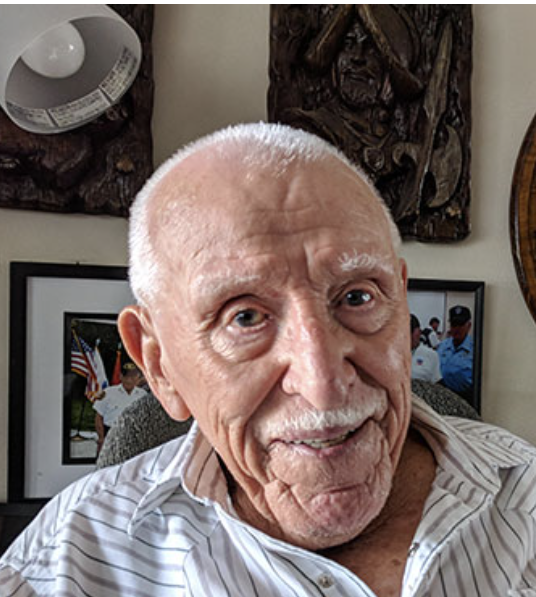
- Unit: Marine Aircraft Group 21, 1st Defense Battalion, Marine Fighting Squadron 211
- Date of Birth: February 21, 1921
- Date of Death: July 22, 2019
- Hometown: Cleveland, Ohio
- Place of Death: Eau Gallie, Florida
- Award(s): Purple Heart, Prisoner of War Medal
- Cemetery: Section A-1 B-4, Grave B1. Cape Canaveral National Cemetery, Mims, Florida
Mentored by Mr. Alex Hujik
Lake Highland Preparatory School
2025/2026
Early Life
Son of Immigrants
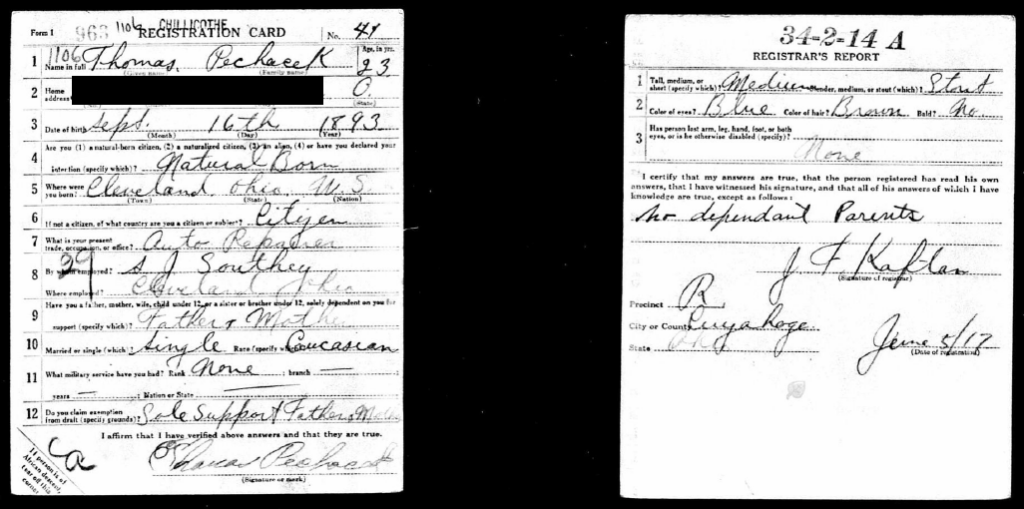
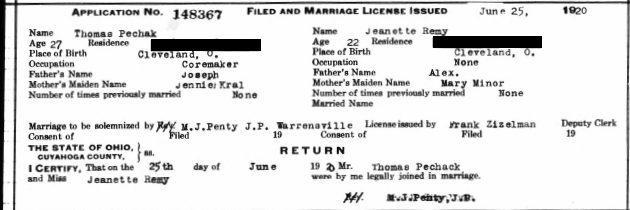
Born in Cleveland, Ohio, Thomas Pechacek (pronounced: pay-check) was the eldest of three children. His father, Thomas Sr., was a veteran of World War I who immigrated from Czechoslovakia, and his mother, Janetta, emigrated from England. After their marriage in 1920, his father worked as a coremaker and truck driver before eventually establishing the family dairy farm. On this farm, young Thomas Pechacek learned the value of service and a strong work ethic.
Mechanical Curiosity and Military Enlistment
From a young age, Thomas Pechacek displayed a natural mechanical aptitude. He was known for constantly tinkering with machinery. Following his high school graduation in 1937, he initially worked on his father’s dairy farm. However, after two years, he sought a new kind of challenge. Driven by his characteristic energy and a “gung-ho” attitude, he left the dairy farm to answer the call of service, enlisting in the United States Marine Corps in 1939.

Homefront
Cleveland grew quickly in the 1920s. Many immigrants, especially Czechs like the Pechacek family, moved to the city. This growth caused tension between the new immigrants and the established “WASP” community, creating a complex social landscape.
Cleveland was hit very hard by the Great Depression. Unemployment reached nearly 50%, while the population fell by 0.2%. Even amid these struggles, some building projects continued in immigrant neighborhoods, reflecting the community’s resilience.
World War II Industrial Boom
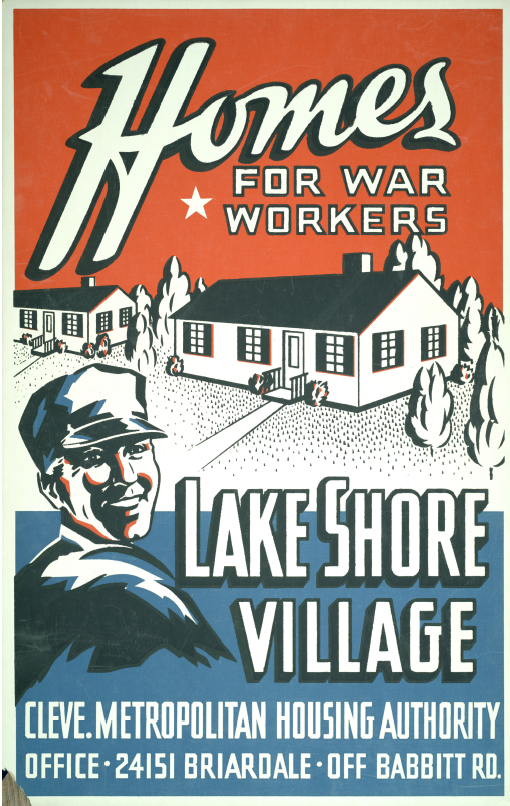
The city transformed after the attack on Pearl Harbor. Manufacturing jobs jumped from 191,000 in 1940 to 340,000 in 1945. By the peak of the war, the output of Cleveland’s industrial establishment ranked fifth in the entire nation. To expand this base, massive facilities like the Thompson Aircraft (Tapco) plant in Euclid were constructed. Though it started in 1941, just before the war, Thompson became Cleveland’s largest employer by 1945, with a workforce of 21,000. Additionally, two large facilities arose in 1942 on the perimeters of the Cleveland Municipal Airport to support the soaring demand for aircraft production.
The Unique Story of JAHCO
During World War II, a company called Jack & Heintz (JAHCO) became a legend. They grew from only 50 employees in 1940 to over 8,700 by 1944. Owner Bill Jack called his workers “associates” and provided extraordinary benefits to maintain high morale. Associates received free health care, paid sick leave, and complimentary meals. The company even offered access to a sauna and massages, frequent cash bonuses, and two weeks of paid vacation at no-cost company resorts.
Small personal touches were also common, such as complimentary donuts and coffee served in personal mugs embossed with the worker’s name. The factory even played music from an extensive collection of nearly 5,000 records during working hours.
In exchange for these unprecedented perks, associates agreed to a grueling schedule: twelve-hour shifts, seven days a week, with only one day off per month. JAHCO was famous for producing aircraft starters and autopilots faster than almost any other factory, earning four Army “E” awards for excellence.
Contributions and Safety
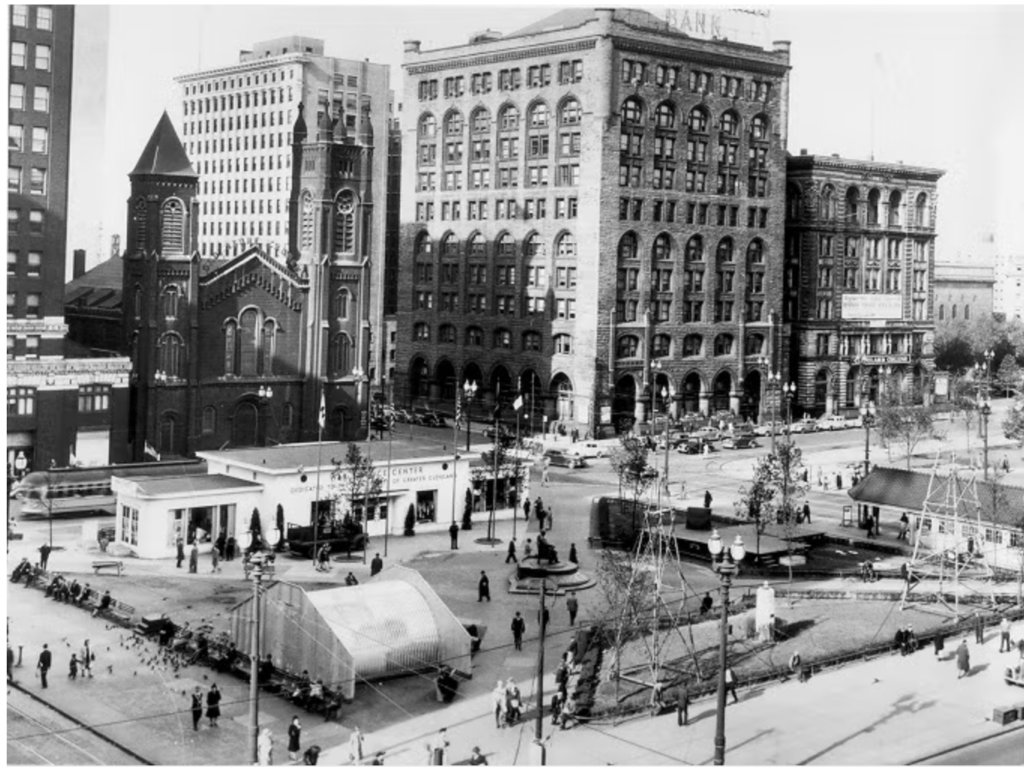
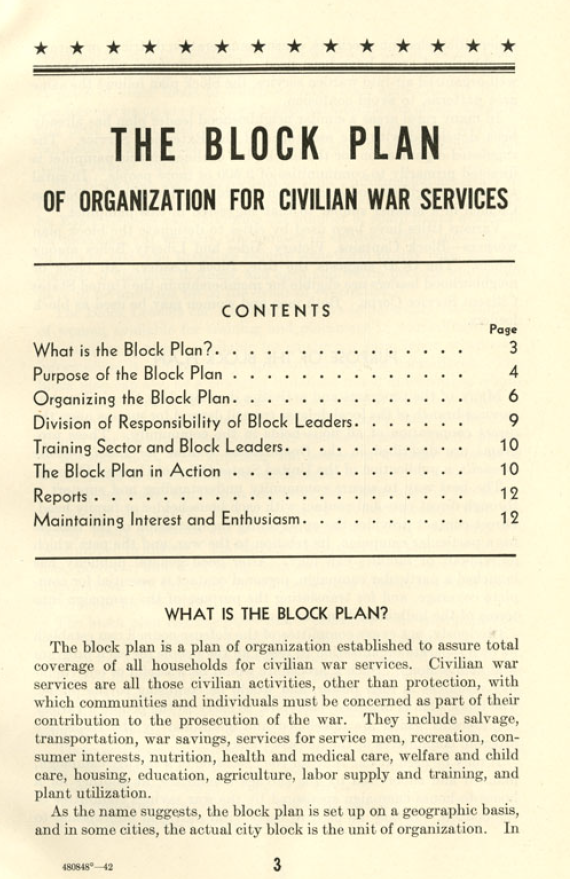
Clevelanders were very active and rallied around the war effort. Notably, Cleveland was the originator of the Block Plan, an organized system that divided the city into blocks to efficiently manage scrap metal collections and blood drives. To anchor these efforts, the city built a temporary War Services Center on Public Square, which served as a central hub for coordinating volunteer activities and distributing information. Financial support was equally immense, as Clevelanders donated $2.5 billion across eight war bond drives. Additionally, Victory Gardens were planted at Memorial Mall downtown, and public schools practiced Duck-and-Cover drills to prepare for potential attacks.
The Nuclear Secret: Harshaw Chemical
While most people knew about the tank and plane factories, Cleveland had a secret: it helped build the atomic bomb. The Harshaw Chemical Company on Harvard Avenue processed thousands of tons of uranium for the Manhattan Project. This work required a massive cleanup project to remove radioactive soil. The Army Corps is currently completing its lengthy Formerly Utilized Sites Remedial Action Program (FUSRAP) cleanup project. This latest phase began in September 2024, following a $13.4 million contract between the Army Corps and Enviro-Fix Solutions to finally resolve the site’s environmental legacy.
Demographic Changes
During the war, Cleveland’s Black population rose from 85,000 in 1940 to 251,000 by 1960. People moved to the city for high-paying factory jobs and the strong post-war economy of the 1950s, forever changing the city’s character and diversity.
Military Experience
Thomas Pechacek joined the United States Marine Corps in 1939. He completed his recruit training at Parris Island, South Carolina, and was subsequently stationed in Cuba and San Diego, California.
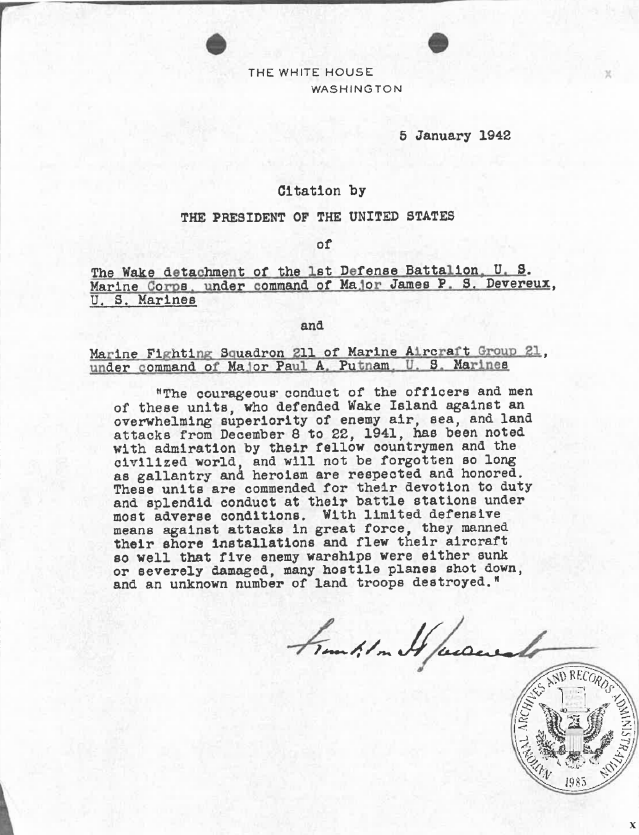
Eventually, he was assigned to the 3rd Defense Battalion on Oahu, Hawaii. In August 1941, Pechacek was transferred to the 1st Defense Battalion on Wake Island to replace a Marine who had been medically evacuated. His primary responsibility on the island was to maintain critical communication lines and service field telephones between gun positions near Peacock Point.
The Battle of Wake Island
Wake Island was a vital strategic outpost used to stage supplies and maintain an airbase. On December 7, 1941, Japanese forces attacked the island as part of their coordinated strike against the Pacific Fleet.
A small Marine garrison, supported by hundreds of civilian contractors from Pan Am, defended the island for two weeks. Despite being isolated and outnumbered, the defenders successfully repelled a major Japanese invasion force, sinking several vessels and inflicting heavy casualties. However, without outside reinforcements, the garrison was eventually overwhelmed. During the defense, Corporal Pechacek was wounded by shrapnel in his left leg. He was among the 1,600 Americans taken prisoner when the island surrendered.
Prisoner of War
While some captives remained on Wake Island as forced laborers, many of whom were later tragically executed in 1943, Pechacek was among those shipped to mainland Asia. He was first confined in the cargo hold of the ship Nitta Maru, transferred through Yokohama, and finally sent to the notorious Woosung Prison Camp in Shanghai, China.
He spent months performing backbreaking work, including coal mining, often while wearing only shorts despite the bitter cold. For the next three and a half years, Pechacek endured brutal conditions and forced labor in several camps in Japan, Korea, and China. He suffered from starvation, dysentery, and malaria. The guards treated him with extreme cruelty, at one point using rifle butts to knock out his teeth. The physical abuse he suffered left scars on his back that remained with him for the rest of his life.
Liberation
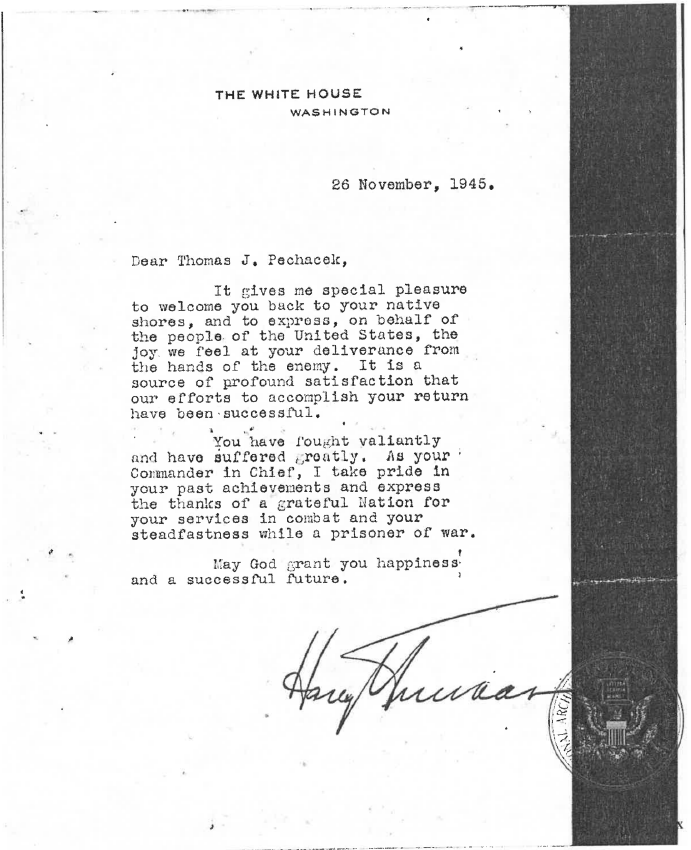
Thomas Pechacek was liberated from his Japanese prison camp on September 11, 1945. On his release, he learned of the atomic bombings of Hiroshima and Nagasaki and the Japanese surrender that ended the war. From there, he sailed to Guam for six weeks of rehabilitation. In January 1946, he was honorably discharged from the Marine Corps and promoted to the rank of staff sergeant.


Veteran Experience
Working at Pan Am
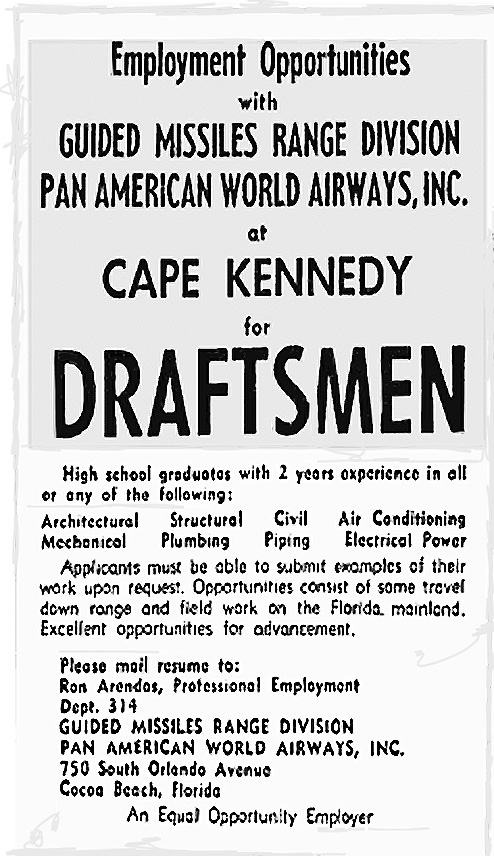
Following the war, he returned to Ohio and began a career as an auto mechanic. He eventually relocated to Florida after securing a position with Pan Am, a company he knew well from his time fighting alongside their contractors on Wake Island.
He served as a duty supervisor at Cape Canaveral for Pan Am’s missile and space program, where he supported the historic Mercury, Gemini, and Apollo missions. Among his most cherished mementos was a photograph of himself with astronaut Alan Shepard.
An Overdue Purple Heart
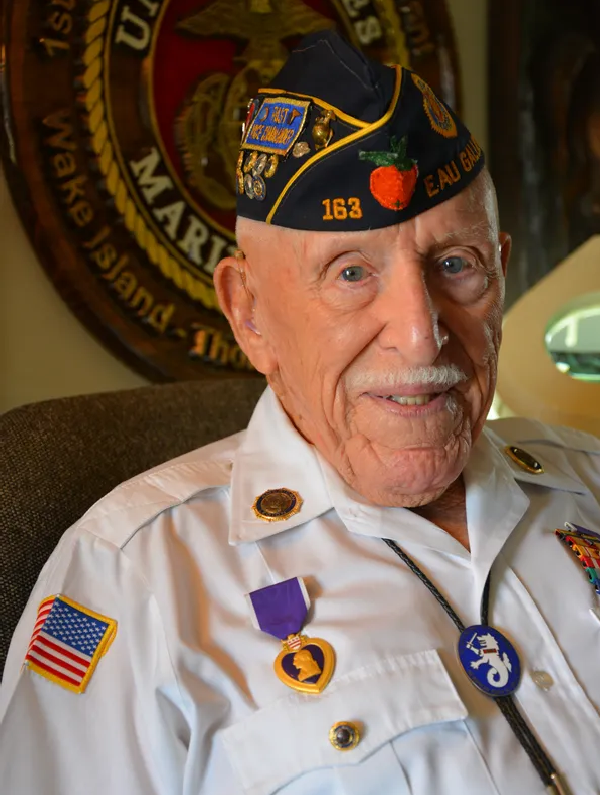
Though he was wounded in combat in 1941, Thomas did not receive his Purple Heart until 76 years later. After decades of being discouraged by bureaucratic obstacles, he had nearly given up on receiving the medal, remarking, “To hell with that,” regarding the Department of Defense bureaucracy.
However, his home care aide, Donna Loretti, and her husband, Art, wanted him to receive the award. They worked tirelessly behind the scenes with the Department of Defense to secure the recognition he had earned.
In a long-overdue tribute, they surprised Thomas with his Purple Heart during an impromptu ceremony at his beloved American Legion Post. As Art Loretti reflected, Pechacek’s legacy, “He’s impacted anyone who’s known him—from someone who’s known him for 55 years to someone who met him for the first time.”
Active in the American Legion
A resident of Melbourne, Florida, for 38 years, Pechacek was deeply involved with the American Legion Post #163 in nearby Eau Gallie. At the time of his passing, he was the post’s oldest and longest-serving member. The dining hall was named after him.
In the Community
Pechacek was a dedicated supporter of the Boys State and Girls State programs and was known in his neighborhood as a gifted handyman who could fix anything from heavy machinery to children’s toys. His prized possession was a restored 1957 Chevy truck, which he enjoyed driving friends to the American Legion.

Commemoration
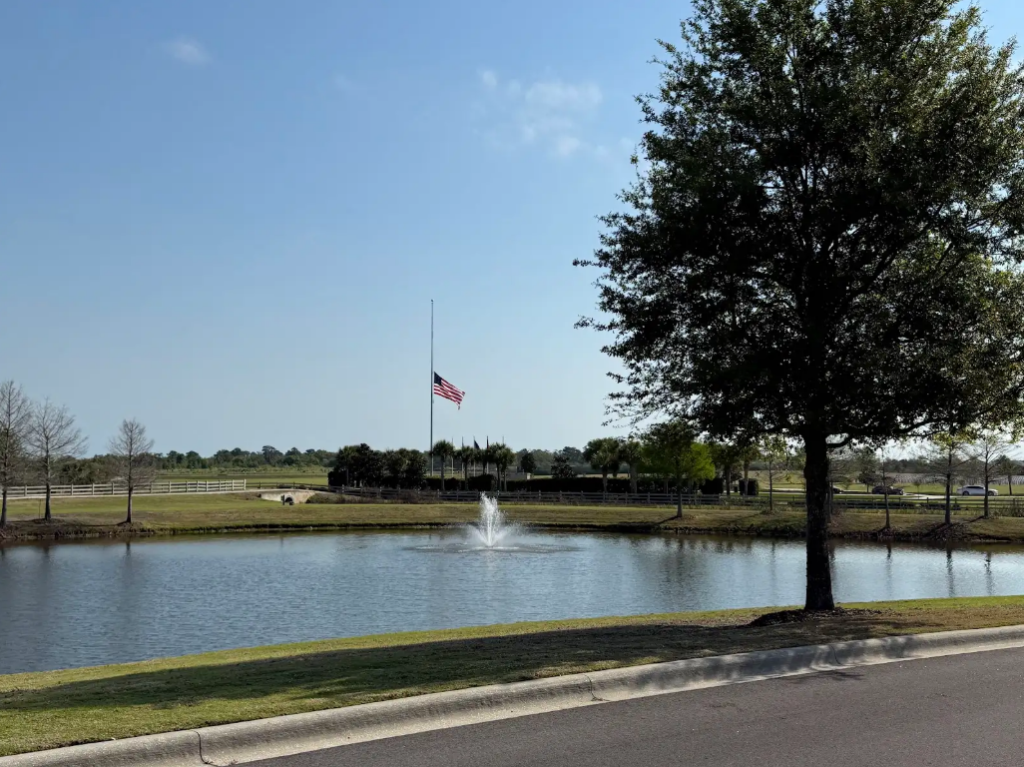
Thomas Pechacek died on July 22, 2019. He lies at Cape Canaveral Veterans Cemetery in Mims, Florida. Friends remember his quiet humility and service to others. Donna and Art Loretti, his close friends, said, “He would give you the shirt off his back. He was such a good man. He didn’t have to be that way with the way he was treated.”

Bibliography
Primary Sources
Block Plan of Organization for Civilian War Services. Government Publication. 1942. Ball State University (MSS268-22). https://dmr.bsu.edu/digital/collection/WWIIGovPubs/id/3949/.
Loretti, Donna. Telephone interview with the authors. December 12, 2026.
Neale, Rick. 2019. “Melbourne WWII POW Who Waited 76 Years for His Purple Heart Dies at Age 98.” Florida Today [Cocoa, Florida], July 31, 2019.
Neale, Rick. “Melbourne World War II POW Finally Receives Purple Heart, 76 Years after His Capture.” Florida Today [Cocoa, Florida], May 9, 2018.
Ohio. Cuyahoga County. 1930 U.S. Census. Digital Images. https://ancestryclassroom.com.
Ohio. Ashtabula County. 1950 U.S. Census. Digital Images. https://ancestryclassroom.com.
“Peter Edson in Washington.” The Daily Advocate [Greenville, Ohio], March 3, 1944. Newspapers.com (6511048980).
Richard Henry Peterson Collection. Personal Narrative. Personal Narrative. Veterans History Project, Library of Congress (AFC/2001/001/5829). https://www.loc.gov/item/afc2001001.05829/.
South Carolina. Beaufort County. 1940 U.S. Census. Digital Images. https://ancestryclassroom.com.
Thomas Joseph Pechacek, Official Military Personnel File, Department of the Navy, National Archives and Records Administration – St. Louis.
Thomas Joseph Pechacek, Report of Separation, Department of the Navy, National Archives and Records Administration – St. Louis.
Thomas Pechacek. Florida Divorce Index, 1927-2001. Digital Images. https://ancestryclassroom.com
Thomas Pechacek. Florida Marriage Indexes, 1822-1875 and 1927-2001. Digital Images. https://ancestryclassroom.com.
Thomas Pechacek. Records of World War II Prisoners of War, 1942-1947. National Archives and Records Administration.
Theresa Pechacek. U.S. Obituary Collection, 1930-Current. Digital Images. https://ancestryclassroom.com.
“Trouble Feared at Cleveland Plant.” The Daily Advocate [Greenville, Ohio], June 22, 1943. Newspapers.com (651146241).
Secondary Sources
Brandon, Reid. “Jack and Heintz.” Engineering and Technology History Wiki. Accessed November 16, 2025. https://ethw.org/Jack_and_Heintz#Christmas_Greeting_for_JAHCO_Associates_and_Customers.
“Chronicling Wake Island – A Brief History.” PanAm. Accessed April 8, 2026. https://www.panam.org/explorations/chronicling-wake-island.
“Cleveland Population Change, 1800-2020.” Visual Cleveland. Accessed November 13, 2025. https://visual.clevelandhistory.org/.
“Episode 5: Missiles, Hotels, and Rebranding an Icon.” The Pan Am Podcast. September 13, 2021. https://podcast.thepanammuseum.org/1836491/episodes/9176393-episode-5-missiles-hotels-and-rebranding-an-icon.
Guerrier, Vince, Thomas Kern, and Bill Nowlin. From Setback to Success: The 1945 Cleveland Buckeyes. Society for American Baseball Research: 2025. https://profile.sabr.org/store/download.aspx?id=FEF9D752-A15B-4370-8D27-F64ADBEE41E9.
“Hokkaido Island POW Camps.” Allied POWs Under the Japanese. Accessed January 16, 2026. https://www.mansell.com/pow_resources/camplists/hokkaido/overview.html.
Hubbs, Major Mark E. “Massacre on Wake Island.” Naval History, February 2001. https://www.usni.org/magazines/naval-history-magazine/2001/february/massacre-wake-island.
Kusmer, Kenneth L. “African Americans.” Encyclopedia of Cleveland History, Case Western Reserve University. Updated October 16, 2023. Accessed November 14, 2025. https://case.edu/ech/articles/a/african-americans.
King-Smith, Ann. “President’s Message.” Mail Call, September 2019. https://alafl.org/wp-content/uploads/ALAFL_VolIX_Issue2September2019r.pdf.
Nicholoff, Annie. “A Cleveland Factory Processed Uranium for the Manhattan Project. It’s Still Being Cleaned Up.” Cleveland Magazine, September 30, 2025. https://clevelandmagazine.com/articles/manhattan-project-cleveland-uranium-harshaw-chemical/.
Pingston, Ed. Telephone interview with the authors. December 12, 2026.
Pingston, Ed. Telephone interview with the authors. December 14, 2026.
Poster Perfect: WPA & WW2 Era Housing Posters from the Ernest J. Bohn Collection, Kelvin Smith Library Special Collections. Digital Exhibit. Case Western Reserve University. https://scalar.case.edu/poster-perfect/index.
Rotman, Michael. “Jack & Heintz Co.” Cleveland Historical Society. Updated March 3, 2011. Accessed April 8, 2026. https://clevelandhistorical.org/items/show/153.
“Ssgt Thomas J. Pechacek.” Pacific Wrecks. Updated 2019. Accessed April 8, 2026. https://pacificwrecks.com/people/veterans/pechacek/index.html.
“Starved and Beaten: Wake Island Prisoners of World War II.” History Net. Updated June 12, 2006. Accessed December 28, 2025. https://www.historynet.com/wake-island-prisoners-of-world-war-ii/.
“Thomas J. Pechacek.” Veterans Legacy Memorial, National Cemetery Administration. Accessed April 8, 2026. https://www.vlm.cem.va.gov/THOMASJPECHACEK/976996.
“Thomas Joseph Pechacek.” Find a Grave. Updated July 31, 2019. Accessed January 10, 2026. https://www.findagrave.com/memorial/201686666/thomas-joseph-pechacek.
“Thomas Pechacek.” Hall of Valor. Updated 2025. Accessed November 6, 2025. https://valor.militarytimes.com/recipient/recipient-51338/.
Urwin, Gregory J. W. “The Battle of Wake Island: Nation’s Morale Lifted in 1941.” The National WWII Museum. Updated December 23, 2020. Accessed January 16, 2026. https://www.nationalww2museum.org/war/articles/battle-of-wake-island-1941.
Vacha, J. E. “World War II.” Encyclopedia of Cleveland History, Case Western Reserve University. Accessed November 11, 2025. https://case.edu/ech/articles/w/world-war-ii.
This profile was funded by a grant from the United States Department of Veterans Affairs. The opinions, findings, and conclusions stated herein are those of the author and do not necessarily reflect those of the United States Department of Veterans Affairs.